

How to Build and Deploy Case Studies for Sales in 2026
84% of reps missed quota last year. Buying committees have ballooned to seven people, and 80% of B2B sales interactions are now digital. Your reps aren't in the room for most of the decision - but case studies are. They get forwarded in Slack threads, dropped into evaluation docs, pulled up on phones before internal meetings.
Here's the disconnect: 67% of marketers create case studies, but only 36% say they produced the best results. The problem isn't the format. It's how case studies for sales are built, collected, and deployed.
Why Customer Stories Matter More in 2026
The median B2B sales cycle now runs 84 days. Lead-to-customer conversion sits around 2-5%, and average win rates hover between 20-30%. Those numbers mean every touchpoint has to earn its place.
A well-crafted customer story is the only asset that works at every stage - awareness through close - and it's the asset buyers trust most because the proof comes from someone who isn't you. Yet 53% of top SaaS companies feature case studies on their homepage, 96% showcase customer logos, and only 19% mention competitors. Everyone signals social proof. Almost nobody weaponizes it properly. That's the gap between having proof assets and having a real sales case study strategy.
What Makes a Case Study Close Deals
We've evaluated hundreds of case studies across SaaS, and seven elements separate the ones that close from the ones that collect dust. 93% of top SaaS companies use a Challenge-Solution-Impact framework, but framework alone isn't enough.
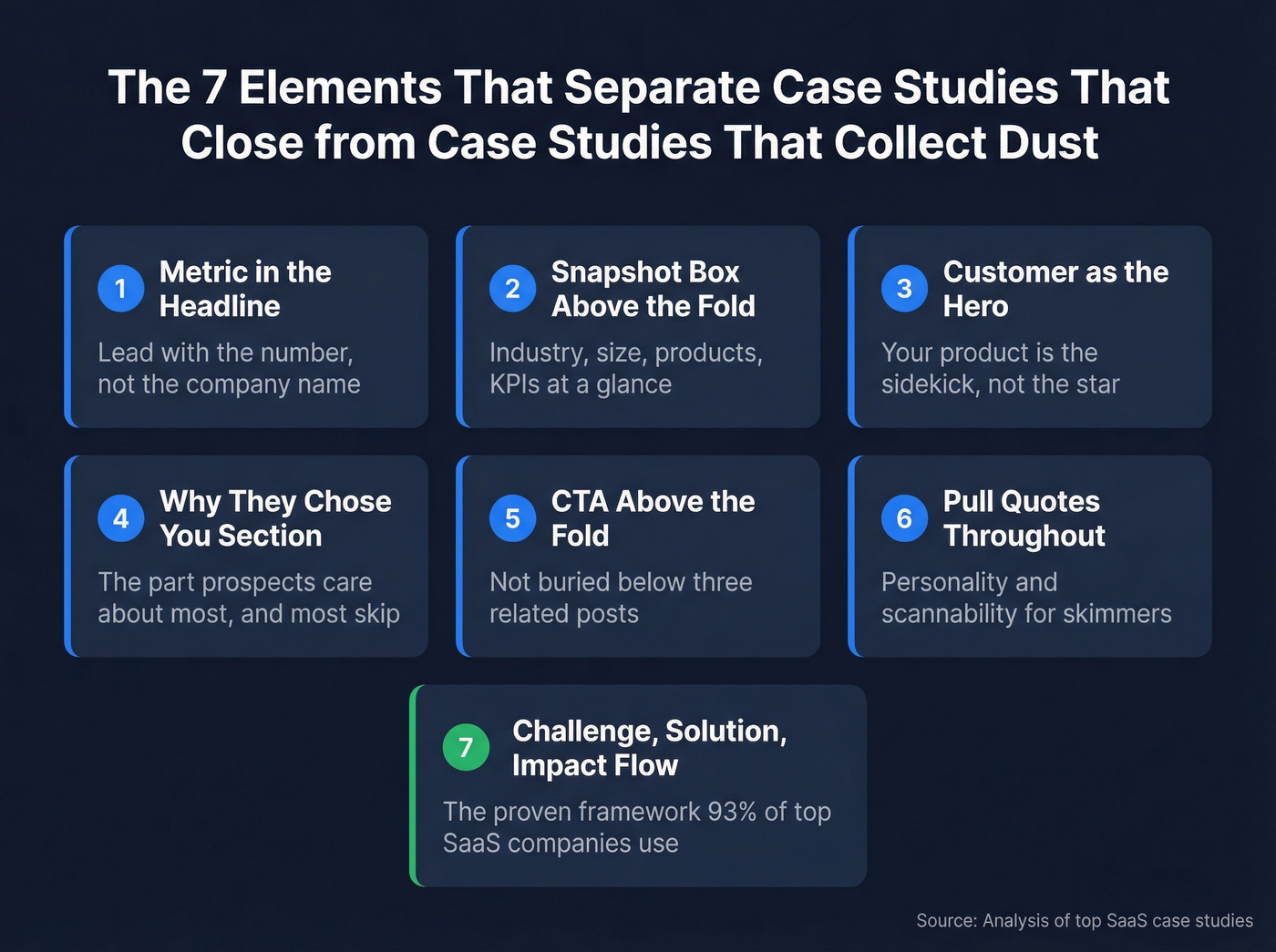
- Metric in the headline. "49% more customers adding products to carts" beats "How Company X Improved Their Business" every time.
- Snapshot box above the fold - industry, company size, products used, KPIs at a glance. Buyers skim before they read.
- Customer as the hero. Your product is the sidekick, not the protagonist. The best customer stories put the buyer's journey front and center.
- A "why they chose you" section. Most case studies skip this, and it's the part prospects care about most.
- CTA above the fold, not buried below three related posts.
- Pull quotes throughout for personality and scannability.
- Challenge, Solution, Impact flow. Don't reinvent the wheel.
The Only Template You Need
Forget 10-page decks. The best proof assets ship as a mini-kit: web page, PDF one-pager, and a short video clip.
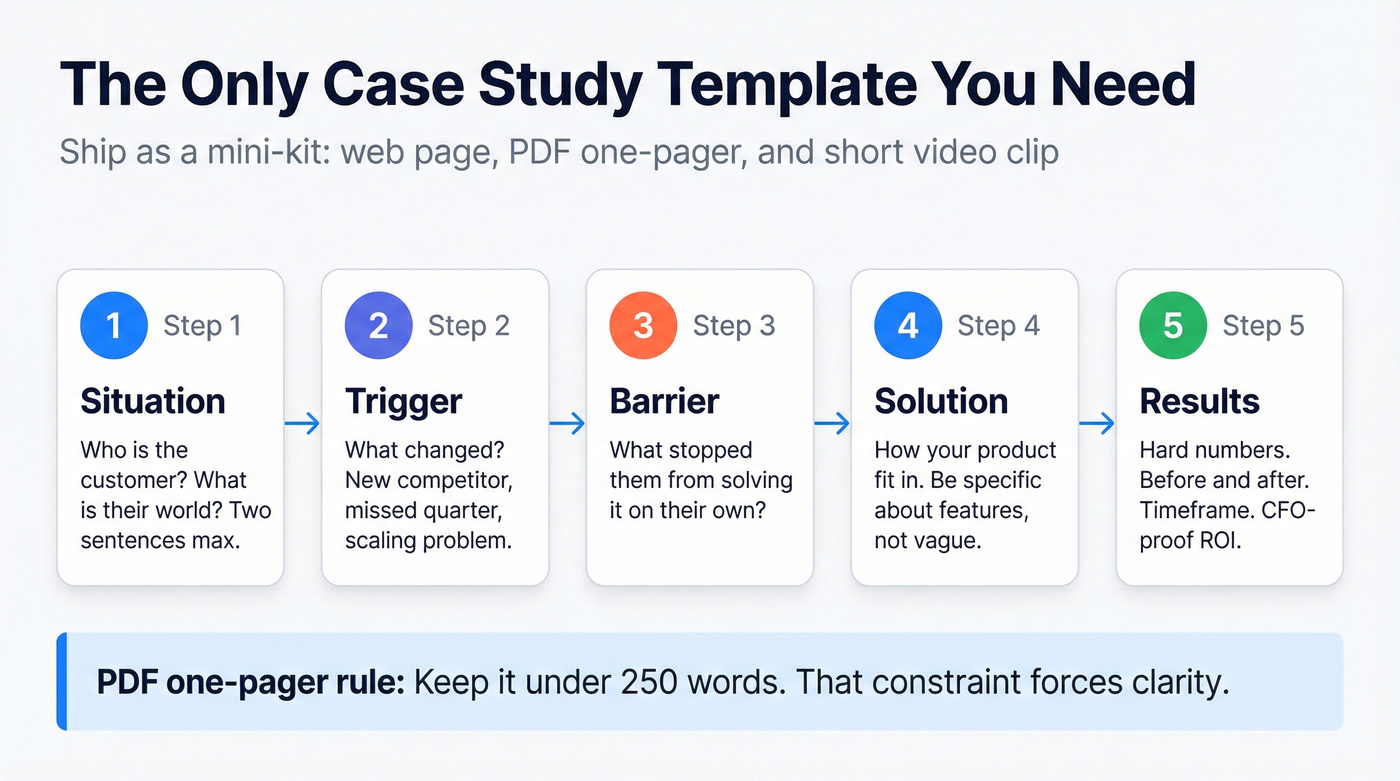
1. Situation - Who's the customer? What's their world look like? Two sentences max.
2. Trigger - What changed? A new competitor, a missed quarter, a scaling problem.
3. Barrier - What stopped them from solving it themselves?
4. Solution - How your product fit in. Be specific about features, not vague about "partnership."
5. Results - Hard numbers. Before-and-after. Timeframe. Tie results to ROI wherever possible - buying committees in 2026 run internal business cases, and your numbers need to survive a CFO's scrutiny. A compelling before-and-after story is what makes the CFO nod instead of push back.
Keep the PDF one-pager under 250 words. That constraint forces clarity. A great one-pager is easy to skim, consistent when forwarded, carries a clear value prop, and has an obvious next step. The web version can go deeper, but the one-pager is what reps actually send.
For context on volume: 88% of top SaaS companies use case studies, and they average 45 per company. You don't need 45 on day one, but you need more than three.

You're building case studies to match prospects by industry and company size. Prospeo's 300M+ profiles with 30+ filters - including buyer intent, technographics, and headcount growth - let you find the right decision-makers and verify their emails in real time. 98% accuracy means your proof assets actually land.
Match the right case study to the right buyer - then reach them.
How to Collect Customer Stories at Scale
Most teams treat case study production like a documentary shoot - weeks of legal review, and maybe four stories a year. There's a better way.
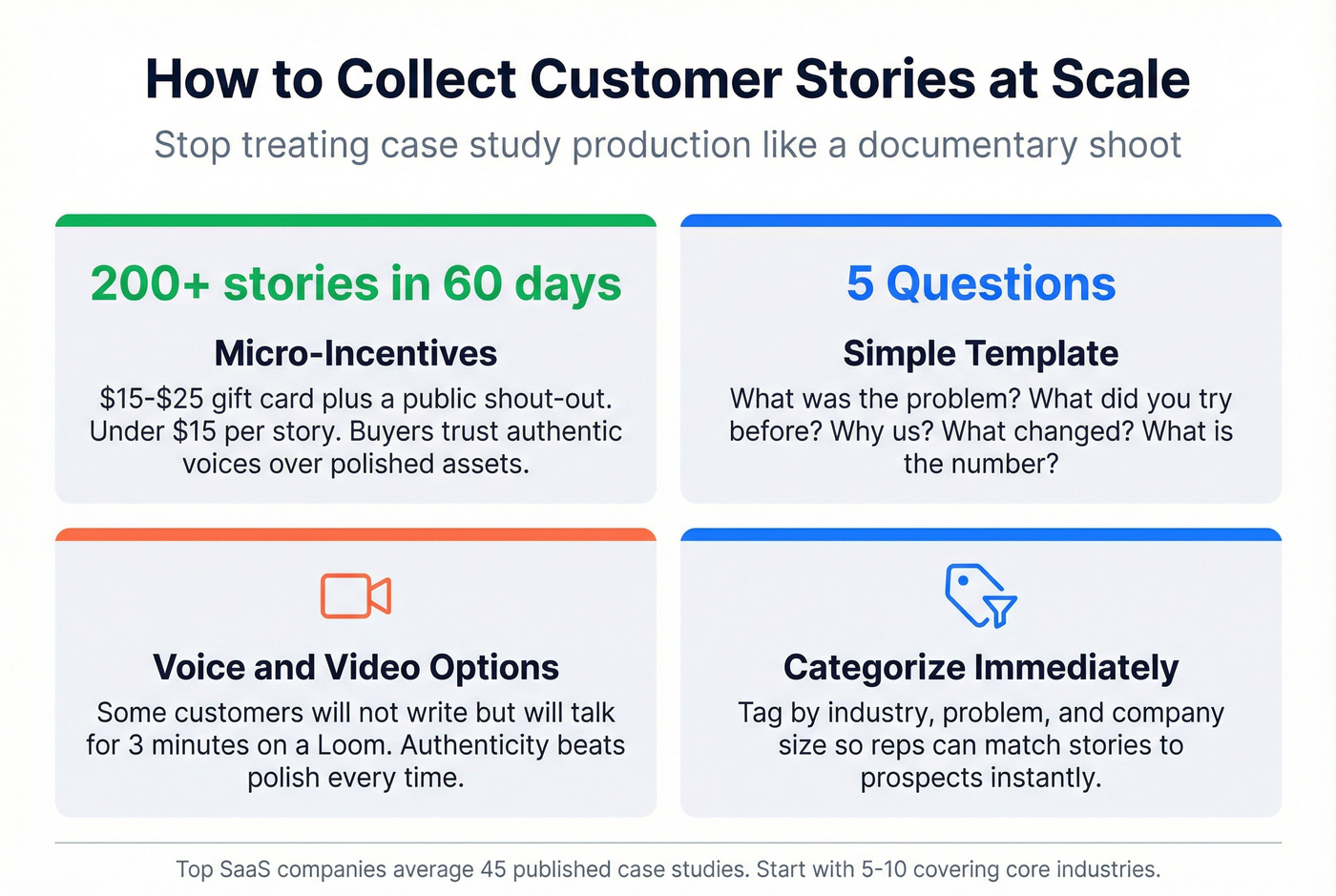
Offer micro-incentives. A $15-$25 gift card and a public shout-out gets you further than a formal ask. Teams have used this approach to collect 200+ customer success stories in 60 days for under $15 each. Buyers don't trust overly polished assets anymore - they want authentic voices.
Use a 5-question template. What was the problem? What did you try before? Why us? What changed? What's the number? That's it.
Offer voice and video options. Some customers won't write but will talk for three minutes on a Loom. Authenticity beats polish, and customer story selling works best when the voice sounds real, not scripted.
Categorize immediately by industry, problem, and company size so reps can match stories to prospects. When you're prioritizing which customers to ask first, tools like Prospeo's B2B database with 30+ search filters help you segment by industry and company size, then verify emails in real time so your outreach actually lands.
Where to Deploy Proof Assets in the Sales Cycle
A case study sitting on your website's /resources page isn't a sales tool. It's a graveyard. Deployment starts with mapping assets to buyer stages.
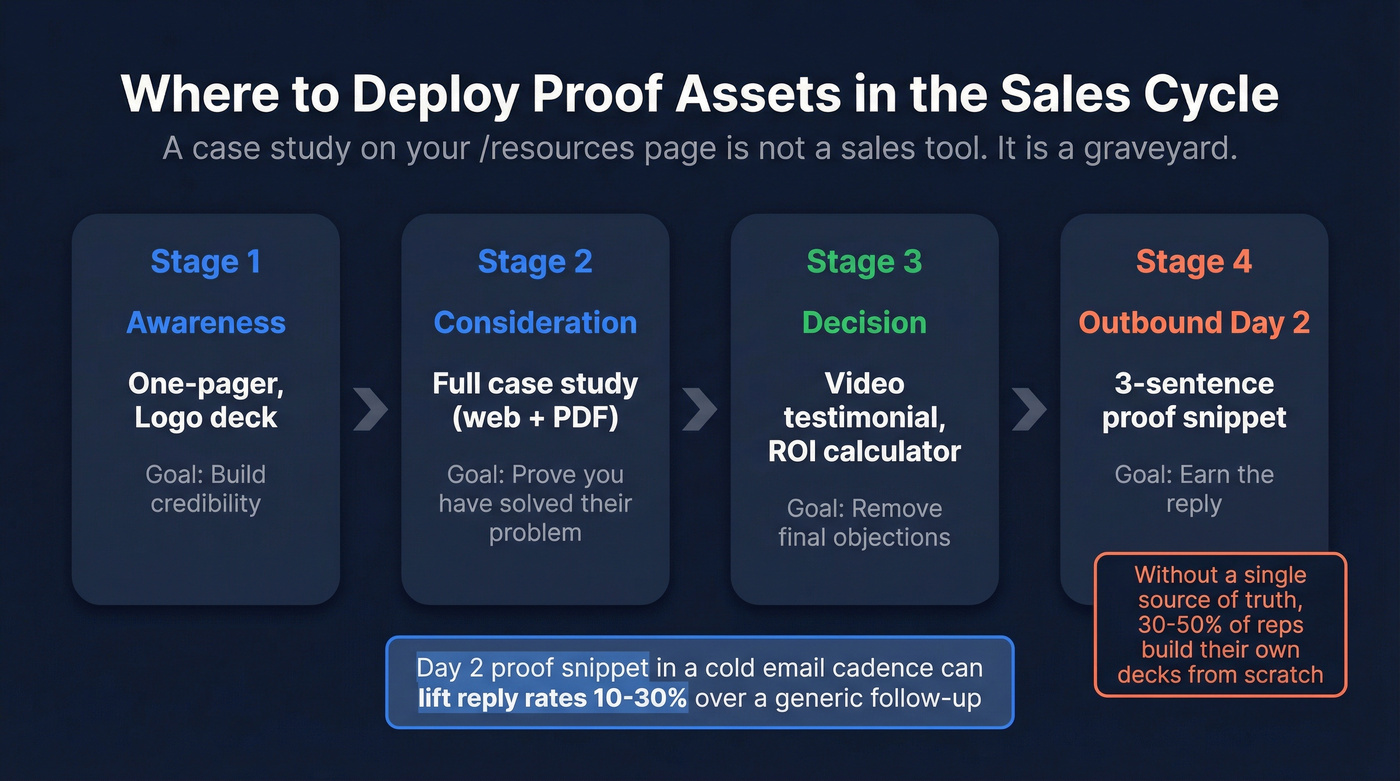
| Buyer Stage | Best Format | Goal |
|---|---|---|
| Awareness | One-pager, logo deck | Build credibility |
| Consideration | Full case study (web + PDF) | Prove you've solved their problem |
| Decision | Video testimonial, ROI calculator | Remove final objections |
| Outbound (Day 2) | 3-sentence proof snippet | Earn the reply |
That Day 2 placement matters. In a 6-email, 23-day cadence, the social proof story lands on Day 2 - right after the cold open, before the prospect has decided to ignore you. A relevant proof snippet in that email can lift reply rates 10-30% over a generic follow-up. This is social proof at its most tactical, delivered at the exact moment skepticism peaks. (If you need the actual copy, start with these sales follow-up templates.)
The centralization problem is real, too. Without a single source of truth - a sales enablement platform or shared content hub - 30-50% of reps end up building their own decks from scratch. That means inconsistent messaging and wasted hours. Split your library into internal enablement assets (battlecards, competitive positioning) and customer-facing assets (one-pagers, proof snippets, video clips) so reps grab the right thing fast.

Here's the thing most teams miss: your case study can't close a deal if it bounces. Snyk's team cut bounce rate from 35-40% to under 5% with verified contact data and generated 200+ new opportunities per month. When you're sending a carefully matched proof asset to a VP of Engineering, the email has to land.
Let's be honest - most teams obsess over case study design and ignore deliverability. A plain-text email with a two-sentence proof snippet that actually reaches the decision-maker will outperform a beautifully designed PDF that bounces or hits a dead inbox. Fix the data layer first. (If you're troubleshooting, this email deliverability guide breaks down the root causes.)
Snyk cut bounce rates from 35-40% to under 5% and generated 200+ new opportunities per month with verified contact data. Your carefully crafted proof snippets deserve the same deliverability. At ~$0.01/email with 98% accuracy, Prospeo fixes the data layer so your Day 2 case study email earns the reply instead of hitting a dead inbox.
Stop sending case studies to addresses that don't exist.
Video Case Studies
36% of top SaaS companies now include video case studies, and that number is climbing fast. The sweet spot is around two minutes - long enough for a real story arc, short enough that a busy buyer won't bail.
What makes them work: a clear narrative arc with relatable pain the viewer recognizes, hard data on results rather than vague praise, and social proof from multiple stakeholders rather than a single champion. Production quality matters less than you'd think. A clean Zoom recording with good audio beats a cinematic shoot that takes six weeks to approve. Mix customer interview footage with UI cutaways and you've got something a rep can drop into a deal room at the decision stage (especially inside a digital sales room).
The consensus on r/sales is that short, unscripted clips from real customers outperform anything your marketing team scripts - so don't overthink it.
Sales Case Study Interviews
This keyword also pulls in people prepping for sales case study interviews - the kind you get in a Director or Manager hiring process. Different intent, but worth covering briefly.
The format varies by role. Director-level cases ask you to design strategy. Manager-level cases focus on team operations. Associate-level cases test execution under pressure. Management Consulted outlines several example prompts:
- Design a market entry strategy for a saturated vertical with three entrenched competitors.
- Build a plan to reduce churn by 15% in a segment with declining NPS scores.
- Reverse a two-quarter sales slump for a team of eight reps with inconsistent pipeline.
The common thread across all levels: interviewers care about your thought process, not the "right" answer. If you're prepping, Harvard Business School's case method resources are worth a read for structuring your thinking under pressure.
FAQ
What's the best format - PDF, web, or video?
Ship all three as a mini-kit. The PDF one-pager is the most versatile for outbound - reps send it in cold sequences and follow-ups. The web page captures organic traffic. Video converts best at the decision stage when buyers need emotional reassurance alongside data.
How many does a sales team actually need?
Top SaaS companies average 45 published case studies. Start with 5-10 covering your core industries and buyer personas, then scale with the micro-incentive system described above. The goal is a library reps can match to any prospect's industry and problem.
How do I make sure my case study reaches the right person?
Verified contact data is the final mile. Real-time email verification with a 7-day refresh cycle keeps your proof assets out of dead inboxes and in front of decision-makers. Bad data wastes your best content. Skip this step if you want to watch your best case study bounce off a role@ alias.
How are success stories different from standard case studies?
Customer success stories focus on the buyer's transformation - their words, their metrics, their journey - rather than your product's feature list. The best ones read like a peer recommendation, which is why they outperform traditional marketing collateral at every funnel stage. Gartner's research on buyer-driven sales consistently shows that peer validation outweighs vendor claims by a wide margin.