

The Challenger Sale Book: What Actually Matters in 240 Pages
Your VP just dropped the Challenger Sale book on your desk - or more likely, Slacked you a link to the Kindle version with "read this by Friday." You're not alone. The book has ranked on Amazon's Marketing & Sales bestseller list consistently since its 2011 release, and it carries a 3.91/5 on Goodreads from 11,448 ratings and 683 reviews. Here's the honest truth, though: there are about 25 pages of genuinely good ideas loosely packed into 240 pages of business-book bloat.
Let's pull out what actually matters so you can spend your weekend doing literally anything else.
Quick Verdict
- Read it if you sell complex, multi-stakeholder B2B deals where the status quo is your biggest competitor. The core framework is still one of the best mental models for enterprise selling.
- Skip it if you sell transactional products, run short sales cycles, or need step-by-step tactical playbooks. The book will feel academic and frustrating.
- Focus on Chapters 4 and 5. That's where the commercial teaching choreography lives - the single most actionable framework in the entire book.
Book Details at a Glance
| Detail | Info |
|---|---|
| Authors | Matthew Dixon & Brent Adamson |
| Publisher | Portfolio/Penguin |
| Published | November 10, 2011 |
| Pages | 240 |
| ISBN | 978-159-1844-35-8 |
| Goodreads | 3.91/5 (11,448 ratings, 683 reviews) |
| Kindle Price | ~$9.99 |
| Formats | Hardcover, Kindle, Audiobook |
Where the Research Came From
Matthew Dixon and Brent Adamson weren't career salespeople - they were researchers at CEB (now Gartner), and they're upfront about that. The study started as a CEB member-client report in 2009, motivated by a simple question: during the 2009 downturn, what were top-performing reps doing differently?
They initially analyzed around 700 reps, then expanded the dataset to 6,000+ reps across 90 companies worldwide. The methodology isn't peer-reviewed or publicly accessible - a point critics love to raise - but the sample size is substantial for sales research. Neil Rackham, who wrote SPIN Selling, penned the foreword, which gave the book instant credibility in the sales methodology world.
The authors describe themselves as researchers and storytellers, not practitioners. That framing explains both the book's strengths (rigorous pattern recognition) and its weaknesses (thin on tactical execution).
The 5 Sales Rep Profiles
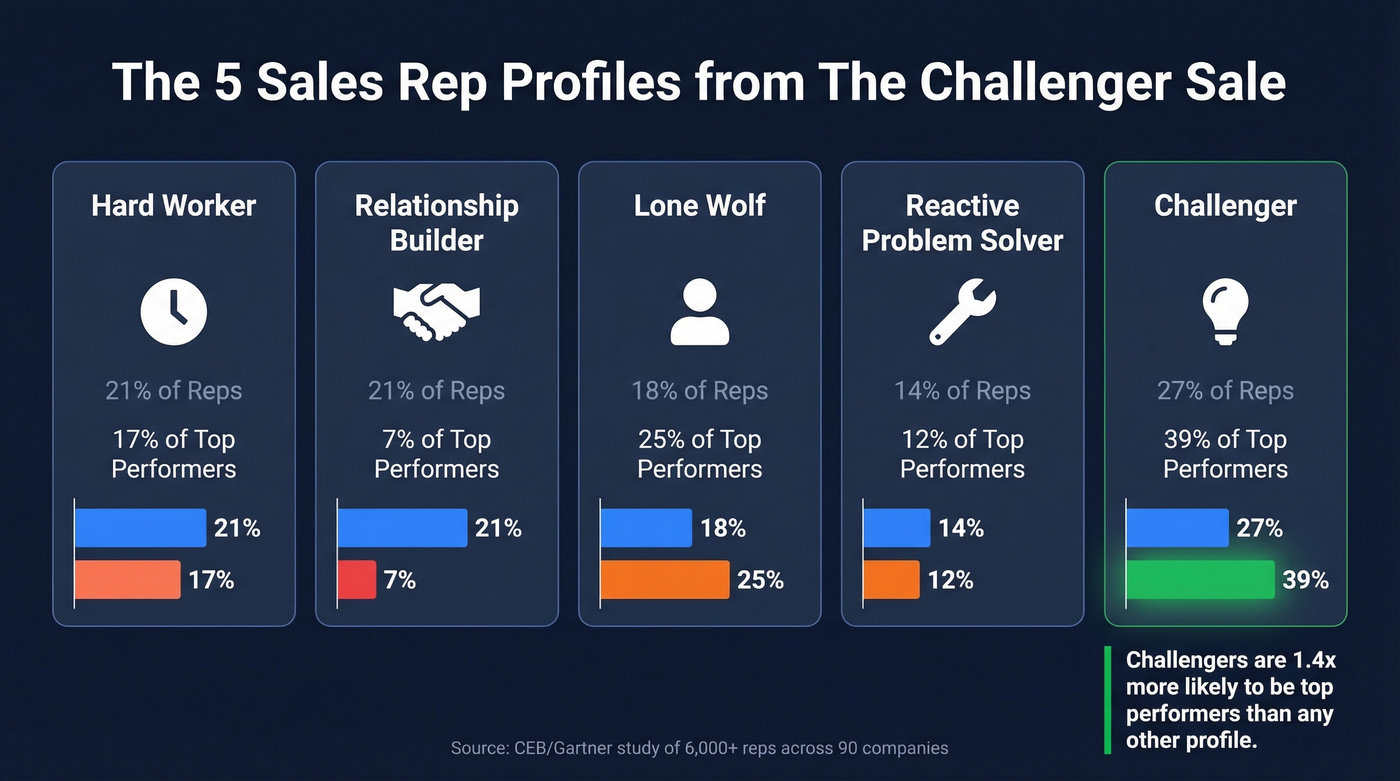
The book's central premise starts with a taxonomy. Dixon and Adamson categorized every rep in their study into one of five profiles based on observable behaviors and attitudes.
Profile Distribution
| Profile | % of Sample | % of High Performers |
|---|---|---|
| Challenger | 27% | 39% |
| Lone Wolf | 18% | 25% |
| Hard Worker | 21% | 17% |
| Problem Solver | 14% | 12% |
| Relationship Builder | 21% | 7% |
The headline stat is striking: Challengers make up 27% of the overall rep population but account for 39% of high performers. Relationship Builders represent 21% of reps but only 7% of top performers. That gap is the engine of the entire book.
Hard Workers show up early, stay late, and make extra calls - pure effort. Relationship Builders focus on harmony, generosity with time, and resolving tensions. Lone Wolves are the self-confident rule-breakers who do things their way. Reactive Problem Solvers are detail-oriented and reliable, especially post-sale. And Challengers? They understand the customer's business deeply, push their thinking, and aren't afraid to share controversial views.
Why "Relationships Don't Matter" Is Misleading
The book's most provocative claim - that relationship selling is dead - is built on a narrow definition. The "Relationship Builder" profile describes reps who prioritize harmony and avoid tension. That's not how most experienced sellers define relationships.
The best account executives we've worked with build relationships through trust, value, and honest conversation. That sounds a lot more like the Challenger profile than the Relationship Builder profile. The book's taxonomy creates a false dichotomy. Real relationships aren't about being agreeable - they're about being useful. Dixon and Adamson would probably agree, but the provocative framing has led to widespread misinterpretation.
If your team already builds relationships by challenging customers and delivering insight, you're already doing Challenger selling. You just didn't have a label for it.

The Challenger Sale says tailoring wins deals - but you can't tailor to a stakeholder you know nothing about. Prospeo returns 50+ data points per contact at 98% email accuracy, so you can frame your commercial teaching for the CFO, the end user, and every buyer in between.
Stop guessing who you're pitching. Start knowing.
Teach, Tailor, Take Control
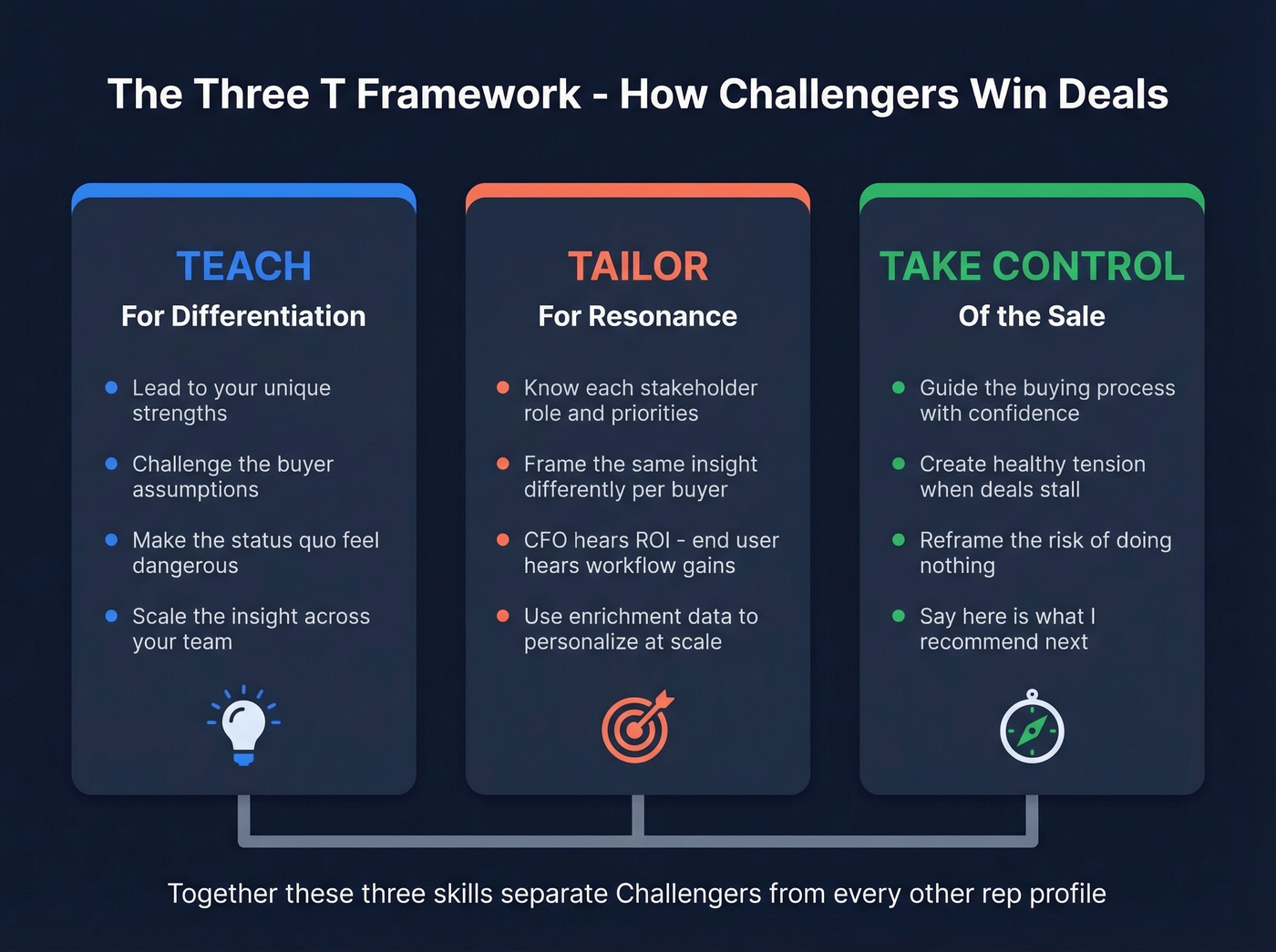
The Three T's are the operational core of the Challenger method. If the five profiles are the "what," this is the "how."
Teach for Differentiation
Challengers don't ask "what keeps you up at night?" They tell the customer what should keep them up at night. Instead of running a discovery call that mirrors every other vendor's, you lead with an insight that reframes how the buyer thinks about their problem.
Commercial teaching has four components: lead to your unique strengths, challenge the customer's assumptions, catalyze action by making the status quo feel dangerous, and scale the insight across your customer base so every rep can deliver it.
Tailor for Resonance
A brilliant insight delivered to the wrong stakeholder in the wrong language falls flat. Tailoring means personalizing your commercial teaching to each person in the buying committee - the CFO cares about cost avoidance and ROI timelines, the end user cares about workflow disruption and daily friction. Same insight, different framing.
Most teams stumble here because they don't know enough about who they're talking to. Their role, priorities, tech stack, department size - all of it matters when you're choosing how to frame your reframe. This is where contact enrichment tools like Prospeo earn their keep, returning 50+ data points per contact so you can actually tailor instead of guessing.
Take Control of the Sale
Challengers guide the buying process with confidence, create healthy tension when the deal stalls, and don't default to discounting when a prospect pushes back on price. They reframe the risk of inaction - what happens if the buyer does nothing?
Taking control means saying "here's what I'd recommend we do next" instead of "what would you like to do?" The difference is subtle but it changes the entire dynamic.
The 6-Step Teaching Pitch
This is the single most actionable framework in the book, buried in Chapters 4 and 5:
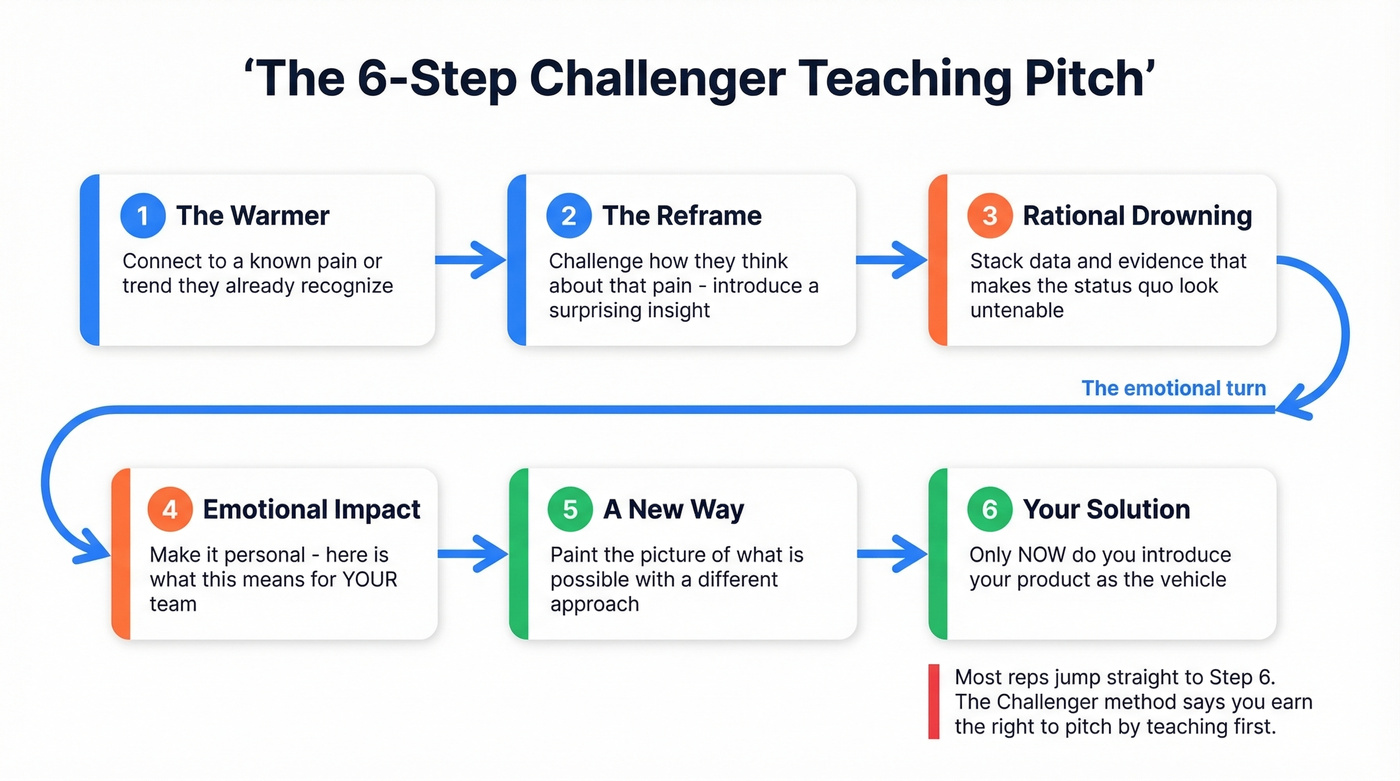
- The Warmer - connect to a known pain or industry trend the buyer recognizes
- The Reframe - introduce an insight that challenges how they think about that pain
- Rational Drowning - stack data and evidence that makes the current approach look untenable
- Emotional Impact - make it personal ("here's what this means for your team")
- A New Way - paint the picture of what's possible with a different approach
- Your Solution - only now do you introduce your product as the vehicle
The sequence matters. Most reps jump straight to step 6. The Challenger method argues you earn the right to pitch by first teaching something the buyer didn't know.
We've seen teams restructure their entire first-call framework around this choreography. The ones who nail "rational drowning" - with real metrics, not hand-waving - consistently run better deals.
Does It Hold Up in 2026?
What Still Works
The core insight - that status quo is your real competitor in complex sales, and you need to teach buyers why change is necessary - hasn't aged a day. Every enterprise deal still dies to "do nothing" more often than to a competitor. The commercial teaching choreography remains one of the clearest frameworks for structuring a first conversation.
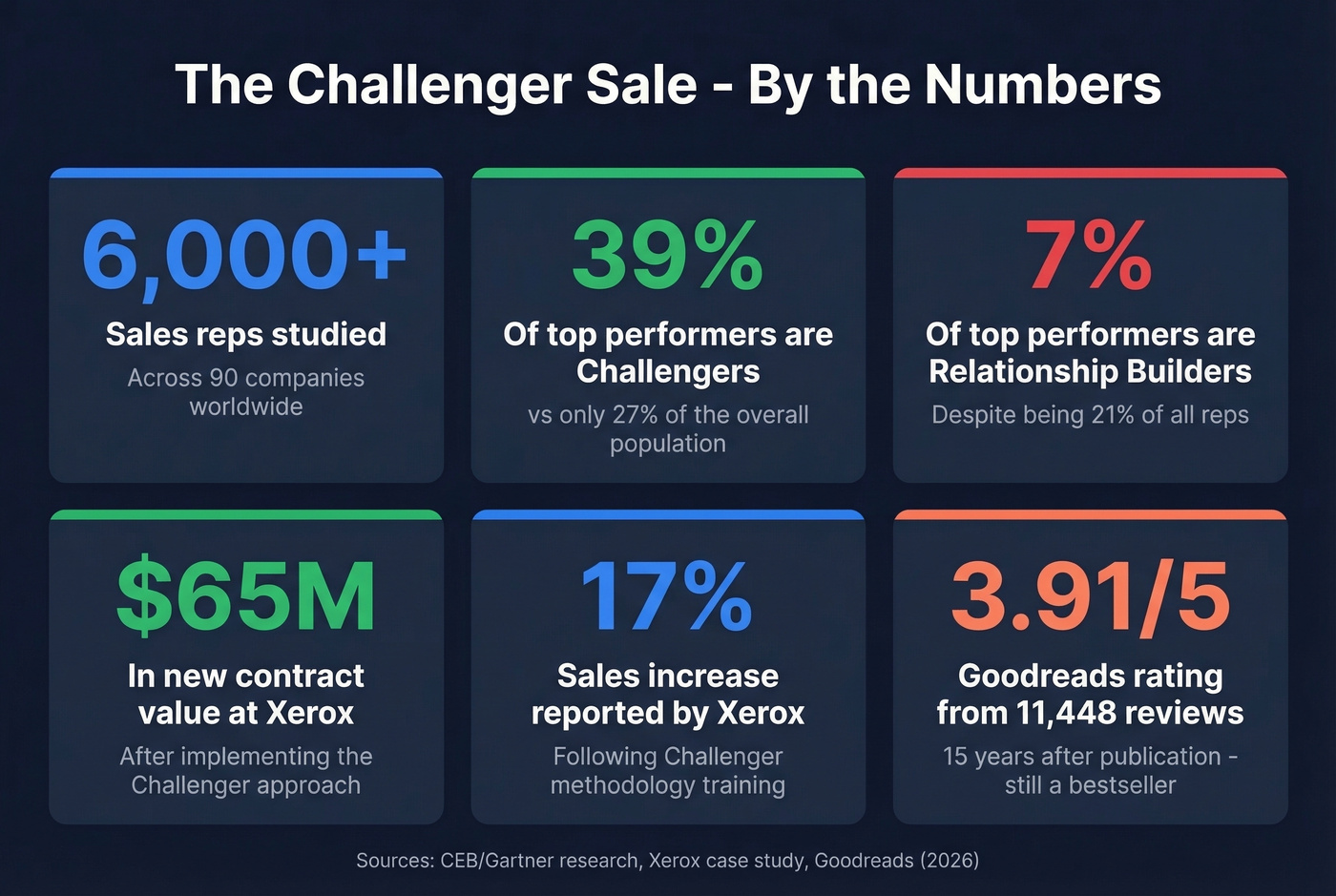
The results speak for themselves: Xerox reported a 17% increase in sales and $65M in contract value after implementing the Challenger approach. The book's continued presence on Amazon bestseller lists more than a decade after publication suggests it's still resonating with new cohorts of sales leaders.
Common Criticisms
Look, the #1 complaint on Reddit is that the book is "conceptual, not actionable." One AE put it bluntly: it lacks applicable sales techniques. That's a fair critique. The book tells you what top performers do but gives limited guidance on how to actually do it, especially if you're an individual contributor without a sales enablement team building teaching playbooks for you.
The "written by researchers, not salespeople" angle cuts both ways. The insights come from data rather than anecdote, but the practical implementation advice feels thin - like getting cooking advice from a food scientist who's never worked a line.
Goodreads reviews often flag that the book works better for sales managers in established organizations than for individual reps or small business contexts. On the flip side, several r/sales commenters credit the Challenger framework with fundamentally changing how they run discovery calls, particularly in enterprise SaaS. The ideas land when you put in the work to operationalize them. And yes, it's 25 pages of good ideas in 240 pages. That's business-book economics, not a reflection of the ideas themselves.
Challenger vs. Other Methodologies
| Dimension | Challenger | SPIN Selling | Solution Selling | MEDDIC |
|---|---|---|---|---|
| Core Approach | Teach & reframe | Question-led discovery | Diagnose & prescribe | Qualify & validate |
| Best For | Buyer doesn't know the problem | Buyer senses the problem | Known pain, complex solution | Deal qualification |
| Key Technique | 6-step teaching pitch | Situation-Need-Payoff Qs | Pain-Vision-Value | Metrics, Champion, Process |
| Origin | CEB research (2009) | Neil Rackham (1988) | Bosworth (1993) | PTC/Parametric (1990s) |
| Best for First Calls | Challenger | SPIN (close second) | Solution Selling | Not designed for this |
| Best for Deal Mgmt | Challenger + MEDDIC | SPIN | Solution Selling | MEDDIC |
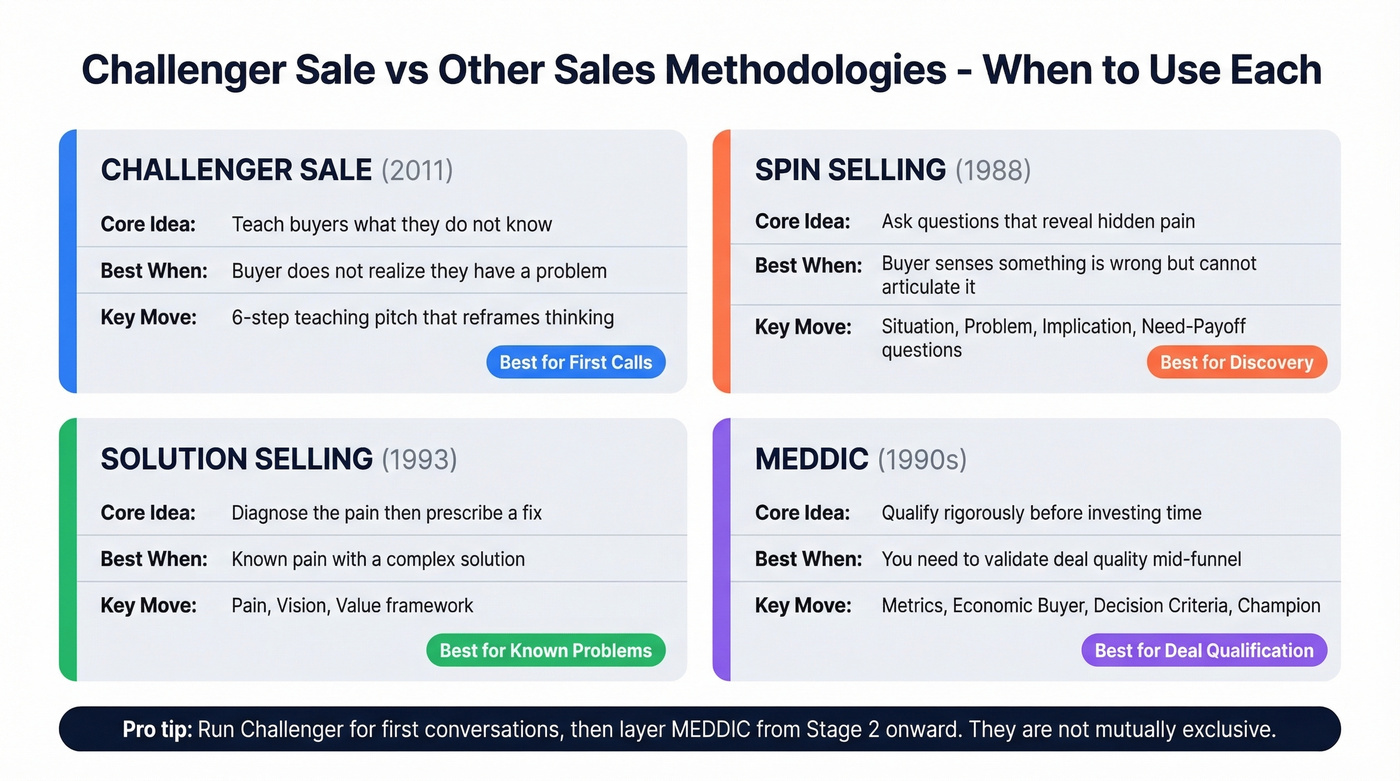
Use Challenger when the buyer doesn't realize they have a problem and you need to create urgency through insight. Use SPIN when the buyer knows something's wrong but hasn't articulated it. Use MEDDIC as a qualification layer that pairs with either. They're not mutually exclusive - the best teams we've talked to run Challenger for first conversations and MEDDIC for deal qualification from stage 2 onward.
Putting the Framework Into Practice
The gap between understanding the Challenger framework and executing it is where most teams stall. You can memorize the 6-step pitch choreography, but it falls apart if you're pitching the wrong person with a dead email address.
Challenger selling requires deep prospect knowledge before the first conversation. You can't teach for differentiation if you don't know the prospect's business, their tech stack, or who holds budget authority. The "Tailor" step is impossible without this intelligence.
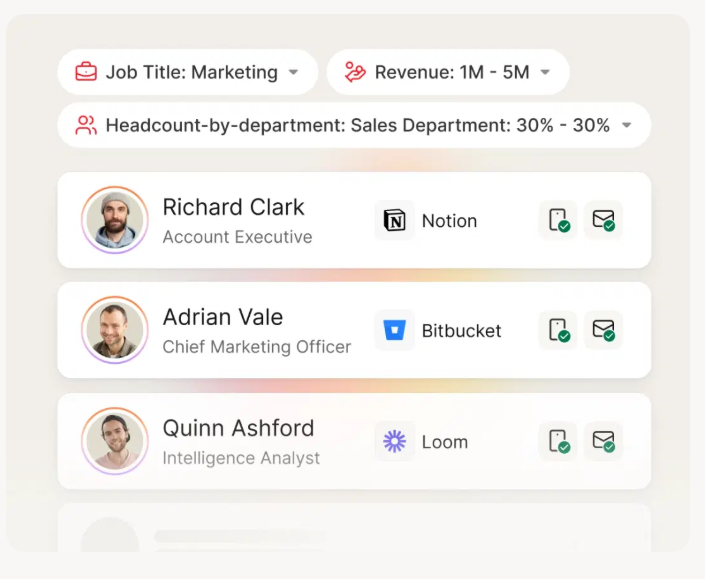
This is where data quality becomes non-negotiable. When your insight-led pitch bounces because the email was stale, or reaches a coordinator instead of the VP, the entire Challenger choreography is wasted. Building a verified prospect list with buyer intent signals, technographics, and department-level data turns the Tailor step from theory into something you can actually execute.
If you're building lists at scale, it helps to systematize your sales prospecting workflow and pair it with the right data enrichment services.
Taking control of the sale means reaching the right decision-maker directly - not waiting for a gatekeeper to forward your email. Prospeo gives you 125M+ verified mobile numbers with a 30% pickup rate and 143M+ verified emails, so your Challenger pitch actually lands.
Deliver your reframe to the person who can actually say yes.
What to Read Next
If the Challenger framework clicks for you, the natural next step is The Challenger Customer by the same authors. It flips the lens to the buying side, introducing the "Mobilizer" archetype - the internal champion who actually drives change within the buying committee. It's arguably more useful than the original for anyone selling into organizations with 5+ stakeholders.
The Effortless Experience, the third book in the Challenger ecosystem, focuses on customer service. Its core finding - that service interactions are four times more likely to drive disloyalty than loyalty - is worth reading if you manage post-sale teams.
For a more tactical alternative, pick up Gap Selling by Keenan. It covers similar territory (leading with insight, challenging the status quo) but with significantly more actionable frameworks for individual reps. And if you haven't read SPIN Selling by Neil Rackham, start there - it's the foundation that Challenger builds on, and it's aged remarkably well.
FAQ
Is The Challenger Sale still relevant in 2026?
Yes. The core insight - that teaching and challenging buyers beats harmony-first selling in complex deals - holds up across any B2B environment where the status quo is the main competitor. The Teach-Tailor-Take Control model and the 6-step teaching pitch are the two ideas worth internalizing even if you skip the rest.
How long does it take to read?
About 5-6 hours cover to cover. Focus on Chapters 4 and 5 for the commercial teaching choreography and 6-step pitch framework - those 50 pages contain 80% of the actionable value.
What's the difference between The Challenger Sale and SPIN Selling?
Challenger leads with insight and teaches the customer something new before asking questions. SPIN leads with questions to collaboratively uncover needs. Challenger works best when buyers don't realize they have a problem; SPIN works best when they sense something's wrong but haven't articulated it.
Does the Challenger approach work for small businesses?
It's designed for complex, multi-stakeholder B2B enterprise sales. If you run sales cycles under a few weeks, the full methodology will feel like overkill. The teaching and tailoring principles still apply at any scale, but the 6-step choreography assumes a longer, consultative selling motion.
How do I start using the Challenger method today?
Research each target account's business challenges, craft an insight that reframes how they think about a problem, and structure your first call around the 6-step teaching pitch. The "Tailor" step requires knowing your prospect's role, priorities, and org structure before you pick up the phone - so invest in contact enrichment before you invest in talk tracks.