

Challenger Sale Choreography: The 6-Step Playbook (2026)
You've read the book. You know the five rep profiles. But when it's time to build a Challenger pitch, most teams stall at the same place: they can name the six steps but can't execute them in a live conversation.
The challenger sale choreography isn't a script. It's six outcomes your pitch must hit, in a specific emotional arc. Here's the thing - most training programs teach the theory and then leave reps to figure out the hard parts alone. We've watched it happen dozens of times.
This is the playbook we wish someone had handed us years ago.
What You Need Before You Start
Set up three things before rolling this out to your team:
- A Reframe + constructive tension checklist so reps don't "go dark" on buyers mid-conversation
- A Rational Drowning calculator slide following the inputs → math → punchline → check-for-understanding structure
- A manager scorecard for call reviews tied to each choreography step
Skip any of these and you'll get reps who understand the theory but freeze on live calls.
What "Choreography" Actually Means
The term comes from CEB's (now Gartner's) original research by Matthew Dixon and Brent Adamson. They studied 10,000 sales professionals across 55 dimensions, excluded rookies under six months, and defined star performers as the top 20%. The standout finding: 53% of customer loyalty is driven by the sales experience itself - not brand, product, or price.
Among the five seller profiles - Problem Solver (14%), Lone Wolf (18%), Hard Worker (21%), Relationship Builder (21%), and Challenger (27%) - nearly 40% of star performers were Challengers. That gap between average distribution and star-performer concentration is the entire argument for this methodology.
So what's the "choreography"? It's their word for the six-step emotional arc Challenger reps follow. Think of it like a drama plotline: comfort → rising tension → resolution. These are psychological outcomes your conversation must produce, regardless of whether the buyer follows your slide deck linearly. At its core, this is a teaching-based sales model - reps lead with insight rather than discovery questions, reshaping how the buyer thinks about their own problem before any product enters the conversation.
The 6 Steps at a Glance
Teach these as six outcomes, not a linear checklist. Buyers jump around. They'll challenge your Reframe before you finish the Warmer, or skip ahead to pricing. The choreography gives you a map so you can navigate back to the right emotional beat.
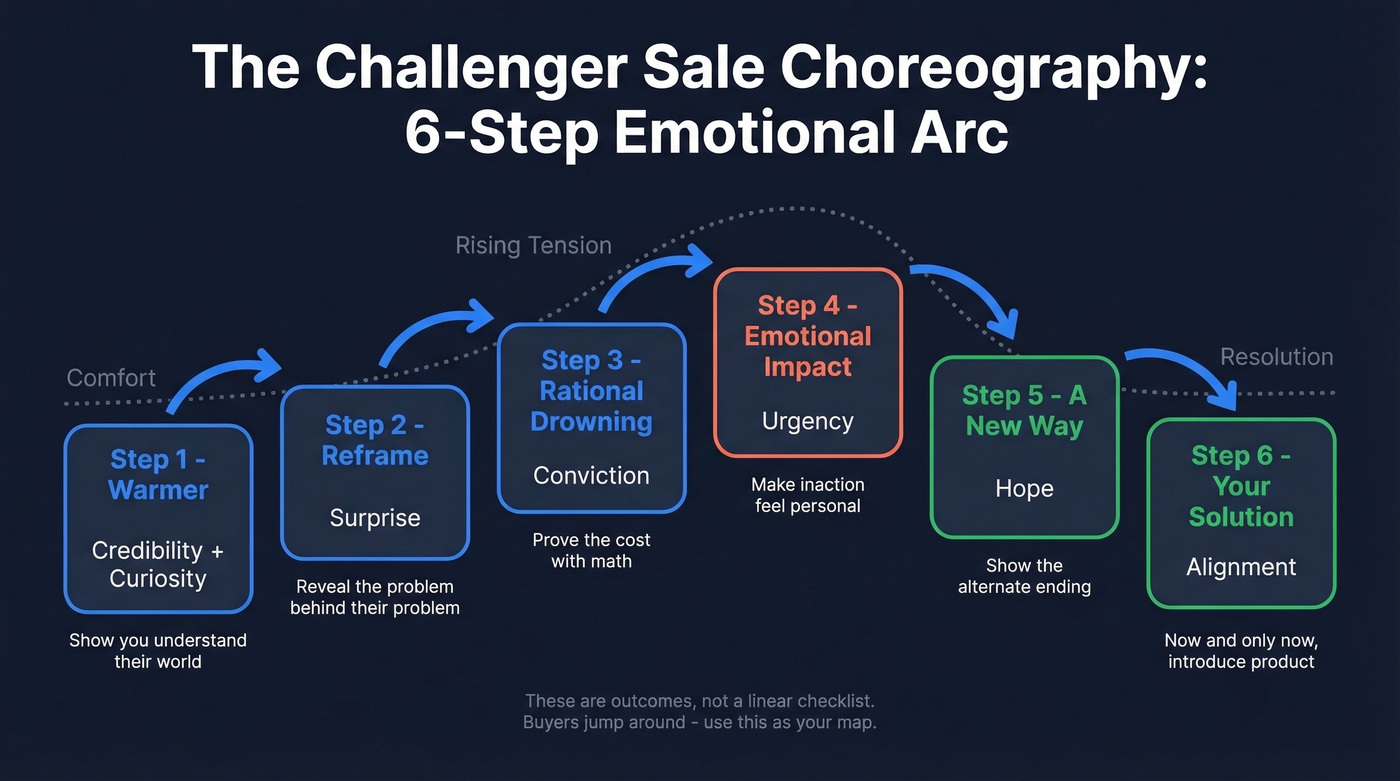
| Step | Outcome | One-Line Description |
|---|---|---|
| Warmer | Credibility + curiosity | Show you understand their world |
| Reframe | Surprise | Reveal the problem behind their problem |
| Rational Drowning | Conviction | Prove the cost with math |
| Emotional Impact | Urgency | Make inaction feel personal |
| A New Way | Hope | Show the alternate ending |
| Your Solution | Alignment | Now - and only now - introduce product |
Step-by-Step Talk Tracks
In our experience, Reframe and Emotional Impact are the two steps reps struggle with most. Rational Drowning tends to get overdone as a data dump. Let's break each one down.
Warmer
Say this: "We've been studying labor scheduling across 200+ retail chains. The pattern we keep seeing is that ops leaders are caught between corporate headcount caps and store-level revenue targets. How are you balancing that right now?"
Skip this step if you mention your product. The Warmer demonstrates homework on their industry. Name your solution here and you've lost the Challenger arc before it starts.
Reframe
Say this: "Most teams frame this as an overtime cost problem. But the bigger number is the revenue you're leaving on the table - understaffing during peak hours doesn't just save labor costs, it kills same-store sales."
The Reframe should feel like a revelation, not a correction. Forbes calls this "the problem behind your problem" - surprising but immediately credible. Another example of commercial teaching in action: a logistics company reframing "delivery speed" as "delivery windows drive 15% of negative online reviews" shifts the conversation from operations to brand risk.
Rational Drowning
This is NOT a data dump. It's a short, structured calculation.
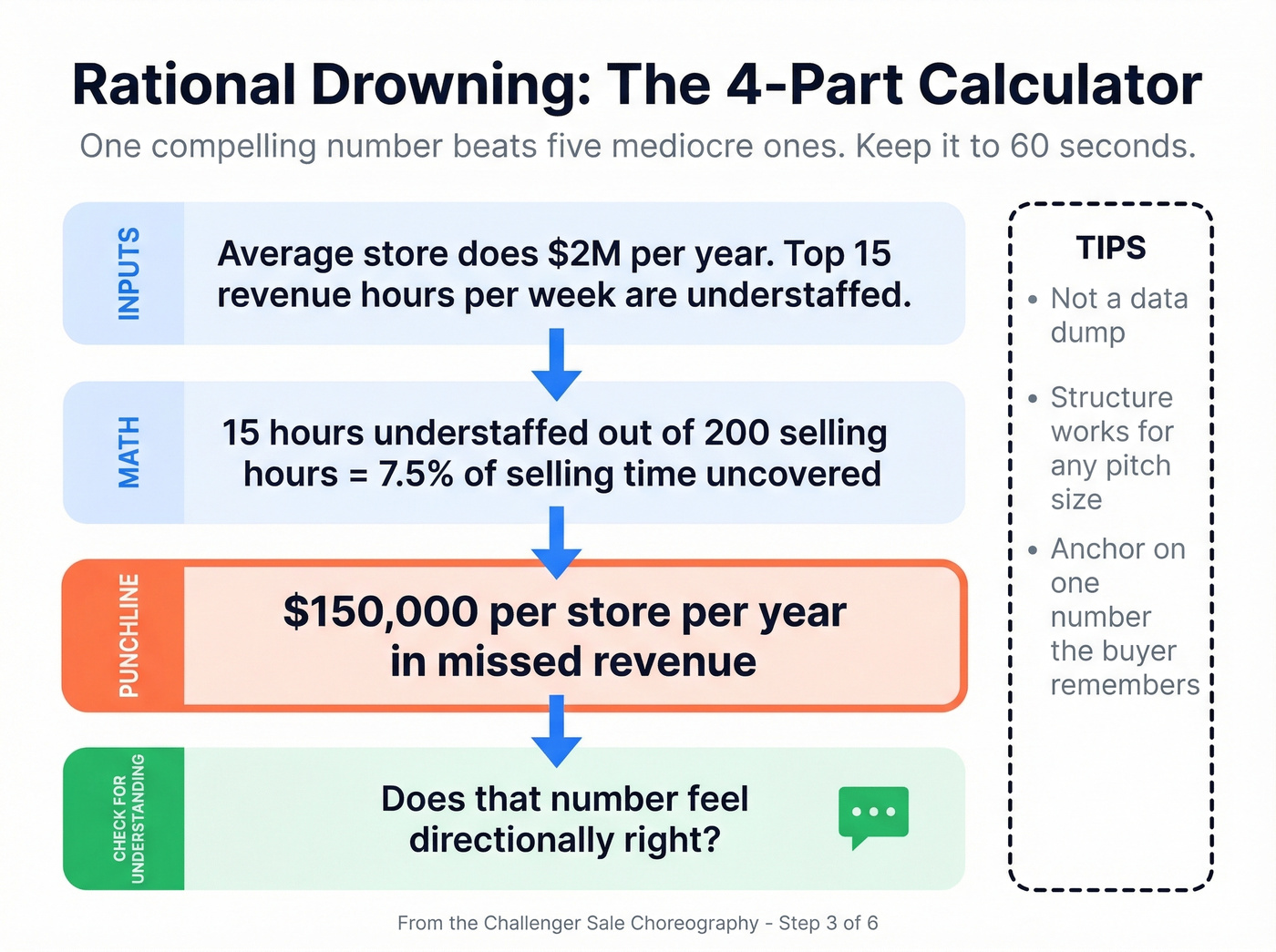
Say this: "If your average store does $2M/year and you're understaffed during the top 15 revenue hours per week, that's roughly 7.5% of selling time uncovered. $150,000 per store per year in missed revenue. Does that number feel directionally right?"
The same structure works for simpler pitches - even "switching to LED bulbs saves $150/year" follows the inputs → math → punchline arc. Keep it to 60 seconds or less. One compelling number beats five mediocre ones.
Emotional Impact
Now tell the story of what happens if they ignore what they just learned. But be careful here - pure fear-based messaging backfires. It triggers loss aversion and status quo bias, making prospects more likely to do nothing.
Say this: "Imagine it's Q4. Your district manager sees the same-store sales dip. The conversation isn't about scheduling anymore - it's about your ops team's ability to execute. That's the meeting nobody wants to be in."
Constructive tension requires empathy first, precise risk second, and a credible resolution waiting in the wings.
A New Way
Show the alternate ending before you name the tool.
Say this: "The teams solving this use demand-signal scheduling - matching staff density to predicted foot traffic by hour, not just by shift. They stop treating labor as a blunt weekly target and start managing it like a revenue lever."
Your Solution
Only now do you introduce your product. The buyer should already be nodding along to the "new way" before they hear a product name. If they aren't, you haven't earned this step - go back to Emotional Impact.

The Challenger choreography fails when your insight reaches the wrong stakeholder. Prospeo's 30+ search filters - including buyer intent, job title, and department headcount - help you target the economic buyer before you build the pitch.
Stop perfecting talk tracks for people who can't sign the deal.
Why the Choreography Fails
Most Challenger guides name the six steps and stop. That's where teams get stuck. Bold & Sharp identified five failure modes that explain why even trained teams struggle with execution.
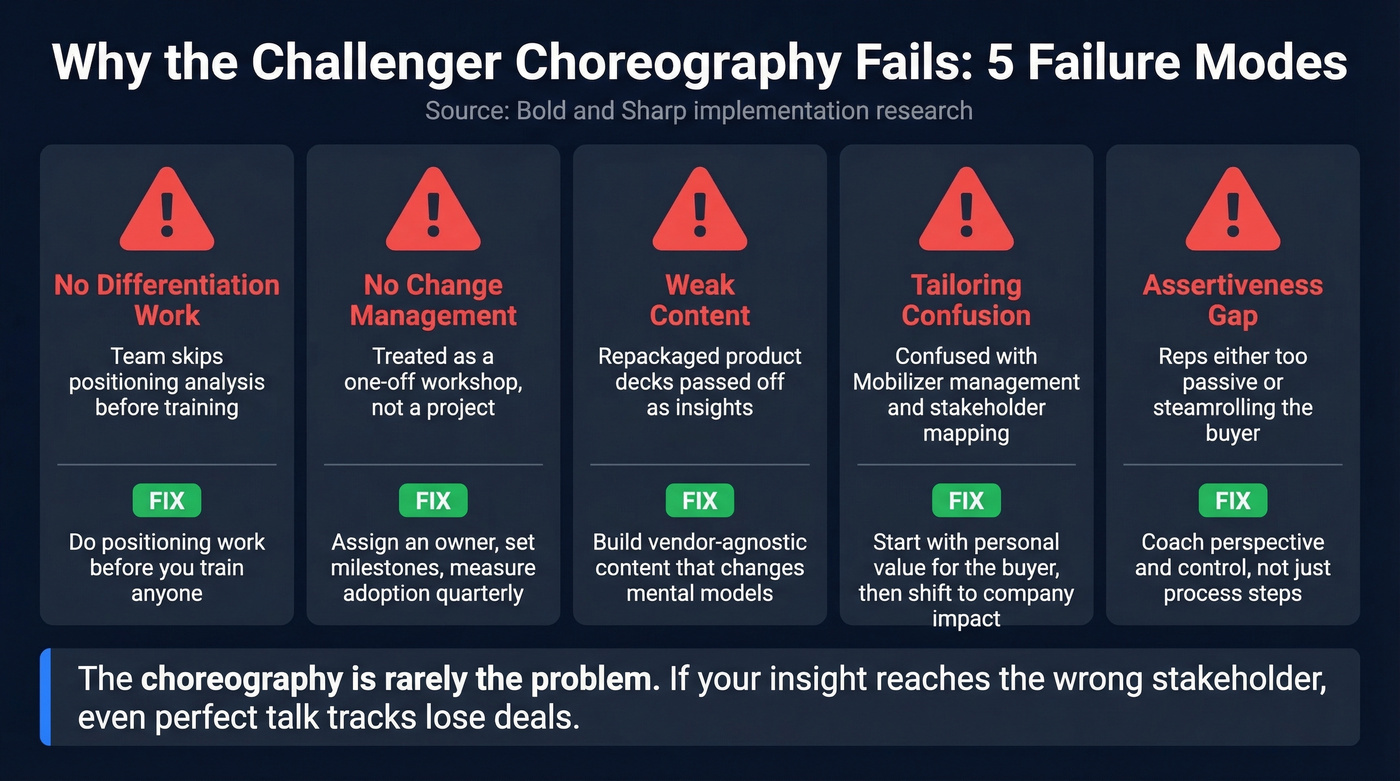
| Failure Mode | What Goes Wrong | The Fix |
|---|---|---|
| No differentiation work | Team skips positioning analysis | Do positioning work before training |
| No change management | Treated as a workshop, not a project | Assign an owner, set milestones, measure adoption |
| Weak content | Repackaged product decks | Build agnostic content that changes mental models |
| Tailoring confusion | Confused with Mobilizer management | Start with personal value, shift to company impact |
| Assertiveness gap | Reps either passive or steamrolling | Coach perspective + control, not just process |
Look - the choreography itself is rarely the problem. I've watched teams nail every talk track and still lose deals because they were pitching the wrong stakeholder. The insight has to reach the economic buyer, not just the person who took the meeting. That's a targeting problem, not a messaging one.
Constructive Tension Rules
A dataset of 2,400 cold emails found that aggressive Challenger-script emails got a 9% response rate versus 25% for conversational approaches. That's a massive gap. Five guardrails keep your pitch from crossing into steamrolling territory:
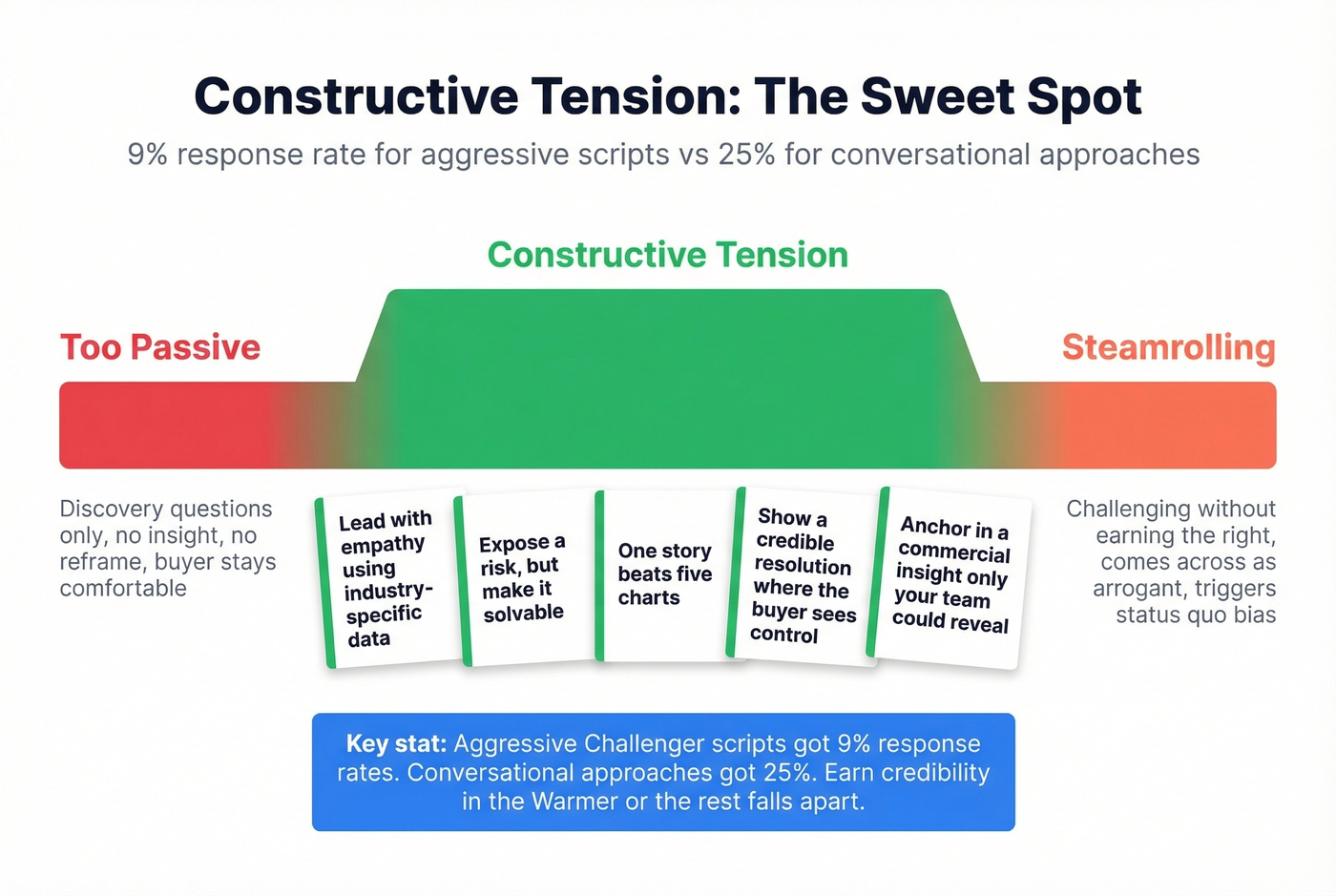
- Lead with empathy and relevance using industry-specific data, not generic stats
- Expose a risk, but make it solvable - precision beats exaggeration every time
- Make it emotional and relatable because one story beats five charts
- Show a credible resolution where the buyer sees control and measurable gain
- Anchor in a commercial insight only your team could reveal
The consensus on r/sales is pretty clear: reps who "challenge" without earning the right to do so just come across as arrogant. Earn credibility in the Warmer, or the rest falls apart.
Reach the Right Stakeholders
The challenger sale choreography only works if it reaches the buying committee - economic buyer, champion, and end users. Roughly 60% of the purchasing process is complete before a rep gets involved, which means your insight needs to land with multiple roles, not just one thread. Companies with a defined sales process are 33% more likely to hit performance benchmarks.
Build a clean stakeholder list so your commercial teaching doesn't die in bounced outreach. We use Prospeo's 30+ search filters - including buyer intent across 15,000 topics, job changes, and department headcount - to map the full buying committee and pull verified emails at 98% accuracy along with direct dials for each role.
When NOT to Use Challenger
If you can't articulate a genuine commercial insight - something surprising and backed by data that only your team could reveal - don't "challenge." You'll just come across as aggressive without substance.
If you need more discovery-led structure first, start with a tighter discovery questions framework before you try to reframe anything.
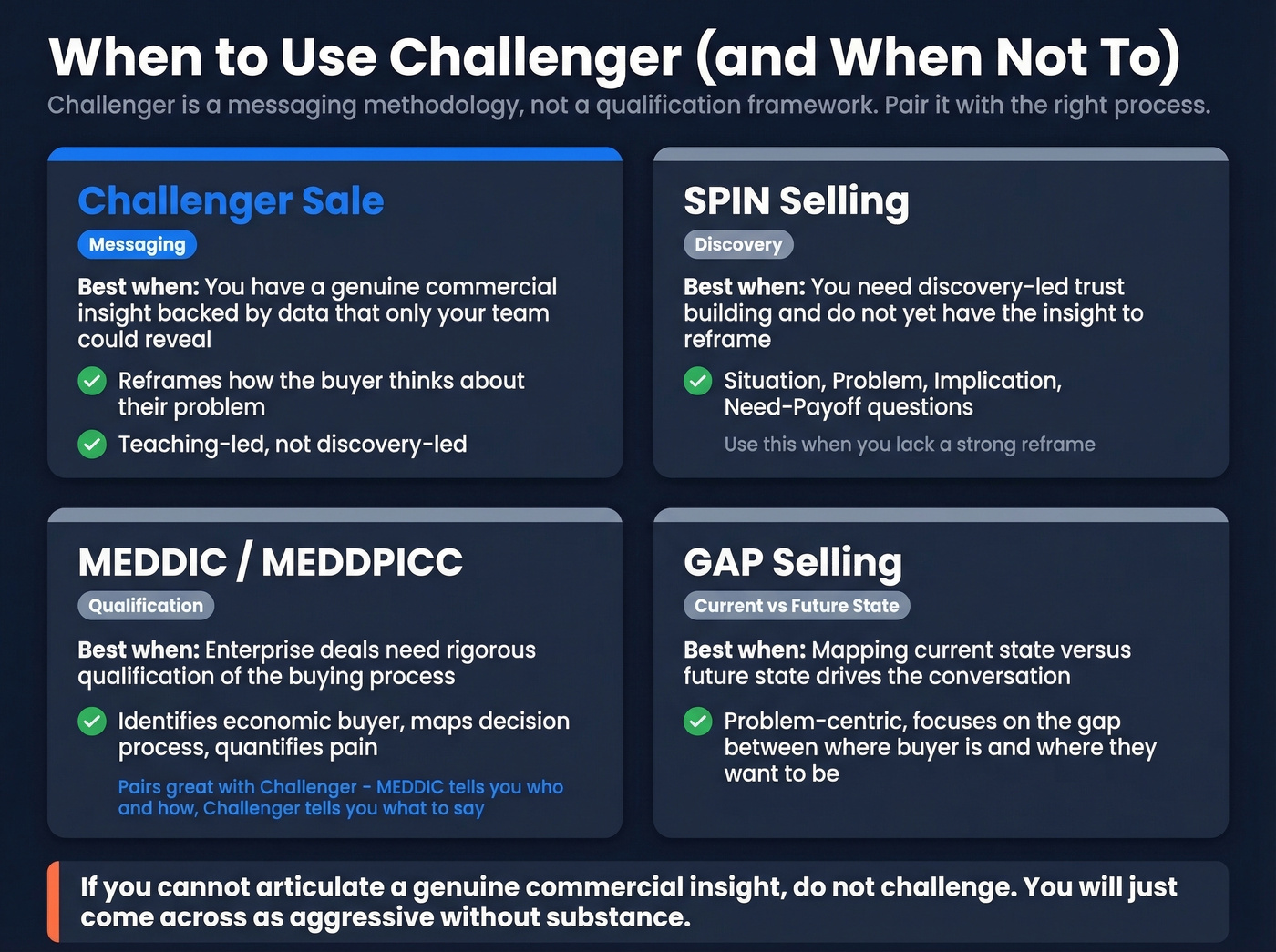
Use SPIN Selling when you need discovery-led trust building and don't yet have the insight to reframe. Use MEDDIC/MEDDPICC for enterprise qualification rigor - it pairs well with Challenger messaging but solves a different problem. For deals where mapping current state versus future state drives the conversation, GAP Selling is a better fit. Challenger is a messaging methodology, not a qualification framework. Pair it with the right process for your deal complexity.
If you're pairing Challenger with MEDDIC, keep a bank of MEDDIC discovery questions so reps don't default to generic probing.
You've nailed the Reframe and Rational Drowning. But 35% bounce rates destroy your outreach before the choreography even starts. Prospeo delivers 98% email accuracy with 7-day data refresh - so every Challenger conversation actually lands.
Great sales methodology deserves data that doesn't waste it.
FAQ
What is Rational Drowning in the Challenger Sale?
Rational Drowning is a short, data-backed calculation that makes your Reframe undeniable - structured as inputs → math → punchline → check for understanding. It's not a data dump; it's one compelling number that forces the buyer to confront the cost of their current approach. Keep it to 60 seconds or less in a live conversation.
Can you combine Challenger with MEDDIC?
Yes, and most enterprise teams should. Use MEDDIC for qualification rigor - identifying the economic buyer, mapping the decision process, quantifying pain. Use the Challenger choreography for messaging and deal control. MEDDIC tells you who and how; Challenger tells you what to say.
How does commercial teaching differ from traditional discovery?
Traditional discovery asks the buyer to diagnose their own problem. Commercial teaching flips that - the rep arrives with a data-backed insight the buyer hasn't considered and uses the six-step choreography to guide them toward a new conclusion. Challengers outperform Relationship Builders in complex B2B deals because they're proactive, not reactive.
How do you build a stakeholder list for Challenger outreach?
Map the buying committee first: economic buyer, champion, end users, and technical evaluators. Then use a B2B data platform to find verified emails and direct dials for each role, filtering by company, department, seniority, and intent signals. Getting this right means your carefully crafted Challenger messaging actually reaches inboxes instead of bouncing.