

Change Management for Sales Teams: The 2026 Playbook Most Leaders Skip
Your VP of Sales just announced a new CRM. Go-live is in six weeks. Your reps are behind on quota, and somehow you've been handed the "change management" mandate on top of everything else.
Over on r/changemanagement, someone recently described the aftermath of a CRM rollout pushed through despite weeks of warnings: wrong data, missing opportunities, broken contracts, and a support team running daily office hours just to keep the lights on. That post had hundreds of upvotes. It struck a nerve because it's the norm, not the exception.
A Gartner survey of 234 sales leaders found only 11% of sales organizations drive commercial success while executing a transformation. Let's be honest - that number should terrify anyone about to flip the switch on a new system.
Here's what actually works:
- Use ADKAR for rep adoption. Use Kotter for true org-wide transformation.
- Track adoption with leading indicators (DAU, feature usage, record completeness). If you don't measure, you're guessing.
- Fix data quality before go-live. Sellers don't "resist change" - they resist garbage inputs.
Why Sales Transformation Is Harder Now
Sales orgs have gone through an average of four transformations in the past two years. Gartner's seller skills survey of 1,026 B2B sellers found 70% feel overwhelmed by the tech required to do their jobs, and 72% feel overwhelmed by the skills demanded of them. Those numbers are staggering when you consider that each new tool or process lands on top of the last one, with barely any breathing room.
Enablement isn't keeping up. Highspot's State of Sales Enablement report found 55% of organizations can't effectively drive GTM initiatives, and 29% still rely on disconnected tools. Here's the kicker: Gartner also found organizations that simplify seller roles are 4.5x more likely to be a top sales organization.
That's the real job of managing change in sales - make the work simpler, not "more adopted."
Why Sales Change Initiatives Fail
The often-cited figure is that 70% of change initiatives fail. In sales, the blast radius is bigger because failure shows up as missed quarters, not messy project plans.
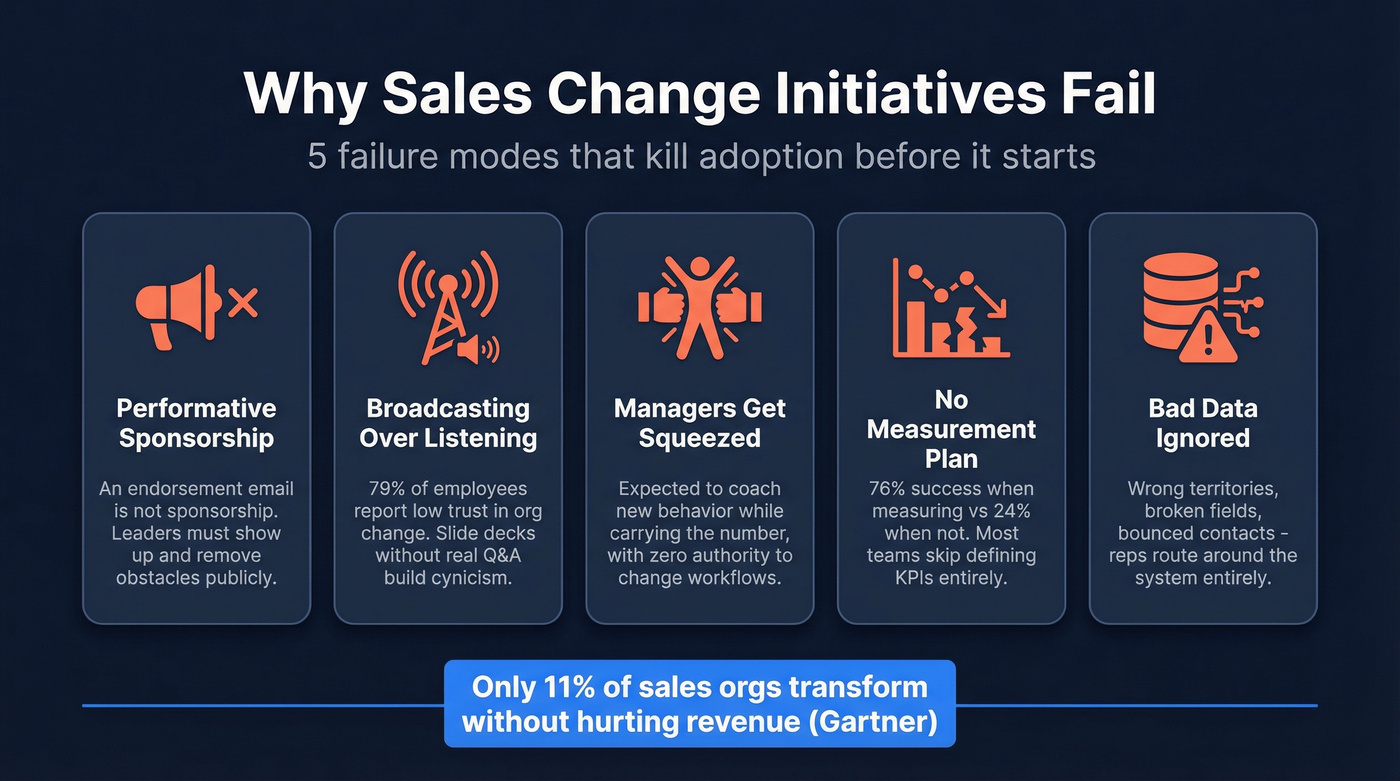
We've seen these five failure modes over and over:
1. Sponsorship is performative. An endorsement email isn't sponsorship. You need visible sales leadership that shows up, repeats the "why," and removes obstacles in public - not just a Slack message on launch day.
2. Broadcasting replaces listening. Slide decks and town halls without real Q&A don't build buy-in. They build cynicism. The PEX Report found 79% of employees report low trust in organizational change, and performative sales communication is a big reason why.
3. Frontline managers get squeezed. They're expected to coach the new behavior while still carrying the number, with no authority to change the workflow that's slowing reps down. This is the failure mode nobody talks about at the exec level.
4. No measurement plan. Teams that measure compliance and performance hit objectives far more often - 76% success when measuring vs. 24% when not.
5. System readiness is ignored, especially data. If territories are wrong, fields are broken, and contacts bounce, reps won't "try harder." They'll route around the system entirely.
Look - if your rollout makes a rep's day even 10% harder in week one, you've already lost. Salespeople don't have slack time. Your change has to earn its place.
Two Frameworks That Actually Work
Most sales leaders skip frameworks and default to "announce, train, hope." Pick one model and run it.
ADKAR for Rep Adoption
ADKAR is the cleanest fit for sales because it tracks the rep's reality: Awareness, Desire, Knowledge, Ability, Reinforcement. Don't turn it into a training plan. Turn it into a rep-success plan:
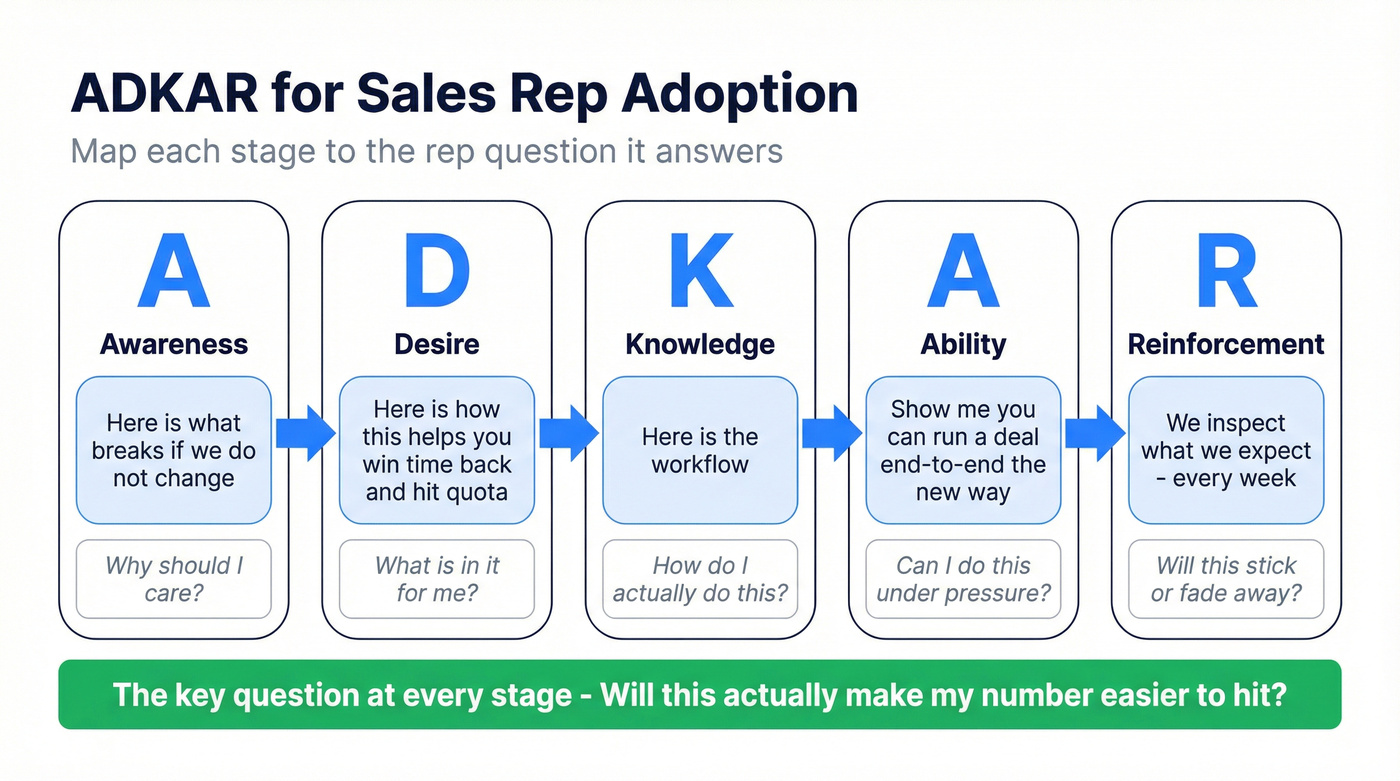
- Awareness: "Here's what breaks if we don't change."
- Desire: "Here's how this helps you win time back and hit quota."
- Knowledge: "Here's the workflow."
- Ability: "Show me you can run a deal end-to-end in the new way."
- Reinforcement: "We inspect what we expect - every week."
The reason ADKAR works for sales specifically is that it forces you to answer the rep's real question at every stage: "What's in it for me, and will this actually make my number easier to hit?" If you can't answer that honestly, the framework will expose the gap before launch rather than after.
Kotter for Org-Wide Transformation
Kotter's 8 steps are for the big stuff: restructures, mergers, comp philosophy changes, full GTM redesigns. It's heavier, slower, and absolutely worth it when the CEO is truly involved.
For most sales tool or process rollouts, ADKAR wins because it's faster and closer to the behavior you're trying to change.

You just read that 70% of sellers feel overwhelmed by their tech stack. Adding another tool only works if it eliminates friction. Prospeo's CRM enrichment returns 50+ data points per contact at a 92% match rate - so your next rollout launches with clean, verified data that reps actually trust.
Give reps a reason to open the CRM on day one.
Measuring Adoption That Matters
Training attendance is trivia. RAIN Group research found only 16% of sellers and sales managers rate their sales training as "extremely effective." The metric that matters is behavior in the workflow.
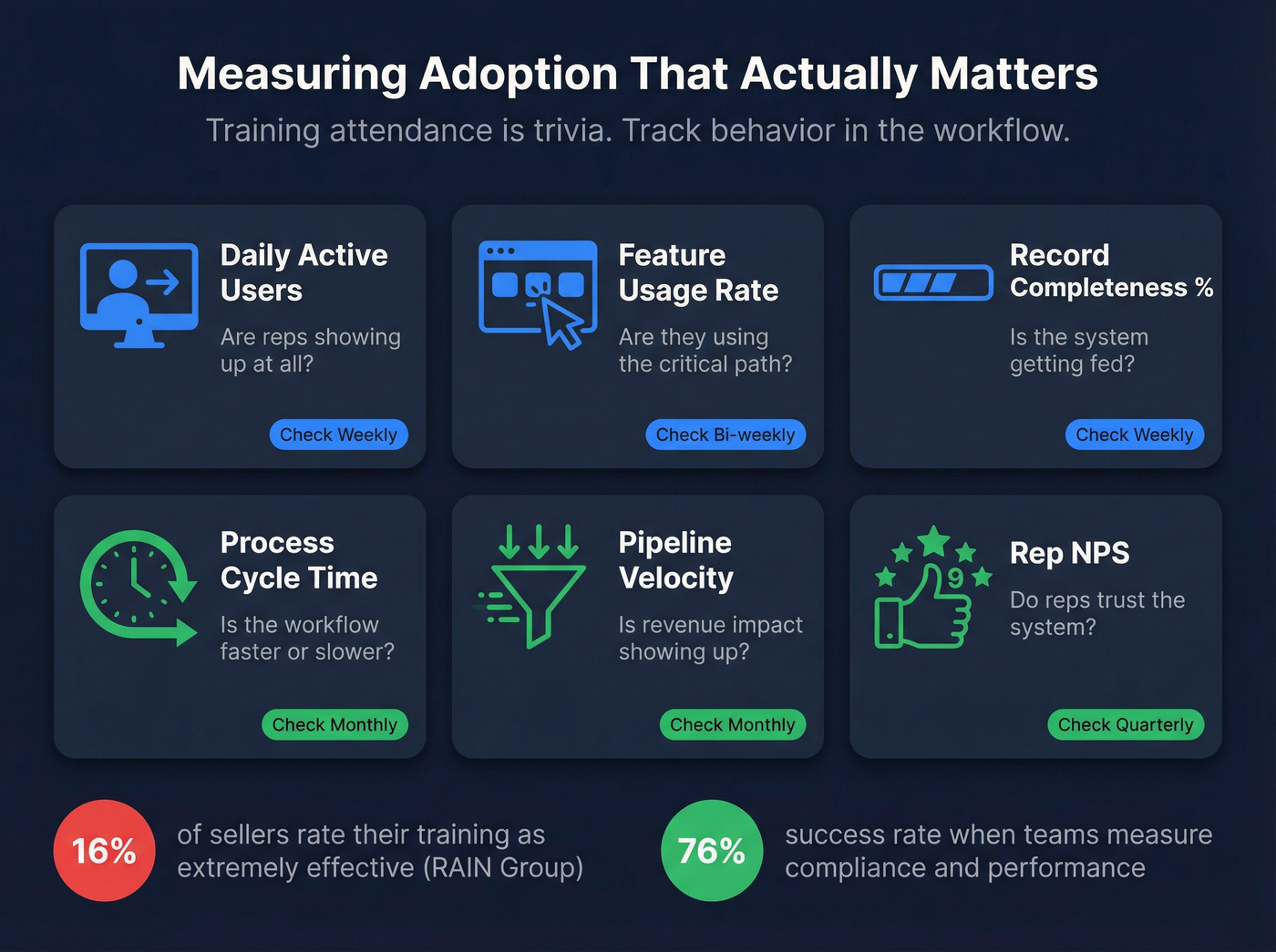
Use a simple dashboard:
| Metric | What it tells you | When to check |
|---|---|---|
| Daily active users | Are reps showing up at all? | Weekly |
| Feature usage rate | Are they using the critical path? | Bi-weekly |
| Record completeness % | Is the system getting fed? | Weekly |
| Process cycle time | Is the workflow faster or slower? | Monthly |
| Pipeline velocity | Is revenue impact showing up? | Monthly |
| Rep NPS | Do reps trust the system? | Quarterly |
Why don't more teams measure? Because 40% can't align on what "success" even means, and 29% struggle to identify the right KPIs. Fix that in week zero: define the 3-5 behaviors you'll inspect, then instrument them before anything else happens.
The Hidden Killer: Bad Data
Reps don't abandon a new CRM because they "hate change." They abandon it because the first ten records they touch are wrong. Bounced emails, disconnected numbers, outdated titles - every bad record is a micro-betrayal of the promise that "this new system will make your life easier."
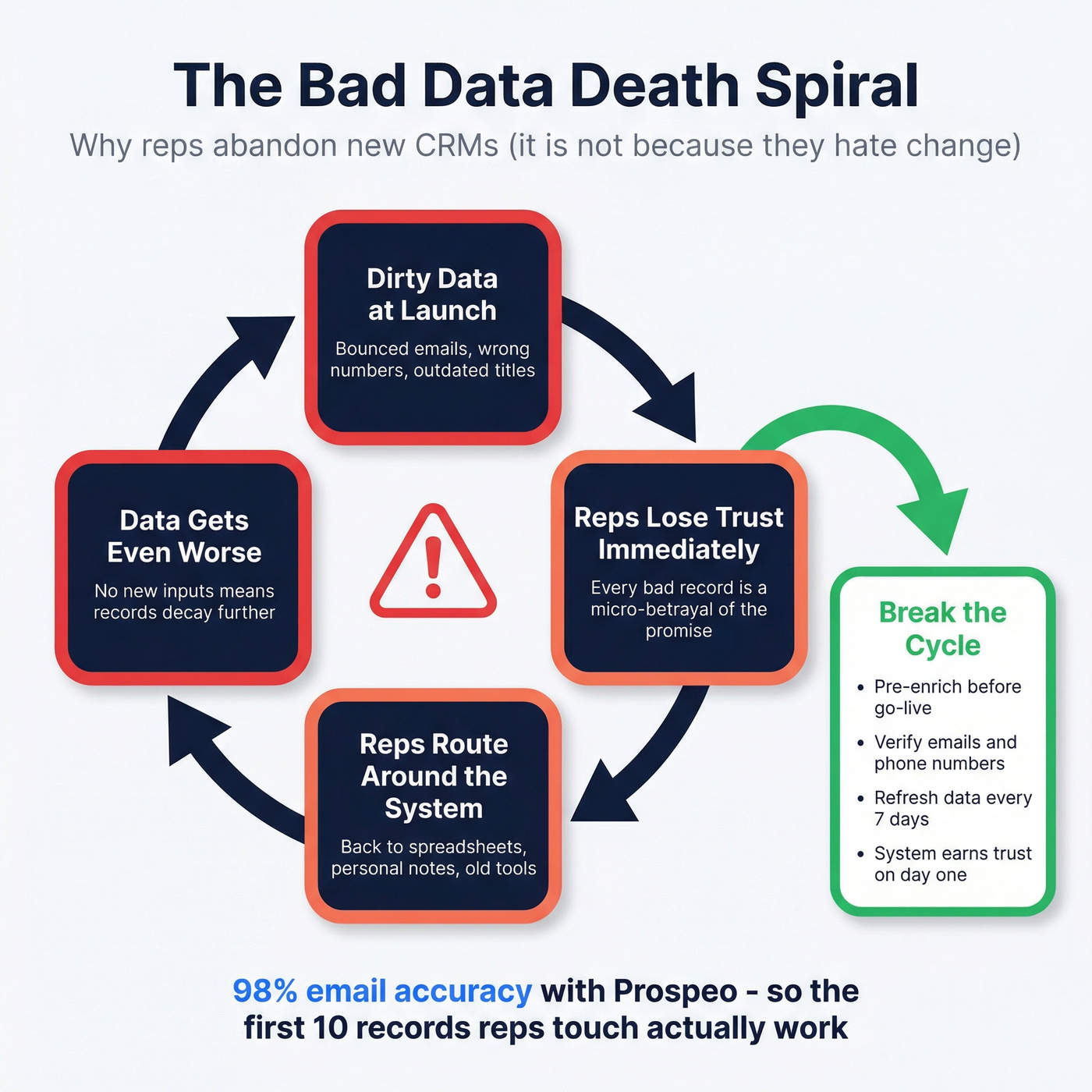
Before go-live, enrich and verify your CRM so the system earns trust on day one. In our experience, teams that pre-enrich their data see dramatically faster adoption curves. Prospeo refreshes data every 7 days with 98% email accuracy and an 83% enrichment match rate, returning 50+ data points per contact - so reps open the CRM and find emails and mobile numbers that actually connect.
If you're evaluating vendors, start with a quick scan of data enrichment services and how they handle match rates and refresh cycles.
The #1 failure mode in sales change management is system readiness - specifically, bad data. Prospeo refreshes 300M+ profiles every 7 days with 98% email accuracy and 125M+ verified mobiles. At $0.01 per email, pre-enriching your database before go-live costs less than one missed deal.
Stop blaming rep resistance when the real problem is bounced emails.

Selling Is Change Management
Every deal requires the buyer to change: switch vendors, rewire workflows, take political risk, and defend the decision internally. That's why the best sellers sound like change leaders - they create a case for change, paint a future state, map the path, and keep momentum from collapsing.
Here's the internal-to-external mirror that matters: if a rep learns stakeholder mapping during a CRM rollout - who's an ally, who's a blocker, who needs proof - they can use the same map to navigate a buyer's procurement committee without getting surprised at the finish line. We've seen reps who went through a well-run internal change initiative become noticeably better at managing complex deals afterward, because the skills transfer directly.
That skill transfer shows up fastest in enterprise B2B sales, where internal alignment and multi-threading are the whole game.
That's also why Reddit threads about "change fatigue" resonate so broadly. Buyers and sellers are both exhausted by change that adds work without adding clarity.
FAQ
What's the biggest reason sales change initiatives fail?
Weak executive sponsorship. If leaders aren't visibly involved - showing up, repeating the why, removing obstacles - managers can't enforce new behavior and reps revert to old habits within weeks.
Which framework works best for sales teams?
ADKAR fits most sales changes because it's built around individual adoption and maps directly to rep behavior. Use Kotter when the change is truly enterprise-wide: restructures, mergers, or full GTM redesigns requiring CEO involvement.
How do you measure change management success in sales?
Track leading indicators inside the workflow: DAU, feature usage, and record completeness. Teams that measure compliance and performance succeed far more often - 76% vs. 24%. Define your 3-5 target behaviors before go-live.
How does bad CRM data undermine adoption?
Reps lose trust the moment they hit bounced emails or wrong phone numbers. Pre-enriching CRM records before launch means the system proves its value from day one instead of creating extra work that confirms every skeptic's worst fears.
Bottom line: change management in sales isn't a communications plan. It's a revenue-protection plan. Make the work simpler, measure the behaviors that matter, and never launch a "new system" on top of broken data.
If you want to operationalize the revenue side, align this rollout with your RevOps owner, define the right sales operations metrics, and keep an eye on pipeline health as the lagging indicator.