

How to Check Email Bounce Free - 8 Tools Compared
You uploaded a cold outreach list, hit send, and a big chunk bounced. Your email sender reputation tanked, your sequences stalled, and now you're scrambling. A total bounce rate under 2% is healthy. Between 2-5% means your list needs work. Anything above 5% will land you in spam folders for weeks, and clawing back from that kind of damage is slow, painful work that nobody wants to deal with twice.
Before reaching for any tool, understand what you're actually catching. Hard bounces are permanent - the address doesn't exist or the domain is dead. Soft bounces are temporary - full inbox, server timeout. Free verifiers are best at identifying likely hard bounces; soft bounces can still happen regardless of what you run.
Let's fix your bounce problem - starting with the free tools that actually work, and ending with the upstream fix that makes most of them unnecessary.
What You Need (Quick Version)
Verify a few emails right now, no signup: Bouncer gives you 5 free verifications per day with zero registration. Mailmeteor also lets you run single checks with no signup.
Verify regularly on a free tier: ZeroBounce offers 100 free verifications per month (recurring), and QuickEmailVerification is surprisingly generous at 3,000 free credits per month.
Stop dealing with bounces altogether: If you're tired of verifying after the fact, source emails that are already verified. Prospeo's email finder verifies every address through a 5-step process - including catch-all handling and spam-trap removal - before delivering it. 98% accuracy, 75 free emails per month, no credit card.
How Email Bounce Checkers Work
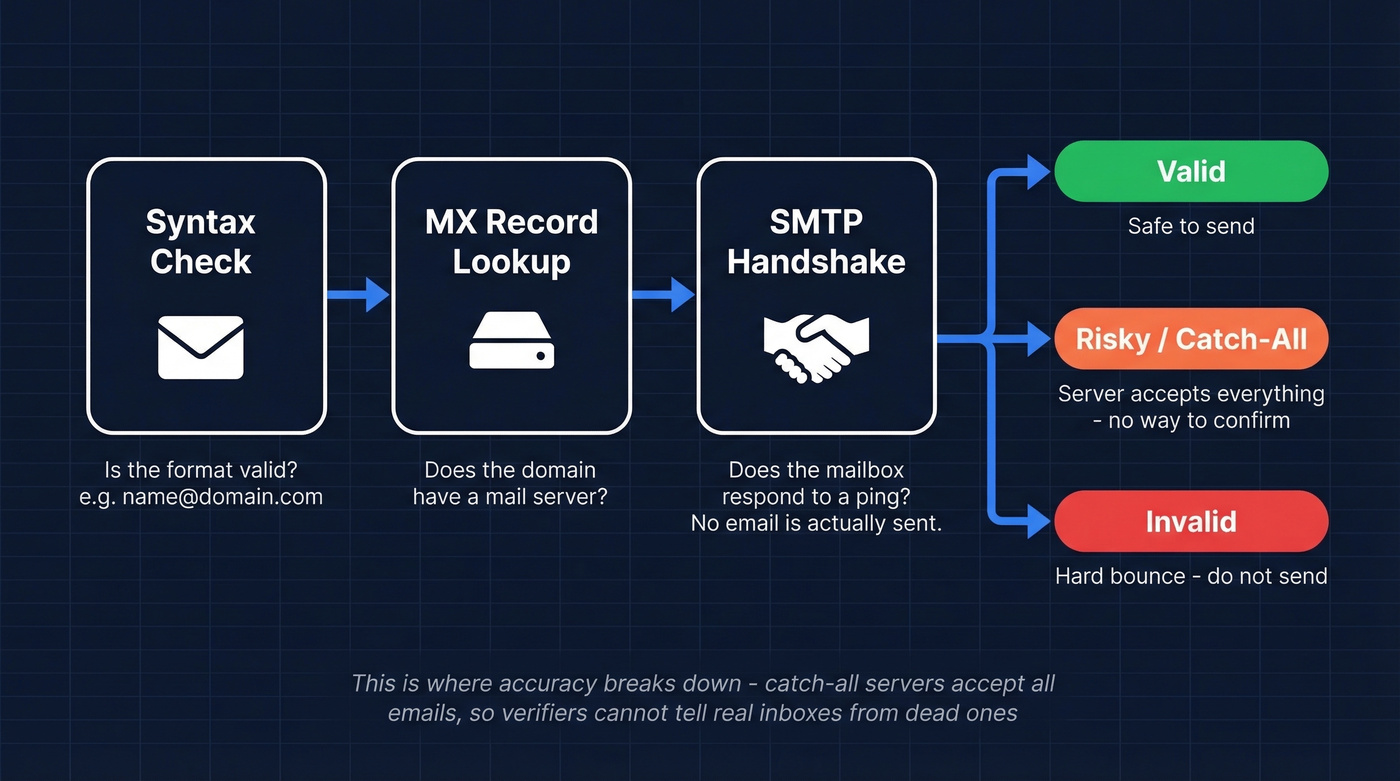
Most free verification tools follow the same basic process. They check email syntax, verify the domain's MX records exist, then initiate an SMTP handshake with the mail server to see if the mailbox responds. None of them actually send an email. That handshake is where accuracy breaks down - catch-all servers accept everything, so the verifier can't tell a real inbox from a dead one.
Every Free Tool Compared
Here's every meaningful free option, honestly assessed.
| Tool | Free Limit | Access | Key Gotcha | Paid Rate |
|---|---|---|---|---|
| ZeroBounce | 100/mo | Signup (business domain required) | No bulk | ~$10/1K |
| QuickEmailVerification | 3,000/mo | Signup, 100 bulk/day | Bulk capped daily | $4/500 |
| Bouncer | 5/day | No signup, no bulk | 100 more on signup | $8/1K |
| Verifalia | 25/day | Signup, bulk OK | Quality modes eat credits | ~$10-15/1K |
| Hunter | 50/mo | No-signup single checks; free plan available | Paid tier is pricey | ~$24.50/1K |
| Mailmeteor | Fair-use | No signup; Sheets add-on | 50/mo in add-on | Free |
| NeverBounce | 3 on-page | Signup; 1,000 credits after demo | Demo-gated free credits | ~$8/1K |
| EmailListVerify | 3 free checks | Signup, no bulk | One-at-a-time only | ~$4/1K |
ZeroBounce
ZeroBounce's free tier is one of the most practical recurring options for light users. You get 100 verifications per month, every month. The catch: signup requires a business or premium domain email - Gmail and Yahoo won't cut it. For anyone verifying a handful of prospects before a targeted outreach push, this is a strong default pick. Paid plans at ~$10 per 1,000 emails are reasonable if you outgrow the free tier.
Bouncer
Bouncer is the fastest way to verify a single email without creating yet another account. Five checks per day, no signup, no friction. Sign up and you unlock 100 more.
Catch-all addresses get flagged as "risky" rather than valid or invalid - which is honest, since no tool can truly confirm those mailboxes exist. For quick one-off checks before sending a high-stakes email, Bouncer is hard to beat.
Verifalia
Verifalia's free plan looks generous at 25 daily credits, but the fine print matters. Credits reset at midnight GMT and don't roll over. The "High" quality mode costs 2 credits per email, and "Extreme" costs 4 - so your effective daily checks drop to 6-12 if you want thorough verification. When credits run out via API, you'll get an HTTP 402 error with no warning. A solid tool for developers who understand the credit mechanics, but frustrating for everyone else.
QuickEmailVerification
One of the most generous free tiers in the space - 3,000 credits per month with 100 bulk verifications per day. If volume matters more than brand name, start here.
Hunter
Skip this if you're price-sensitive. Hunter's paid tier at ~$24.50 per 1,000 emails is roughly 3x what competitors charge. Only worth it if you're already deep in Hunter's ecosystem for email finding.
Mailmeteor
The non-technical user's pick. No signup, no account, fair-use single checks right on the website. The Google Sheets add-on gives you 50 free verifications per month. If you live in spreadsheets and hate dashboards, this is your tool.
NeverBounce
Three free on-page checks at neverbounce.com. Want the 1,000 free credits? You'll need to book and attend a sales demo. Demo-gated free credits in 2026 - that's a choice. Paid plans run ~$8 per 1,000, which is fair, but the onboarding friction is a dealbreaker for self-serve users.
EmailListVerify
Three free checks. That's a product demo, not a free tier. Paid plans are competitive at ~$4 per 1,000, but don't come here expecting to verify anything meaningful for free.

Free verifiers top out at 70% accuracy and still can't handle catch-all domains. Prospeo's email finder runs a 5-step verification - including catch-all handling and spam-trap removal - before you ever see the address. 98% accuracy, 75 free emails/month, no credit card.
Fix bounces at the source instead of cleaning up after them.
How Accurate Are Free Verifiers?
Here's the thing: if your average deal size is under $10K, you probably don't need to obsess over verifier accuracy - you need to obsess over data source quality. But the accuracy data is still worth knowing.
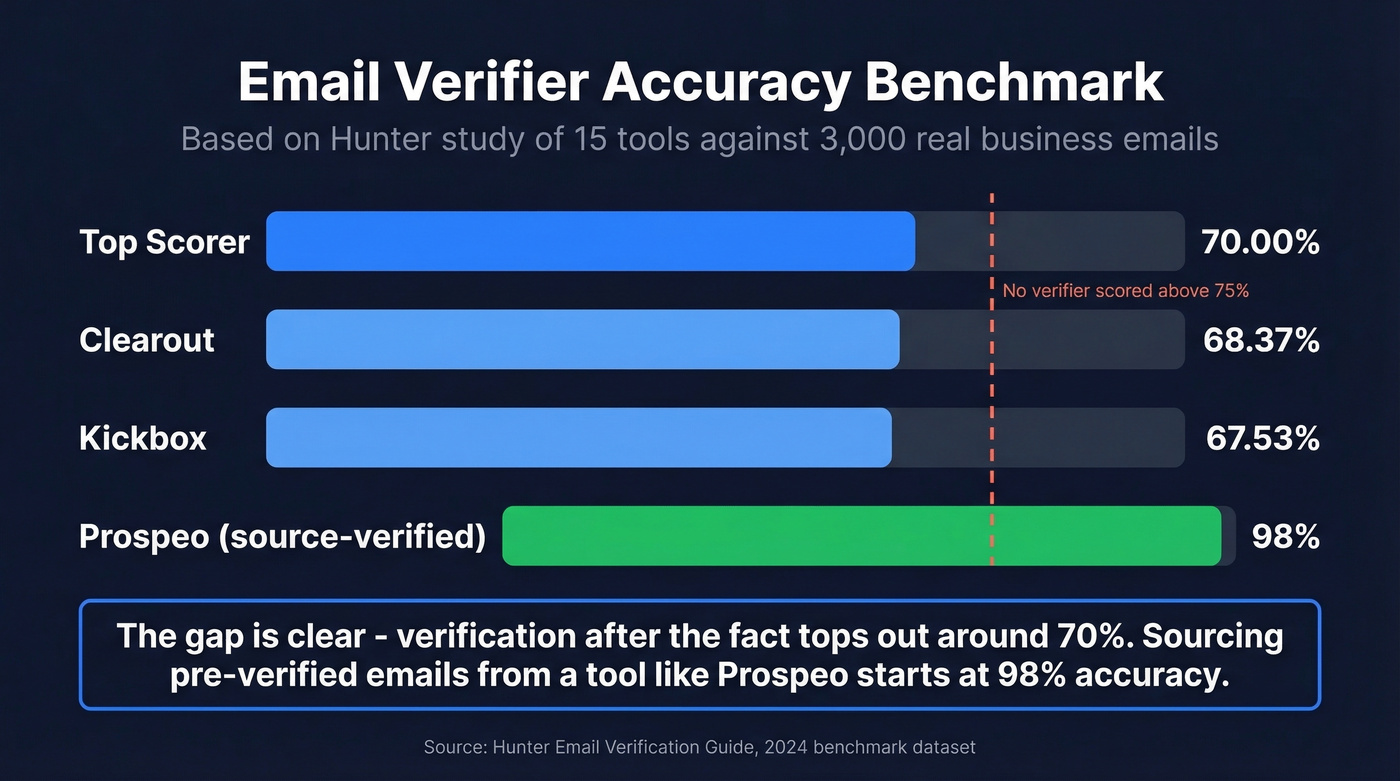
Hunter ran a benchmark of 15 verification tools against 3,000 real business emails. The top accuracy score was 70.00%. Clearout hit 68.37%. Kickbox came in at 67.53%. No verifier scored above 75%. Hunter disclosed that the dataset may slightly favor their own tool, but it's still the most structured public benchmark we've seen.
The benchmark segmented results by company size and found accuracy dropped further on mid-market and enterprise domains with stricter server configurations. The culprit is catch-all and accept-all domains - servers that accept every incoming email regardless of whether the specific mailbox exists, which means the verifier simply can't give you a definitive answer. Any tool claiming 99%+ accuracy on verification is marketing, not math.
The Upstream Fix: Source Verified Emails
If your bounce rate keeps climbing despite running every list through a free verifier, the problem isn't your verifier. It's your data source.
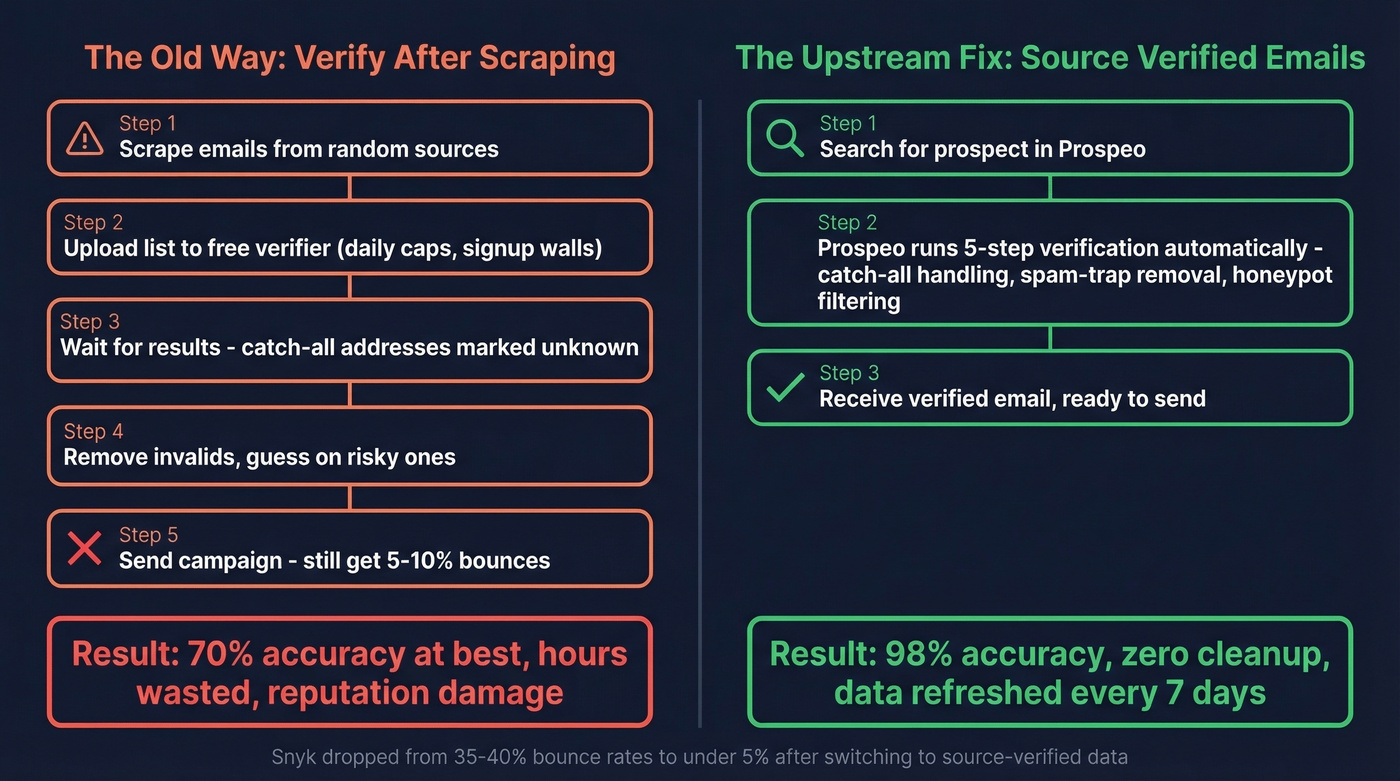
Verification catches bad data after it enters your pipeline. It doesn't prevent it. We've watched teams burn hours cleaning lists that were garbage from the start - that's a workflow problem, not a verification problem. Prospeo's email finder runs a proprietary 5-step verification process with catch-all handling, spam-trap removal, and honeypot filtering before delivering any email address. 98% accuracy out of the box, with data refreshed every 7 days versus the 6-week industry average.
The proof is in the numbers. Snyk's 50-person AE team dropped from 35-40% bounce rates to under 5% after switching their primary data source. Stack Optimize maintains under 3% bounce across all clients with zero domain flags.
How Often Should You Verify?
Email lists decay at roughly 2% per month - that's over 20% per year from job changes, company closures, and mailbox deactivations alone.
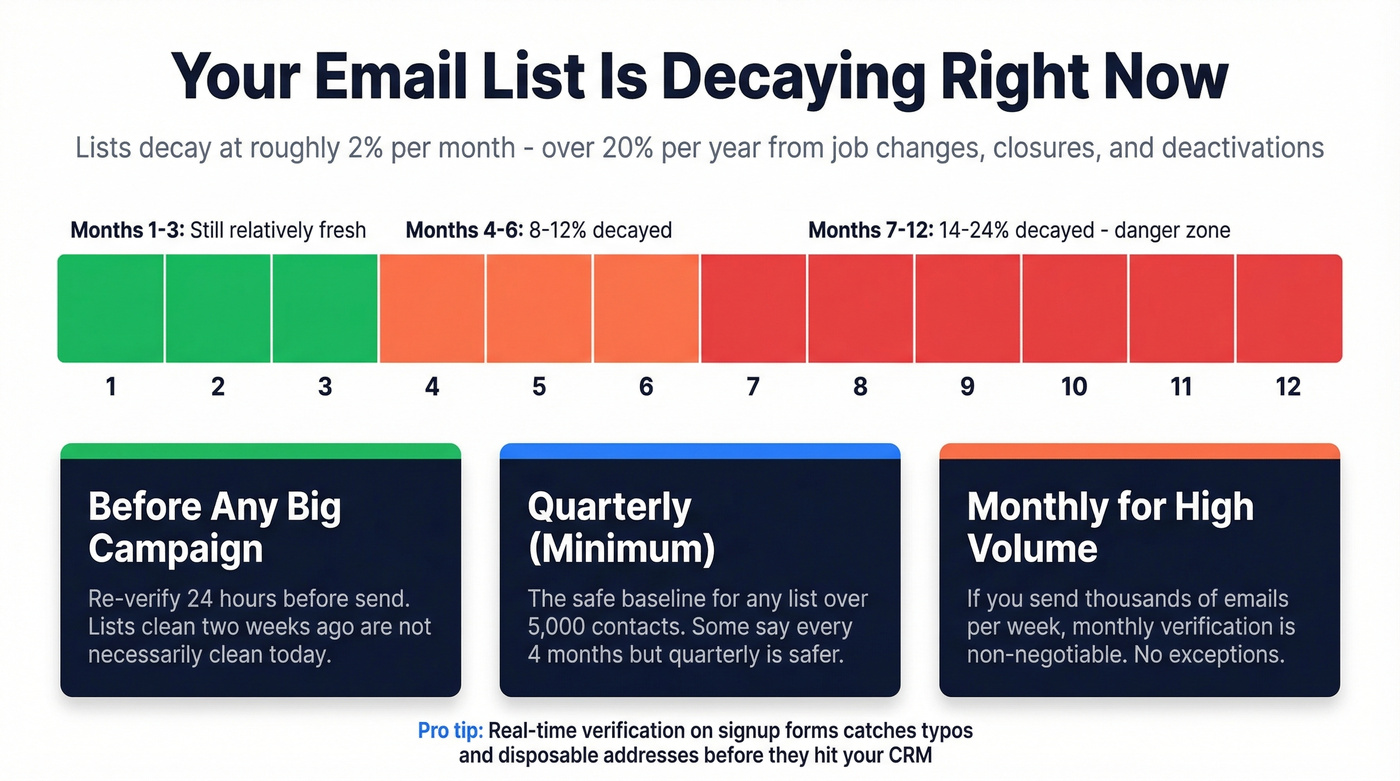
Minimum: verify quarterly. Some practitioners recommend every 4 months as a baseline, but in our experience, quarterly is the safer bet for any list over 5,000 contacts.
High-volume senders: monthly. No exceptions.
Before any major campaign: re-verify 24 hours before send. Lists that were clean two weeks ago aren't necessarily clean today, and a big campaign is exactly the wrong time to find out.
Real-time verification on signup forms is worth the effort too - it catches typos and disposable addresses before they ever hit your CRM. And don't ignore catch-all and disposable addresses. They're the silent bounce killers that free verifiers handle worst.
If bounces are already hurting performance, run an email deliverability audit and check whether you're triggering 550 High Probability of Spam issues.
You're spending hours stitching together free tools with daily caps and signup walls to verify emails that were bad from the start. Prospeo delivers pre-verified emails at $0.01 each with a 7-day data refresh cycle - so the addresses are accurate when you hit send, not just when you found them.
Ditch the verification treadmill. Start with clean data.
FAQ
What's a good email bounce rate?
Below 2% total is healthy for any outbound or marketing campaign. Between 2-5% signals list quality issues. Above 5% risks your sender reputation and inbox placement. Industry averages vary - ecommerce sits around 0.19%, IT and software at 0.90%, and construction as high as 2.20%.
Why do different verifiers give different results?
Catch-all and accept-all domains are the main culprit. These servers accept all incoming mail regardless of whether the specific mailbox exists, so verifiers can't confirm validity. Greylisting and anti-tarpit delays also cause inconsistencies between tools running checks at different times.
Can I avoid bounces without a verification tool?
Yes - source emails from a provider that verifies before delivery. That's the whole point of the upstream approach. You get clean data from the start instead of cleaning dirty data after the fact. It's a fundamentally different workflow, and for teams doing consistent outbound, it saves hours every week.
Is there a free bulk email bounce checker?
QuickEmailVerification offers 3,000 free credits per month with up to 100 bulk verifications per day - the most generous free bulk option available. Verifalia also supports bulk uploads on its free plan at 25 credits per day. For larger lists, paid tools like EmailListVerify start at ~$4 per 1,000 emails.