

Chief Sales Officer vs VP of Sales: Different Floors, Same Building
Your board just told you to hire a CSO. You have 30 employees and one product line. That's like hiring a four-star general to lead a platoon - impressive title, wrong job. Title inflation in sales leadership is rampant, and confusing the chief sales officer vs VP of sales distinction wastes money, creates org chart chaos, and frustrates the person you hire.
The 30-second verdict: A VP of Sales owns quarterly execution - quota, pipeline, reps. A CSO owns multi-year sales strategy - TAM penetration, new markets, P&L influence. If you're running a single motion with one sales leader, you usually need a VP. If you have multiple segments, multiple VPs, and board-level sales strategy conversations, you need a CSO. They're not interchangeable titles. They're different jobs.
The Core Difference
The VP of Sales is an operational leader. Their world is the current fiscal year, broken into quarters. They're measured on whether reps hit number, whether pipeline coverage is 3x or 4x, and whether deal velocity is improving. They execute the GTM playbook.
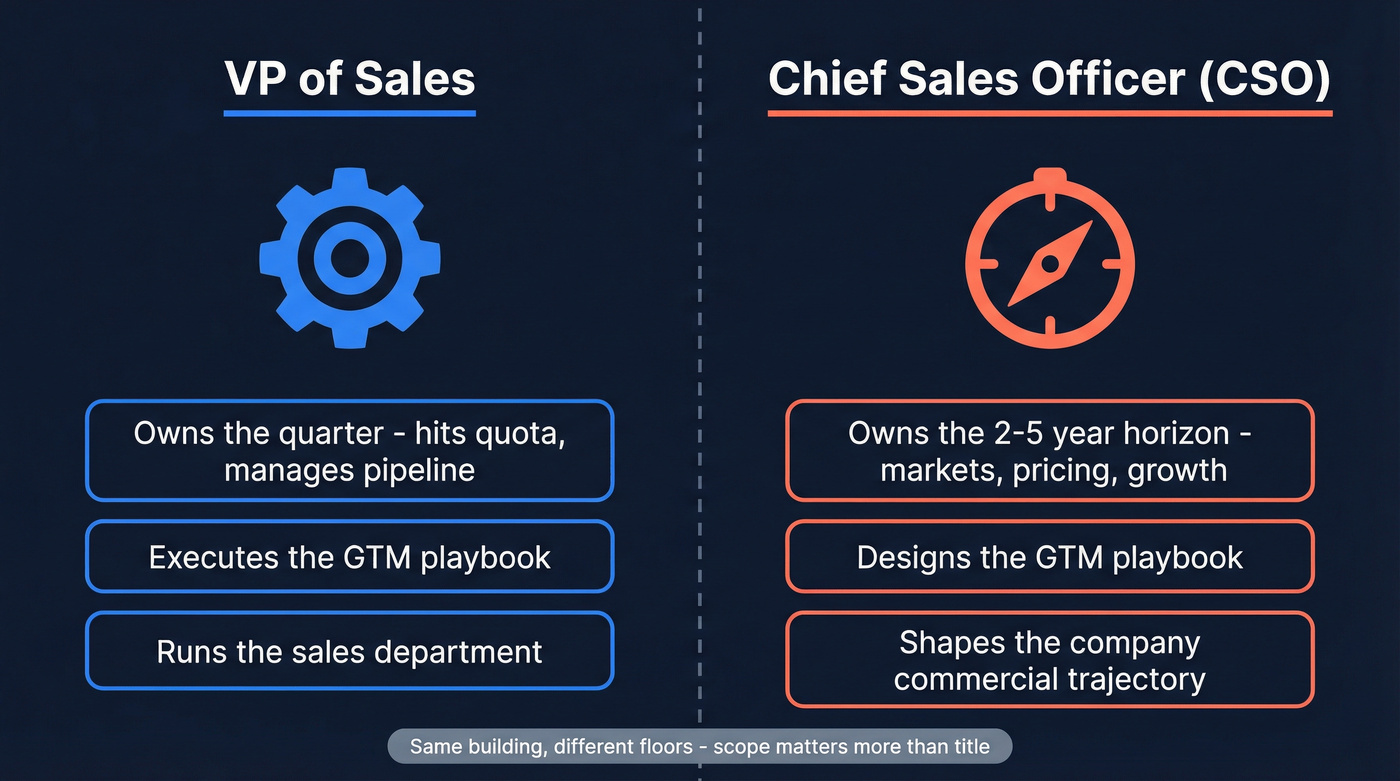
The CSO is a corporate strategist. Their horizon is two to five years. They're asking "Should we enter APAC?" and "Do we need a channel program?" and "Is our pricing model right for the next phase of growth?" They design the go-to-market strategy playbook.
The market still hasn't standardized where CSO ends and CRO begins - which is exactly why scope matters more than the three letters on someone's business card. One builds the engine. The other decides which road to drive on. They're not even the same job family.
Responsibilities and KPIs
Here's where the gap becomes concrete:
| Dimension | VP of Sales | CSO |
|---|---|---|
| Time horizon | Quarterly / current FY | 2-5 years |
| Core KPIs | Quota, pipeline, deal size, cycle time | TAM, CAC:LTV, YoY growth, market share |
| Budget scope | Dept budget (comp, T&E, tools) | P&L influence across pricing, markets, M&A |
| Team scope | Reps, managers, directors | Multiple VPs across segments |
| Cross-functional | Collaborates with marketing/CS | Drives alignment across all GTM |
| Strategy | Executes GTM playbook | Designs GTM playbook |
| Board role | Presents forecast | Owns revenue narrative |
The VP's world is the sales department. The CSO's world is the company's commercial trajectory. A VP worries about whether Q3 pipeline is soft. A CSO worries about whether the company is selling into the right markets at all.
When a company has multiple products or divisions - say, a SaaS platform selling to both SMB and enterprise - the CSO oversees differentiated sales strategies and the VPs who run each. That multi-segment complexity is the clearest trigger for the CSO role.
Reporting Structure
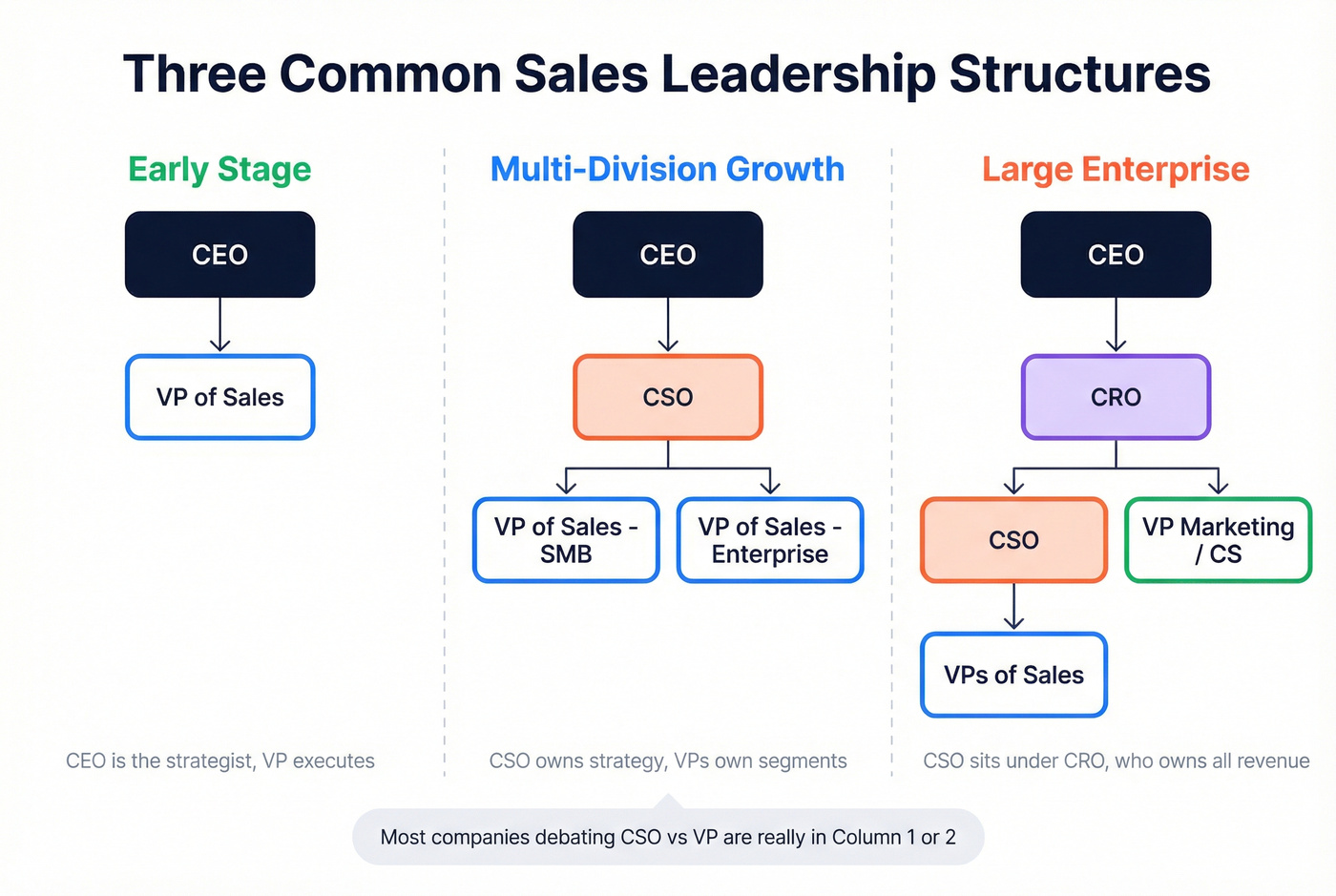
Three common structures, depending on company stage:
- Early stage: VP of Sales reports to CEO. No CSO needed. The CEO is effectively the chief strategist.
- Multi-division growth: CSO reports to CEO, with multiple VPs reporting to the CSO. This is the classic CSO structure.
- Large enterprise with CRO: CSO reports to CRO, who reports to CEO. When both roles exist, the CSO typically sits under the CRO, who owns the broader revenue org including marketing and customer success.
Most companies don't need the third structure. If you're debating it, you probably don't need it yet.
Compensation in 2026
Money clarifies titles faster than org charts do. Only about 55% of executive sales postings disclose pay, which is why benchmarks vary so widely - but here's what the market looks like:
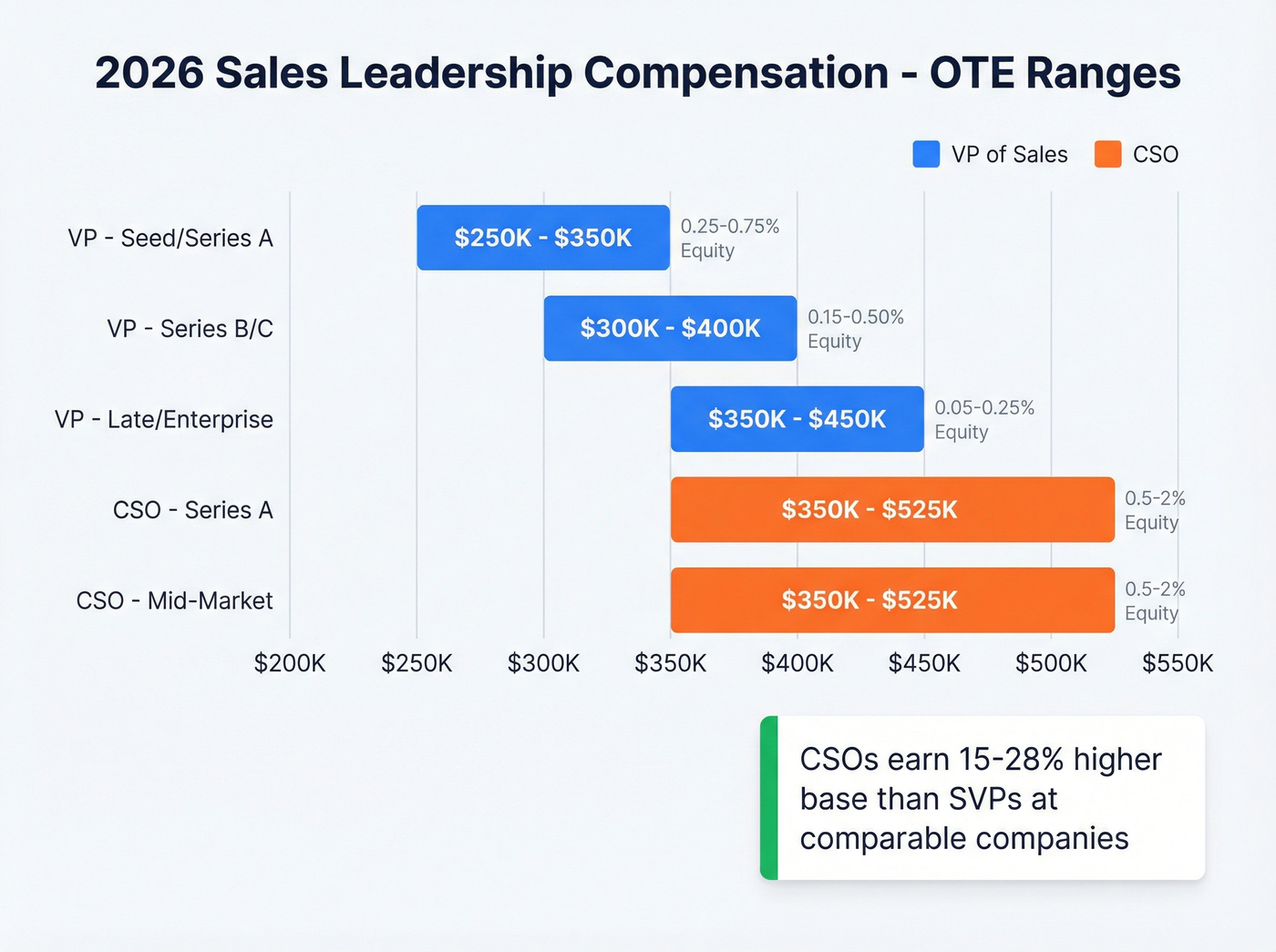
| Role / Stage | Base Salary | OTE | Equity |
|---|---|---|---|
| VP - Seed/A | $140K-$180K | $250K-$350K | 0.25%-0.75% |
| VP - Series B/C | $180K-$220K | $300K-$400K | 0.15%-0.50% |
| VP - Late/Enterprise | $220K-$300K+ | $350K-$450K | 0.05%-0.25% |
| CSO - Series A | $185K-$230K | $350K-$525K | 0.5%-2% |
| CSO - Mid-Market | $230K-$340K | $350K-$525K | 0.5%-2% |
| Fractional CSO | $210-$360/hr | N/A | N/A |
CSO salaries run 15-28% higher than SVP of Sales at comparable companies. The equity gap is even wider - CSO equity is typically 0.5%-2%, versus 0.25%-0.75% for a VP.
The standard base-to-variable split for both roles is 60/40 or 70/30. Anything with variable above 60% feels aggressive for candidates at this level, and you'll lose good people in the offer stage. A dataset of 1,349 executive sales postings with disclosed pay shows an average VP base of $167K-$251K, with San Francisco pushing that to $244K-$347K and remote roles averaging $152K-$217K.
Here's the thing: if you're a VP being offered a CSO title without a comp bump, you're getting a title change, not a promotion. The CSO premium exists because the scope is genuinely larger.
The fractional CSO option is worth considering as a bridge. You get the strategic thinking without the full-time compensation package - useful when you need guidance on market entry or pricing architecture but can't justify another C-suite salary.

Your new VP of Sales will be measured on pipeline and quota from day one. Give them a database with 300M+ profiles, 30+ filters including buyer intent and technographics, and 98% verified email accuracy - so they spend time closing, not cleaning data.
Arm your sales leader with data that actually connects to real buyers.
When to Hire Each Role
Hire a Head of Sales if you're under $5M ARR. You need a player-coach who closes deals and builds the first repeatable process.
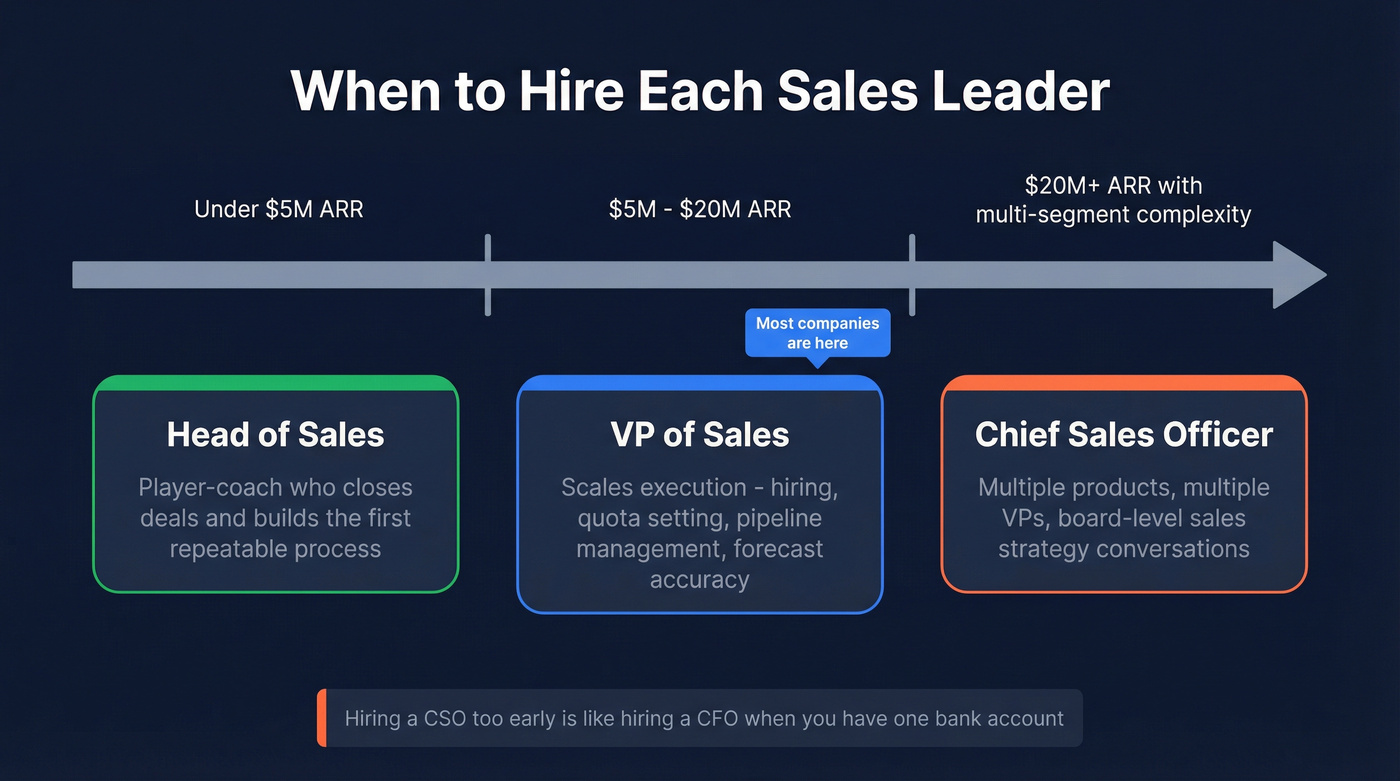
Hire a VP of Sales between $5M and $20M ARR. You've got product-market fit, a growing team, and you need someone to scale execution - hiring, quota setting, pipeline management, forecast accuracy. This is where most companies are when they start Googling "chief sales officer vs VP of sales," and the answer is almost always VP.
Hire a CSO when you have multi-segment complexity: multiple products, multiple buyer personas, and multiple VPs who need strategic alignment. The CSO becomes necessary when sales strategy is a board-level conversation, not just a department function.
Hiring one too early is like hiring a CFO when you have one bank account. When you're still running a single sales motion under $15M ARR, you don't need C-suite territory and channel strategy. You need someone who can carry a bag and build a team simultaneously.
Qualities That Separate CSOs from VPs
One of the hardest jumps in sales leadership is moving from a VP-style "own the quarter" mindset into a role that demands true cross-functional ownership. Suddenly you're responsible for customer success metrics, channel strategy, and RevOps infrastructure - not just the number.
The qualities boards look for in a chief sales officer go well beyond quota attainment: strategic vision across multiple market segments, the ability to influence pricing and product decisions, comfort presenting a multi-year revenue narrative to investors, and the executive presence to align cross-functional leaders who don't report to them. A VP who only speaks the language of pipeline coverage and close rates will struggle in the CSO seat.
Let's be honest - we've watched strong VPs flame out in CSO roles because nobody told them the job was different. If you're a VP eyeing that seat, start owning customer success metrics and pricing strategy conversations now. Get deep on CRM strategy too - CSOs with CRM expertise command a 12-22% premium. Volunteer for the cross-functional projects nobody wants. The CSO role isn't "VP with a better title." It's a fundamentally different skill set.
Where the CRO Fits In
The CRO owns the entire revenue org: sales, marketing, customer success, and revenue operations. Some companies have both a CSO and a CRO - in that structure, the CSO reports to the CRO and focuses purely on the sales function while the CRO aligns all customer-facing teams.
The title landscape is fragmenting fast. Russell Reynolds now groups sales officers, revenue officers, commercial officers, and growth officers under a single "Customer Activation and Growth" umbrella, and 14% of US firms already have a Chief Growth Officer. The alphabet soup keeps thickening - what matters is the scope of the role, not the acronym on the business card.
Our take: Most companies debating CSO vs VP of Sales are really debating whether they've outgrown founder-led sales strategy. If the CEO is still the one deciding which markets to enter, you don't need a CSO - you need a VP who executes brilliantly while the CEO retains strategic control. The CSO hire only makes sense when the CEO genuinely wants to hand off that strategic ownership.
Set Your New Leader Up for Day One
Whether you hire a VP or a CSO, their first priority is pipeline. We've seen new sales leaders burn 6-8 weeks cleaning CRM data before making a single strategic outbound call. Bad contact data is the silent killer of a new leader's momentum - and it's the most fixable problem on the list.
Give them clean, verified prospect data from day one. Prospeo's database covers 300M+ professional profiles with 98% email accuracy and a 7-day refresh cycle, so your new hire is building pipeline in week one instead of filing Salesforce tickets about bounced emails and disconnected numbers.
If you want a tighter outbound motion, start with sales prospecting techniques and a clean list-building workflow.
A CSO designing multi-segment GTM strategy needs accurate TAM data across markets. Prospeo's 7-day refresh cycle, 125M+ verified mobiles, and intent signals across 15,000 topics give your leadership team the foundation to enter new segments with confidence - at $0.01 per email.
Enterprise-grade sales data without the enterprise contract. Start free today.
FAQ
Is a CSO higher than a VP of Sales?
Yes. The CSO is a C-suite executive who typically oversees multiple VPs and owns multi-year revenue strategy. The comp gap - 15-28% higher base for CSOs - reflects this broader scope and board-level accountability.
Can a company have both a CSO and a VP of Sales?
Most companies with a CSO do. The CSO sets multi-year strategy and owns the board narrative. The VP executes quarterly targets and manages the team. They're complementary, not redundant - one designs the playbook, the other runs it.
What tools does a new sales leader need on day one?
A CRM like Salesforce or HubSpot, a B2B data platform for verified prospect data, a sales engagement tool like Outreach or Salesloft, and a forecasting system. Clean contact data is the highest-leverage first investment - bad data costs new leaders 6-8 weeks of ramp time.
When should a startup hire a CSO instead of a VP?
Hire a CSO once you exceed $20M ARR with multiple product lines, buyer segments, or geographic markets requiring differentiated strategies. Below that threshold, a strong VP of Sales reporting directly to the CEO covers both execution and strategy more efficiently.