

Clickbait Email Subject Lines: Curiosity Without Deception
You've copied 50 subject line templates from a blog post, pasted them into your email platform, and watched your open rates stay exactly the same. The templates weren't the problem - the missing strategy was.
Clickbait email subject lines aren't the enemy. Lazy ones are.
The average professional gets about 120 emails a day. Your subject line gets a split-second of attention before the thumb scrolls past. 47% of recipients decide to open based on the subject line alone, and 69% will mark you as spam based on that same line. So the instinct to reach for something provocative makes sense. The real question is whether you can wield curiosity without torching trust.
Why Curiosity-Driven Subject Lines Work
Curiosity isn't a marketing trick - it's neurochemistry. When you encounter a gap in your knowledge, your brain's reward system activates. The open is the dopamine hit that closes the gap. "The one metric we stopped tracking" outperforms "Our Q1 analytics update" because the first creates tension and the second creates nothing.
Loss aversion amplifies this. "Don't miss" consistently outperforms "Check out" because people are wired to avoid losing something more than they desire gaining it. Add social proof and lines like "Why 2,000 founders switched this quarter" drive opens that generic alternatives can't touch.
Here's the benchmark most articles won't give you: MailerLite's 2026 data across 3.6M campaigns shows a 43.46% median open rate and 2.09% click rate. E-commerce sits lower at 32.67% opens; non-profits run hot at 52.38%. If you're beating your industry median on clicks, your subject lines are working. If not, keep reading.
Curiosity Gap vs. Deception
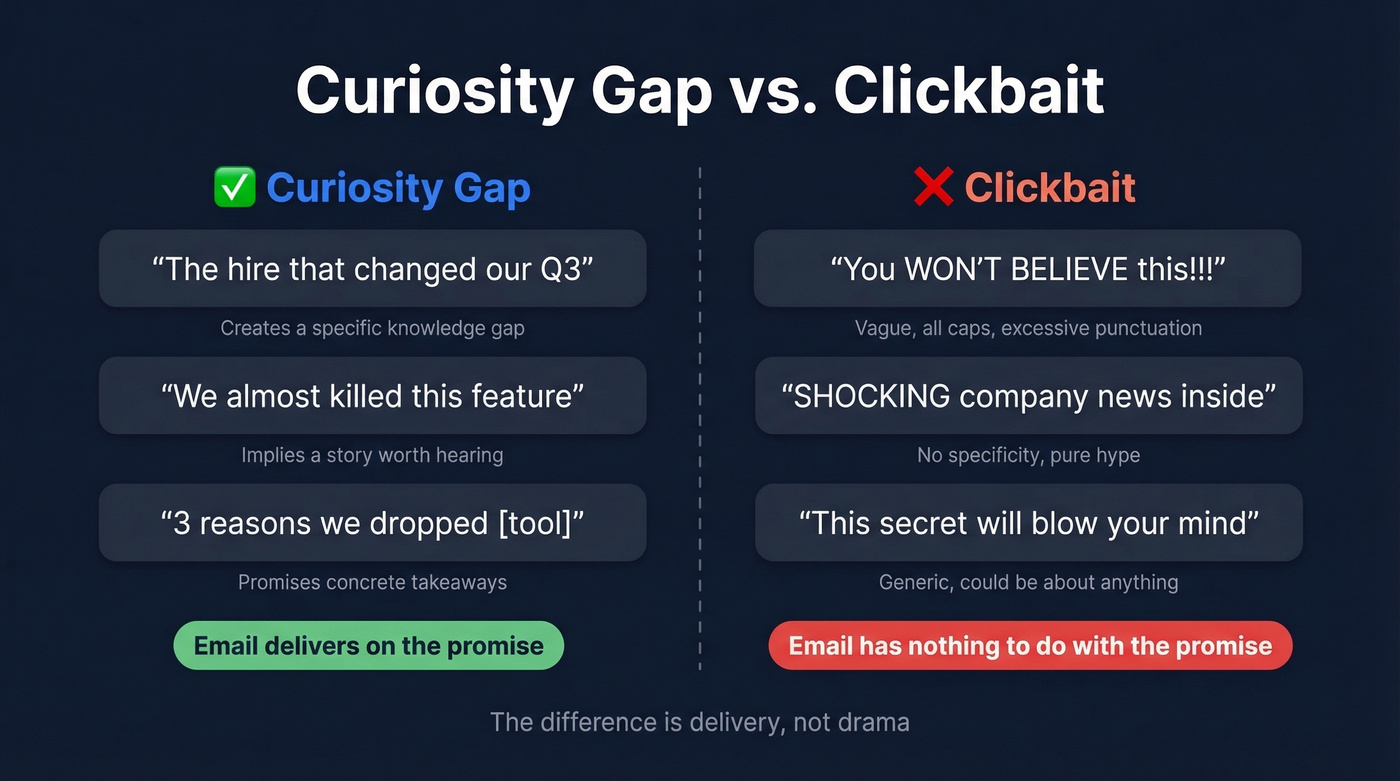
A curiosity gap is a teaser paired with delivery - the email answers the question the subject line raises. Clickbait is exaggeration paired with mismatch - the email has nothing to do with the promise. The MailerStack framework puts it simply: if the content is "nothing like described," you've crossed from curiosity into deception.
Curiosity tactics work best on segmented lists. What intrigues a paying customer will annoy a cold lead. Segment first, then write the hook.
Your preheader text is the second lever - it's the line visible right after the subject in most inboxes, and most marketers leave it as the default first sentence of the email body. We've tested preheader optimization across dozens of B2B campaigns, and it's the single most underused lever in email marketing. Use it to deepen the curiosity gap without giving away the answer.
| Curiosity Gap | Clickbait |
|---|---|
| "The hire that changed our Q3" | "You WON'T BELIEVE this!!!" |
| "We almost killed this feature" | "SHOCKING company news inside" |
| "3 reasons we dropped [tool]" | "This secret will blow your mind" |
The left column makes you want to know more. The right column makes you want to unsubscribe.
Subject Lines That Actually Get Clicks
Six to ten words tends to perform best. Aim for around 50 characters so your subject line doesn't get chopped in the inbox - on mobile, many clients only show 30-40 characters, and roughly 70% of emails are opened on phones. Here are templates organized by the psychological lever they pull, with a Clickbait Score from 1 (mild curiosity) to 5 (deceptive) so you can calibrate.
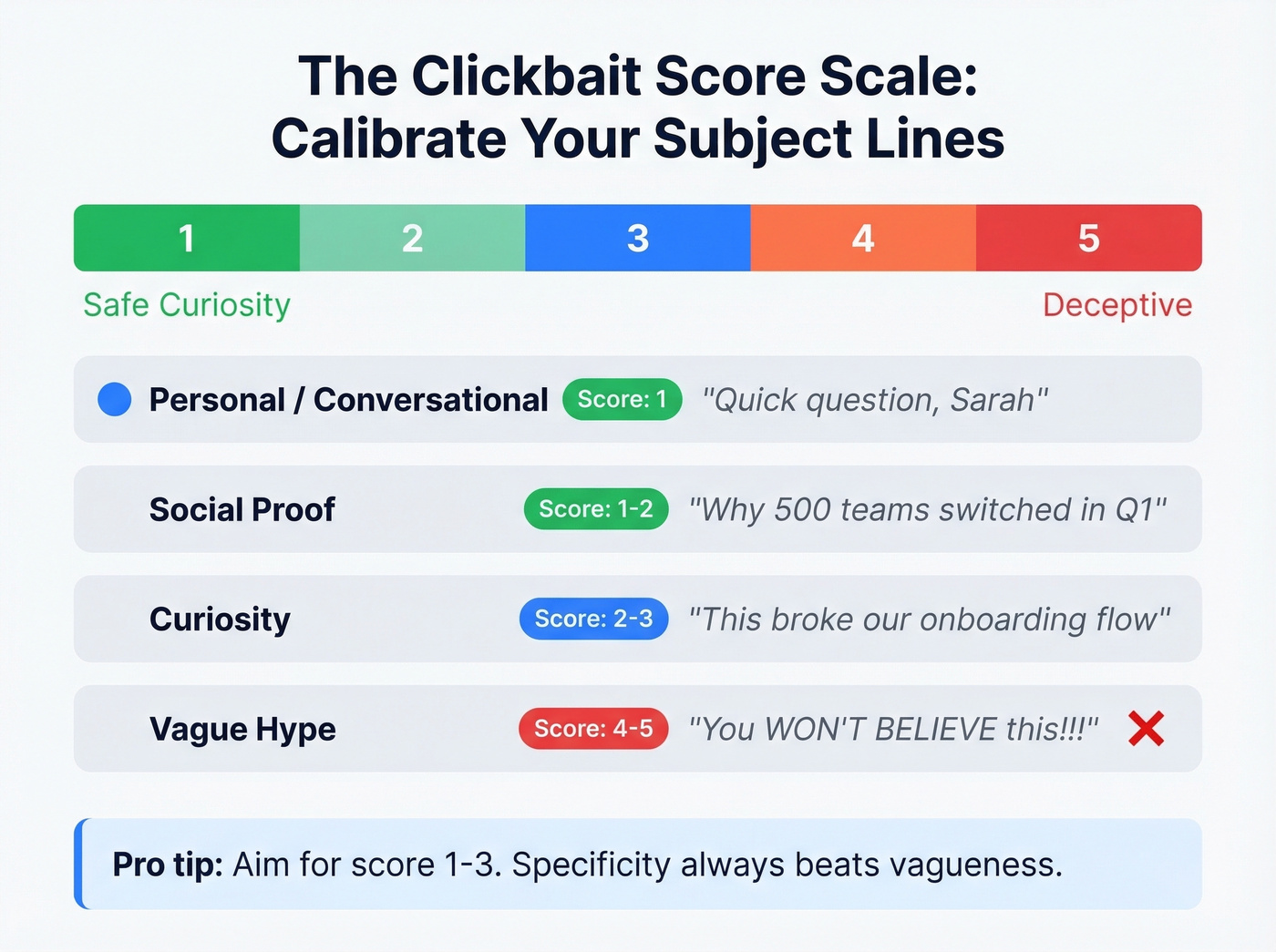
Curiosity (Score: 2-3):
- "The one thing we'd change about [process]"
- "We almost didn't send this"
- "This broke our onboarding flow"
- "What nobody tells you about [topic]"
Urgency - specific, not generic (Score: 1-2):
- "48 hours left: [specific thing]"
- "Enrollment closes Friday at 5pm"
- "Last batch ships tomorrow"
Social proof subject lines sit at a Clickbait Score of 1-2. They're the safest curiosity play because they promise a concrete story: "Why 500 teams switched in Q1," "The playbook [Company] used to hit $10M," or "How [Name] cut churn by 40%." The specificity does the heavy lifting. Vague social proof ("Everyone's talking about this!") jumps to a 4.
The personal / conversational pattern is one of the best performers we've seen across B2B campaigns. "Quick question, [name]" or "Thought of you when I saw this" - these read like a colleague wrote them, not a marketing team. A practitioner analysis of 2,500+ subject lines on r/DigitalMarketing found the same thing: conversational subject lines consistently win. Clickbait Score: 1 - curiosity through intimacy rather than exaggeration.
Specificity always beats vagueness. "3 Reasons You Need a New Leather Bag" outperforms "You Won't Believe This" because the first makes a clear promise and the second could be about literally anything. The reader knows it.
If you want more swipeable options, pull from these email subject line examples and adapt them to your audience.

A perfect subject line means nothing if it bounces. Prospeo's 98% email accuracy and 7-day data refresh ensure every clever hook you write actually lands in a real inbox - not a dead address that tanks your sender reputation.
Stop crafting subject lines for email addresses that don't exist.
Before/After Rewrites
This is where theory becomes practice.
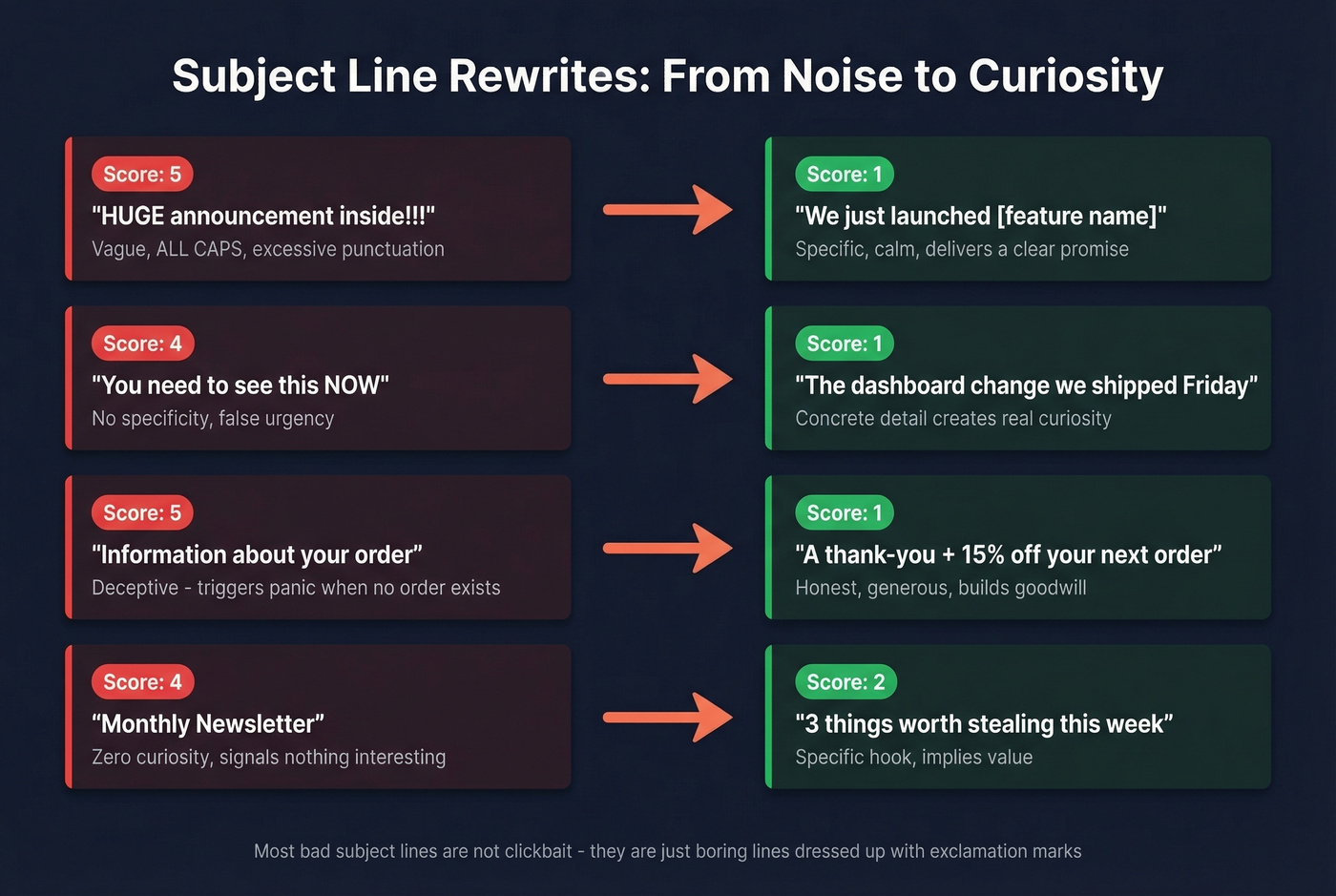
| Before (Score: 4-5) | Problem | After (Score: 1-2) |
|---|---|---|
| "HUGE announcement inside!!!" | Vague + ALL CAPS + punctuation | "We just launched [feature name]" |
| "You need to see this NOW" | No specificity, false urgency | "The dashboard change we shipped Friday" |
| "Information about your order" (no order exists) | Deceptive - triggers panic | "A thank-you + 15% off your next order" |
| "Monthly Newsletter" | Zero curiosity | "3 things worth stealing this week" |
| "Don't miss this opportunity" | Generic loss aversion | "Applications close Thursday at noon" |
Here's the thing: most "clickbait" subject lines aren't clickbait at all - they're just boring lines dressed up with exclamation marks. Real clickbait requires a genuine information gap. If you can't articulate what gap your subject line creates, you don't have clickbait. You have noise.
Real Brand Examples
Marks & Spencer sent an email with the subject line "Your annual leave request." It had nothing to do with HR - it was a promotional campaign. But the sheer novelty of seeing that in a retail inbox drove massive opens. It worked because it was unexpected and the brand had enough goodwill to absorb the mismatch. Clickbait Score: 4, but earned through brand equity most of us don't have.
Pergola on the Wharf went with "TEST" - a subject line that looks like someone accidentally hit send on a draft. The intrigue of a possible mistake drove opens. Smart, and low-risk for a restaurant brand.
Then there's Lux Skin, which sent "Information about your order" to people who hadn't placed an order. The email pushed a promo code. That's not clever - it's deceptive. It triggers panic, erodes trust, and trains recipients to ignore your future emails. Clickbait Score: 5. Skip this approach entirely.
Subject Lines That Backfire
Certain signals reliably increase spam risk, no matter how clever the copy.
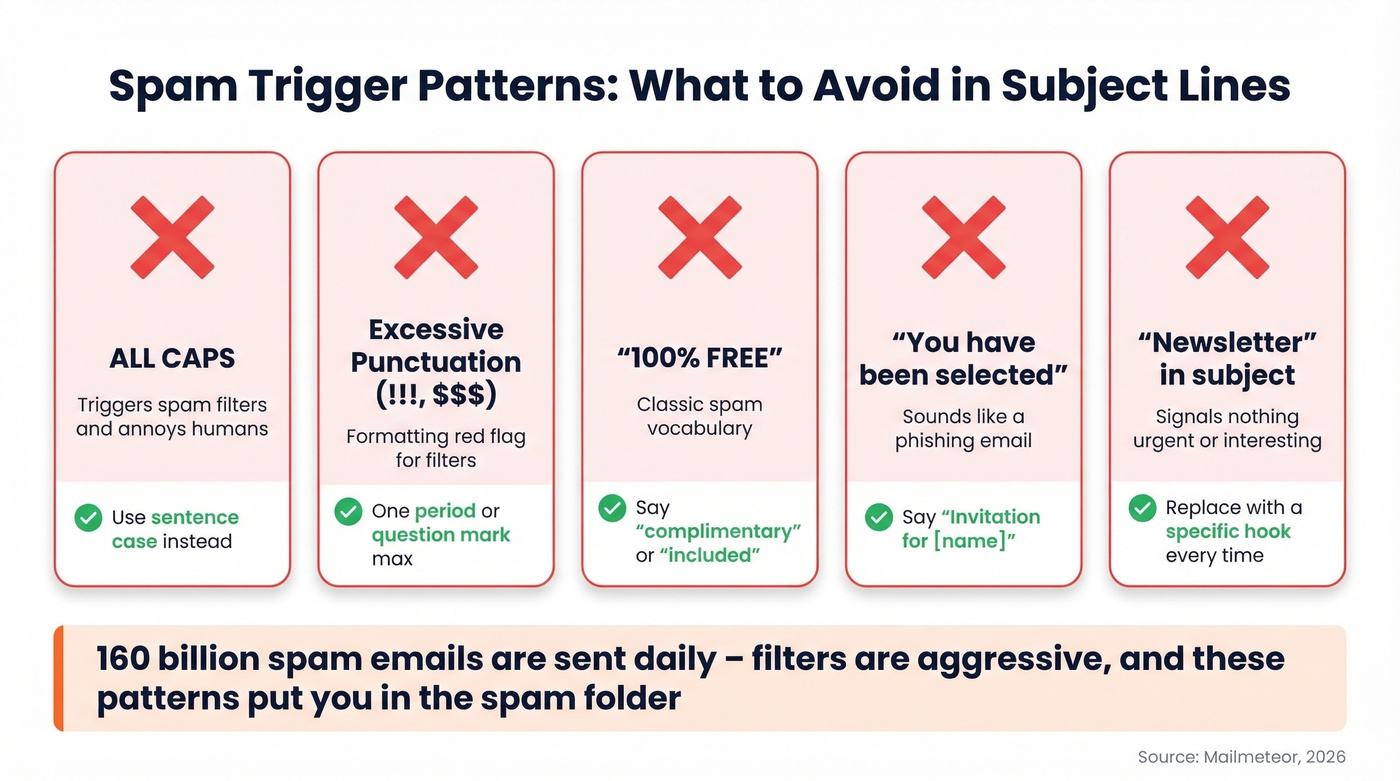
| High-Risk Pattern | Say This Instead |
|---|---|
| "LAST CHANCE!!!" | "Enrollment closes Thursday" |
| "100% FREE" | "Complimentary" or "Included" |
| "You've been selected" | "Invitation for [name]" |
| "Act immediately" | "Worth a look this week" |
| "Monthly Newsletter" | "3 things worth reading this week" |
ALL CAPS is shouting at a networking event. Spam filters hate it, and so do humans. Excessive punctuation (!!!, $$$) is a formatting red flag that triggers both automated filters and human skepticism.
"Newsletter" in the subject line deserves its own warning. That same r/DigitalMarketing analysis found it's one of the fastest ways to get ignored - the word signals "nothing urgent, nothing interesting, delete later." Replace it with a specific hook every time.
On the technical side, SPF, DKIM, and DMARC authentication are table stakes. Without them, even a perfect subject line won't save you from the spam folder. If you need a checklist, start with this email deliverability guide and then tighten DMARC alignment. With 160 billion spam emails sent daily, filters are aggressive - and they should be.
Deliverability isn't just about subject lines, though. If you're emailing unverified addresses, bounce rates tank sender reputation before anyone sees your copy. We've watched teams obsess over A/B testing subject lines while 15% of their list was bouncing - that's like tuning a race car engine while the tires are flat. Prospeo's real-time email verification catches bad addresses before they hit your sending infrastructure, so your open rate reflects your copywriting, not bad data. If you’re diagnosing issues, start by tracking your email bounce rate and then improve sender reputation.

How to Test and Measure
A/B testing subject lines sounds simple. Most teams do it wrong.
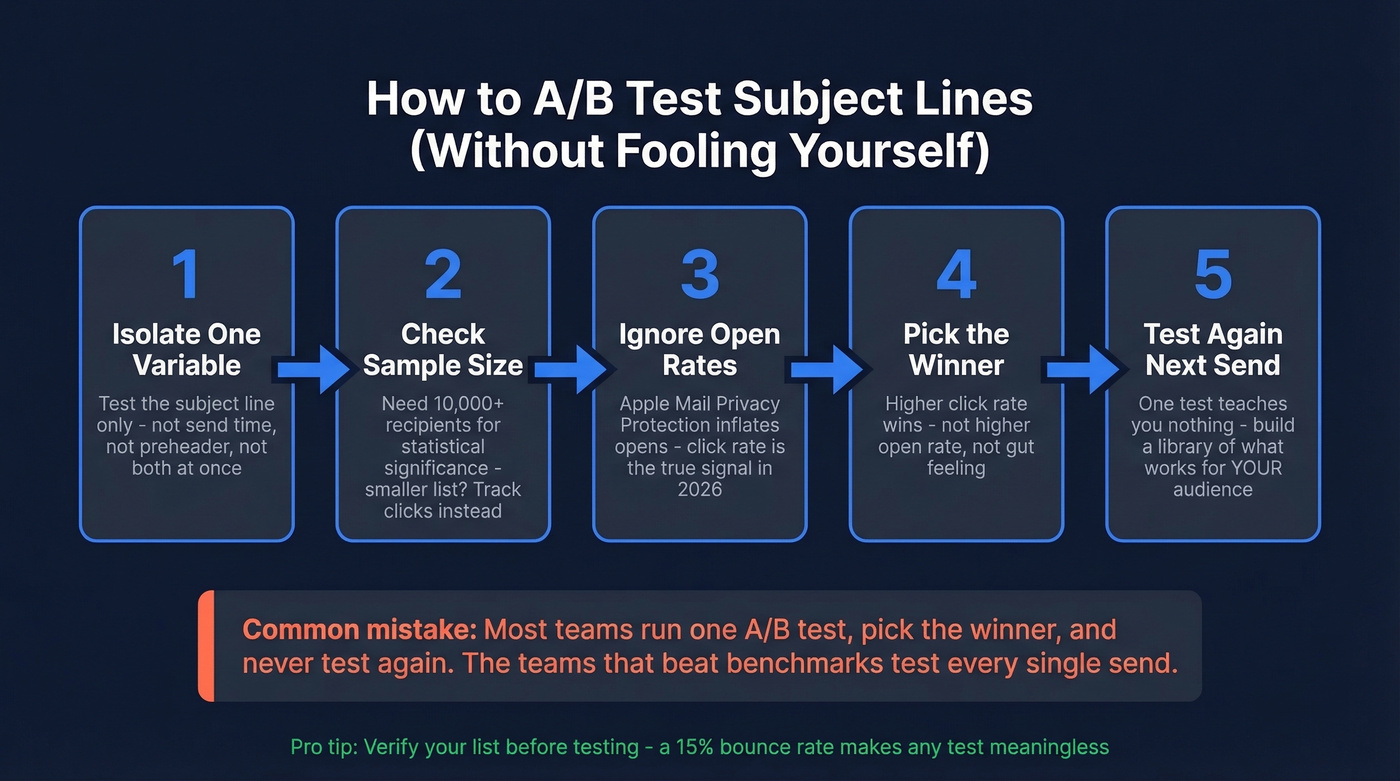
One variable at a time. Test the subject line, not the subject line plus the send time plus the preheader. Isolate the variable or you learn nothing.
Sample size matters. Litmus recommends 10,000+ recipients for statistically meaningful results. Smaller list? Track clicks and replies instead - they're more reliable signals at low volume.
Apple Mail Privacy Protection inflates open rates. MPP pre-loads tracking pixels, so your "45% open rate" is probably fiction. Click rate is the truer signal in 2026. If your team is still reporting open rates as gospel, it's time for a conversation about what you're actually measuring. (If you want to standardize reporting, use a consistent click rate formula in email marketing.)
Let's be honest about the testing cycle: most teams run one A/B test, pick the winner, and never test again. The teams that consistently beat benchmarks test every send. They build a library of what works for their audience - not someone else's audience - and iterate on it weekly.
You've nailed the curiosity gap. Now make sure you're sending to decision-makers who care. Prospeo gives you 300M+ verified contacts with 30+ filters - buyer intent, job changes, tech stack - so your best subject lines reach the right people.
Great copy deserves a great list. Build yours in minutes.
FAQ
Do clickbait email subject lines increase spam complaints?
Only when the email doesn't deliver on the promise. A subject line that creates intrigue paired with content that satisfies it won't spike complaints. A line that implies urgency about a nonexistent order will. Keep content aligned with the subject and complaint rates stay near zero.
What's a good email open rate in 2026?
MailerLite's benchmark across 3.6M campaigns is a 43.46% median open rate, but Apple MPP inflates this significantly. Focus on click rate - 2.09% median - as the truer engagement signal. Software companies should target around 39% opens; e-commerce closer to 33%.
Does list quality affect subject line performance?
Absolutely. If a big chunk of your list has invalid addresses, bounces destroy sender reputation and push future emails to spam - no subject line can fix that. Clean your list before you optimize your copy, or you're measuring noise instead of signal.