

Clodura.AI vs Lusha: Which B2B Data Tool Is Actually Worth It?
If your SDRs are burning through Lusha credits by Wednesday, you already know the problem. Most Clodura.AI vs Lusha comparisons are thinly veiled affiliate content that won't help you fix it. Here's what the data actually says - and where both tools fall short.
30-Second Verdict
Pick Lusha if you need fast, compliant contact lookups and your team is small enough that credit limits don't sting.
Pick Clodura.AI if you want sequences, calling, and intent triggers in one platform and can invest time in onboarding.
Feature Snapshot
| Feature | Clodura.AI | Lusha | Winner |
|---|---|---|---|
| G2 Rating | 4.5/5 (301 reviews) | 4.3/5 (1,619 reviews) | Lusha (~5x the review base) |
| Database | 600M+ contacts | 100M+ profiles, 60M+ emails, 50M+ dials | Clodura (raw size) |
| Free Tier | 100 credits (one-time) | Up to 70 credits/month | Lusha (monthly refresh) |
| Paid Starting Price | $99/mo | From ~$22-$30/user/mo (annual) | Depends on team size |
| Compliance | Not prominently highlighted | GDPR, CCPA, ISO 27701, SOC 2 | Lusha |
| Built-in Sequences | Yes (+ AI writer, call disposition) | No | Clodura |
| Chrome Extension | Basic | Fast reveals from profiles and company sites | Lusha |
| Intent Data | Trigger-based | Bombora-powered | Lusha |
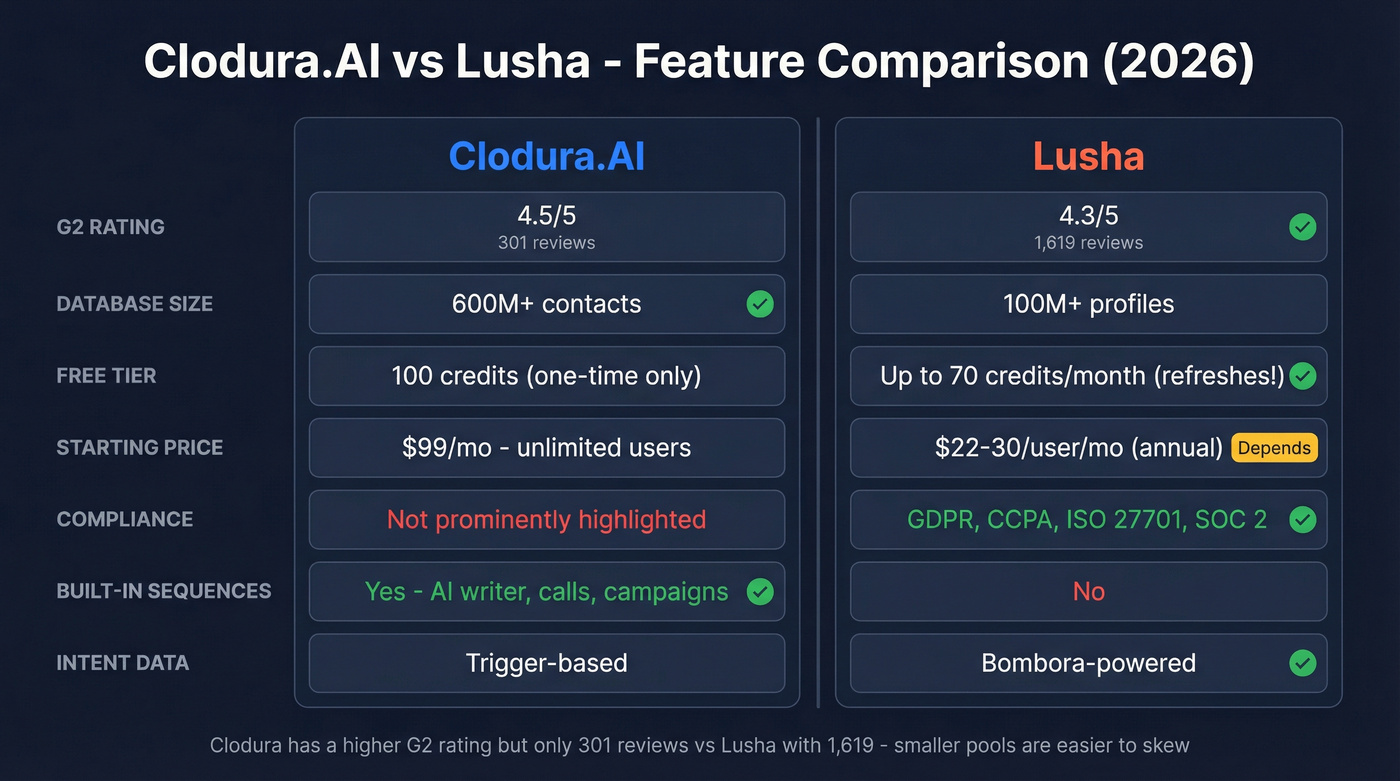
Clodura's higher G2 rating looks good on paper, but 301 reviews is a small pool - much easier to skew than Lusha's 1,619.
Pricing Breakdown
Credit economics are where this comparison gets interesting. Both tools charge 1 credit per email and 10 credits per phone number, but the packaging is wildly different.
If you’re evaluating credit-based tools across your stack, it helps to compare them against other sales prospecting databases and free lead generation tools before you commit.
Lusha (2026)
| Plan | Annual Price | Credits/Mo |
|---|---|---|
| Free | $0 | Up to 70 |
| Pro | ~$22-$30/user/mo (annual) | 250/user |
| Premium | ~$52/user/mo (annual) | 800/user |
| Scale | Custom (~$37k/yr for 25 seats) | "Unlimited" (fair-use caps apply) |
Monthly subscribers keep unused credits up to 2x their plan limit. Annual subscribers get credits issued up front, and unused credits reset at the end of the annual cycle - a painful surprise for teams that buy ahead.
Clodura.AI (2026)
| Plan | Price | Credits |
|---|---|---|
| Free Forever | $0 | 100 (one-time) |
| Max | $99/mo | 5,000 |
| PAYG | $99 one-time | 2,500 |
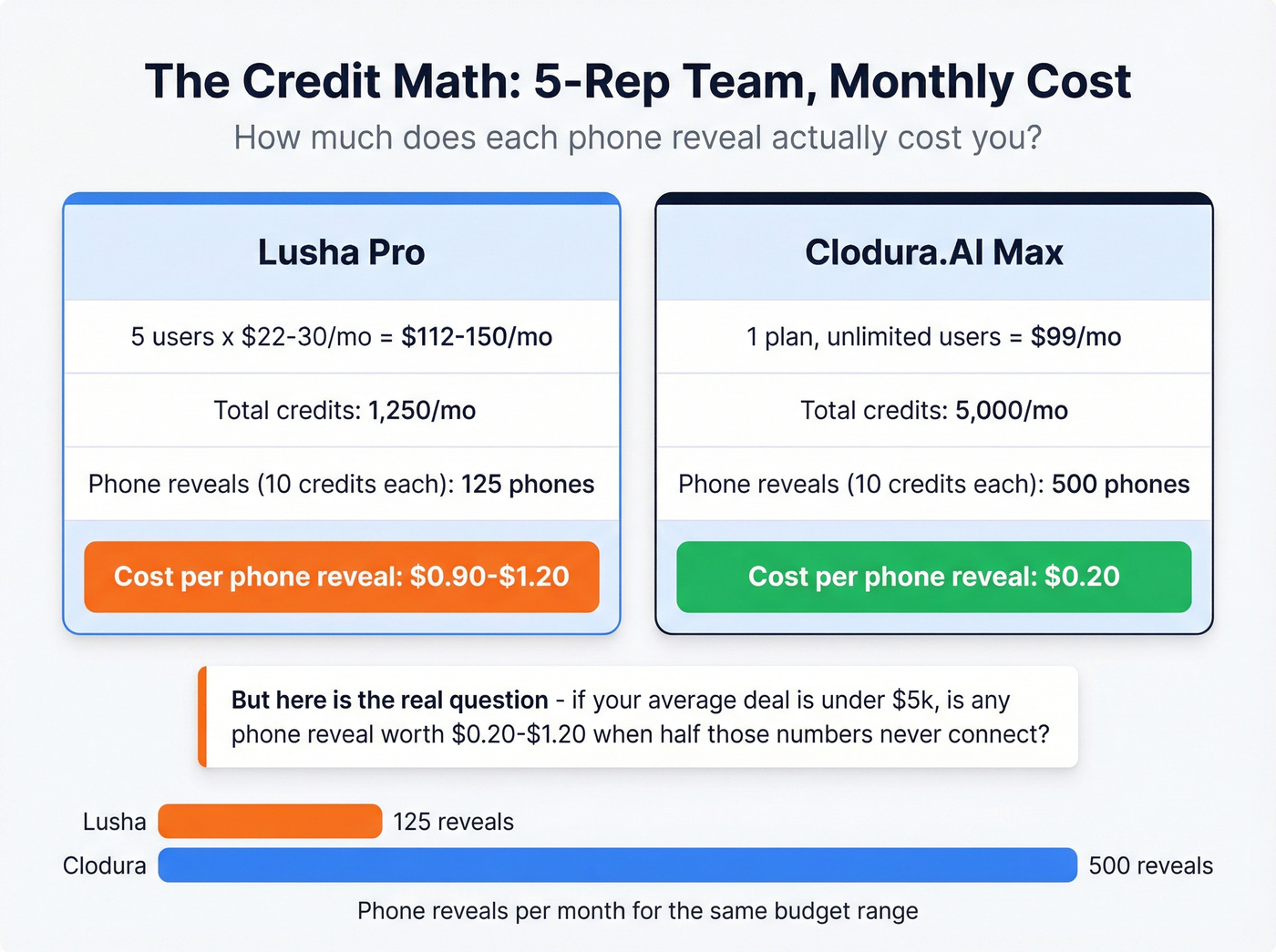
We ran the credit math on both tools and the gap is stark. A 5-rep team on Lusha Pro pays roughly $112-$150/month on annual billing and gets 1,250 total credits - that's just 125 phone reveals at about $0.90-$1.20 each. Clodura's big advantage is unlimited users on every plan, so a single $99/month Max plan gives your whole team 5,000 shared credits. For teams under 10 reps, Clodura's unit economics win decisively.
Here's the thing: if your average deal size is under $5k, neither tool's phone credits are worth the cost. You'll get better ROI from verified email-first outreach than burning ~$1 per phone reveal on prospects who won't pick up. (If you’re tightening your outbound process, these sales prospecting techniques help reduce wasted reveals.)

Both Clodura and Lusha charge ~$1 per phone reveal - and half those numbers don't connect. Prospeo gives you 125M+ verified mobiles with a 30% pickup rate and emails at 98% accuracy for ~$0.01 each. No credit anxiety, no mid-month burnout.
Stop burning $1 per reveal on numbers that don't pick up.
Data Accuracy
Neither tool is winning awards here. If you’re trying to fix accuracy issues systematically, start with a proper data enrichment services workflow and layer in deliverability checks from an email deliverability guide.
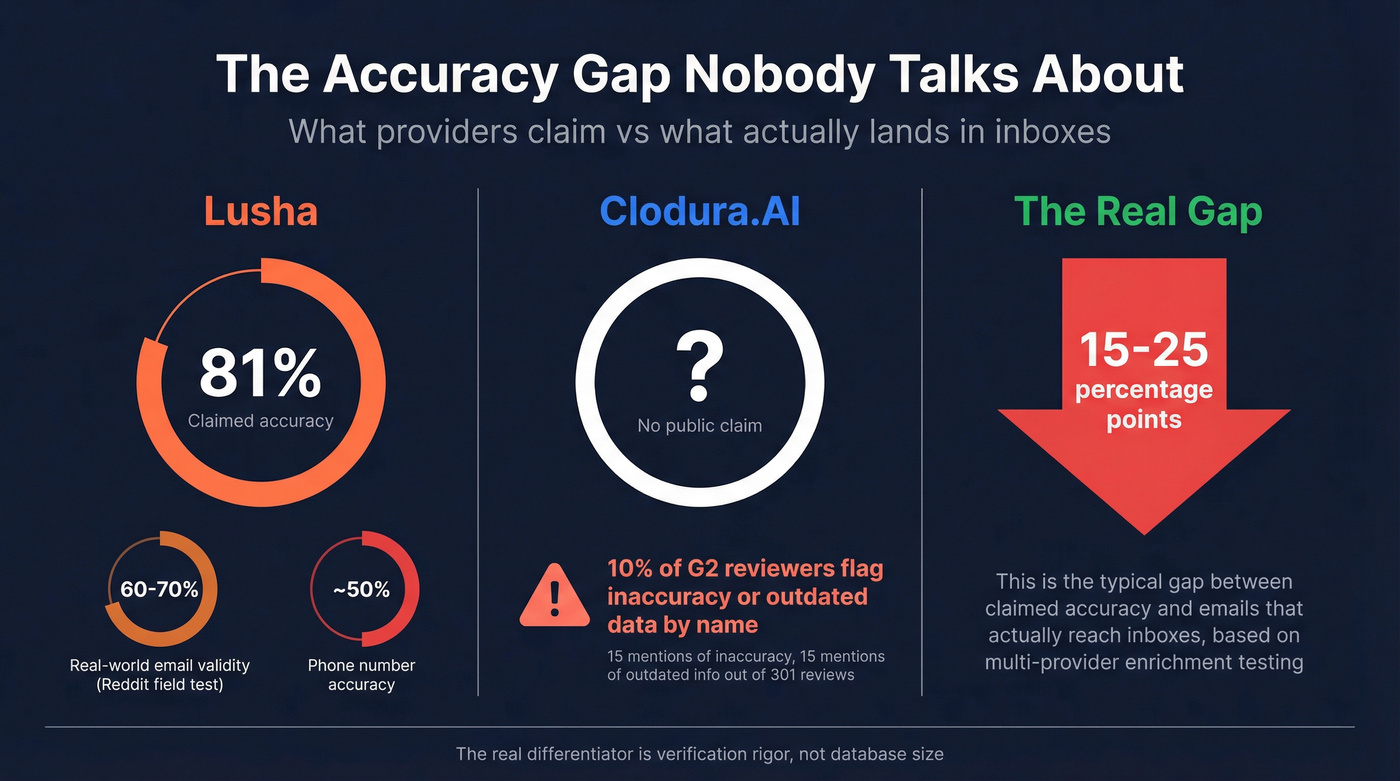
Lusha is commonly cited at an 81% data accuracy rate, which sounds reasonable until you check field performance. A Reddit field test after a few thousand enrichments put Lusha around 60-70% valid emails, with phone numbers about 50/50. Coverage outside North America is a recurring weak spot - reviewers consistently flag inaccurate numbers for non-NA contacts.
Clodura uses multi-provider waterfall enrichment across 50+ email providers and 20+ phone providers. But out of 301 G2 reviews, 15 mention "inaccuracy" and another 15 flag "outdated information" - roughly 10% of reviewers calling out data quality by name. That's not a rounding error.

Let's be honest: many tools pull from the same big databases, so the underlying quality ceiling is similar. In our testing, the real differentiator is verification rigor - and that's where both fall short of what outbound teams actually need. When we've enriched the same lists through multiple providers, the gap between "claimed accuracy" and "emails that actually land in inboxes" is consistently 15-25 percentage points. (If bounces are your main pain, see email bounce rate benchmarks and fixes.)
What Users Actually Say
Clodura.AI gets praise for ease of use (73 review mentions), lead generation features (62), and contact information breadth (56). The all-in-one pitch - AI writer, campaign automation, call disposition, built-in sequences - appeals to teams that want one platform. But the learning curve is steep (18 mentions), and one Reddit recruiter who'd bought it through AppSumo described the data as "marginal." If you’re building a modern outbound stack, compare it against other SDR tools that specialize in execution vs data.
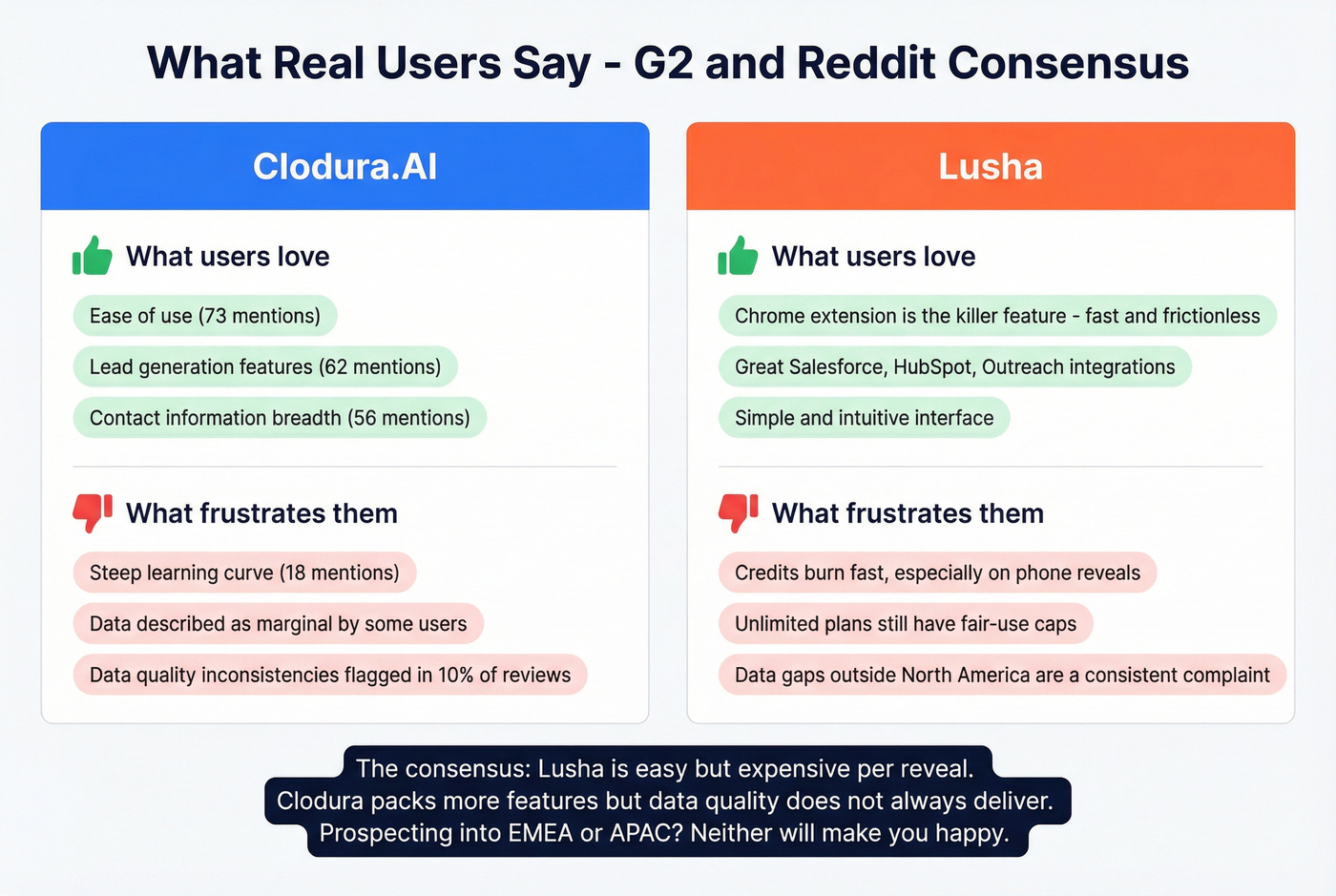
Lusha tells a different story. The Chrome extension is the killer feature - fast reveals directly from professional profiles and company websites with minimal friction. Integrations with Salesforce, HubSpot, and Outreach are a big part of the workflow. But credits burn fast on phone reveals, "unlimited" plans still come with fair-use limits, and data gaps outside North America are a consistent complaint across Reddit and G2 alike.
The consensus across user communities is clear: Lusha is easy to use but expensive per reveal. Clodura packs more features but the data quality doesn't always deliver. If you're prospecting heavily into EMEA or APAC, neither tool will make you happy.
A Third Option Worth Testing
Prospeo also offers 125M+ verified mobile numbers with a 30% pickup rate - significantly higher than what most teams report from either Clodura or Lusha. Native integrations with Salesforce, HubSpot, Smartlead, Instantly, and Lemlist mean it slots into existing workflows without ripping anything out. One customer, Snyk, dropped their bounce rate from 35-40% to under 5% and saw AE-sourced pipeline jump 180% after switching. (If you’re optimizing follow-through after list building, use these sales follow-up templates to lift reply rates.)
Claimed accuracy and inbox-ready accuracy are two different things. Prospeo's 5-step verification and 7-day data refresh close that 15-25 point gap other providers leave wide open. Snyk cut bounce rates from 35-40% to under 5% and grew AE-sourced pipeline 180%.
Get emails that actually land - 98% verified, refreshed every 7 days.
FAQ
Is Clodura.AI really free?
The Free Forever plan gives 100 credits total - not monthly. That's 100 emails or 10 phone reveals, enough to test the interface but not to prospect seriously. Most teams hit the $99/mo Max plan within a week.
How fast do Lusha credits run out?
On Pro (250 credits/month per user), revealing 25 phone numbers burns your entire allotment. A 5-rep team gets 125 total phone reveals for ~$112-$150/month on annual pricing. If reps prospect daily, expect credits to run dry by mid-month.
What if neither fits?
Skip the credit anxiety entirely. Prospeo gives you 75 free emails/month at 98% accuracy with a 7-day data refresh - better verification than either tool at a fraction of the cost. For teams that need phones, 125M+ verified mobiles with 30% pickup rates outperform both Clodura and Lusha on connect rates.