Closing Email Examples Backed by 350,000 Emails - Pick the Right One for Every Situation
Your closing line isn't decoration. Boomerang's analysis of 350,000+ email threads found an ~18-point spread between the best and worst sign-offs, which means the last sentence you write might be doing more work than the first. These closing email examples break down exactly which sign-offs earn replies, which ones tank your rate, and how to match them to every situation you'll face in 2026.
Three Closings Worth Memorizing Right Now
- "Thanks in advance" - use on warm contacts where you've already delivered value. 65.7% response rate in Boomerang's study.
- "Looking forward to [specific next step]" - for sales and meeting contexts where you want to lock a commitment.
- "Best regards" - a safe, professional default that correlated with a 52.9% response rate.
The baseline across all emails in that dataset was 47.5%. Picking the right closing puts you well above that floor. But here's the thing: your closing line is worthless if a chunk of your emails never reach the inbox. Fix your data first (start with an email checker tool).
What 350,000 Emails Say About Sign-Offs
Gratitude-based closings beat everything else. Not by a little - by a lot.
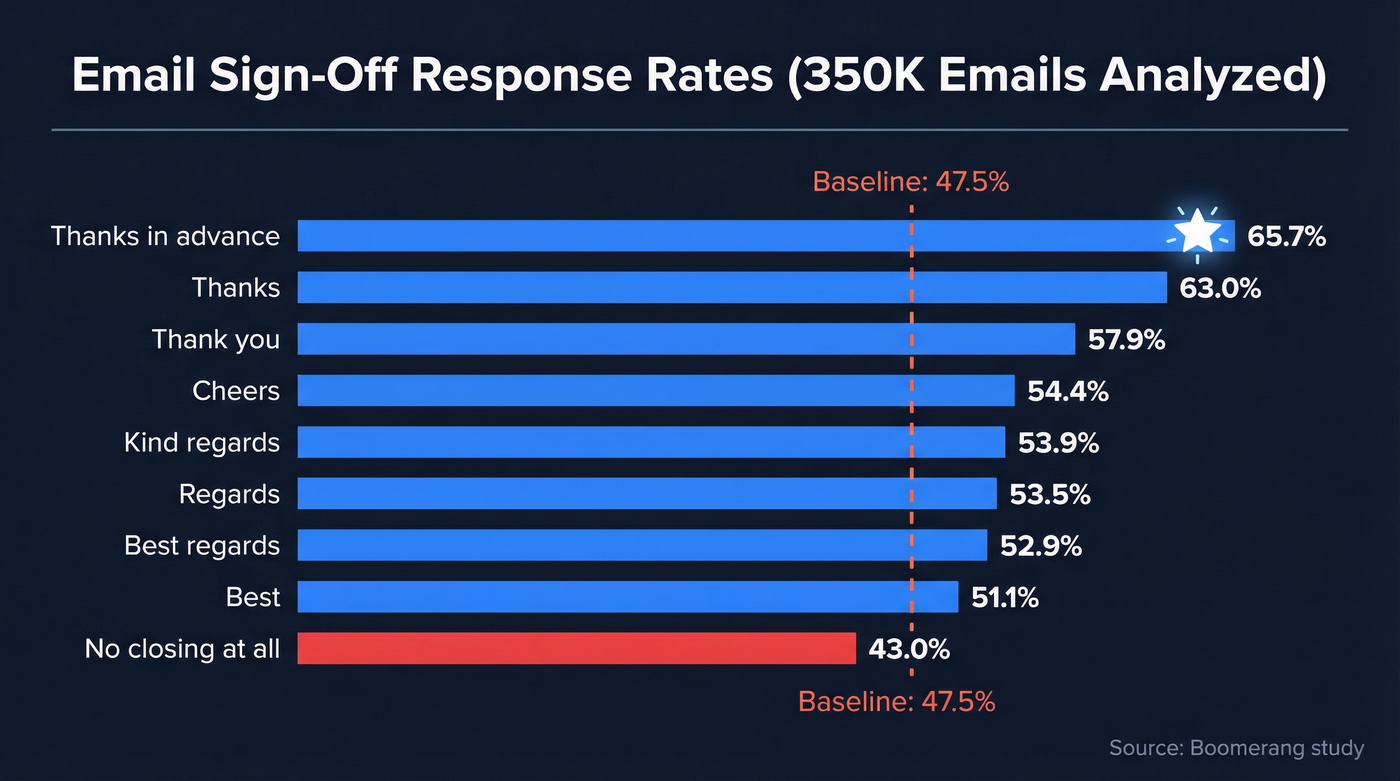
| Sign-Off | Response Rate | vs. Baseline (47.5%) |
|---|---|---|
| Thanks in advance | 65.7% | +18.2 pp |
| Thanks | 63.0% | +15.5 pp |
| Thank you | 57.9% | +10.4 pp |
| Cheers | 54.4% | +6.9 pp |
| Kind regards | 53.9% | +6.4 pp |
| Regards | 53.5% | +6.0 pp |
| Best regards | 52.9% | +5.4 pp |
| Best | 51.1% | +3.6 pp |
| No closing | 43.0% | -4.5 pp |
Skipping a sign-off entirely drops you to 43.0%. That's worse than every named option on the list.
Now, here's the paradox. "Thanks in advance" is the top performer by a wide margin, but Grammarly flags it as presumptuous, and on r/sales it's one of the most polarizing sign-offs - some call it efficient, others call it passive-aggressive. The data sides with the former, but only when context supports it. If you've already provided value - shared a resource, answered a question, done a demo - gratitude-in-advance feels natural. On a cold first touch to a stranger, it feels entitled.
The 2026 Cold Email Reality
These sign-off stats matter more now than they did five years ago because you're getting fewer shots. Belkins' benchmark, covering 16.5 million cold emails across 93 business domains, found the average reply rate hit 5.8% - down 15% year-over-year from 6.8%.
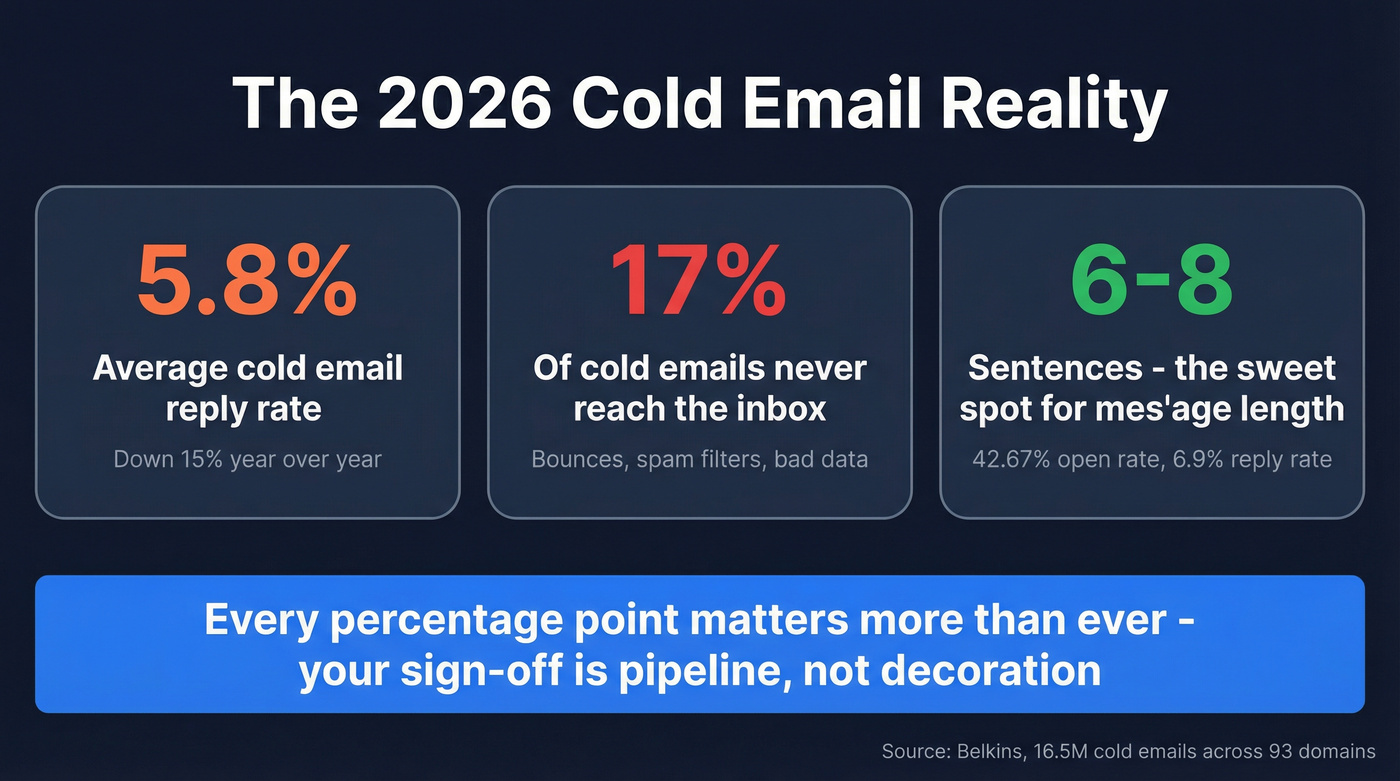
Meanwhile, roughly 17% of cold emails never reach the inbox. Authentication failures, bounces, spam filters - your carefully crafted closing never gets read. If you want the full deliverability playbook, start with an email deliverability checklist.
The sweet spot for message length is 6-8 sentences, which pulled a 42.67% open rate and 6.9% reply rate in that same dataset. Keep it tight (and use proven cold email tactics). When every percentage point of reply rate is harder to earn, the difference between a "Best" closing (51.1%) and a "Thanks in advance" closing (65.7%) isn't academic. It's pipeline.
Email Closing Examples by Situation
Cold Outreach (First Touch)
On a first touch, you haven't earned "Thanks in advance." Use a question-based CTA paired with a clean sign-off - interest-based CTAs have roughly a 30% success rate. And keep your signature block lean. Overstuffed signatures with icons, banners, and long disclaimers add clutter and can trigger spam filters (especially if your email sending infrastructure is shaky).
Example 1:
Would it make sense to spend 15 minutes on how [Company] handles [specific pain point]? Happy to share what's working for teams like yours.
Best, [Name]
Example 2:
I put together a quick breakdown of how [similar company] cut their [metric] by 30%. Worth a look?
Thanks, [Name]
Example 3:
Curious - is [specific challenge] something your team is actively working on this quarter?
Best regards, [Name]
Follow-Up (No Response)
Reply rates drop 55% by the fifth email in a sequence, and only 8.5% of sales outreach emails get responses in the first place. Your follow-ups need to escalate gently without sounding desperate (use a tighter sales cadence example).
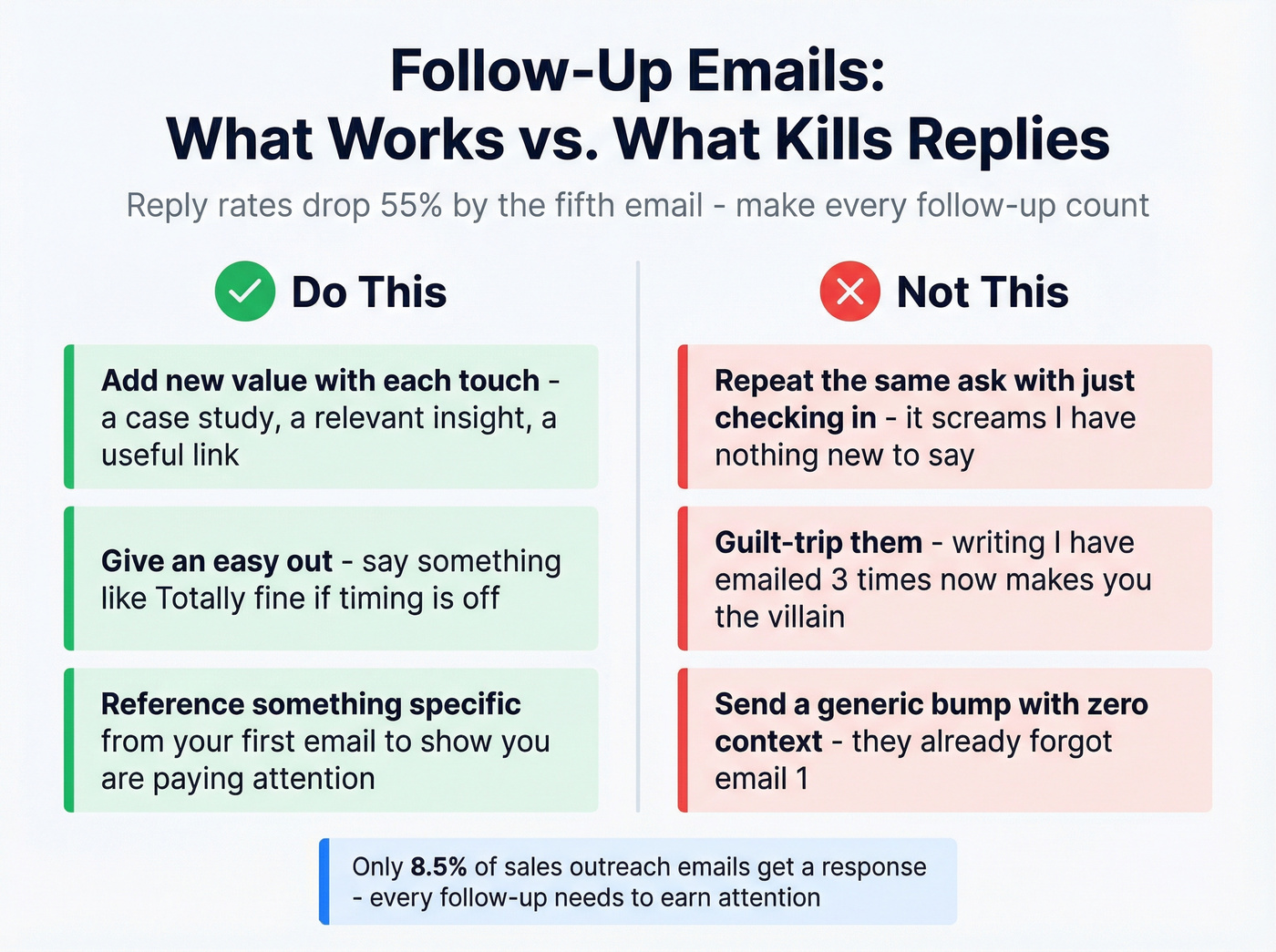
| Do This | Not This |
|---|---|
| Add new value (case study, insight) | Repeat the same ask with "just checking in" |
| Give an easy out ("Totally fine if timing's off") | Guilt-trip ("I've emailed 3 times now...") |
| Reference something specific from email 1 | Send a generic bump with no context |
Light touch:
Wanted to bump this up in case it got buried. The offer to walk through [specific value] still stands.
Thanks, [Name]
Add new value:
Since my last note, we published a case study on [relevant topic] that might be useful regardless. Here's the link: [URL]. Let me know if it sparks any questions.
Best, [Name]
Permission-based exit:
Totally fine if the timing isn't right - I'd rather not clutter your inbox. If [pain point] becomes a priority later, I'm easy to find.
Best regards, [Name]
After a Meeting or Demo
Post-meeting emails should lock a specific next step. Vague closings like "Let me know your thoughts" give the prospect an easy off-ramp. Commitment-style questions force a decision instead of inviting drift, and in our experience, they're the single biggest factor in whether a deal moves forward or stalls (see a full post-demo workflow).
Either/or close:
Great conversation today. I'll send over the proposal by EOD. Would Tuesday or Thursday work better for a 20-minute review call?
Thanks, [Name]
Recap + commitment:
To recap: you mentioned [pain point] and [goal]. I've attached the ROI model we discussed. Looking forward to connecting with [stakeholder name] next week to walk through it together.
Best regards, [Name]
Soft urgency:
The pilot pricing I mentioned is available through [date]. Happy to hold a slot if you want to loop in [decision-maker] first. What works on your end?
Thanks in advance, [Name]
The Breakup (Final Follow-Up)
The goal here isn't to close. It's to leave a positive last impression that keeps the door open six months from now. Be human, be brief, and let go.
Example 1:
I don't want to be that person who won't stop emailing. This'll be my last note. If [pain point] comes back around, you know where to find me.
All the best, [Name]
Example 2:
Closing the loop on this thread. No hard feelings - timing is everything. I'll check back in Q3 unless you beat me to it.
Cheers, [Name]
Professional / Formal Contexts
When emailing clients, vendors, or leadership, matching formality to the relationship matters more than optimizing for reply rate.
| Formality Level | Sign-Off | When to Use |
|---|---|---|
| High | Kind regards / Thank you | Client contracts, executive updates |
| Medium | Best regards | Cross-team projects, vendor comms |
| Casual | Best / Thanks | Internal threads, familiar contacts |
Formal request to a client:
I've attached the updated scope document reflecting the changes we discussed. Please let me know if anything needs adjustment before we finalize on Friday.
Kind regards, [Name]
Vendor communication:
We'd like to move forward with the annual plan. Could you send over the updated contract with the pricing we discussed? Appreciate the quick turnaround.
Thank you, [Name]

That 18-point spread between sign-offs means nothing if your emails bounce. 17% of cold emails never reach the inbox - most of that is bad data. Prospeo's 5-step verification delivers 98% email accuracy, so every carefully crafted closing line actually gets read.
Stop perfecting closings that land in the void. Start with verified emails.
Closings to Avoid
Some closings actively hurt you. Skip these:
- "Love" / "XOXO" - Unless you're emailing your partner, this reads as wildly unprofessional.
- Emoji-only sign-offs - A prayer-hands emoji isn't a closing. It's a gamble on whether the recipient finds it charming or juvenile.
- "Hope that makes sense" - Passive-aggressive. It implies the recipient won't understand.
- "Good luck" - Ambiguous at best, ominous at worst.
- "Respectfully yours" - So formal it feels sarcastic in most modern business contexts.
- No sign-off at all - The data is clear: dropping your closing entirely tanks response rates to 43.0%, below every named option in the dataset.
Even a boring "Best" outperforms trying to be clever. When in doubt, default to gratitude.
How Your Closing Reads Abroad
If you're selling internationally, your sign-off carries cultural weight.
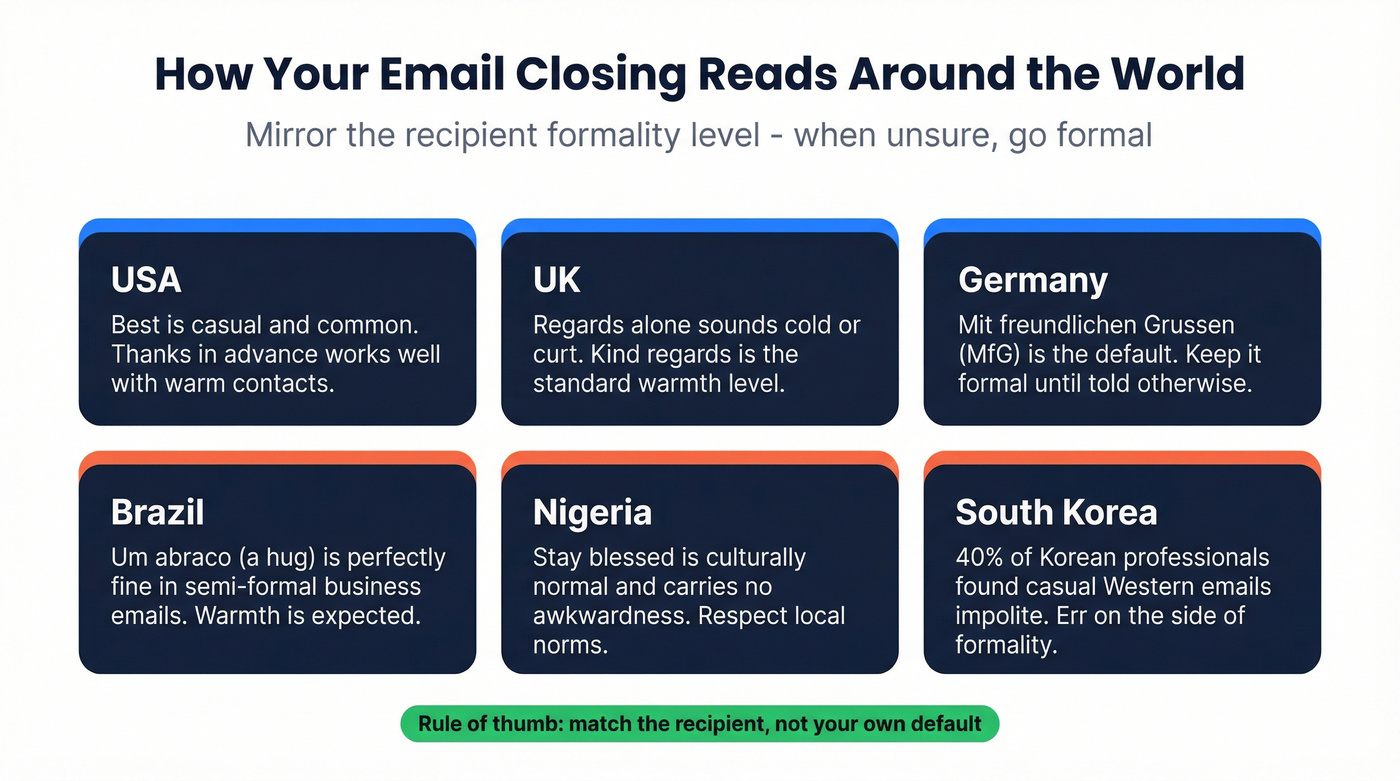
In the UK, "Regards" alone can sound cold or curt - "Kind regards" is the standard warmth level. Americans use "Best" casually; Brits read it as clipped. Germany defaults to "Mit freundlichen Grussen," commonly abbreviated MfG, while Sweden and Norway use "Med vanliga halsningar"/"Med vennlig hilsen," shortened to Mvh - both translate roughly to "with friendly greetings."
In Brazil, "Um abraco" - literally "a hug" - is perfectly acceptable in semi-formal business emails. Try that in a cold email to a German procurement director and you'll get silence. In Nigeria, "Stay blessed" is culturally normal and carries no religious awkwardness. And in a study comparing Korean and Australian academics, 40% of Koreans found Australian emails impolite versus only 28% the other way around.
Let's be honest: most of us default to whatever sign-off we've always used without thinking about the recipient's cultural context. For cross-border selling, mirror the recipient's formality level. When you're unsure, err formal.
How to A/B Test Your Closings
Don't take Boomerang's data as gospel for your audience. Test it yourself.
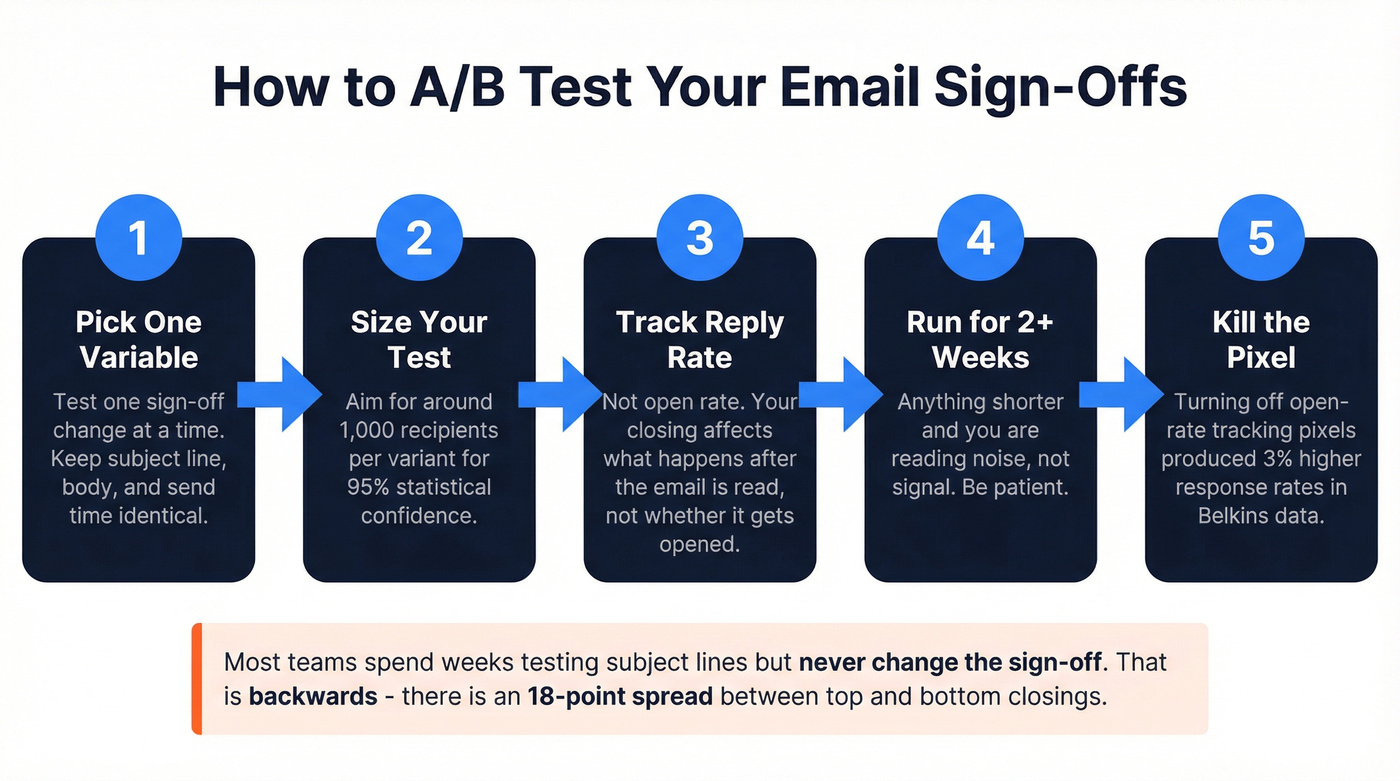
Change one variable at a time. If you're testing "Best" vs. "Thanks in advance," keep everything else identical - same subject line, same body, same send time. Aim for ~1,000 recipients per variant for 95% statistical confidence, and track reply rate, not open rate. Your closing line doesn't affect opens - it affects what happens after the email is read. Belkins found that turning off open-rate tracking pixels produced 3% higher response rates, so you might want to kill that pixel anyway (more on does open tracking hurt cold email).
We've found that two weeks is the minimum for meaningful results. Anything shorter and you're reading noise.
Here's a frustrating truth most teams ignore: they'll spend weeks testing subject lines and send times while never once changing the sign-off. That's backwards. An ~18-point spread between top and bottom sign-offs means the bottom of your email deserves as much attention as the top.
Fix Your Data Before Your Closing
Your closing line is one lever. Data quality is the bigger one. The biggest reply-rate killer isn't the wrong sign-off - it's the email that never arrives. If 17% of your cold emails bounce or land in spam, you're optimizing the paint job on a car with no engine.
Prospeo verifies email addresses in real time with 98% accuracy and refreshes its database every 7 days - versus the 6-week industry average. One customer, Meritt, dropped their bounce rate from 35% to under 4% after switching. That's the upstream fix that makes every downstream optimization, including your closing line, actually matter (see invalid emails and hard bounce root causes).
FAQ
What are the best closing email examples that get replies?
"Thanks in advance" pulls a 65.7% response rate in Boomerang's 350,000-thread study - the highest of any sign-off tested. Use it on warm contacts where you've already delivered value. For cold outreach, pair a question-based CTA with "Best" or "Thanks."
Is "Thanks in advance" rude?
After you've delivered value - a resource, a demo, a useful intro - it's the top-performing sign-off by a wide margin. On a cold first touch to a stranger with no prior relationship, it reads as presumptuous. Match it to the relationship stage.
How should you end a breakup email?
Keep it human and brief. Sign-offs like "All the best" or "Cheers" leave a warm final impression without pressure. The goal is to keep the door open for a future conversation, not force a reply today.
Does my closing matter if emails aren't reaching inboxes?
No. Roughly 17% of cold emails never arrive. Verify your contact data first, then optimize the sign-off. Tools like Prospeo deliver 98% email accuracy on a 7-day refresh cycle, and customers like Meritt cut bounce rates from 35% to under 4%.
Reply rates are down 15% year-over-year. Every send matters more than ever. Prospeo gives you 300M+ verified contacts refreshed every 7 days - not the stale data that tanks your deliverability and wastes your best closing lines.
Your breakup email shouldn't be caused by a bounce. Get fresh data.