The Permission-Based Opener: Scripts, Data, and When to Skip It
A RevOps lead we know reviewed a batch of recorded cold calls last quarter. Same list, same reps, same product. The reps who opened with a permission-based opener consistently booked more meetings - and the biggest difference was the first sentence. When cold calls average around 93 seconds, those opening words carry outsized weight.
Best opener to try tomorrow: The tailored permission opener - lead with proof you did homework, then ask for 30 seconds. (Script 2 below.)
The line to never say: "Is this a bad time?" It kills your meeting rate by 40%.
The upstream fix most reps ignore: Verify your phone numbers before you practice your opener. The best script in the world doesn't help if the number's disconnected. (If you need a process, start with a phone validator.)
What Is a Permission-Based Opener?
A permission-based opener is a cold call opening that acknowledges the interruption and asks the prospect for a small commitment to keep listening. It has three moving parts: a brief intro, a permission ask, and a value hook.
Here's the classic version from Nooks: "Hi, this is Peter from Nooks. I know I'm calling out of the blue - do you have 30 seconds to hear why I called?"
Here's the thing: you're not actually asking permission. You're creating a micro-commitment. Once someone says "sure, go ahead," they've psychologically opted in - psychologists call this self-determination theory, where people become more receptive when they feel they chose to engage rather than being forced into it. That tiny act of autonomy changes the entire dynamic of the call.
Do These Openers Actually Work?
The short answer: yes, and it isn't close.
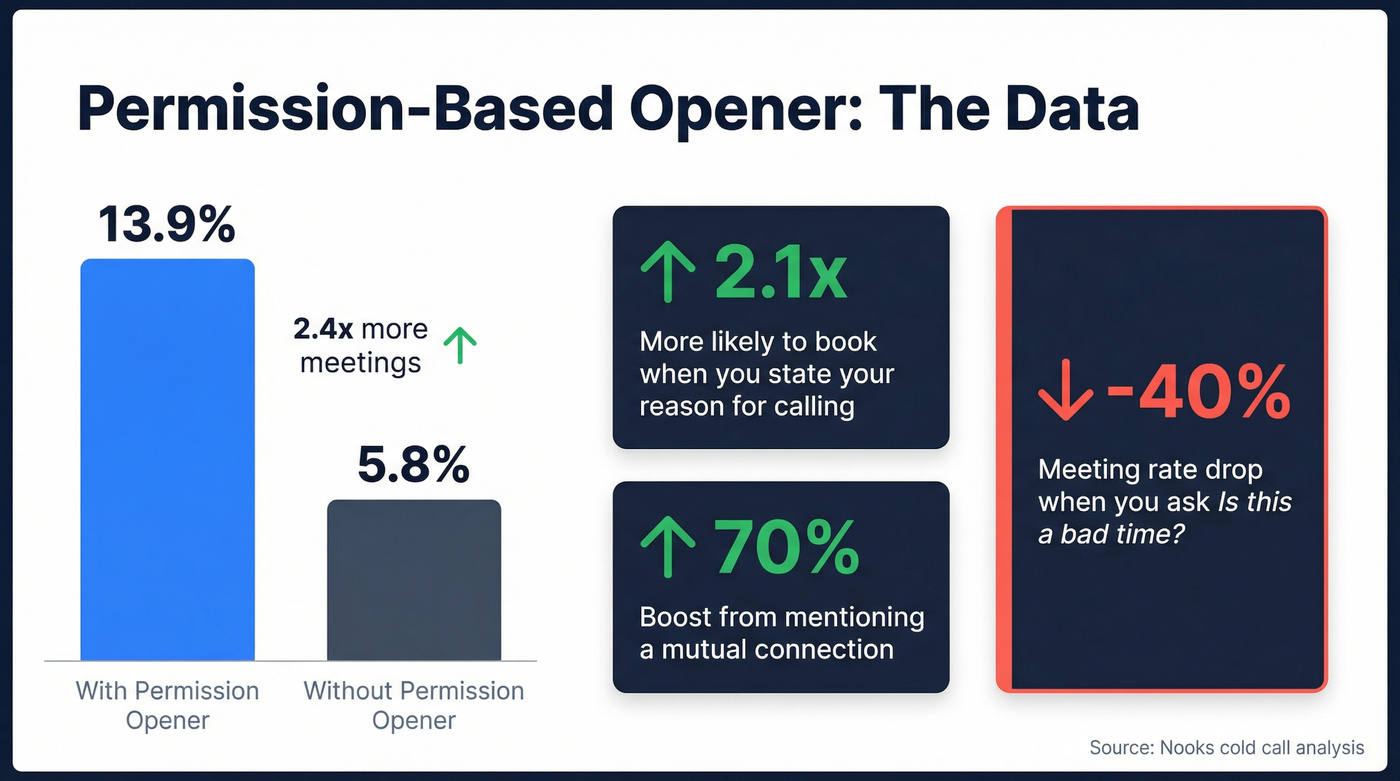
Nooks analyzed thousands of cold calls and found that calls using a permission-based opener booked meetings at 13.9% versus 5.8% for calls without one. That's a 2.4x difference - same platform, same prospects, same reps.
The supporting data lines up. Stating the reason for your call makes you 2.1x more likely to book a meeting. Mentioning a mutual connection boosts your chances by 70%. And the anti-pattern is just as clear: asking "Is this a bad time?" craters your success rate by 40%.
The debate on r/sales is polarized - some reps swear by context-first openers, while others prefer direct pattern interrupts that skip the ask entirely. The data sides with the permission camp, but the real insight is that how you deliver the opener matters as much as the words themselves. Most objections on cold calls aren't objections to your product. They're reactions to the interruption. A well-delivered opening question defuses that reaction before it starts, and that single insight is worth more than any script. (For a broader framework, see our B2B cold calling guide.)
Five Proven Cold Call Opener Scripts
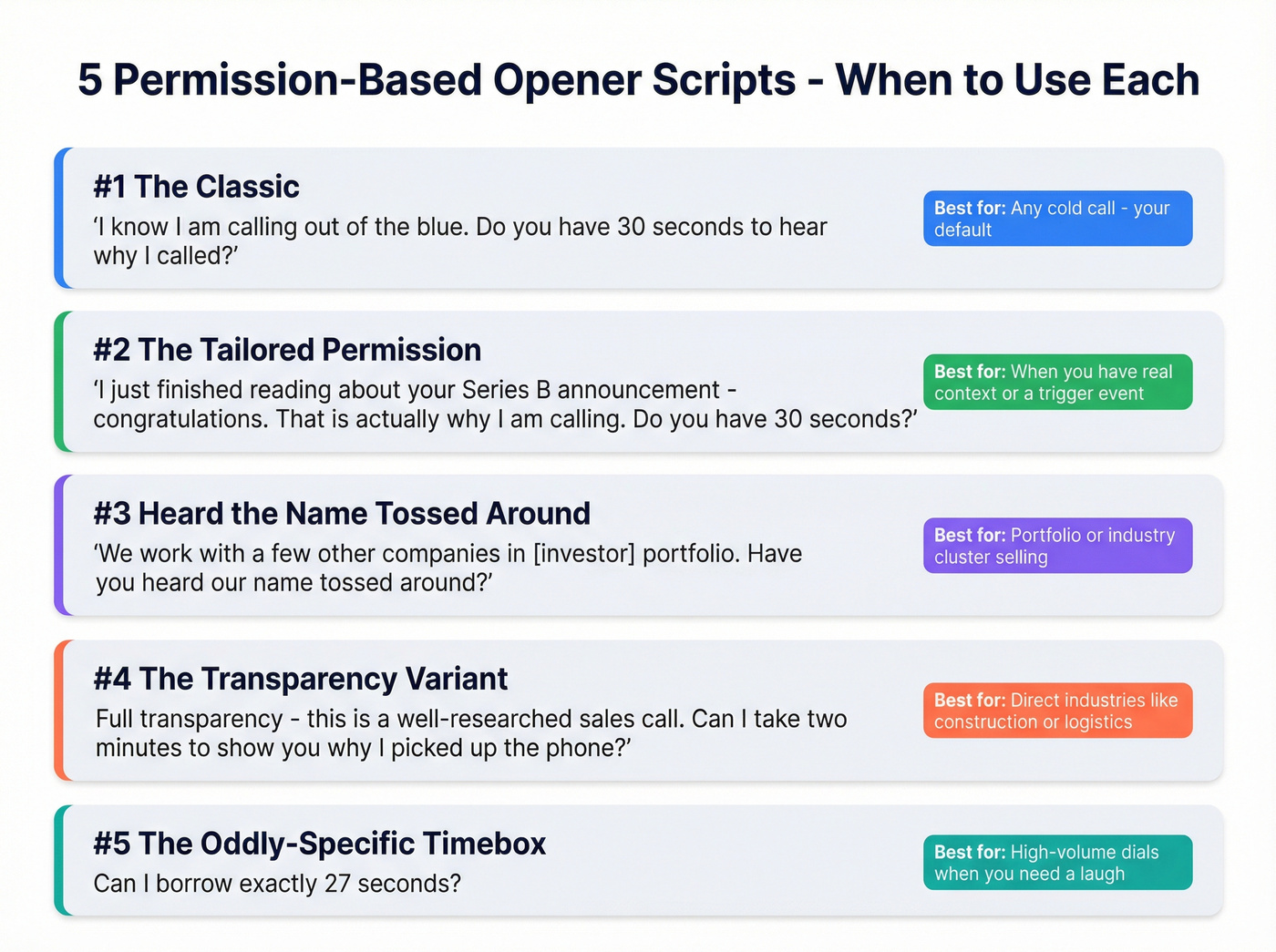
1. The Classic
"I know I'm calling out of the blue. Do you have 30 seconds to hear why I called?"
This is the tested baseline. It works because it's honest, direct, and gives the prospect a clear exit. Deliver it with a downward inflection - an upward tone turns a confident ask into a nervous question. Most people say yes out of curiosity alone. (If you want to tighten delivery, use a cold call tonality checklist.)
2. The Tailored Permission Opener
"I just finished reading about your Series B announcement - congratulations. That's actually why I'm calling. Do you have 30 seconds?"
This is the Nick Cegelski / 30MPC variant, and it's the best opener when you have real context. The proof of homework - a press release, job post, podcast appearance - separates you from every telemarketer who's ever dialed that number. A tailored opener signals effort before you ever pitch. Use it when you have context. Skip it when you don't; a fake trigger is worse than no trigger at all. (If you need a system for the “homework,” use a pre call research checklist.)
3. "Heard the Name Tossed Around"
Armand Farrokh's approach flips the dynamic. Instead of asking for time, you ask a question:
"Hey, this is Alex from Acme. We work with a few other companies in [investor's] portfolio. Have you heard our name tossed around?"
If they say no, pivot: "Can I give you a quick sense of what we have going on with them? Then you tell me if it's even relevant." The nonchalant tone is everything here - you're a peer sharing context, not a seller begging for attention. (More options: sales pitch opening lines.)
4. The Transparency Variant
"Full transparency - this is a well-researched sales call. Can I take two minutes to show you why I picked up the phone?"
Owning the cold call disarms the prospect. The phrase "well-researched" does heavy lifting because it implies you're not just dialing down a list. This one works best in industries where prospects respect directness over polish, like construction tech or logistics. (If you’re building a repeatable motion, map it to an outbound calling strategy.)
5. The Oddly-Specific Timebox
"Can I borrow exactly 27 seconds?"
Nobody asks for 27 seconds. It gets a laugh, and laughs buy you time. That's the whole script. (If you want more “oddly specific” options, borrow from best open-ended sales questions.)

A 2.4x meeting boost means nothing if half your dials hit disconnected lines. Prospeo gives you 125M+ verified mobile numbers with a 30% pickup rate - refreshed every 7 days, not every 6 weeks. Your permission-based opener deserves a live human on the other end.
Stop rehearsing scripts into voicemail. Start dialing verified numbers.
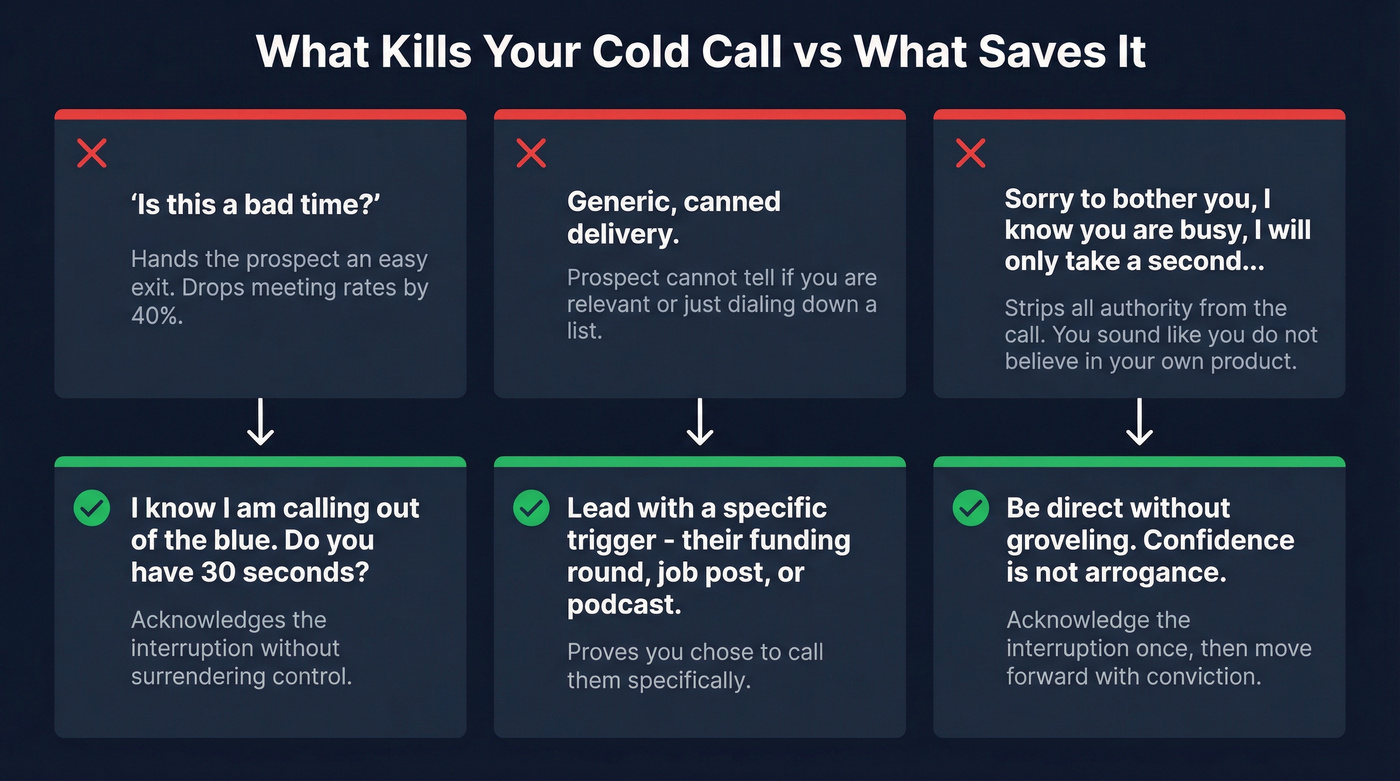
Three Mistakes That Kill Cold Calls
"Is this a bad time?"
It's always a bad time. This question puts you in a position of inferiority - you're handing the prospect an easy exit and signaling that your call isn't worth their time. The data backs this up: it drops meeting rates by 40%.
Generic, canned delivery
If your opener sounds identical to the last five cold calls the prospect received, you've already lost. The prospect can't tell if you're a relevant professional or a telemarketer going through the phone book. The fix is the tailored version - lead with context that proves you know who they are. The words matter far less than whether the prospect believes you chose to call them specifically. (This is also a cold calling quality vs quantity problem.)
Over-apologizing
"Sorry to bother you, I know you're busy, I'll only take a second..." This strips all authority from the call. There's a difference between acknowledging the interruption ("I know I'm calling out of the blue") and apologizing for your own existence. Be direct without groveling. (If you want a tighter framework, use communication skills in sales.)
When to Skip the Permission Ask
Not every call needs one.
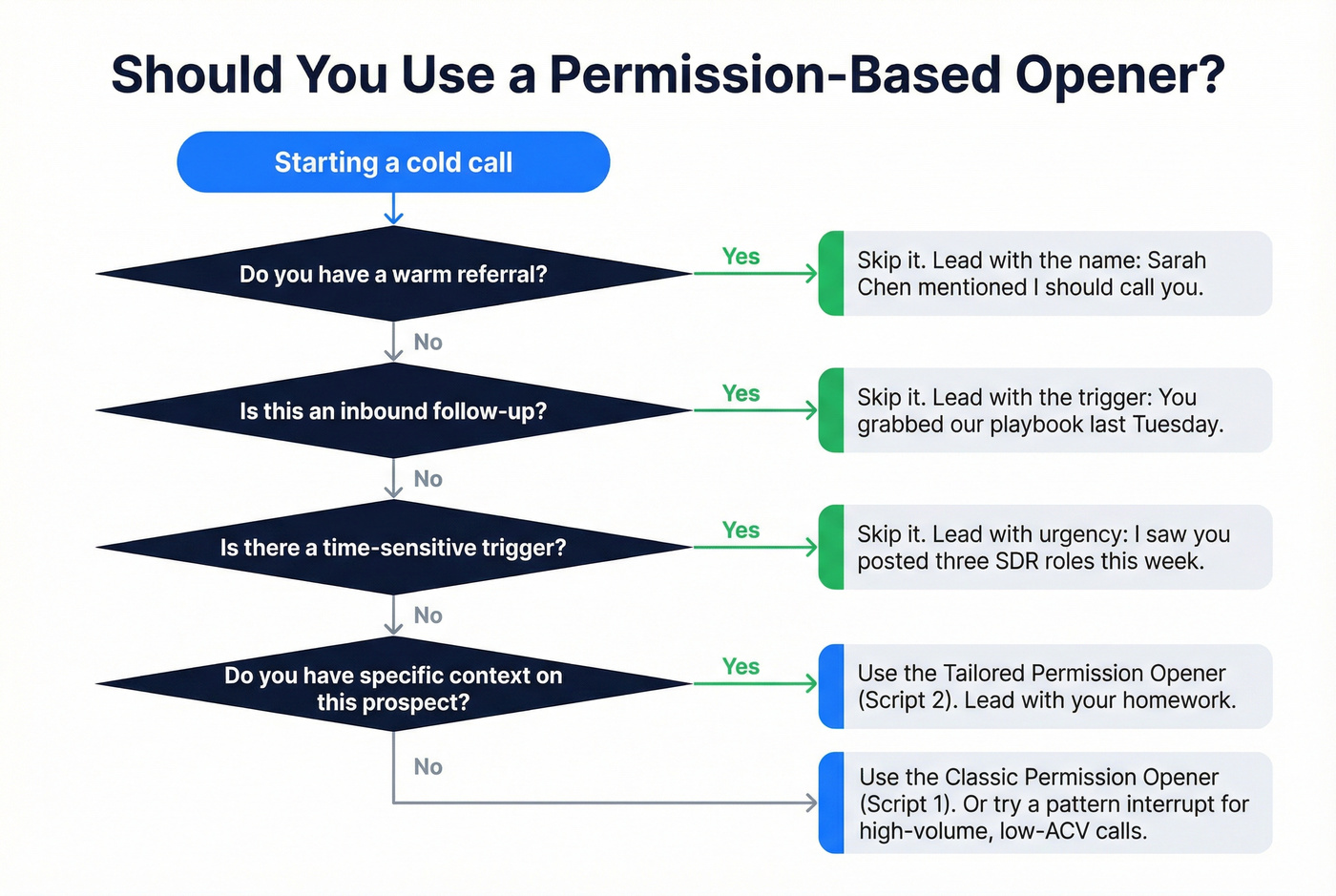
Warm referral. Skip the permission ask entirely. Lead with the name: "Sarah Chen mentioned I should call you about your Q3 pipeline goals." The referral is your permission.
Inbound follow-up. They already gave permission when they downloaded your content or filled out a form. Lead with the trigger: "You grabbed our outbound playbook last Tuesday - I wanted to see what caught your eye."
Time-sensitive trigger. When the context is urgent, lead with it: "I saw you just posted three SDR roles this week. I have 30 seconds of context that might save you some ramp time." The trigger earns the time; you don't need to ask for it.
Hot take from our team: If your deal size sits below $10k and you're running high-volume dials, pattern interrupts will outperform permission-based openers. The permission ask costs you 5-8 seconds per call, and at high volume with low-stakes deals, speed wins. Save the tailored opener for the accounts that actually matter.
Step Zero: Call the Right Number
Let's be honest - none of this matters if you're dialing dead numbers. We've seen teams obsess over opener scripts while a huge chunk of their call list bounces to voicemail on disconnected lines. The best permission-based opener in the world can't book a meeting with a number that doesn't ring.
Prospeo's mobile database covers 125M+ verified numbers with a 30% pickup rate, compared to roughly 12.5% at ZoomInfo and 11% at Apollo. That difference compounds fast across a full dial session. GreyScout cut rep ramp time from 8-10 weeks to 4 weeks after switching, and their bounce rate dropped from 38% to under 4%. Fix the data first. Then perfect the opener. (If you’re seeing decay, start with B2B contact data decay and prospect data accuracy.)
You just invested time perfecting your opener. Don't waste it on bad data. Prospeo's 300M+ profiles and 98% email accuracy mean every call and follow-up email lands where it should - for about $0.01 per lead.
Fix step zero before you touch another script.
FAQ
Permission-based opener vs pattern interrupt - which wins?
Neither universally. Permission-based openers outperform when you have context - a trigger event, mutual connection, or proof of homework. Pattern interrupts win when you lack that context and need to break through on energy alone. Most experienced reps use both depending on the call.
Do permission-based openers work for email?
Yes, but the mechanism shifts. Your subject line earns the open; your first sentence earns the read. Something like "Saw your Series B news - worth a 2-minute read?" follows the same structure: acknowledge the interruption, create a micro-commitment, give the reader autonomy.
What's the best opener for C-suite prospects?
The tailored permission opener, every time. C-suite buyers filter harder for relevance than anyone else on your list. Generic openers get instant hangups at this level. You need proof of homework and verified direct dials - skip the general office line and reach them on a number they actually answer.