

How to Write a Coffee Chat Email That Actually Gets a Reply
You found the perfect person - same career path you want, three years ahead of you, working at a company you'd love to join. You're staring at a blank email draft, cursor blinking. A Reddit user in r/FinancialCareers described sending roughly 100 coffee chat email requests and getting a response rate under 5%. That's not unusual. The average cold email reply rate sits at 3.43%. Top performers hit 10%+, but they're running a system, not sending one-off messages and hoping.
Here's the system.
What Makes a Networking Coffee Email Work
A coffee chat request isn't a sales pitch, and it's not a job application. It's a request for a short conversation with someone who has zero obligation to say yes.
Three rules, all backed by data. First, keep it short - campaigns under 80 words consistently outperform longer ones, which means every sentence earns its place and anything you can cut, you should. Second, format for mobile. 81% of emails open on mobile devices, so a wall of text gets thumb-scrolled into oblivion. Third, make one specific ask. Not "I'd love to connect sometime" - that's too vague to act on. "Would you have 15 minutes next week?" gives them something to say yes or no to.
Cold email also tends to outperform LinkedIn DMs for networking outreach. Your message lands in a less crowded inbox, and it feels more intentional.
Here's the thing: if you engage with someone's content before emailing - comment on a post, share their article - your reply rate can jump from under 15% to 40-50%. Most people skip this step because it takes effort. That's exactly why it works.
Find Their Email First
Every coffee chat guide gives you templates. Almost none address the actual first problem: you don't have the person's email address.
Prospeo's Email Finder handles this in seconds. Paste a professional profile URL or company domain, and you get a verified address pulled from 143M+ verified emails at 98% accuracy. The free tier gives you 75 email lookups a month - more than enough for a focused networking campaign. The Chrome extension makes it even faster: one click from any website or professional profile, and you've got a verified email without leaving your browser.
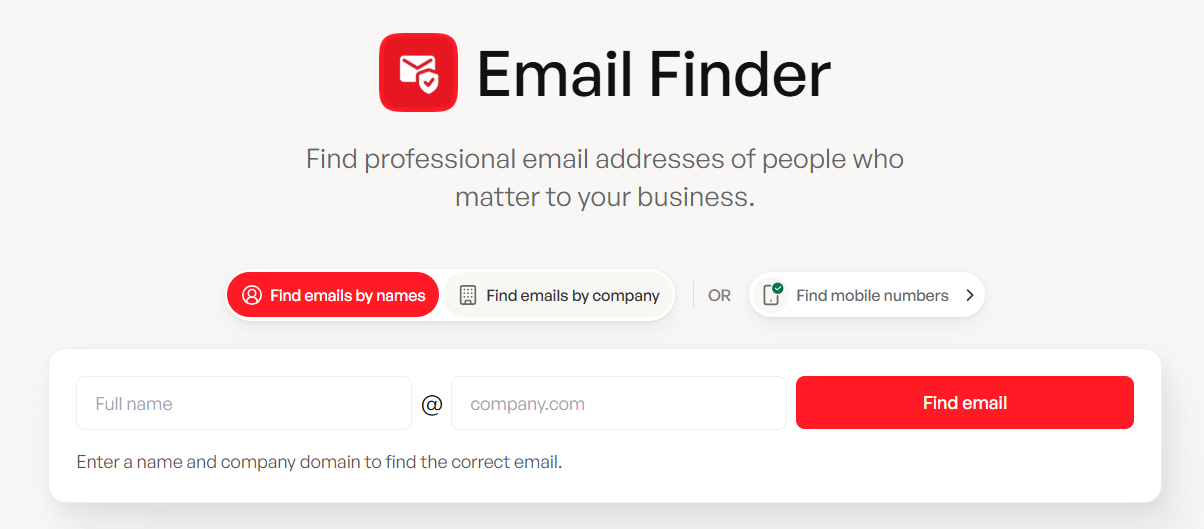
Don't skip verification. Sending a carefully crafted request to a dead address wastes your time and, if you're using a personal domain, hurts your sender reputation.
Anatomy of a Great Coffee Chat Email
Every effective networking email has five parts. Understanding this structure is how you stand out from the dozens of generic messages your recipient gets each week.
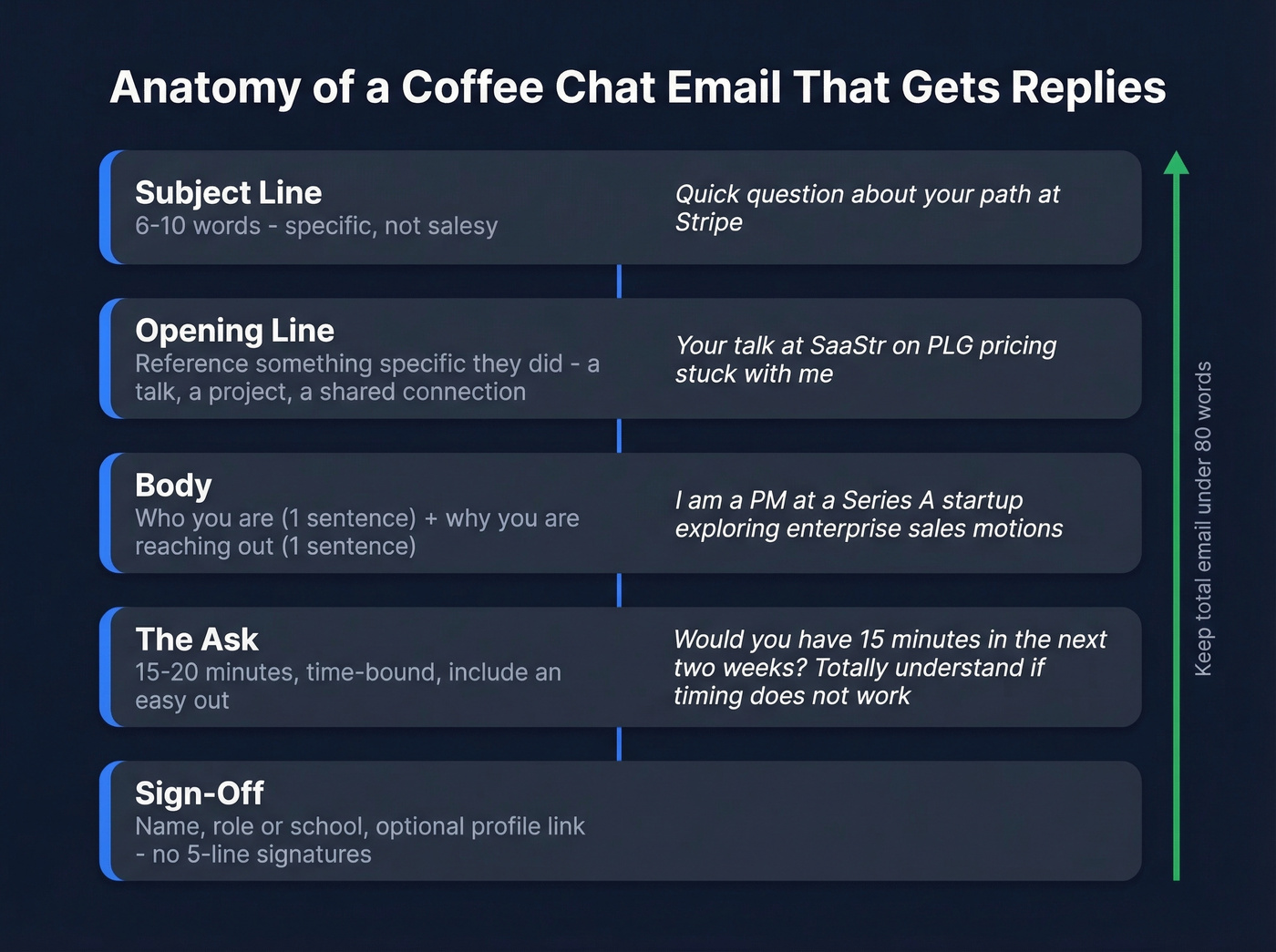
Subject line. Keep it to 6-10 words - that's the sweet spot for open rates. "Quick question about your path at [Company]" or "Fellow [School] alum - 15 min chat?" works. Avoid anything that reads like marketing. If you want more options, borrow from these email subject lines and adapt them to networking.
Opening line. This is where personalization lives. Reference something specific - a talk they gave, a project they shipped, a mutual connection. Commonalities like shared industry, location, or professional groups work especially well. "Dear Sir/Madam" is an instant delete. So is "I came across your profile and was impressed." Be specific or be ignored.
Body. State who you are in one sentence, then explain why you're reaching out in one more. If you struggle to introduce yourself cleanly, use a few of these sample elevator pitches as a starting point.
Career coach Phoebe Gavin, quoted by CNBC, recommends a contrarian approach: instead of asking for a meeting, ask one specific question they can answer in two sentences. Once they reply, propose a 15-minute call. This "question-first" strategy lowers the commitment barrier dramatically.
The ask. Request 15-20 minutes . Time-bound it. "Would you have 15 minutes sometime in the next two weeks?" is concrete and easy to say yes to. Always include an easy out - "Totally understand if the timing doesn't work" reduces pressure and paradoxically increases reply rates.
Sign-off. Your name, what you do or where you study, and optionally a link to your profile. No five-line email signatures.

Your coffee chat email is only as good as the address it lands in. Prospeo's Email Finder pulls from 143M+ verified emails at 98% accuracy - so your carefully written request actually reaches a real inbox, not a dead end.
Stop crafting perfect emails to wrong addresses. Verify first.
7 Coffee Chat Email Templates
Each template below stays under ~80 words once personalized. Copy, personalize, send.
Cold Outreach (No Shared Connection)
Subject: Quick question about your work at [Company]
Hi [Name],
I'm [Your Name], a [role/student] at [Organization]. I've been following [Company]'s work on [specific project or initiative], and your background in [area] really stands out.
Would you have 15 minutes in the next couple of weeks to chat about your experience? I'd love to hear how you approached [specific topic].
Thanks so much, [Your Name]
This is your workhorse template. We've seen it outperform vague "let's connect" messages by a wide margin because it names something specific about their work - which proves you actually looked.
Alumni Network
Subject: Fellow [School] grad - quick career question
Hi [Name],
I'm [Your Name], [Class of 20XX] from [School/Program]. I saw you've built a career in [field] since graduating, and I'm exploring a similar path.
Would you be open to a 15-minute call? I'd especially love to hear how you made the jump from [previous role] to [current role].
Best, [Your Name]
Your strongest warm opener. Shared alma mater is the highest-converting commonality in networking outreach - use it whenever you can.
Career Change
This template works because career-changers are rare enough to be interesting. The person you're emailing once stood exactly where you stand, and most people enjoy reflecting on their own pivot.
Subject: Transitioning into [industry] - would love your perspective
Hi [Name],
I'm [Your Name], currently in [current field] and actively transitioning into [target field]. Your move from [their previous industry] to [current role] is exactly the kind of path I'm trying to understand better.
Could I ask you a couple of questions about how you navigated that shift? Happy to keep it to 15 minutes.
Thanks, [Your Name]
Internal Coffee Meeting Invitation
Subject: Coffee chat? [Your Team] <> [Their Team]
Hi [Name],
I'm [Your Name] on the [Your Team] team. I've been curious about the work [Their Team] is doing on [project], and I think there's some interesting overlap with what we're building.
Would you be up for a 15-minute coffee chat this week or next?
Best, [Your Name]
You share a Slack workspace and a paycheck signer. The bar for saying yes is much lower, so you can be more casual and skip the credentialing.
Post-Event Follow-Up
Subject: Great meeting you at [Event]
Hi [Name],
It was great chatting briefly at [Event] - your point about [specific thing they said] stuck with me. I'd love to continue that conversation.
Would you have 15 minutes for a quick call in the next week or two?
Best, [Your Name]
The specific reference to something they said is what separates this from a generic follow-up that screams "I'm blasting everyone I met."
The Question-First Email
In our experience, this is the single best template for reaching senior people. Asking for 15 minutes of a VP's time is a big ask. Asking one smart question they can answer in a Slack-length reply? Easy. Once they respond, you've started a conversation - and proposing a call feels natural.
Subject: One quick question about [specific topic]
Hi [Name],
I'm [Your Name], a [role] exploring [area]. I've been thinking about [specific challenge or question], and given your experience at [Company], I'd really value your take.
[Ask one specific, answerable question - e.g., "What's the biggest skill gap you see in new hires entering [field]?"]
Thanks for any insight, [Your Name]
Casual "Grab Coffee" Template
Sometimes the context is casual enough - a coworker you've been meaning to meet, a local contact in your industry - that a simple grab coffee email does the job:
Subject: Coffee sometime?
Hi [Name],
I'm [Your Name] - we [share a mutual connection / are both in the local [industry] community / both spoke at [event]]. I've been meaning to reach out.
Would you want to grab coffee sometime in the next couple of weeks? I'd love to hear about what you're working on at [Company].
Best, [Your Name]
Keep this one in your back pocket for warmer contacts where formality would feel forced.
When to Send and How to Follow Up
Here's the stat that should change your behavior: 42% of replies come from follow-ups, not the first email. If you send one message and give up, you're leaving nearly half your potential replies on the table. If you want a few ready-to-send nudges, keep these sales follow-up templates handy and soften the language for networking.
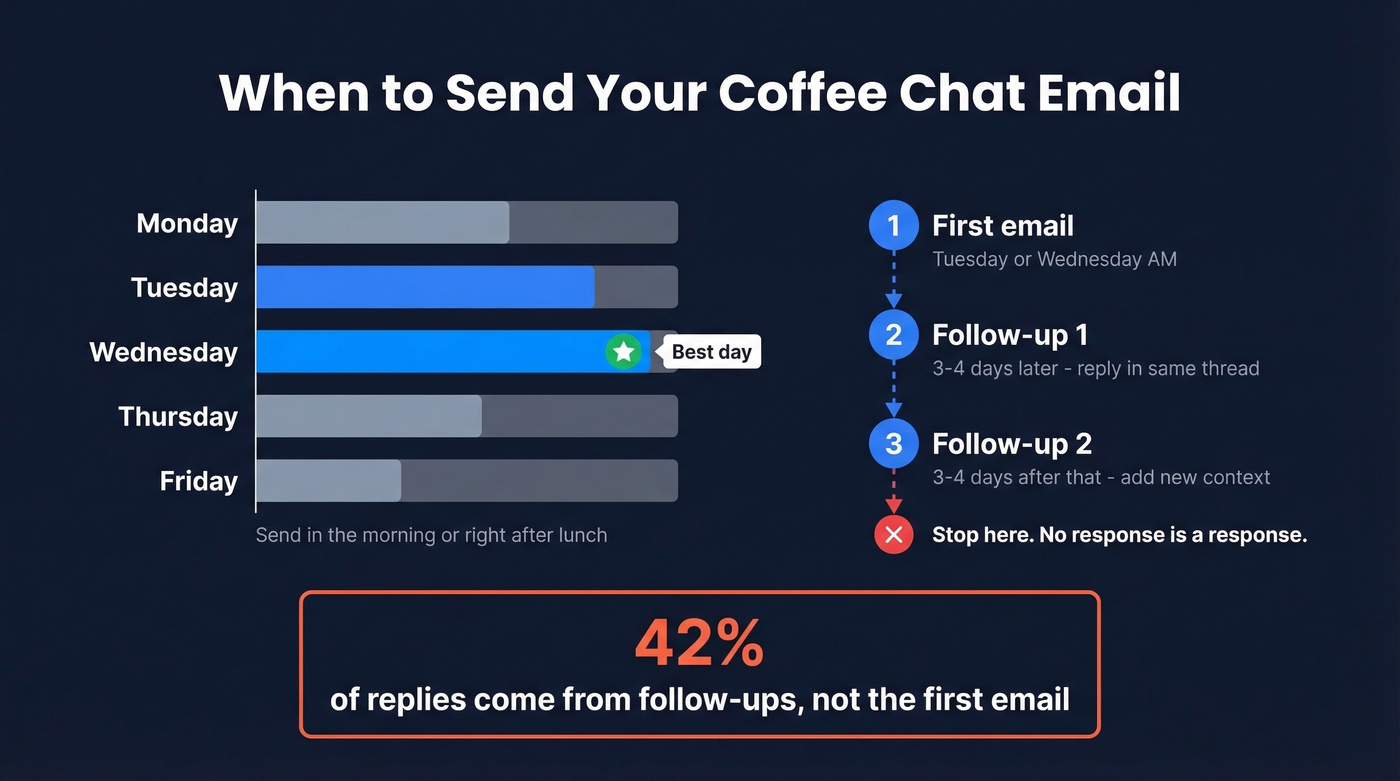
Tuesday and Wednesday are peak reply days, with Wednesday edging ahead. Send in the morning or right after lunch - that's when people are actively processing their inbox. For a deeper breakdown, see our guide on the best time to send cold emails.
For networking, cap your sequence at two follow-ups total. Sales outreach often runs 4-7 touchpoints, but coffee chat requests have a different social contract. Two follow-ups spaced 3-4 days apart is persistent without being pushy. After two with no reply, move on. No response is a response - respect it.
Reply in the same thread so it feels like a continuation, not a new cold email. Keep it shorter than your original, and add one new piece of context:
Hi [Name], just bumping this up - I know inboxes get buried. I recently [read/saw/worked on something relevant] and it reinforced my interest in chatting. Totally understand if the timing doesn't work.
Mistakes That Kill Your Reply Rate
Saying "pick your brain." It signals you want free consulting. Say "learn from your experience" or "get your perspective" instead. Phoebe Gavin calls this out specifically - and she's right.
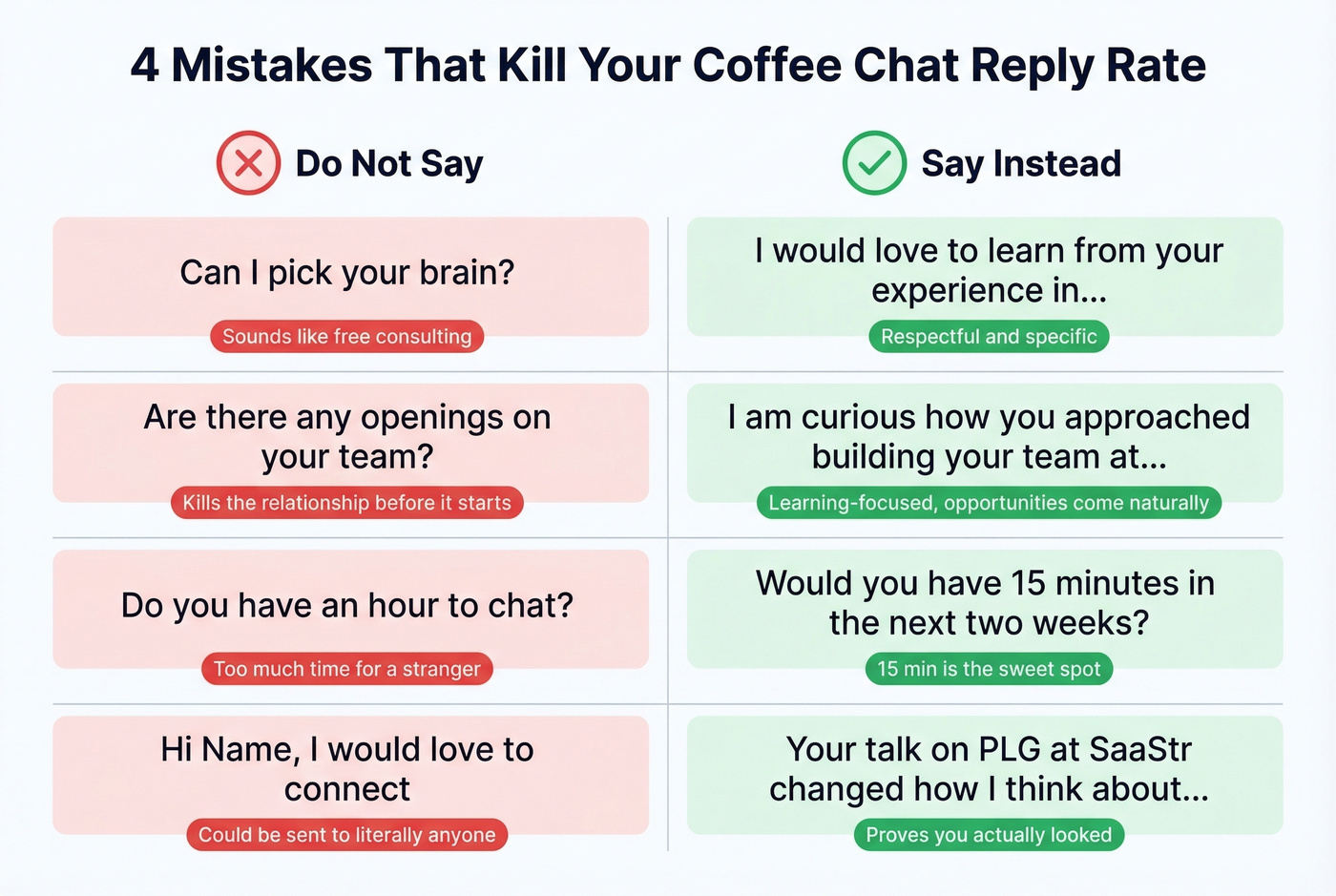
Asking for a job. The fastest way to end a networking relationship before it starts. A coffee chat is about learning. If there's an opportunity, it'll come up naturally.
Requesting more than 30 minutes. You're asking a stranger for a favor. Fifteen minutes is the right opening ask. If the conversation's going well, they'll extend it themselves.
Zero personalization beyond their name. "Hi [Name], I'd love to connect" could be sent to anyone. Reference their specific work, a talk they gave, or a shared connection. If you need a framework, use a simple personalized outreach checklist before you hit send.
Sending one email and quitting. 42% of replies come from follow-ups. One email isn't a strategy - it's a lottery ticket.
During the Chat and After
The 70/30 rule is the single best framework for the actual conversation: they talk 70%, you talk 30%. You're there to learn, not to pitch yourself. Ask follow-up questions based on what they say, not just the list you prepared.
After the chat, send a thank-you email within 24 hours. Reference something specific they said - this proves you were listening and makes you memorable. If they agreed to a call, send the calendar invite within four hours and offer a broad time window rather than scattered slots.
Hi [Name], thanks so much for the time today. Your point about [specific takeaway] really reframed how I'm thinking about [topic]. I'm going to [specific action you'll take based on their advice]. I'll send you that article on [topic] this week.
End with a concrete next step. "Let's stay in touch" is vague. "I'll send you that article on [topic] this week" is actionable. If you want to tighten your closing, borrow a few patterns from this email call to action guide.
Running a focused networking campaign? Prospeo's free tier gives you 75 verified email lookups per month - enough to send dozens of coffee chat requests to the right people. One click from any professional profile, no guesswork.
Get 75 free email lookups and start booking coffee chats this week.
FAQ
How long should a coffee chat email be?
Under 80 words. Benchmark data shows short emails consistently outperform longer ones, and with 81% of emails opening on mobile, anything requiring scrolling gets skipped. Write your draft, then cut it in half.
What's a normal reply rate for networking emails?
3-5% is a common baseline for cold outreach. With strong personalization and a two-email follow-up sequence, top performers push past 10%. Don't judge success by a single send - judge it by your system over 50+ messages.
How do I find someone's email for a coffee chat?
Use an email finder tool - paste a professional profile URL or company domain and get a verified address in seconds. A free tier covering 75 lookups a month is plenty for a focused networking campaign.
How do I ask for coffee without being awkward?
Lead with specificity. Reference something concrete about their work, explain who you are in one sentence, and make a time-bound ask of 15 minutes. Including an easy out like "No worries if the timing doesn't work" removes pressure and actually increases your chances of getting a yes.
Does the question-first approach work for senior executives?
Yes - it's the highest-converting format for reaching VPs and directors. Instead of asking them to block 15 minutes, send one smart question they can answer in a quick reply. Once they respond, you've opened a conversation and proposing a brief call feels natural.