

Cold Call Subject Lines That Actually Work in 2026
You just left your third voicemail today. Nobody called back. Your follow-up email has a subject line that reads like a newsletter, and it's sitting unopened in a sea of other unopened emails. The problem isn't your pitch - it's the first few words people see and hear.
What "Cold Call Subject Line" Actually Covers
People searching this phrase usually want one of three things: the verbal opener (your first sentence when a prospect picks up), the voicemail hook (the 15-second message that determines whether they listen or delete), or the email title on a pre-call or post-call follow-up.
All three function the same way. They decide whether you get a conversation at all. Over 80% of cold dials hit voicemail, and the average dial-to-meeting rate sits around 2.3%. Your subject line - in every form - is doing most of the heavy lifting before you ever get to talk.
What 5.5 Million Emails Tell Us
A Belkins study across 5.5 million cold emails is one of the largest clean datasets on B2B cold email subject line performance. We've dug through it, and the findings contradict a lot of conventional wisdom.
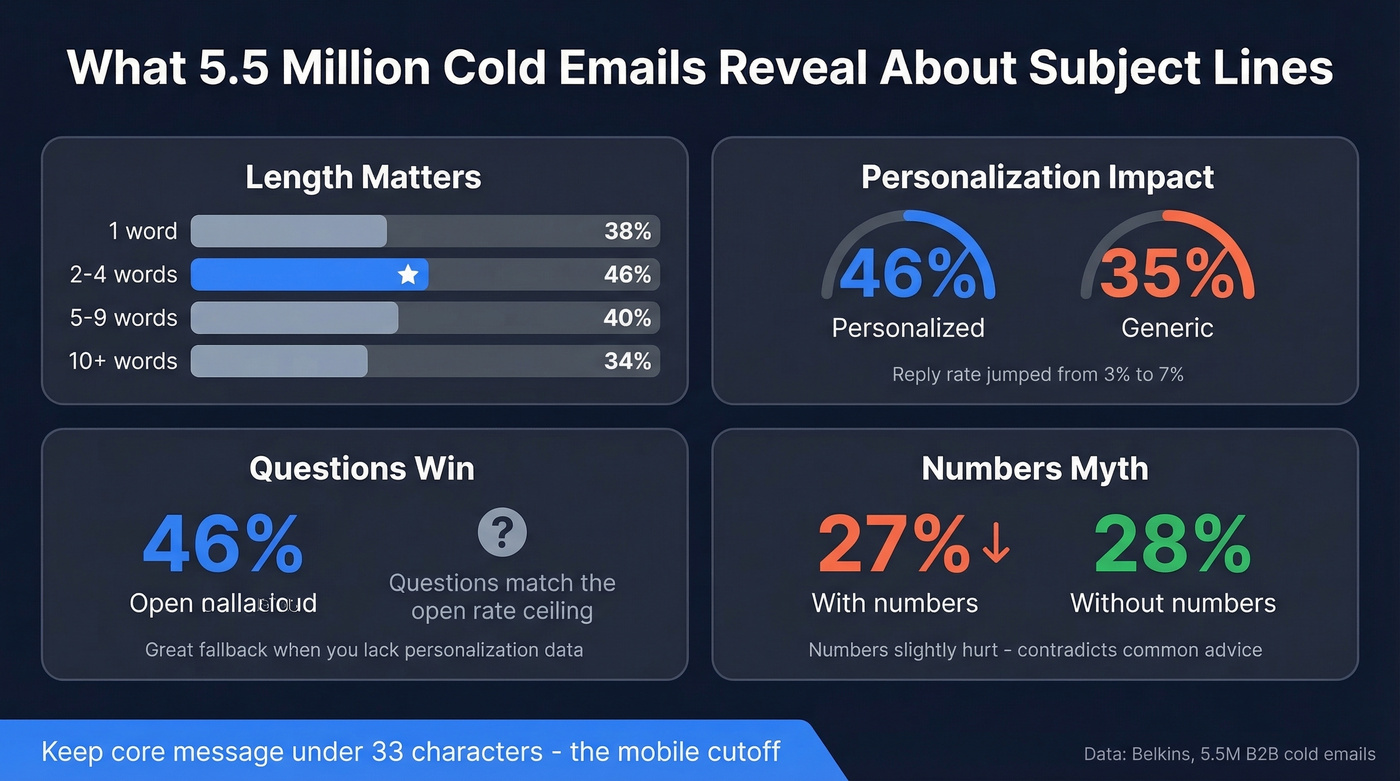
Two to four words hit 46% open rates - the best-performing bracket by a wide margin. One-word lines dropped to 38%, and by ten words you're down to 34%. Shorter wins.
Personalized subject lines pulled 46% opens vs. 35% without. Reply rates jumped from 3% to 7%. But here's what's interesting: Lemlist's analysis of hundreds of thousands of campaigns found that {{firstname}} alone made no notable difference. You need company name, pain point, or trigger event - not just a mail-merge token.
Questions matched the 46% open ceiling. A subject line framed as a question performed as well as the best personalized lines, which gives you a useful fallback when you don't have deep personalization data.
Numbers slightly hurt performance - 27% opens vs. 28% without. This contradicts the "numbers always win" advice you'll see everywhere.
And keep the core message within 33 characters. That's the cutoff on most mobile devices, where most B2B emails get their first glance.
Cold Call Openers That Work
Use these:
- "I noticed [specific thing about their company]. Quick thought on that."
- "We help [similar company] with [outcome]. Worth 30 seconds?"
- "[Mutual connection] suggested I reach out."
- "Congrats on [trigger event]. That usually creates [problem] - want to compare notes?"
Skip these:
- "Do you have a minute?" - easy out, zero curiosity.
- "I have a quick question." - dead. Everyone uses it.
- "How are you today?" - prospects know you don't care.
Top-performing teams hit 6-10%+ connect-to-meeting rates with tight, specific openers. We've seen the gap between 2% and 8% come down almost entirely to that first sentence - the rest of the call matters far less than most reps think.
If you want more scripts beyond openers, pull from these email subject line examples and adapt them to your call + voicemail context.

Trigger-based openers only work when you're reaching real people at real addresses. Prospeo's 5-step verification and 7-day data refresh give you 98% email accuracy - so your carefully crafted subject lines actually reach inboxes, not bounce folders.
Stop perfecting subject lines that bounce. Start with verified data.
Voicemail: Your Other Subject Line
Here's the thing about voicemails: they don't drive callbacks. Gong's 300M+ call analysis found they actually reduce future connect rates by 28%. But they more than double email reply rates - from 2.73% to 5.87%. The voicemail isn't the message. It's the primer.
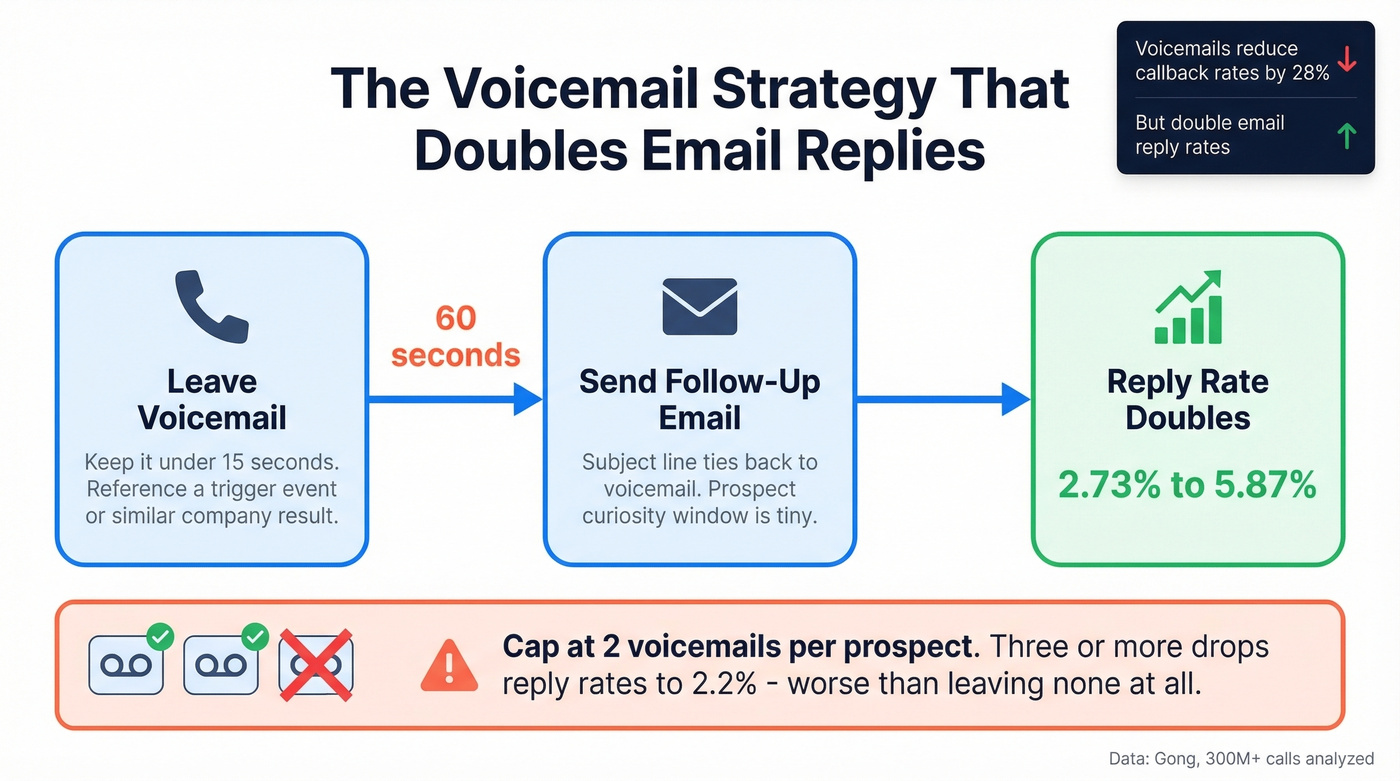
Leave it, then send a follow-up email within 60 seconds. The prospect's curiosity window is tiny.
Cap it at two voicemails per prospect. Three or more drops email reply rates to 2.2%, which is worse than leaving none at all. Two scripts that work:
- "Hey [Name], quick 12-second voicemail. We helped [similar company] cut [metric] by [number]. Sending you a one-liner now."
- "[Name], saw [trigger event]. Leaving this so my email doesn't look random. Check your inbox."
If you're building a repeatable cadence, a simple cold calling system helps keep call + voicemail + email consistent.
Subject Lines for Follow-Up Emails
The most recent large-scale benchmark (16.5M emails, Belkins) puts the average cold email reply rate at 5.8%, down from 6.8% the prior year. Your cold call subject line is competing against dozens of other emails in their inbox this week, so every word has to earn its place.
If you need plug-and-play copy for the body (not just the subject), start with these sales follow-up templates and tailor the first line to your trigger.
| Approach | Example |
|---|---|
| Question | "Scaling [team] this quarter?" |
| Trigger event | "Re: your Series B" |
| Value prop | "[Outcome] for [Company]" |
| Social proof | "[Similar company] switched" |
| FOMU (fear of messing up) | "Is [process] costing you deals?" |
Personalization has tiers. Tier 1 is company and title - table stakes. Tier 2 is tech stack and funding round, and that's where reply rates start climbing. Tier 3 is trigger events like executive hires, product launches, or earnings calls.
To operationalize Tier 3, you need a process for how to track sales triggers so reps aren't guessing.
The line between "relevant" and "creepy" is simple: stick to public professional data. Referencing someone's podcast appearance is smart. Referencing their kid's school is not.
One more thing worth flagging: target 1-2 contacts per company, not 10+. Reply rates drop from 7.8% to 3.8% when you spray an entire org chart. Keep your email body to 6-8 sentences - that range hit 42.67% opens and 6.9% replies in the data.
A quick CAN-SPAM note: your subject line can't mislead the recipient. Using "Re:" on a first-touch email is deceptive if there's no prior thread, and it can put you on the wrong side of CAN-SPAM's requirement that subject lines reflect the message content.
Words That Kill Your Open Rate
Modern spam filters use context, reputation, and engagement signals - not just keyword blacklists. But certain words act as risk multipliers:
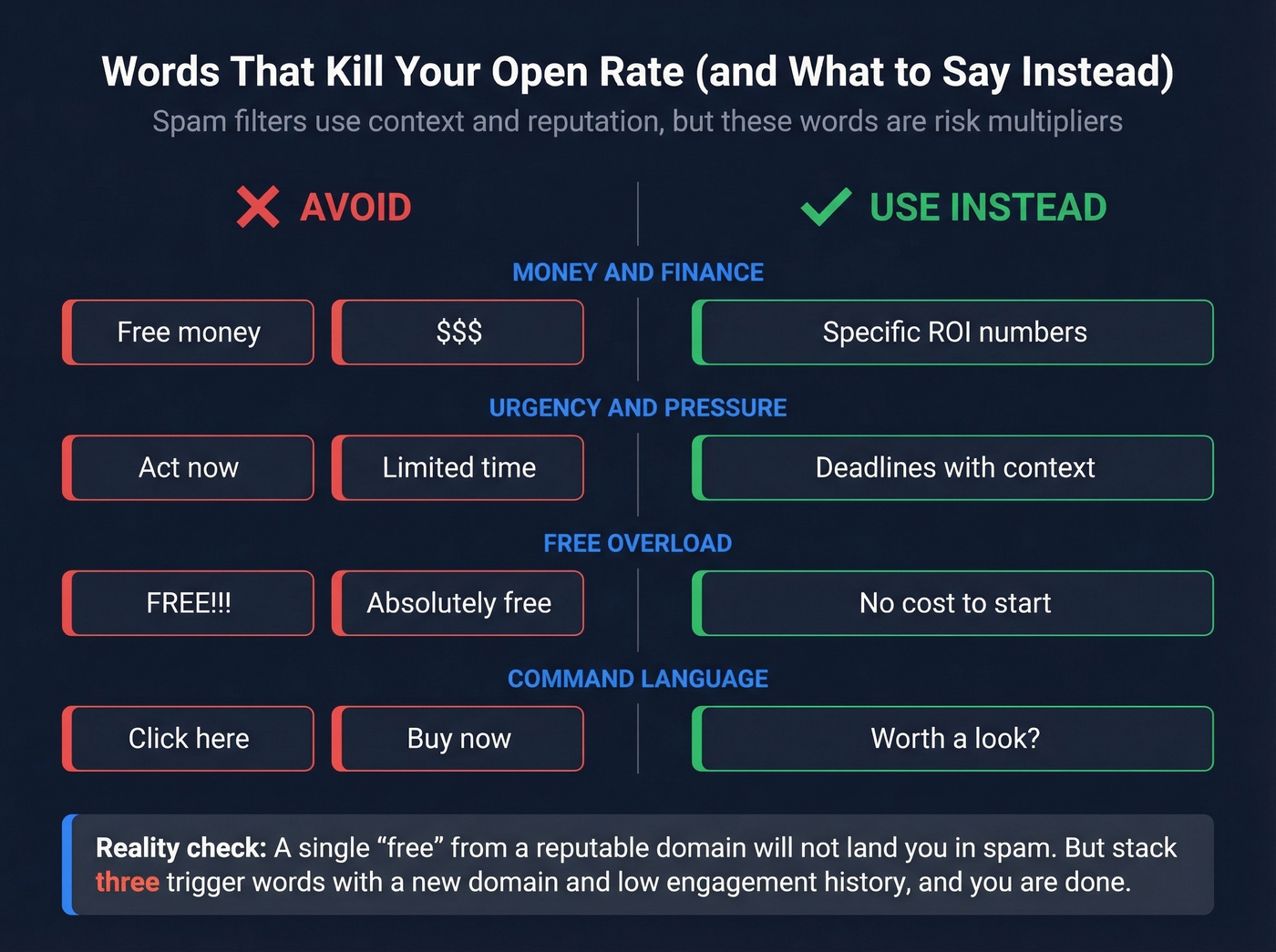
| Category | Avoid | Use Instead |
|---|---|---|
| Money/finance | "Free money," "$$$" | Specific ROI numbers |
| Urgency/pressure | "Act now," "Limited time" | Deadlines with context |
| Free overload | "FREE!!!," "Absolutely free" | "No cost to start" |
| Command language | "Click here," "Buy now" | "Worth a look?" |
Real talk: a single "free" in a well-crafted email from a reputable domain won't land you in spam. But stack three trigger words with a new domain and low engagement history, and you're done.
None of this matters if you're emailing dead addresses, either. A high bounce rate tanks sender reputation and sends even perfect subject lines to spam. Prospeo runs a 5-step verification process with 98% accuracy and refreshes data every 7 days, which catches invalid addresses, spam traps, and honeypots before they touch your domain.
If you're troubleshooting bounces specifically, use this email bounce rate guide to map codes to fixes.
How to Test Without Guessing
Send to 250+ contacts per variant minimum - 50 sends is a coin flip, not a test. Change one variable at a time: subject line length OR personalization type, never both. And optimize for positive reply rate, not opens. Clickbait subject lines spike opens but tank replies and hurt sender reputation long-term.
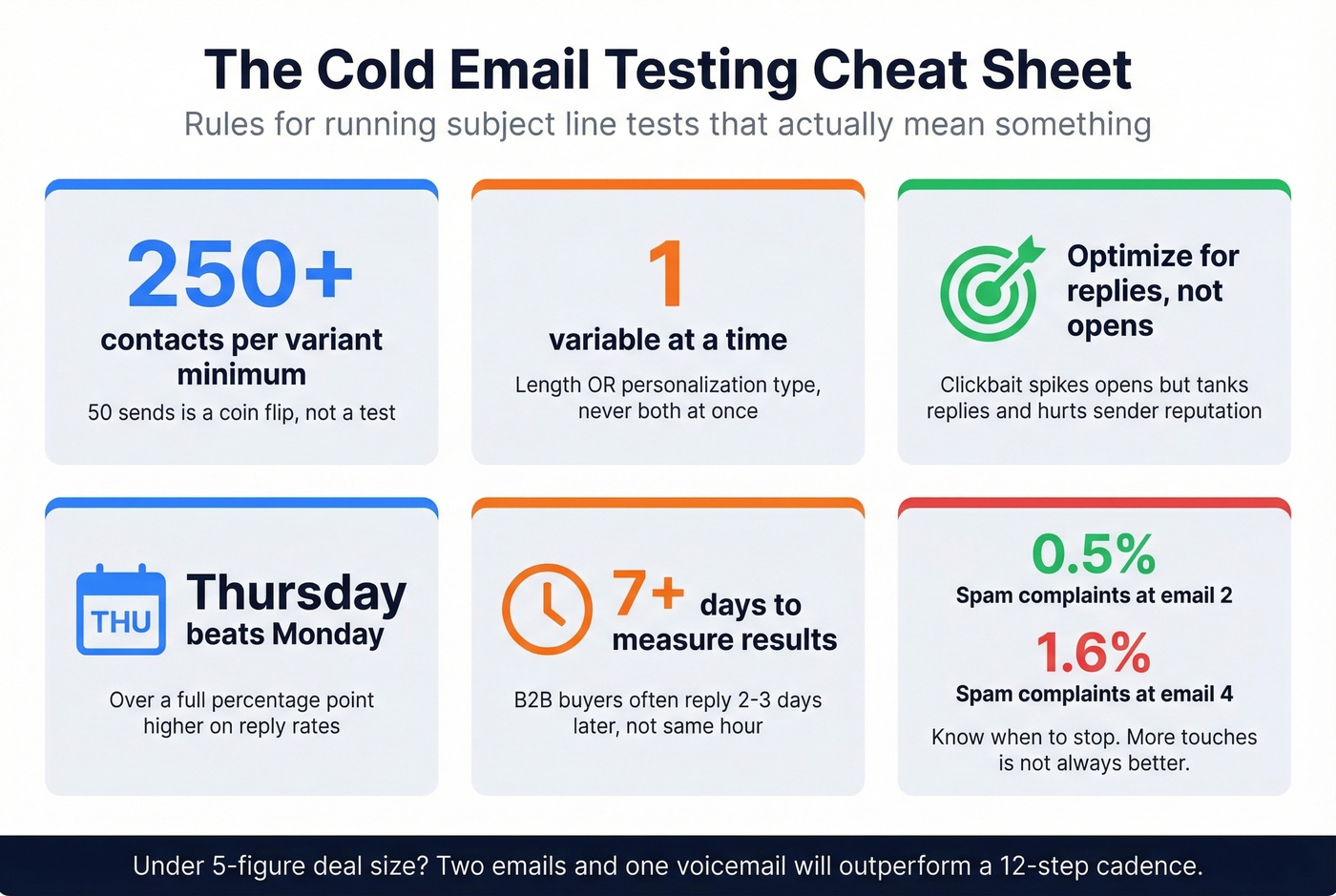
Run tests under the same conditions - same audience, same sending window. Thursday outperforms Monday by over a percentage point on reply rates. Track results over 7+ days because B2B buyers don't reply the same hour, and many respond 2-3 days later.
For timing benchmarks and a repeatable schedule, see best time to send cold emails and keep your tests consistent.
Let's be honest about sequencing, too. If your deal size is under five figures, you probably don't need a 12-step multi-channel cadence. Two emails with sharp subject lines and one voicemail will outperform a bloated sequence that triggers spam complaints. Spam complaints jump from 0.5% to 1.6% by the fourth follow-up. Know when to stop.
If you're building a full outbound motion, these sales prospecting techniques help you choose the right channels and sequencing.
Tier 2 and Tier 3 personalization - tech stack, funding rounds, job changes - requires fresh data. Prospeo refreshes every 7 days and returns 50+ data points per contact, so your subject lines reference triggers that happened this week, not last quarter.
Write subject lines with real-time trigger data at $0.01 per email.
FAQ
How long should a cold email subject line be?
Two to four words performs best at a 46% open rate across 5.5 million emails. Keep the core message within 33 characters - that's the mobile cutoff where most B2B recipients first see your message.
Does leaving a voicemail help cold outreach?
Not for callbacks - but voicemails double email reply rates from 2.73% to 5.87%. Send a follow-up email within 60 seconds of hanging up. Cap it at two voicemails per prospect; three or more drops reply rates below baseline.
What makes the best cold call email subject lines stand out?
Specificity and brevity. Personalized, two-to-four-word subject lines consistently outperform generic ones. Reference a trigger event or company-specific detail rather than relying on first-name tokens alone.
How do I keep cold emails out of spam?
Verify every address before sending - bounces destroy sender reputation faster than any spam-trigger word. Use a verification tool with catch-all handling and spam-trap removal, and keep your sending volume consistent rather than spiking it. A clean list is worth more than any subject line trick.