

Cold Calling Best Practices That Actually Work (Backed by 10M+ Calls)
It's 9 AM on a Tuesday. You've got a fresh list, a decent script, and eight straight dials that hit disconnected numbers. By the time you reach a human, your energy's shot and your opener sounds like you're reading a cereal box.
Reps lose 27.3% of their calling time to bad contact data - nearly a third of your dial session wasted before you even test your pitch. Every guide tells you to "research your prospect" and "be confident." That's not advice. That's a motivational poster.
Here's what actually moves the needle: fix your data before your script.
The Three Changes That Matter Most
If you read nothing else, make these three changes. They compound on each other.
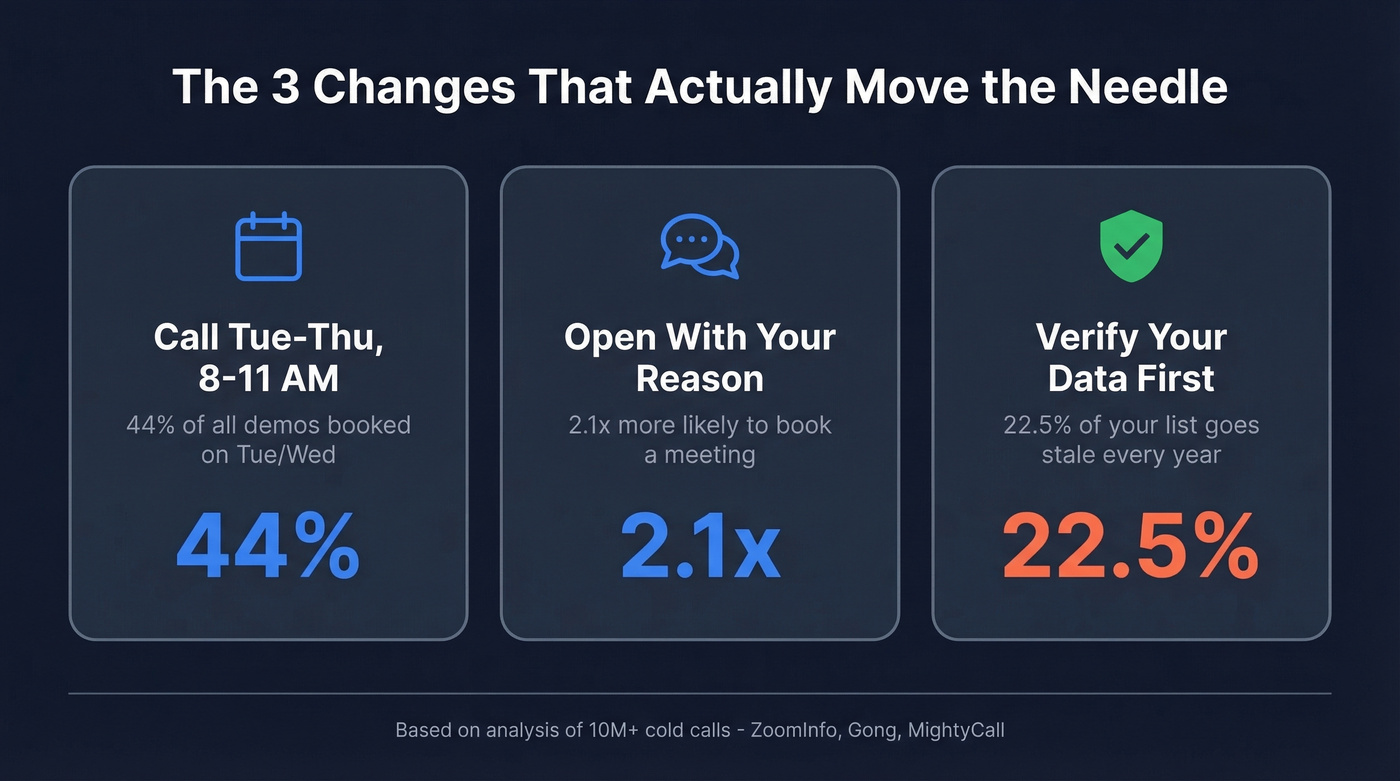
Call Tuesday through Thursday, 8-11 AM local time. ZoomInfo's analysis of 1.4M outbound calls found Tuesday and Wednesday account for 44% of all demos booked. MightyCall's 187K-call dataset confirms the 8-11 AM window consistently outperforms every other slot.
Open with the reason for your call. An analysis of millions of sales calls shows this single change makes you 2.1x more likely to book a meeting. Not rapport. Not "how's your day." The reason you're calling.
Verify your contact data before every session. B2B data decays roughly 2.1% per month - that's 22.5% of your list going stale every year. If your reps are dialing dead numbers, nothing else matters.
Cold Calling Benchmarks Worth Knowing
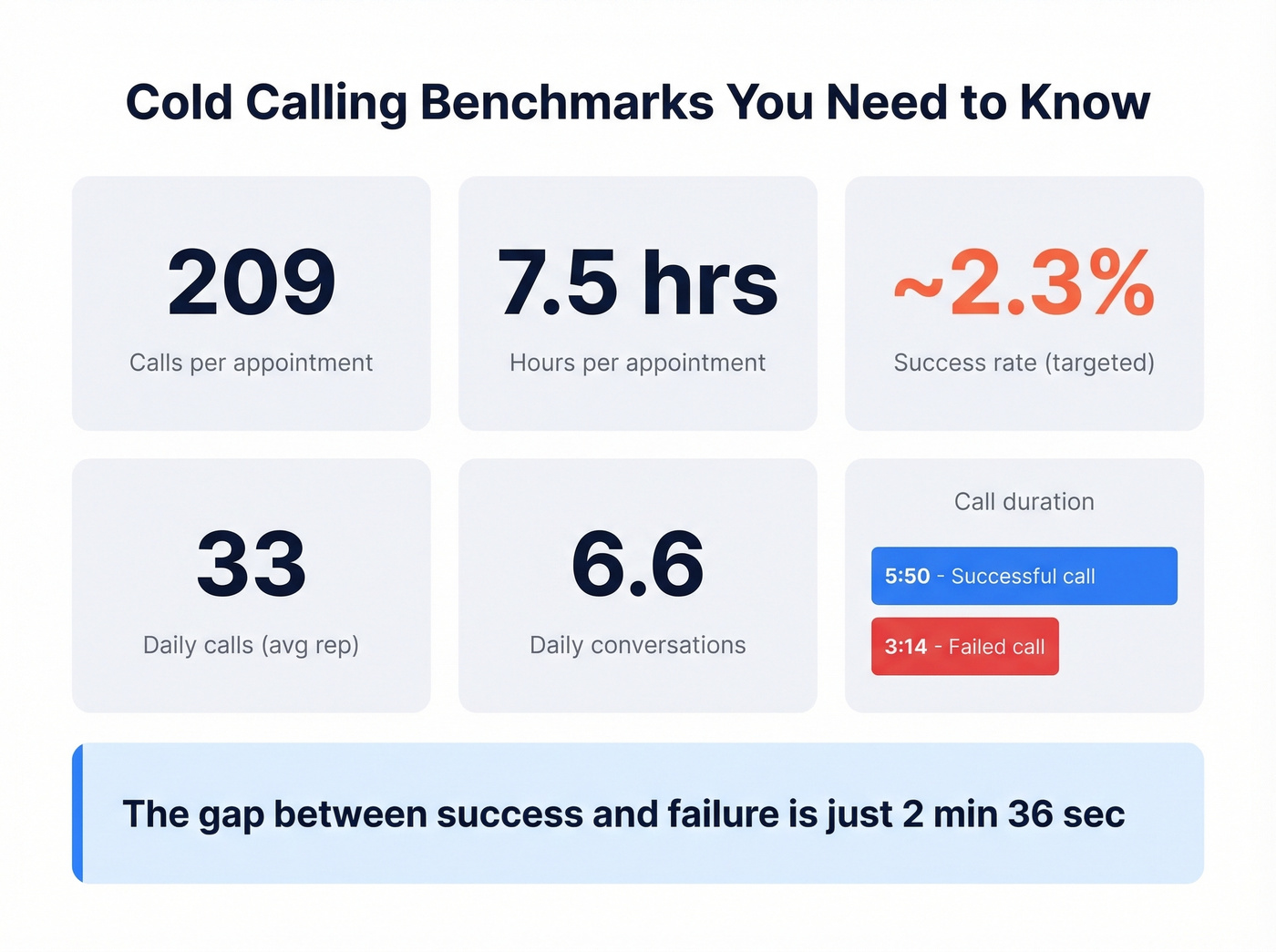
These numbers aren't discouraging - they're a baseline to beat. Most reps have no idea what "normal" looks like, so they either overestimate their problem or underestimate their progress.
| Metric | Benchmark | Source |
|---|---|---|
| Calls per appointment | 209 | Bridge Group |
| Hours per appointment | 7.5 | Baylor University |
| Appointment rate | ~1% | CRMNext |
| Daily calls (inside sales) | 33 | Bridge Group |
| Daily conversations | 6.6 | Bridge Group |
| Successful call duration | 5:50 | Gong |
| Failed call duration | 3:14 | Gong |
The gap between successful and failed calls is 2 minutes 36 seconds. Top reps aren't talking longer because they're rambling - they're talking longer because the prospect is engaged enough to stay on the line.

The average cold calling success rate sits around 2.3% for well-targeted campaigns. For every 100 dials, you're getting two to three real conversations that go somewhere. The question isn't whether cold calling works. It's whether your process is efficient enough to make those 100 dials count.
Before You Call
Best Days and Times
ZoomInfo's 1.4M-call study ranks Tuesday as the best overall day. Monday leads on call-to-demo efficiency at 1.19% and ties Tuesday for the highest positive call rate at 4.8%. Friday is dead last across every metric - lowest volume, lowest connection rates, lowest demos.
MightyCall's dataset adds the time dimension: Monday at 8 AM hits a 30.4% success rate against a 20.8% average. The 8-11 AM window outperforms afternoon slots consistently, regardless of the day. If you're scheduling power hours, stack them Tuesday through Thursday mornings in your prospect's local time zone.
Research That Actually Helps
Stop Googling your prospect for 20 minutes before each dial. You don't need their life story. You need two or three things that make your opener relevant: a recent company trigger event like a funding round or new hire in your buyer's department, their tech stack if it's relevant to what you sell, and one role-specific pain point you can reference in your first sentence.
Two to three minutes per prospect. Anything more is procrastination disguised as preparation.
Fix Your Data First
Here's the thing: none of the timing or scripting advice matters if half your numbers are wrong. B2B contact data decays at roughly 2.1% per month. Over a year, that's nearly a quarter of your list going stale - people changing jobs, getting new numbers, leaving companies entirely. Bad data costs the average organization $12.9M per year, and for individual reps, it means burning through dial sessions reaching voicemails and disconnected lines instead of humans.
Most teams obsess over scripts and objection handling when their real problem is upstream. If your connect rate is below 10%, no amount of coaching fixes that - your data does. Verify your list before every calling session. We've seen teams using Prospeo's Mobile Finder triple their connect rates to 20-25% because the 125M+ verified mobile numbers refresh on a 7-day cycle, meaning the numbers reps dial actually ring. Your basic cold calling tech stack should be a parallel dialer, a verified data source, and a CRM to log outcomes. Get those three right and everything downstream improves. If you need a repeatable process, build a full cold calling system around it.
Openers That Work (With Data)
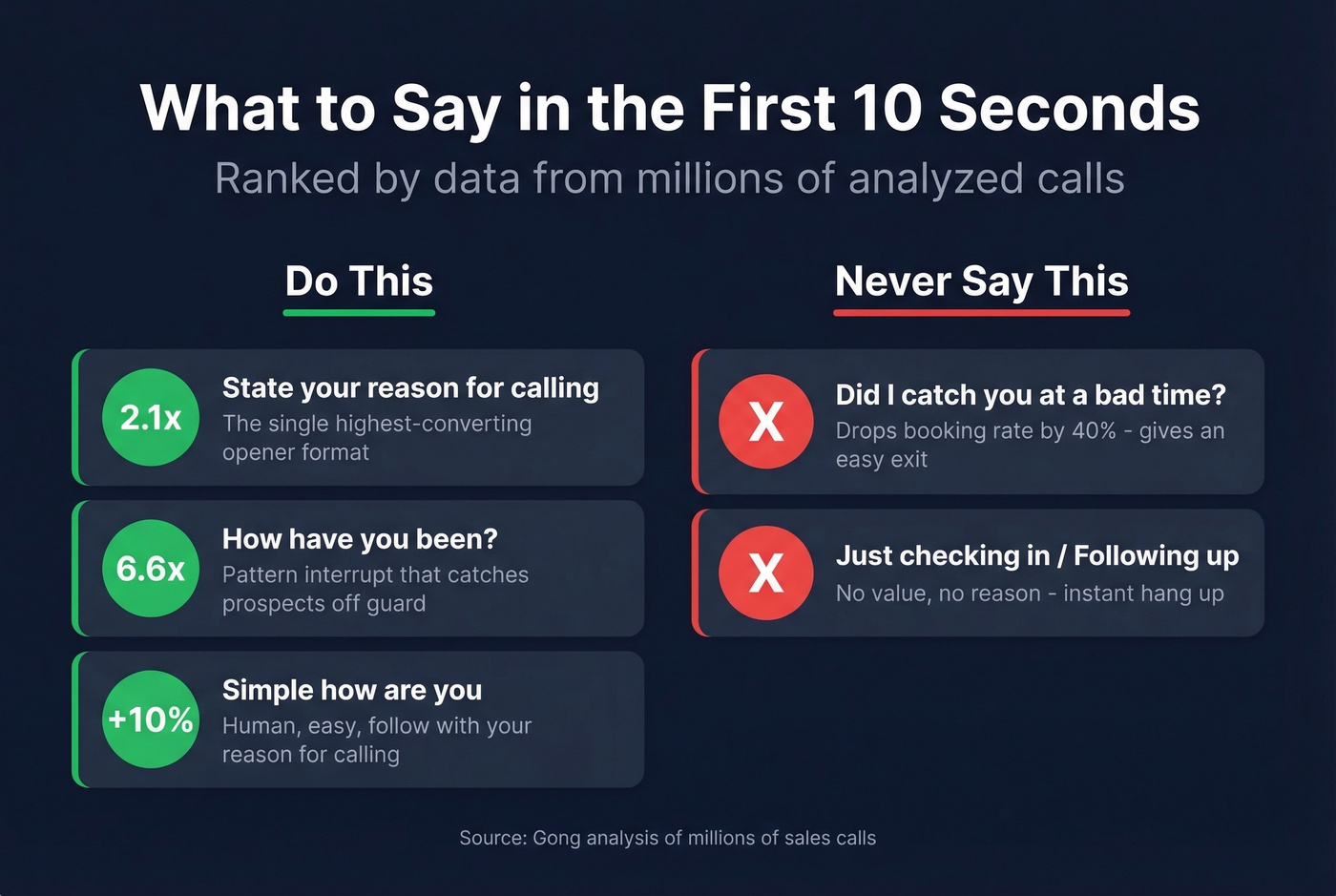
The first 10 seconds of a cold call determine whether you get 5 more minutes or a dial tone. Gong's analysis of millions of calls gives us hard numbers.
Kill "Did I catch you at a bad time?" first. It drops your meeting booking rate by 40%, gives the prospect an easy exit, and frames the entire call as an interruption. Delete it from your vocabulary permanently.
Stating the reason for your call makes you 2.1x more likely to book. "How've you been?" performs 6.6x better than calls without it - probably because it's a pattern interrupt that catches prospects off guard. A simple "how are you" boosts success rates by about 10%.
One more data point that surprises people: on successful cold calls, the rep talks about 55% of the time and delivers longer monologues - 53 seconds versus 25 seconds on unsuccessful calls. Cold calling isn't discovery. You need to earn the right to ask questions by delivering value first. If you want more plug-and-play language, keep a few talk track examples ready for different segments.
Five Openers You Can Steal
The Transparency Opener works best when you're calling into a market that gets hammered by SDRs. "Hey [Name], this is [You] from [Company]. Full transparency - this is a well-researched B2B sales call. If it's not relevant, tell me and I'll hang up. Fair?" The disarming honesty buys you 15 extra seconds most of the time.
The Reason-for-Call Opener is the single highest-converting format. "Hey [Name], the reason I'm calling is that I saw you just hired three new SDRs. We help teams like yours [specific outcome]. Got 90 seconds?"
| Opener | When to Use | Why It Works |
|---|---|---|
| Pattern Interrupt ("How've you been?") | Cold list, no trigger event | 6.6x better than no greeting - breaks the "sales call" pattern |
| Mutual Connection | Warm intro available | Referencing a shared contact boosts meeting rates ~70% |
| Simple "How Are You" | Any situation | Backed by data, human, easy - follow with your reason for calling |

Bad data kills cold calls before your opener gets a chance. Prospeo's Mobile Finder gives reps 125M+ verified mobile numbers on a 7-day refresh cycle - not the 6-week-old data that fills your sessions with disconnected lines. Teams using Prospeo hit 20-25% connect rates with a 30% pickup rate across all regions.
Stop dialing dead numbers. Start every power hour with data that picks up.
During the Call
An analysis of 326,000 sales calls found something that contradicts most cold calling advice: asking more questions doesn't help. Reps who closed deals asked 15-16 questions. Reps who lost asked around 20. More questions creates an interrogation dynamic - the prospect feels grilled, not understood.
The talk-to-listen ratio tells a similar story. Closed-won deals averaged 57% rep talk time. Lost deals hit 62%. Top performers give the prospect slightly more room to breathe, and their ratio barely shifts between won and lost calls, while low performers swing 10 points depending on the outcome. This is a core piece of sales communication that most teams never measure.
Anatomy of a 5-Minute Call
Think of a productive cold call in four segments. Your opener and reason for calling should take the first 30 seconds. Spend the next two minutes delivering a specific, relevant value statement - this is where those 53-second monologues live. Then shift to one or two targeted questions for about 90 seconds, letting the prospect talk. Close with a clear next step in the final minute: propose a specific time, confirm it, and send the calendar invite while they're still on the line.
If you’re struggling to keep calls tight, it helps to treat this like sales activities with a defined cadence and scorecard.
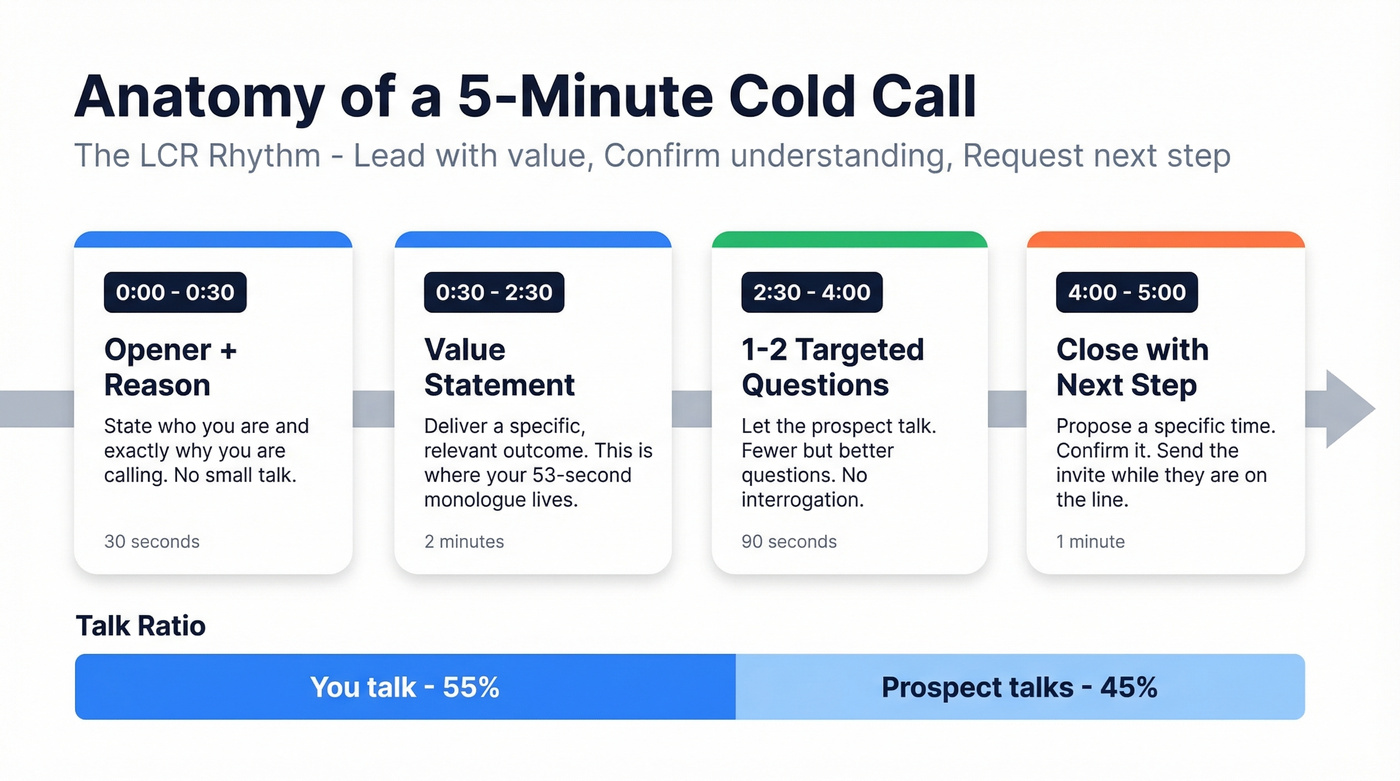
Let's break this down to one number: aim for roughly 55% talk time. Ask fewer but better questions. We call this the LCR rhythm - Lead with value, Confirm understanding, Request the next step. We've seen reps dramatically improve their booking rates just by slowing down and saying less.
Objection Handling: The LCR Method
Sixty percent of cold calls hit "I'm not interested." It's the default brush-off, not a real objection. Having a scripted response ready is table stakes. The LCR framework: Listen (let them finish), Clarify (make sure you understand the real concern), Respond with value - not with a pitch, but with a specific outcome.
If this is where you freeze up, build reps’ confidence with a dedicated cold call rejection playbook.
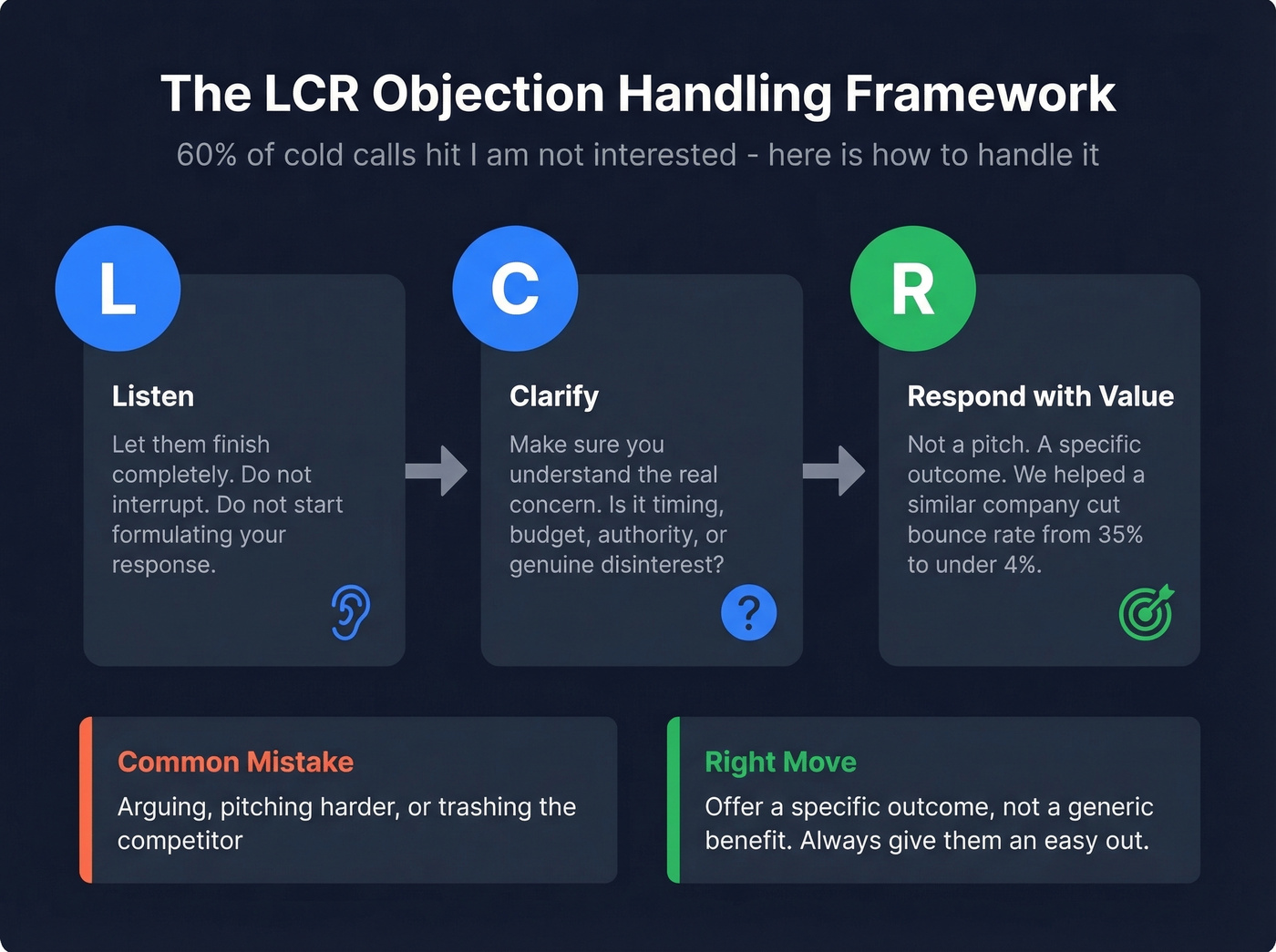
"I'm not interested." "Totally fair - most people say that before they hear why I'm calling. Can I take 90 seconds to share one thing? If it's not relevant, I'll let you go. We helped a similar company cut their bounce rate from 35% to under 4%."
"I'm too busy right now." "I respect that. Could I take 90 seconds? If it's not a fit, you'll never hear from me again."
"Just send me an email." "Happy to. Before I do - could I ask one quick question so I send you something actually relevant instead of a generic pitch?"
| Objection | Key Move | What NOT to Do |
|---|---|---|
| "I'm not the decision maker" | Ask who handles the specific area by name - "Who typically owns sales tech stack decisions?" | Don't pitch them anyway hoping they'll relay the message |
| "We already have a solution" | Ask how it's working for one specific pain point, then offer a concrete improvement | Don't trash the competitor - it makes you look desperate |
The key across all of these: don't argue, don't pitch harder, and always offer a specific outcome rather than a generic benefit.
After the Call
Most reps quit after one or two follow-ups. It typically takes at least five to get a prospect's attention. The consensus on r/sales is that persistence beats perfection - but only when each touchpoint adds something new.
For your follow-up email, go ultra-short: 40-60 words max. Context signal, outcome, proof, soft CTA. That's it. No three-paragraph recap. No PDF attachment. Personalization without a strong offer is wasted effort - "I read your blog post" means nothing if your email doesn't promise a specific outcome. If you want copy you can paste, use these sales follow-up templates.
For voicemails, keep it under 30 seconds. "Hey [Name], it's [You] from [Company]. Calling because [one-sentence reason]. My number is [number]. Talk soon." Anything longer gets deleted before the halfway mark.
Build a self-scoring habit after every session. Rate each call 1-10 on execution - not outcome. This shifts the focus from "did they book?" to "did I run the play correctly?" Over time, the scores and the bookings converge.
Mistakes That Kill Your Results
A HubSpot practitioner shared their real numbers: 11,519 cold calls, 335 meetings booked, $287K closed at a startup and $40M in enterprise deals. Their 69.1% meeting-to-SQL conversion and sub-18% no-show rate are elite. The biggest lesson from all those dials? Stop pitching too early. Open with relevance, not rapport.
I've watched reps read from a rigid script like they're doing a table read for a bad movie. The prospect can hear it. A script is a framework, not a teleprompter. Know your key points, but sound like a human having a conversation - not an actor who forgot their motivation. If you need a tighter structure, borrow from proven sample elevator pitches and adapt them to phone.
The other consistent killer: giving up after one or two attempts when the data clearly shows five-plus touches is where meetings happen. Skip the "spray and pray" approach entirely - if you aren't willing to follow up at least five times, don't bother making the first call.
Compliance in 2026
Compliance isn't optional, and the penalties have teeth.
| Regulation | Penalty | Key Rule |
|---|---|---|
| TCPA | $500-$1,500/violation | Consent for auto/prerecorded calls |
| TSR | Up to $50,120/violation | No misrepresentation (covers B2B*) |
| State mini-TCPAs | Up to $20,000/violation (CT) | Some states including TX, VA, CT have stricter rules |
*TSR's misrepresentation rules apply to B2B, but DNC provisions under TSR don't apply to B2B calls - an important distinction.
Your compliance checklist:
- Call only between 8 AM and 9 PM in the recipient's local time zone
- Scrub your list against the National DNC Registry every 31 days minimum - 241M+ numbers are on it
- Maintain an internal DNC list and honor opt-outs within 10 business days
- Know your EBR exemptions: 18 months after a transaction, 3 months after an inquiry
- Since February 2024, the FCC has classified AI-generated voice as "artificial/prerecorded" under TCPA - you need prior express written consent for any AI voice marketing calls
- Consent revocation rules effective April 2025: consumers can revoke consent by any reasonable means, honored within 10 business days
If you’re expanding channels, make sure your team understands cold texting rules too.
At 209 calls per appointment, every wasted dial compounds. Prospeo delivers direct dials at $0.01 per lead with 98% email accuracy and 125M+ verified mobiles - so your Tuesday morning power hours connect to real humans, not voicemail graveyards. One team tripled their pipeline from $100K to $300K/week after switching.
Triple your connect rate before you touch your script.
FAQ
Does cold calling still work in 2026?
Yes - the average success rate for targeted campaigns is around 2.3%, and top reps consistently book 335+ meetings from ~11,500 dials. Bad calling doesn't work. That's a process problem, not a channel problem.
What's the best time to cold call?
Tuesday through Thursday, 8-11 AM in the prospect's local time zone. Monday at 8 AM hits a 30.4% success rate versus a 20.8% average. Timing alone can meaningfully lift your connect rate.
How many dials does it take to book a meeting?
About 209 dials per appointment on average. That number drops significantly when you verify contact data first - our customers have seen connect rates triple to 20-25% with verified mobile numbers.
What should I say in the first 10 seconds?
State the reason for your call - it makes you 2.1x more likely to book a meeting. Avoid "Did I catch you at a bad time?" which drops your booking rate by 40%. Lead with relevance, not small talk.
How do I handle "I'm not interested"?
Don't argue. Ask for 90 seconds to share one specific benefit relevant to their role. Sixty percent of cold calls hit this objection - having a scripted LCR response (Listen, Clarify, Respond with value) is essential.