

Cold Calling Strategies: The Data-Backed Playbook for 2026
47 dials. Three pickups. Zero meetings. That was a Tuesday - supposedly the best day to cold call. If that sounds familiar, your cold calling strategies aren't broken. Everything that happens before you open your mouth is.
Here's what the data says: [4.82% of cold call conversations](https://www.cognism.com/cold-calling-report-2025) resulted in a meeting booked in 2024, dropping to about 2.3% in 2025. Meanwhile, 69% of buyers have picked up a call from a new vendor in a recent survey. Cold calling outperforms cold email by a wide margin - email averages a 7% response rate and takes roughly 306 touches to generate a single lead. The phone channel works. Lazy execution doesn't.
The Short Version
Your connect rate problem is a data problem, not a script problem. Fix your numbers first - verified mobiles, 7-day data refresh - then use a permission-based opener and the Embrace, Inform, Question objection framework. The rest is consistency.
Benchmarks That Actually Matter
Most "cold calling stats" articles dump 50 numbers without context. These are the ones that change how you plan your day.
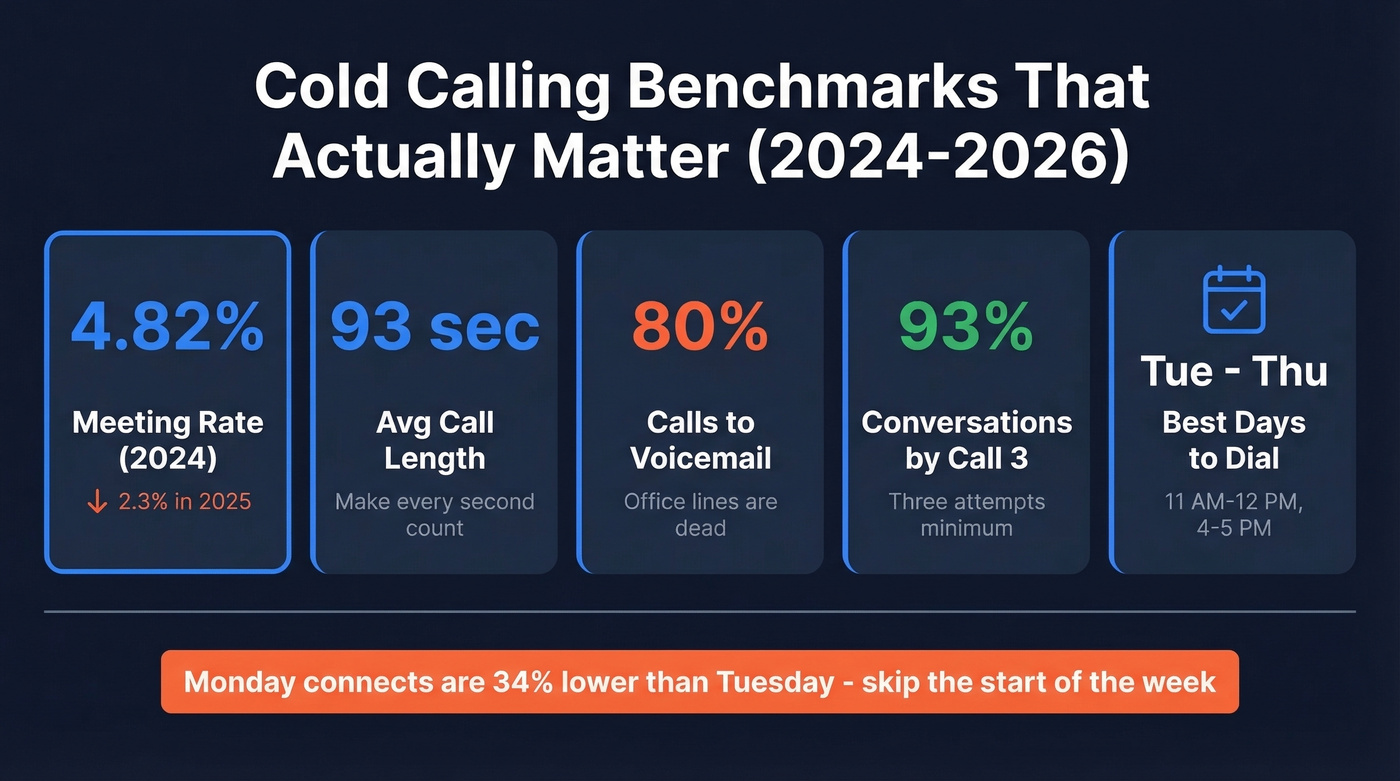
| Metric | Value | Source |
|---|---|---|
| Meeting-booked rate (2024) | 4.82% | WHAM/Cognism |
| Meeting-booked rate (2025) | ~2.3% | WHAM/Cognism |
| Avg. call length | 93 seconds | WHAM |
| Best days to dial | Tue-Thu | WHAM + HubSpot |
| Best call windows | 11 AM-12 PM, 4-5 PM | Zendesk + HubSpot |
| Calls to voicemail | 80% | RingLead |
| Conversations by call 3 | 93% | WHAM |
| Conversations by call 5 | 98.6% | WHAM |
| Monday vs. Tuesday connect | 34% lower on Monday | InsideSales |
Two numbers jump out. First, 80% of calls go to voicemail - your office-line-only data provider is burning four out of five dials. Second, 93% of conversations happen by the third attempt. One-and-done dialing leaves meetings on the table.
The drop-off between attempts is steep: call 1 to call 2 loses 73% of potential conversations, call 2 to call 3 loses another 60%. After call 5, you're chasing the last 1.4%. Three attempts minimum, five for high-value accounts, then move on.
Before You Dial: Research and Data Quality
Most reps spend zero minutes on research and then wonder why prospects hang up in eight seconds. The fix isn't a 20-minute deep dive - it's a 2-3 minute pre-call checklist.
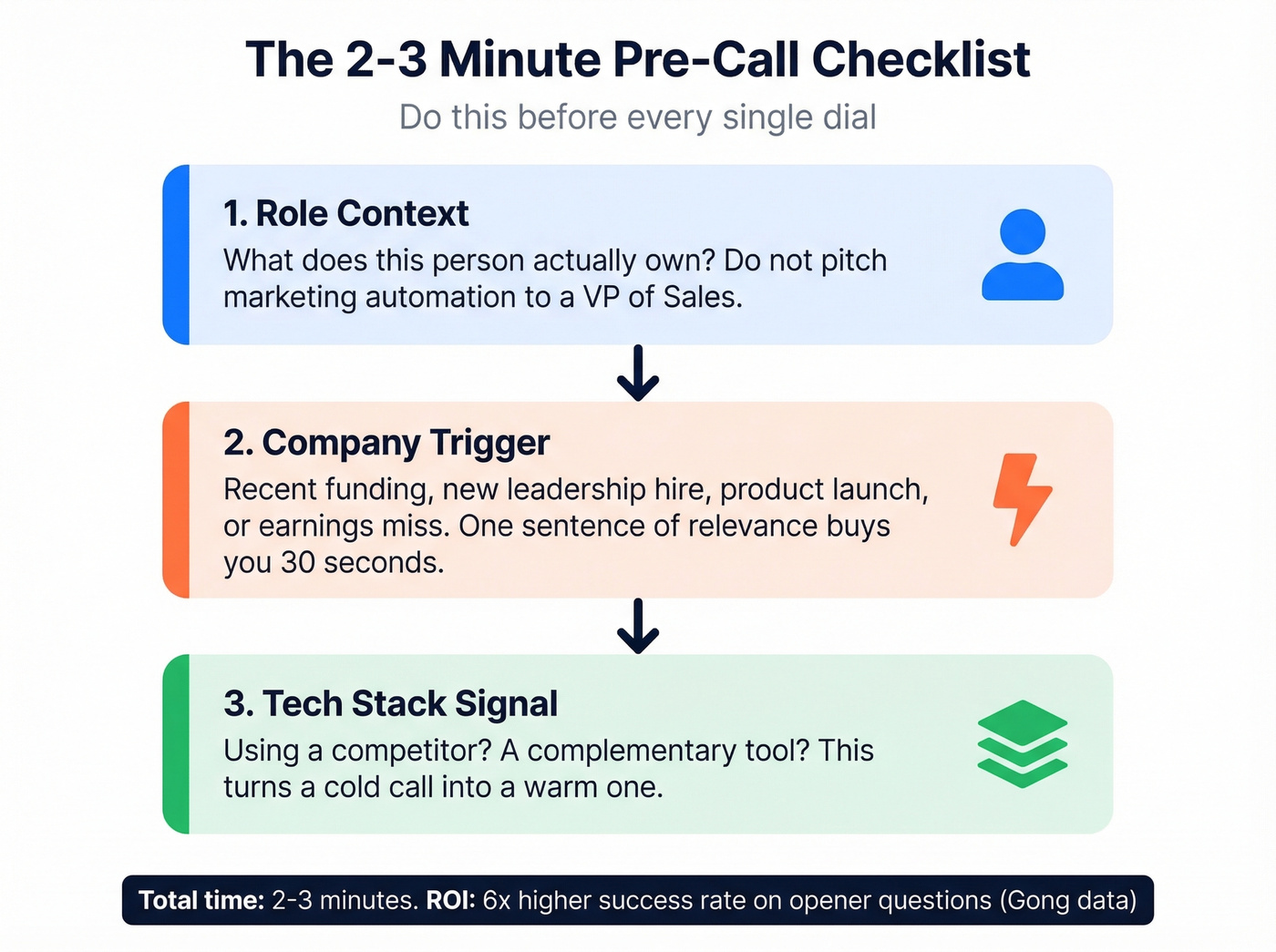
Before every dial, check three things:
- Role context - What does this person actually own? Don't pitch marketing automation to a VP of Sales.
- Company trigger - Recent funding, new hire in leadership, product launch, or earnings miss. One sentence of relevance buys you 30 seconds.
- Tech stack signal - Are they using a competitor? A complementary tool? This turns a cold call into a warm one.
Intent data makes this sharper. If a prospect's company is actively researching solutions in your category, that "cold" call is already warm before you dial. Prioritize accounts showing buying signals and you'll spend less time convincing people to listen.
Now the elephant in the room: your phone numbers. If 80% of office-line calls go to voicemail, the single highest-leverage thing you can do is dial verified mobile numbers instead.
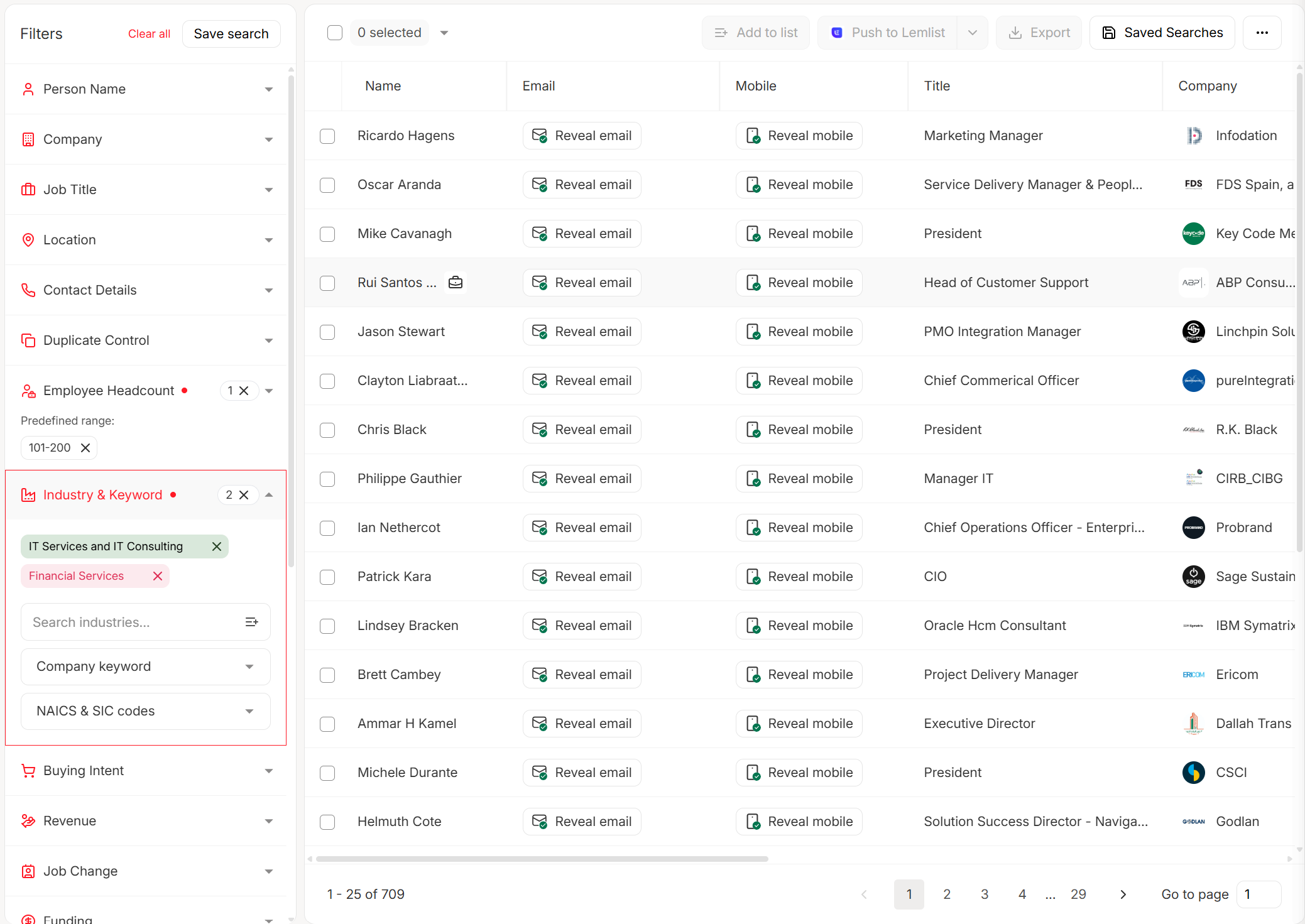
One SalesOps team on r/sales reported a ~6% connect rate and questioned whether the old 15-20% benchmarks still hold. Based on WHAM data, they don't - but 6% is achievable with verified mobiles and proper cadence. We've seen teams using Prospeo's 125M+ verified mobile numbers hit a 30% pickup rate, which is roughly 2.5x what most providers deliver. The industry average refresh cycle is 6 weeks. A list you pulled last month has already decayed.
Cold Call Scripts That Work
Scripts aren't meant to be read verbatim. They're guardrails that keep you from rambling when adrenaline kicks in.
Permission-Based Opener
This is one of the highest-converting opener patterns we've tested. It gives the prospect control - and people who feel in control stay on the line.
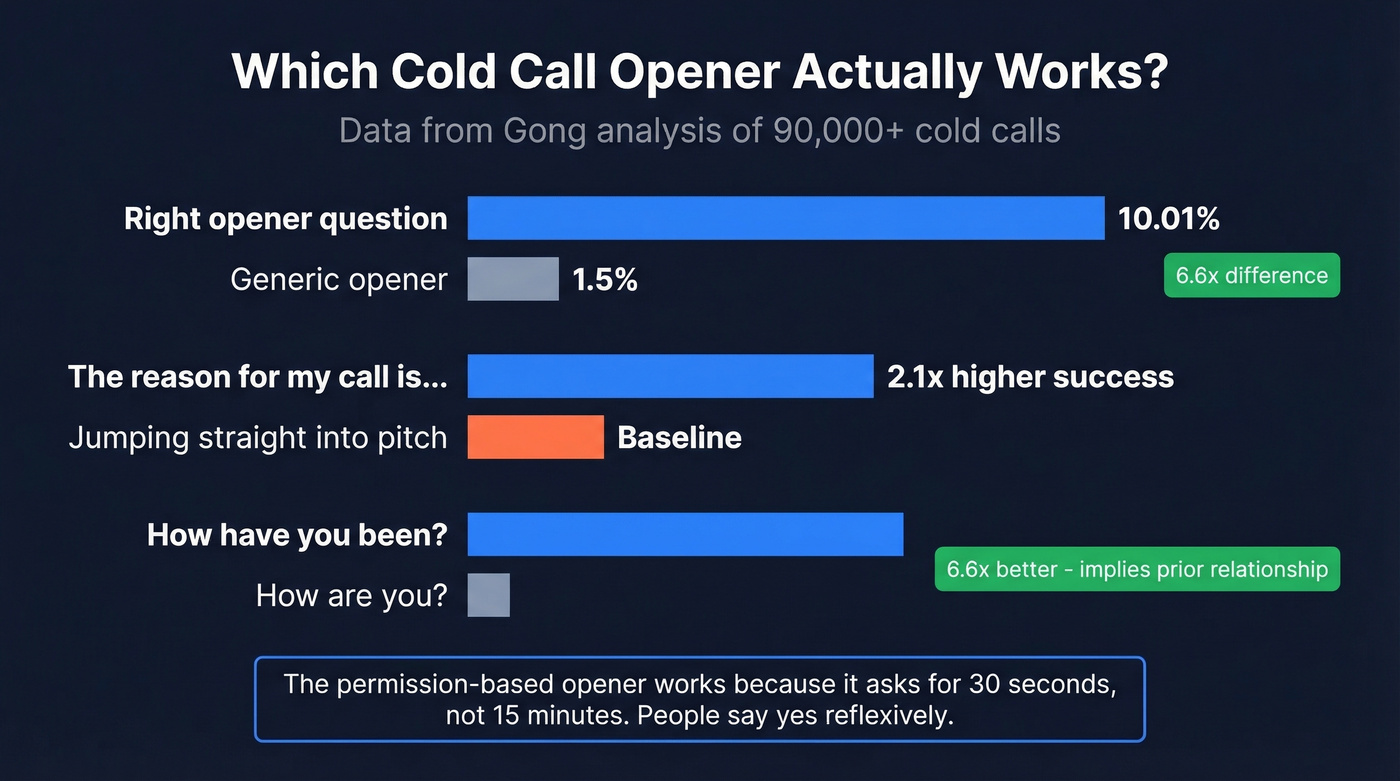
"Hey [Name], this is [Your Name] from [Company]. Mind if I take 30 seconds to tell you why I'm calling? Then you can decide if it's worth continuing."
The key is the micro-commitment. You're not asking for 15 minutes. You're asking for 30 seconds. Most people say yes reflexively.
"The reason for my call is..." as an opener drives a 2.1x higher success rate than jumping straight into a pitch. And "How have you been?" outperforms "How are you?" by 6.6x - it implies a prior relationship, which lowers the prospect's guard. Gong's analysis of 90,000+ cold calls found that the right opener question hits a 10.01% success rate versus a 1.5% baseline.
Gatekeeper Script
Gatekeepers aren't obstacles - they're people with information.
"Hi [Gatekeeper Name], I was wondering if you could help me. I'm trying to reach [Prospect Name] about [specific topic]. What's the best way to make that happen?"
You're asking for help, not demanding a transfer. Use the gatekeeper's name. Be human. This builds rapport instead of triggering the "another sales call" reflex.
Voicemail Script
You'll leave a lot of voicemails. Make them count. The rules: 30 seconds max, state your callback number twice, give one clear reason to call back.
"Hey [Name], it's [Your Name] at [Company]. I'm calling because [one-sentence reason tied to their business]. My number is [number] - that's [number] again. I'll try you again Thursday."
No rambling pitch. No "I'd love to connect." Just the reason and the number.
6 Strategies That Move Prospects to Meetings
Getting someone on the phone is step one. Converting that 93-second average call into a meeting is step two.
1. Delay the pitch. Earn 30 seconds before you sell anything. On call one, you're not building a friendship. You're earning five more minutes. The pitch comes after the prospect signals interest, not before.
2. Find the pain before presenting the solution. Ask one open-ended question about their current process. "How are you handling [specific workflow] today?" gets more mileage than any feature dump.
3. Listen more than you talk. Aim for a 40/60 split - you talk 40%, they talk 60%. 49% of successful cold calls last 2-5 minutes, and that length only happens when the prospect is doing most of the talking.
4. Use social proof from their world. "We work with three other Series B fintech companies dealing with the same problem" hits harder than any generic value prop. Specificity builds credibility.
5. Ask for a micro-commitment, not a meeting. "Would a 10-minute call Thursday make sense so I can show you what I mean?" converts better than "Can I get 30 minutes on your calendar?" Lower the bar.
6. Confirm the next step before hanging up. Never end a call with "I'll send you some info." End with a calendar invite sent while you're still on the line. If you can't book it live, get a specific day and time - vague follow-ups die in the inbox.

Your cold calling strategy is only as good as your phone numbers. Prospeo gives you 125M+ verified mobile numbers with a 30% pickup rate - 2.5x the industry average. Data refreshes every 7 days, not every 6 weeks.
Stop burning dials on dead office lines.
How to Handle Objections
Objections aren't rejections - they're information. The question is whether you're hearing a blocking objection or a qualifying one, because your response should be completely different.
Blocking vs. Qualifying
ZoomInfo's framework breaks this down cleanly. Blocking objections - "I'm busy," "send me an email," "not interested" - are reflexive. The prospect hasn't processed what you said. Qualifying objections - "we already have a vendor," "it's outside our budget" - are real concerns that mean the prospect is actually thinking about your offer.
Embrace, Inform, Question
This three-step pattern handles both types. Embrace the objection (don't fight it). Inform with a relevant fact. Question to re-engage.
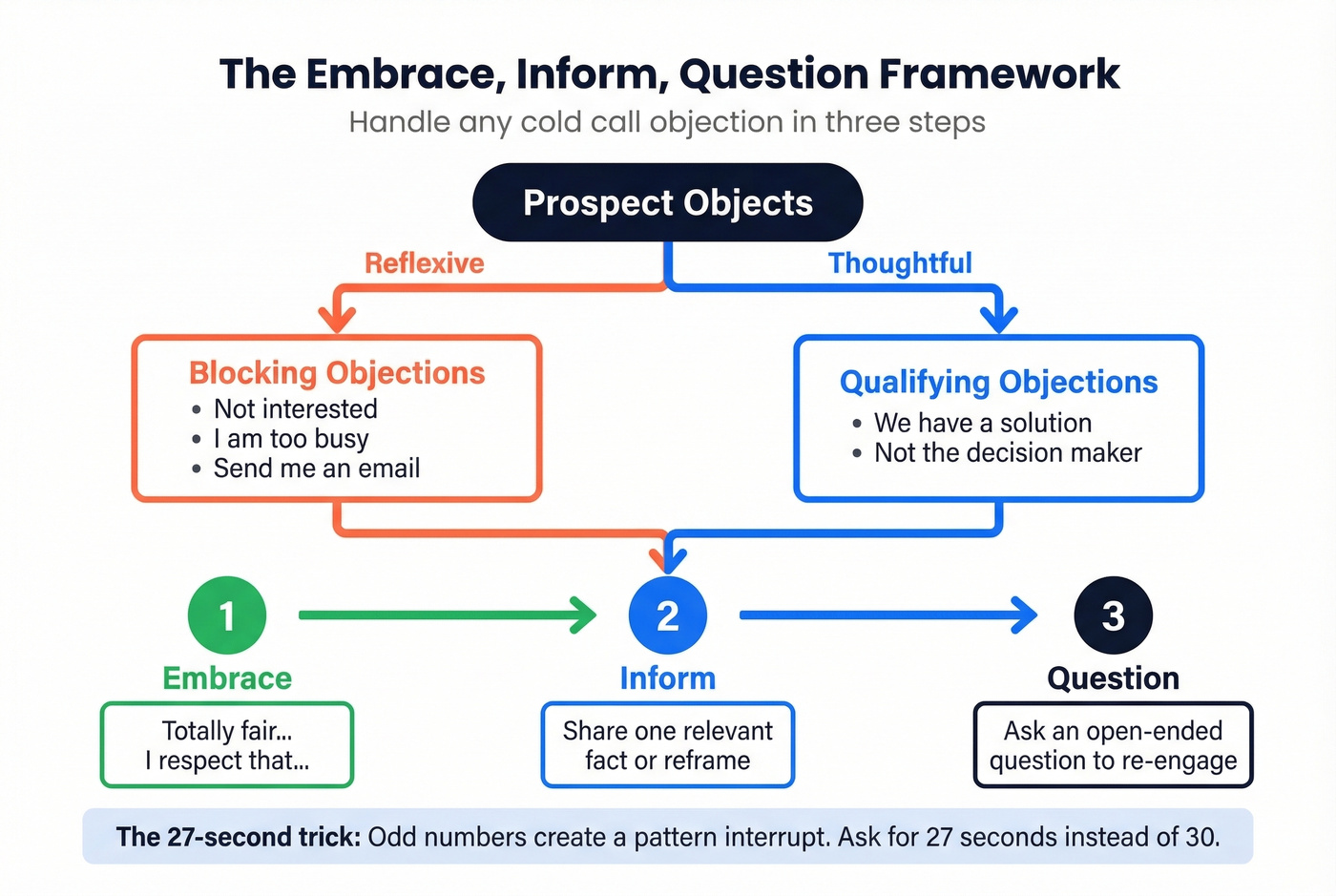
| Objection | Type | Approach |
|---|---|---|
| "Not interested" | Blocking | Validate, pivot to curiosity question |
| "I'm too busy" | Blocking | Odd-number time ask (27 seconds) |
| "Send me an email" | Blocking | Agree, ask what to include |
| "We have a solution" | Qualifying | Acknowledge, probe for gaps |
| "Not the decision maker" | Qualifying | Keep them as internal champion |
"Not interested" - "Totally fair - most people say that before they hear the specific reason I called. What's your current approach to [problem]?" Treat this as a timing issue, not a fit issue. That reframe changes everything.
"I'm too busy" - "I respect that. Can I have 27 seconds? If it's not relevant, I'll hang up." The odd number creates a pattern interrupt that buys you attention.
"Send me an email" - "Happy to. So I send the right thing - what's your biggest priority around [topic] right now?" This turns a brush-off into discovery.
"We already have a solution" - "Good - that tells me you take this seriously. How's it working? Most teams I talk to have one or two gaps they're living with." You're positioning yourself as a peer, not a challenger.
"I'm not the decision maker" - "Appreciate the honesty. Who else would need to weigh in? I'd love your take on whether this is even worth their time." Acknowledge the objection with genuine empathy before any redirect - the tone matters as much as the words.
After the Call: Follow-Up and Self-Coaching
The call ended. Most reps move to the next dial immediately. Top performers spend 60 seconds on post-call discipline - and that minute compounds into dramatically better results over a quarter.
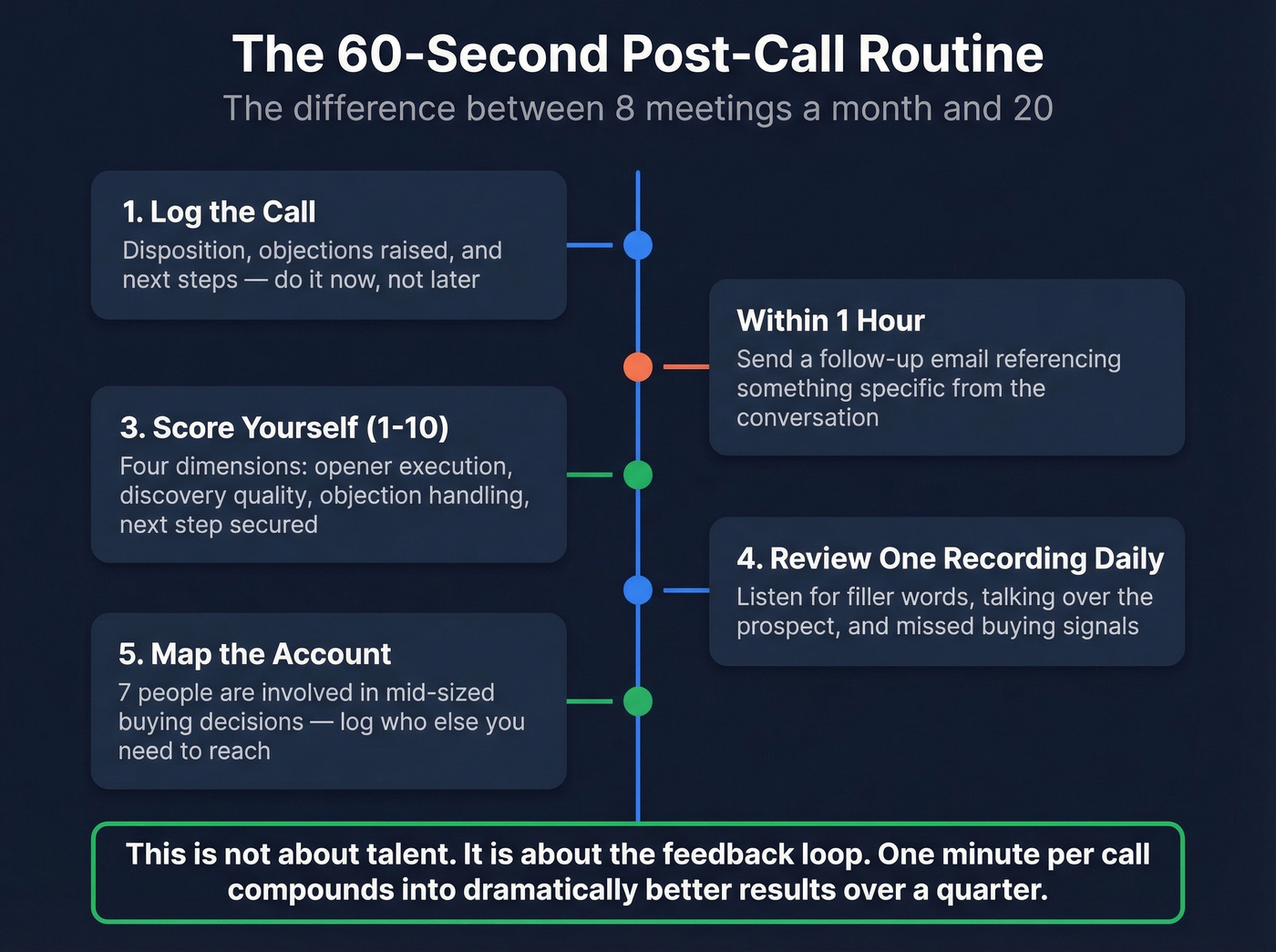
Here's the thing: the difference between reps who book 8 meetings a month and those who book 20 is rarely talent. It's the feedback loop.
- Log the call in your CRM immediately. Include disposition, objections raised, and next steps.
- Send a follow-up email within one hour. Reference something specific from the conversation. If you need copy, use these follow-up templates.
- Score yourself on four dimensions: opener execution (1-10), discovery quality, objection handling, and whether you secured a next step.
- Review one recorded call per day. Listen for filler words, talking over the prospect, and missed buying signals.
- Map the account. Gartner data shows 7 individuals are involved in mid-sized buying decisions. If you talked to one person, log who else you need to reach.
5 Mistakes That Kill Results
1. Skipping research. Two to three minutes per prospect is the minimum. Gong's data shows research-backed opener questions hit a 10.01% success rate versus 1.5% for generic openers. That's a 6x difference for three minutes of work.
2. Pitching in the first 30 seconds. Your opener should be a question or a permission ask, never a feature list. The prospect hasn't decided to listen yet.
3. Dialing outdated phone numbers. If your data provider refreshes every 4-6 weeks, you're dialing numbers that are already stale. Weekly refresh cycles are the difference between reaching someone and leaving your third voicemail at a number they left two months ago.
4. Giving up after one attempt. WHAM data is unambiguous: 3 calls capture 93% of conversations, 5 calls capture 98.6%. One-and-done dialing is the most expensive mistake in outbound because it wastes all the research and list-building work upstream.
5. Sounding robotic. Reading a script word-for-word kills trust in the first five seconds. Use your scripts as guardrails, not teleprompter copy. Vary your pacing, pause after questions, and match the prospect's energy.
If you want a full process (not just tactics), build a repeatable cold calling system your team can run weekly.
Compliance: Don't Skip This
Most cold calling guides ignore compliance, which is a mistake that can cost you real money. The FTC's Telemarketing Sales Rule sets clear boundaries:
- Permitted hours: 8 AM-9 PM in the prospect's local time zone. Calling outside this window is a violation, not just bad manners.
- 2-second rule: When using a dialer, you must connect the prospect to a live agent within 2 seconds of their "hello." Dead air longer than that triggers abandonment rules.
- DNC registry: Scrub your lists against the National Do Not Call Registry before every campaign. Fines run up to $50,000+ per violation.
- Caller ID: You must transmit an accurate caller ID and provide a callback number.
If you're calling into the EU or UK, GDPR adds another layer - you need a legitimate interest basis for B2B calls, and you must honor opt-out requests immediately. (If you're considering alternatives, see our guide to cold texting compliance too.)
Your Cold Calling Tech Stack
You need three things. Skip this section if you already have a dialer, CRM, and data provider you're happy with - but if your connect rate is below 5%, the data provider is almost certainly the weak link.
Dialer: A power or parallel dialer with CRM integration and call recording. Allo starts at $18/user/month; Aircall and Kixie typically run $50-$150/user/month depending on plan. If you're evaluating options, compare SDR tools and these Dialpad alternatives.
CRM: HubSpot's free tier works for small teams. Salesforce runs $25-$300/user/month depending on edition. The key requirement is that your dialer syncs call logs automatically - manual logging kills productivity. If you're still deciding, here are a few examples of a CRM and the best contact management software.
Data provider: This is where your connect rate lives or dies. If your average deal size is under $15k, you probably don't need a $30k/year enterprise platform. A self-serve provider with verified mobiles will get you 80% of the way there at a fraction of the cost. In our experience, the single biggest ROI improvement comes from switching to a provider with weekly data refresh and verified mobile numbers - it's not glamorous, but it's where the math changes. For a broader comparison, start with B2B company data providers.
Intent data, tech stack signals, and verified direct dials in one platform. Prospeo tracks 15,000 buyer intent topics so you know which accounts are in-market before you pick up the phone. At $0.01 per email and 10 credits per mobile, enterprise-grade cold calling data doesn't require enterprise pricing.
Turn every cold call into a warm one with real-time buying signals.
FAQ
Is cold calling still effective in 2026?
Yes. WHAM data shows a 4.82% meeting-booked rate from conversations, and 69% of buyers have accepted a call from a new vendor. The channel works - bad data and lazy execution are what kill results.
How many cold calls should I make per day?
Most SDRs target 50-80 dials in focused 2-hour blocks. 50 dials to verified mobiles outperform 100 dials to stale office numbers every time.
What's the best time to cold call?
Tuesday through Thursday, 11 AM-12 PM or 4-5 PM local time. Avoid the 12-2 PM dead zone where answer rates drop roughly 35%.
How do I get past the gatekeeper?
Ask for help rather than demanding a transfer. Use the gatekeeper's name, frame your request as a favor, and be genuinely curious. "I was wondering if you could help me" beats "Can you put me through to..." every time.
What tools do I need?
Three things: a dialer with CRM integration ($18-$150/month), a CRM for logging calls and tracking accounts, and a data provider with verified mobile numbers. Prospeo's free tier includes 75 emails and 100 credits per month - enough to test your connect rate before committing to anything.