

Cold Calling Success in 2026: Real Numbers and Framework
Cold calling success rates are all over the map. One source says 2.3%. Another says 4.8%. A third says 6.3%. They're all technically accurate - the difference is what they're measuring: connects, conversations, meetings booked, or leads generated. That distinction matters more than the number itself.
Here's the math that should keep you up at night: one HubSpot practitioner logged 11,519 cold calls over a year, booked 335 meetings, and converted 69.1% to SQLs - generating $287K in new business. At average performance, those same dials would have produced a fraction of that. The gap isn't talent. It's data and process.
What Actually Drives Cold Calling Success
Three levers, in this order:
- Data quality - verified numbers that someone actually picks up
- Timing and persistence - calling the right day, right window, enough times
- What you say - openers, talk ratio, objection handling
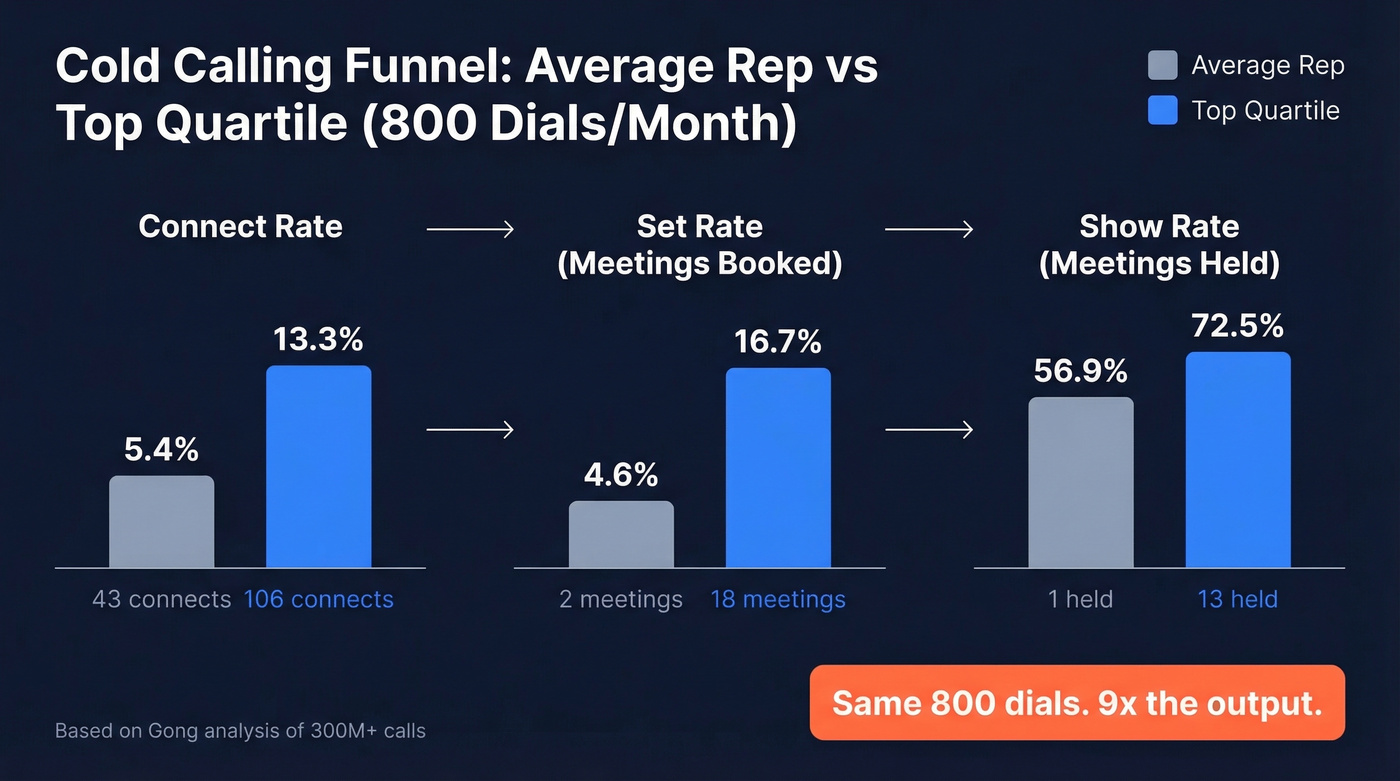
The gap between average and great is staggering. An analysis of 300M+ calls found that from the same 800 monthly dials, average reps book 2 meetings while top-quartile reps book 18. Same dial count, 9x the output. The difference starts with dialing numbers that actually ring - verified mobile numbers, not purchased list data that's been recycled through three different providers.
Real Benchmarks by Funnel Stage
Most articles throw a single number at you without explaining what it measures. Here's the funnel broken into stages using Gong's 300M-call dataset:
| Funnel Stage | Average Rep | Top Quartile |
|---|---|---|
| Connect rate | 5.4% | 13.3% |
| Set rate | 4.6% | 16.7% |
| Show rate | 56.9% | 72.5% |
Running the math on 800 dials per month:
- Average rep: ~43 connects, 2 meetings booked, 1 held
- Top-quartile rep: ~106 connects, 18 meetings booked, 13 held
The conflicting benchmarks you see online - Cognism's 2.3%, Amplemarket's 6.3%, even Cognism's own internal 6.7% - measure different funnel stages. Rates also vary by industry: janitorial services convert at ~2.85% while technology hovers around 0.88%. Gong's framework separating connects from sets from shows is the only one that's actually useful for diagnosing where your funnel breaks.
The r/salesdevelopment community repeats these same funnel benchmarks and the 800-dial math, which is exactly why this stage-by-stage view has become the standard for diagnosing cold calling performance.
Data Quality: The #1 Lever
Here's the thing: 40% of purchased contact lists contain invalid or outdated information. Nearly half your dials are dead before you pick up the phone. Another 30% of records have stale role or company data, so even when someone answers, you're pitching the wrong person at the wrong company.
The difference between traditional cold calling and intent-driven calling is a 15-20x gap in engagement. Traditional approaches land 2-3% engagement rates. Intent-driven calling - reaching prospects actively researching your category - hits 40-50%. Even without a live connect, cold calls nearly double email reply rates: 3.44% vs 1.81% for email-only sequences. Cold calls work best as part of a multichannel sequence combining phone, email, and voicemail.
If your connect rate is below 10%, don't touch your script. Fix your data first. We've seen teams that clean up their numbers before rewriting their openers see results within the first week - one agency client went from a 6% connect rate to 22% just by switching to verified direct dials. A perfect pitch dialed to a disconnected line is still zero pipeline.

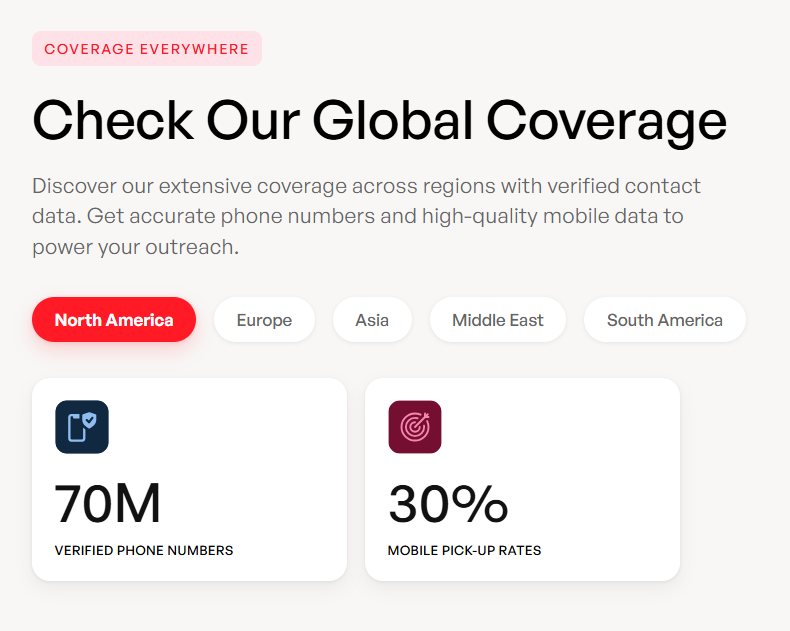
The data says top reps get 13.3% connect rates while average reps sit at 5.4%. The difference isn't skill - it's dialing verified numbers. Prospeo gives you 125M+ verified mobiles with a 30% pickup rate, refreshed every 7 days so you never waste a dial on a dead line.
Turn 800 dials into 18 meetings instead of 2.
When to Call
Best Days
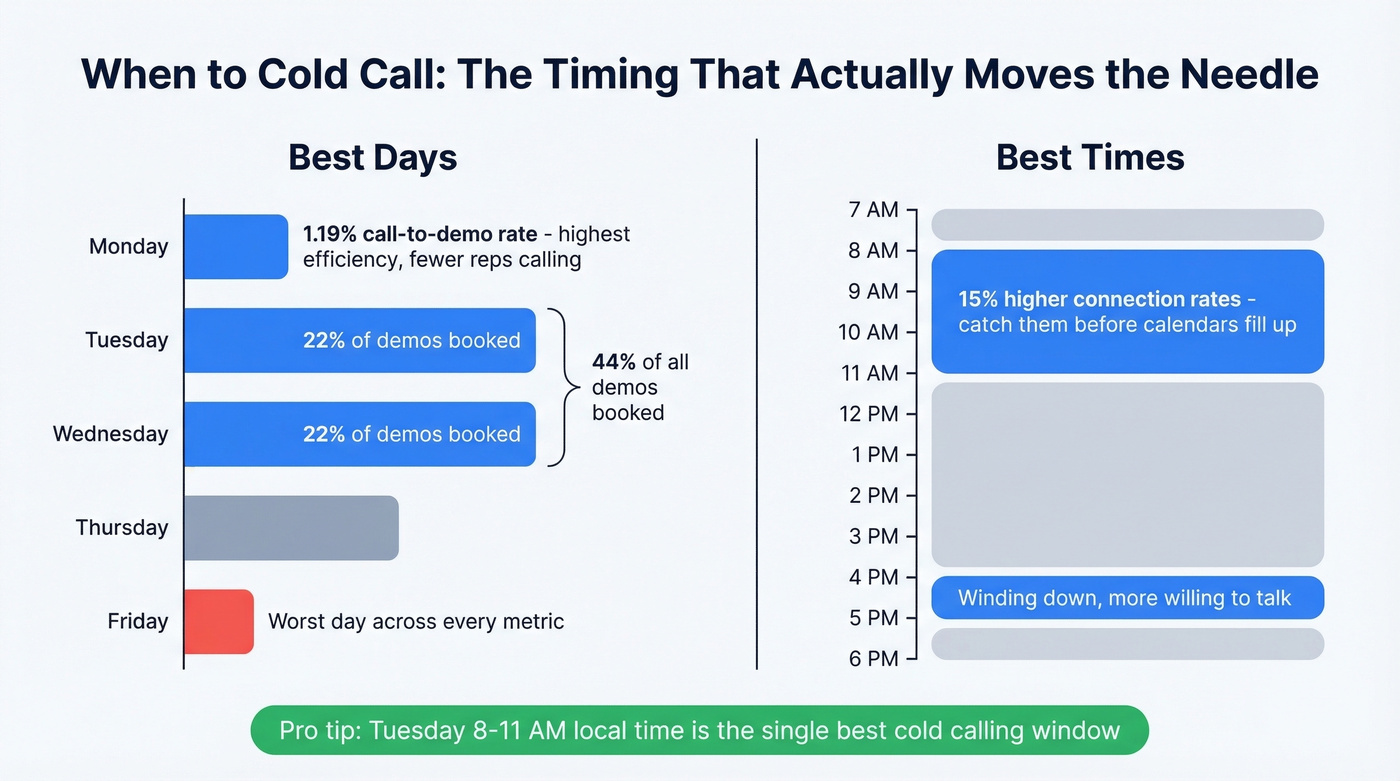
ZoomInfo's 1.4M-call study makes this clear: Tuesday and Wednesday account for 44% of all demos booked. Monday actually has the highest call-to-demo efficiency at 1.19%, because fewer reps are calling and prospects haven't hit meeting overload yet. Friday is the worst day across every metric.
Best Times
Two windows consistently outperform: 8-11 AM local time with 15% higher connection rates, and 4-5 PM. The morning window catches people before their calendar fills up. Late afternoon catches them winding down and more willing to talk.
You nailed the timing, perfected your opener, and handled the objection - but none of it matters if you're calling the wrong person. Prospeo layers intent data across 15,000 topics with verified direct dials so every call reaches a real buyer actively researching your category.
Stop cold calling blind. Start calling buyers who are already in-market.
The 3-Part Call Framework
1. Opener: "Hey [Name], this is [Your Name] from [Company]. How've you been?" This pattern-interrupt opener performs 6.6x higher than calls without it. Don't open with "Did I catch you at a bad time?" - that drops your booking rate by 40%.
2. Why you're calling: State your reason immediately for a 2.1x higher success rate. "I work with [role] teams at [similar companies] dealing with [specific problem]. That's why I'm reaching out." No preamble, no throat-clearing. Get to it.
3. The ask: "I'd love 15 minutes this week to show you how we're solving this. Does Thursday afternoon work?" Successful cold calls run nearly 2x longer than unsuccessful ones, and reps talk about 55% of the time - hold the floor when you're delivering value, but make sure you're delivering value and not just monologuing about features.
Voicemails and Follow-Up
Don't skip voicemail. Leave two across your sequence: the first establishing context, the second highlighting a specific pain point. This tactic lifts email reply rates. After booking, send a calendar invite with a brief agenda immediately - confirm it while still on the call. Space follow-ups 48 hours apart and alternate between phone, email, and voicemail.
Rate each call 1-10 afterward on opener delivery, objection handling, and next-step clarity. This self-scoring habit compounds faster than any coaching session.
Handling 92% of Objections
Only about 10% of prospects are ready to buy right now, and buying groups have grown to 12 stakeholders. Objections aren't rejection - they're the natural response to complexity.
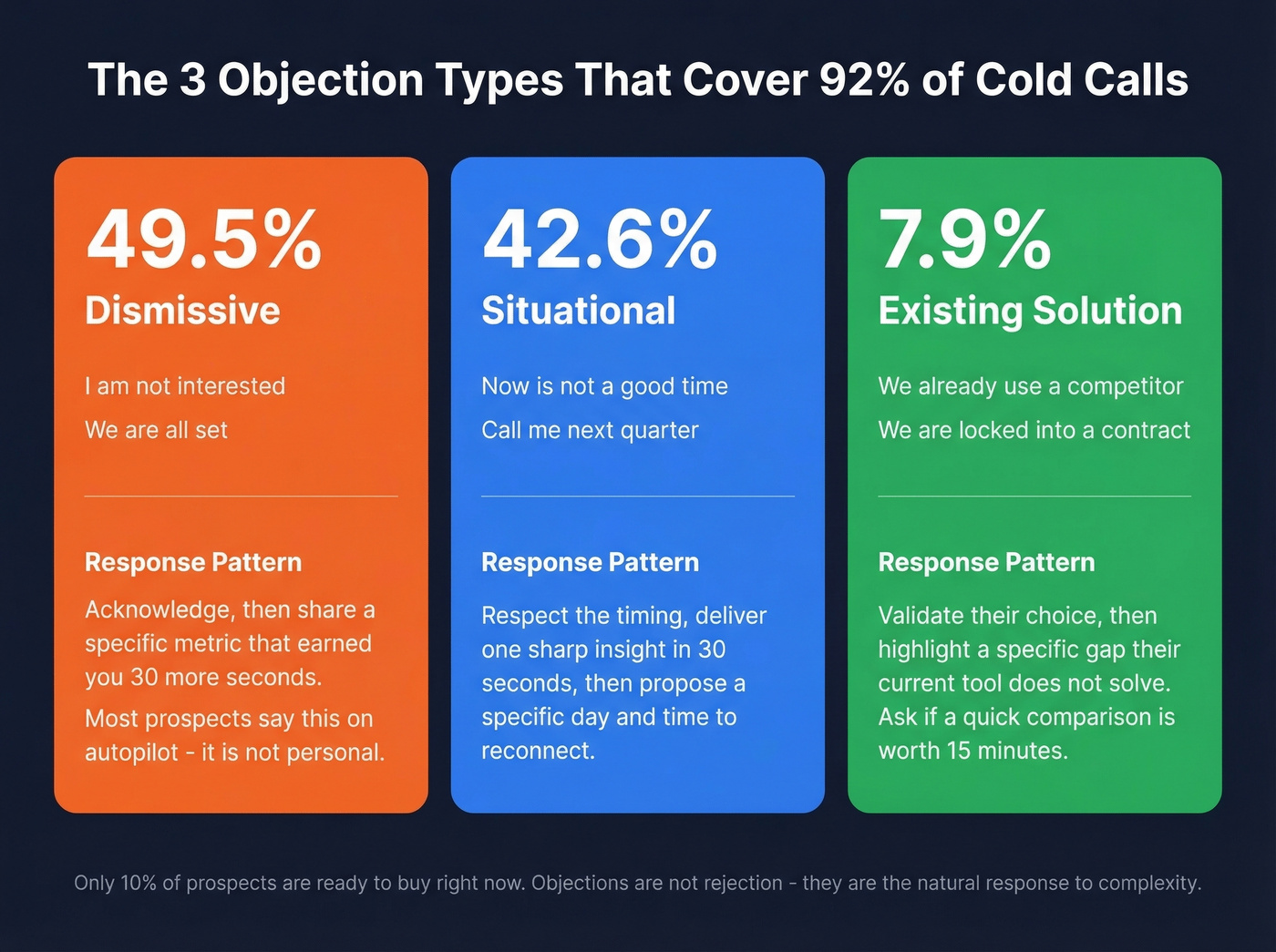
Dismissive (49.5%) - "I'm not interested" / "We're all set." These are reflexive, not informed. Response: "Totally fair - most [role] I talk to say the same thing before they see how we cut [specific metric] by [X%]. Can I ask one quick question before I let you go?"
Situational (42.6%) - "Now's not a good time." Response: "I get it - I'll keep this to 30 seconds. [One sharp insight.] Worth a 15-minute call next Tuesday?"
Existing Solution (7.9%) - "We already use [competitor]." Response: "Good - that tells me you take this seriously. The question is whether [specific gap] is costing you. Worth a quick comparison?"
Let's be honest: most reps freeze on the dismissive ones because they feel personal. They're not. The prospect doesn't know you, doesn't know your product, and is running on autopilot. Your job is to break the pattern with something specific enough to earn 30 more seconds.
What Kills Your Results
Pitching in the first 30 seconds. You haven't earned the right. Open with relevance, not a product dump.
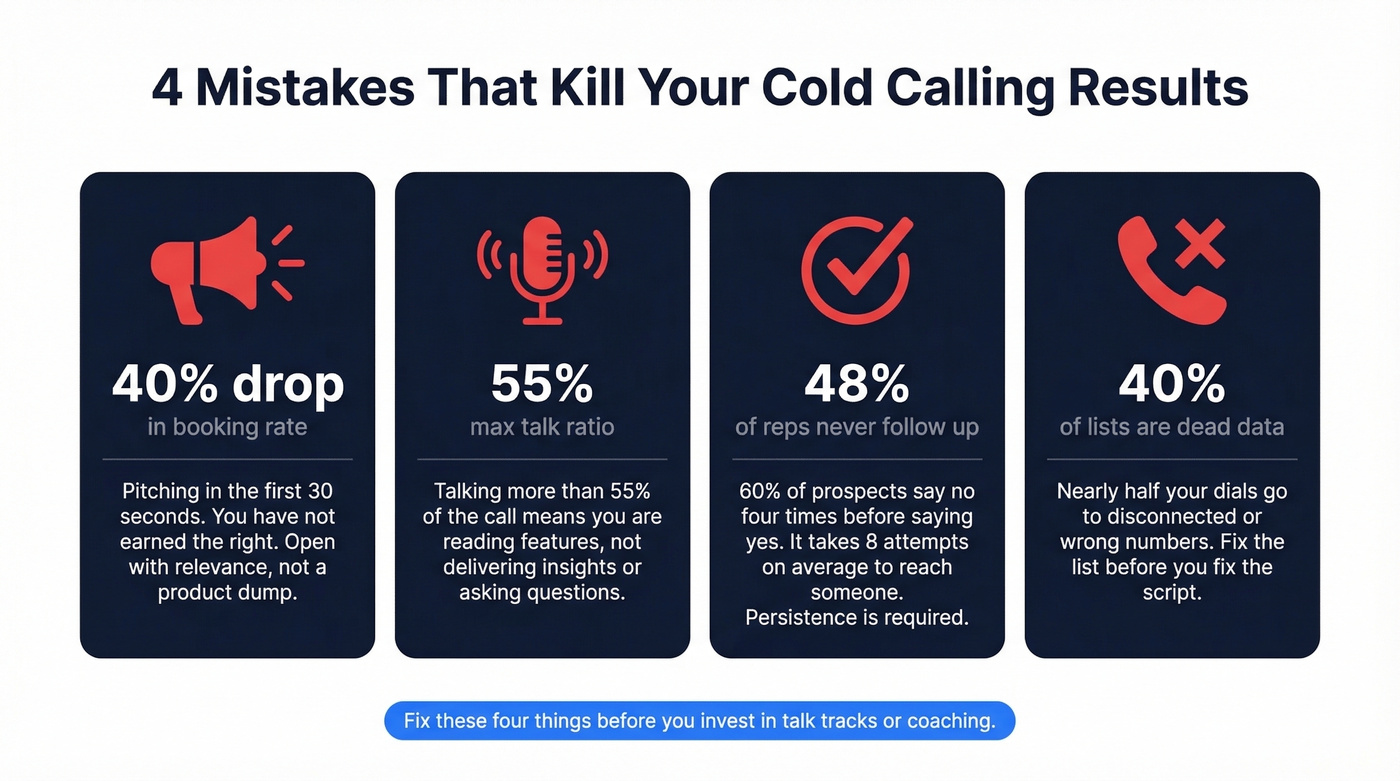
Talking more than 55% of the call. Reps behind successful sales calls talk slightly more than average - but they're asking questions and delivering insights, not reading a feature list.
Giving up after one attempt. 48% of salespeople fail to make a single follow-up after an initial cold call. Meanwhile, 60% of prospects decline four times before eventually saying yes. It takes an average of 8 attempts to reach a prospect. Persistence isn't annoying - it's required. (For a full system, see sales follow-up.)
Dialing unverified numbers. If 40% of your list is dead, you're spending nearly half your calling block listening to disconnected tones. Fix the list before you fix the script. Skip this step if you enjoy wasting two hours a day on voicemail boxes that will never be checked.
Practical Tips to Improve
Prioritize data over delivery
Reaching the right person at the right time matters more than charisma. No amount of smooth talking compensates for a disconnected number or a prospect who left the company six months ago. We've tested this across dozens of outbound campaigns - teams that invest in verified contact data before investing in talk tracks consistently outperform teams that do it the other way around. If you're rebuilding your stack, start with data enrichment and a reliable sales prospecting database.
Record and review your calls
Top performers listen back to at least two calls per day. They're not looking for perfection - they're identifying patterns: which openers get engagement, which objection responses stall, and where they lose momentum. This is a skill built through deliberate repetition, not natural talent. Pair this with a simple 30-60-90 day plan so the habit sticks.
Batch your dials
Calling in focused 90-minute blocks with no email, no Slack, and no CRM busywork produces 2-3x more conversations than scattered dialing throughout the day. Protect those blocks like you'd protect a meeting with your biggest prospect. If you can't do 90 minutes, start with 45 - the key is zero interruptions, not a specific duration. If you need a repeatable workflow, build a cold calling system and track the right funnel metrics.
FAQ
What's a good cold call conversion rate?
Top-quartile reps hit a 13.3% connect rate and 16.7% set rate, while average reps land around 5.4% and 4.6% respectively. "Good" depends on which funnel stage you're measuring, which is why published benchmarks range from 2.3% to 6.7%.
How many dials does it take to book a meeting?
At average rates, roughly 400 dials per meeting booked. Top performers need about 44 - a 9x efficiency gap driven primarily by data quality, timing, and conversation skills. Better data and smarter timing alone can cut your dials-per-meeting in half.
Is cold calling still effective in 2026?
Yes. Cold calls nearly double email reply rates (3.44% vs 1.81%), and 49% of buyers prefer to be contacted by phone. The channel isn't dead - bad data and bad process are what make it feel that way.
How do I improve my connect rate fast?
Start with verified phone numbers - 40% of purchased lists contain invalid data. Use intent signals to prioritize in-market prospects, call during peak windows (Tuesday-Wednesday, 8-11 AM), and source verified direct dials before each calling block. That alone will move the needle more than any script change.