

Cold Email Benchmarks 2026: What the Data Actually Says
You're staring at your campaign dashboard, trying to figure out if a 3% reply rate is good, bad, or average. You pull up five vendor reports and get five different numbers. Here's the thing: most of those numbers are directionally right but contextually useless without knowing what to compare against - and which metric actually matters for pipeline.
The Numbers at a Glance
Three metrics worth tracking: positive reply rate, bounce rate, and meetings booked. Raw reply rate is a vanity metric dressed up as a KPI.
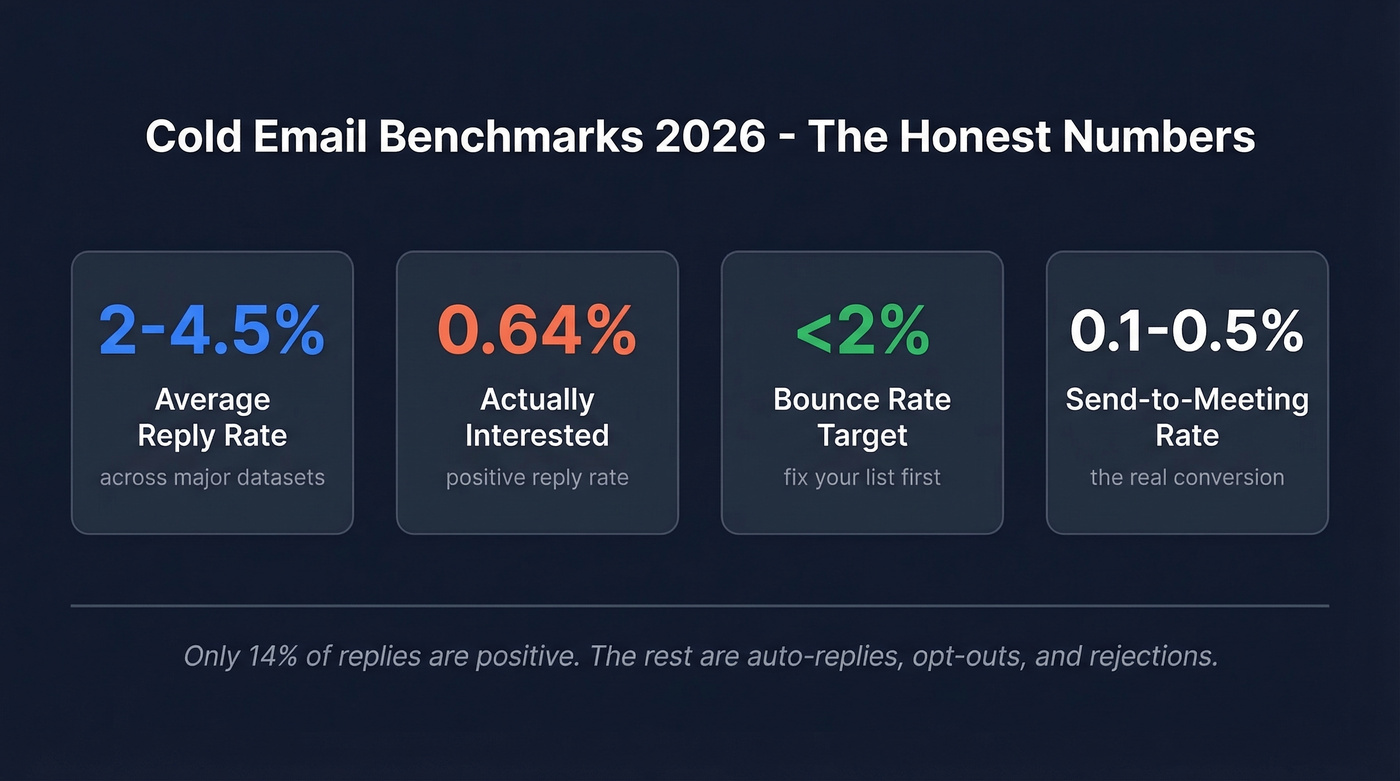
The averages across major 2026 datasets land between 2-4.5% reply rate, depending on volume and list quality. But only 0.64% of contacts emailed actually express interest. For typical cold outbound, send-to-meeting conversion sits around 0.1-0.5%. Those are the honest numbers nobody puts in the headline.
If your bounce rate is above 2%, stop optimizing subject lines. Fix your list first.
2026 Cold Email Benchmarks by Dataset
Three large datasets give us the clearest picture. They don't agree perfectly, which is actually useful - the spread tells you where "average" really sits.
| Metric | Instantly | Hunter | Sales.co |
|---|---|---|---|
| Avg reply rate | 3.43% | 4.5% | 2.09% |
| Good (top 25%) | 5.5%+ | - | - |
| Elite (top 10%) | 10.7%+ | - | - |
| Bounce rate | <2% target | 3.6% avg | - |
| Inbox placement (global) | ~84% | - | - |
Instantly's 2026 report covers the largest dataset of the three, spanning thousands of workspaces. Hunter's dataset covers 31 million emails. Sales.co analyzed 2M+ emails across 161 campaigns. We weight Instantly's tiers most heavily for benchmarking because of the dataset size, but Hunter's segmentation data is the most actionable.
The gap between Instantly (3.43%) and Hunter (4.5%) likely comes down to volume mix. Hunter shows smaller segments perform better: sequences with 21-50 recipients average 6.2%, while 500+ recipient campaigns drop to 2.4%. Bigger lists, lower rates. Always.
If you're above 3.43%, you're average. Above 5.5%, you're good. Above 10%, you're elite or running very small, hyper-targeted lists. Both can be true.
Positive Reply Rate: The Only Metric That Connects to Revenue
That 3-4.5% average reply rate hides something ugly.
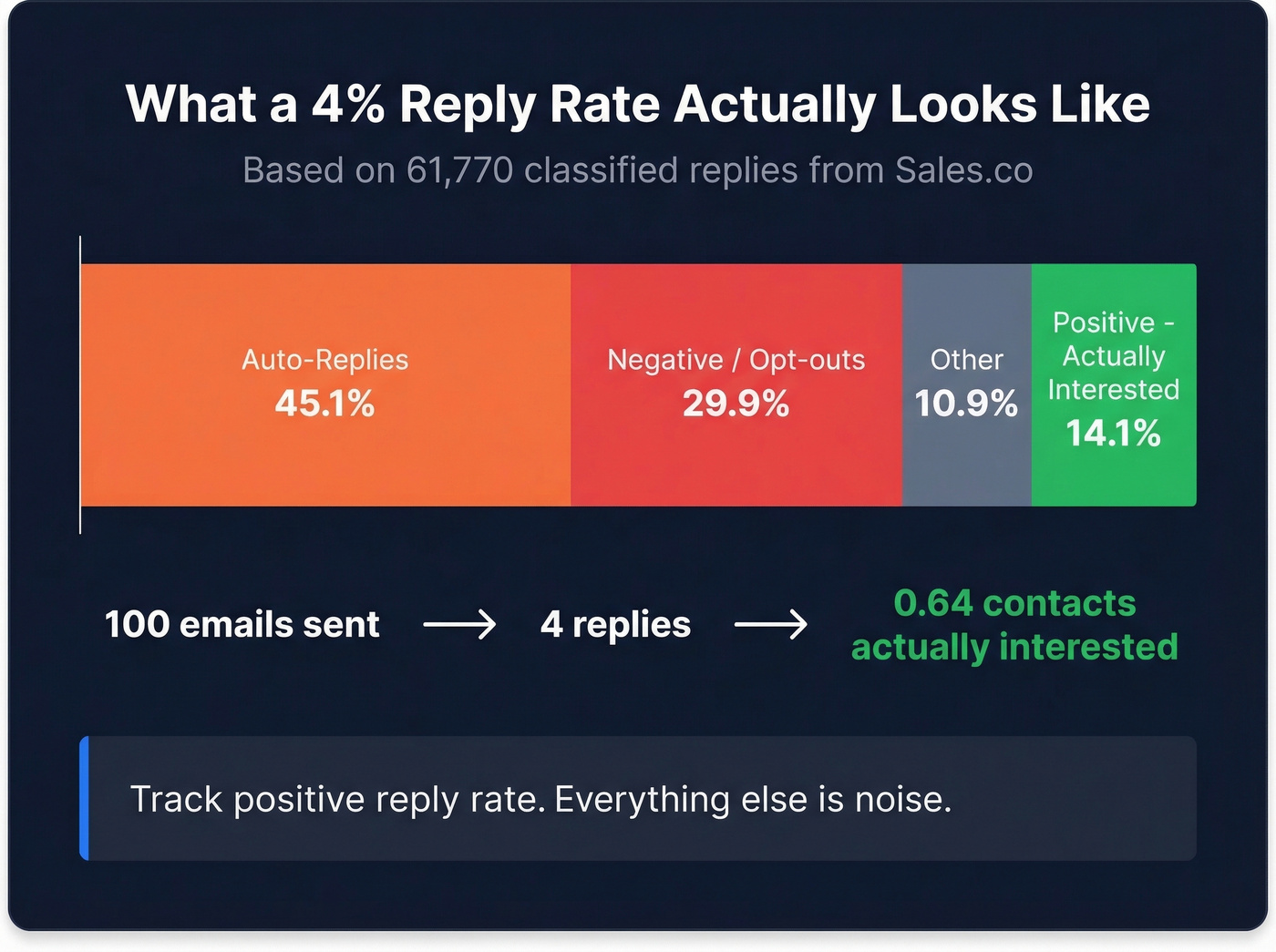
Sales.co classified 61,770 replies across their dataset. Of those, 14.1% were positive, 29.9% negative, 45.1% auto-replies, and the remainder fell into smaller categories. That means only 0.64% of all contacts emailed actually expressed interest. When your SDR manager celebrates a 4% reply rate, roughly 1.8% of that is auto-replies alone, plus another 1.2% in negative replies.
The real math is brutal. One sender who pushed 147,000 cold emails got 1,764 conversations and 40 actual calls - a 0.027% send-to-call rate. Even their 1.2% "positive reply rate" only converted 2.3% of the time into a live conversation.
Track positive reply rate. Everything else is noise.

The data is clear: 80% of cold email performance comes down to list quality and deliverability. Every point above 2% bounce rate is killing your reply rate before your prospect even sees the subject line. Prospeo's 7-day data refresh and 98% email accuracy keep bounce rates under 2% - the exact threshold this benchmarking data says separates broken campaigns from pipeline.
Stop optimizing copy on a list that bounces at 8%. Fix the data first.
Why Open Rates Are Dead
Apple Mail Privacy Protection preloads tracking pixels on every email, marking them as "opened" whether the recipient reads them or not. Nearly 50% of subscribers use MPP, and unique open rates nearly doubled within six months of its rollout.
It gets worse. Snov.io analyzed 44 million emails and found that disabling open tracking more than doubled reply rates - 2.36% vs 1.08%. Hunter's 31M-email dataset tells a similar story: campaigns without open tracking saw a 68% higher reply rate (7.4% vs 4.4%).
Kill your open tracking. Track replies. Move on.
Reply Rates by Use Case and Industry
Not all cold email is sales outreach, and the differences are massive.
Reply rate by use case (Hunter, 31M emails)
| Use Case | Reply Rate |
|---|---|
| Digital PR / Link Building | 13% |
| Headhunting | 7.5% |
| Marketing | 6.2% |
| Sales Outreach | 3% |
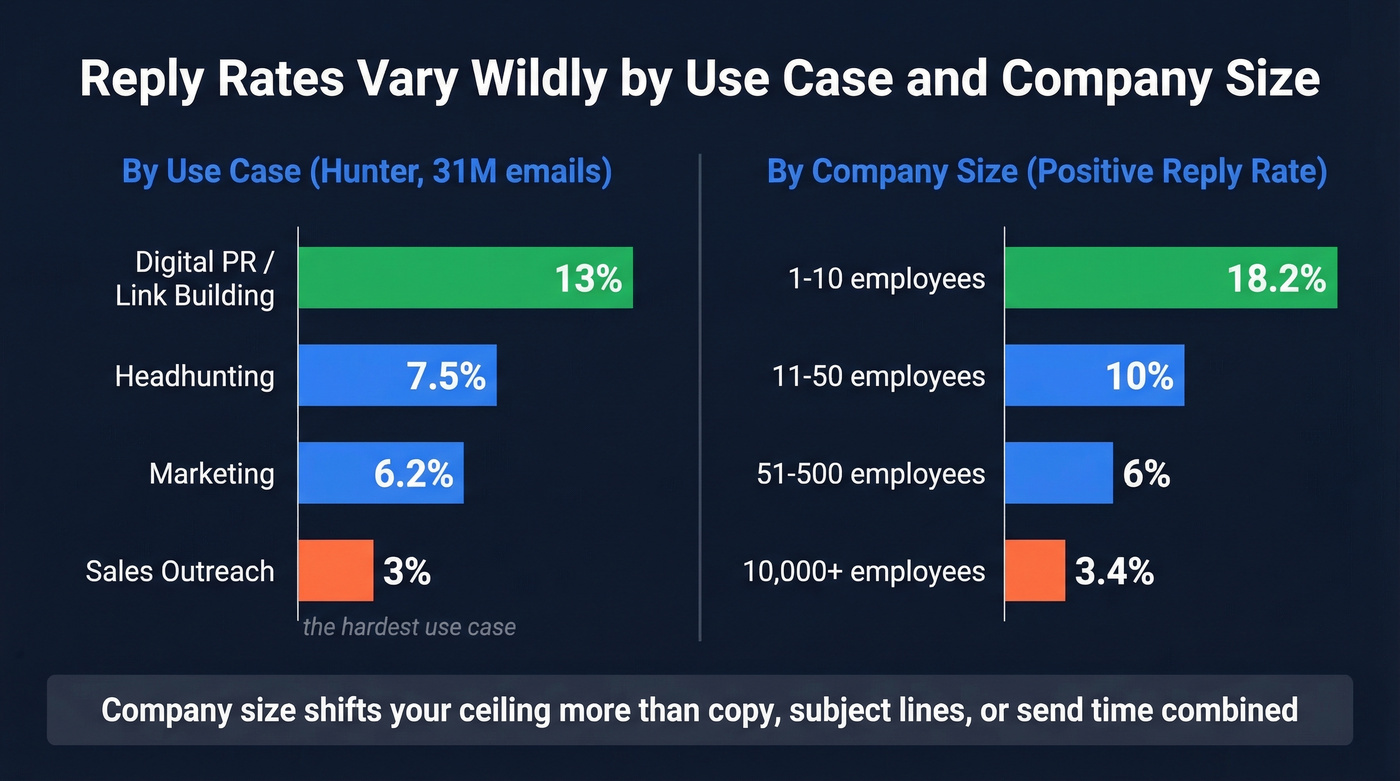
Sales outreach is the hardest use case. If you're benchmarking your SDR team against a link-building campaign, you're setting impossible expectations.
Company size and department
Company size swings results dramatically. Small companies (1-10 employees) generate 18.2% positive replies versus just 3.4% for enterprises with 10,000+ employees. This is the single most underrated segmentation variable - it shifts your ceiling more than copy, subject lines, or send time combined.
Department matters too. Customer Success contacts reply at 2.79% vs Engineering at 0.98%. The person you're emailing changes your ceiling more than your copy does.
What Actually Moves the Numbers
Here's our hot take after watching hundreds of campaigns: 80% of teams optimizing cold email are working on the wrong thing. They A/B test subject lines while sending to lists with double-digit bounce rates.
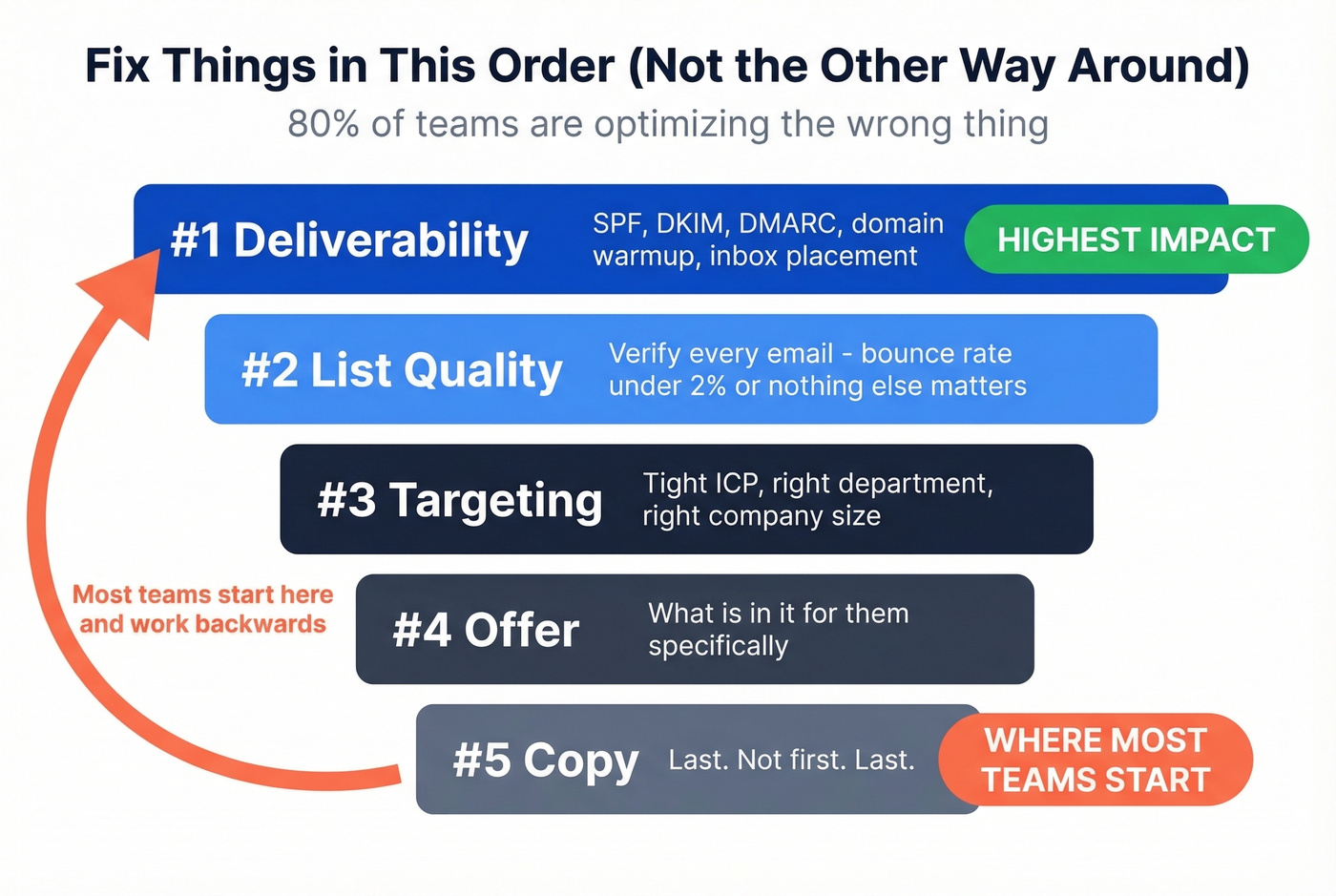
Fix things in this order:
- Deliverability - Domain warmup, SPF/DKIM/DMARC authentication, inbox placement testing (see a full email deliverability breakdown)
- List quality - Verify every email. Bounce rate under 2% or nothing else matters (use an AI email checker if you need speed)
- Targeting - Tight ICP, right department, right seniority
- Offer - What's in it for them, specifically. 65% of recipients say cold emails fail because they're too sales-focused
- Copy - Last. Not first. Last. (start with proven cold email follow-up templates before reinventing the wheel)
One practitioner documented their full rebuild on r/coldemail. Reply rate had decayed from 8% to 3% over 18 months. In 62 days, they got it back to 6% on a ~$420/month stack generating 16 qualified leads per month. The changes: expanded from 3 domains to 7, capped at 26 sends/day per domain, dropped email length from 141 words to under 56, and - critically - fixed their bounce rate from 11% to under 2% through manual verification.
That bounce rate fix is where most campaigns live or die. Bad data is the #1 benchmark killer. We've seen this pattern over and over: teams blame copy or timing when the real problem is stale contact data bouncing at 8-10%. Prospeo runs a 7-day data refresh cycle with 98% email accuracy - not the 6-week industry average where contacts decay between campaigns. Stack Optimize, an outbound agency using Prospeo, maintains 94%+ deliverability and sub-3% bounce rates across all client campaigns with zero domain flags. If your current provider's data is bouncing above 2%, that's your bottleneck.
Follow-up and sequence benchmarks
In Instantly's dataset, 58% of replies come from the first email, with 4-7 touchpoints being the sweet spot. After 7, diminishing returns kick in hard. Keep follow-ups under 80 words with a single CTA. (More on sequence management if you're standardizing this across reps.)
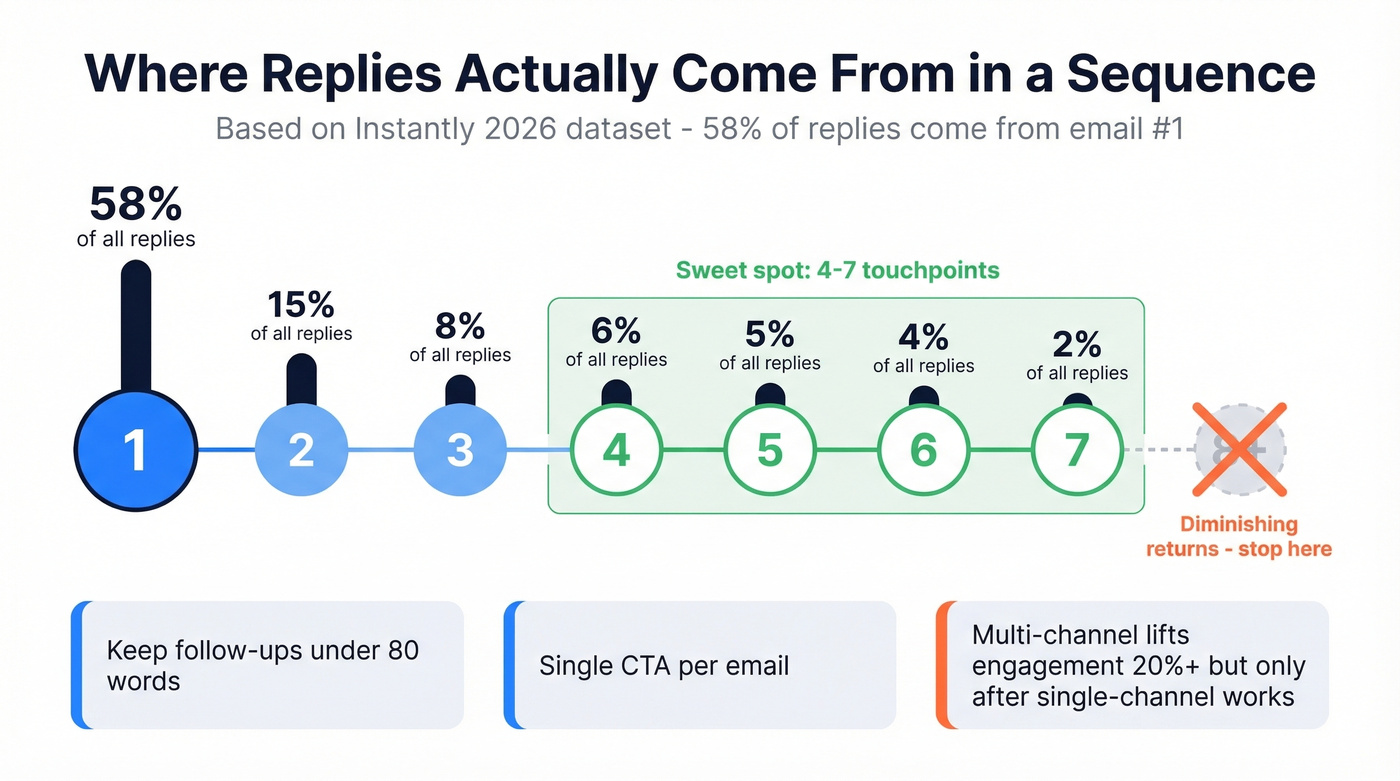
Cold email doesn't exist in a vacuum either - layering in other outreach channels lifts engagement 20%+. Skip this if you haven't nailed single-channel first, though. Multi-channel on top of broken fundamentals just burns contacts faster.
Stack Optimize built a $1M agency on Prospeo data: 94%+ deliverability, sub-3% bounce rates, zero domain flags across every client campaign. At $0.01 per verified email with no contracts, you can test the difference in your next campaign for free - 75 emails/month on the free tier.
Your benchmarks are only as good as your contact data. Start with accurate data.
FAQ
What's a good cold email reply rate in 2026?
A 5.5%+ reply rate puts you in the top 25% of senders. The average across major 2026 datasets is 2-4.5%, but only ~14% of replies are positive. Track positive reply rate - it's the only number that predicts pipeline.
Should I track open rates for cold email?
No. Apple Mail Privacy Protection inflates open rates by preloading pixels, and enabling open tracking cuts reply rates nearly in half (1.08% vs 2.36%). Turn tracking off and measure replies instead.
How do I improve my cold email reply rate?
Fix deliverability first (SPF/DKIM/DMARC), then list quality - verify every address and get bounce rate under 2%. Then tighten targeting by company size and department. Copy optimization comes last. Most teams we've worked with see the biggest jump just from cleaning their lists.
What cold email metric matters most for pipeline?
Positive reply rate, bounce rate, and meetings booked. Raw reply rate includes auto-replies (45%) and opt-outs (30%), making it misleading. Positive reply rate - the share of contacts who express genuine interest - is the only cold email benchmark that connects directly to revenue.