

How to Write Cold Emails for Partnership, Not Sales Calls
Most partnership outreach advice is just sales templates with the word "partnership" swapped in. That's why it doesn't work. Deals are 53% more likely to close when a partner is involved, but you'll never get there if your first email reads like a pitch deck.
We've spent years watching outbound teams confuse "partnership" with "soft sell" - and the results are predictably bad. Here's a framework built specifically for cold email for partnership outreach, not repurposed sales playbooks.
The Short Version
- Partnership emails are structurally different from sales emails - different tone, different CTA, different success metric. Stop using sales templates.
- Find the right decision-maker and verify their email before you write a word.
- Send 3 touches max over about 2 weeks. After that, you're annoying a potential partner, not being persistent.
Why Partnership Emails Work Differently
A sales email tries to move someone toward a purchase. A partnership email tries to start a conversation about shared upside. That difference changes everything - your tone, your CTA, even how long the email should be.
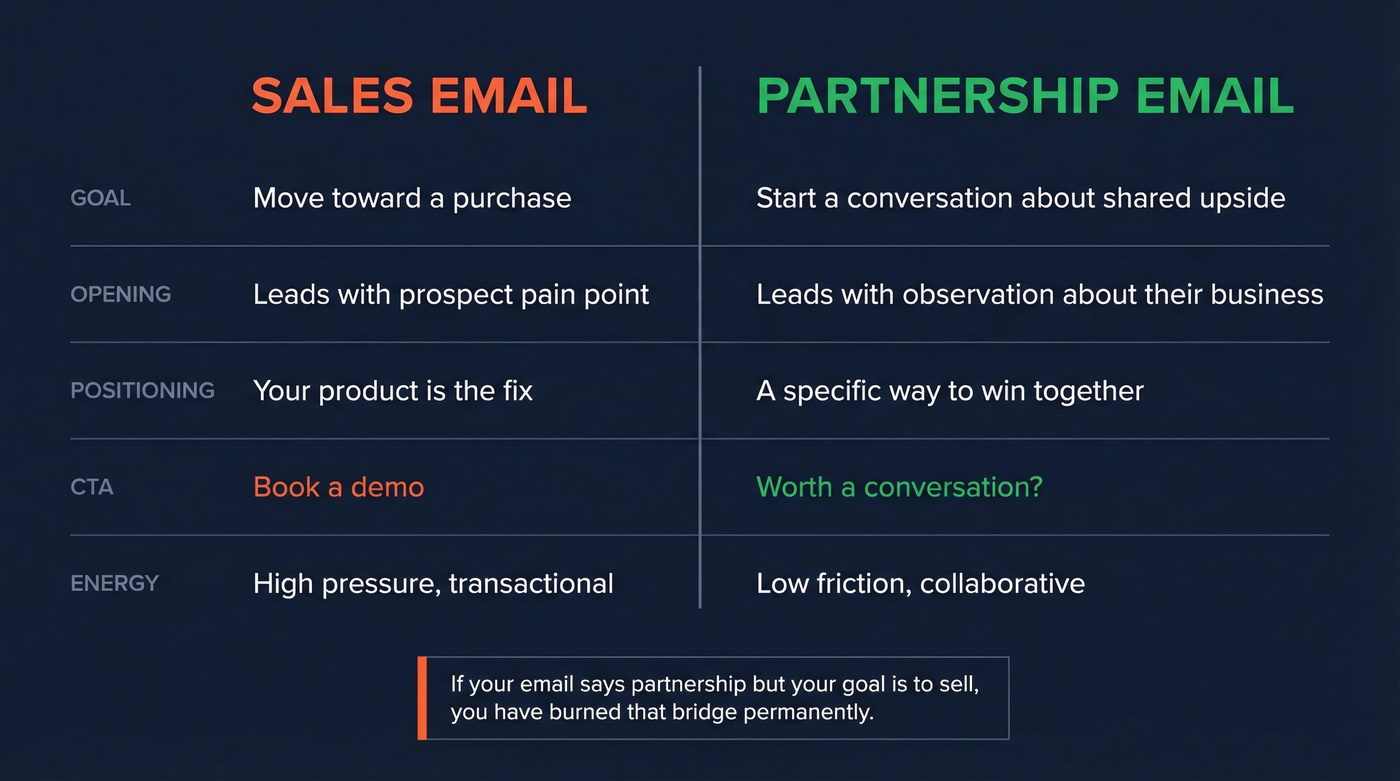
A sales email leads with the prospect's pain and positions your product as the fix. A partnership email leads with an observation about their business and proposes a specific way you could win together. The CTA in a sales email is "book a demo." The CTA in a partnership email is "worth a conversation?" Lower friction, lower commitment, completely different energy.
Here's the thing: nothing kills partnership outreach faster than the bait-and-switch. If your email says "partnership" but your real goal is to sell them something, you've burned that bridge permanently. As one Reddit poster put it, "Most outreach advice seems built around selling... but I'm looking more for collabs and affiliate partners." The frustration is real because the advice gap is real.
Find the Right Person First
A perfectly written partnership email sent to info@company.com is a perfectly wasted email. Generic inboxes are where partnership proposals go to die.
The targeting heuristic is straightforward. At companies with 20 or fewer employees, email the CEO or founder - they're involved in every strategic decision anyway. At larger companies, look for Head of Partnerships, VP of Business Development, or Director of Strategic Alliances. If those titles don't exist, the CMO or CRO is your next best bet.
Time your outreach around trigger events. A company that just announced a funding round, launched a new product, or expanded into a new market is far more receptive to collaboration conversations than one in maintenance mode. These signals tell you the company is actively building - and building companies need partners. Monitor press releases, job postings, and product announcements to find your window.
Before you write a word, verify you're emailing the right person at a real address. We use Prospeo's Chrome extension for this - paste a company URL and get verified contact emails in seconds. Partnership outreach is low-volume, high-stakes. A bounce to a potential partner's domain isn't a wasted credit; it's a burned first impression you can't undo.
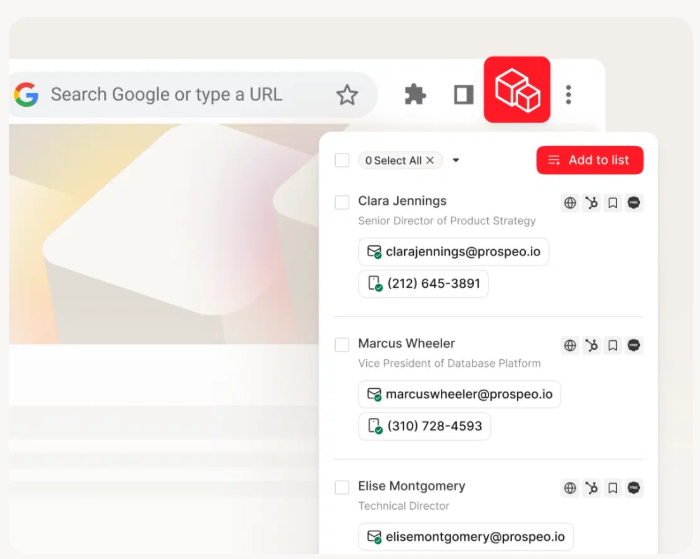

Partnership outreach fails when your email bounces. Prospeo's Chrome extension gives you verified emails for CEOs, Heads of Partnerships, and VPs of BD - straight from any company website. 98% accuracy means your first impression lands, not bounces.
Stop burning bridges with bad data. Verify before you send.
The 5-Part Partnership Email Framework
Templates decay. The consensus on r/coldemail is that once 10,000 people copy a template, prospects recognize the pattern and tune out. Frameworks survive because they adapt to your voice, your ICP, and the specific collaboration you're proposing.
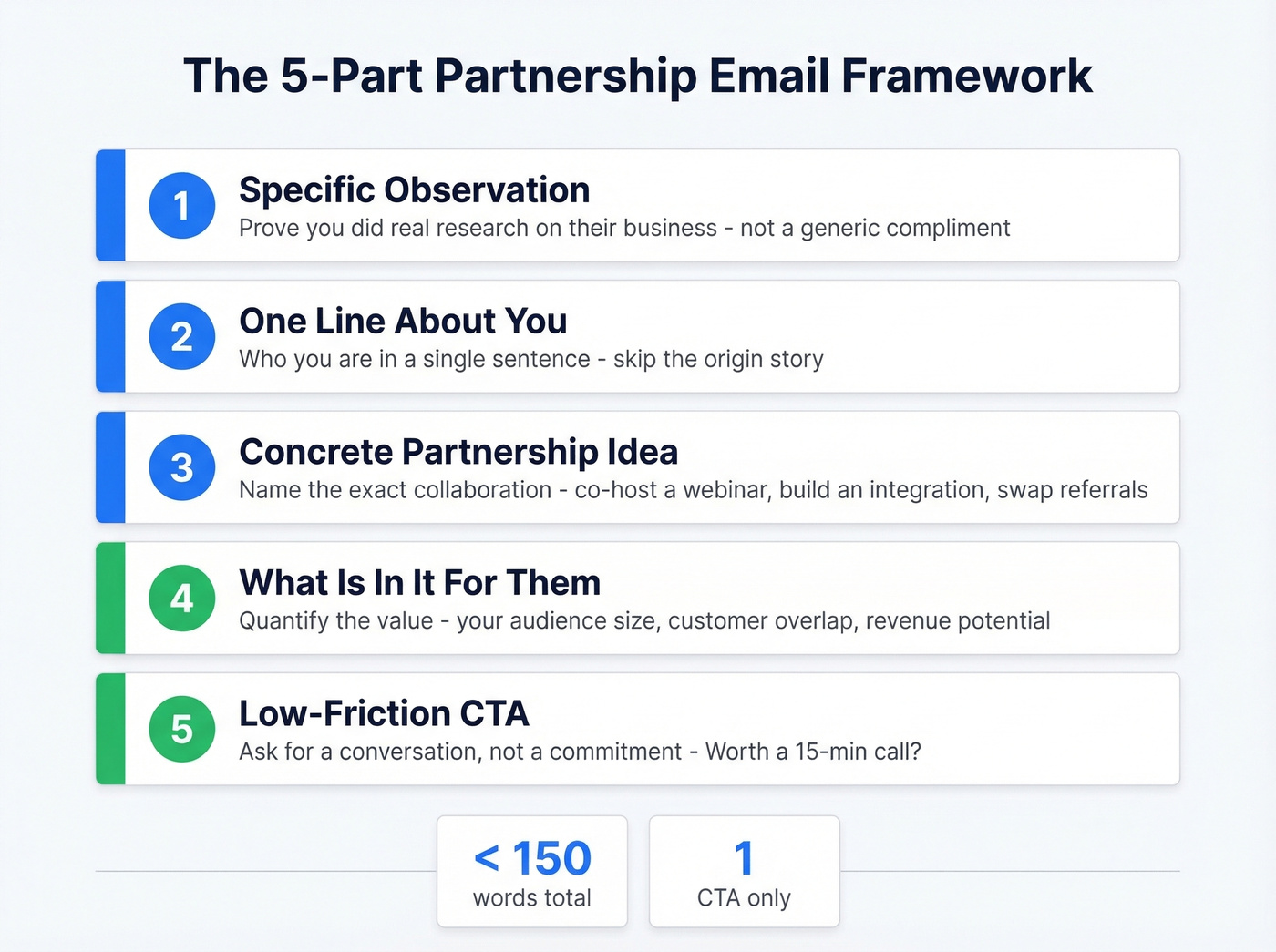
Keep the email under 150 words. One CTA, not three. Your recipient should understand the proposal within 5 seconds of scanning.
1. A specific observation about their business. This proves you did actual research. "I noticed you launched a Shopify integration last month" beats "I admire your company's growth" by a mile.
2. One sentence on who you are. Not a paragraph. Not your company's origin story. One line. (If you need help tightening this, borrow from these sample elevator pitches.)
3. The partnership idea in concrete terms. "We could co-host a webinar for our combined subscriber lists" is a partnership proposal. "Mutually beneficial strategic partnership" is nothing. It's the business equivalent of saying "we should hang out sometime" - nobody follows up on that.
4. What's in it for them, specifically. Quantify if possible. "Our audience is 8,000 mid-market SaaS buyers - that's your ICP" gives them a reason to reply. Vague promises of "mutual benefit" don't. (More on making this land: how to add value in sales.)
5. A low-friction CTA. You're asking for a conversation, not a commitment. "Worth a 15-minute call to see if there's a fit?" works. "Would you or someone on your team be interested in exploring this?" doesn't - too vague, too formal, too easy to ignore. If you want more options, see email call to action.
On subject lines: Benchmark data from Belkins shows 2-4 word subject lines hit 46% open rates, and personalized subject lines outperform generic ones by 30-50%. Keep them short, specific, and free of clickbait. "Joint webinar idea" beats "Exciting Partnership Opportunity!!!" every time. For more ideas, use these cold email subject line examples.
Partnership Email Examples by Type
Co-Marketing Partnership
Subject: Joint webinar idea
Hi Sarah, I saw your team's Q1 report on PLG metrics - best breakdown I've read this year. We publish a weekly newsletter to 9,000 B2B product leaders, and your research would make a killer co-branded webinar topic. We'd handle production and promotion to our list. You'd get a new audience channel without the content lift. Worth a 15-minute call next week?
Integration / Tech Partnership
This one works best when you can show demand already exists. Customer requests are the strongest proof point.
Subject: [Your product] + [their product]
Hi Marcus, three of our customers asked about connecting [your tool] with [our tool] last month. We built a prototype integration over the weekend - it syncs [specific data] in real time. If your team has heard similar demand, I'd love to show you the prototype. Free Thursday afternoon?
Referral / Affiliate Partnership
Subject: Sending you leads
Hi Priya, we work with 200+ e-commerce brands on email deliverability. About 30% ask us for a shipping logistics recommendation. Your platform keeps coming up. Would you be open to a referral arrangement? Happy to discuss structure on a quick call this week.
The "Bad Email" Teardown
Let's be honest - most partnership emails we see in the wild are terrible. Here's a real one posted on Reddit for critique:
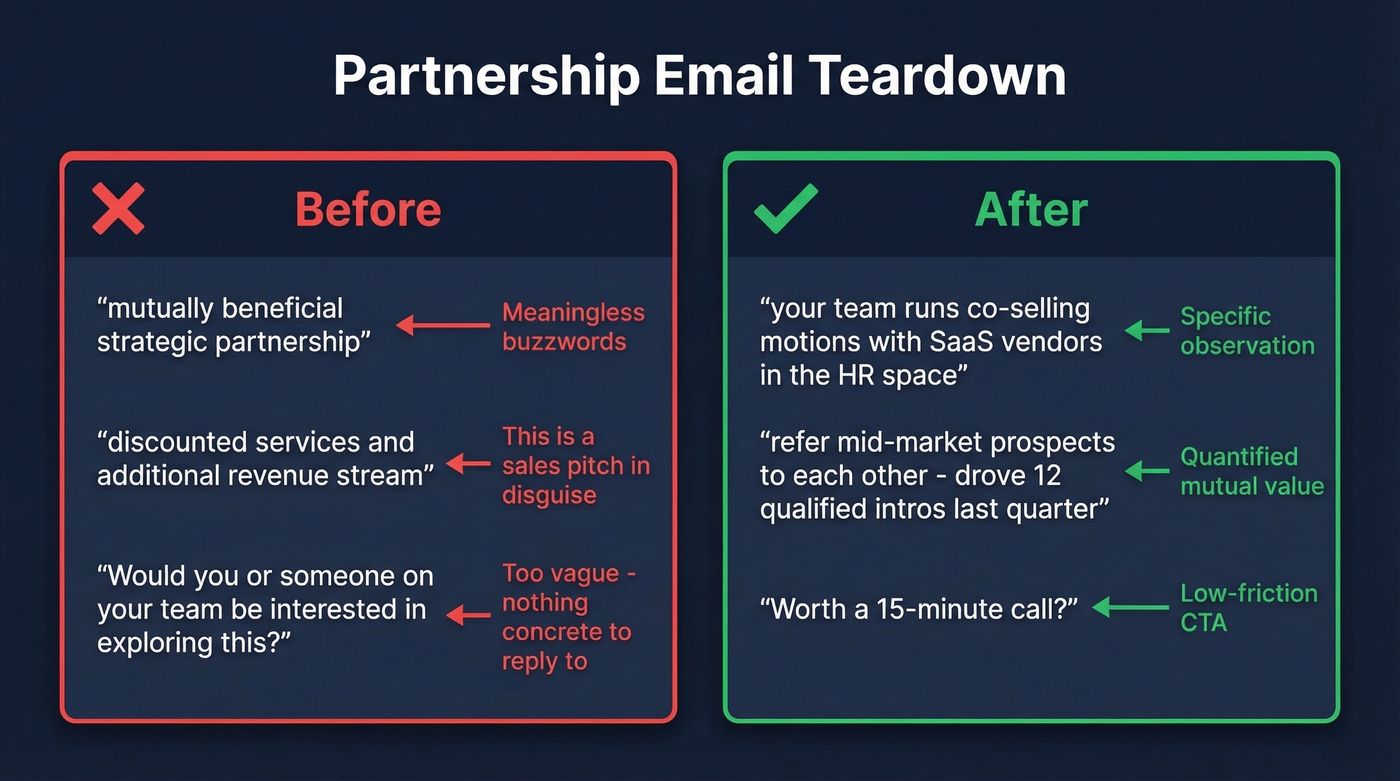
"I'm reaching out to explore a mutually beneficial strategic partnership... We could increase your volume of {KPI}... We offer discounted services and an additional revenue stream... Would you, or someone on your team, be interested in exploring this?"
Three things kill this email. "Mutually beneficial strategic partnership" is the most meaningless phrase in business email. "Discounted services" sounds like a sales pitch wearing a partnership costume. And the CTA is so vague it gives the recipient nothing concrete to respond to.
Rewritten using the framework:
"Hi [Name], I noticed your team runs co-selling motions with SaaS vendors in the HR space - we work with 150 HR tech companies on outbound. We could refer mid-market prospects to each other when they're outside our respective sweet spots. A similar arrangement drove 12 qualified intros for both sides last quarter. Worth a 15-minute call?"
Specific. Quantified. Easy to say yes to.
Follow-Up Cadence for Partnerships
The data on follow-ups argues for restraint. Belkins' study of 16.5 million emails found that the first follow-up boosts replies by up to 49%. But by the fourth email, response rates drop 55% and spam complaints hit 1.6%. They also found that contacting 1-2 people per company yields 7.8% reply rates versus 3.8% when blasting 10+ contacts - further proof that partnership outreach rewards precision over volume.
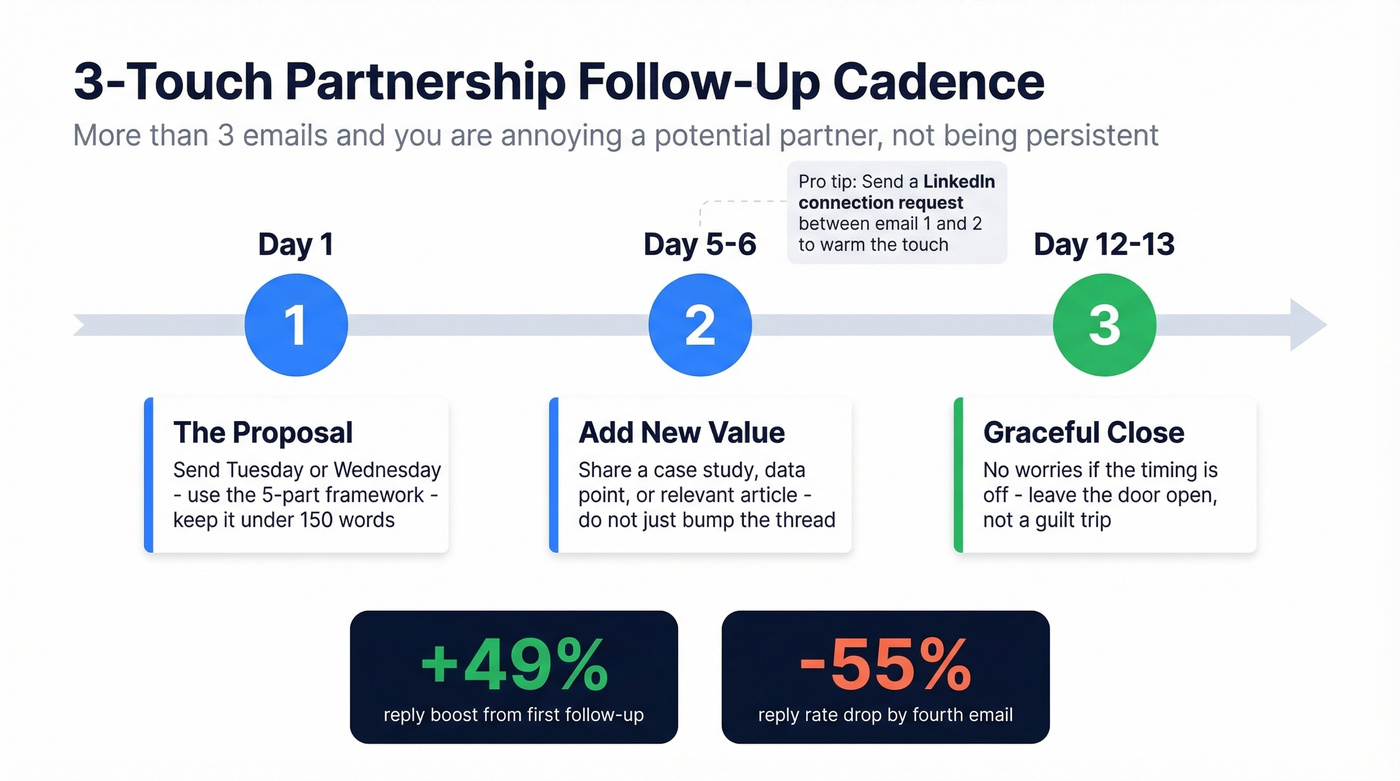
I'll say it plainly: if your deal sizes are under five figures, you probably don't need a 7-touch sequence for anything. For partnerships, cap it at 3. You're proposing a relationship with a peer, not chasing a prospect. Persistence reads differently when you're asking someone to collaborate. (If you need language, use these cold email follow-up templates.)
| Touch | Timing | Purpose |
|---|---|---|
| Email 1 | Tuesday or Wednesday | The proposal (framework above) |
| Email 2 | 4-5 days later | Add new value - a case study, data point, or relevant article |
| Email 3 | 7 days later | Graceful close ("No worries if the timing's off") |
Tuesday and Wednesday are peak days for reply rates across modern benchmarks. If email 1 gets no reply, a brief connection request on a professional network before email 2 can warm the touch. And verify every address before you send - a bounced email to a potential partner doesn't just waste a credit, it damages your sender reputation for every future email you send from that domain. (Related: email bounce rate.)
Skip the follow-up entirely if the company is clearly a bad fit after more research. Sending email 2 just because it's on the calendar is how you end up on spam lists.
You wrote the perfect partnership email. Now make sure it reaches the right person. Prospeo's database covers 300M+ profiles with 30+ filters - search by company size, funding stage, and job title to find the exact decision-maker who owns partnerships.
Find the partner, not the gatekeeper. Start free with 75 verified emails.
FAQ
How many cold emails should I send for partnership outreach?
Target 10-30 highly researched companies per batch. Benchmark data from Martal Group shows targeting 50 or fewer recipients yields 5.8% reply rates versus 2.1% for larger lists. Precision beats volume every time, and this is doubly true for partnerships where each relationship has outsized long-term value.
What reply rate should I expect?
General cold email averages 3-6% reply rates depending on the study. Well-targeted partnership emails with clear mutual value should hit 8-12%, since you're proposing collaboration rather than selling. If you're below 5%, your targeting or your value proposition needs work - not your send volume.
How do I find the right person to email about a partnership?
At companies under 20 people, email the CEO. At larger companies, target Head of Partnerships or VP of Business Development. Use a verified email finder to confirm the address before sending - a bounced email to a potential partner is worse than no email at all.
Can I use cold email for strategic partnerships, not just sales?
Cold email is one of the highest-ROI channels for strategic partnerships because you reach decision-makers directly with a specific collaboration proposal. The key difference from standard outbound is intent: you're not pushing a product, you're proposing shared upside. Follow the framework above, keep volume low, and focus on companies where audience overlap is obvious.