

The Cold Email Greeting That Gets 23% More Replies
The average cold email reply rate sits at 3.43%, and 58% of those replies come from the very first email. That means your cold email greeting - the literal first word a prospect reads - carries more weight than most senders realize. Gmail's transformer-based spam filters detect generic sales templates with near-perfect accuracy, so a robotic salutation doesn't just feel bad; it can tank your deliverability before a human ever sees the message.
The short answer: Use "Hey [First Name]" for most B2B cold emails - SalesLoft data shows it boosts reply rates by 23%. Use "Hi [First Name]" if you're unsure about formality. Avoid "Dear," "Hello," and anything without a name.
Which Salutation Words Actually Work
Surfe's breakdown of SalesLoft's greeting data shows the gaps are bigger than you'd expect:
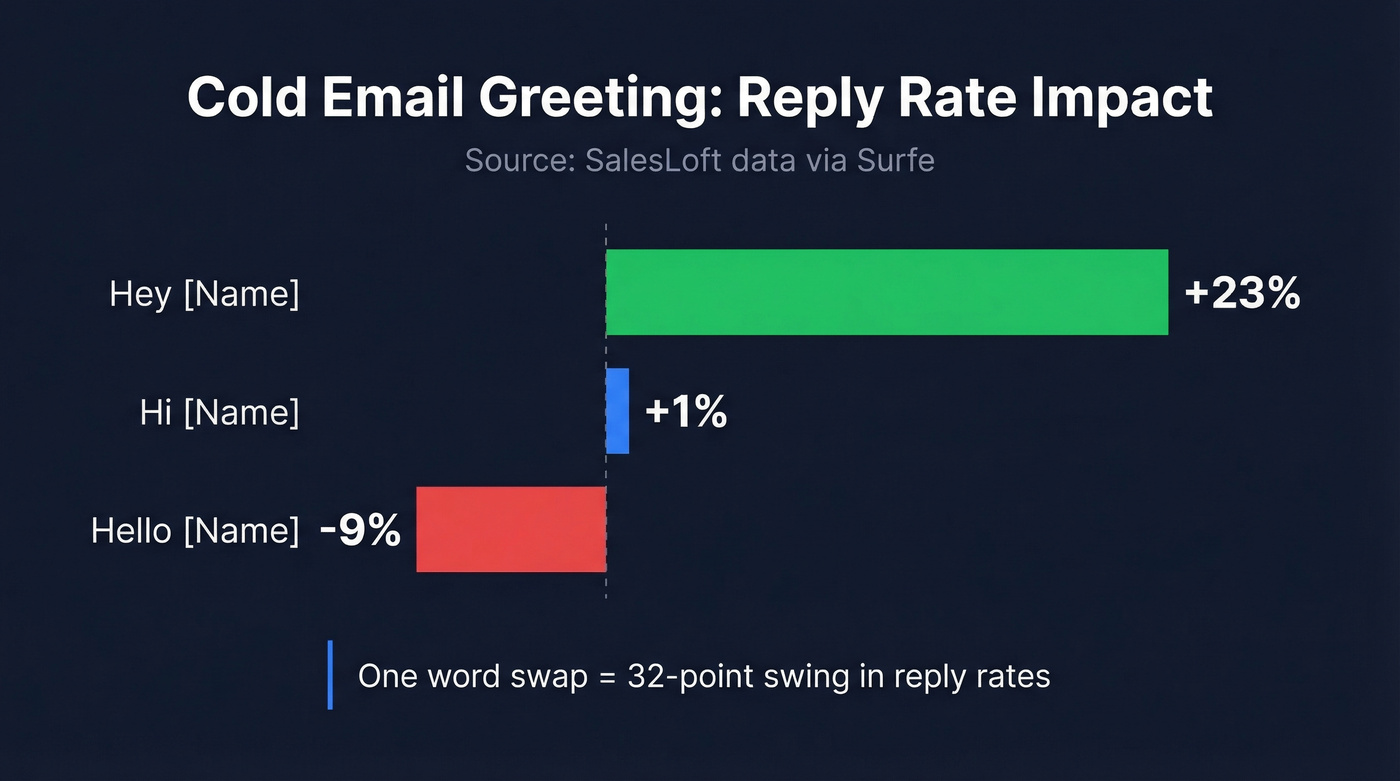
| Greeting | Reply Rate Impact |
|---|---|
| Hey [Name] | +23% |
| Hi [Name] | +1% |
| Hello [Name] | -9% |
"Hey" wins by a wide margin. "Hi" is neutral - it won't help, but it won't hurt. "Hello" actively drags performance down, likely because it reads as stiff and templated. We've watched teams materially lift reply rates just by making this one-word swap.
A Wall Street Oasis poll (n=95) in a finance-heavy community backs this up from the recipient side: 73% preferred "Hi," 16% chose "Dear," and only 12% picked "Hello." Even in traditional industries, "Hello" isn't the safe choice people assume it is.
"Hey [First Name]" is your default. "Hi [First Name]" is your fallback when you want to play it slightly safer. Everything else costs you replies.
Match Your Greeting to Your Prospect
"Hey" works for most outreach, but context matters. Getting tone right can lift response rates by up to 20%, according to PrimeForge's analysis of formal vs. casual cold emails. Here's a quick decision matrix:
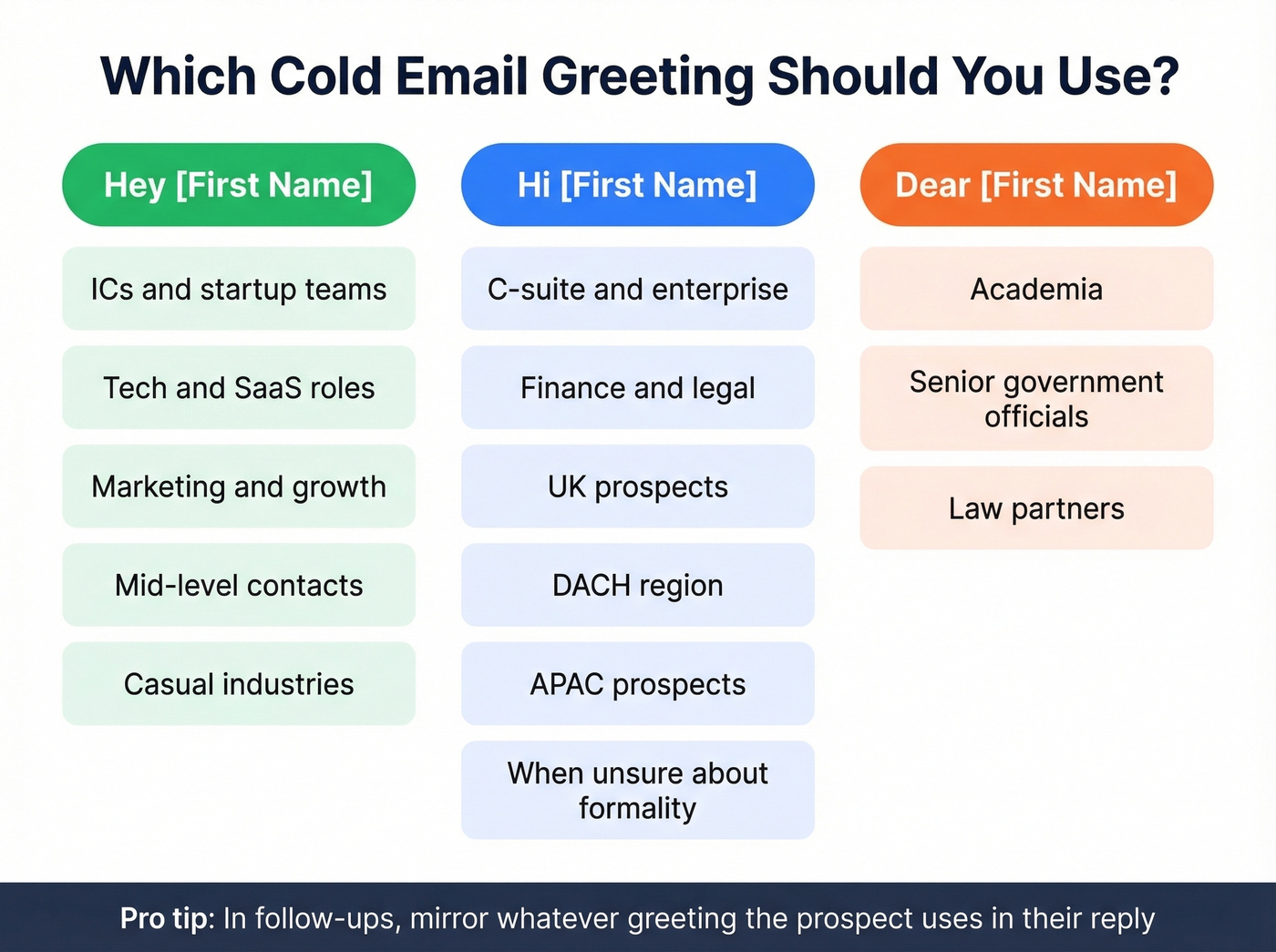
| Prospect Profile | Recommended Greeting |
|---|---|
| IC / startup / tech | Hey [First Name] |
| Mid-level / SaaS / marketing | Hey [First Name] |
| C-suite / enterprise | Hi [First Name] |
| Finance / legal / govt | Hi [First Name] |
| Academia / senior govt | Dear [First Name] |
| UK prospects | Hi [First Name] |
| DACH region | Hi [First Name/Last Name] |
| APAC prospects | Hi [First Name] - varies by country |
The pattern is straightforward: younger recipients and casual industries lean "Hey," while traditional industries and senior titles lean "Hi." One WSO commenter nailed it: "Under 45 -> Hi First Name. Over 45 -> Good morning Mr./Ms. Last Name." That's a rough heuristic, but it's directionally right.
Here's the thing: almost nobody cold-emailing a VP of Engineering at a Series B startup needs "Dear." Save that for law partners and university deans. In follow-up emails, mirror whatever salutation the prospect uses in their reply - that's the fastest way to build rapport.

A "Hey [First Name]" that lands in spam is worse than no email at all. Prospeo's 5-step verification catches spam traps, honeypots, and catch-all domains so your carefully crafted greeting actually reaches a real inbox - 98% accuracy, refreshed every 7 days.
Stop perfecting greetings for emails that bounce.
Greetings That Kill Replies
Some of these seem obvious. They still show up in our inboxes every single day.
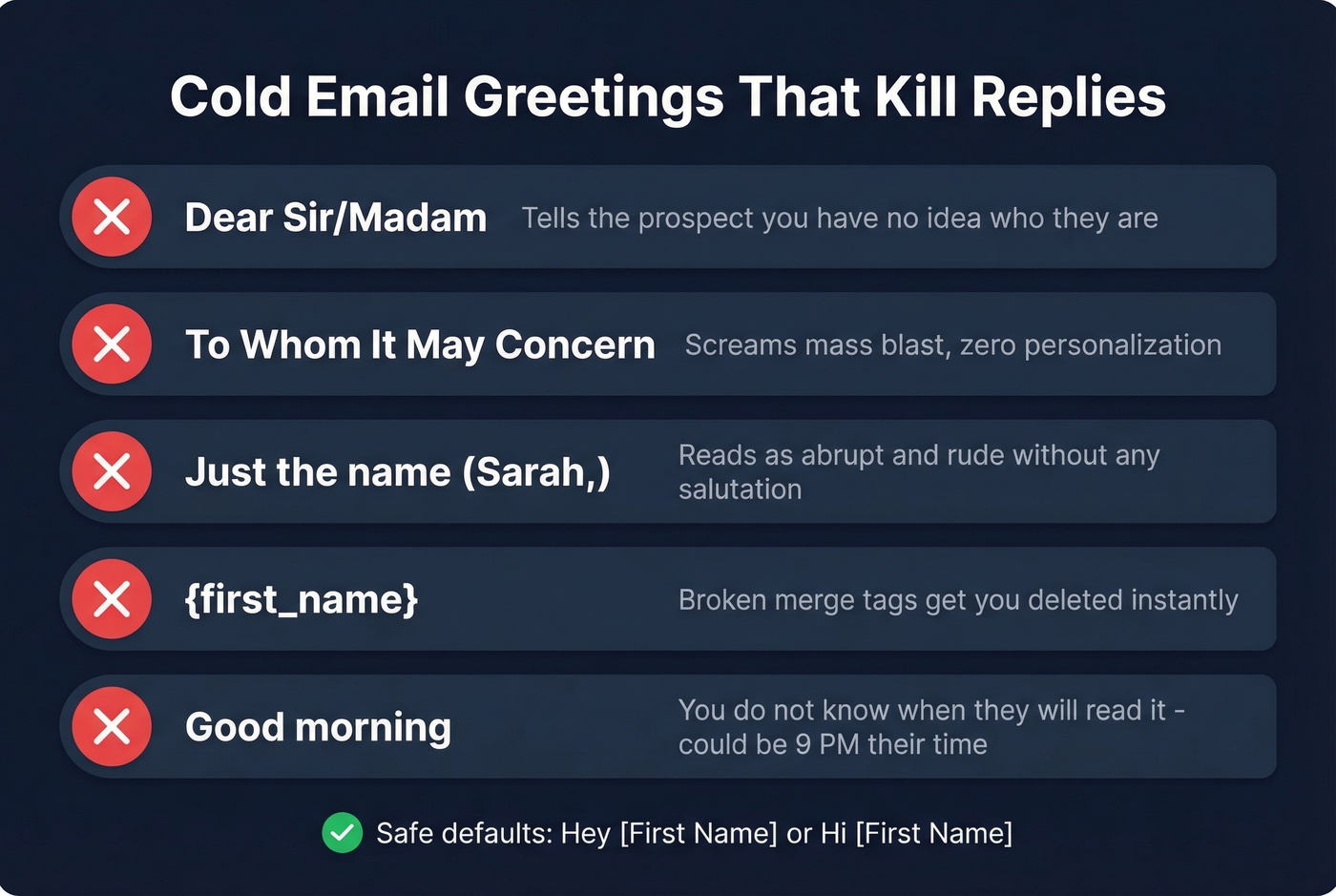
- "Dear Sir/Madam" / "To Whom It May Concern" - universally hated. Tells the prospect you don't know who they are.
- Name only, no greeting - starting with just "Sarah," reads as abrupt and rude. A simple "Hi" costs you nothing.
- Broken merge tags - sending "{first_name}" literally is the fastest way to get deleted. In our experience, bad merge tags are a top reason cold emails get trashed before the first sentence even registers.
- "Good morning" - you don't know when they'll read it. A prospect in Singapore opening your email at 9 PM doesn't appreciate the fiction.
- Overly templated openers - Gmail's spam filters flag generic sales templates even with basic personalization tokens, so if your opening looks like every other sales email, it may never reach the inbox.
If your average deal size is under five figures, you probably don't need a 14-step personalization framework. But you absolutely need to get the greeting right - it's the highest-ROI word in the entire email.
What Comes After the Greeting
Let's clear up a distinction most people miss: your greeting isn't your opening line. As Surfe's cold email guide puts it, "opening lines are what come after your greeting." The greeting sets tone; the opening line earns the next sentence.
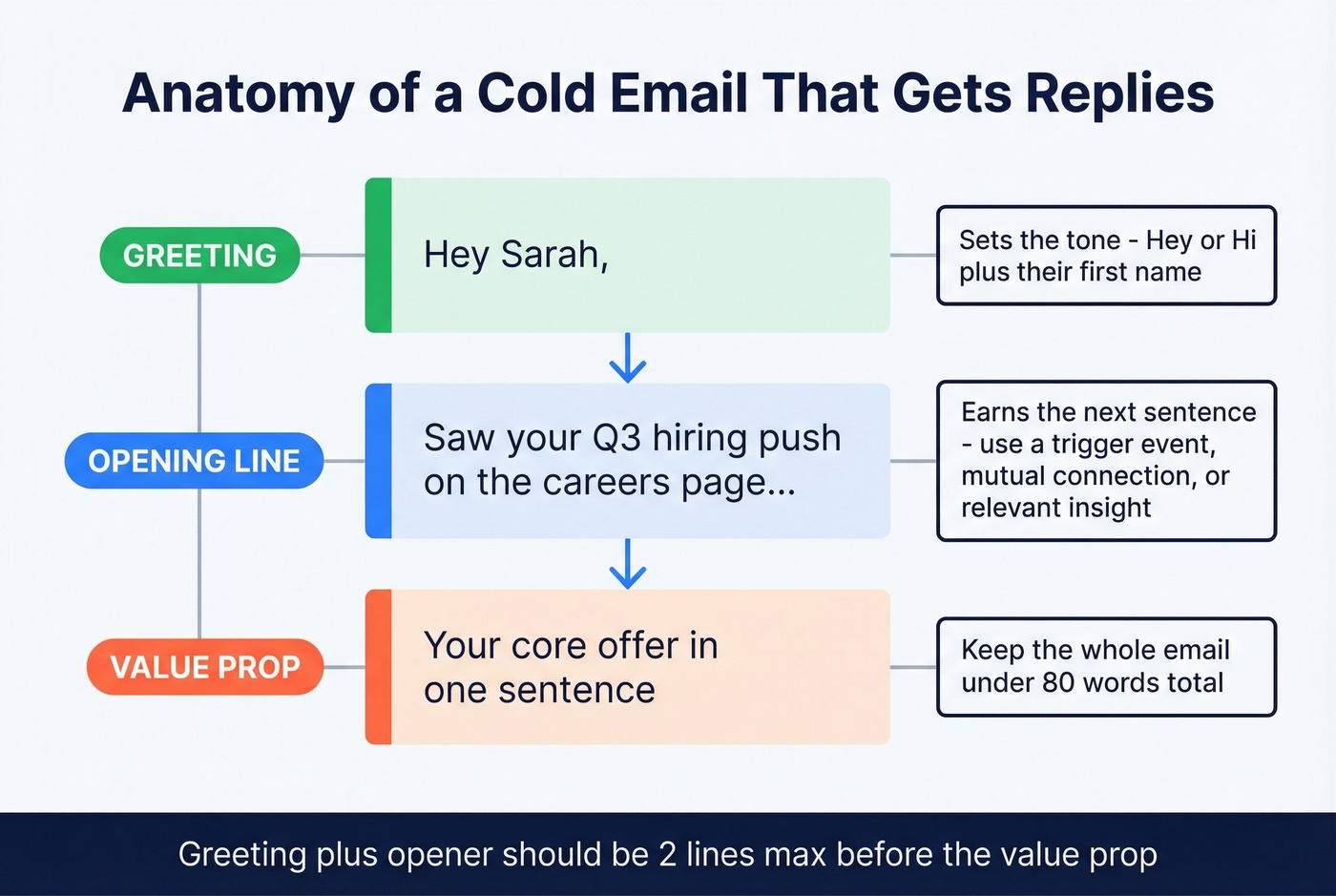
Strong openers fall into a few categories:
- Mutual connection - "Alex mentioned you're rebuilding the SDR team..."
- Relevant insight - "Saw your Q3 hiring push on the careers page..."
- Direct question - "Quick question about how you're handling [specific problem]..."
- Trigger event - "Congrats on the Series B - curious how you're scaling outbound now..."
Keep the whole email under 80 words. That's the sweet spot for top-performing campaigns, and it means your greeting and opener together should be two lines max before you hit the value prop. I've seen reps agonize over the body copy while sending 200-word novels that nobody finishes - the constraint itself is the strategy.
If you want to stack wins, pair the right greeting with better cold email subject lines and a tighter email call to action.
Verify Before You Send
None of this matters if the email bounces. Broken merge tags and "Dear Sir/Madam" are symptoms of the same root problem: bad data. Before you obsess over word choice in your cold email greeting, make sure your sending infrastructure is solid - SPF, DKIM, and DMARC are non-negotiable in 2026, and major providers now hard-reject unauthenticated mail.
For the contact data itself, Prospeo runs 98% email accuracy through a 5-step verification process that catches spam traps, honeypots, and catch-all domains. The free tier gives you 75 verified emails per month - enough to test whether your greeting strategy actually moves the needle before you scale.
If you're troubleshooting bounces and inboxing, start with an email deliverability audit, then check your email bounce rate and improve sender reputation before increasing email velocity.
Broken merge tags kill more cold emails than bad greetings. Prospeo enriches every contact with 50+ verified data points - first name, title, seniority, region - so your salutation matches the prospect every time. 83% enrichment match rate, no guesswork.
Never send another "{first_name}" email again.
FAQ
Should I use "Dear" in a cold email?
Almost never - only 16% of WSO poll respondents prefer it. Reserve "Dear" for academia, legal, or government contexts where formality is expected. For everyone else, "Hi [First Name]" performs measurably better and carries zero downside risk.
Does the greeting really affect reply rates?
Yes. SalesLoft data shows a 32-point swing between "Hey" (+23%) and "Hello" (-9%). One word change, outsized impact - it's the simplest optimization in your entire outbound stack.