

Cold Email Metrics: Stop Tracking Opens, Start Tracking Revenue
Your SDR dashboard says 52% open rate. Your positive reply rate is 0.3%. One of those numbers is lying to you - the other is telling you your campaign is dead.
Here's a framework built around what actually predicts revenue, not what looks good in a weekly standup.
What You Need (Quick Version)
The metrics that matter fall into three tiers. Deliverability metrics tell you if emails land. Engagement metrics tell you if the right people respond. Revenue metrics tell you if it's making money. Most teams obsess over engagement and activity while ignoring the deliverability and revenue layers entirely. If you only add one KPI this quarter, make it positive reply rate - the share of replies expressing genuine interest, not the total count padded with "not interested" and auto-replies.
Why Open Rates Are Broken
Apple Mail Privacy Protection accounts for 49.29% of all email opens - nearly half your data fabricated by a privacy proxy. Inflation runs +15-20 percentage points on average, and security scanners from Gmail, Outlook, and Yahoo generate "dark clicks" on top of that.
Belkins ran an experiment across 16.5M cold emails: when they turned off open tracking, response rates improved by ~3%. The metric you're measuring is actively making your campaigns worse.
Open rates have one remaining use: if they suddenly crater, you've got a deliverability problem. That's it.
The Three-Tier Metric Hierarchy
Deliverability is the foundation - if emails don't land, nothing else matters. Engagement sits in the middle. Revenue metrics sit on top.
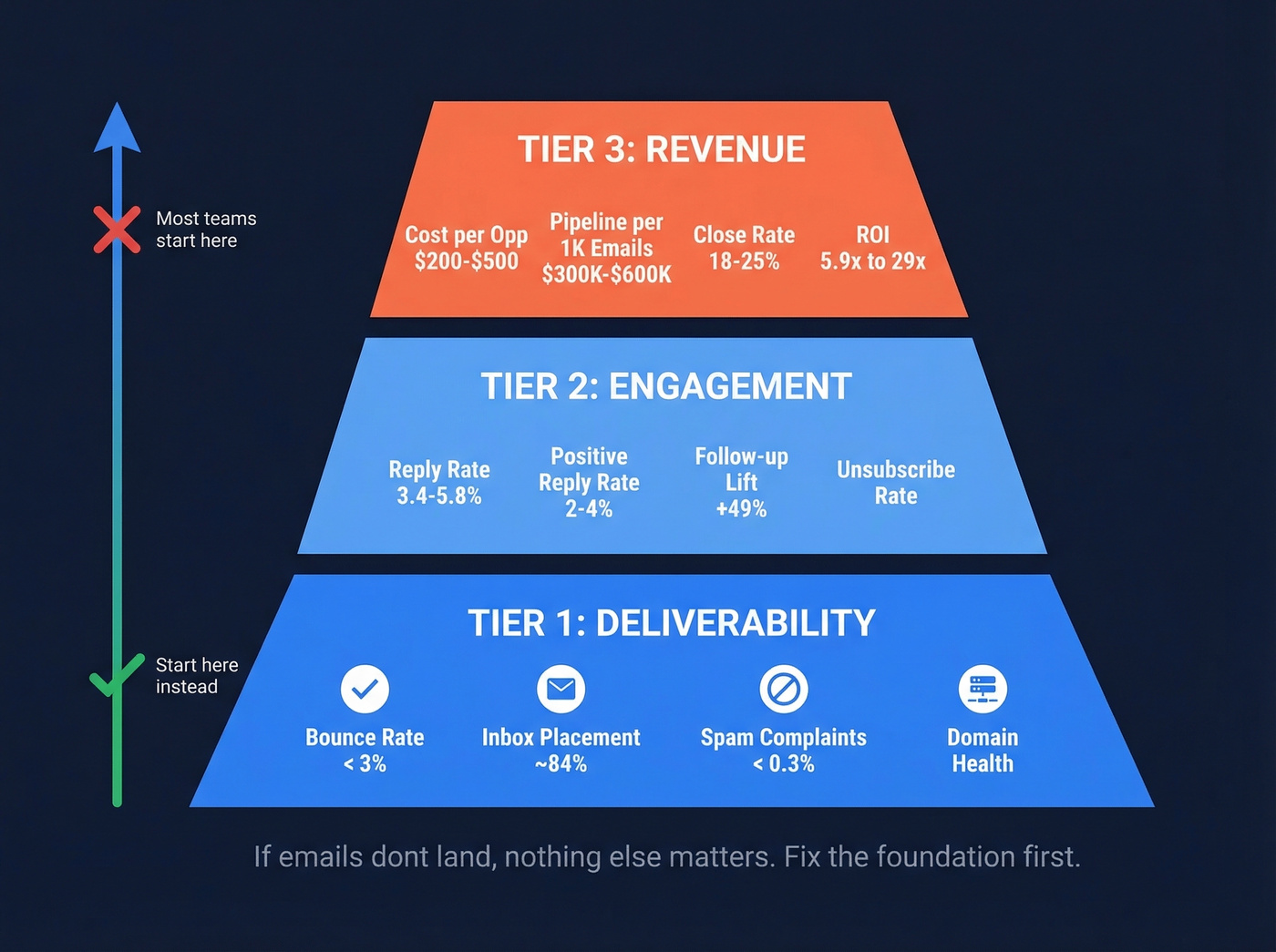
Most teams start optimizing from the wrong end.
Tier 1: Deliverability Metrics
Keep bounce rate under 2-3%. Gmail's spam complaint threshold is 0.3% - cross it and inbox placement drops fast. Here's what inbox placement looks like by provider:
| Provider | Inbox | Spam | Missing |
|---|---|---|---|
| Gmail | 87.2% | 6.8% | 6.0% |
| Microsoft | 75.6% | 14.6% | 9.8% |
| Yahoo/AOL | 86.0% | 4.8% | 9.2% |
| Apple Mail | 76.3% | 14.3% | 9.4% |
Microsoft is the toughest environment - nearly 25% of emails hit spam or vanish entirely. Domain warmup takes 4-6 weeks at 5-10 sends per day. No shortcuts.
We've seen most bounce rate problems trace back to data quality, not domain setup. Prospeo's 5-step verification - catch-all handling, spam-trap removal, honeypot filtering - delivers 98% email accuracy on a 7-day refresh cycle. Stack Optimize built to $1M ARR using that data with 94%+ client deliverability and sub-3% bounce rates across every campaign.

Bounce rate is the metric that breaks everything else. Prospeo's 5-step verification delivers 98% email accuracy with catch-all handling, spam-trap removal, and honeypot filtering - refreshed every 7 days, not 6 weeks. Stack Optimize used it to hold sub-3% bounce rates across every client campaign on their way to $1M ARR.
Fix deliverability first. Every metric above it depends on it.
Tier 2: Engagement Metrics
The Instantly 2026 benchmark report puts the average reply rate at 3.43%. Top 25% hit 5.5%+. Top 10% clear 10.7%+. But a practitioner on r/coldemail running 100K+ sends per month puts their reply rate around ~1.6% - and considers that profitable. At scale, total positive replies per month matters more than the percentage.
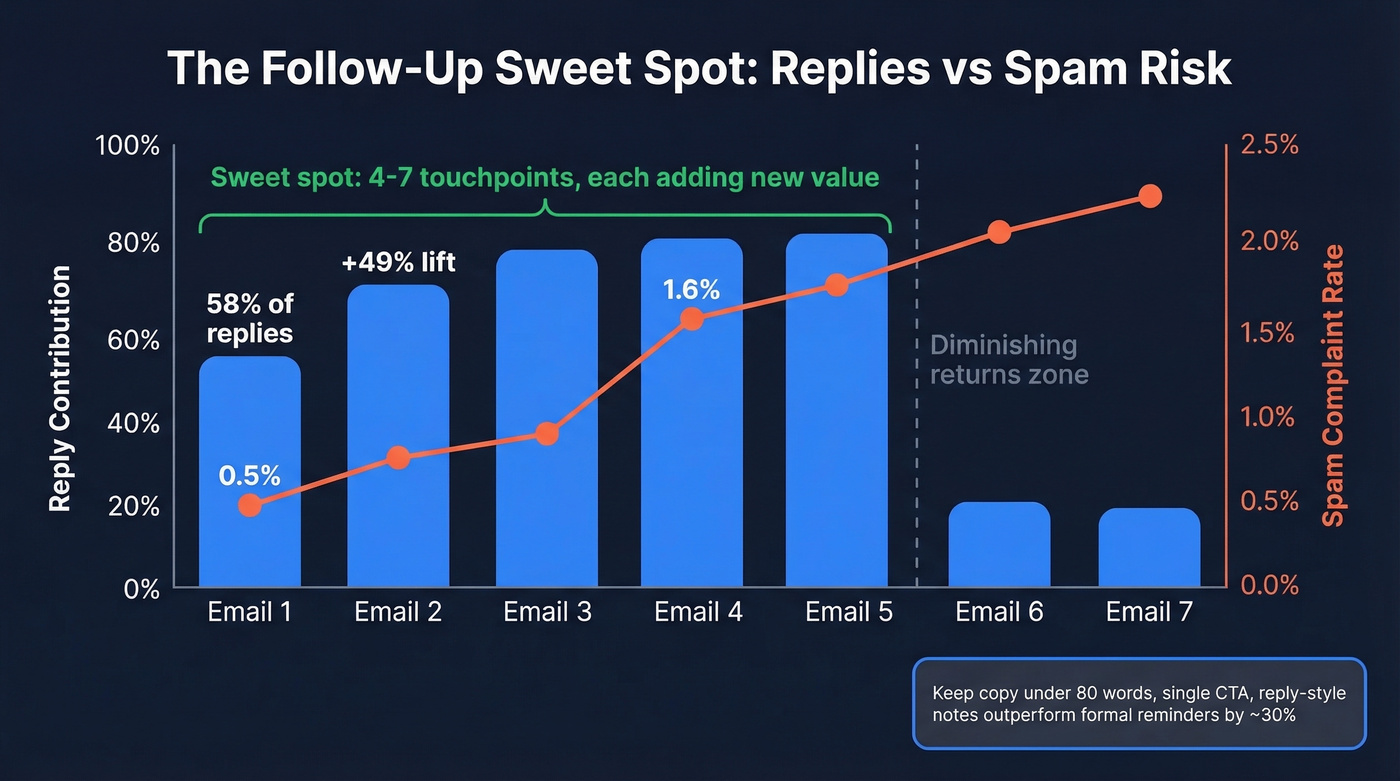
Positive reply rate is the metric most teams ignore. Threshold: above 15% of total replies should be positive. As a share of emails sent, 2-4% is a common practitioner benchmark. If your total reply rate is 5% but positive reply rate is 0.8%, you've got a targeting problem, not an engagement problem.
Here's the thing about follow-ups: 58% of replies come from the first email. The first follow-up lifts total replies by up to 49%. But as you stack more, diminishing returns hit hard - spam complaints climb from 0.5% on email one to 1.6% by email four. The sweet spot is 4-7 touchpoints, each adding new value. Keep copy under 80 words with a single CTA, because multi-ask emails consistently underperform. If you need copy ideas, start with proven sales follow-up templates and adapt them to your ICP.
Tier 3: Revenue Metrics
This is where cold email either justifies its budget or gets cut.
| Metric | Benchmark | Good | Elite |
|---|---|---|---|
| Opp conversion rate | 0.3-0.8% | 0.8-1.5% | 1.5-3% |
| Pipeline / 1K emails | $300K-$600K | - | $1M+ |
| Cost per qualified opp | $200-$500 | - | $100-$200 |
| Meeting booking rate | 40-60% | 60% | 60%+ |
| Close rate | 18-25% | 25-30% | 30-40% |
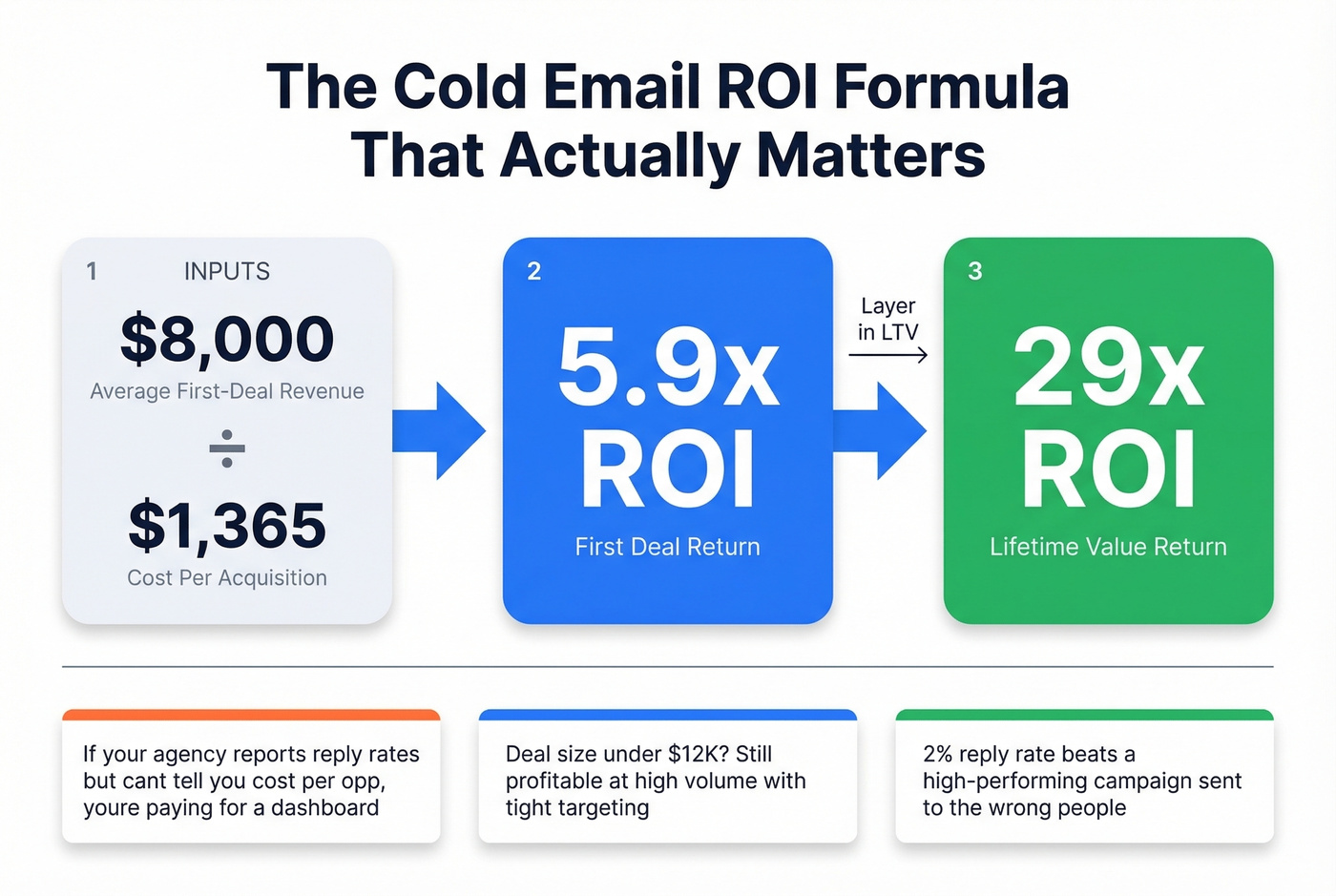
The ROI formula that actually matters: first-deal revenue divided by CPA. At $8K average first-deal revenue and $1,365 CPA, that's 5.9x. Layer in lifetime value and it's 29x. If your agency reports reply rates but can't tell you cost per qualified opportunity, you're paying for a dashboard, not results.
Let's be honest - if your average deal size is under $12K, you can still run a profitable cold email program without chasing vanity reply rates. A 2% reply rate at high volume with tight targeting will outperform a "high-performing" campaign sent to the wrong people every single time.
If you want a cleaner way to tie outbound to revenue, borrow the same logic you use for funnel metrics and report each stage with a single owner.
Master Benchmark Table
One table to bookmark:
| Metric | Benchmark | Elite |
|---|---|---|
| Bounce rate | <3% | <1% |
| Inbox placement | ~84% | 90%+ |
| Reply rate | 3.4-5.8% | 10.7%+ |
| Positive reply rate | 2-4% of sent | 5%+ |
| Meeting booking | 40-60% | 60%+ |
| Opp conversion | 0.3-0.8% | 1.5-3% |
| Pipeline / 1K emails | $300K-$600K | $1M+ |
| Cost per opp | $200-$500 | <$200 |
| Close rate | 18-25% | 30-40% |
What to Optimize First
A practitioner on r/coldemail shared a case that nails the priority order: 68% open rate, 0.3% reply rate. Instead of A/B testing subject lines, they rebuilt targeting with intent signals - SDR job postings, founders discussing sales challenges, competitor churn. Same copy. Reply rate jumped to 17%.
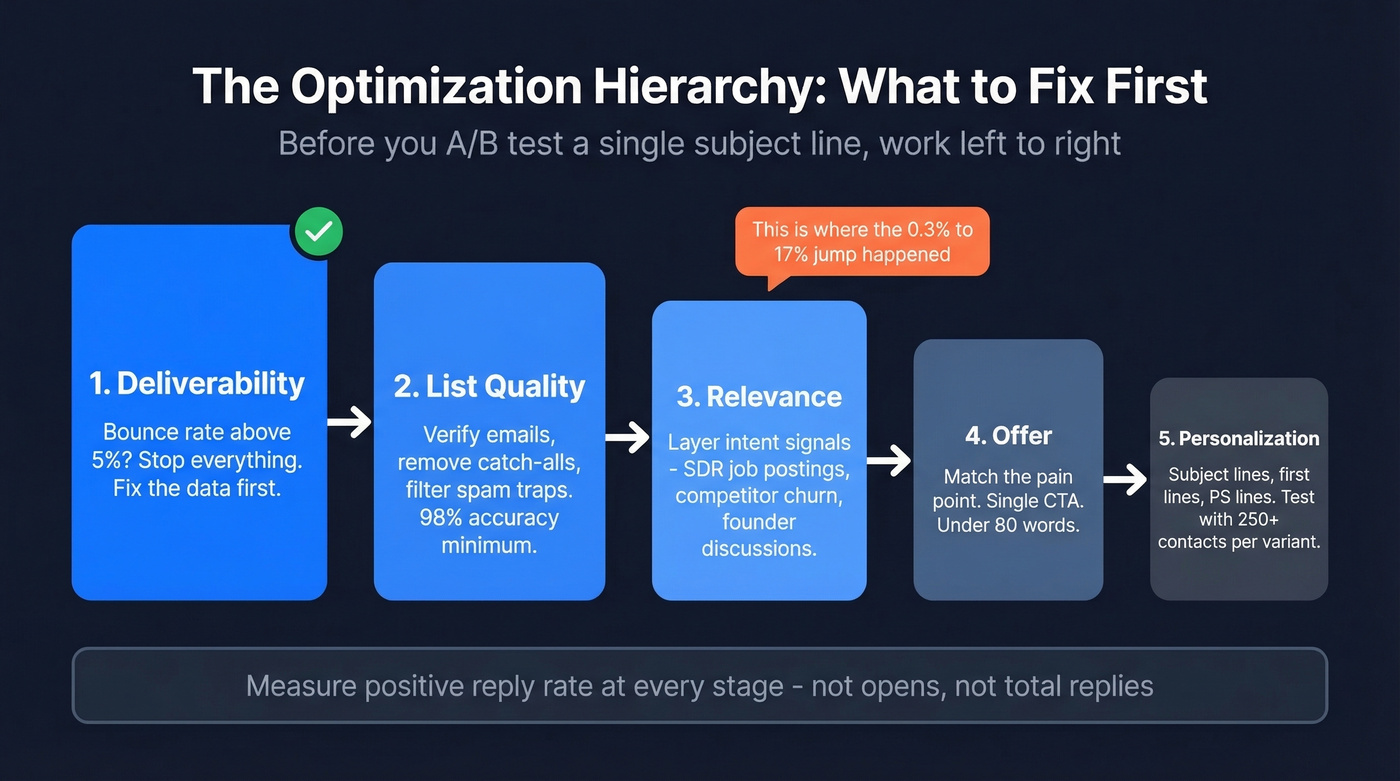
In our experience, the optimization hierarchy never changes: deliverability -> list quality -> relevance -> offer -> personalization. Before you A/B test a single subject line, verify your list and layer in intent data to fix the targeting problem that actually moves reply rates. When you do test, use 250+ contacts per variant and measure positive reply rate - not opens.
If you're still stuck at the "list quality" step, use a repeatable lead generation workflow so targeting doesn't reset every campaign.
Skip the optimization entirely if your bounce rate is above 5%. Nothing downstream will save you. Fix the data first, then worry about copy. (If you need a deeper diagnostic, start with email bounce rate benchmarks and root causes.)
The article's math is clear: at $0.01 per verified email, your cost per 1K sends barely registers. Prospeo gives you 300M+ profiles with 30+ filters - including buyer intent across 15,000 topics - so you fix targeting and deliverability in the same workflow. That's how teams move from 0.3% reply rates to double digits.
Stop A/B testing copy. Start fixing your list.
FAQ
Which cold email metrics matter most in 2026?
Positive reply rate and cost per qualified opportunity. Everything else is either a diagnostic signal like bounce rate and inbox placement, or a vanity metric like open rate. These two tell you whether your program generates revenue or just generates activity.
What's a good reply rate in 2026?
Average is 3.43%, and top 25% of senders hit 5.5%+. At 100K+ monthly volume, even 1.6% can be highly profitable - focus on total positive replies and pipeline generated, not raw percentages. The Woodpecker cold email stats page and Mailshake's benchmarks are worth checking for updated numbers throughout the year.
How many follow-ups should I send?
Four to seven touchpoints is the sweet spot. The first follow-up lifts replies by 49%, but by email four spam complaints hit 1.6%. Each message must add new value - reply-style notes outperform formal reminders by ~30%.
What should I report to leadership?
Lead with revenue-tier numbers: cost per qualified opportunity, pipeline generated per 1,000 emails, and close rate. These connect directly to business outcomes and justify continued investment far better than open or reply rates ever will.
How do I fix high bounce rates?
Run your list through a verification tool with catch-all handling and spam-trap removal before every send. Free-tier tools like NeverBounce or ZeroBounce work for smaller lists, but they lack the refresh frequency needed at scale - stale data is the silent killer of deliverability.