

How to Write a Cold Introduction Email That Actually Gets Replies
You spent 45 minutes crafting the perfect cold introduction email. Personalized opener, compelling value prop, clean CTA. You hit send on 200 contacts. Fourteen bounced. Zero replies.
The copy wasn't the problem - the infrastructure was.
The average cold email reply rate is 3.43%. Top quartile senders hit 5.5%. Elite campaigns push past 10.7%. The gap between average and elite isn't better writing - it's better data, better deliverability, and a follow-up sequence most senders never build.
The Short Version
- Your intro email should be under 80 words, lead with the prospect's problem, and end with one clear CTA.
- Most campaigns fail because of bad data and deliverability, not bad copy. Verify your list before you send.
- Follow up. 42% of all replies come from follow-up emails, and 70% of cold emails never get a follow-up.
2026 Cold Email Benchmarks
Reply rates are the only metric that matters for cold outreach. Open rates are noise thanks to Apple Mail Privacy Protection and pixel-blocking - stop optimizing for them.
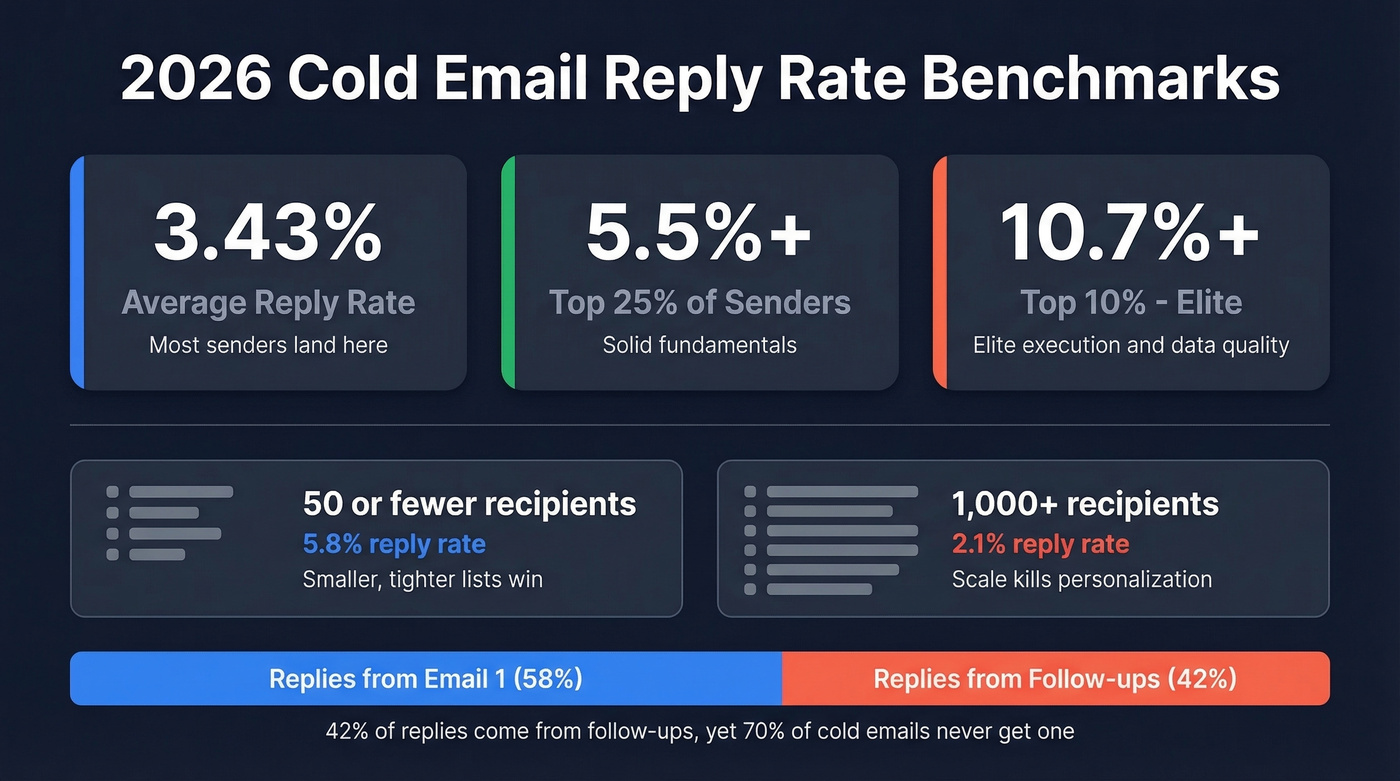
| Tier | Reply Rate | What It Means |
|---|---|---|
| Average | 3.43% | Most senders land here |
| Top 25% | 5.5%+ | Solid fundamentals |
| Top 10% | 10.7%+ | Elite execution |
Campaign size matters more than most people realize. Campaigns targeting 50 or fewer recipients average a 5.8% reply rate - scale to 1,000+ and you drop to 2.1%. Smaller, tighter lists win every time. And 42% of all replies come from follow-ups, not the first touch, yet most senders quit after email one.
Tuesday and Wednesday see the highest reply rates, with Wednesday peaking. If you're blasting on Fridays, you're leaving responses on the table.
Anatomy of a Cold Intro Email
Subject Line
An analysis of 85M+ cold emails found that 1-4 word subject lines get the highest open rates. All-lowercase outperforms title case. Salesy subject lines - "Exclusive Offer" or "Quick Question for {{firstName}}" - reduce opens by up to 17.9%.
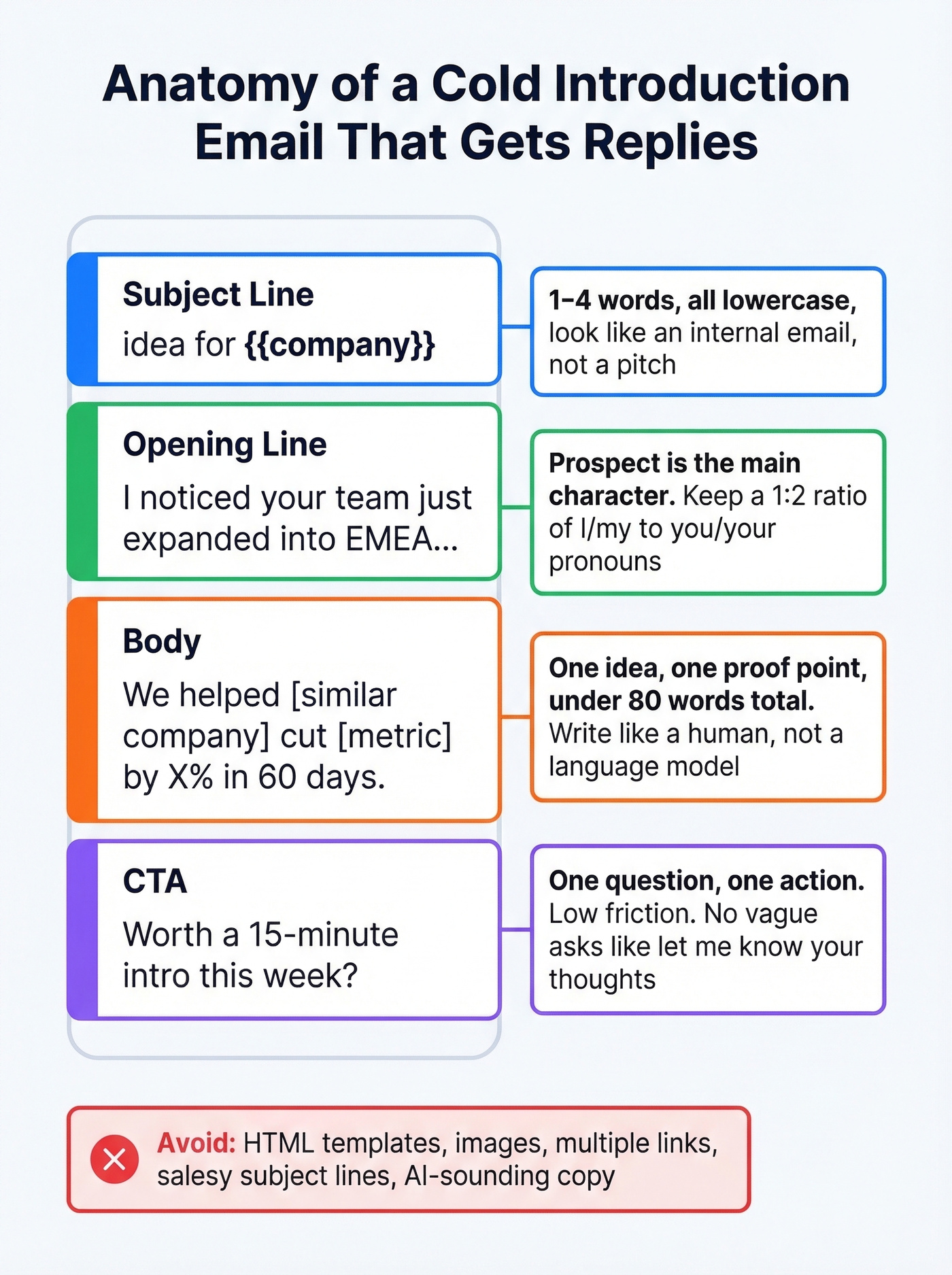
Keep it boring. "Quick question," "idea for {{company}}," or just "{{company}}" all work. The goal is to look like an internal email, not a pitch.
Opening Line
The prospect is the main character, not you. Lead with their problem or a specific observation about their business. "I noticed your team just expanded into EMEA" beats "My name is Jake and I work at..." every time.
Here's a rule we swear by: maintain a 1:2 ratio of "I/my" to "you/your" pronouns. If your email talks about yourself more than the reader, rewrite it. Prospects get 10-15 cold emails a day, and the ones that survive the first-line scan feel relevant within three seconds.
Body and CTA
One idea. One ask. Under 80 words.
Include a single proof point - "We helped [similar company] cut [specific metric] by X%" - but keep it to one sentence, not a case study. AI-generated emails are easy to spot in 2026 because they're grammatically perfect but emotionally flat. Write like a person with a specific observation, not a language model filling a template.
Your CTA needs to be direct and low-friction. "Worth a 15-minute intro this week?" works. "Let me know if you'd be interested in learning more" doesn't. One question, one action. (If you want more options, see these email call to action rules and examples.)
Cold Intro Email Templates
The Problem-First Template
Subject: {{pain point}}
Hi {{firstName}},
Most {{role}} teams at {{company size}} companies waste 5-8 hours a week on {{specific problem}}. It's usually a {{root cause}} issue.
We built {{product}} to fix that - {{one-line value prop}}. {{Similar company}} cut their {{metric}} by {{number}} in 60 days.
Worth a 15-minute intro this week?
This is the default cold introduction email for any ICP where you understand the pain well. It works because a specific, measurable problem forces the reader to self-identify - they either have this problem or they don't. No ambiguity.
The Trigger-Based Template
Subject: congrats on the raise
Hi {{firstName}},
Saw {{company}} just closed your Series B - congrats. Teams at this stage usually hit a wall with {{problem that scales with growth}}.
We work with {{2-3 similar companies}} on exactly that. Happy to share what's working if useful.
Open to a quick call Thursday or Friday?
Use this after a funding round, leadership hire, or expansion announcement. Signal-based emails referencing triggers like these can push reply rates to 15-25% because the trigger gives you a natural reason to reach out and proves you've done your homework. In our experience, trigger-based outreach outperforms generic cold emails by 3-5x when the timing is right.
The Mutual Value Template
Subject: {{metric}} at {{peer company}}
Hi {{firstName}},
We helped {{peer company}} increase {{metric}} by {{number}} - here's the 2-min case study: {{link}}.
Their setup before we started looked a lot like {{company}}'s current {{observable situation}}.
Worth comparing notes? I can walk through what worked in 15 minutes.
Best when you have a strong case study in the prospect's industry. Social proof does the heavy lifting - your job is to make the connection between their situation and the result obvious.

You just read that 14 out of 200 emails bounced. That's a 7% bounce rate - enough to tank your sender reputation and kill every cold introduction email that follows. Prospeo's 5-step verification delivers 98% email accuracy with a 7-day refresh cycle, so your intros land in inboxes, not spam folders.
Stop writing perfect cold emails to addresses that don't exist.
The Follow-Up Sequence
58% of replies come from the first email, but 42% come from follow-ups. And 70% of cold emails never get a follow-up. That's free pipeline left on the table. (If you need copy, start with these cold email follow-up templates.)
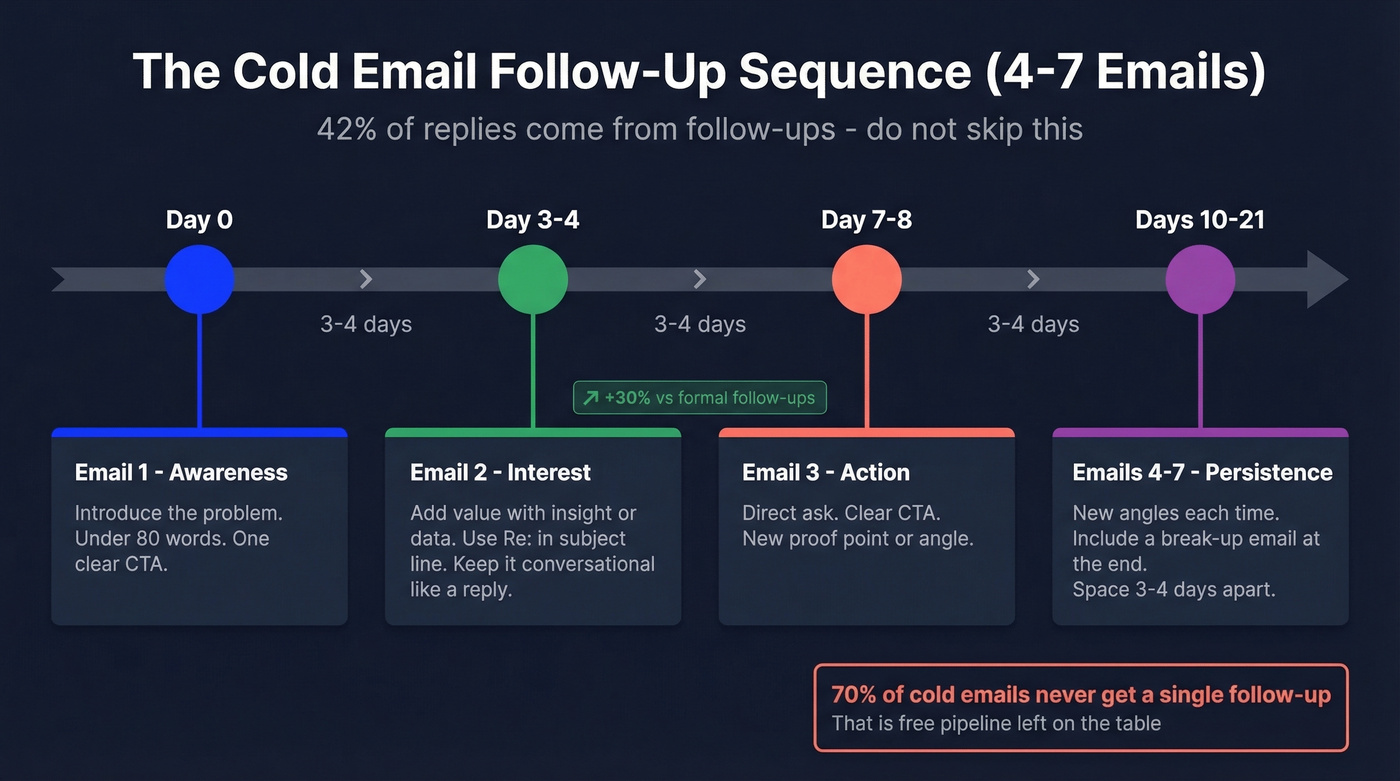
| Timing | Purpose | |
|---|---|---|
| 1 | Day 0 | Awareness - introduce the problem |
| 2 | Day 3-4 | Interest - add value with insight or data |
| 3 | Day 7-8 | Action - clear CTA, direct ask |
| 4-7 | Days 10-21 | Persistence - new angles, break-up |
The sweet spot is 4-7 emails spaced 3-4 days apart.
One trick that consistently works: make email two look like a reply. Use "Re:" in the subject line, keep the original subject text intact, and maintain a conversational tone as if you're continuing a thread. Don't add new subject text or formatting. This outperforms formal follow-ups by about 30%.
Fix Your Data First
Here's the thing: the consensus on r/coldemail is blunt. Cold email feels broken in 2026. Senders report wildly inconsistent results week to week - even with solid copy, tight targeting, and proper warmup. The bottleneck isn't messaging. It's data quality.
Run 2-3 inboxes per domain, cap each at 10-15 emails per day, and warm up for 14-21 days before sending. Then ramp volume over the next 4-6 weeks. SPF, DKIM, and DMARC are mandatory - Google, Yahoo, and Microsoft all enforce them. Keep spam complaints under 0.3%, bounces under 2%, and set up a custom tracking domain.
But none of that matters if the email addresses themselves are bad. We've seen campaigns go from 2% to 8% reply rates just by switching to verified data. Prospeo runs every address through a 5-step verification process - catch-all handling, spam-trap removal, honeypot filtering - and delivers 98% accuracy on 143M+ verified addresses with a 7-day refresh cycle. Stack Optimize used Prospeo to build to $1M ARR with 94%+ deliverability, under 3% bounce rates, and zero domain flags across all their clients.
Mistakes That Kill Cold Emails
Sending from your primary domain is the most common one - use a secondary domain to protect your main reputation. Skipping warmup is a close second; new domains need 14-21 days minimum. (More: how to improve sender reputation.)
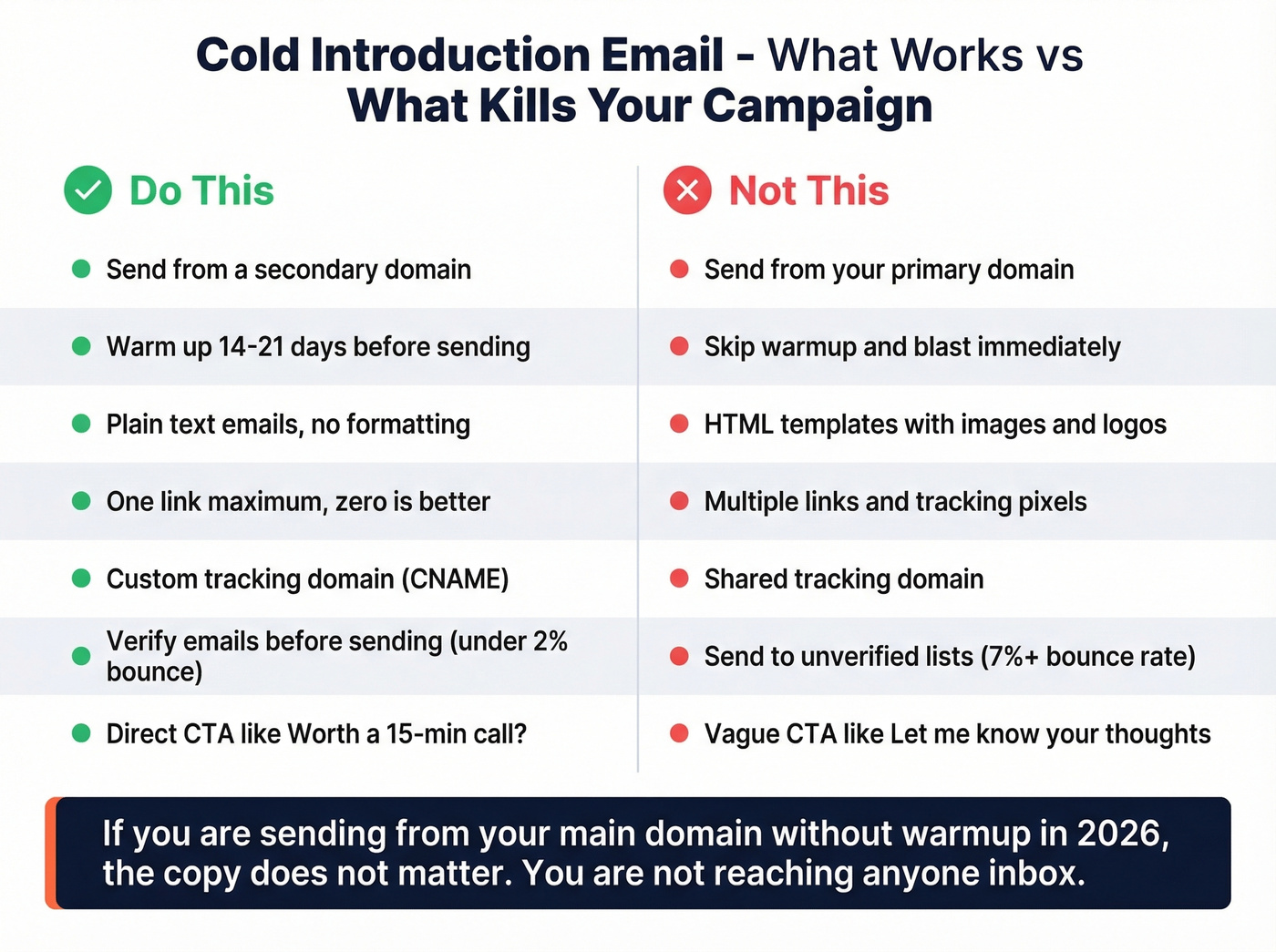
A recurring complaint on r/sales is people using HTML templates, images, or logos when plain text outperforms them. Skip the fancy formatting. Other killers include multiple links in one email (one max, zero is better), vague CTAs like "let me know your thoughts," shared tracking domains instead of a custom CNAME, and missing an unsubscribe option. AI/NLP filters now detect and flag generic templates too, so cookie-cutter outreach gets buried faster than ever.
Let's be honest - if you're still sending from your main domain without warmup in 2026, the copy doesn't matter. You're not reaching anyone's inbox.
Compliance Essentials
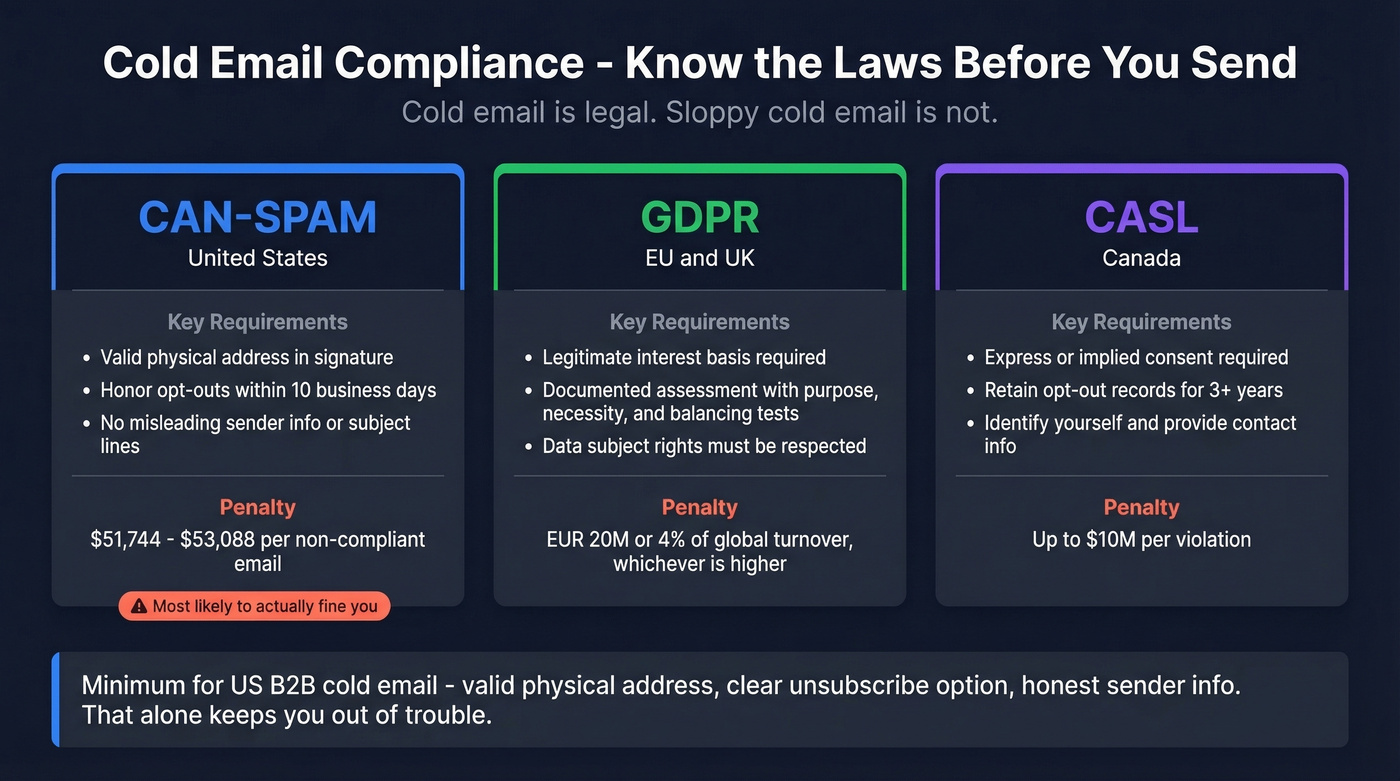
Cold email is legal. Sloppy cold email isn't. (If you're unsure about list sourcing, read is it illegal to buy email lists.)
| Law | Key Requirement | Penalty |
|---|---|---|
| CAN-SPAM (US) | Valid physical address, honor opt-outs within 10 business days, no misleading sender info | $51,744-$53,088 per non-compliant email |
| GDPR (EU/UK) | Legitimate interest basis with documented assessment; purpose, necessity, balancing tests | EUR 20M or 4% of global turnover |
| CASL (Canada) | Express or implied consent required; retain opt-out records 3+ years | Up to $10M per violation |
Most teams obsess over GDPR compliance while ignoring CAN-SPAM, which is the law most likely to actually fine you. If you're sending B2B cold email in the US, get a valid physical address in your signature and honor every opt-out. That alone keeps you out of trouble.
Trigger-based cold intros hit 15-25% reply rates - but only if you catch the signal in time. Prospeo tracks 15,000 intent topics, job changes, funding rounds, and headcount growth across 300M+ profiles, refreshed every 7 days. Build the tight, targeted lists this article recommends at $0.01 per verified email.
Find the right prospects before your competitors email them first.
FAQ
How long should a cold introduction email be?
Under 80 words for the body, with a 1-4 word subject line. Total email including signature should stay under 125 words. Shorter emails consistently outperform longer ones because prospects decide within three seconds whether to keep reading.
How many follow-ups should I send?
Four to seven emails spaced 3-4 days apart. 42% of all cold email replies come from follow-ups, so quitting after one send leaves nearly half your potential pipeline untouched. Each follow-up should add a new angle or proof point - not just "bumping this."
What's a good reply rate for a cold intro?
The average is 3.43%. Top 25% of senders hit 5.5%+, and elite campaigns exceed 10.7%. If you're below 3%, your data or deliverability needs work before your copy does.
How do I verify emails before sending?
Use a dedicated verification tool that checks for catch-all domains, spam traps, and honeypots. Prospeo's 5-step verification delivers 98% accuracy across 143M+ addresses, and its free tier includes 75 verifications per month - enough to test a first campaign without spending anything.