

Cold Outreach Frameworks: What Actually Works in 2026 (484k Emails Tested)
You've read five of these guides already. They all say the same thing: personalize your subject line, keep it short, use a CTA. Then you send 2,000 emails and get 14 replies.
The problem isn't that you're bad at writing cold emails - it's that most cold outreach frameworks don't survive contact with real inboxes. There's a growing camp on Reddit that says cold outreach is dead. The data says otherwise, but only if your infrastructure and frameworks are right.
A practitioner on r/coldemail ran 484k emails across 18 opener variations over four months, controlling for list quality, infrastructure, and offer. Only three patterns consistently beat a 2% reply rate. The rest - including several "proven" frameworks you've probably tried - landed between 0.8% and 1.8%. That gap is the difference between a pipeline and a spreadsheet of wasted sends.
What You Need (Quick Version)
- 3-4 frameworks matched to prospect awareness level, not 16. Most of those 18 tested patterns failed. Fewer, sharper plays win.
- Multi-channel sequencing - email plus phone plus social. Multi-channel outreach increases response rates by 287% vs single-channel.
- Verified data and clean infrastructure before any framework matters. The best copy in the world fails when 22% of your list bounces.
2026 Cold Email Benchmarks
The Instantly 2026 benchmark report analyzed billions of cold email interactions across thousands of workspaces:
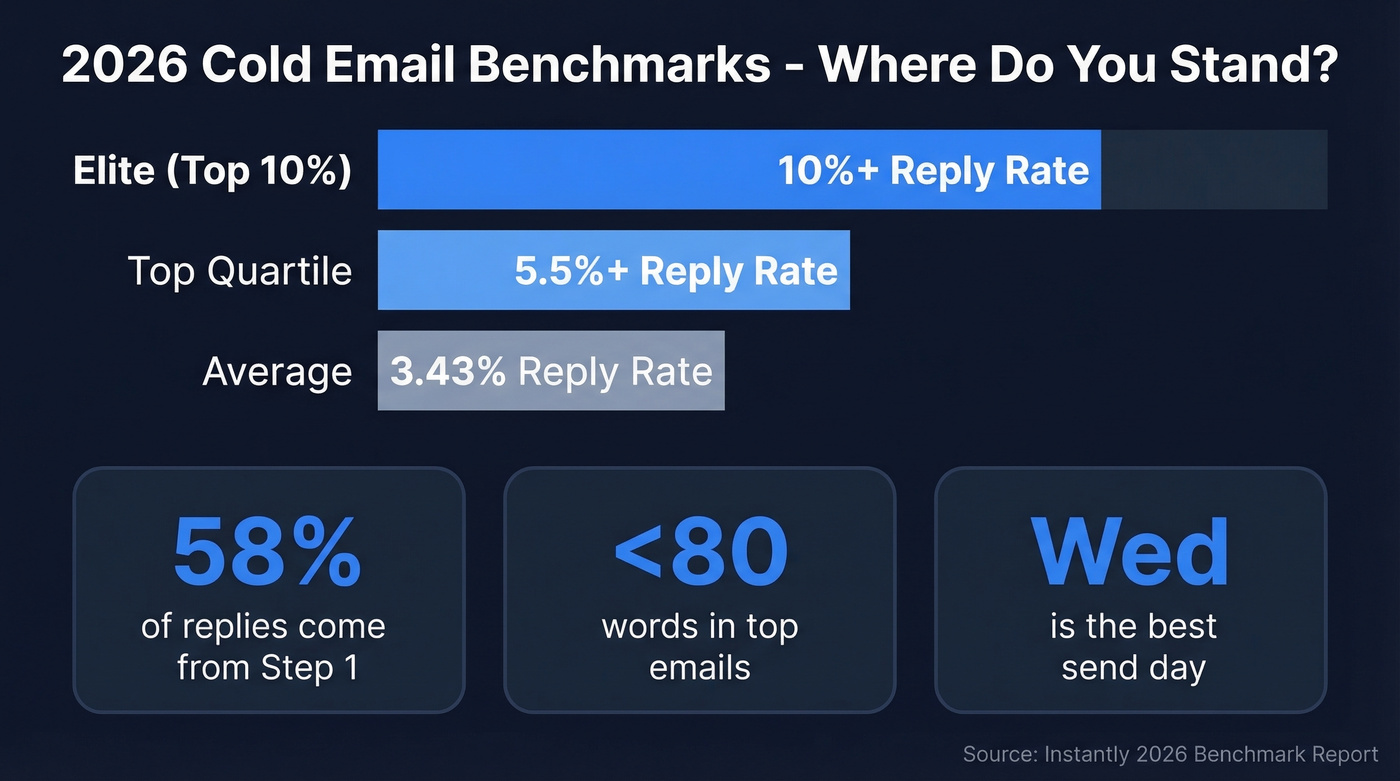
| Tier | Reply Rate | What It Means |
|---|---|---|
| Average | 3.43% | Median across thousands of workspaces |
| Top Quartile | 5.5%+ | Good infra + relevant messaging |
| Elite (Top 10%) | 10%+ | Signal-based personalization + multi-channel |
A few things jump out. First, 58% of replies come from step one - your opener matters more than your follow-up sequence. Second, top-performing campaigns keep emails under 80 words. Third, Tuesday and Wednesday are peak send days, with Wednesday edging ahead.
Department matters too. Lavender's analysis of 231,818 cold emails found engineering and product teams reply at 5.2%, while HR - the hardest department - sits at 3.4%. Emails that scored an "A grade" in Lavender's system lifted HR reply rates to 4.3%, a 27% improvement. Quality isn't a platitude. It's measurable.
In our experience, teams under 2% almost always have a data quality problem, not a copy problem. Fix your list before you rewrite your subject lines.
Email Frameworks That Beat 2%
Out of 18 patterns tested across 484k sends (1,000-1,500 sends per variation, bounce kept under 2%), these three cleared the bar.
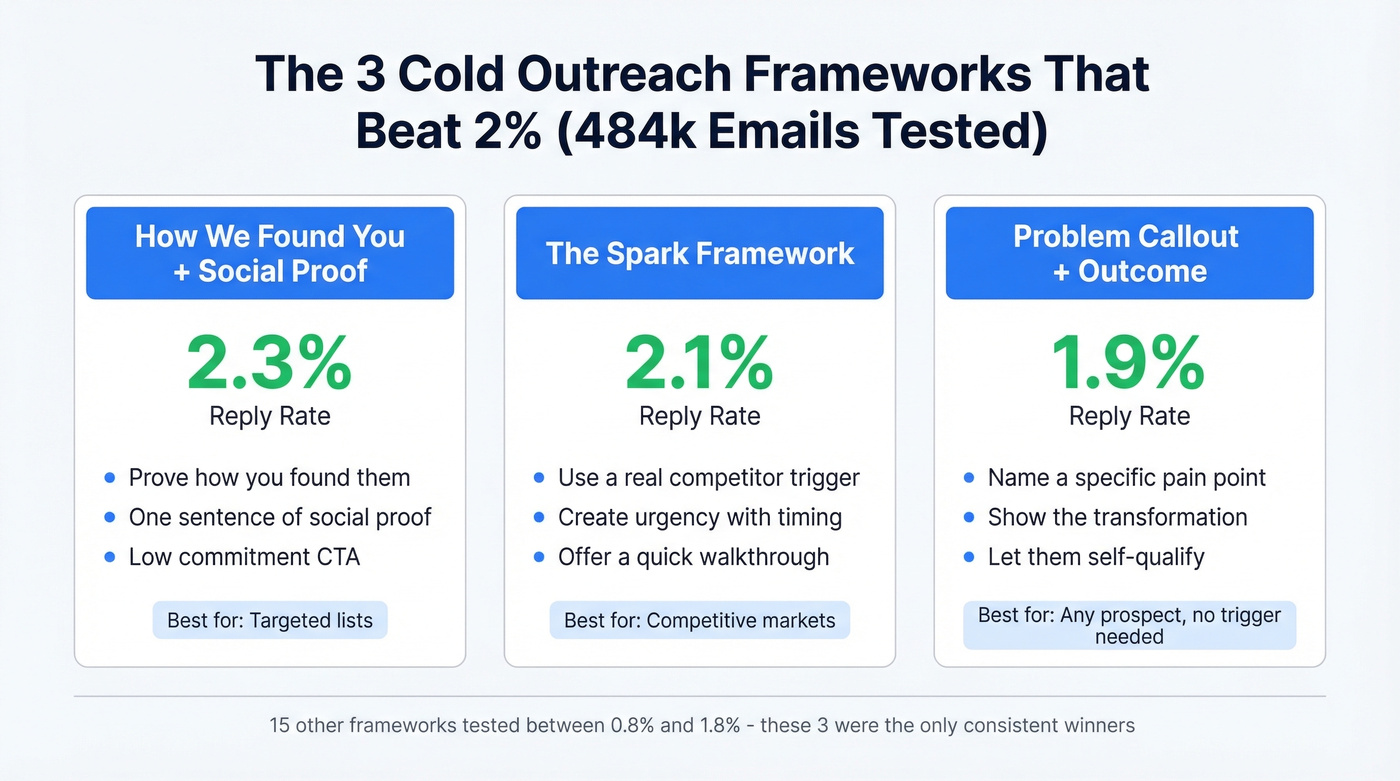
"How We Found You" + Social Proof
Reply rate: 2.3%
Hi {{firstName}}, saw {{company}} on a list of fast-growing Series B fintechs expanding into EMEA. We helped [similar company] cut their compliance onboarding from 6 weeks to 9 days. Worth a quick look?
Why it works: the "how we found you" line proves you didn't pull their name from a random database. The social proof is compressed into one sentence - not a paragraph. And "worth a quick look?" is a low-commitment ask that doesn't trigger the "this person wants 30 minutes of my life" reflex.
The Spark Framework
Reply rate: 2.1%
This one - sometimes called the spark framework cold email approach - runs on competitive tension and curiosity. Nobody wants to be caught flat-footed by a competitor move. It works best when the trigger is real and recent.
Hi {{firstName}}, noticed {{competitor}} just launched [feature/expansion]. Usually when that happens, {{company}}'s team starts getting questions about [related problem]. We built [solution] specifically for that moment. Open to a 10-min walkthrough?
The trigger has to be genuine. Fake competitor news gets sniffed out instantly, and you'll burn the relationship before it starts.
Problem Callout + Outcome
Reply rate: 1.9% - the lowest of the three winners, but the most versatile because it doesn't depend on a specific trigger event.
Hi {{firstName}}, most [role] at [company stage] companies spend 4+ hours/week manually reconciling [process]. Our customers automated that and got the time back. Curious - is that a problem you're solving right now?
The structure is clean: name the problem, show the transformation, then ask a question that lets them self-qualify. You're not saying "I know you're struggling" - you're saying "this is common, is it true for you?"
Structural Frameworks by Awareness Level
The three patterns above are openers. You also need structural frameworks for different prospect awareness levels.
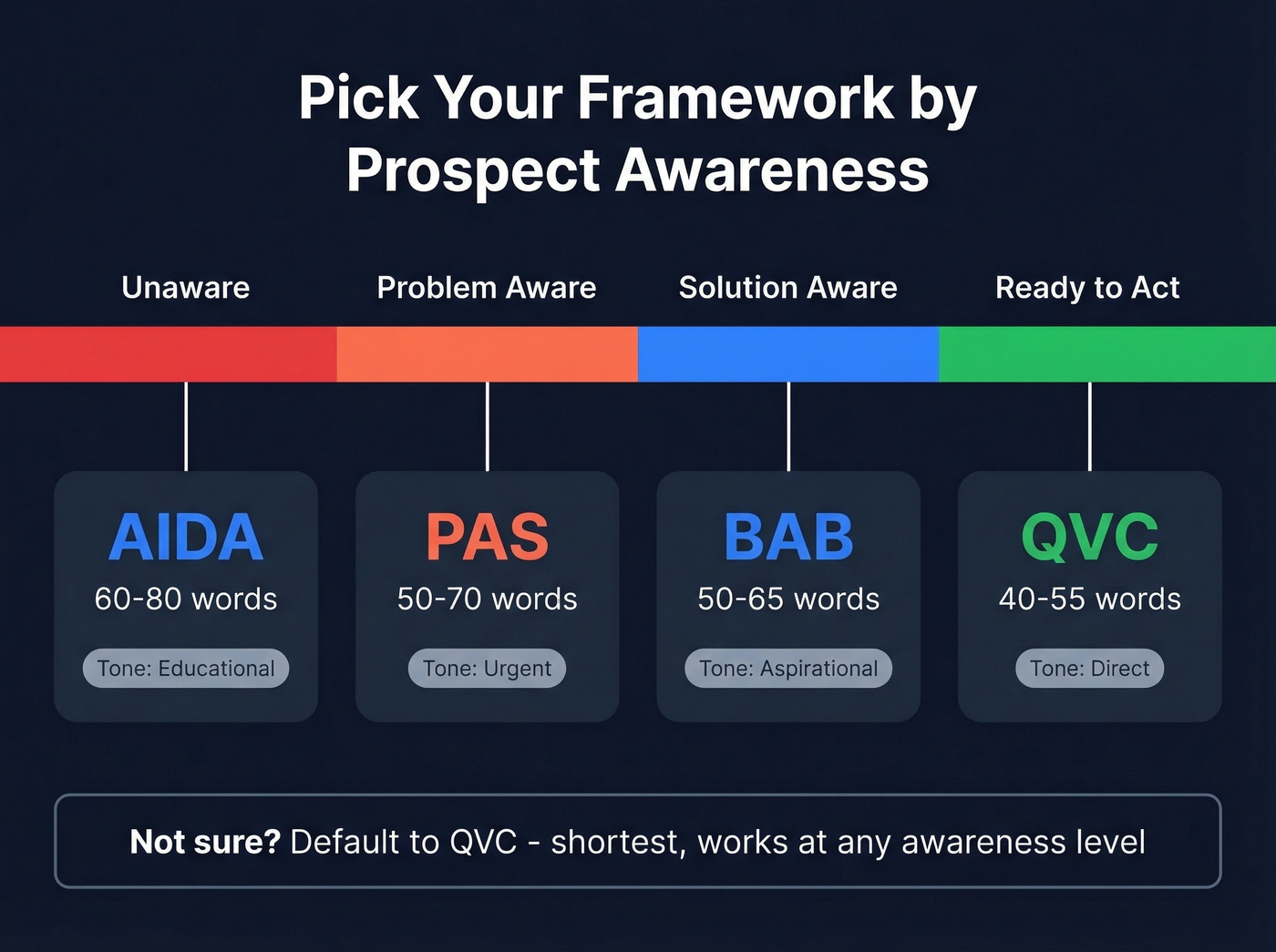
PAS (Problem-Agitate-Solve) works best for prospects who know they have a problem but haven't acted. The "agitate" step uses loss aversion - what happens if they keep ignoring it? Keep agitation to one sentence. Two sentences and you sound like an infomercial.
AIDA (Attention-Interest-Desire-Action) is for unaware prospects. You're guiding them through a mini-journey: grab attention, build interest with a relevant insight, create desire with an outcome, then ask for action. This framework tends to run longer, so fight to keep it under 80 words.
BAB (Before-After-Bridge) is for transformation selling. Paint the "before" state, show the "after," then bridge with your solution. Works well when the outcome is concrete - "before: 6-week onboarding; after: 9 days."
QVC (Question-Value-CTA) is your default when you're unsure. Three to five sentences max. Ask a question, deliver one line of value, close with a CTA.
| Framework | Best When Prospect Is... | Ideal Length | Tone |
|---|---|---|---|
| PAS | Problem-aware, hasn't acted | 50-70 words | Urgent |
| AIDA | Unaware of the problem | 60-80 words | Educational |
| BAB | Aware, needs proof | 50-65 words | Aspirational |
| QVC | Any - when brevity wins | 40-55 words | Direct |
The most common mistakes across all four: skipping the hook entirely, cramming in multiple CTAs (pick one), and leading with features instead of outcomes. Nobody cares about your "AI-powered platform." They care about getting 4 hours back per week.

The 484k-email test proved that sub-2% reply rates are almost always a data problem, not a copy problem. Prospeo's 5-step verification delivers 98% email accuracy with a 7-day refresh cycle - so your carefully crafted frameworks actually reach real inboxes.
Stop rewriting subject lines. Start fixing your list.
Follow-Up and Recovery Sequences
Here's the thing: your follow-up sequence matters more than your opener for total pipeline. While 58% of replies come from step one, 42% come from follow-ups - and most teams write those as lazy "just bumping this" nudges that trigger spam filters.
The 50% rule is a good guardrail: no more than 50% of your sequence steps should be emails. The rest should be calls, social engagement, or video messages.
Ghost Recovery (they went silent after initial interest): Reference the specific thing they engaged with. "You opened the case study on Tuesday - did the numbers make sense for your team?" Skip this if they never opened anything. You're guessing, and it shows.
OOO Pivot: Don't just wait. Note the return date, research something new about their company in the interim, and re-enter with fresh context.
Referral Recovery (wrong person): "Totally understand if this isn't your area - who on your team handles [function]?" Skip this if you're mass-sending to generic titles. Fix your targeting instead.
Step counts by segment: SMB sequences run 5-8 steps over ~30 days. Mid-market needs 7-12 steps over 30-45 days. Enterprise stretches to 10-18 steps over 30-60+ days.
If you want plug-and-play sequences, start with follow-up sequence options that match your segment.
Cold Call Frameworks
Most guides on cold outreach stop at email. That's a blind spot - phone still works, especially paired with email touches, and the first 30-60 seconds decide the outcome.
Permission-Based Opener: "Can I take 20 seconds to tell you why I called, and you can tell me if it's worth continuing?" This works because it gives the prospect control. Most people say yes out of curiosity.
Trigger Event Opener: "I saw {{company}} just {{trigger}}. Usually when that happens, {{problem}} becomes urgent pretty fast." Same logic as the email spark pattern, compressed for voice.
Pattern Recognition Opener: "We've been seeing a pattern with [industry/role] - [specific observation]. Are you seeing that too?" This positions you as someone who talks to their peers, not a stranger reading a script.
Once you're past the first 20 seconds: confirm the problem, ask about their current approach, identify the gap, deliver a 15-second punchline, then ask for a small next step. Not a demo. A 10-minute call, a case study, a relevant resource.
If you're building a repeatable phone motion, a cold calling system helps you standardize openers, routing, and follow-through.
None of these openers matter if you can't reach the prospect. For direct dials, Prospeo's Mobile Finder covers 125M+ verified numbers with a 30% pickup rate - a real edge when you're trying to reach decision-makers who screen unknown callers.
Multi-Channel Sequencing
Single-channel email is the baseline. An omni cold email strategy - adding phone and social to your sequences - lifts response rates by 287%. We've tested single-channel vs multi-channel sequences across multiple campaigns, and the lift is real every time.
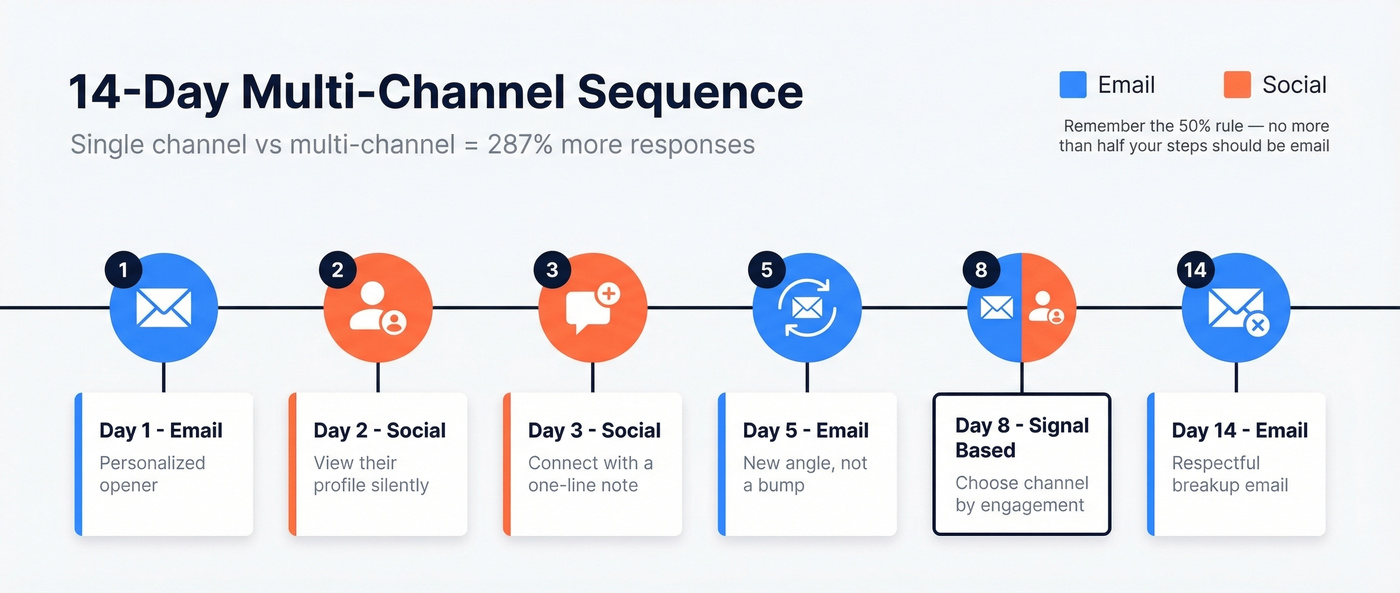
A concrete two-week cadence:
| Day | Channel | Action |
|---|---|---|
| 1 | Personalized opener (Pattern 1 or 3) | |
| 2 | Social | View their professional profile - no message, just visibility |
| 3 | Social | Connection request with a one-line note |
| 5 | Follow-up with a new angle, not a bump | |
| 8 | Social or Email | Depends on engagement signals |
| 14 | Breakup - clear, respectful, leaves the door open |
If you want a tighter outbound motion, borrow from sales prospecting techniques that combine channels and timing.
Don't blast all three channels on the same day. And don't copy-paste your email into a social message - each channel has its own tone and length expectations. Social messages should be shorter and more conversational. Phone calls should reference the email you already sent.
Remember the 50% rule: if your sequence has 8 steps, no more than 4 should be emails.
The Infrastructure Layer
Let's be honest - frameworks are the fun part. Infrastructure is the part that actually determines whether your emails land in inboxes. We've seen teams obsess over copy for weeks while sending from a single domain with no authentication. That's like tuning a race car engine and forgetting to put tires on.
Deliverability Requirements
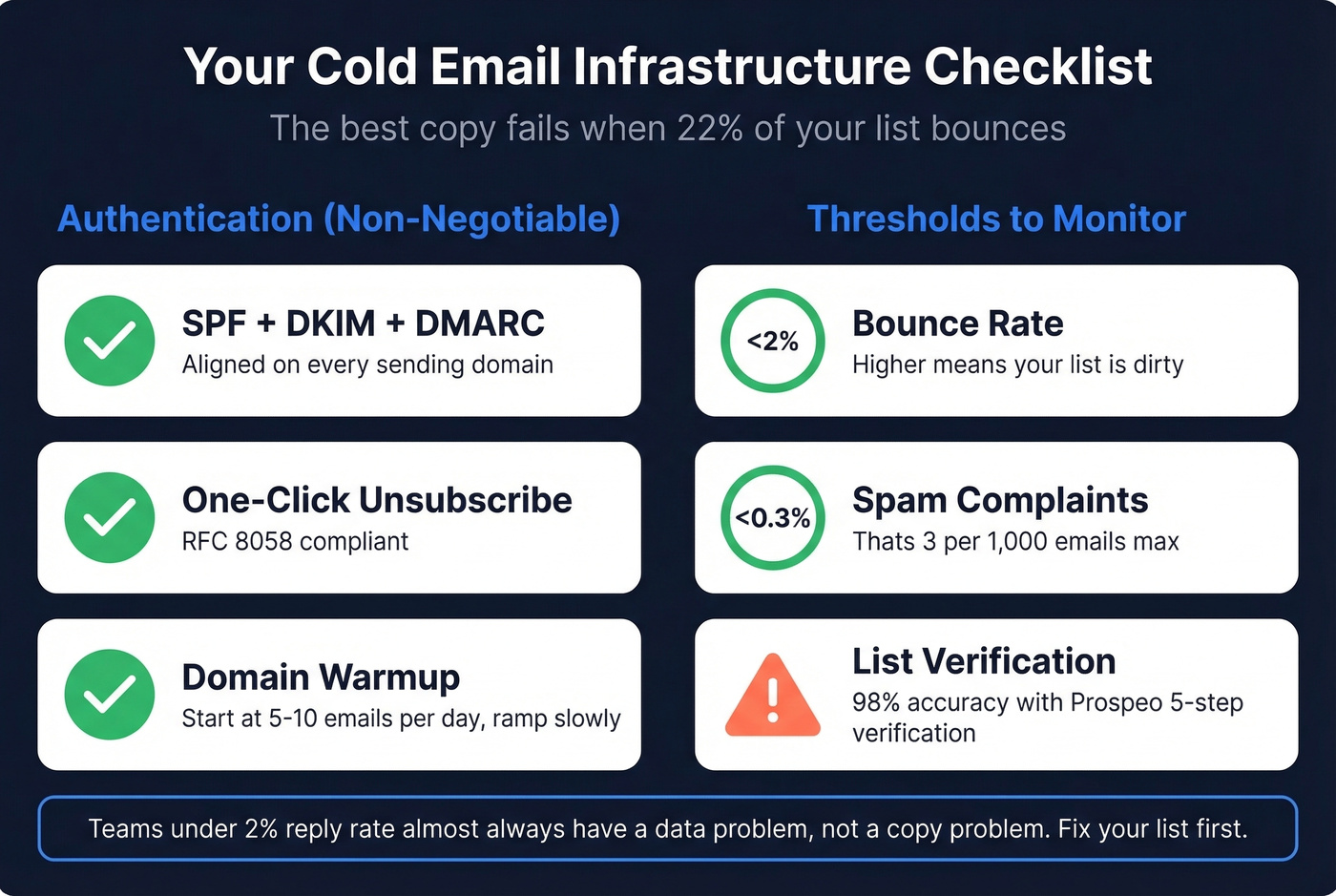
These aren't optional anymore. Google, Yahoo, and Microsoft enforce them:
- SPF + DKIM + DMARC alignment on every sending domain
- One-click unsubscribe (RFC 8058)
- Spam complaints under 0.3% - that's 3 complaints per 1,000 emails
- Bounces under 2%
- Warmup ramp: start at 5-10 emails/day per domain, increase over 4-6 weeks
If you need a deeper checklist, use an email deliverability guide to audit the full stack.
Domain and Volume Strategy
One practitioner on r/Entrepreneur documented their rebuild from a 3% to 6% reply rate. The changes: expanded from 3 to 7 domains, capped each at 26 emails/day, cut email length from 141 words to under 56, and shifted sends to Tuesday-Thursday, 8-11 AM in the recipient's timezone. Total stack cost: ~$420/month. Result: 16 qualified leads per month from email alone.
To avoid getting throttled or flagged, keep an eye on email velocity as you scale.
List Quality
This is where most outreach operations quietly fail.
One practitioner found that verifying every email dropped their bounce rate from 22% to under 3%. Meritt, an outbound agency, saw bounce rates fall from 35% to under 4% after switching to verified data - and their pipeline tripled from $100K to $300K per week. The pattern is consistent: bad data silently kills campaigns that would otherwise perform.
If you're fixing list quality at the source, start with data enrichment and then validate with an AI email checker.
Prospeo runs a 5-step verification process with catch-all handling, spam-trap removal, and honeypot filtering - delivering 98% email accuracy on 143M+ verified addresses. Data refreshes every 7 days, compared to the 6-week industry average, so you're not sending to someone who changed jobs last month. The free tier covers 75 emails + 100 Chrome extension credits per month, enough to test before committing.
Signal-based personalization - like job changes, funding rounds, and buyer intent - is what separates elite 10%+ reply rates from average. Prospeo tracks 15,000 intent topics and gives you 30+ filters to build lists that match every framework above.
Find the trigger events that make the Spark Framework actually spark.
What Doesn't Work (With Data)
The 484k-email test didn't just reveal winners. It exposed patterns that consistently underperformed - and that most framework guides still recommend.
| Pattern | Reply Rate | Why It Fails |
|---|---|---|
| Compliment openers | 1.4% | Read as fake at scale |
| "Are you struggling..." | 0.9% | Feels like a survey |
| Long intros (>75 words) | 0.8% | Nobody reads past sentence 2 |
| Feature dumps | 1.2% | Prospects don't care about your features |
The compliment opener is the worst offender because it feels so right. "Love what you're doing at {{company}}!" sounds personal. At scale, it's transparently hollow - and prospects pattern-match it instantly as a sales email. The consensus on r/sales backs this up: compliment openers get flagged and ignored faster than almost any other template.
Beyond copy, watch for infrastructure-level failures. Daily generic follow-up bumps trigger velocity pattern detection. Reusing the same template across thousands of sends creates template fingerprints that spam filters catch. Vary your copy, space your touches, and treat deliverability as a living system, not a one-time setup.
For more examples you can test quickly, pull from cold email subject line examples and iterate based on replies, not vibes.
FAQ
How many cold emails should I send per day?
Cap at 25-30 per mailbox per day. Use 5-10 domains to scale volume without burning reputation. Top performers in the 2026 benchmark data averaged 26 emails per day per domain. More volume from fewer domains is the fastest way to land in spam.
What's a good cold email reply rate in 2026?
The average across thousands of workspaces is 3.43%. Top quartile hits 5.5%+, and elite performers exceed 10%. If you're under 2%, your infrastructure or data quality needs work before your copy does. Fix bounces and deliverability first, then optimize messaging.
Do I need to verify emails before sending?
Yes. Unverified lists routinely bounce at 20%+, which tanks domain reputation and triggers spam filters. Verification drops bounce rates to under 3%. If more than 2% bounce, your list needs cleaning - full stop.
Which framework works best for enterprise deals?
BAB (Before-After-Bridge) paired with a trigger event opener consistently outperforms for enterprise. Enterprise buyers need concrete proof of transformation, and longer sequences of 10-18 touches over 30-60 days give you room to layer in case studies, social touches, and direct dials across the cycle.