

How to Find Company Contact Information in 2026
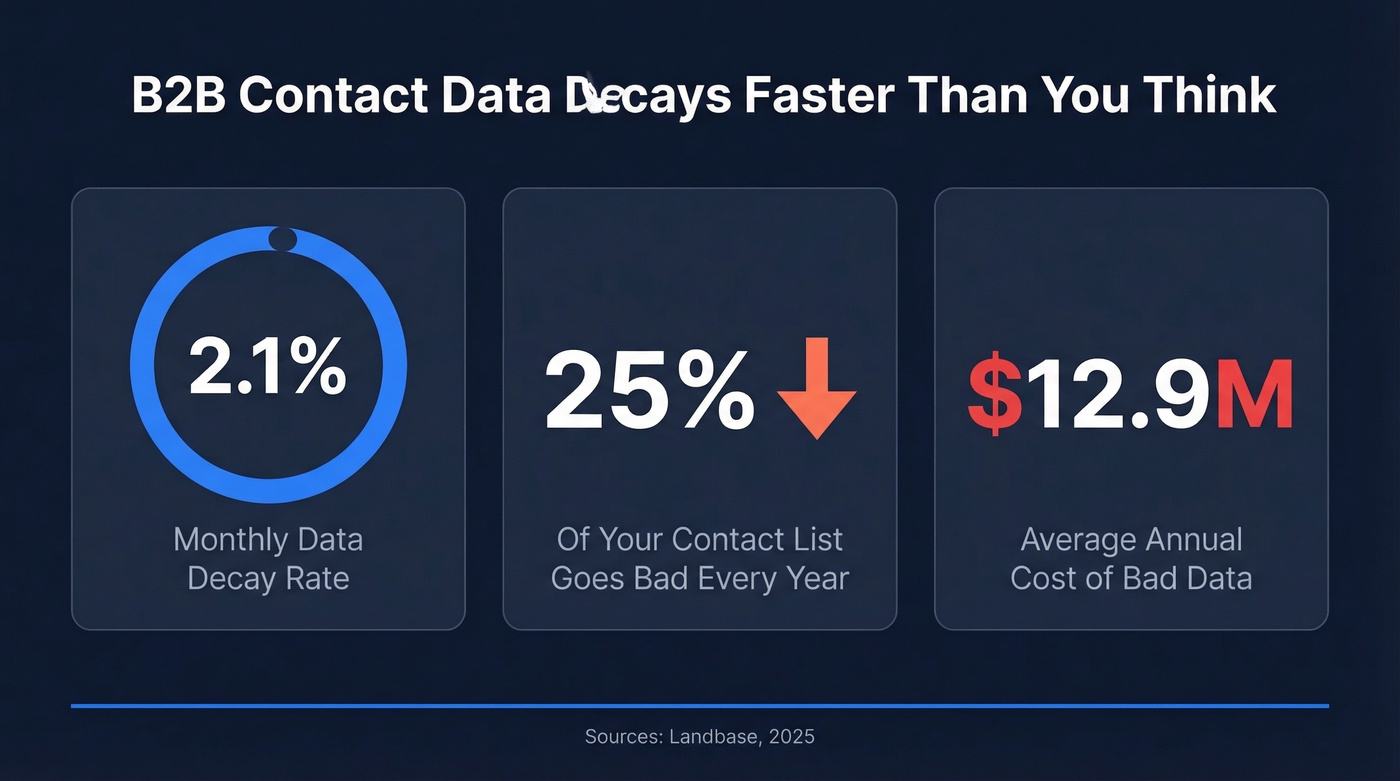
B2B contact data decays at 2.1% per month. By year's end, roughly a quarter of your company contact information is wrong - bad emails, disconnected phones, people who've moved on. Bad data costs the average organization $12.9M annually. Even at a fraction of that scale, every bounced email and dead dial is pipeline you didn't build.
The Quick Version
For one-off lookups, free methods work fine - company websites, Google operators, guessing email formats. For anything at scale, you need a tool with built-in verification. Three worth testing first:
- Hunter - Zero false positives in a hands-on test. Domain-based discovery that's dead simple. $49/mo to start, 25 free searches/month.
- Apollo - 275M+ contacts, generous free tier, $49/mo paid. Accuracy runs around 65-70% per community reports, so verify before sending.
If you're looking up fewer than 10 contacts a week, go manual. Anything more, pick a tool.
What Counts as Business Contact Information
This covers everything you need to reach a person or organization for business purposes:
- Work email addresses - the backbone of outbound. Direct emails, not info@ or sales@, are what matter.
- Direct dial phone numbers - mobile and desk lines that bypass the switchboard.
- HQ phone and physical address - useful for account mapping and compliance.
- Firmographics - revenue, headcount, industry, tech stack. Context that turns a name into a qualified lead.
- Social profiles - professional presence that helps personalize outreach.
B2B contact data focuses on work emails and professional identities. B2C people-search tools deal with personal emails and home addresses - different tools, different regulations, different game entirely.
Free Methods That Actually Work
Before you pay for anything, these approaches handle small-volume lookups surprisingly well.
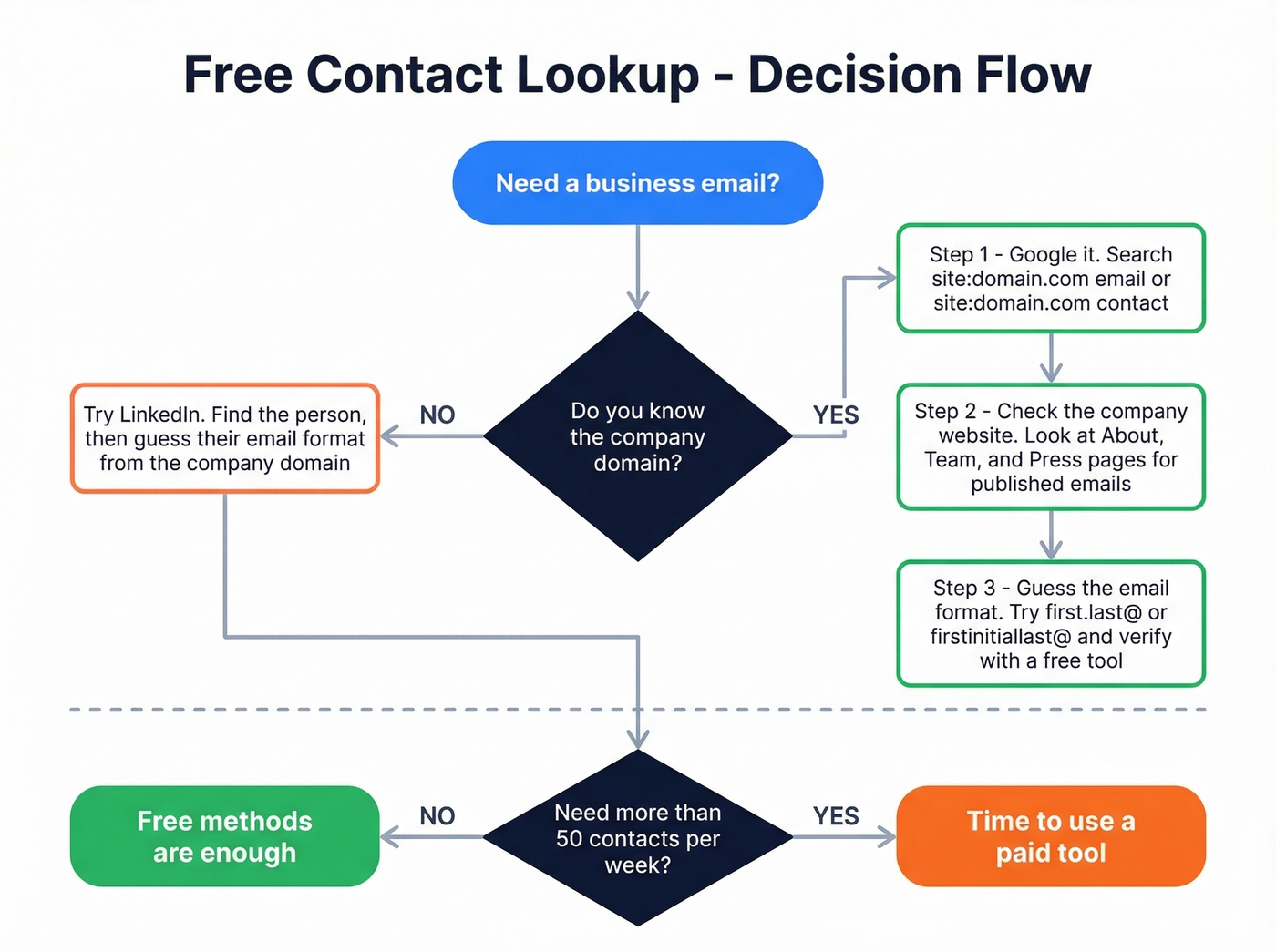
Google operators are underrated. Search site:companydomain.com email or site:companydomain.com contact to surface published emails and staff pages. It takes five seconds and works more often than you'd expect.
Email format guessing covers more ground than most people realize. The majority of companies follow a pattern - first.last@, firstinitiallast@, first@. Check the pattern on one known contact, then apply it to others at the same domain. We've used this approach hundreds of times and it holds up well for companies under 500 employees, where naming conventions tend to stay consistent.
Company websites and contact pages often list direct emails for leadership on "About" and "Team" pages. Press pages are another goldmine - PR contacts are almost always published. Industry associations, chamber of commerce listings, and conference speaker pages also surface verified business contacts.
The ceiling on free methods is volume. Once you're building lists of 50+ contacts a week, manual research eats hours you don't have.

Free methods hit a wall at 50+ contacts a week. Prospeo's database covers 300M+ profiles with 98% email accuracy and a 7-day refresh cycle - so the company contact information you pull today is still valid next week, not stale data from six weeks ago.
Start with 75 free verified emails and see the difference fresh data makes.
Best Tools for Finding Company Contact Information
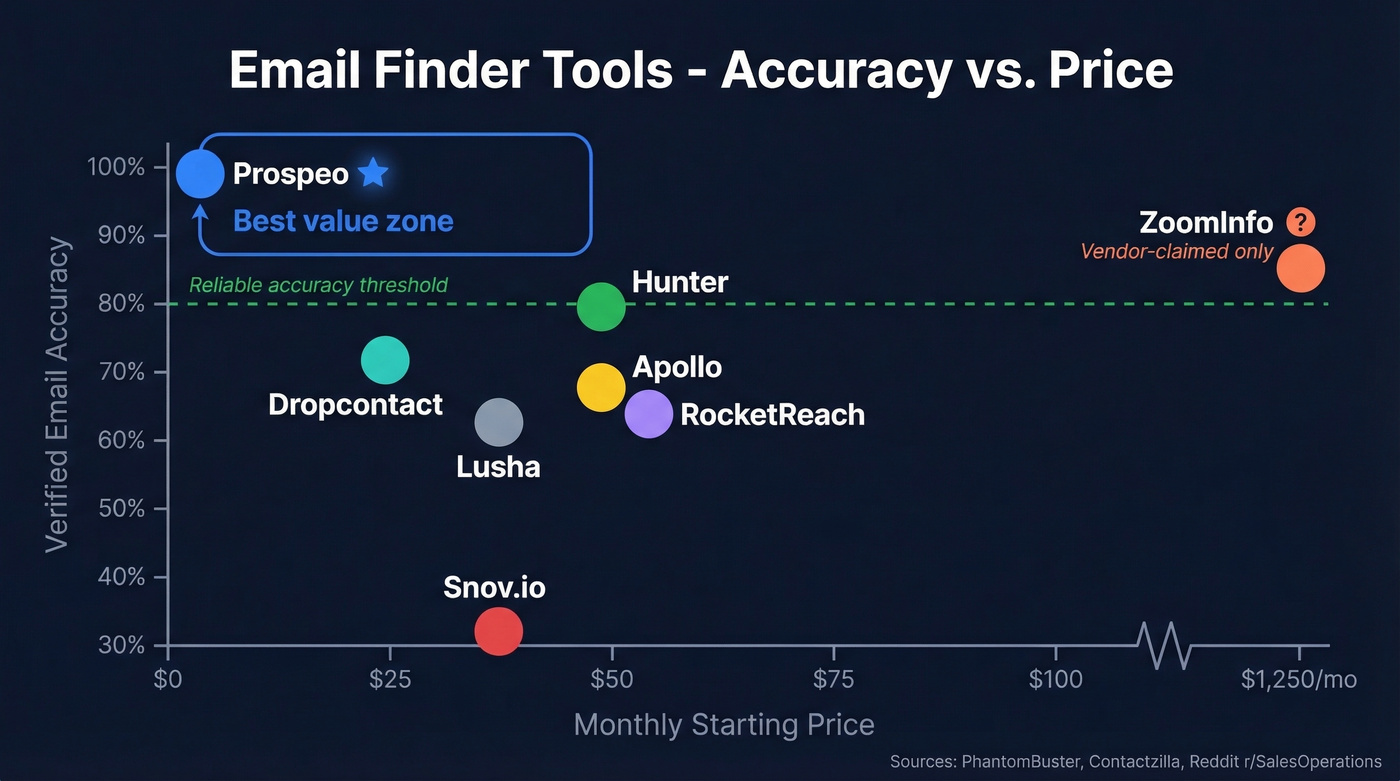
Here's the thing about accuracy claims from vendors: they're almost always inflated. A PhantomBuster test of 1,000 profiles found verified match rates ranging from 31% (Snov.io) to 72% (Dropcontact). That same test revealed massive speed differences - Hunter returns results in about 1 second per lead, while manual lookups take around 2 minutes each. Independent testing tells a very different story than marketing pages.
One distinction worth understanding: some tools query a stored database, while others perform real-time lookups against live sources. Stored databases are faster. Real-time tools can be more current for niche contacts. The best tools combine both approaches and offer search filters so you can narrow results by job title, seniority, location, or industry before pulling a single record.
| Tool | Starting Price | Free Tier | Database Size | Verified Match Rate | Speed |
|---|---|---|---|---|---|
| Prospeo | ~$0.01/lead | 75 emails/mo | 300M+ profiles | 98% verified | ~1 sec |
| Hunter | $49/mo | 25 searches/mo | Not public | 79% (11/14 found)* | ~1 sec |
| Apollo | $49/mo | Generous | 275M+ contacts | ~65-70%** | ~2 sec |
| Dropcontact | ~€24/mo | 25 credits/mo | Real-time lookup | 72%*** | ~8 sec |
| Lusha | $29-50/mo | 40 credits/mo | Not public | ~60-65%** | ~1 sec |
| Snov.io | $39/mo | 50 credits/mo | Not public | 31%*** | ~3 sec |
| RocketReach | ~$53/mo | 5 lookups/mo | Not public | ~60-70%** | ~2 sec |
| ZoomInfo | $14,995/yr | None | 321M contacts | Vendor-claimed only | - |
*Contactzilla hands-on test, 14 known contacts. **Community-reported ranges from r/SalesOperations. ***PhantomBuster test.
Prospeo
Use this if you're running outbound at scale and can't afford bounced emails tanking your domain reputation. The database covers 300M+ professional profiles with 98% email accuracy and 125M+ verified mobile numbers. The 7-day data refresh cycle is the real differentiator - the industry average sits around 6 weeks, which means most providers are feeding you stale records by default.

Pricing is credit-based at roughly $0.01 per lead - 90% cheaper than ZoomInfo on a per-lead basis. The free tier gives you 75 verified emails and 100 Chrome extension credits monthly, enough to test properly before committing. No annual contracts, no sales calls required. One customer, Meritt, saw bounce rates drop from 35% to under 4% after switching, which tracks with what the 5-step verification process - including catch-all handling and spam-trap removal - is designed to deliver.
If you're comparing providers, start with Best B2B Company Data Providers and then narrow down based on your workflow.
Hunter
Hunter earned something no other tool in the Contactzilla hands-on test managed: zero false positives across 14 known contacts. That matters more than raw match rate. A false positive means you're confidently emailing the wrong person, which is worse than not finding them at all.
Hunter's strength is domain-based discovery - enter a company domain, get every email pattern and known address associated with it. $49/mo to start, 25 free searches monthly. The tradeoff is phone data. If you need mobiles alongside emails, you'll want to pair Hunter with a dedicated mobile finder.
If you want more options in the same category, see Hunter alternatives.
Apollo
Apollo's 275M+ contact database and generous free tier make it the default starting point for bootstrapped teams. $49/mo for paid plans, accessible pricing. But accuracy is the catch - the consensus on r/SalesOperations puts email accuracy around 65-70%, so run everything through a verifier before hitting send. The built-in sequencer is a nice bonus if you don't already have Outreach or Instantly.
If you're building a full outbound stack, compare it with other SDR tools.
Skip These Unless You Have a Specific Reason
Lusha ($29-50/mo, 40 free credits) is solid for quick US-market lookups but doesn't justify the price if you need volume. Snov.io ($39/mo) scored only 31% in the PhantomBuster test - better as a drip campaign tool than a data source. RocketReach (~$53/mo, 5 free lookups) works for one-off executive searches but gets expensive fast at low volumes. Dropcontact (~€24/mo) hit 72% using real-time lookups, making it a decent option for European contacts specifically.
ZoomInfo remains the enterprise default at $14,995/year for the Professional plan with 3 seats and 5,000 credits. The #1 complaint on Reddit? Price. A mid-market contract with intent data and mobile numbers easily runs $25-40k/year.
Let's be honest: ZoomInfo is still the most comprehensive all-in-one platform. But most teams don't need all-in-one. If your average deal size is under $20k, you're paying for features you'll never touch. A focused email finder plus a sequencer will outperform a bloated enterprise suite nine times out of ten.
Why Verification Matters Most
Finding an email is half the job. Verifying it protects your sender reputation.
Even top tools produce false positives. In the Contactzilla test, Voila Norbert returned 2 confident-but-wrong emails out of 14. Zerobounce returned 1. Hunter was the only tool with zero. One bad email in a 100-contact sequence won't kill you, but at scale, a 5% false positive rate means 50 wrong emails per thousand - enough to trigger spam filters and damage your domain for months.

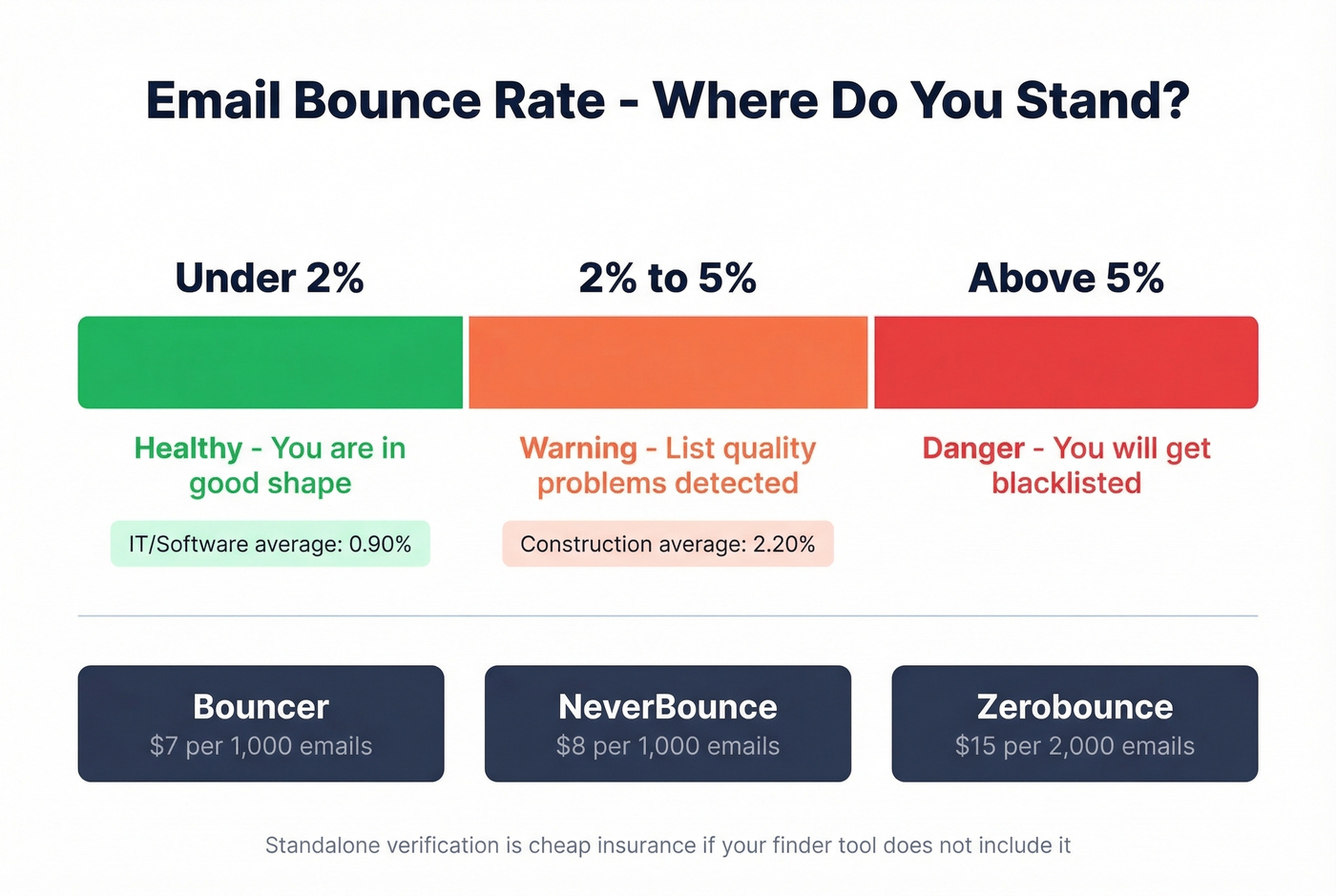
The benchmarks are clear: a bounce rate under 2% is healthy. Between 2-5% signals list quality problems. Above 5% gets you blacklisted. For context, IT/software companies average 0.90% bounce rates; construction runs 2.20%.
If you want a deeper breakdown of bounce codes and thresholds, see Email Bounce Rate.
Standalone verification tools are cheap insurance. Bouncer charges $7 per 1,000 emails, NeverBounce runs $8/1K, and Zerobounce starts at $15/2K. If your email finder already includes verification with catch-all handling, you can skip the extra step. But if you're using a tool with 65-70% accuracy, verify everything before hitting send.
Catch-all domains are the wildcard. These domains accept any email address, making verification impossible without actually sending. Good tools flag catch-alls so you can decide whether to risk it.
To reduce risk long-term, pair verification with deliverability hygiene like improving sender reputation and monitoring with email reputation tools.
Compliance: GDPR, CCPA, and CAN-SPAM
Collecting business contact details is legal. How you use them determines whether you stay out of trouble.
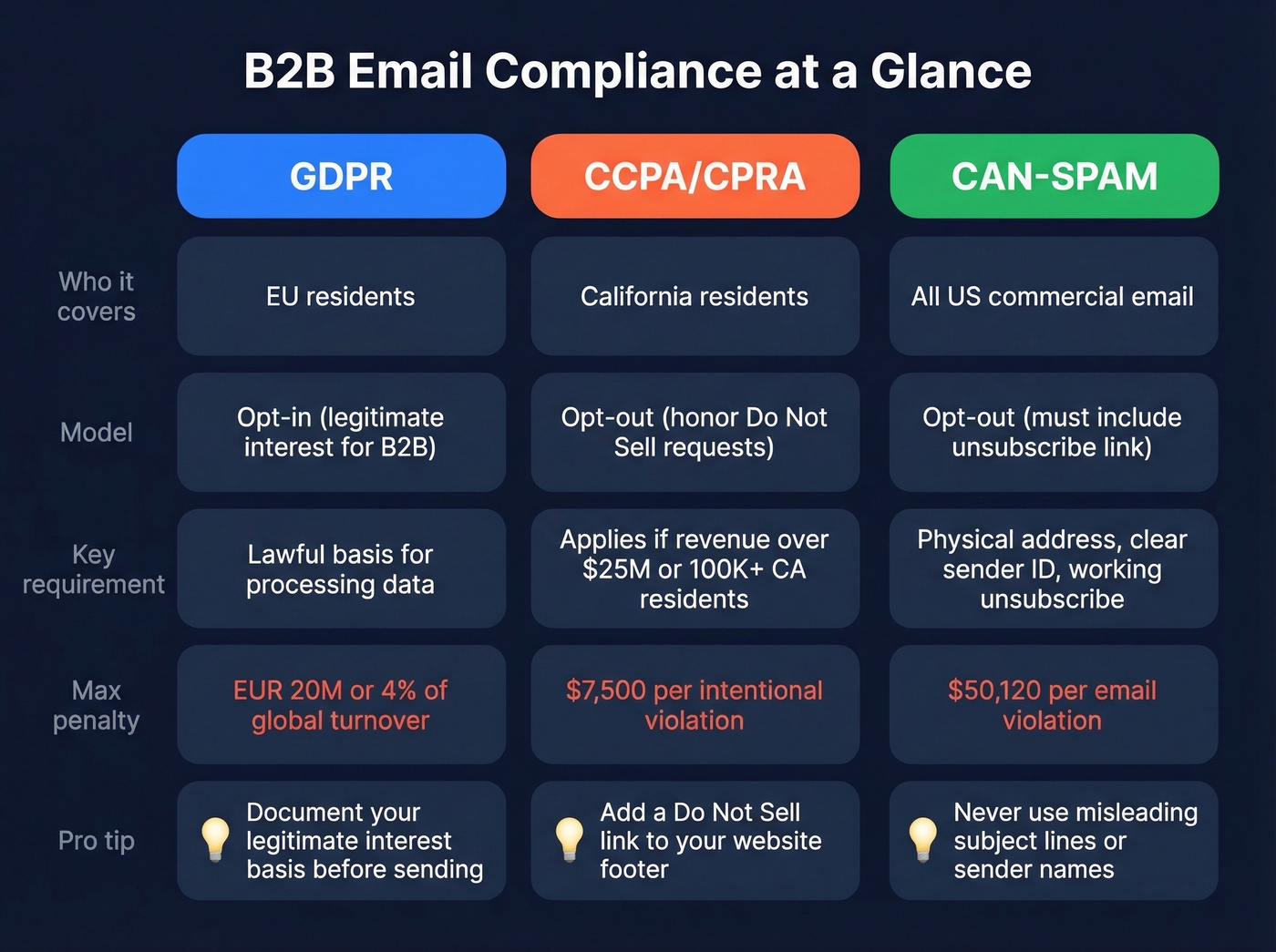
GDPR applies to EU residents and requires a lawful basis for processing - typically "legitimate interest" for B2B outreach. Opt-in consent is the safest path. Penalties run up to EUR 20M or 4% of global turnover, whichever is higher.
CCPA/CPRA covers California residents under an opt-out model. You can collect and use data but must honor "Do Not Sell" requests. Penalties hit $7,500 per intentional violation. The law applies if your business exceeds $25M revenue, handles data on 100K+ CA residents, or earns 50%+ revenue from selling personal information.
CAN-SPAM requires every commercial email to include a physical address, clear sender identity, and a working unsubscribe link. No opt-in required. Most B2B outbound operates under legitimate interest or opt-out. Always include an unsubscribe mechanism and your business identity - it's the bare minimum.
If you're running cold outreach, it also helps to align your process with cold email marketing best practices.
Keeping Your Database Fresh
Email addresses decay 23-30% annually. Phone numbers churn at 18% per year. If you built a list six months ago and haven't touched it, a quarter of it is wrong.
Quarterly re-verification is the minimum. Flag bounces, enrich stale records, and automate what you can through tools like Zapier, Make, or Clay. We've verified thousands of contacts across multiple tools, and the pattern is consistent: teams that re-verify quarterly maintain bounce rates under 2%, while those that don't see rates climb past 5% within six months. That's the difference between a healthy sending domain and one that's slowly dying.
If you're doing this at scale, consider adding data enrichment services to keep records current.
Independent tests show most tools deliver 31-72% verified match rates. Prospeo's 5-step verification - with catch-all handling, spam-trap removal, and honeypot filtering - delivers 98% email accuracy. One team dropped bounce rates from 35% to under 4% overnight.
Stop paying for company contact information that bounces.
FAQ
What's the fastest way to find contact information for a company?
Use an email finder tool - paste a name and domain, get a verified result in under two seconds. Prospeo and Hunter both return results in about 1 second. For one-off lookups, try site:companydomain.com + "email" in Google. Tools win on anything above a handful of lookups per week.
How often does B2B contact data go stale?
B2B data decays at roughly 2.1% per month, meaning 23-30% of emails go bad annually. Quarterly re-verification is the minimum to keep bounce rates under 2%. Tools with a 7-day refresh cycle reduce stale-data risk significantly compared to the 6-week industry average.
Is it legal to collect company contact information for outreach?
Yes, in most jurisdictions. GDPR requires legitimate interest or consent for EU residents. CCPA uses an opt-out model for California. CAN-SPAM requires a physical address and unsubscribe link in every commercial email. Always include opt-out mechanisms.
What free tools can I use to find business contact details?
Prospeo's free tier offers 75 verified emails and 100 Chrome extension credits monthly - the most generous option for accurate data. Hunter gives 25 free searches/month with zero false positives. Apollo's free plan includes broad database access but accuracy sits around 65-70%, so verify results separately.