

Company Profiling: Templates, Tools, and a Step-by-Step Workflow
Your sales team spent a week prepping for a target account meeting. They built slides, rehearsed objections, mapped the org chart. Then the prospect's VP of Engineering - the one they'd built the entire pitch around - left three months ago. The profile was stale, and nobody caught it.
That's the cost of bad company profiling: wasted cycles, blown credibility, and a pipeline full of ghosts. You don't need a $30k+ intelligence platform to fix this. You need a methodology, a few free-to-cheap tools, and about 45 minutes per company once you've got the workflow down.
What Is Company Profiling?
Company profiling is the process of building a structured, multi-dimensional view of a target business - its financials, org structure, technology decisions, competitive positioning, and the people who make buying decisions. The output is a company profile. The profiling is the ongoing discipline that keeps it current.
Most guides conflate the two. A company profile is a static document. Profiling produces it and keeps it from going stale - feeding M&A due diligence, competitive intelligence, ABM campaigns, investment analysis, and enterprise sales motions.
An M&A team profiles acquisition targets to surface red flags before a letter of intent. A sales team profiles enterprise accounts to personalize outreach and map decision-makers. A VC analyst profiles portfolio candidates to validate market positioning. Same methodology, different depth.
Why Profiling Matters for Revenue Teams
A Fortune analysis found that 70-75% of acquisitions fail to deliver intended value. Bain research attributes roughly 60% of those failures to poor due diligence - companies writing nine-figure checks based on incomplete profiles.
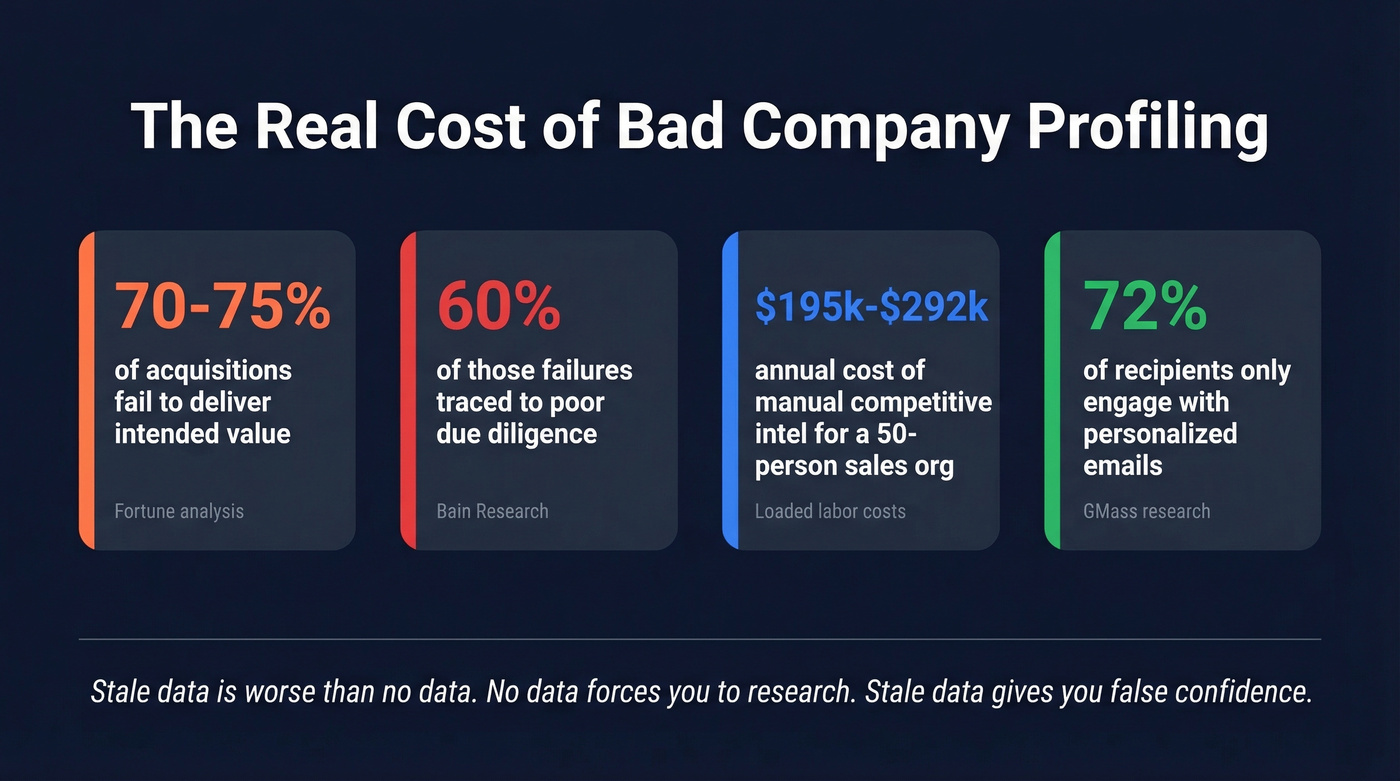
The hidden cost of manual research is staggering. Reps spend 8-12 hours per month on competitor research. Product marketing burns 30-40 hours per quarter updating battlecards that go stale within 30 days. For a 50-person sales org, that manual competitive intelligence work costs $195k-$292k per year in loaded labor costs.

And when the profile finally reaches a rep's hands? 72% of recipients only engage with personalized emails. Generic outreach built on generic profiles gets ignored.
Here's the thing - stale data is worse than no data. No data forces you to do research. Stale data gives you false confidence. You think you know the account. You don't.
What to Include in a Company Profile
Every profile should cover these layers. Skip one, and you've got a gap that'll cost you later.
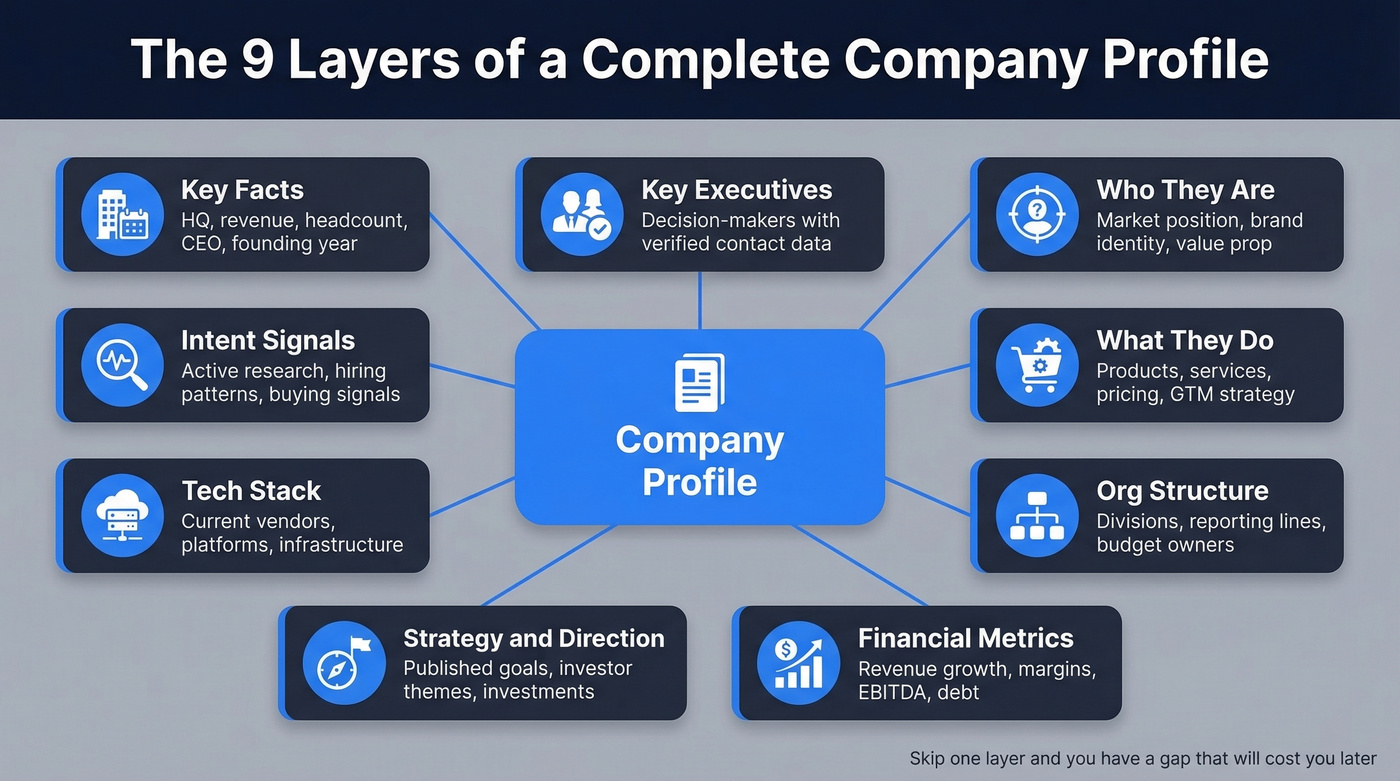
Key Facts - Company name, HQ, website, founding year, headcount, CEO, revenue, ownership structure. This is your header; takes five minutes.
Who They Are - A one-paragraph overview of market position, brand identity, and value proposition.
What They Do - Products, services, target markets, pricing model, go-to-market strategy. Include their own language and positioning statements.
Org Structure - Divisions, departments, reporting lines. For enterprise sales, this is where you identify which business unit owns the budget.
Financial Metrics - Revenue growth rate, gross margin, EBITDA, debt-to-equity. Public companies: pull from 10-Ks. Private companies: estimate from funding rounds, headcount growth, and industry benchmarks.
Strategy & Direction - Published goals, press releases, investor presentations, earnings call themes. Where are they investing this year?
Tech Stack - Current technology vendors, platforms, infrastructure decisions. Most profiles miss this layer entirely, and it's often the most actionable for technology sellers.
Intent Signals - Are they actively researching solutions in your category? Hiring for roles that signal a buying motion? This separates a modern profile from a dated one.
Key Executives - Decision-makers, influencers, and champions with verified contact data. A profile without contacts is a research paper. A profile with contacts is a pipeline opportunity.
Company Profile Template
Most profiling guides stop at "analyze financial performance" without showing the deliverable structure. Here's the actual document layout with realistic time estimates per section.
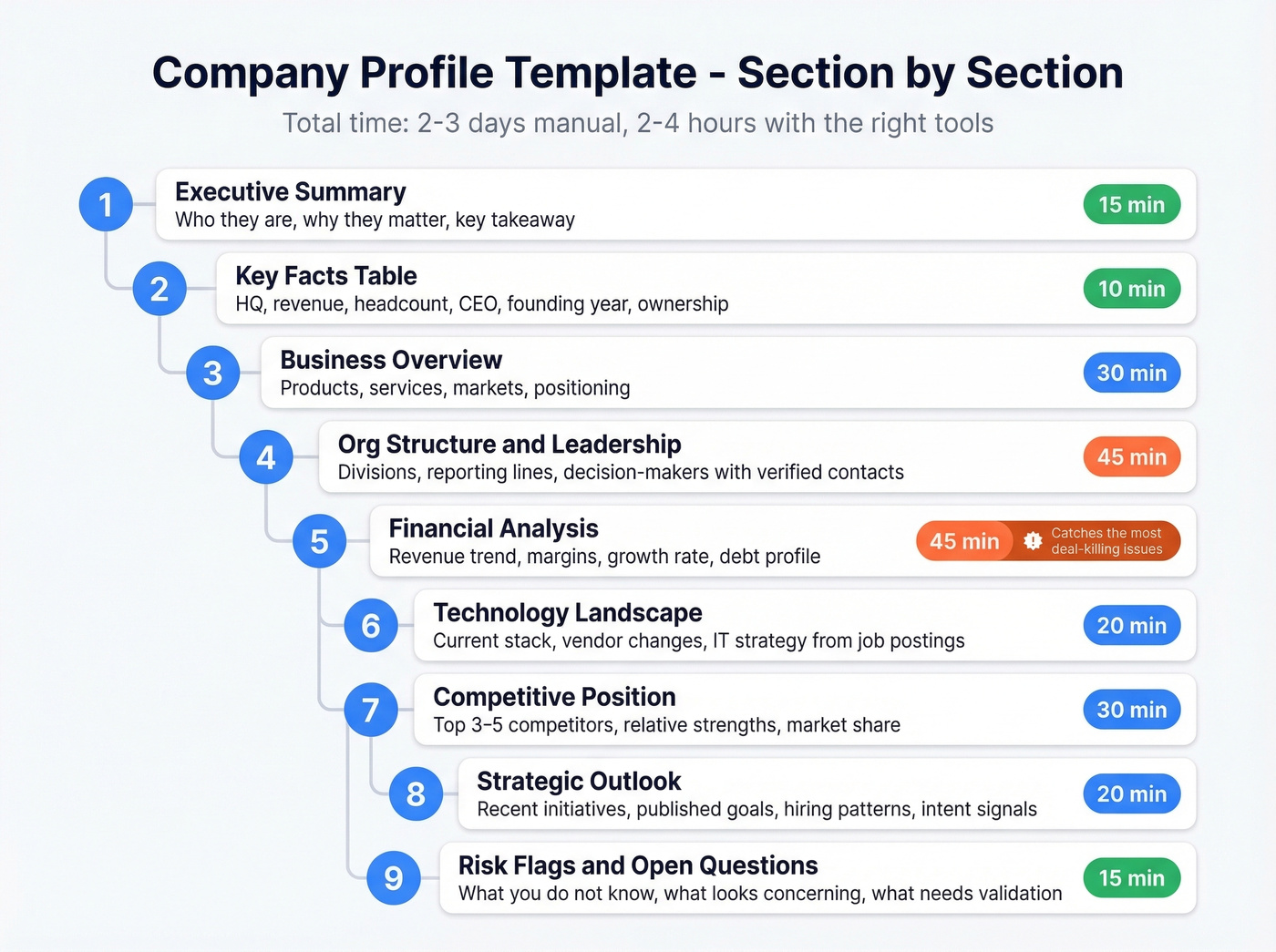
- Executive Summary - One-page overview: who they are, why they matter, key takeaway. (15 min)
- Key Facts Table - HQ, revenue, headcount, CEO, founding year, ownership. (10 min)
- Business Overview - Products, services, markets, positioning. (30 min)
- Org Structure & Leadership - Divisions, reporting lines, decision-makers with verified contact info. (45 min)
- Financial Analysis - Revenue trend, margins, growth rate, debt profile. (45 min)
- Technology Landscape - Current stack, recent vendor changes, IT strategy signals from job postings. (20 min)
- Competitive Position - Top 3-5 competitors, relative strengths, market share estimates. (30 min)
- Strategic Outlook - Recent initiatives, published goals, hiring patterns, intent signals. (20 min)
- Risk Flags & Open Questions - What you don't know, what looks concerning, what needs validation. (15 min)
Total estimated time: 2-3 days manually, per Viewpoint Analysis. With the right tools and a repeatable process, you can compress that to 2-4 hours for a solid first pass. In our experience, the financial analysis section takes the longest but catches the most deal-killing issues - don't shortcut it.

Your company profiles are only as good as the contact data inside them. Prospeo gives you verified emails (98% accuracy) and 125M+ direct dials for the decision-makers you map - refreshed every 7 days, not every 6 weeks.
Turn static company profiles into pipeline opportunities at $0.01 per email.
How to Build Profiles Step by Step
Eight steps. Each one builds on the last.
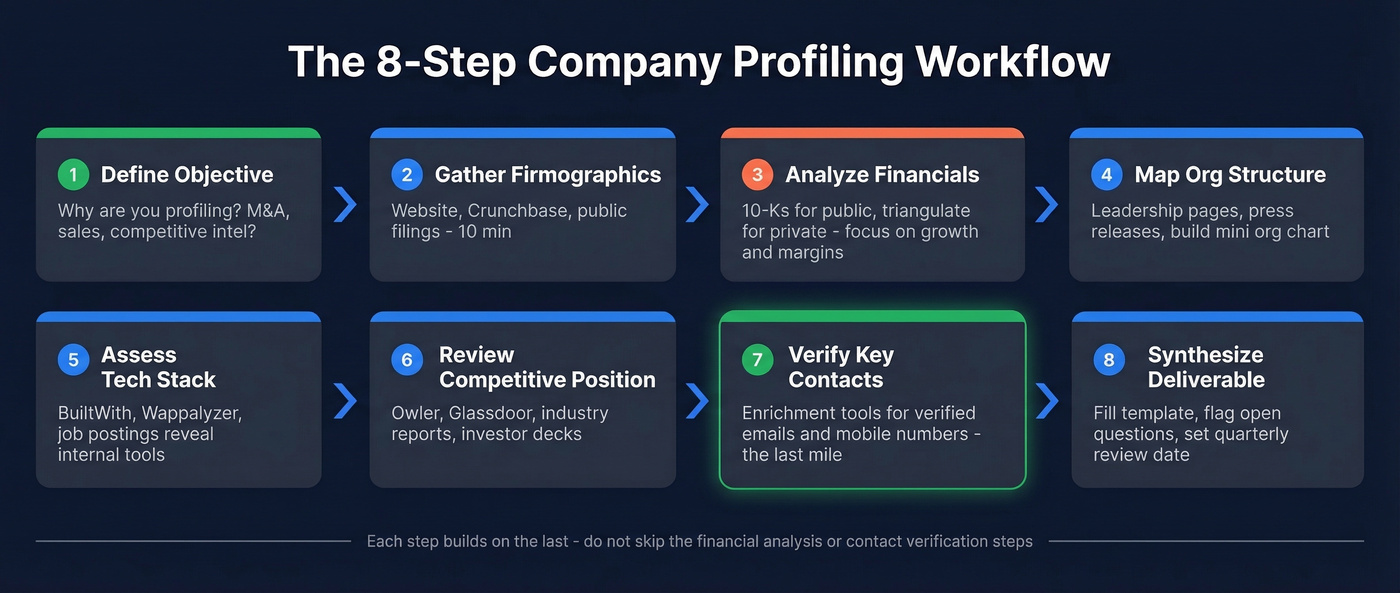
Step 1: Define Objective and Scope
Why are you profiling this company? M&A diligence requires financial depth. Sales outreach requires contact data and tech stack. Competitive intelligence requires market positioning. Define the use case first - it determines how deep you go on each layer.
Step 2: Gather Firmographic Basics
Start with the company's website, Crunchbase for funded companies, and public filings. Pull HQ, headcount, revenue, founding year, ownership structure. Ten minutes gives you the skeleton.
Step 3: Analyze Financials
For public companies, pull 10-Ks and quarterly filings from SEC EDGAR. For private companies, triangulate from funding announcements, headcount growth, and industry revenue benchmarks. Focus on revenue growth rate, gross margin, and cash position.
Step 4: Map Org Structure and Leadership
Use the company's leadership page, press releases, and professional profile searches. Build a mini org chart: who reports to whom, which business unit owns the budget, who's been promoted or hired recently. This step is where most profiles either shine or fall flat - the org chart is what turns a research document into a sales weapon.
Step 5: Assess Tech Stack
BuiltWith and Wappalyzer give you the web-facing stack. Job postings reveal internal tools - if they're hiring a "Salesforce Admin," you know the CRM.
Step 6: Review Competitive Position
Owler provides quick competitive snapshots. Glassdoor reviews surface internal sentiment. Industry reports and investor presentations reveal how they position against competitors.
Step 7: Identify and Verify Key Contacts
This is the "last mile" that turns research into action. Use a data enrichment tool to pull verified emails and mobile numbers for the decision-makers you've identified. Prioritize tools with short data refresh cycles - people change roles constantly, and reaching out to someone who left months ago kills your credibility.
Step 8: Synthesize Into the Deliverable
Fill in the template. Flag open questions. Assign a review date - quarterly at minimum. A profile that isn't maintained is a profile that'll embarrass you.
Best Tools for Sourcing Profile Data
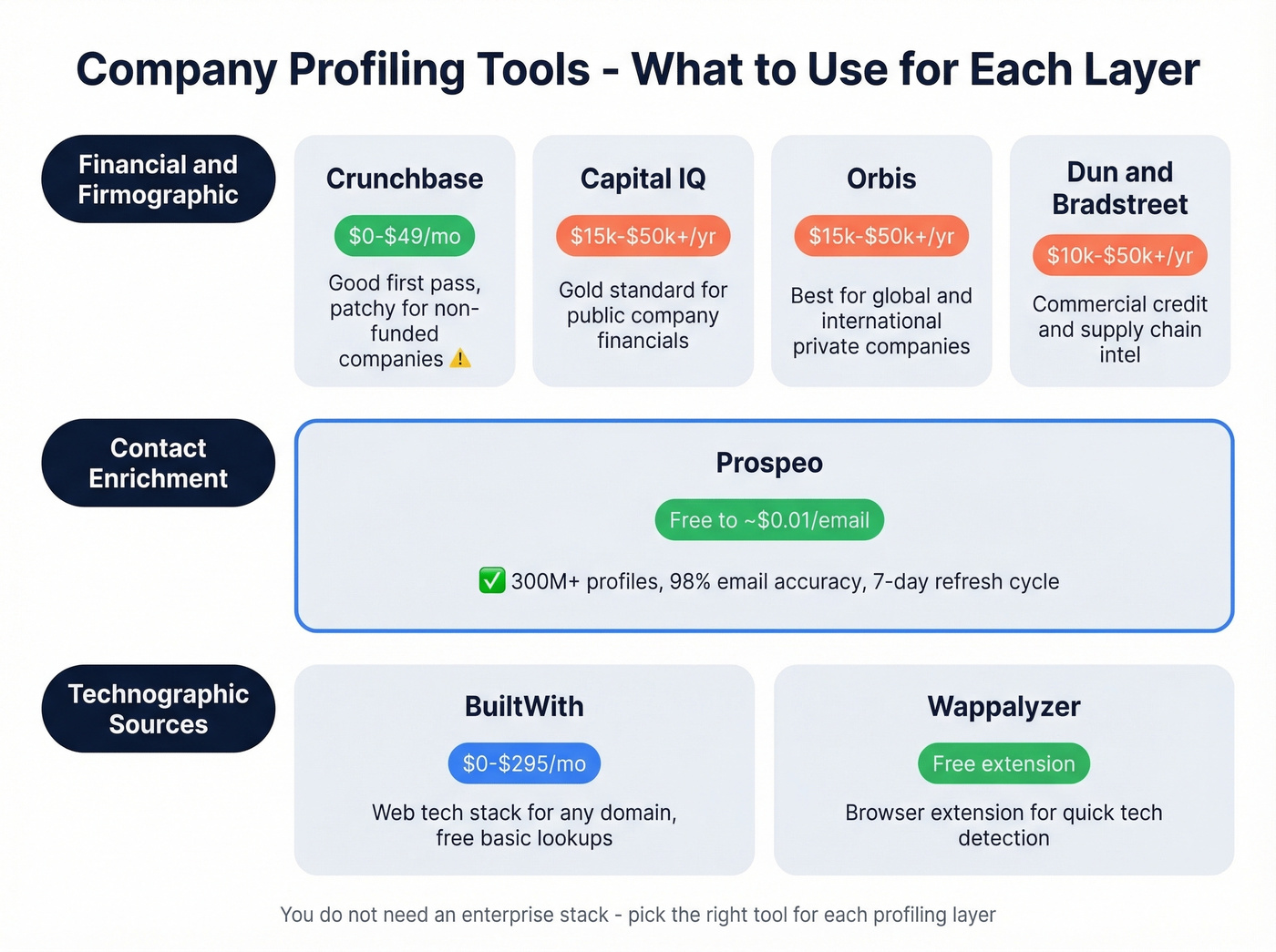
You don't need an enterprise stack. You need the right tool for each profiling layer.
Financial and Firmographic Databases
Crunchbase is the default starting point for funded startups and tech companies. The free tier covers basics; Pro runs around $49/mo for deeper data. The limitation is real - Crunchbase relies heavily on user submissions and press releases, so coverage for non-funded private companies is patchy and financial data can lag. A lead gen practitioner on Reddit put it bluntly: they'd been using Apollo and Crunchbase and "haven't been too impressed" with data freshness. Fine for a first pass, not for diligence.
Capital IQ ($15k-$50k+/year) is the gold standard for public company financials. Orbis ($15k-$50k+/year) is a common pick for global company coverage, especially international private company data. Dun & Bradstreet ($10k-$50k+/year) provides commercial credit data and supply chain intelligence. All three are enterprise-priced and overkill for most sales teams.
Contact Enrichment
You can have rich data on strategy, financials, and tech stack - but if you can't reach the right person with a verified email or mobile number, the profile sits in a folder.
Prospeo covers 300M+ professional profiles with 143M+ verified emails and 125M+ verified mobile numbers. Email accuracy runs 98%, and the database refreshes every 7 days compared to the 6-week industry average. The 30+ search filters go beyond basic firmographics - you can filter by buyer intent on 15,000 topics, technographics, headcount growth, funding events, and department-level headcount. The Chrome extension, used by 40,000+ people, lets you pull verified contact data while browsing any company website or professional profile. Pricing starts free with 75 emails/month, and paid plans run from ~$0.01 per email with no contracts.

That 2-3 day manual profiling timeline? Cut it to hours. Prospeo's 30+ search filters - buyer intent, technographics, headcount growth, funding - deliver the exact data points your company profiles need, pre-verified and enriched with 50+ fields.
Stop researching companies manually. Let 300M+ profiles do the work.
Technographic Sources
BuiltWith reveals the web technology stack of any domain - CMS, analytics, advertising, hosting, frameworks. Free basic lookups cover most needs; Pro runs around $295/mo for bulk analysis and historical data. Wappalyzer offers a free browser extension for quick lookups and paid plans for API access. Between the two, you'll cover the web-facing stack. For internal tools, check job postings.
Competitive Intelligence and Sentiment
Owler aggregates competitive graphs, revenue estimates, and news for millions of companies. Free tier is useful; Pro runs around $35/mo. Glassdoor is underrated for profiling - employee reviews surface internal culture, leadership sentiment, and strategic priorities that never make it into press releases.
| Tool | Profiling Layer | Free Tier? | Starting Price | Best For |
|---|---|---|---|---|
| Prospeo | Contact enrichment | Yes (75 emails/mo + 100 extension credits/mo) | ~$0.01/email | Verified emails & mobile numbers |
| Crunchbase | Firmographics | Yes | ~$49/mo (Pro) | Funded startup data |
| BuiltWith | Technographics | Yes | ~$295/mo (Pro) | Web tech stack analysis |
| Capital IQ | Financials | No | ~$15k+/year | Public company depth |
| Orbis | Global firmographics | No | ~$15k+/year | International coverage |
| Owler | Competitive intel | Yes | ~$35/mo (Pro) | Quick competitor maps |
| Glassdoor | Sentiment | Yes | Free | Employee reviews |
Look, if your average deal size is under $25k, skip Capital IQ and Orbis. A disciplined analyst with Crunchbase, and BuiltWith will produce a better profile than a lazy one with a $40k enterprise license. The methodology matters more than the budget.
Automating Profiles with AI
A practitioner on r/n8n shared an automation workflow that compresses roughly 8 hours of manual company research into about 2 minutes per company. The pipeline: pull a company URL from Google Sheets, scrape website content via Firecrawl or Jina AI, extract review sentiment from Trustpilot, pull professional profile data via Apify, and write structured output back to the sheet.
The results are real but imperfect. AI handles collection and summarization well - expect a 75%+ labor reduction versus fully manual approaches, and teams that automate competitive intelligence see 30-40% improvements in competitive win rates. But LLM accuracy on complex analytical tasks runs 85-90%, which means a 10-15% error rate on things like competitive positioning assessments or financial interpretation. Automate collection and first-draft synthesis, then have a human verify the strategic conclusions. AI is the research assistant, not the analyst.
If you're building this into your GTM motion, treat it like GTM AI: automate the repeatable collection, then QA the decisions.
M&A Due Diligence Profiles
M&A profiling is the same discipline with the stakes turned up. 85% of deals see purchase price reductions during diligence, and 50% of tech deals collapse entirely based on what diligence uncovers.
A thorough diligence profile covers 12 categories: financial, legal/corporate, contracts, IP, employment, tax, environmental, regulatory, insurance, real property, technology, and commercial. The timeline typically runs 8-12 weeks - weeks 1-2 for document collection and setup, weeks 2-6 for deep-dive analysis across all categories, and weeks 6-12 for findings synthesis and negotiation.
Red flags that kill deals:
- Change-of-control termination rights in key customer contracts - the acquirer buys the company, and the biggest customer can walk
- Missing IP assignments from contractors - the company doesn't actually own the code it's selling
- Revenue recognition inconsistencies between financial statements and tax returns
- Key contracts expiring within 12 months with no renewal commitments
We've reviewed dozens of post-mortem deal analyses, and the pattern is consistent: the red flags were there in the data, but the profiling process didn't surface them in time. Commission a Quality of Earnings report. It adjusts the purchase price in 85% of deals. Don't skip it to save $50k on a $20M acquisition.
Mistakes That Ruin Profiles
Using stale data. A profile built on 6-week-old records gives you false confidence. You think you know the account; you're actually working with ghosts.
Stopping at company-level data. A profile without verified contacts for decision-makers is a research paper, not a sales asset.
Relying on a single source. Crunchbase alone isn't a profile. Neither is a 10-K. Cross-reference at least three sources per layer.
No update cadence. Set a quarterly review at minimum. For active sales targets, monthly. Contact data degrades fastest - people change roles constantly.
Ignoring technographics and intent signals. If you're not tracking what technology a company uses and whether they're actively researching solutions, you're profiling with one eye closed. This is where technographics and intent signals pay off.
FAQ
What's the difference between company profiling and competitive analysis?
Company profiling is a deep dive into a single target business - its financials, leadership, tech stack, and operations. Competitive analysis compares multiple companies against each other on dimensions like pricing, market share, or product capabilities. Profiling feeds into competitive analysis, but they're distinct exercises with different deliverables.
How often should you update a company profile?
Quarterly at minimum; monthly for active sales targets or M&A prospects. Contact data degrades fastest - look for enrichment tools with weekly refresh cycles - while firmographic data like revenue and headcount should be re-checked every 90 days.
Can you build a useful profile for free?
Yes. Crunchbase's free tier, BuiltWith's free lookups, Prospeo's 75 free emails per month, and Glassdoor's free reviews cover most of what an enterprise stack provides. A disciplined analyst with free tools will outperform a careless one with a $40k Capital IQ license every time.
What's the most overlooked section in a company profile?
Technographic data. Most teams nail firmographics and financials but skip the tech stack entirely. Knowing a prospect runs Salesforce, uses AWS, or recently adopted a competitor's product gives you specific, actionable angles for outreach - and job postings are a free source for internal tool intelligence.