

Complex Sales: Benchmarks, Frameworks, and the System That Wins Enterprise Deals
The deal is "closing this quarter" for the third quarter in a row. Your champion went dark two weeks ago. Someone in procurement you've never heard of just asked for a new security review. Welcome to complex sales - where the product demo is maybe 10% of the work, and the other 90% is navigating a buying committee that can't agree on lunch, let alone a six-figure software contract.
What You Need (Quick Version)
This isn't a product pitch. It's a consensus-building exercise across 6-12 stakeholders who each have different priorities, budgets, and risk tolerances.
- Cycle times scale with deal size. Expect 120-270 days depending on ACV - and that's the average, not the worst case.
- Map stakeholders early. Deals don't die because of your product. They die because a hidden approver you never met vetoed the deal in a meeting you didn't know about.
- Pick one methodology and commit. MEDDICC for CRM discipline, Challenger for insight-led differentiation. Don't blend three frameworks into a Frankenstein process.
- Fix your data before optimizing your process. Reps spend 72% of their week not selling. Bad contact data makes that number worse - you can't multi-thread an account when your CRM has emails for 3 of 11 stakeholders.
What Is a Complex Sale?
Every sales article defines this differently. The clearest framework treats complexity as a function of three variables: the number of decision-makers, the length of the sales cycle, and the buyer's perceived risk. When all three are high, you're in complex territory.
There's no single dollar threshold. A $50k deal with eight stakeholders and a 6-month procurement process is complex. An $80k deal with one decision-maker who signs in two weeks isn't. Complexity lives on a continuum, from mid-five-figures to eight-figure enterprise contracts.
| Factor | Transactional Sale | Complex Sale |
|---|---|---|
| Decision-makers | 1-2 | 6-12 |
| Cycle length | Days to weeks | Months to quarters |
| Perceived risk | Low | High |
| Pricing | Fixed/published | Customized/negotiated |
| Buying process | Linear | Non-linear, political |
Here's what makes 2026 different: Gartner's latest release found that 67% of B2B buyers prefer a rep-free experience. They want to self-serve. But complex purchases - by definition - involve too much risk, too many stakeholders, and too much customization for a checkout page. The rep isn't going away. The rep's job is just harder.
Why Enterprise Deals Are Harder in 2026
The buying committee has gotten bigger, more distributed, and more digitally armed. 80% of B2B sales interactions now happen through digital channels. Buyers spend just 17% of their total buying time meeting with potential suppliers. The rest is internal research, peer conversations, and committee alignment you never see.
Buying committees average 6-12 people. HubSpot puts the average at 5; Gartner says 7 for mid-sized firms; Salesforce research puts complex B2B deals at 11 stakeholders. The number scales with deal size - and only 5% of B2B accounts are actively looking to buy at any given time, which means 95% of your pipeline is in education or nurture mode.
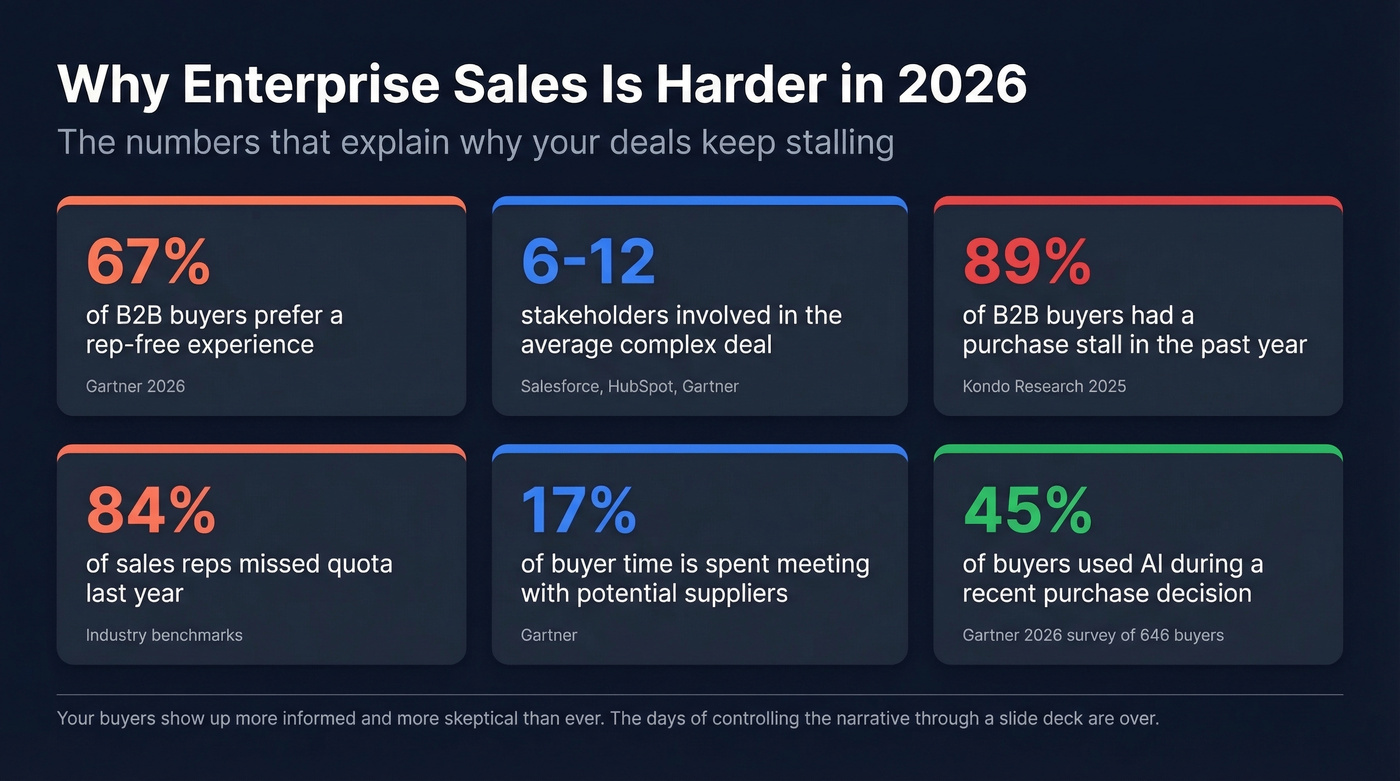
And the stall rate is brutal. 89% of B2B buyers report a purchase stalling in the past year - usually budget freezes or internal priority shifts. 84% of reps missed quota last year.
Then there's the AI layer. A 2026 survey of 646 buyers found that 45% used AI during a recent purchase - to compare vendors, model ROI, or draft internal business cases. Your buyers are showing up more informed and more skeptical than ever. The days of controlling the narrative through a slide deck are over.
Complex Sales Benchmarks
We've seen too many teams forecast based on vibes instead of data. These benchmarks, drawn from 2025-2026 industry analysis, give you a baseline.
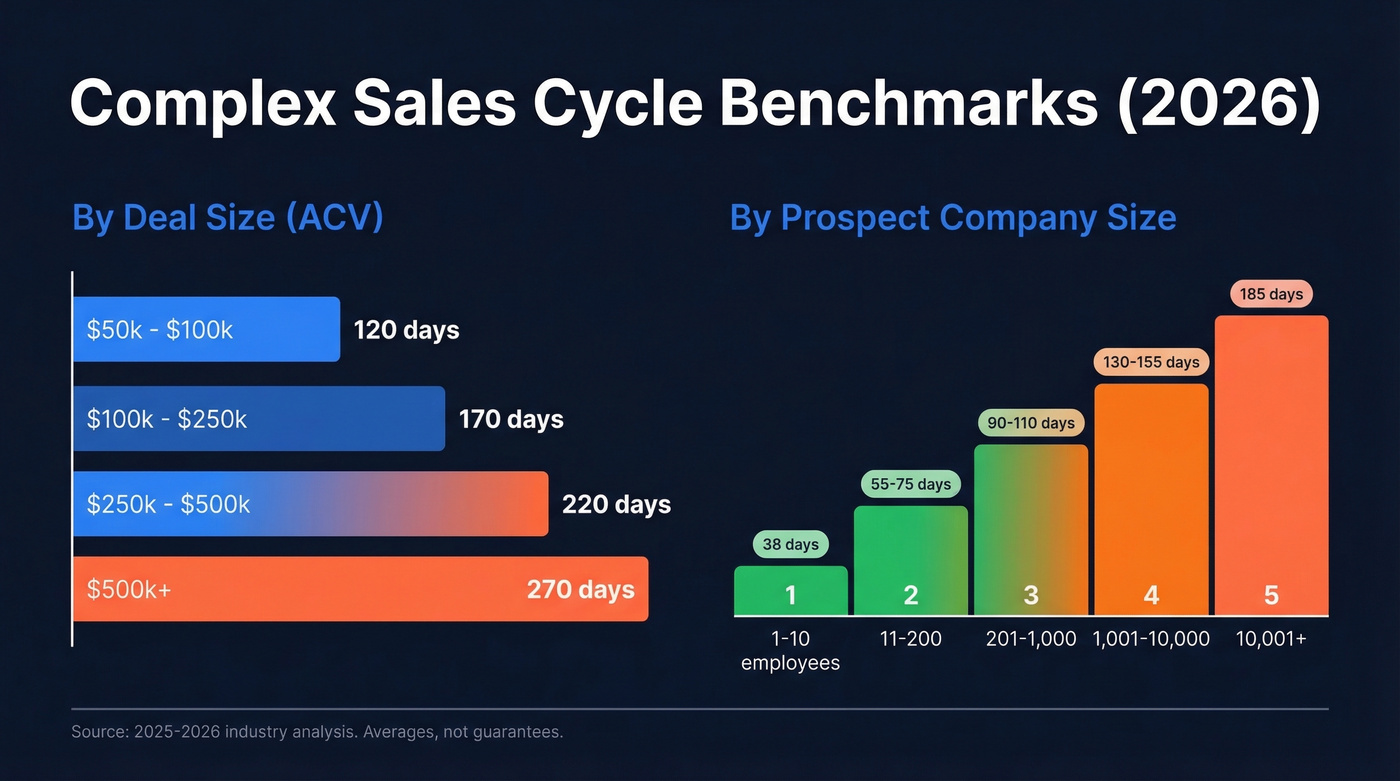
By Deal Size (ACV)
| ACV Range | Avg. Cycle (Days) |
|---|---|
| $50k-$100k | 120 |
| $100k-$250k | 170 |
| $250k-$500k | 220 |
| >$500k | 270 |
By Prospect Company Size
| Employees | Avg. Cycle (Days) |
|---|---|
| 1-10 | 38 |
| 11-200 | 55-75 |
| 201-1,000 | 90-110 |
| 1,001-10,000 | 130-155 |
| 10,001+ | 185 |
By Industry
| Industry | Avg. Cycle (Days) |
|---|---|
| Software | 90 |
| Financial Services | 98 |
| Healthcare | 125 |
| Manufacturing | 130 |
| Energy | 155 |
| Non-Profit | 162 |
By Source Channel and Complexity Level
This is the data nobody else publishes. Channel matters as much as deal size - and the gap compounds at higher complexity.
| Channel | Low Complexity (Days) | Medium Complexity (Days) | High Complexity (Days) |
|---|---|---|---|
| Referrals | 20 | 35 | 60 |
| Cold Calling | 60 | 85 | 110 |
A referral-sourced deal at high complexity closes in roughly half the time of a cold-called deal at the same level. That's not a marginal difference - it's the difference between closing this quarter and closing next quarter. If your enterprise sales motion doesn't have a systematic referral engine, you're leaving speed on the table.

Complex deals die when you can only reach 3 of 11 stakeholders. Prospeo gives you verified emails and direct dials for entire buying committees - 300M+ profiles, 98% email accuracy, 125M+ verified mobiles. Stop losing 270-day deals to contacts you never found.
Multi-thread every enterprise account with data that actually connects.
The 5-Stage Process
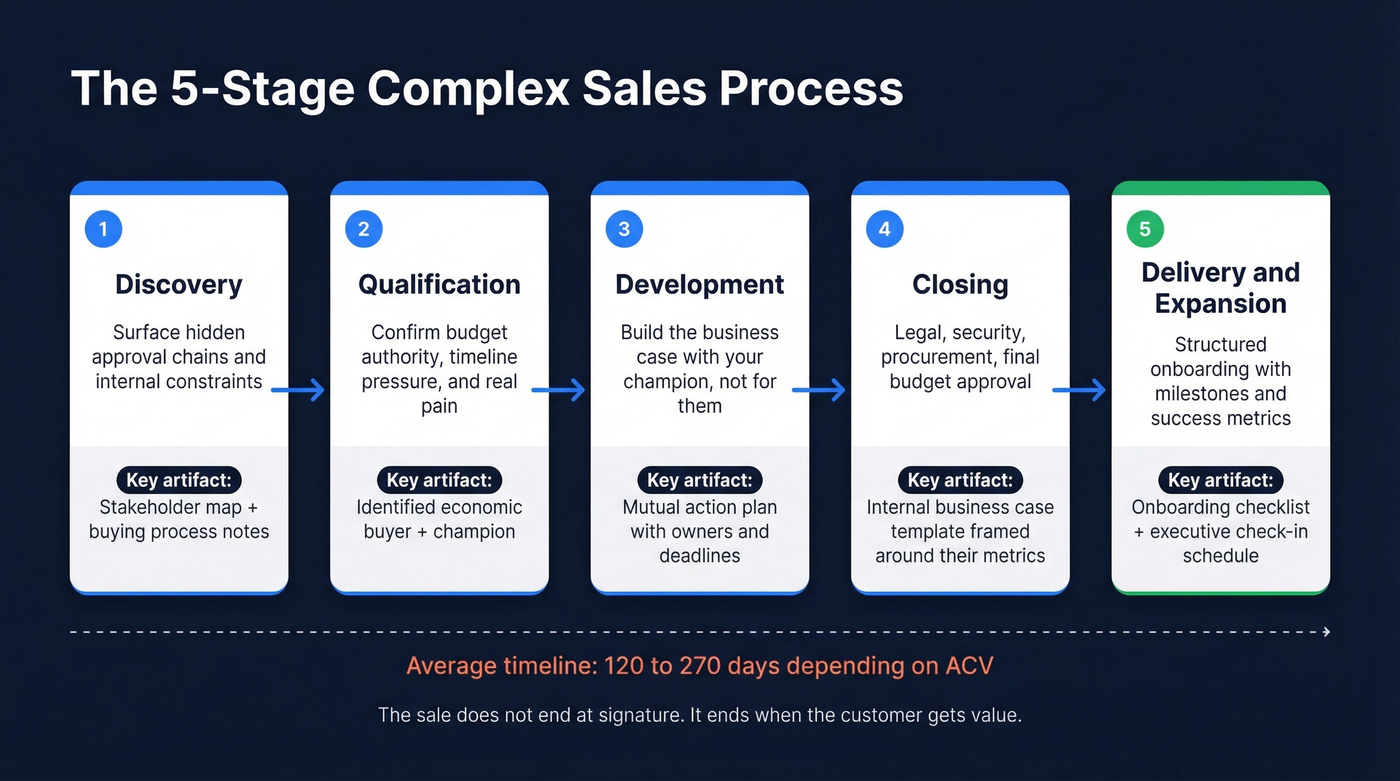
Most frameworks describe four stages. We add a fifth - delivery - because the fastest way to kill expansion revenue is to botch onboarding after a 9-month sales cycle.
Discovery
The goal isn't to pitch. It's to surface the hidden approval chains and internal constraints that'll derail you later. Ask questions like: "Walk me through what happens after your team decides to move forward - who else needs to sign off?" and "Have you bought anything in this price range in the last year? What did that process look like?"
A rep on r/sales described it perfectly: they organized everything around stakeholders, tech stack, metrics, value, and gaps - and still hit last-minute failures because of hidden process constraints. Discovery that doesn't uncover the internal buying process is just a product Q&A.
Qualification
This is where you decide if the deal is real. Not "are they interested" - that's a low bar. Real qualification means confirming budget authority, timeline pressure, and whether the problem is painful enough to justify the switching cost.
If you can't identify an economic buyer and at least one champion by the end of this stage, you don't have a qualified deal. You have a conversation.
Development
Your champion just went silent. Nine days. You check their profile - still at the company. They're just busy, buried under their actual job, and your deal isn't their top priority.
This is the moment that separates reps who close enterprise deals from reps who "almost" close them. Build the business case with your champion, not for them. The artifact here is a mutual action plan - a shared document listing every step, owner, and deadline between now and go-live. This is where team selling becomes critical: you need relationships with the economic buyer, the technical evaluator, and at least one end user. When your champion goes dark (not if - when), you need other threads to pull.
Closing
Closing isn't a single event. It's a sequence: legal review, security review, procurement negotiation, final budget approval. The artifact is a business case template your champion can circulate internally - framed around their metrics, not your features. Confident buyers are twice as likely to report a high-quality deal. Your job is to make the buying committee confident, not just interested.
Delivery and Expansion
Here's the stage most teams skip, and it's where revenue compounds or evaporates. A structured onboarding checklist - with clear milestones, success metrics, and executive check-ins - sets the foundation for expansion. We've seen teams close $200k deals and then lose the account at renewal because implementation was a mess. The sale doesn't end at signature. It ends when the customer gets value.
Let's be honest: some frameworks argue you should optimize for time-to-customer-profit, not time-to-close. They're right - but you can't get there without fixing the process that gets you to close first.
Stakeholder Mapping
Deals over $100k almost always involve people you haven't met yet. Enterprise deals average 11 stakeholders; mid-sized firms average 7. If you're only talking to 2-3 people, you're exposed.
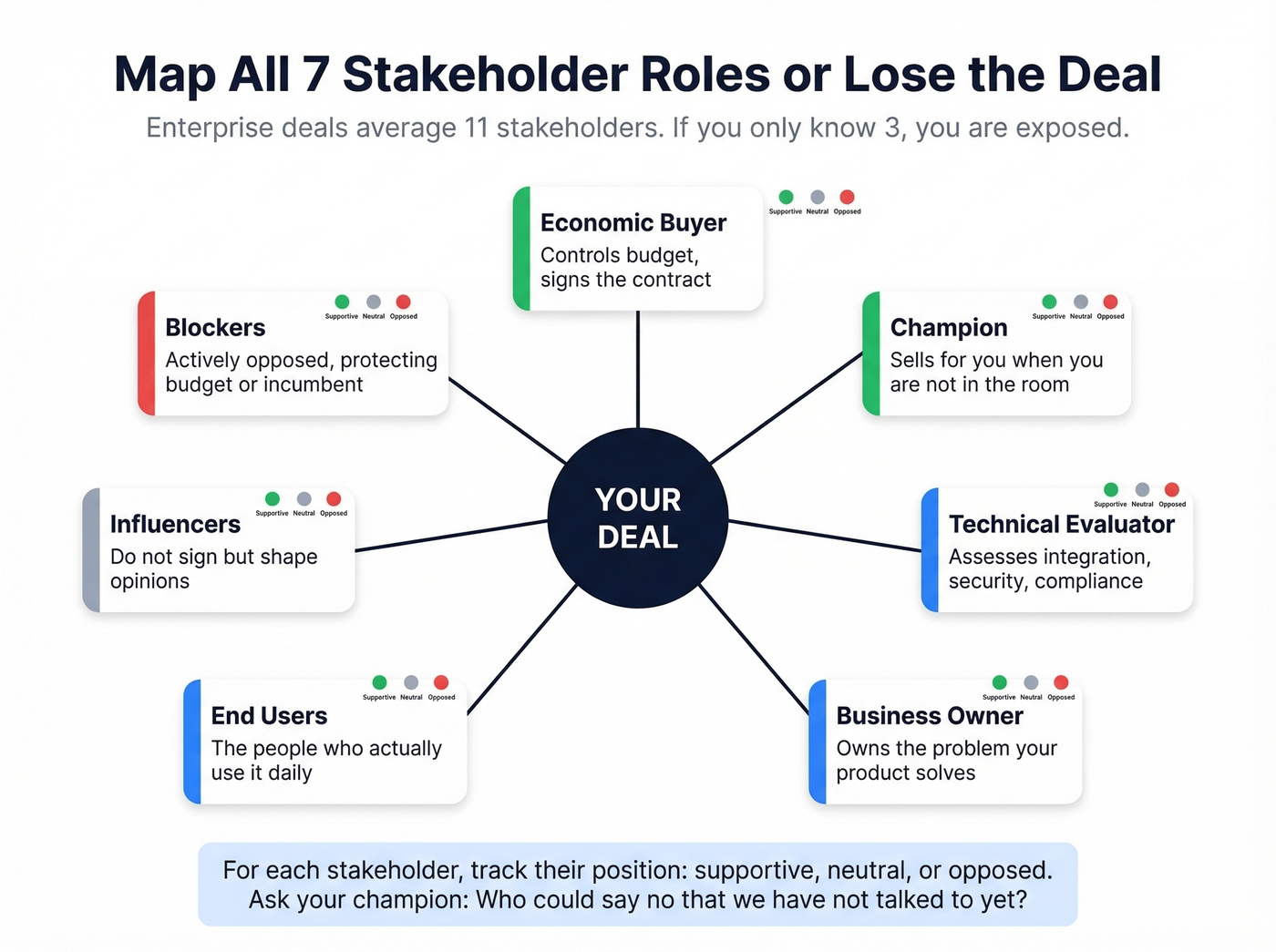
This classification model works across industries:
- Economic Buyer - controls the budget, signs the contract
- Champion - your internal advocate who sells when you're not in the room
- Technical Evaluator - assesses integration, security, compliance
- Business Owner - owns the problem your product solves
- End Users - the people who'll actually use it daily
- Influencers - don't sign but shape opinions, often executives one level up
- Blockers - actively opposed, usually protecting budget or an incumbent vendor
For each stakeholder, track their position: supportive, neutral, or opposed. Fewer than 20% of companies have fully embedded account planning into their operations. The ones that do see 28% faster sales cycles and 35% higher close rates.
The hidden approver who reviews once per month and can kill your deal with a single email - that person exists in almost every enterprise account. You won't find them on the org chart. You find them by asking your champion: "Who could say no to this that we haven't talked to yet?"
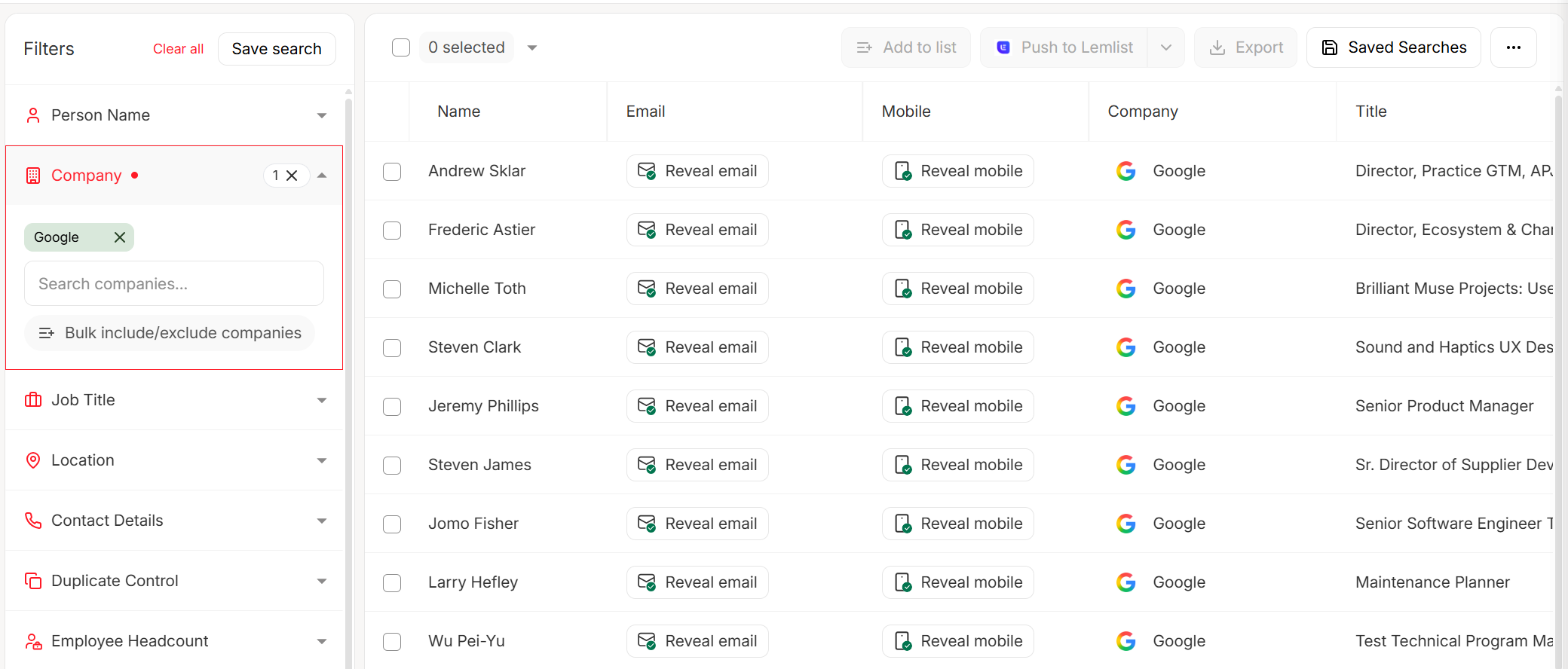
Once you've built your stakeholder map, pull verified contact details for every person on it. You can't multi-thread an account if you don't have direct contact info for the full buying committee - and most CRMs only have data on the 2-3 people who filled out a form. Prospeo fills that gap with 98% email accuracy and a 7-day refresh cycle, so the data's still good when you actually reach out.
Methodologies Compared
Every methodology reduces to the same fundamentals. A popular r/sales thread put it bluntly - Sandler, BANT, Challenger, MEDDIC all boil down to need, budget, stakeholders, and timeline. That's not wrong. But frameworks matter because they create shared language across a team and force discipline into CRM data.
| Methodology | Research Base | Best For | CRM Fit |
|---|---|---|---|
| MEDDICC | Practitioner-evolved | Enterprise CRM teams | Excellent |
| Challenger | 6,000+ reps studied | Insight-led selling | Good |
| SPIN | 35,000+ calls over 12 years | Discovery depth | Moderate |
| Sandler | Decades of practice | Relationship sales | Moderate |
MEDDICC wins for enterprise teams running Salesforce or HubSpot because each element - Metrics, Economic Buyer, Decision Criteria, Decision Process, Identify Pain, Champion, Competition - maps to a distinct CRM field. That structure makes it AI-ready: conversation intelligence tools can auto-populate MEDDICC fields from call transcripts. Reps spend just 28% of their week actually selling. MEDDICC reduces the admin overhead on the other 72%.
Challenger wins when you're displacing an incumbent and need to reframe how the buyer thinks about the problem. Nearly 40% of top performers were sellers who pushed customer thinking rather than leaning on relationship-building alone. Xerox saw a 17% sales increase and $65M in contract value after implementing Challenger. It's the right play when your differentiation is insight, not features.
Our recommendation: MEDDICC for CRM-disciplined enterprise teams, Challenger for insight-led differentiation against entrenched competitors. Pick one and commit. Blending three frameworks gives you the worst of all worlds - complexity without clarity.
Mistakes That Kill Deals
Ignoring the internal buying process. You mapped stakeholders but didn't map the approval workflow. Then you discover - three months in - that "for THAT product you need approval from the wizard, and he reviews once per month, then the SOW can be reworked." That's a real example from r/sales. One hidden step. One month of delay. Multiply that across a 270-day cycle.
Selling features instead of business outcomes. Enterprise buyers don't care about your feature matrix. They care about the $5.5M average cost of a failed digital transformation project. They care that 75% of ERP projects fail. Software failures cost the enterprise market $61B annually. Your buyer's CFO knows this. Frame your solution around their risk, not your roadmap.
Underestimating switching friction. A seller on r/sales described trying to displace an incumbent in school photography - schools with 500-1,000+ students locked into multi-year contracts. Even with a better product, the operational disruption of switching was a dealbreaker. In enterprise deals, "better" doesn't win. "Worth the pain of change" wins. That's a much higher bar.
Single-threading the account. If your entire deal depends on one champion, you're one job change away from starting over. Multi-thread or lose.
The Tech Stack
You don't need 15 tools. You need four categories covered well.
CRM. Your existing Salesforce or HubSpot instance. The goal isn't a new CRM - it's using the one you have with enough discipline that MEDDICC fields are actually populated and pipeline data is trustworthy. (If you need examples, see examples of a CRM.)
Conversation Intelligence. Gong or a comparable tool. Auto-capture calls, surface coaching moments, and extract stakeholder mentions you missed. Essential for high-stakes conversations where a single call can shift the entire deal trajectory. Gong typically runs $100-$200+/user/month for mid-market teams, scaling with seat count and package.
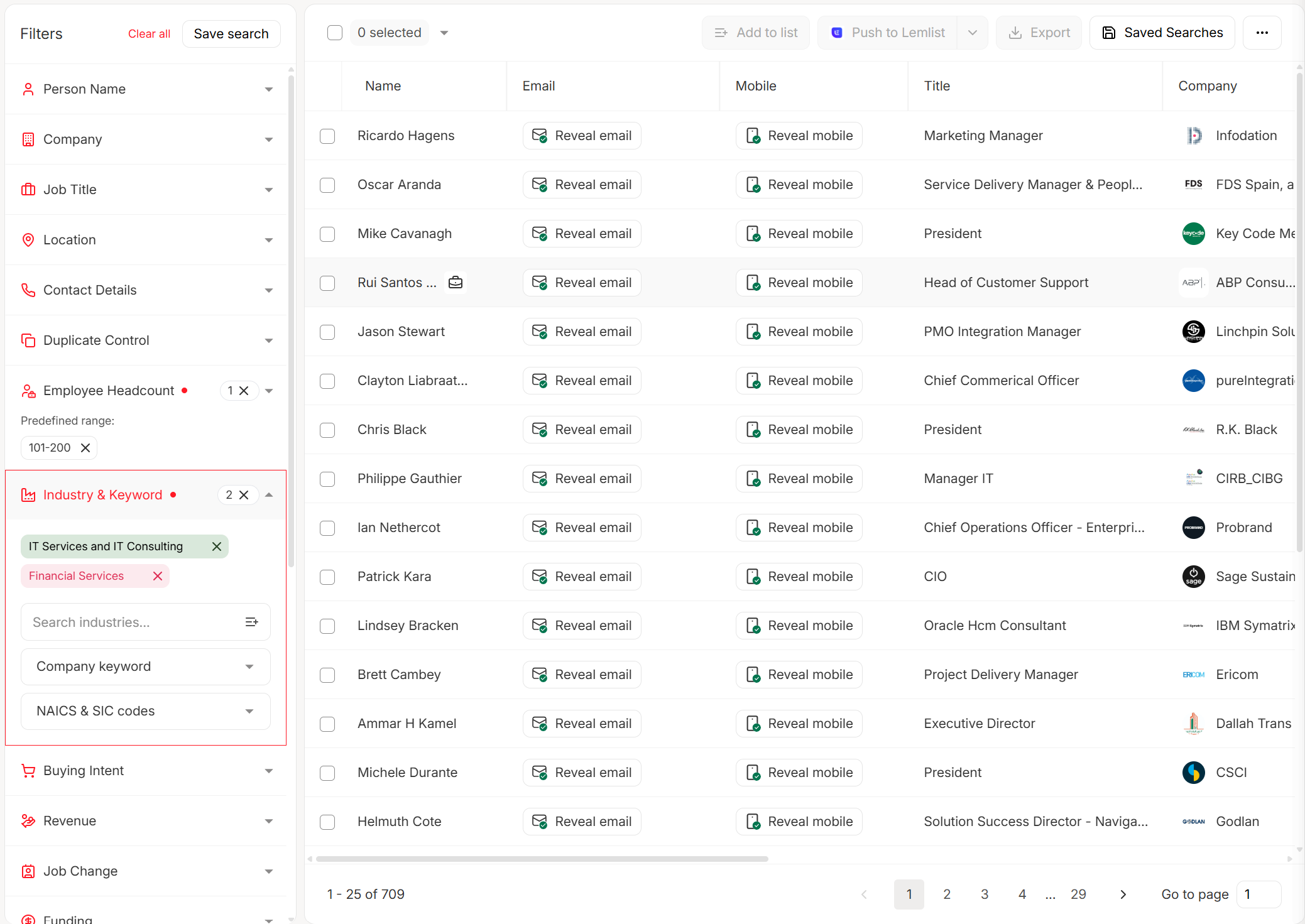
Verified Contact Data. This is where most enterprise sales motions break down quietly. You've mapped 10 stakeholders across procurement, IT, finance, and the business unit. Your CRM has contact info for 3 of them. That's the gap that kills multi-threading before it starts. Prospeo covers 300M+ professional profiles with 143M+ verified emails and 125M+ verified mobile numbers, all on a 7-day refresh cycle. Self-serve at roughly $0.01 per email, no contracts. (More options: data enrichment services.)
Mutual Action Plans / Digital Sales Rooms. DealHub or similar. A shared space where your champion can track progress, access materials, and keep their internal team aligned without forwarding 47 emails. DealHub pricing is custom, typically $10k-$50k+/year depending on seats and modules. If you're evaluating the category, start with a digital sales room breakdown.
Skip the "all-in-one" platforms that promise CRM, engagement, and data in a single tool. In our experience, they do three things at 60% quality instead of one thing well. For complex deals where accuracy matters, best-of-breed stacks outperform bundled solutions every time.
Reps already spend 72% of their week not selling. Don't make it worse with stale CRM data. Prospeo refreshes every 7 days - not 6 weeks - so your stakeholder maps stay current even on 9-month cycles. Enrich your CRM with 50+ data points per contact at $0.01/email.
Keep every contact in your deal fresh, verified, and reachable.
FAQ
How long is a typical complex sales cycle?
120-270 days depending on deal size. Deals in the $50k-$100k range average 120 days; deals over $500k average 270 days. Selling to organizations with 10,001+ employees averages 185 days regardless of ACV.
How many stakeholders are involved?
Typically 6-12 decision-makers and influencers. Mid-sized firms average 7, while enterprise deals can involve 11 or more. Map them early and track each person's stance - hidden stakeholders are the number-one deal killer.
What's the best methodology for complex sales?
MEDDICC for CRM-disciplined enterprise teams that want structured, AI-ready deal data. Challenger for insight-led differentiation when displacing an incumbent. Pick one and commit - blending frameworks creates confusion without clarity.
How do you get contact data for the full buying committee?
Use a verified B2B data platform to pull emails and direct dials for every mapped stakeholder. Your CRM probably has data on 2-3 of 11 people. Filling that gap is the difference between a multi-threaded deal and a single point of failure.