

Consultative Selling vs Transactional Selling: A Data-Backed Framework
Your sales manager just told you to "stop being so transactional" after a deal review. You nodded, smiled, and walked back to your desk with zero idea what to actually change.
A broker shared a version of this tension on r/sales: he sells NYC real estate in the $2M-$20M range. His consultative approach works when prospects come to him, but he struggles at the absolute front end of prospecting - turning cold targets into engaged conversations. More transactional agents seem to detect early deal signals faster and move the conversation forward while he's still building rapport with people who didn't ask for it.
That tension isn't a personality flaw. It's a deal-by-deal decision about consultative selling vs transactional selling, and the best reps don't pick a lane. They read the situation and shift gears.
Quick Decision Framework
- Deals under $10K with one or two stakeholders: default transactional. Speed wins.
- Deals above ~$30K: default consultative. Depth wins.
- Everything in between: use the decision framework below. Deal size relative to your average, buyer complexity, and prospect stage all matter more than your "selling style."
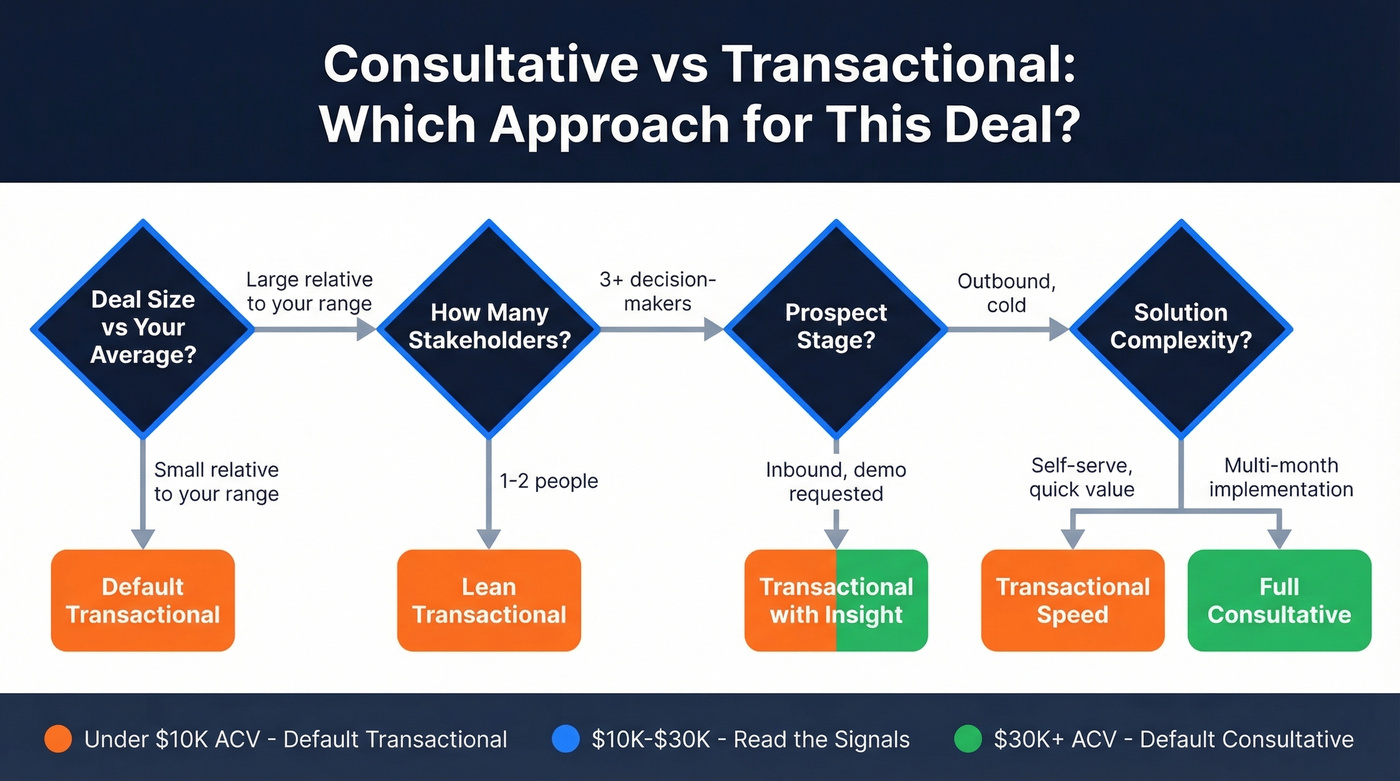
Misapplying a consultative approach to a $3K deal wastes quota capacity. This isn't about being "better" - it's about being efficient.
What Each Approach Actually Means
Transactional Selling
Transactional selling optimizes for speed and volume. The buyer knows what they want, the rep's job is to make the purchase frictionless, and the relationship is secondary to the transaction. Think retail, low-ACV SaaS, commodity purchases.
Digital Humans uses a great example: if someone walks into a store knowing exactly which coffee machine they want, the best move is to ring them up fast, maybe suggest compatible pods, and get out of the way. Trying to "discover their pain points" around coffee would be absurd. The rep skill here is efficiency - qualifying fast, handling objections on price or timing, and closing volume.
Consultative Selling
Consultative selling treats the rep as an adviser, not an order-taker. The buyer has a problem they don't fully understand, multiple stakeholders need alignment, and the solution requires tailoring - enterprise software, complex services, anything where the wrong purchase costs the buyer real money.
The rep skill here is business acumen. You need to understand the prospect's industry, diagnose problems they haven't articulated, and sometimes tell them they're wrong. That last part is critical - and it's where most "consultative" reps actually fail. We'll get to that.
Side-by-Side Comparison
| Dimension | Transactional | Consultative |
|---|---|---|
| Focus | Product/price | Buyer's problem |
| Cycle length | 25-55 days (low ACV) | 75-270+ days (higher ACV) |
| ACV sweet spot | Under $10K | $30K+ |
| Buyer involvement | 1-2 people | Multi-stakeholder |
| Relationship depth | Shallow, repeat-buy | Deep, advisory |
| Price sensitivity | High | Lower (value-based) |
| Rep skill required | Efficiency, volume | Business acumen |
| Scalability | High | Lower per-rep |
| CLV potential | Moderate | High |
| Best industries | Retail, SMB SaaS | Enterprise, services |
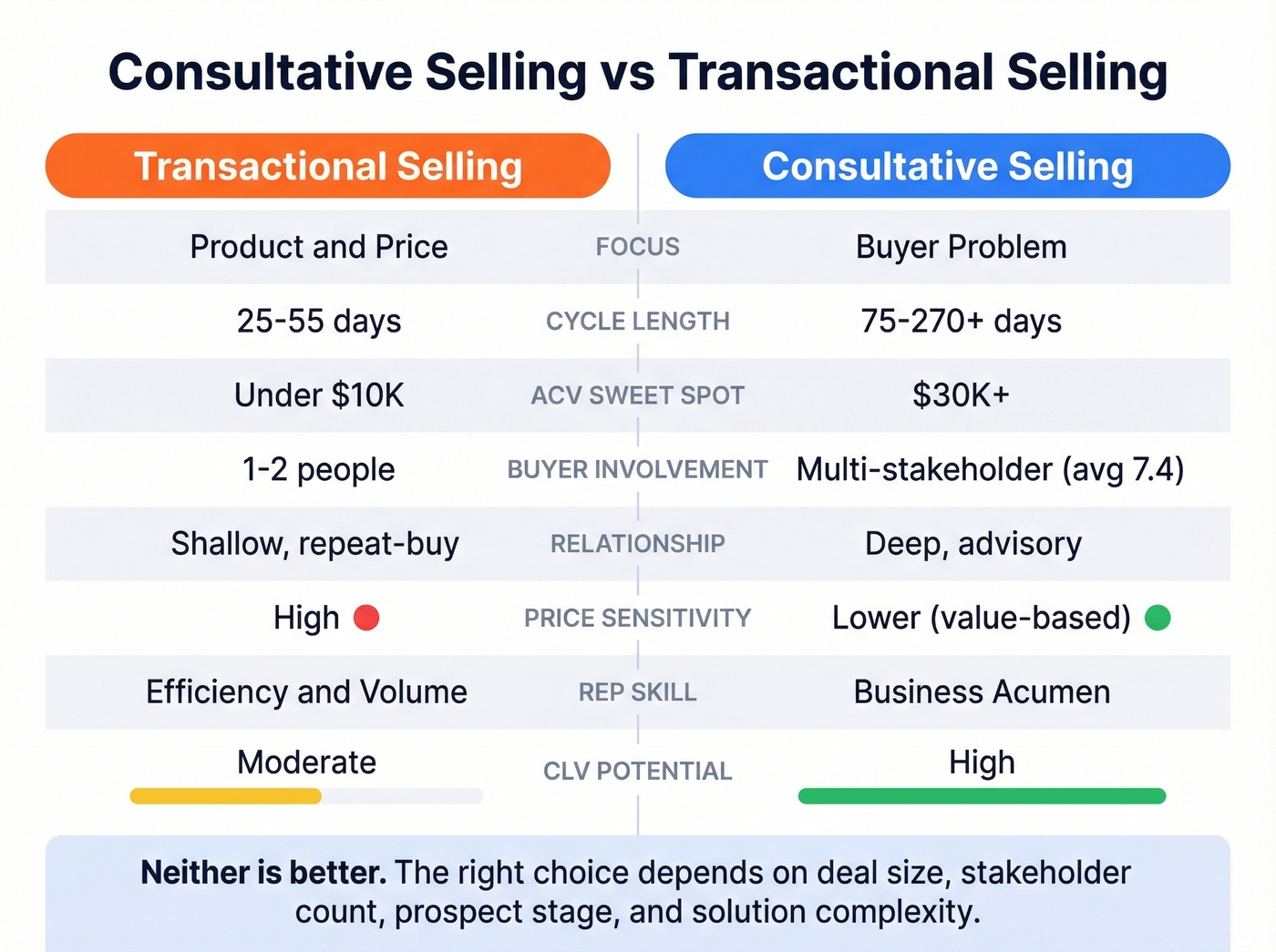
The cycle-length gap is the clearest signal.
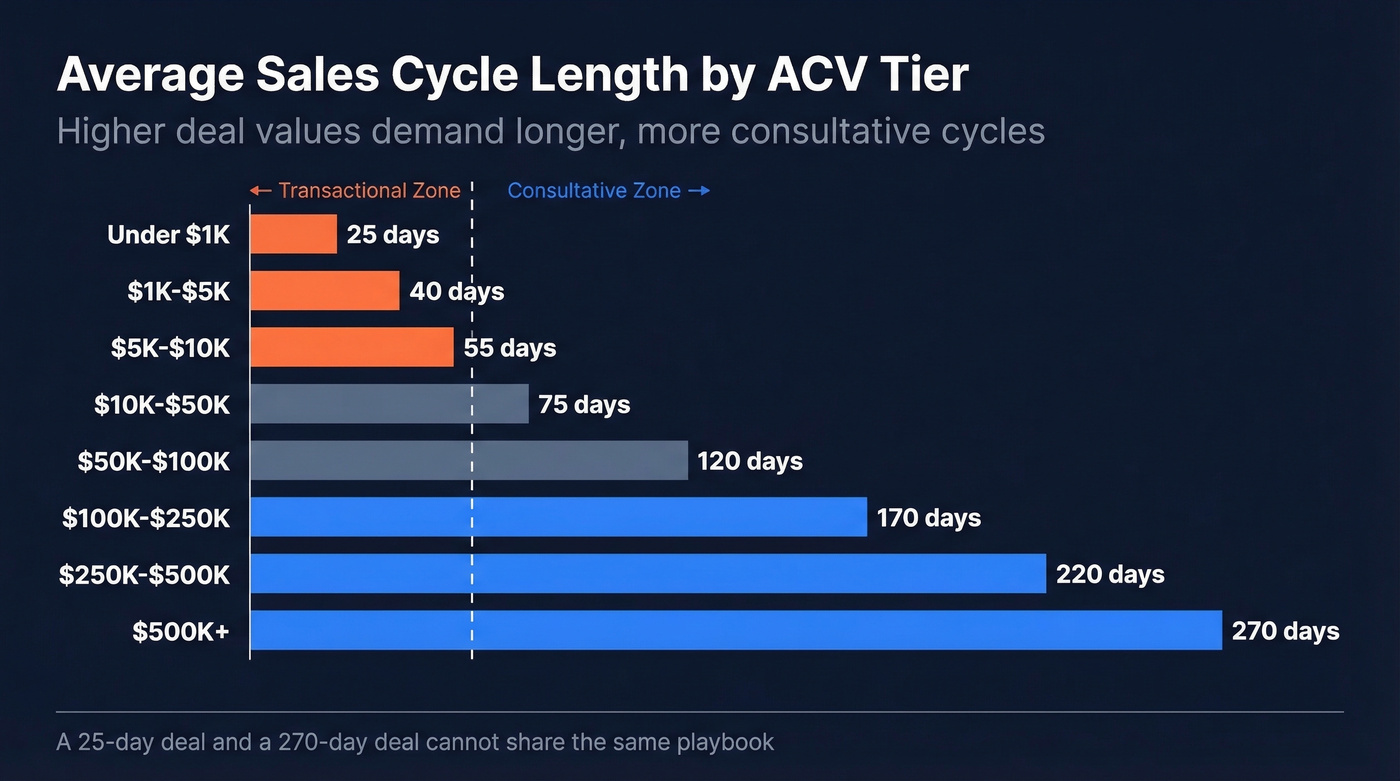
Average Sales Cycle by ACV
| ACV Tier | Average Cycle Length |
|---|---|
| Under $1K | 25 days |
| $1K-$5K | 40 days |
| $5K-$10K | 55 days |
| $10K-$50K | 75 days |
| $50K-$100K | 120 days |
| $100K-$250K | 170 days |
| $250K-$500K | 220 days |
| $500K+ | 270 days |
Median Sales Cycle by ACV
| ACV Tier | Median Cycle Length |
|---|---|
| $10K-$25K | 38 days |
| $25K-$50K | 72 days |
| $50K-$100K | 128 days |
| $100K+ | 187 days |
You can't run the same playbook across that range. A deal that closes in 25 days and one that takes 187 days require fundamentally different motions.
The Data Behind the Debate
The "consultative is always better" crowd tends to skip the numbers. Here's what they miss.
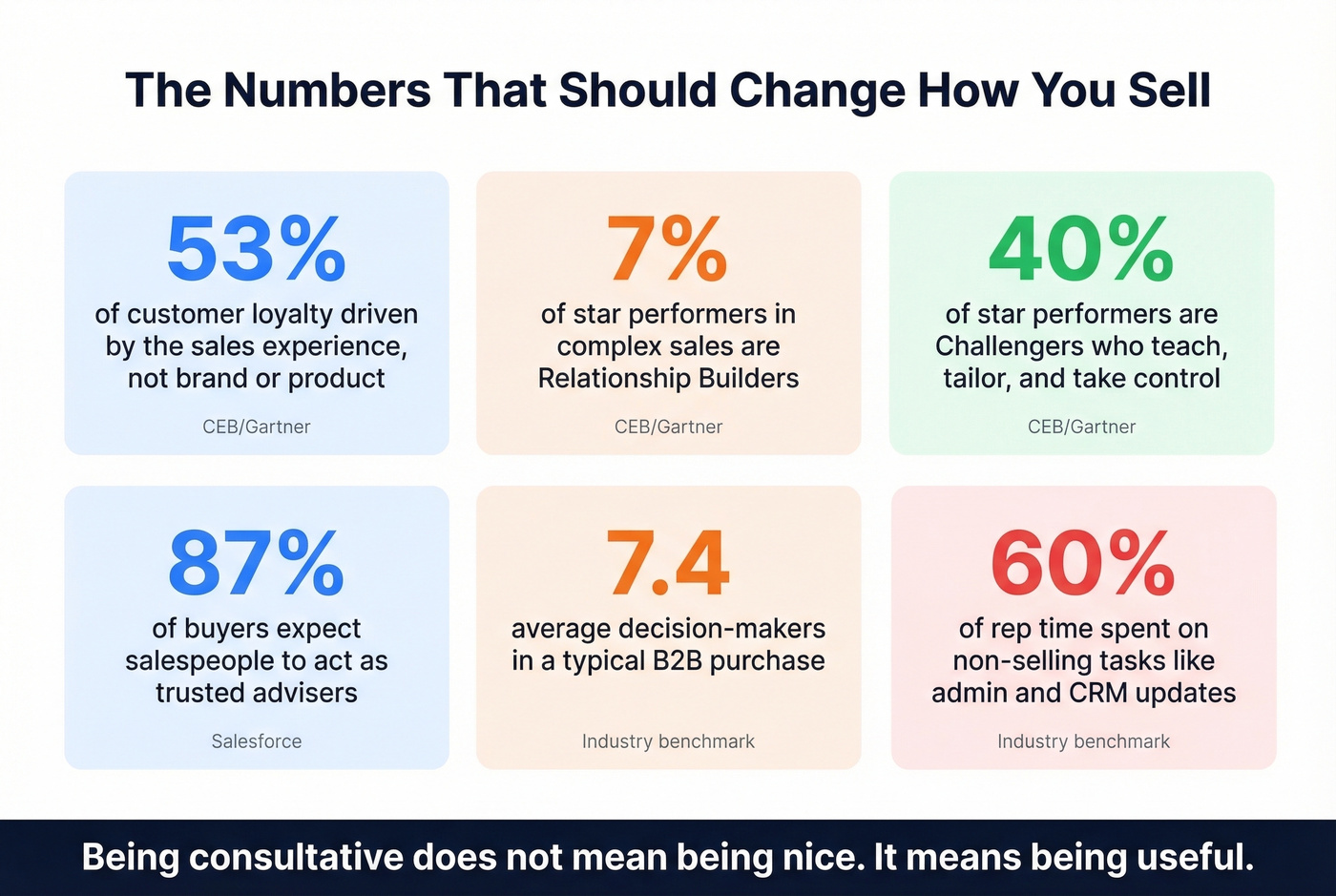
CEB's research (now owned by Gartner) found that 53% of customer loyalty is driven by the quality of the sales experience - not brand, product, or price. That sounds like a win for the advisory approach until you dig deeper. They also found that Relationship Builders - the reps who focus on rapport, accommodation, and being "consultative" in the traditional sense - produced just 7% of star performers in complex sales. Nearly 40% of star performers were Challengers: reps who teach, tailor, and take control, including pushing back on the buyer.
Being consultative doesn't mean being nice. It means being useful. And sometimes useful means telling a VP their current approach is costing them money, even when that's uncomfortable.
The buyer side reinforces this. Salesforce's State of Sales report shows that 87% of buyers expect salespeople to act as trusted advisers. A common benchmark puts 7.4 decision-makers in a typical B2B purchase. And nearly 70% of the buyer's journey is complete before a prospect reaches out to a sales rep.
By the time you're in the room, the buyer has often done serious homework. Showing up with a generic demo and a pricing sheet is transactional. Showing up with insight they didn't have is consultative - and it's what earns the deal.
Here's the stat that makes the efficiency argument impossible to ignore: reps spend roughly 60% of their time on non-selling tasks - admin, CRM updates, internal meetings. That leaves 40% for actual selling. If you burn that 40% running a full discovery cycle on a $3K deal, you're not being thorough. You're being wasteful.

Consultative selling demands deep buyer research before the first call. Prospeo gives you 50+ data points per contact - job changes, intent signals across 15,000 topics, technographics, and verified direct dials - so you show up with insight, not a generic pitch. At $0.01 per email, even your transactional deals get accurate data.
Sell like an adviser, not an order-taker. Start with better data.
When to Use Which Approach
The decision isn't about your personality. It's about four variables.
Deal size relative to your range. This is the insight most frameworks miss, and it's the most important one. A $10K deal is consultative territory if your largest deal is $10K - it deserves your full discovery process. But if you routinely close six-figure deals, that same $10K-$20K opportunity is transactional. Handle it efficiently and protect your time for bigger fish. Your threshold is relative, not absolute.
Stakeholder count. One or two decision-makers? A transactional playbook can work. As deal size rises, stakeholder count rises too. Above ~$30K ACV, a second stakeholder typically enters the process and multi-threading becomes structurally necessary.
Prospect stage. Inbound leads who've already evaluated competitors and requested a demo are further along - lean transactional and focus on differentiation and close. Outbound cold prospects who don't know they have a problem? That's consultative territory from the first touch. (If you need a system for the very top of funnel, start with these sales prospecting techniques.)
Solution complexity. Self-serve trials where buyers grasp value fast favor transactional speed. Implementations that take months and require cross-functional buy-in demand consultative depth. There's no shortcut.
How to Execute Consultative Selling
Knowing you should be consultative is the easy part. Actually doing it well is where most reps fall apart.
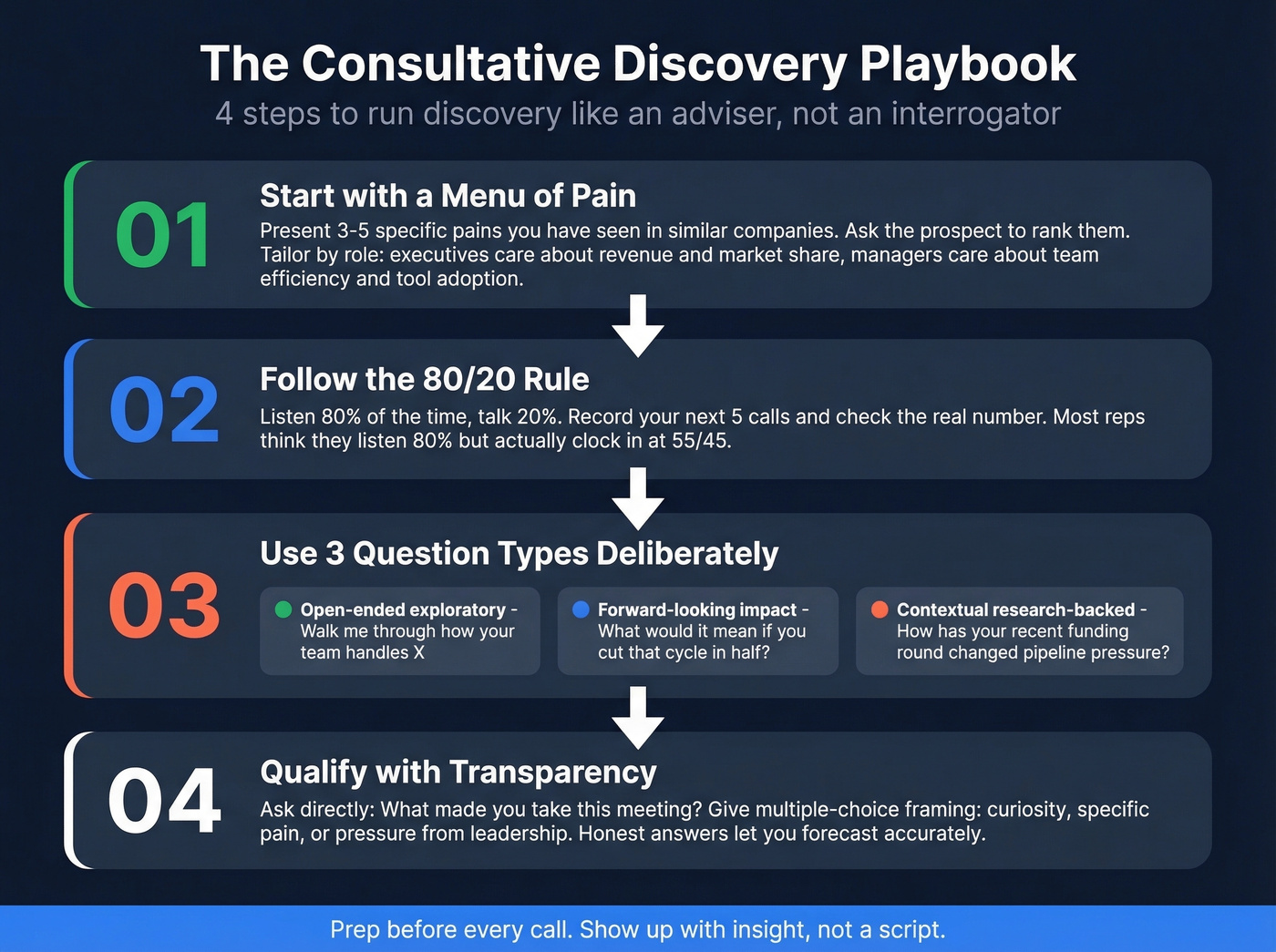
Start with a "Menu of Pain"
Instead of open-ended "tell me about your challenges" questions that go nowhere, present three to five specific pains you've seen in similar companies and ask the prospect to rank them. This demonstrates you understand their world and gets to the root problem faster than fishing.
Tailor the menu by where the prospect sits relative to the power line - executives above it care about strategic outcomes like revenue growth and market share, while managers below it care about tactical execution like team efficiency and tool adoption.
The 80/20 Rule
Target an 80/20 listen-to-talk ratio. Record your next five calls and check the actual number. We've seen reps who swear they listen 80% of the time clock in at 55/45 when they review the recordings. The gap between perception and reality is almost always larger than you'd expect.
Three Question Types to Use Deliberately
Open-ended exploratory questions get the conversation flowing: "Walk me through how your team currently handles X" or "What changed in the last six months that made this a priority?"
Forward-looking impact questions build urgency: "What would it mean for your team if you could cut that cycle in half?"
Contextual questions - "How has your recent funding round changed the pressure on pipeline targets?" - signal that you've done your homework. This kind of question requires current data. Prospeo returns 50+ data points per contact via enrichment, including technographics and company signals, so your questions are informed rather than generic.
Qualify with Transparency
Ask directly: "What made you take this meeting? Was it curiosity, a specific pain point, or pressure from leadership?" Multiple-choice framing gives the prospect permission to be honest, and honest answers let you forecast accurately instead of hoping.
A quick note on AI-assisted prep: 88% of B2B buyers only finalize a purchase when they see the vendor as a trusted advisor. AI tools can accelerate the identify-pinpoint-personalize workflow - scanning a prospect's recent activity, company news, and competitive landscape in minutes rather than hours. Use that time savings to prepare sharper hypotheses, not to skip preparation entirely.
Why Consultative Selling Backfires
Let's be honest: consultative selling fails more often than sales leaders admit. Here are the five most common failure modes.
The most damaging is lack of business acumen. The rep asks great questions but can't interpret the answers in business terms. The fix requires discipline: study your prospect's industry before every call. Read their 10-K, their last earnings call, their competitors' press releases. If you can't explain how your prospect makes money, you're not ready for a consultative conversation.
Closely related is insufficient knowledge or experience - the rep simply doesn't know enough to counsel the buyer. These two problems compound each other, and the solution for both is the same: pair junior reps with senior AEs on complex deals until they've seen enough patterns to advise independently.
Then there's borrowing credibility - name-dropping clients and leaning on the company brand instead of providing original insight. Lead with a point of view, not a logo slide. Your prospect doesn't care that you work with Fortune 500 companies. They care whether you understand their problem.
Conflict aversion keeps reps at the surface. They uncover a problem but won't push on it because the conversation might get uncomfortable. Write down the three hardest questions before every call and commit to asking at least two. The Challenger data proves this works - the reps who push back outperform the ones who accommodate.
Finally, lack of confidence to advise. The rep does the discovery, identifies the problem, and then asks the prospect what they think instead of making a recommendation. Practice delivering recommendations in role-plays until it feels natural, not pushy. Your buyer is paying for your expertise, not your questions.
Skip the consultative label entirely if your reps have three or more of these problems. You're running a transactional process with longer meetings, and that's the worst of both worlds.
Blending Both Into a Hybrid Model
The smartest sales orgs build a progressive engagement model. Start transactional: qualify fast, detect deal signals, move volume. When deal size or complexity crosses your threshold, escalate to consultative. That r/sales broker's insight applies broadly - hunting is transactional, farming is consultative, and most pipelines need both.
Nine out of ten companies plan to stick with hybrid sales models, and hybrid organizations report up to 50% higher revenue growth than single-approach teams.
If your team is transitioning to a hybrid model, start here:
- Segment your pipeline by ACV relative to your median deal size. Everything below the median gets a transactional playbook with a 2-call close target.
- Define your escalation triggers - stakeholder count rising, deal size above 2x your median, or solution complexity requiring implementation planning.
- Build separate cadences. Transactional targets get sequenced at scale with efficiency-focused messaging. Consultative targets get researched and approached with context. Prospeo's 30+ search filters, including buyer intent powered by Bombora and headcount growth signals, let you segment prospects by approach before the first outreach. (To operationalize this, use a lead scoring model and track pipeline health by segment.)
- Track close rates and cycle lengths by segment monthly. Adjust the threshold as your data grows.
FAQ
What's the difference between consultative and transactional selling?
Transactional selling optimizes for speed - the buyer knows what they want, and the rep closes with minimal friction. Consultative selling positions the rep as an adviser who diagnoses problems and tailors solutions across multiple stakeholders. Choose based on deal size, stakeholder count, and solution complexity, not personality.
Can you blend both approaches in one sales org?
Yes, and you should. Segment your pipeline by deal size relative to your median ACV. Deals below the median get a transactional playbook with fast close timelines; deals above it get full consultative discovery with multi-threaded engagement. Hybrid orgs report up to 50% higher revenue growth.
What's the biggest mistake reps make with consultative selling?
Confusing "asking questions" with advising. Real consultative selling requires business acumen and the confidence to challenge buyer assumptions. CEB's Challenger data shows Relationship Builders produce just 7% of star performers in complex sales - rapport without insight doesn't close enterprise deals.
How do you prepare for a consultative discovery call?
Research the prospect's company, recent news, and competitive landscape before the call. Enrich their profile with current data - 50+ data points per contact including technographics and company signals make for sharper questions. Prepare a "menu of pain" tailored to their role and walk in with a hypothesis, not a blank notepad.
Reps spend 60% of their time on non-selling tasks. Prospeo's 30+ search filters - buyer intent, headcount growth, funding, department size - let you instantly decide which deals deserve consultative depth and which to close fast. 98% email accuracy means zero time wasted on bounces.
Protect your 40% selling time. Let the data qualify the approach.