

Contact-Level Advertising: The Practitioner's Guide for 2026
Your ABM platform lights up with 50 surging accounts. Marketing celebrates. But your SDRs open the list and ask the only question that matters: which person do we actually reach?
That's the gap contact-level advertising exists to close - and most ABM programs still haven't solved it.
The Short Version
Contact-level advertising targets specific contacts from your list across LinkedIn, Meta, Google, and other ad platforms - not just accounts. It fixes ABM's biggest blind spot: knowing which person inside a target account to reach. Plan for 30-50% real-world match rates, not the 70-90% vendors love to quote. And none of it works if your CRM data is stale. Clean your contact list before spending $1K-$5K/mo on a platform.
What Is Person-Based Advertising?
Traditional ABM targets companies. You build an account list, run display ads against those domains, and hope the right people see them. Contact-level advertising flips that model: instead of blanketing an account with impressions, you serve ads to specific individuals - the VP of Engineering, the CFO, the procurement lead - across the platforms they actually use.
The VP of Engineering sees a technical deep-dive. The CFO sees an ROI case study. Same account, different conversations.
This is the core shift from targeting logos to targeting people, and it matters because enterprise deals involve 4+ stakeholders in nearly two-thirds of cases, with sales cycles stretching 6 months to 2 years. Reaching "the account" isn't enough when four different people need four different reasons to say yes.
Why CLA Matters Now
Three shifts explain why this approach is more relevant now than it was two years ago.
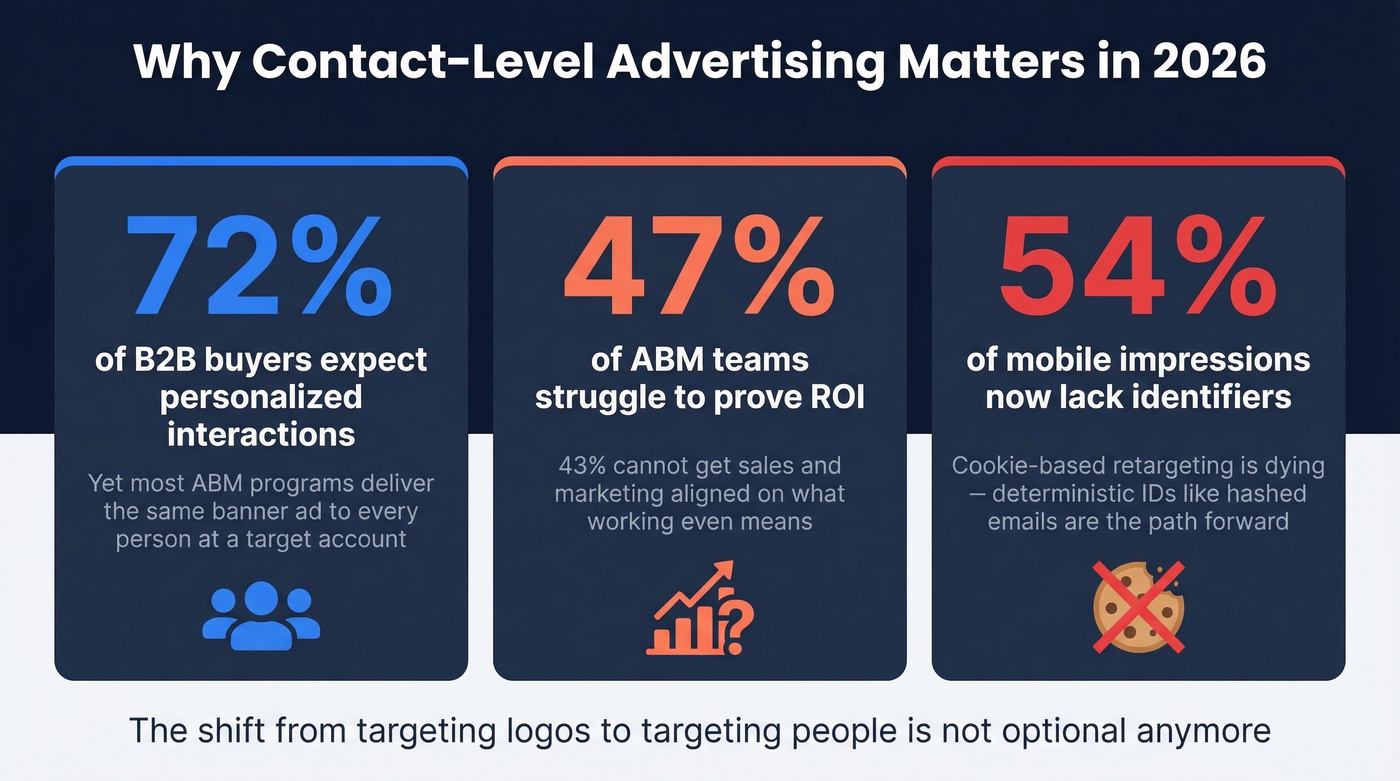
Buying committees keep growing. 72% of B2B buyers expect personalized interactions, yet most ABM programs deliver the same banner ad to everyone at a target account. That's not personalization - it's account-level spray and pray. Persona targeting solves this by letting you craft distinct creative for each role in the buying committee.
ABM's ROI problem is real. A Demand Gen Report benchmark survey found 47% of teams struggle to prove ABM ROI, and 43% can't get sales and marketing aligned on what "working" even means. Contact-level attribution changes this. You see which person engaged with which ad before they booked a meeting. That's a fundamentally different measurement conversation.
Signal loss is accelerating. Comscore data shows 54% of mobile impressions and 36% of desktop impressions now lack identifiers. Cookie-based retargeting is dying. CLA leans on deterministic identifiers like hashed emails and mobile advertising IDs, reducing reliance on third-party cookies that are disappearing anyway.
How Identity Resolution Works
CLA platforms match the contact data you provide - typically email addresses - to identifiers that ad platforms recognize. Here's the flow: you upload a list of business emails, the platform hashes them, and matches against hashed email databases maintained by ad networks, data partners, and identity graphs. When there's a match, the platform serves ads to that specific person on LinkedIn, Meta, Google, or other channels.
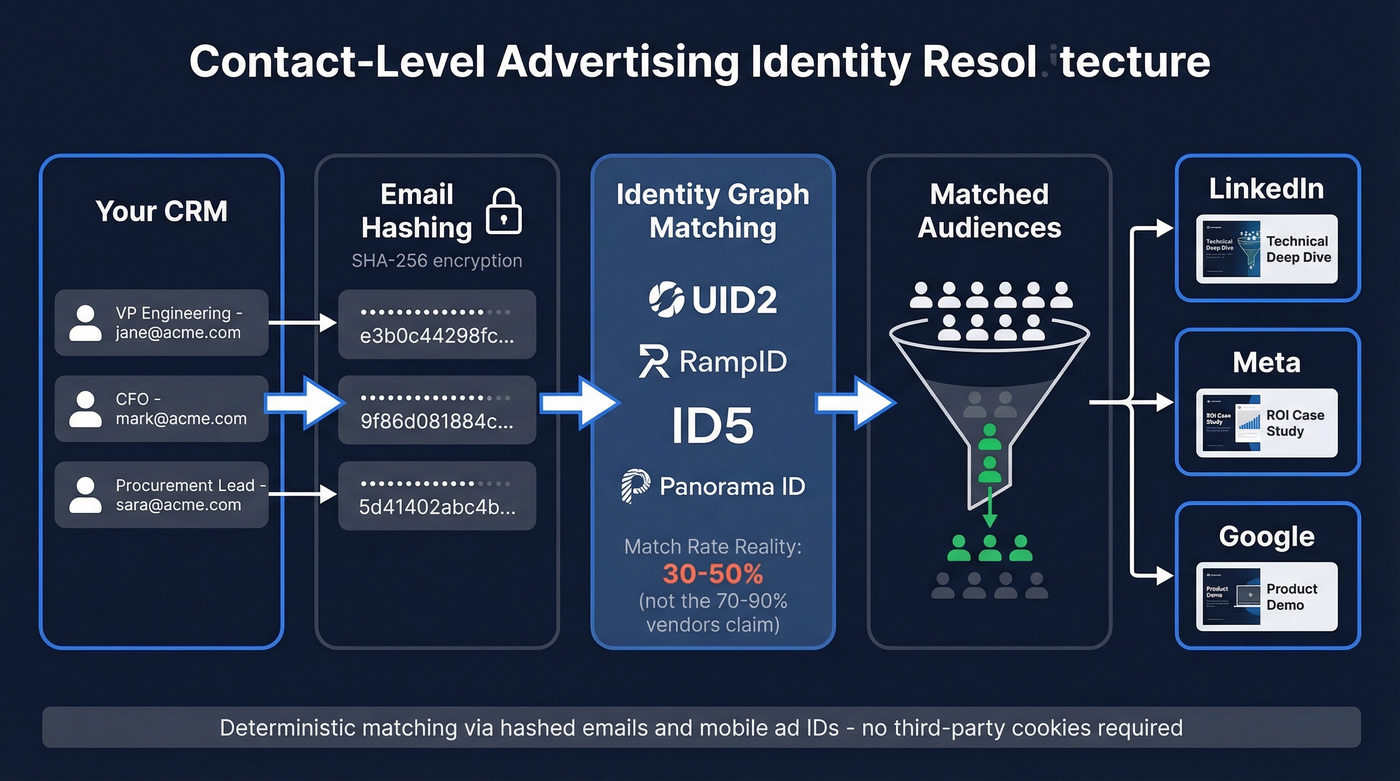
Many identity-resolution stacks also use mobile advertising IDs, device fingerprinting, and clean room environments where first-party data gets matched without either side exposing raw records. The identity ecosystem has fragmented into competing standards - UID2, RampID, ID5, Panorama ID - with no single universal ID winning out.
Here's the thing about match rates: every CLA vendor claims 70-90%, but none publish methodology or sample sizes. Independent data tells a different story. Vector reports a 35% contact-level match rate for US-based web traffic, and native platform uploads typically match around 30%. Plan for 30-50% in practice. We've never seen a client hit 70% on a cold list.

You just read that real-world CLA match rates drop to 30-50% - and stale CRM data is the #1 reason. Prospeo refreshes 300M+ profiles every 7 days (not the 6-week industry average) and verifies emails at 98% accuracy. Clean contacts before they hit your ad platform, and your match rates climb.
Stop burning ad budget on contacts that can't match. Fix your data first.
CLA Tools Compared
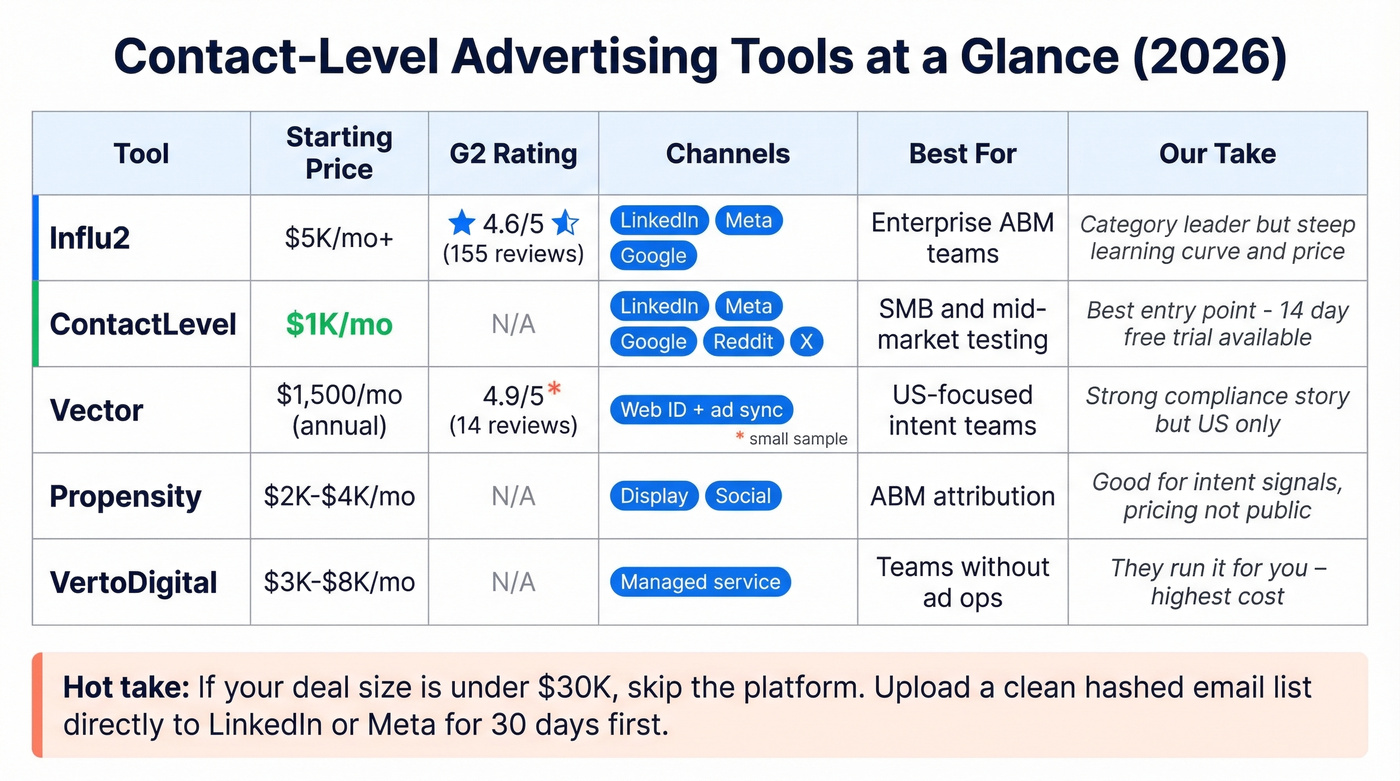
| Tool | Starting Price | G2 Rating | Channels | Best For |
|---|---|---|---|---|
| Influ2 | ~$5K/mo+ | 4.6/5 (155) | LinkedIn, Meta, Google | Enterprise ABM teams |
| ContactLevel | $1K/mo | N/A | LinkedIn, Meta, Google, Reddit, X | SMB/mid-market testing |
| Vector | ~$1,500/mo (annual) | 4.9/5 (14) | Web ID + ad sync | US-focused intent teams |
| Propensity | ~$2K-$4K/mo | N/A | Display, social | ABM attribution |
| VertoDigital | ~$3K-$8K/mo | N/A | Managed service | Teams without ad ops |
Influ2
Influ2 is the category leader and priced accordingly. The median contract runs $60,000/year according to Vendr procurement data, with enterprise deals running well above that. You get deep CRM integrations with Salesforce, HubSpot, Marketo, and Eloqua, plus the most mature contact-level reporting in the space. The tradeoff is a real learning curve - G2 reviewers consistently flag onboarding complexity and limited ad management flexibility.
If your org runs a serious ABM program with dedicated ad ops, Influ2 is the obvious pick. For a 5-person marketing team, it's overkill.
ContactLevel
Use this if you want to test CLA without a five-figure annual commitment. ContactLevel starts at $1,000/mo for 10,000 net new contacts, scaling to $2,500/mo for 30,000 contacts. A 14-day free trial with 1,000 free contacts lets you validate before committing. It covers the widest channel mix - LinkedIn, Meta, Google, Reddit, and X - and includes website visitor identification with session recordings.
Skip this if you need enterprise-grade reporting or complex multi-touch attribution. The vendor claims 70-90% match rates and 470% outbound reply rate increases - those are vendor-reported with no published methodology, so treat them as ceiling estimates.
Vector
Vector takes a different angle. It's primarily an identity resolution and intent platform that feeds ad platforms, starting around $1,500/mo annually with add-ons for intent topics at $100/mo each and email enrichment at $199/mo. The 4.9/5 G2 rating comes from just 14 reviews, but users praise easy setup and actionable contact-level insights. Main complaints center on clunky integrations and HubSpot limitations. Vector is geofenced to operate only in the US, which doubles as a compliance strength - it filters out non-US visitors by IP and stores zero data for non-US website visitors.
Propensity approaches CLA from the attribution side, focusing on generating contact-level intent signals within ABM programs. Pricing isn't public - expect $2K-$4K/mo based on market positioning. VertoDigital runs a managed-service model where they handle ad ops for you, typically $3K-$8K/mo depending on scope. Best for teams that want person-based targeting without building internal capability.
Let's be honest: most teams with deal sizes under $30K don't need a dedicated CLA platform. Upload a clean hashed-email list directly to LinkedIn or Meta, run it for 30 days, and see if targeting specific contacts moves pipeline. If it does, then invest in a platform. The tooling is only worth it when your deal size justifies the spend.
The Data Quality Problem Nobody Talks About
CLA is only as good as the contacts feeding it. We've seen this pattern over and over: a team uploads their CRM list to a CLA platform, gets excited about the channel coverage, then discovers that 40% of their email addresses are outdated. Stale emails don't match. Contacts who changed jobs six months ago don't resolve. You end up paying platform fees to target ghosts.
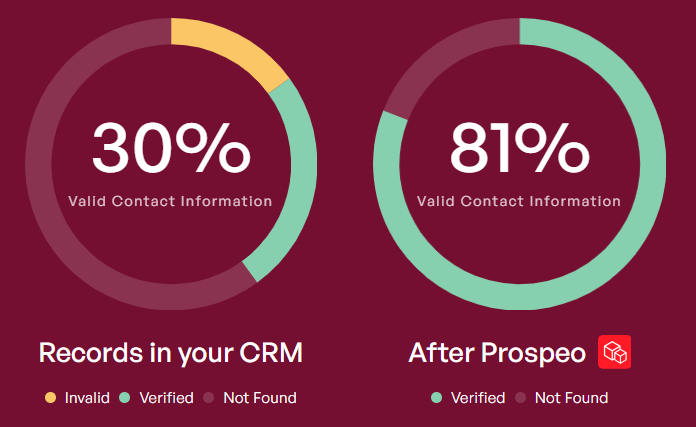
Before spending a dollar on any CLA platform, run your contact list through an enrichment and verification pass. Prospeo's 7-day data refresh cycle and 98% email accuracy make it the cleanest input you can feed into a CLA workflow - with an 83% enrichment match rate and 50+ data points returned per contact, you're not just verifying emails but updating job titles, confirming the person still works at the target account, and flagging contacts who've moved on. At roughly $0.01 per email, verifying 10,000 contacts costs less than a single wasted day of ad spend on outdated records.
If you're evaluating vendors, compare options in our roundup of data enrichment services and keep a separate shortlist of email verification tools for list hygiene.
Privacy and Compliance
Contact-level advertising sits in a regulatory zone that's getting stricter every year. Under GDPR, fines run up to EUR 20M or 4% of global turnover, and targeting European contacts with hashed emails requires a defensible legal basis - "legitimate interest" is increasingly challenged by regulators. CCPA/CPRA penalties reach $7,500 per intentional violation, and your "Do Not Sell or Share" mechanism must actually stop downstream data flows, not just display a banner.
The enforcement landscape shifted meaningfully in 2025, with regulators now testing opt-out mechanisms and auditing downstream data usage. Auditability isn't optional anymore. Vector's approach of filtering out non-US visitors by IP and storing zero data for non-US traffic is becoming a compliance template. If your vendor can't explain their geographic data handling, that's a red flag.
How to Get Started
Audit and enrich your CRM data. Verify emails and update job titles before syncing to any CLA platform. Stale data kills match rates before you start. This single step will do more for your CLA results than any platform feature. If you need a repeatable process, use an Ideal Customer Profile to define who belongs on the list first.
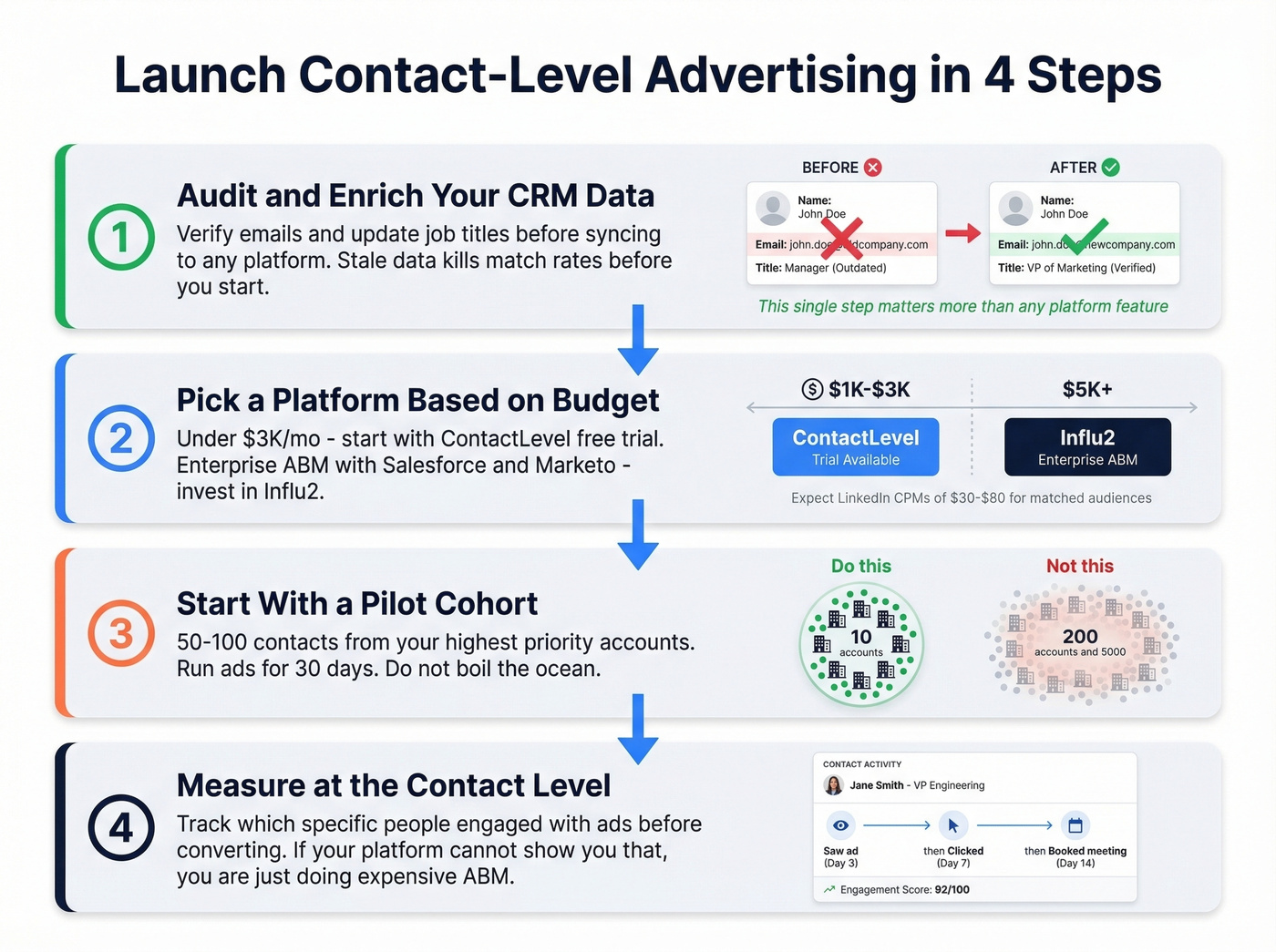
Pick a platform based on budget. Under $3K/mo, ContactLevel's free trial is the obvious starting point. Running enterprise ABM with Salesforce and Marketo? Influ2 is worth the investment. Expect LinkedIn CPMs of $30-$80 for matched audiences and $5-$15 for programmatic display.
Start with a pilot cohort. Pick 50-100 contacts from your highest-priority accounts. Run ads for 30 days. Don't boil the ocean - you need a controlled test to calibrate expectations. In our experience, teams that start with a tight list of 75 contacts across 10 accounts learn more in 30 days than teams that blast 5,000 contacts across 200 accounts.
Measure at the contact level. Track which specific people engaged with ads before converting. If your CLA platform can't show you that, you're just doing expensive ABM. Tie this back to pipeline health so sales and marketing agree on what “working” means.
If you’re operationalizing this across SDRs, standardize the handoff with a lightweight sales follow-up motion so engaged contacts get contacted fast.
CLA only works when you know the right person at each account - the VP of Engineering, the CFO, the procurement lead. Prospeo's 30+ filters including buyer intent, job changes, and department headcount let you build those persona-specific lists at $0.01/email. No contracts, no sales calls.
Build buyer-committee lists with verified emails in minutes, not days.
FAQ
How does contact-level advertising differ from ABM?
ABM targets accounts as a whole - serving the same display ads to everyone at a company. Contact-level advertising targets specific individuals within those accounts across platforms like LinkedIn, Meta, and Google. CLA is the precision layer on top of ABM: same account lists, but tailored messages to each decision-maker instead of generic banners.
What match rates should I realistically expect?
Plan for 30-50%. Vendors claim 70-90%, but independent data shows 30-35% for native platform uploads and US web traffic. Your actual rate depends on data freshness, geography, and whether contacts use work emails on ad platforms.
Can I retarget website visitors at the contact level?
Yes - tools like Vector and ContactLevel de-anonymize website visitors, resolving them to individual contacts rather than just company names. Once identified, you can add them to a CLA audience and serve personalized ads based on pages viewed. Match rates hover around 35% for US traffic, so pair this with enriched CRM data for broader coverage.
Do I need a dedicated CLA platform?
Not always. Upload a CSV of hashed emails directly to Meta or Google for a low-cost test - match rates sit around 30% with zero attribution. Dedicated platforms use identity resolution across multiple ID graphs to reach 2-3x more contacts. For lists under 1,000 contacts, start with native uploads and focus on data quality first.
What's the minimum budget to test CLA?
ContactLevel starts at $1,000/mo with a 14-day free trial, making it the lowest barrier to entry. Add $100-$200 for data enrichment to clean your list first. Total test budget: roughly $1,200-$1,500 for a meaningful 30-day pilot targeting 50-100 contacts across 2-3 channels.