


ContactOut vs Webbula: Finder or Verifier?
ContactOut and Webbula aren't real competitors. If you're comparing them, you're actually looking at two different steps of the outbound workflow: ContactOut helps you find emails, while Webbula helps you verify emails you already have. You won't find many true head-to-head comparisons because they solve different problems.
Here's the thing - if your team is still debating "finder vs verifier," you're already losing time. The winning setup gets verified contacts into your sequences with the least operational drag.
30-Second Verdict
- Building prospect lists from scratch? ContactOut works best for one-at-a-time lookups with a browser extension.
- Cleaning an existing email list before a campaign? Webbula runs deep hygiene checks that catch risky addresses basic tools miss.
Why Finder vs Verifier Matters
An email finder takes a name + company (or a profile/website) and discovers a likely email address. An email verifier takes an existing address and tells you whether it's valid, risky, or dead. Different inputs, different outputs, different success metrics.
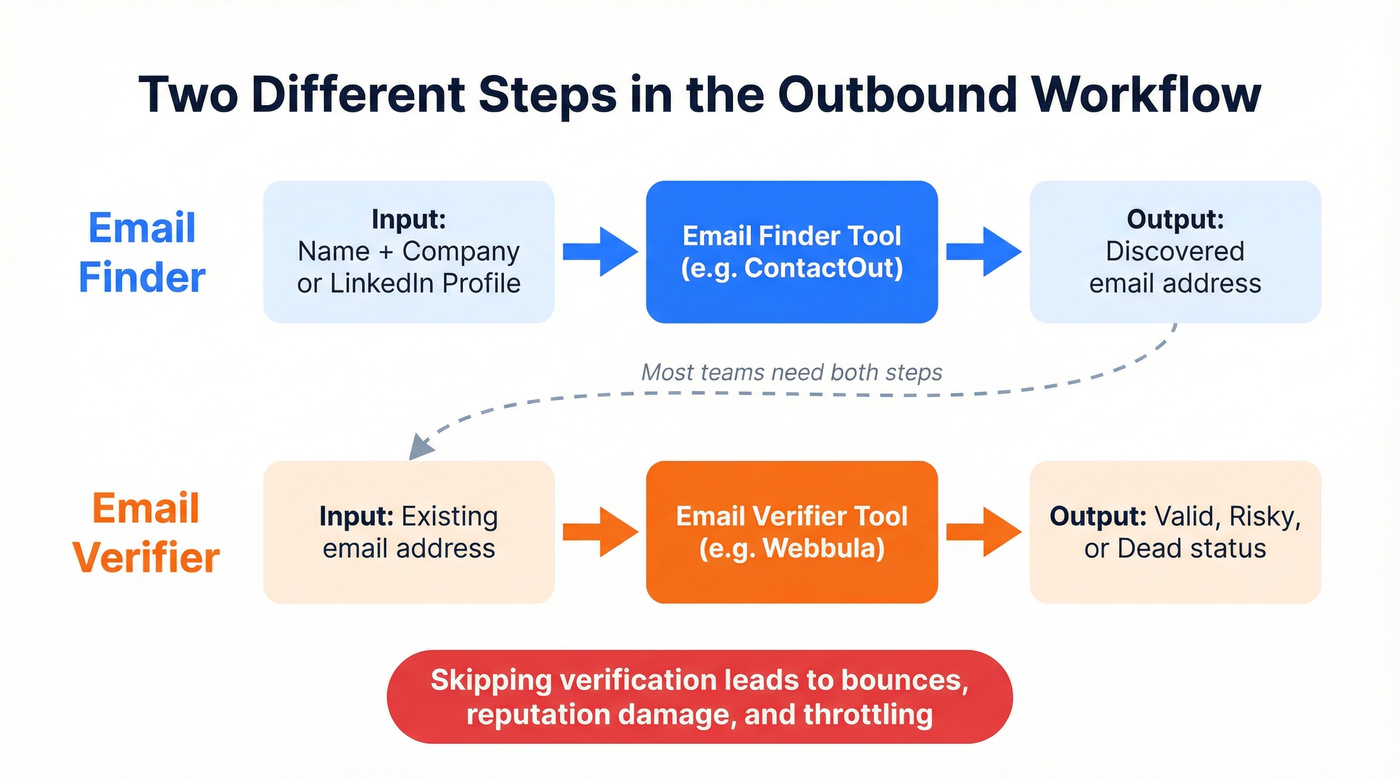
In our experience, teams get burned when they treat verification as optional after list building. It's not just about bounces - bad addresses snowball into reputation damage, throttling, and inbox placement problems that take weeks to recover from. If you send at any real volume, verification isn't optional. It's basic hygiene. (If you want the deeper playbook, start with our email deliverability guide.)
Most outbound teams end up needing both capabilities: find contacts, then verify before you load a sequence.
Feature Comparison
Use this table like a routing guide: if you're creating emails, you're in finder territory; if you're protecting deliverability, you're in verifier territory.
| Feature | ContactOut | Webbula |
|---|---|---|
| Category | Email Finder | Email Verifier |
| Starting Price | $29/mo (basic); $79/user/mo (Sales plan) | Free (100 credits), then quote-based |
| G2 Rating | 4.4/5 (109 reviews) | 4.5/5 (4 reviews) |
| Best For | Net-new list building | Cleaning lists pre-campaign |
| Key Limitation | Credit caps behind "unlimited" marketing | No public paid pricing |

ContactOut finds emails. Webbula verifies them. Prospeo does both - 143M+ verified emails from 300M+ profiles, all run through 5-step verification with catch-all handling and spam-trap removal. No CSV handoffs. No second tool. One workflow, 98% accuracy, ~$0.01/email.
Collapse two tools into one and start sending to verified contacts today.
ContactOut: The Breakdown
ContactOut shines when you're prospecting manually and want a fast, low-friction way to pull contact data as you browse. The Chrome extension is the product - when it fits your workflow, it feels effortless. One Reddit thread on cold email tooling rates it slightly above RocketReach for that "grab contacts as you go" motion, and that matches what we typically see. (If you're comparing more options, see our roundup of SDR tools.)
Where it falls apart is volume and predictability. The free trial tier includes 40 emails per year - enough to evaluate the extension, not enough for ongoing outbound. The Sales plan at $79/month includes 6,000 emails/year, and the Recruiter plan at $199/month bumps that to 12,000 emails/year. Multiple G2 reviewers complain about an "unlimited" message but a fair-use cap around ~2,000 emails, which will frustrate you once you scale past manual lookups. The data quality can be solid. The credit expectations are what trip teams up.

Webbula: The Breakdown
Webbula is built for list hygiene, not discovery. It runs addresses through deliverability and risk checks - syntax, domain, MX, mailbox validation, plus risk signals like disposable domains and spam traps. It's SOC 2 certified, and Truthset ranked it a top performer for accuracy with daily updates. (Related: if you're evaluating alternatives, our list of Bouncer alternatives is a good starting point.)
Best at: high-stakes cleaning before a big send, especially if you're protecting warmed domains. Not great at: giving you a slick self-serve UI. Some power features lean API-first, and G2 review volume is thin enough that it's hard to get a broad read on user sentiment. If you can run hygiene automatically through their API or scheduled bulk jobs, Webbula makes a lot more sense than doing one-off CSV cleanups manually. (For bounce benchmarks and what “good” looks like, see email bounce rate.)
Which One Do You Actually Need?
Pick based on where your bottleneck sits.
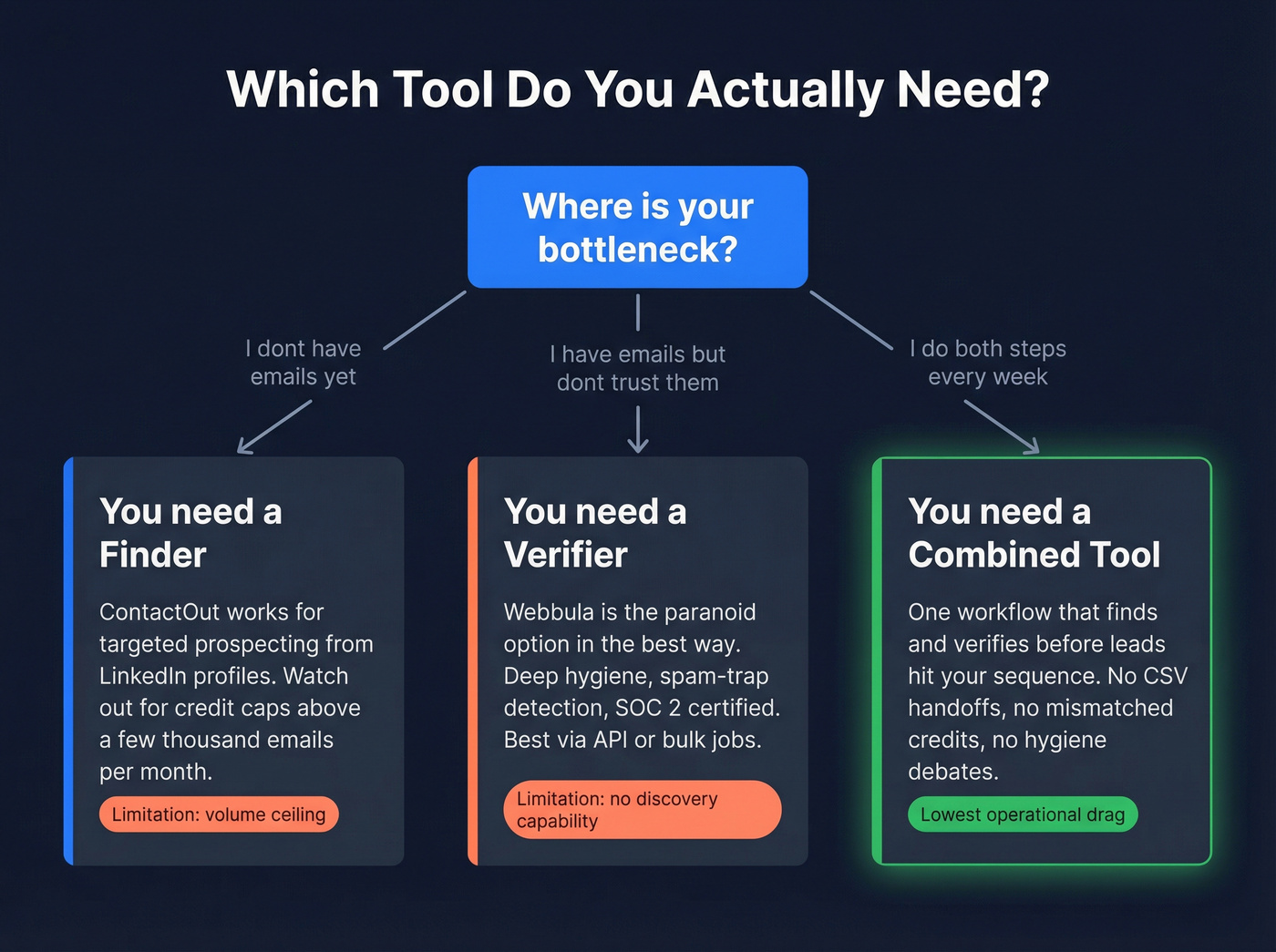
If you don't have emails yet, you need a finder. ContactOut is a practical choice for targeted prospecting, especially when you're working from professional profiles and moving fast. Skip it if you need more than a few thousand emails per month - the credit math won't work. (If you're building lists at scale, our guide to how to generate an email list will save you time.)
If you have emails but don't trust them, you need a verifier. Webbula is the "paranoid" option in the best way. It's the tool you use when you'd rather block a questionable address than risk deliverability fallout. (If you're troubleshooting validity checks, see how to check if an email exists.)
If you're doing both steps every week, pay attention to the operational cost. Let's be honest: CSV handoffs, mismatched credit systems, and "who owns hygiene?" debates are the quiet killers of outbound velocity. We see the cleanest ops when verification happens before a lead ever hits a sequence tool - ideally as part of enrichment, not as a last-minute cleanup after the list is already in motion. (More on this in our breakdown of lead enrichment.)
What If You Need Both?
Prospeo consolidates finding and verification into one workflow. It draws from 300M+ professional profiles and 143M+ verified emails, and every email you export goes through a 5-step verification process with catch-all handling, spam-trap removal, and honeypot filtering. Data refreshes on a 7-day cycle, and verified email accuracy sits at 98%. (If you're comparing providers, see data enrichment services.)
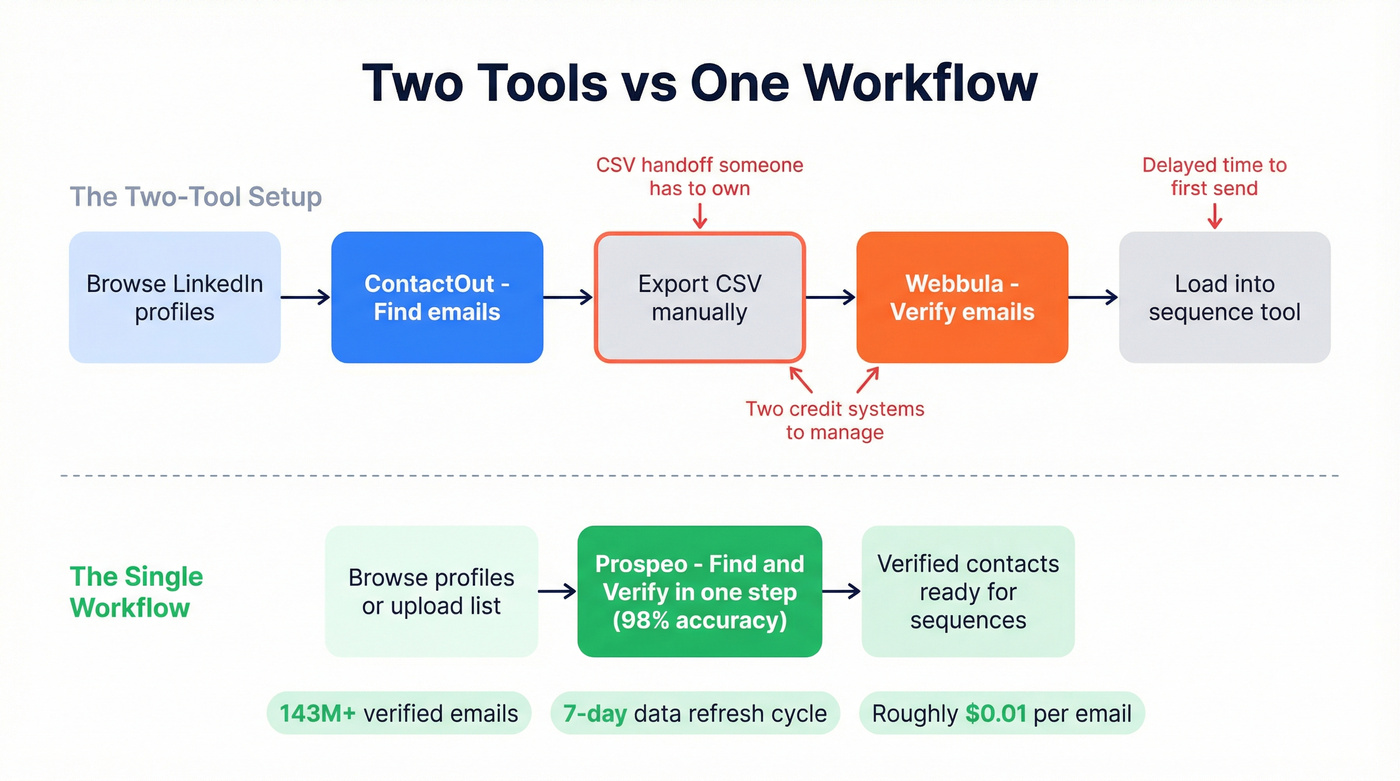
Pricing is self-serve and credit-based at roughly $0.01 per email, with no contracts. There's a free tier that includes 75 emails plus 100 Chrome extension credits per month - enough to test it in a real prospecting week. For teams weighing ContactOut vs Webbula, this often eliminates the need for both tools by collapsing the find-then-verify workflow into a single step. Stack Optimize, for example, built from $0 to $1M ARR using this approach while maintaining 94%+ deliverability and under 3% bounce rates across all clients.

Stack Optimize hit $1M ARR with under 3% bounce rates and zero domain flags - using one platform instead of stitching together a finder and a verifier. Prospeo refreshes data every 7 days and verifies every email before export. Free tier includes 75 emails/month.
Stop managing two credit systems for one workflow.
FAQ
Can I use ContactOut and Webbula together?
Yes - a common setup is finding emails with ContactOut, exporting the list, then running it through Webbula before sending. It works, but it's two tools, two credit systems, and a CSV or API handoff someone has to own.
Is there a free option for either tool?
ContactOut's free trial includes 40 emails per year. Webbula offers 100 free hygiene credits. Prospeo's free tier gives you 75 emails plus 100 Chrome extension credits per month, making it the most usable free option for teams running real campaigns.
What's the difference between email finding and email verification?
Finding answers "what's the email for this person?" Verification answers "is this email safe and deliverable?" Finders optimize for coverage and speed; verifiers optimize for risk reduction. Most outbound teams need both - either as separate tools or through a platform that handles both steps natively.
Which tool is best for protecting domain reputation?
Webbula excels at deep list hygiene with SOC 2 certification and spam-trap detection. That said, the most effective protection comes from never loading unverified emails in the first place. Pre-verified emails at 98% accuracy mean fewer risky addresses enter your sequences, which is a fundamentally different approach than cleaning up after the fact.