

The Best Conversation Intelligence Platforms for 2026
Your sales manager swears reps aren't following the talk track, but you can only review about 3% of calls manually. Meanwhile, the CI vendor wants a two-year contract and nobody on your team can tell you what year-one actually costs. The conversation intelligence platform category now has 167 listings on G2 - and weighted scoring across 12 tools in different categories is meaningless. A contact center QA tool and a meeting note-taker shouldn't share the same rubric.
This guide sorts the market into lanes, attaches real pricing where vendors won't, and gives you a 14-day pilot scorecard so you don't pick the wrong tool.
Our Picks (TL;DR)
Best for sales teams: Gong. Deal intelligence, pipeline analytics, and real-time coaching in one platform. Expect ~$28,500 year-one for 10 users (platform fee + seats + mandatory onboarding). Expensive, but it's the benchmark for a reason.
Best for contact centers: Calabrio. Automated QA, compliance redaction, and omnichannel analytics built for teams running hundreds of agents. Estimate $50K-$150K+ annually depending on agent count.
Best free starting point: Fathom. A lightweight meeting assistant with a genuinely strong free tier. It's not full CI, but it's where many teams discover they need it.
What Is Conversation Intelligence?
Conversation intelligence goes beyond recording calls. G2 defines the category as software that records, transcribes, and analyzes sales conversations to surface buyer intent, deal risks, competitor mentions, and coaching opportunities. The key distinction from AI note-taking apps: CI doesn't just capture what was said - it identifies patterns across hundreds or thousands of conversations and turns them into actionable revenue insights.
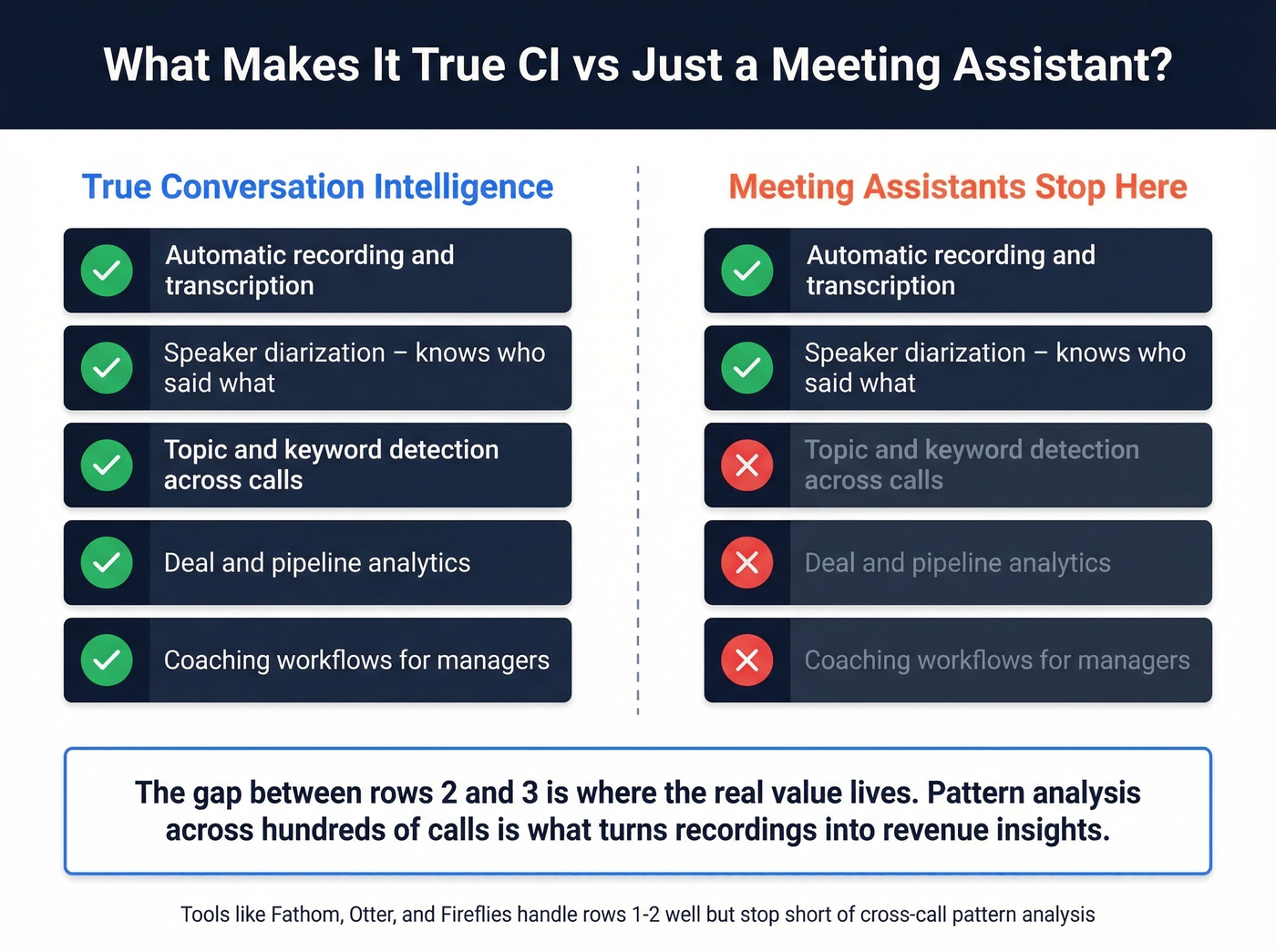
A tool qualifies as true CI if it checks these boxes:
- Automatic recording and transcription across calls, video meetings, and sometimes email/chat
- Speaker diarization - knowing who said what
- Topic and keyword detection - tracking competitor mentions, pricing objections, feature requests
- Deal and pipeline analytics - aggregating conversation signals into forecasting data
- Coaching workflows - surfacing coachable moments for managers without manual review
AI meeting assistants like Fathom, Otter, and Fireflies handle the first two well. They stop short of the pattern analysis, deal intelligence, and revenue insights that define the CI category. With 167 tools listed, the biggest mistake buyers make is comparing tools from completely different lanes.
Pick Your Lane First
Most "best CI" lists throw Gong, CallMiner, and Otter into the same ranking and pretend they're interchangeable. They're not. Before you evaluate any tool, figure out which lane you're in.
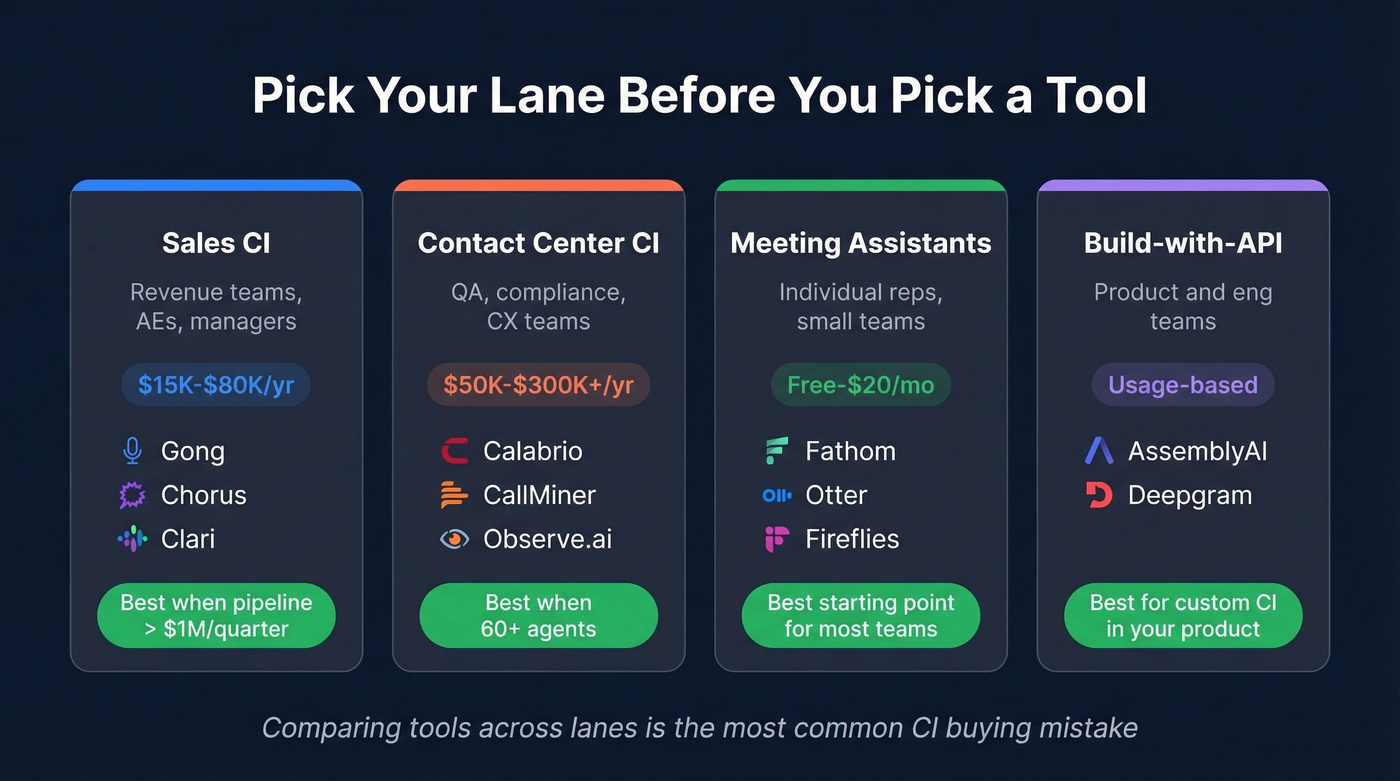
| Lane | Best for | Budget range | Example tools | When to upgrade |
|---|---|---|---|---|
| Sales CI | Revenue teams, AEs, managers | $15K-$80K/yr | Gong, Chorus, Clari | Pipeline > $1M/quarter |
| Contact Center CI | QA, compliance, CX teams | $50K-$300K+/yr | Calabrio, CallMiner, Observe.ai | 60+ agents |
| Meeting Assistants | Individual reps, small teams | Free-$20/mo | Fathom, Otter, Fireflies | Need cross-call analytics |
| Build-with-API | Product/eng teams | Usage-based | AssemblyAI, Deepgram | Custom CI in your product |
Sales CI platforms are built around deal outcomes. They connect conversation data to pipeline stages, forecast accuracy, and rep performance. If your primary question is "why are we losing deals?" - this is your lane.
Contact Center CI focuses on QA automation, compliance, and agent performance at scale. These tools process thousands of interactions daily and care about CSAT, average handle time, and regulatory adherence. Completely different buying criteria from sales CI.
Meeting Assistants are where most teams start. They're lightweight, often free, and solve the immediate problem of "I need notes from this call." But they don't analyze patterns across your pipeline.
Build-with-API is for teams embedding CI into their own product - a different article entirely.
We deliberately excluded niche players like Jiminny, Avoma, Salesken, and Dialpad. They're solid tools but don't offer enough differentiation from the leaders in each lane to warrant separate coverage.
Best Sales CI Platforms
Sales CI is the most crowded lane and the one where pricing gets most opaque. These tools live or die on their ability to connect conversation signals to revenue outcomes.
Gong
Use this if you want the deepest deal intelligence in the market and can stomach the year-one investment. Gong's pipeline analytics, real-time coaching, and cross-call pattern detection are best-in-class. The 4.8/5 rating across 6,500+ G2 reviews isn't an accident.
Skip this if you have fewer than 10 reps or your annual software budget is under $30K.

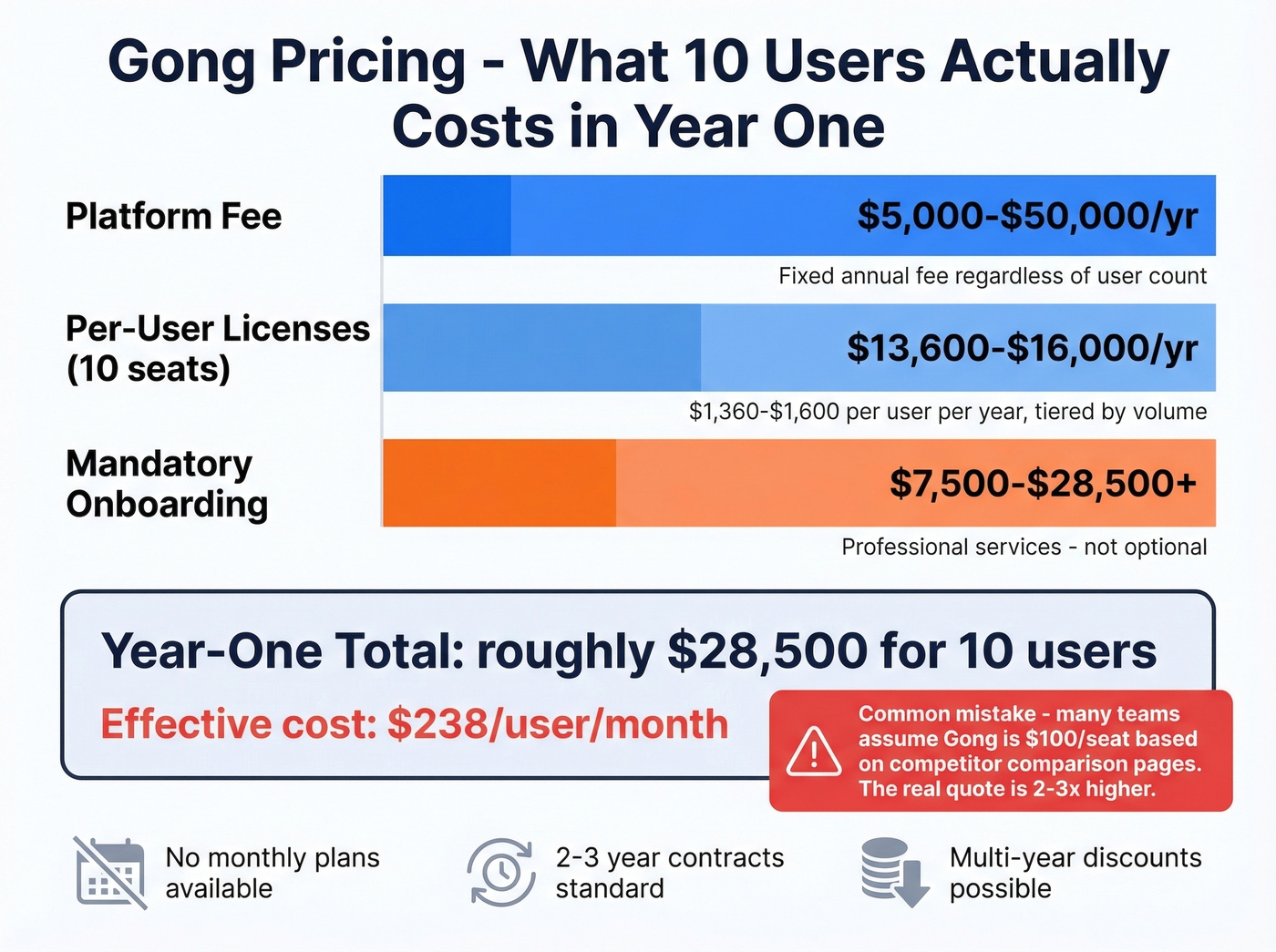
Gong won't put pricing on their website, so here it is. It's a three-part structure: annual platform fee ($5,000-$50,000), per-user licenses ($1,360-$1,600/user/year, tiered by volume), and mandatory professional services ($7,500-$28,500+). For a 10-user team on the Starter tier, year-one runs about $28,500 - an effective $238/user/month. Multi-year contracts of 2-3 years are standard, with no monthly plans available.
We've talked to teams who assumed Gong was "$100 a seat" based on a competitor's comparison page. The sticker shock when they got the actual quote was real. Know the three-part structure going in and you'll negotiate better.
Chorus (ZoomInfo)
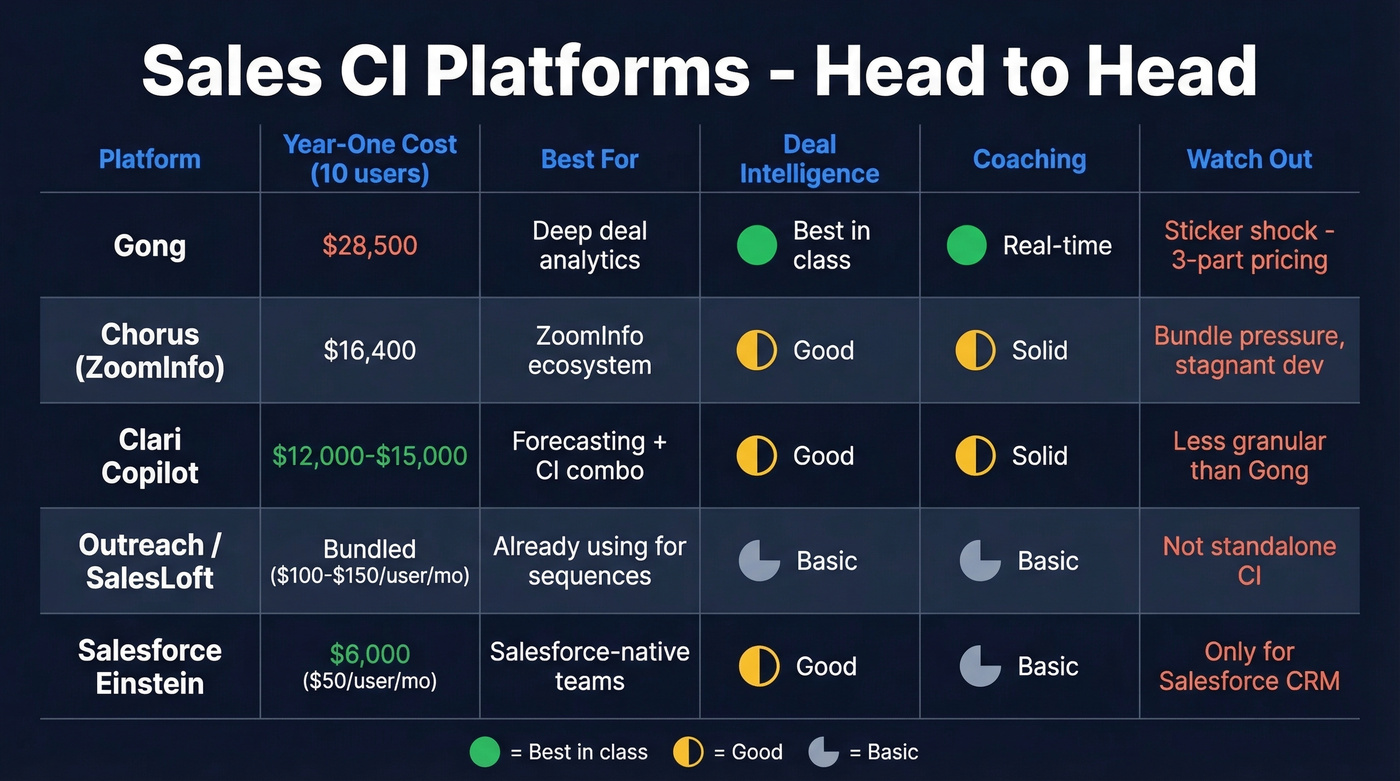
Use this if you're already deep in the ZoomInfo ecosystem and want CI bundled into your existing contract. Chorus's base package runs $8,000/year and includes 3 seats, with additional seats at $1,200/year each. A 10-user deployment lands around $16,400/year - roughly half of Gong's year-one cost.
Skip this if you want a CI tool that's actively innovating. Chorus development has a reputation for stagnating post-acquisition, and teams commonly switch to alternatives after renewal cycles. You also can't buy single seats - the minimum is that 3-seat base package, and contracts typically lock you in for two years.
The real cost trap is bundle pressure. ZoomInfo reps will push Chorus + ZoomInfo packages ranging from $35K-$50K/year on the low end and $60K-$80K/year on the high end for a 10-user bundle. The "cheaper" CI tool can end up costing more if you're not careful about what you're actually signing.
Clari Copilot
The pitch: CI and revenue forecasting in one platform. Clari Copilot (formerly Wingman) sits at $1,200-$1,500/user/year and combines conversation analytics with pipeline forecasting and deal inspection. For revenue leaders who care as much about forecast accuracy as rep coaching, it's a compelling single-vendor play. If you're already using Clari for forecasting, adding Copilot is a natural extension.
The trade-off is analytics depth. Clari's CI features are solid but not as granular as Gong's - the strength is the revenue intelligence wrapper, not standalone conversation analysis.
Outreach / SalesLoft
Both platforms now include CI features - call recording, transcription, and basic analytics - within their sales engagement suites. If you're already running sequences through Outreach or Salesloft, their built-in CI handles basic call review. Pricing is bundled into their platform tiers, typically $100-$150/user/month. Don't buy a separate CI tool if your engagement platform already covers 80% of what you need.
Salesforce Einstein Conversation Insights
Native CRM CI at $50/user/month billed annually, or $100/user/month for the Sales Programs bundle. The advantage is obvious: zero integration friction with Salesforce. Conversation data flows directly into opportunity records, dashboards, and reports. The limitation is equally obvious - it only makes sense if Salesforce is your CRM, and the analytics depth doesn't match Gong or Clari.
Best Contact Center CI Tools
Contact center CI is a different animal. Platforms in this lane process thousands of interactions daily, automate QA scoring, and handle compliance requirements that sales CI tools don't touch.
Calabrio
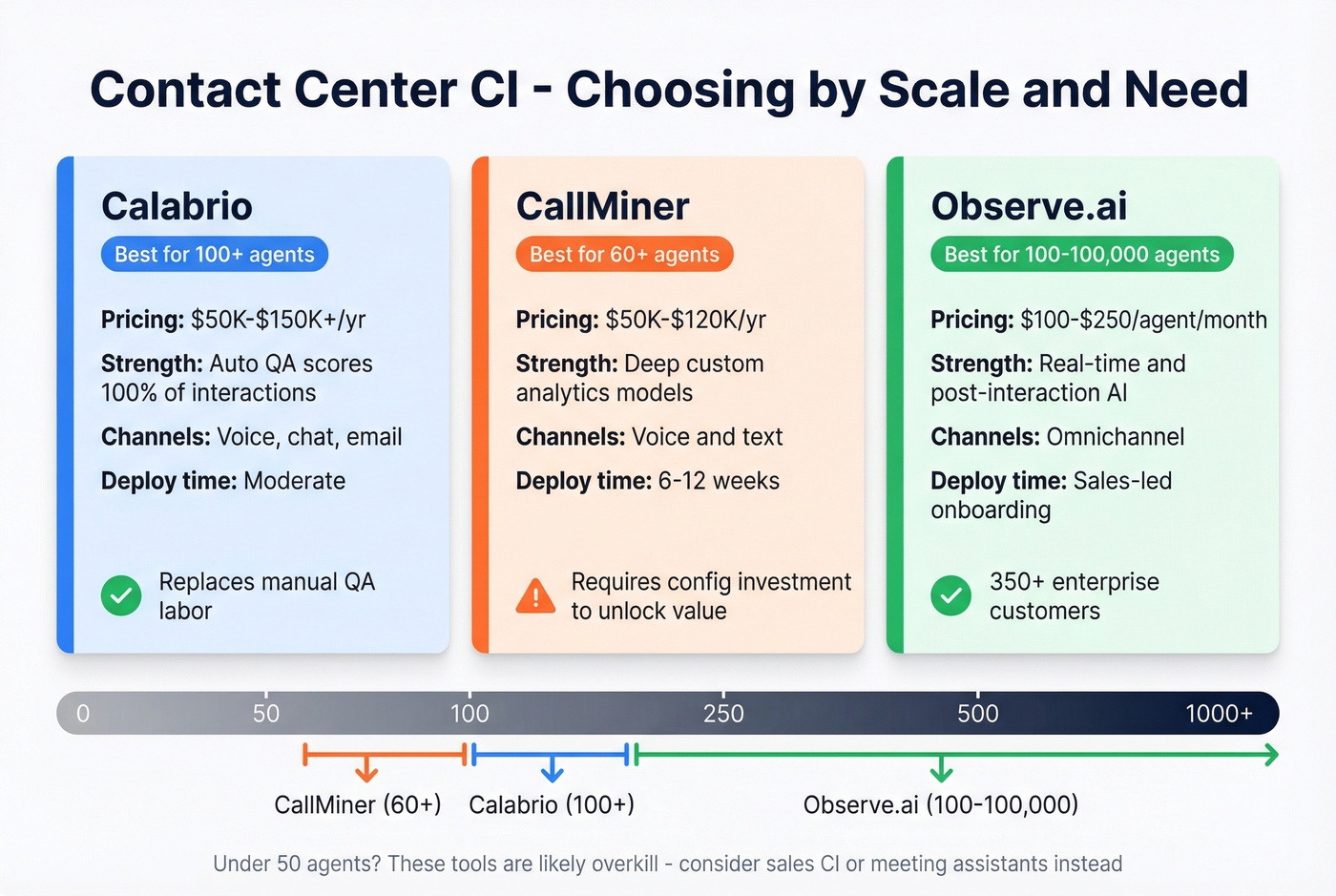
Use this if you're running a contact center with 100+ agents and want to automate QA at scale. Calabrio's Auto QA can score up to 100% of interactions against custom scorecards - replacing the manual process where supervisors listen to a handful of calls per agent per month. That shift alone justifies the investment for most operations.
Skip this if you have fewer than 50 agents or your primary need is sales deal intelligence. Calabrio is purpose-built for contact center operations: compliance redaction, omnichannel analytics across voice, chat, and email, and workforce management integration.
Pricing is enterprise and sales-led - expect $50K-$150K+ annually depending on agent count and modules. The ROI case is straightforward: if you're paying QA analysts to manually score calls, Calabrio replaces that labor with AI that scores every interaction consistently.
CallMiner
Enterprise-grade interaction analytics across voice and text channels. CallMiner's pricing is based on user count or interaction volume, with packages bundled by analytics modules, integrations, and deployment model. Expect $50K-$120K annually for a mid-size deployment. The minimum viable deployment is typically 60+ agents.
Implementation takes 6-12 weeks, and the platform rewards teams that invest in configuring custom analytics models. CallMiner is recognized in the Forrester Wave for Conversation Intelligence Solutions for Contact Centers - it's powerful, but not quick to deploy.
Observe.ai
An enterprise contact center platform scaling from 100 to 100,000 agents with both real-time and post-interaction AI. Observe.ai serves 350+ customers with modules spanning live agent assist, automated QA, and coaching workflows. All tiers are sales-led - estimate $100-$250/agent/month depending on modules and volume. Under 100 agents? This isn't your tool.

Conversation intelligence shows you which deals are at risk. But the best CI platform in the world can't help if your reps are reaching the wrong people. Prospeo's 300M+ profiles with 30+ filters - including buyer intent and job changes - ensure every conversation starts with a verified decision-maker.
Feed your CI tool conversations worth analyzing.
Meeting Assistants (Gateway CI)
These aren't full CI platforms, but they're where many teams start - and for good reason. If you've never recorded and reviewed calls systematically, a meeting assistant gets you 80% of the value at 0% of the cost.
Here's the thing: if your average deal size is under $10K and your team has fewer than 15 reps, you probably don't need a full-blown CI solution. Start with Fathom, build the habit of reviewing calls, and upgrade when you have enough pipeline volume that manual review becomes impossible.
Fathom
A Reddit deep-dive into 25 AI note-taking apps called Fathom's free plan "shockingly good" - and that tracks with our experience. It's a fast way to start recording calls, generating summaries, and building the habit of call review before you graduate to full CI.
The downsides are real but minor: the bot announces when it joins and leaves meetings, and timestamps can drift on longer calls. These are annoyances, not dealbreakers. Fathom is the obvious starting point for any team that hasn't committed to enterprise CI yet.
Fireflies.ai
The free plan is very limited - you'll hit caps quickly. The UI is clunky and processing slows down on longer meetings. Worth a look if Fathom doesn't integrate with your video platform, but it's not our first recommendation. Paid plans from ~$10/user/month.
Otter.ai
Strong transcription accuracy and a clean UI. The frustrations: a 30-minute cap on the free plan and English-only support. If your team runs international calls, that's a hard limitation. Paid plans from ~$17/user/month.
Pricing Reality
If a vendor won't give you pricing ranges on their website, assume enterprise spend. Salesforce is the transparency benchmark here - $50/user/month, published, done. Everyone else makes you talk to sales.
| Tool | Pricing model | Starting range | 10-user yr-1 est. | Contract terms |
|---|---|---|---|---|
| Gong | Platform + seat + services | ~$28.5K (10 users) | $28,500 | 2-3 yr, annual |
| Chorus | Base pkg + seat | $8K/yr (3 seats) | ~$16,400 | 2 yr typical |
| Clari Copilot | Per-seat | $1,200-$1,500/user/yr | ~$12K-$15K | Annual |
| Calabrio | Enterprise, sales-led | $50K-$150K+/yr | N/A (agent-based)* | Annual |
| CallMiner | Volume or user-based | $50K-$120K/yr | N/A (60+ agents)* | Annual |
| Observe.ai | Per-agent, sales-led | ~$100-$250/agent/mo | N/A (100+ agents)* | Annual |
| Fathom | Freemium + per-seat | Free tier available | N/A | Monthly available |
| Salesforce Einstein | Per-seat | $50/user/mo | $6,000 | Annual |
| Outreach/Salesloft | Bundled in platform | ~$100-$150/user/mo | ~$12K-$18K | Annual |
*Contact center tools are priced per agent, not per user seat - 10-user estimates don't apply.
The biggest hidden cost across all these platforms is mandatory professional services. Gong charges $7,500-$28,500+ just for onboarding. Always ask for the all-in first-year number before you compare.
Accuracy - What Vendors Won't Tell You
Every CI demo sounds perfect because demos aren't your messy, real-world calls. A systematic review of 29 studies from clinical and conversational settings found that word error rates range from 0.087 in controlled dictation to over 50% in multi-speaker scenarios. That's not a typo - some transcription engines get more than half the words wrong when people talk over each other.
Here's how the underlying transcription engines compare on published benchmarks:
| Engine | WER (clean audio) | WER (noisy audio) |
|---|---|---|
| AssemblyAI Universal | 4.2% | 8.5% |
| Deepgram Nova-3 | 4.8% | 9.2% |
| Whisper large-v3 | 5.0% | 12.0% |
| Fireflies.ai | 5.5% | 11.0% |
| Otter.ai | 7.0% | 15.0% |
The WER bands to know: below 5% is excellent, 5-10% is good, and above 20% needs work. Most CI vendors don't disclose which transcription engine they use or publish their own WER numbers. That's by design.
Test these scenarios in your pilot - don't trust the demo:
- Accented speakers, both regional and non-native
- Crosstalk and interruptions
- Speakerphone recordings and poor-quality audio
- Industry-specific jargon and acronyms
- Background noise from open offices and coffee shops
The gap between "clean audio" and "your actual calls" is where CI tools either deliver value or create frustration. Insist on testing with your real recordings.
How to Choose: The 14-Day Pilot Scorecard
Don't sign a multi-year contract based on a demo. Run a structured 14-day pilot.
Start by pulling 50+ real calls spanning different scenarios - discovery calls, demos, negotiations, support interactions. Include your worst audio quality, not just your best. Mix in accented speakers and multi-participant meetings.
Score each tool across five dimensions:
- Transcription accuracy - Spot-check 10 calls manually. Count errors per 100 words. Anything above 10% WER on your actual calls is a red flag.
- Speaker diarization - Can the tool correctly identify who said what? Test with 3+ participants.
- CRM field mapping - Do conversation insights flow into the right opportunity fields? Test with 5 real deals.
- Keyword and topic detection - Set up 10 custom topics (competitor names, pricing objections, feature requests). Measure detection accuracy.
- Redaction - If you handle sensitive data, test PII and payment card redaction on real examples.
Before go-live, run through the governance checklist. This is non-negotiable:
- Data retention policy configured and documented
- Consent workflow for recording in two-party consent states and GDPR jurisdictions
- SOC 2 Type II certification confirmed
- LLM training opt-out verified in writing
- Admin controls for data access and export
- GDPR data processing agreement signed
We've seen teams skip governance and regret it six months later when legal gets involved. Do it upfront.
Complete the Stack - Data Quality
Here's a pattern we see repeatedly: a team invests $30K+ in conversation intelligence, gets beautiful analytics on call performance, and then realizes their connect rates are terrible because they're dialing bad numbers and emailing invalid addresses. CI optimizes what happens during conversations. It can't fix who you're calling.

Pricing is self-serve and transparent - roughly $0.01 per email, no annual contracts. The free tier gives you 75 verified emails per month to test. Native integrations with Salesforce, HubSpot, Smartlead, Instantly, and Lemlist mean your verified contacts flow directly into sequences without manual export.
If you're rebuilding your prospecting foundation, start with a B2B database and layer in data enrichment so your CI insights map to the right accounts.
You're about to spend $15K-$80K/year on sales CI. Make sure the pipeline it's analyzing is built on accurate data. Prospeo delivers 98% email accuracy at $0.01/lead - 90% cheaper than ZoomInfo - so your reps book 26% more meetings before CI even enters the picture.
Don't optimize bad pipeline. Start with better data.
How to Measure CI ROI
CI vendors love throwing around ROI numbers. Let's ground them in reality. Based on published benchmarks from AssemblyAI and cross-referenced with what we've observed in deployments:
| Metric | Typical improvement | Timeline |
|---|---|---|
| Win rates | +15-25% | 2-3 months |
| Manual review time | -90% | 4-6 weeks |
| CSAT scores | +20-30% | 3-4 months |
These ranges are directional, not guaranteed. The teams that hit the high end share a common trait: clean inputs. Deloitte's 2025 AI Survey found that 91% of organizations plan to increase AI spending, but 25% cite inadequate infrastructure and data as the primary barrier to AI ROI. Conversation intelligence is no exception.
Before you can measure CI ROI, you need these inputs in order:
- Recording quality - Are calls being captured clearly? Poor audio means poor transcription means poor insights.
- CRM hygiene - Do opportunities have the right stages, amounts, and close dates? CI analytics are only as good as the pipeline data they connect to. Tighten this with CRM automation.
- Consent workflows - Are you legally recording in all jurisdictions where you operate? If you're operating in regulated markets, align with a B2B compliance checklist.
- Taxonomy - Have you defined the topics, competitors, and objections you want to track? This gets easier when you standardize sales battle cards.
- Contact data quality - If reps are calling wrong numbers and emailing invalid addresses, your CI tool has nothing useful to analyze. Fix this first with an email verifier and a verified contact database.
Without these foundations, CI ROI is unmeasurable. The tool will generate dashboards, but the dashboards won't mean anything.
FAQ
Is a conversation intelligence platform the same as call recording?
No. Call recording captures audio - that's one input. CI adds transcription, speaker identification, topic detection, coaching insights, deal-risk alerts, and CRM automation on top of that recording. Recording is the foundation; CI is the intelligence layer built on it.
Do I need CI with fewer than 10 reps?
Yes, if you can't manually review every call. Even small teams benefit from automated coaching moments and deal-risk alerts. Start with Fathom's free plan and upgrade to Gong or Clari when pipeline volume justifies the investment.
How long does implementation take?
Sales CI tools like Gong and Chorus typically deploy in 2-4 weeks - calendar integrations, CRM connections, and initial topic configuration. Contact center platforms like CallMiner and Observe.ai take 6-12 weeks due to compliance requirements and custom QA scorecards.
What's the biggest hidden cost?
Mandatory onboarding and professional services. Gong charges $7,500-$28,500+ on top of license fees. Chorus locks you into 2-year contracts with early termination penalties of 50-100% of remaining value. Always ask for the full first-year cost before comparing per-seat prices.
Can CI improve outbound connect rates?
CI optimizes what happens during calls - talk tracks, objection handling, competitive positioning. Connect rates depend on upstream data quality. Pairing CI with a verified data source like Prospeo closes the loop: 98% email accuracy and 30% mobile pickup rates mean more live conversations for your CI tool to analyze and learn from.