

Cost Per User Acquisition: Benchmarks, Formulas, and How to Actually Reduce It
Your cost per user acquisition went up last year. You know it, your CFO knows it, and the board deck you're building this quarter needs a better answer than "market conditions." CAC jumped 40-60% between 2023 and 2025 across most paid channels, and the teams that can't explain why - or segment where - are the ones getting their budgets cut.
Most companies are calculating this metric wrong. Not slightly wrong. Structurally wrong, in ways that poison every downstream decision from channel allocation to hiring to pricing.
The Quick Version
Definition: Cost per user acquisition is the total spend required to acquire one new paying customer or user.
The formula:
CAC = Total Sales & Marketing Spend / Number of New Customers Acquired
2026 benchmark range: $86 for B2B ecommerce to $1,143 for education, with B2B SaaS landing around $239 blended.
The ratio that matters: LTV:CAC of 3:1 to 4:1 is the sweet spot. Around 2:1 needs work. At 1:1 or lower, you're burning cash. At 8:1+, you're underinvesting in growth.
The single biggest insight: Blended CAC is useless. Segment by channel, customer type, and geography - or you're making decisions with a number that hides more than it reveals.
The lever most teams miss: Fix your data before you fix your ads. Bad contact data silently inflates outbound CAC by 30-40%.
CPI vs CPA vs CPL vs CAC
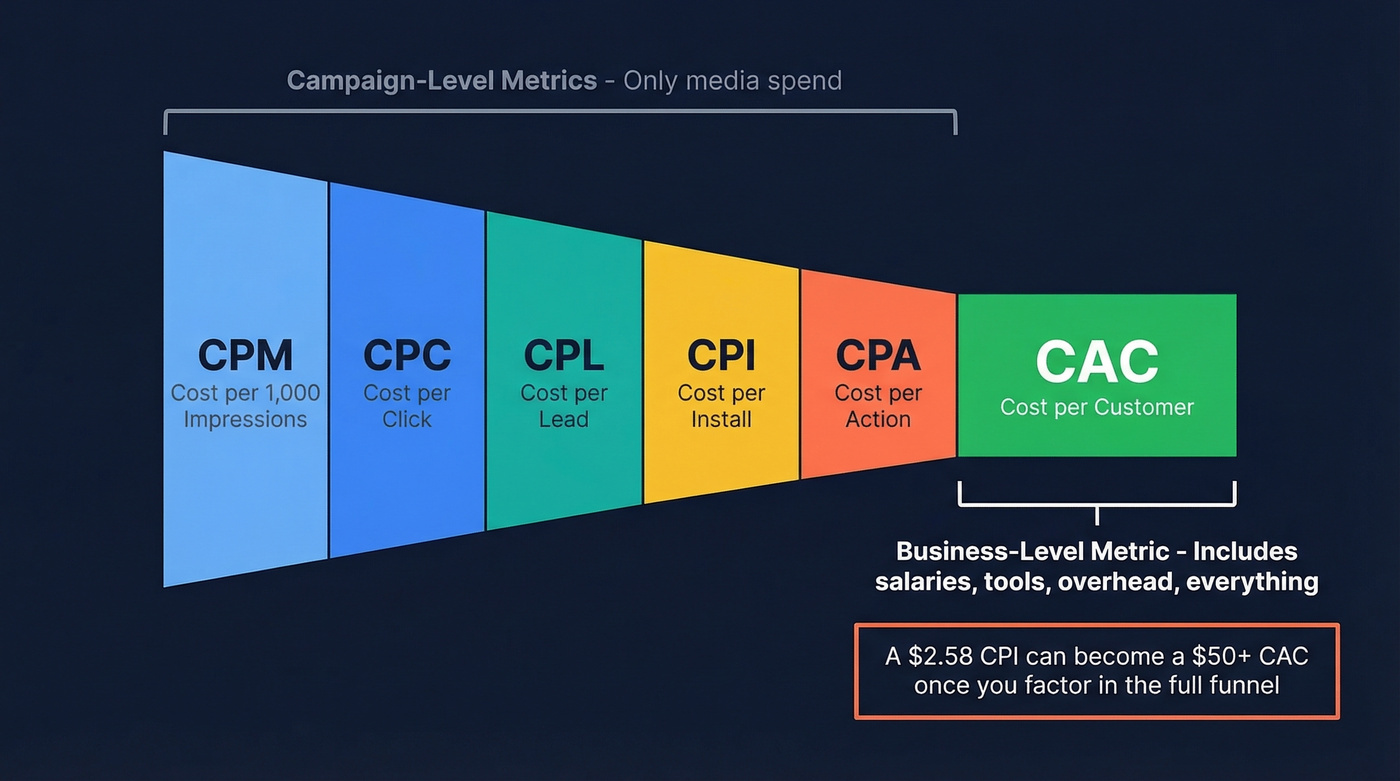
These acronyms get thrown around interchangeably. That's how teams end up comparing apples to aircraft carriers.
| Metric | What It Measures | Scope | Typical Use |
|---|---|---|---|
| CPM | Cost per 1,000 impressions | Media buy | Brand awareness |
| CPC | Cost per click | Media buy | Paid search, display |
| CPL | Cost per lead | Campaign | Demand gen, forms |
| CPI | Cost per install | Campaign | Mobile apps |
| CPA | Cost per action | Campaign | Specific conversion |
| CAC / UAC | Cost per customer | Business | Full acquisition cost |
A note on terminology: UAC - user acquisition cost - is the same concept as CAC, just more common in mobile and gaming contexts. If you're searching for this metric, you're asking the CAC question regardless of which acronym your team uses.
The critical distinction is scope. CPA and CPI are campaign-level metrics that typically include only media spend. CAC is a business-level metric that should include salaries, tools, overhead - everything it takes to turn a stranger into a paying customer.
Apple Search Ads average CPA is $2.58, but only a fraction of those installs convert to paying users. A $2.58 CPI can easily become a $50+ CAC once you factor in the full funnel. CPI is also where fraud risk is highest - Singular flags incentivized installs and bot farms as persistent problems in mobile acquisition.
How to Calculate Acquisition Cost
The Simple Formula
CAC = Total Sales & Marketing Spend / New Customers Acquired
One line. The devil is in what you include in "total spend."
The Full-Stack Calculation
Most CAC calculations are wrong because they only count ad spend. Here's what a realistic calculation looks like for a B2B SaaS company that acquired 200 customers last quarter:
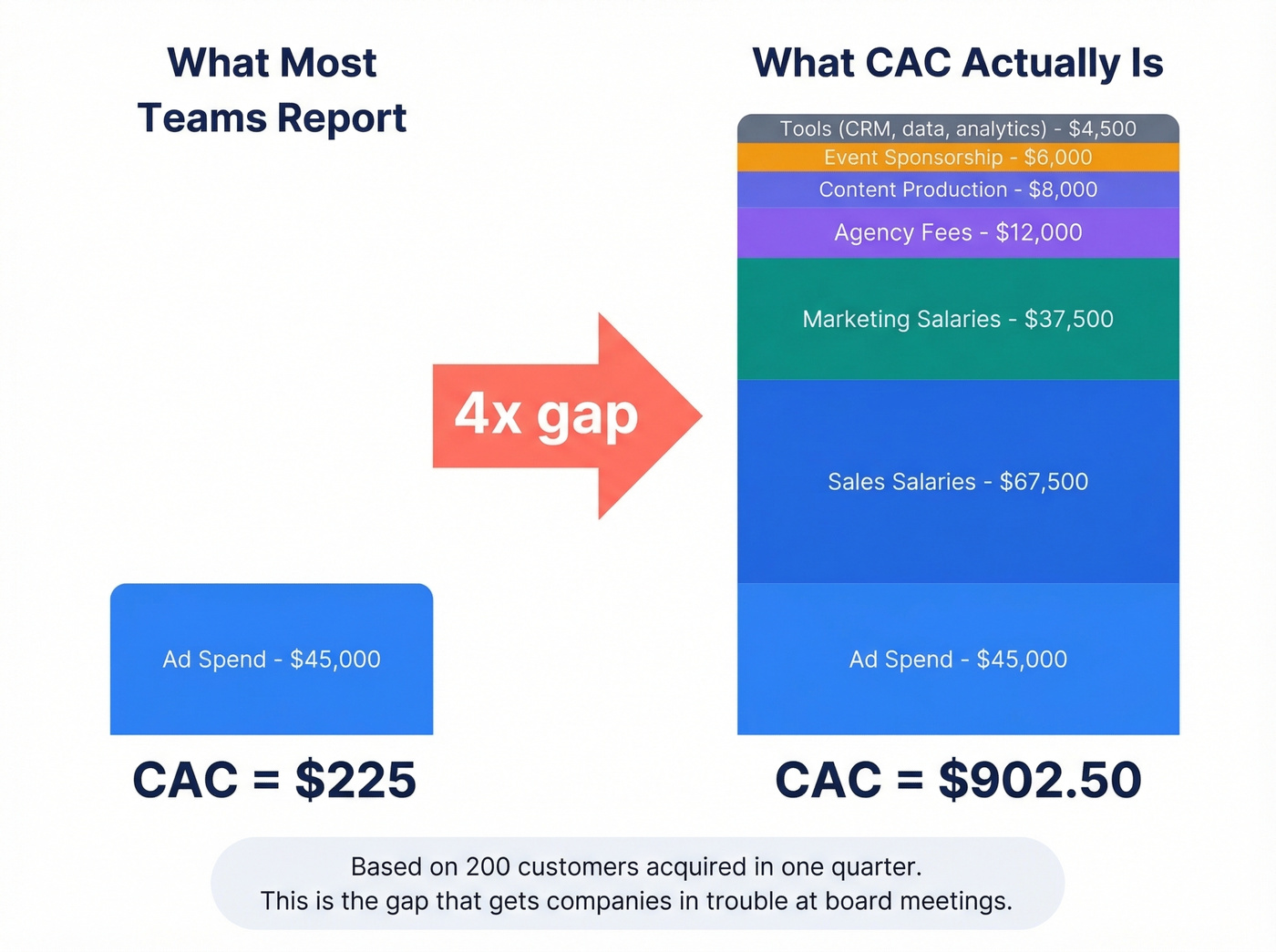
- Ad spend - Google, Meta, LinkedIn: $45,000
- Sales team salaries - 3 reps, prorated: $67,500
- Marketing team salaries - 2 people, prorated: $37,500
- Tools - CRM, sequencer, data platform, analytics: $4,500
- Agency fees: $12,000
- Content production: $8,000
- Event sponsorship: $6,000
Total: $180,500 / 200 customers = $902.50 CAC
If you'd only counted ad spend, you'd have reported $225. That's a 4x gap - and it's the gap that gets companies in trouble when the board starts asking harder questions.
The common mistakes are predictable: excluding salaries, ignoring tool costs, and forgetting the time lag between when you spend and when the customer actually converts. In B2B, that lag can be 3-6 months, which means this quarter's spend is producing next quarter's customers.
2026 Benchmarks by Industry and Channel
Benchmarks are directional, not prescriptive. Your numbers depend on your market, motion, and maturity. But you need a reference point.
B2B CAC by Industry
Data from First Page Sage's January 2026 report, covering clients from 2022-2025:
| Industry | Organic CAC | Inorganic CAC | Blended CAC |
|---|---|---|---|
| B2B eCommerce | $87 | $81 | $86 |
| B2B SaaS | $205 | $341 | $239 |
| Cybersecurity | $345 | $512 | $387 |
| Financial Services | $644 | $1,202 | $784 |
| Legal Services | $584 | $1,245 | $749 |
| Education | $862 | $1,985 | $1,143 |
The blended figures are weighted 75% organic / 25% inorganic, reflecting First Page Sage's client mix. If your mix is 50/50 or paid-heavy, your blended number will be higher. Self-serve SaaS products typically run $100-$200 CAC; enterprise motions with 3-6 month sales cycles can hit $800-$1,500.
Average CAC by Channel
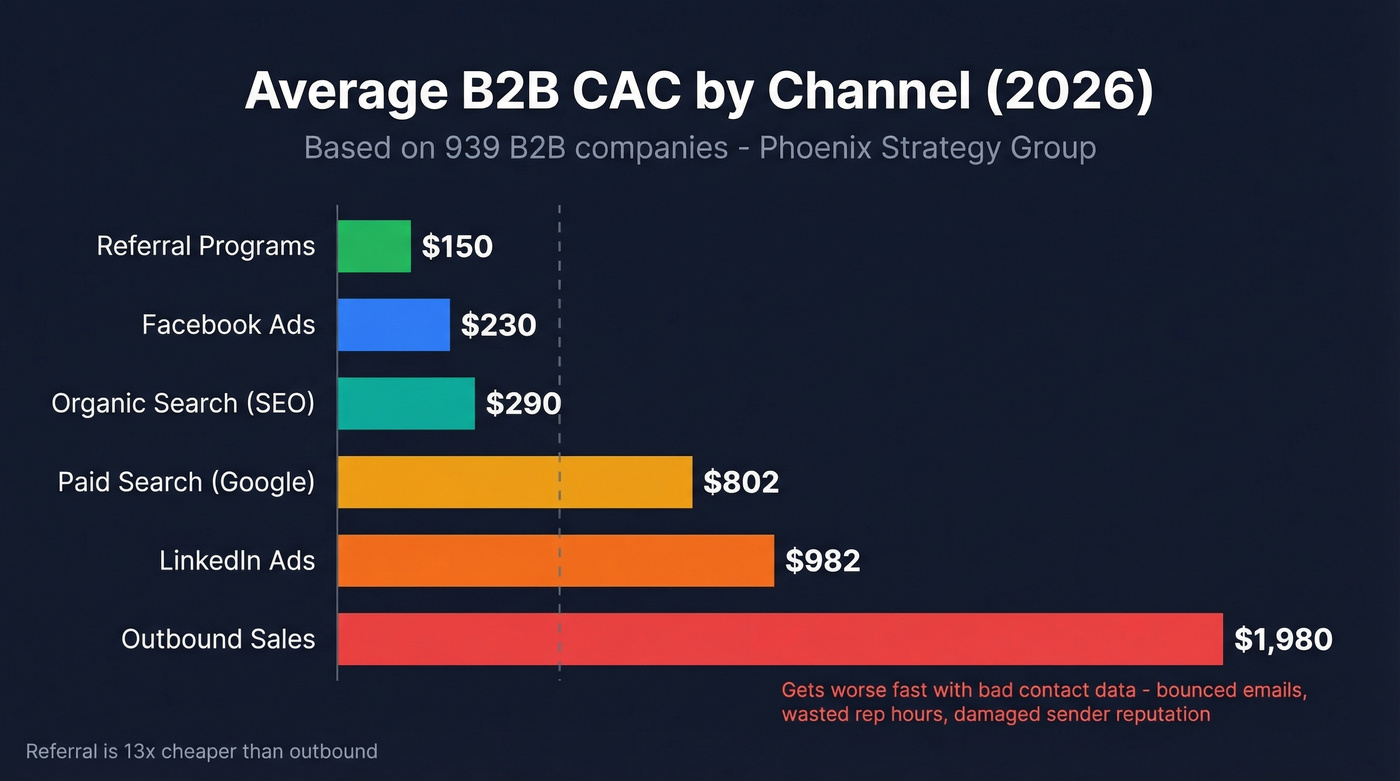
From Phoenix Strategy Group's benchmark study of 939 B2B companies:
| Channel | Avg B2B CAC |
|---|---|
| Referral programs | $150 |
| Facebook Ads | $230 |
| Organic Search (SEO) | $290 |
| Paid Search (Google) | $802 |
| LinkedIn Ads | $982 |
| Outbound sales | $1,980 |
Referral is the cheapest channel by a wide margin. Outbound is the most expensive - and that number gets worse fast when your contact data is bad. Outbound costs can balloon well past $2,000 when you factor in bounced emails, wasted rep hours, and damaged sender reputation.
Mobile App CPI Benchmarks
| Segment | CPI |
|---|---|
| iOS (global avg) | $5.11 |
| Android (global avg) | $4.61 |
| Gaming | $4.83 |
| Fintech | $2.50-$6.00 |
| Facebook Ads | $2.09 |
| Instagram Ads | $1.75-$4.50 |
| US market | $2.50-$5.00 |
| EMEA market | $1.75-$4.50 |
| Latin America | $0.50-$2.00 |
Sources include Mapendo, Liftoff, and Adjust as aggregated by Business of Apps. Remember: CPI isn't CAC. These are install costs, not paying-customer costs.

You just saw it: outbound CAC averages $1,980 - and bad data makes it worse. Every bounced email is wasted rep time, damaged sender reputation, and inflated acquisition cost. Prospeo delivers 98% email accuracy with 5-step verification at $0.01 per email, so your outbound spend actually converts.
Cut your outbound CAC by fixing the data that feeds it.
Why Acquisition Costs Keep Rising
Four forces are driving this, and none are reversing.
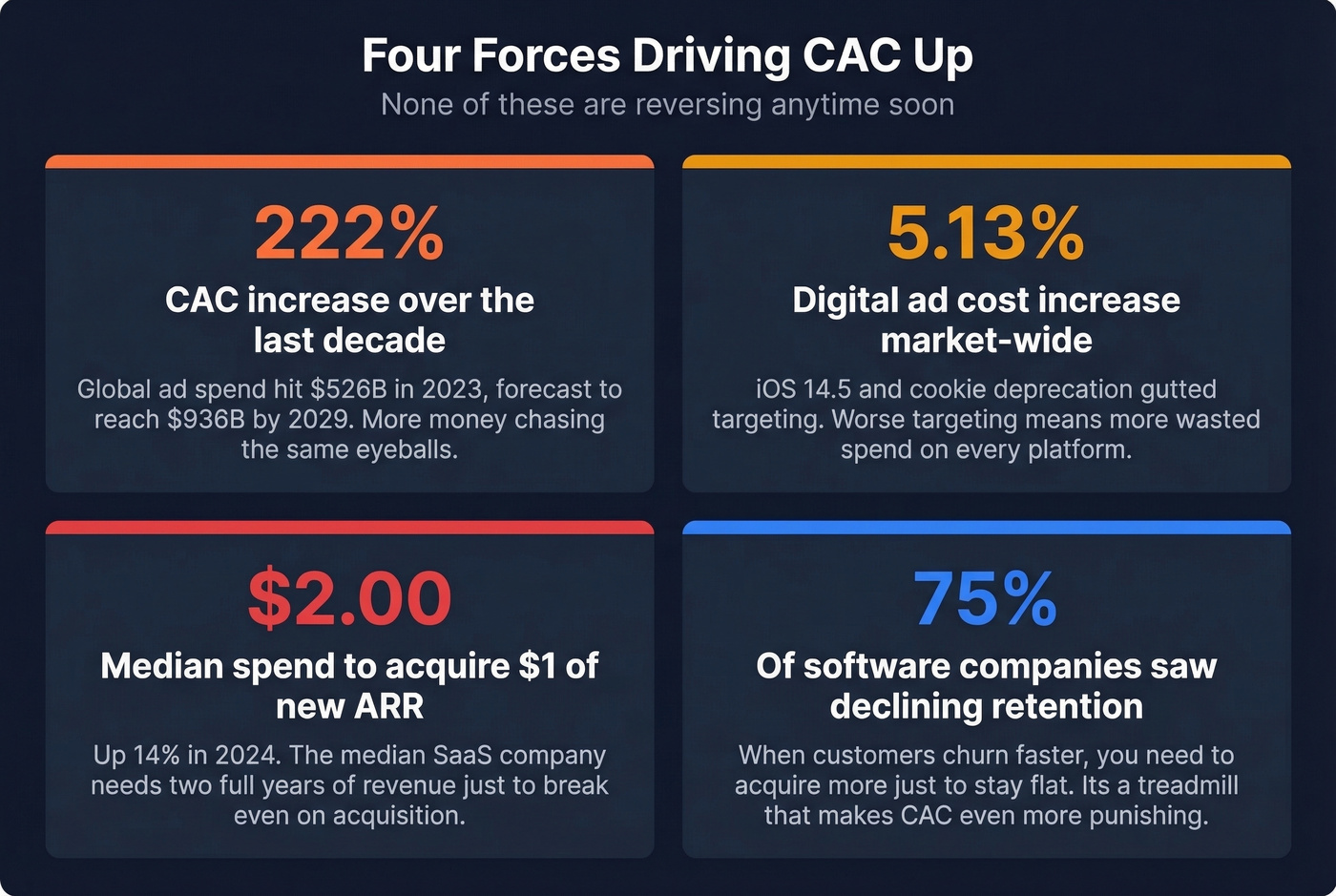
Global digital ad spend hit $526B in 2023 and is forecast to reach $936B by 2029. More money chasing the same eyeballs means higher auction prices across every platform - digital ad costs are up 5.13% market-wide. Zooming out further, SimplicityDX estimates CAC surged 222% over the last decade.
Privacy changes made everything harder. iOS 14.5 and ATT gutted mobile attribution. Cookie deprecation is fragmenting web tracking. The result: worse targeting, more wasted spend, and attribution models that can't tell you which channel actually drove the conversion.
SaaS efficiency is declining too. The median New CAC Ratio - how much you spend to acquire $1 of new ARR - rose 14% in 2024 to $2.00. Fourth-quartile companies are spending $2.82 for every dollar of new revenue. That $2.00 ratio deserves more attention than it gets: it means the median SaaS company needs two full years of a customer's revenue just to break even on acquisition.
Retention is getting worse at the same time. 75% of software companies reported declining retention in 2024. When customers churn faster, you need to acquire more just to stay flat - a treadmill that makes CAC feel even more punishing. The recurring frustration on r/sales and r/startups is the same: Meta CPMs are up, attribution is broken post-privacy changes, and the only reliable levers left are creative testing and retention.
Your Average CAC Is Lying
Here's a scenario we've seen play out dozens of times. A VP of Marketing reports a $200 blended CAC to the board. Sounds great. But when you break it down, SEO is producing customers at $80, paid search at $400, and outbound at $1,500. The "average" is masking a channel that's hemorrhaging money.
Brian Balfour's framework is the right one here. Segment your CAC across at least three dimensions: customer type from enterprise down to self-serve, channel with every channel getting its own number, and geography across your key regions. The numbers will look completely different.
Attribution makes this even messier. First-touch attribution credits that blog post from six months ago. Last-touch credits the demo request. Same customer, wildly different CAC depending on which model you use. If you're not looking at CAC from multiple attribution angles, you're making resource allocation decisions based on whichever model happens to flatter the channel your CMO cares about most.
Let's be honest: if your team only tracks blended CAC, you don't actually know your acquisition economics. You have a vanity metric.
What's a Good LTV:CAC Ratio?
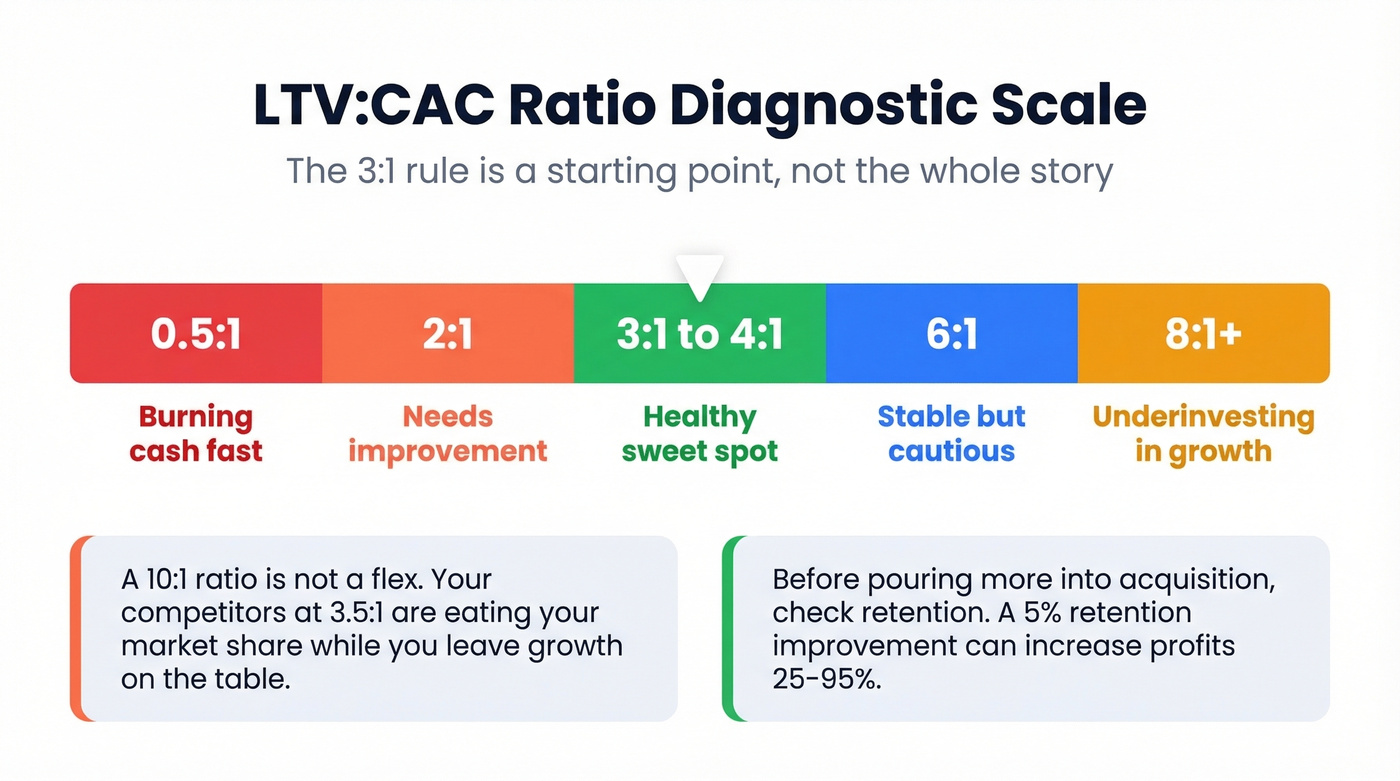
The 3:1 rule gets repeated everywhere, and it's a decent starting point. But the full diagnostic scale is more nuanced:
| LTV:CAC Ratio | What It Means |
|---|---|
| 0.5:1 | Burning cash fast |
| 2:1 | Needs improvement |
| 3:1-4:1 | Healthy sweet spot |
| 6:1 | Stable but cautious |
| 8:1+ | Underinvesting in growth |
Here's the thing: a very high ratio isn't a flex. If your LTV:CAC is 8:1, you're leaving growth on the table. You could be spending more aggressively on acquisition and still maintaining healthy unit economics. We've seen founders brag about 10:1 ratios while their competitors with 3.5:1 ratios eat their market share.
If your average deal size is under $15k, you probably don't need enterprise-grade data or six-month sales cycles - a lean self-serve funnel with tight creative testing will outperform a bloated outbound operation every time.
The retention math reinforces this. Acquiring a new customer costs 5-25x more than retaining an existing one. A 5% improvement in retention can increase profits by 25-95%. So before you pour more into acquisition, make sure you're not leaking customers out the back door.
Six Ways to Reduce Your Acquisition Cost
Ranked roughly by impact-to-effort.
Double down on referral programs. At $150 CAC for B2B SaaS, referral is the cheapest channel by far. If you don't have a structured referral program, that's your highest-ROI project this quarter. Skip this if you're pre-product-market-fit - referrals don't work when customers aren't genuinely happy yet.
Invest in SEO for the long game. Organic search CAC runs around $290 - less than half of paid search. It takes 4-6 months to ramp, but the compounding effect makes it the best long-term CAC reducer in most B2B companies. Our team has watched organic become the dominant acquisition channel for clients who stuck with it past the initial plateau.
Test creative relentlessly on paid social. Most paid social waste comes from creative fatigue, not targeting problems. Rotating 3-5 ad variants per week and killing underperformers within 72 hours can cut Facebook CAC by 20-30%.
Fix your landing pages. A 1% conversion rate improvement on a page getting 10,000 visits/month means 100 more leads without spending an extra dollar on traffic. CRO is the most underused CAC reduction tool in most orgs.
Clean your outbound data. This is the silent CAC killer. If 30% of your outbound emails bounce, you're paying roughly 43% more per acquired customer from that channel - because you're burning rep time, sequence credits, and domain reputation on contacts that don't exist. Prospeo verifies emails in real time with 98% accuracy at about $0.01 per lead, on a 7-day refresh cycle that keeps data from going stale. Snyk cut their bounce rate from 35-40% to under 5% after switching, and AE-sourced pipeline jumped 180%.
If you want a tighter outbound stack, start with your sales prospecting techniques and the outbound lead generation tools you’re using.
Focus on retention, not just acquisition. Every churned customer is a customer you need to re-acquire. Reducing churn by even a few percentage points has a multiplicative effect on your effective CAC over time. This isn't glamorous work, but it's often the single highest-leverage move a growth team can make.
If you’re seeing CAC rise while growth stays flat, it’s usually a churn problem hiding as an acquisition problem.
Your full-stack CAC calculation includes tools, salaries, and rep hours. Every hour a rep spends chasing bad numbers is acquisition cost going up. Prospeo's 125M+ verified mobiles hit a 30% pickup rate - 3x the industry average - so reps connect with real buyers instead of voicemails and dead lines.
Stop paying $1,980 per customer when your contact data is the bottleneck.
FAQ
What's the difference between CPA and CAC?
CPA measures the cost of a specific campaign-level action like an install or signup, typically including only media spend. CAC measures the full cost to acquire a paying customer - salaries, tools, overhead, everything. A $2.58 CPI can become a $50+ CAC once you account for the full funnel.
What's a good CAC for B2B SaaS?
Blended B2B SaaS CAC averages $239 per First Page Sage's 2026 data. Self-serve products should target under $300; enterprise motions can justify $1,000+ if LTV supports a 3:1 ratio or better.
How often should I recalculate CAC?
Monthly for your blended number. Quarterly, break it down by segment, channel, and geography - that's where you catch a channel going sideways before it burns a full quarter's budget.
Does bad contact data really affect acquisition costs?
Yes, significantly. If 30% of your outbound emails bounce, your effective CAC from that channel rises roughly 43%. Email verification tools eliminate this waste before it hits your pipeline.
Is a high LTV:CAC ratio always good?
No. Above 8:1 signals you're underinvesting in growth. Competitors with 3:1 ratios are acquiring customers faster and building market share. The sweet spot for most companies is 3:1 to 4:1.