

Crayon Pricing, Reviews, Pros & Cons (2026)
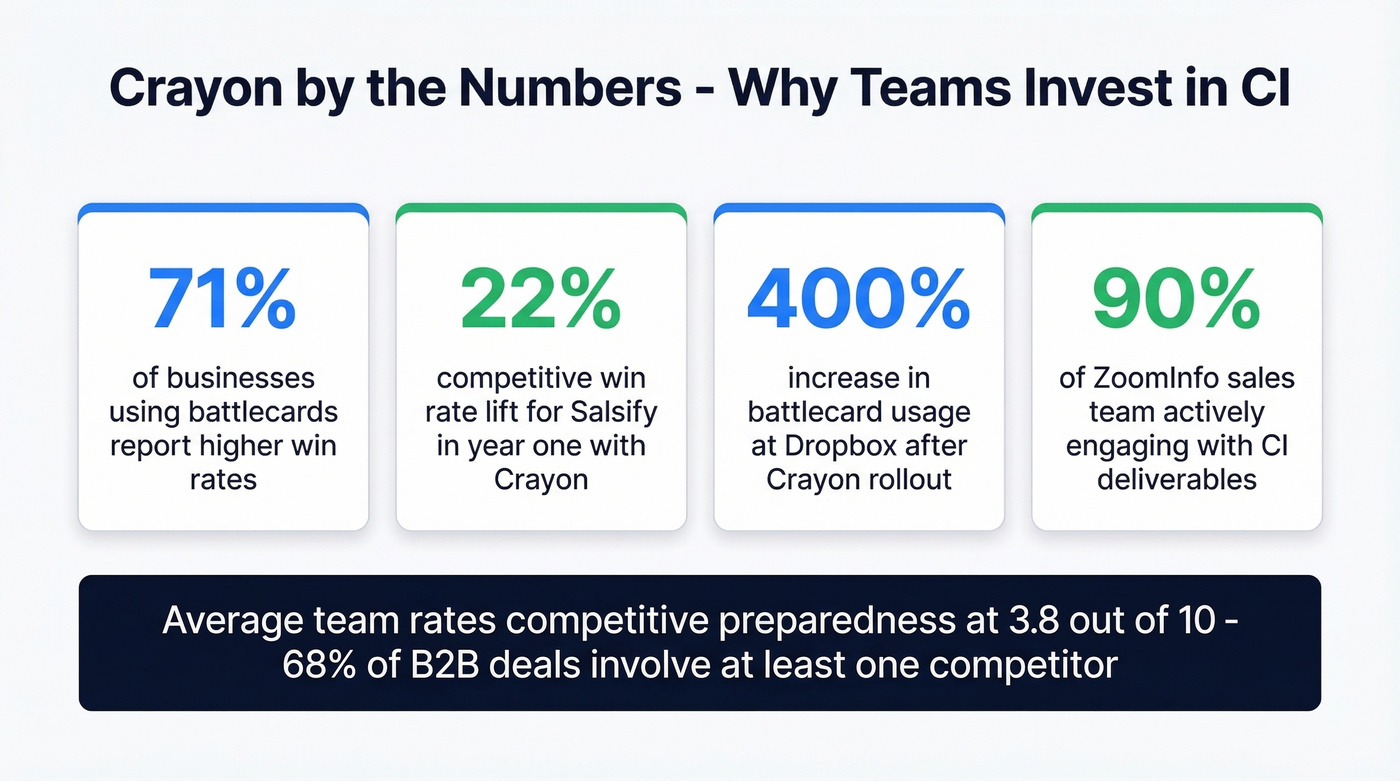
Crayon's own State of Competitive Intelligence report found that 68% of B2B sales deals involve at least one direct competitor. The average team rates its competitive preparedness at 3.8 out of 10. That's brutal.
If you're trying to figure out what Crayon actually costs before committing to a demo, good luck finding it on their site - the platform doesn't publish pricing anywhere. We've dug through G2 reviews, Capterra feedback, and real customer stories to give you the full picture: what Crayon costs, what users love and hate, and whether it's worth the investment for your team.
30-Second Verdict
| G2 Rating | 4.6/5 (385 reviews) |
| Price | ~$20K-$40K/yr |
| Best For | Enterprise PMM teams on Salesforce with 50+ reps |
| Verdict | Powerful CI platform with a noise problem and a Salesforce dependency - worth it if you've got the budget and admin bandwidth to curate it |
What Crayon Actually Costs
Most third-party estimates place Crayon at $20K-$40K/year, with starting prices around $25K+. Contracts are sized around the scope of your competitive intelligence strategy - especially how many competitors you're tracking - while user seats usually aren't the main cost driver. That means you can enable a big sales org without getting nickel-and-dimed on per-seat pricing, but expanding competitor coverage pushes the number up fast.
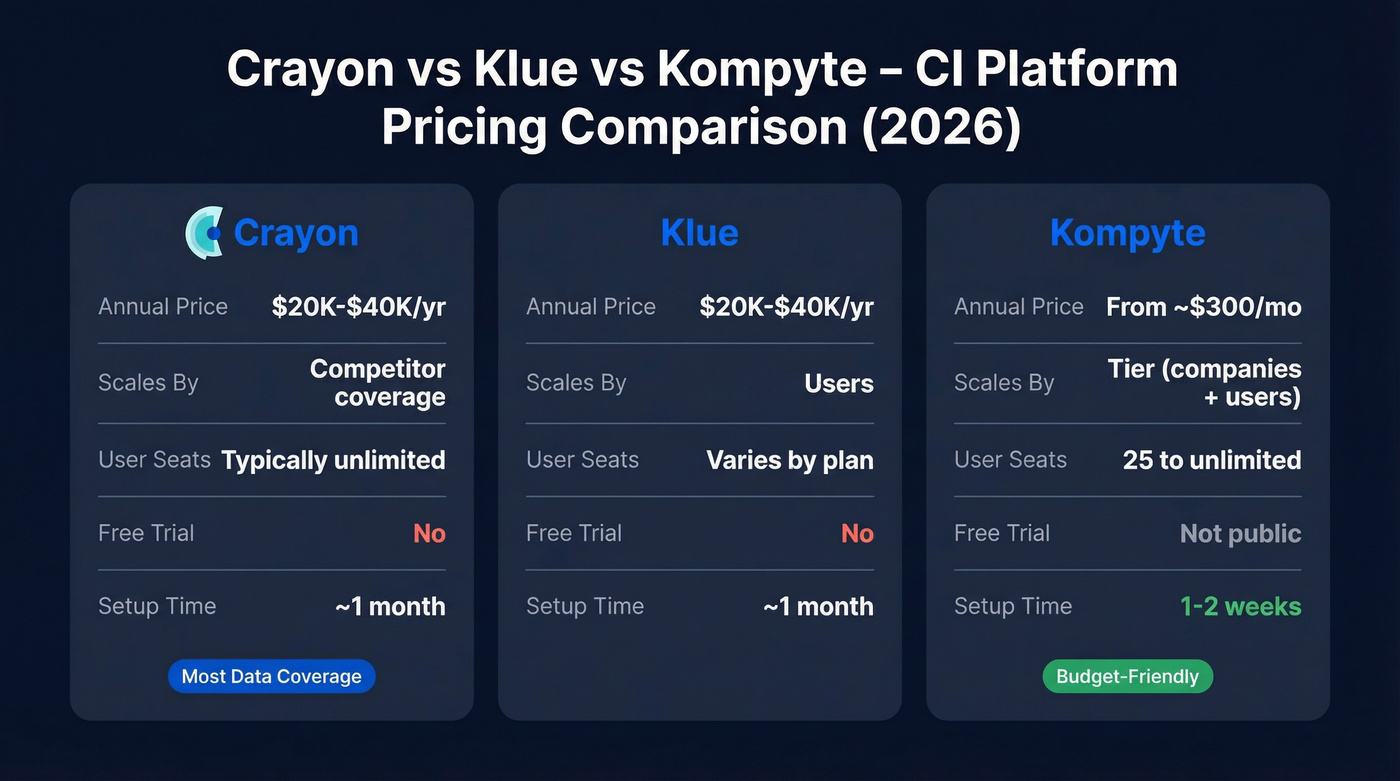
There's no free trial. Implementation takes roughly a month. And per G2's aggregate review data, expect about 14 months before you see meaningful ROI. That's a long payback window for a five-figure annual commitment.
| Crayon | Klue | Kompyte | |
|---|---|---|---|
| Price | $20K-$40K/yr | $20K-$40K/yr | From ~$300/mo |
| Scales by | Competitor coverage | Users | Tier (companies + users) |
| Users | Typically not seat-limited | Varies by plan | 25-unlimited |
| Free trial | No | No | Not public |
| Setup time | ~1 month | ~1 month | 1-2 weeks |
What Reviewers Love About Crayon
Massive data coverage. Crayon tracks over 100 data types across competitor footprints - pricing pages, job postings, product updates, reviews, SEC filings, press releases - and funnels everything into battlecards, newsletters, and alerts your reps can actually use. The breadth is genuinely impressive, and it's the single feature reviewers mention most often.
AI that saves real time. Sparks handles research and automated content updates, while Crayon Answers lets reps ask competitor questions directly inside Slack or Teams. Well-configured CI programs routinely save 8-12 hours per month on competitor research, and Crayon is built to deliver that kind of time back.
Battlecards that move the needle. 71% of businesses using battlecards report higher win rates. Crayon's own case studies back this up: Salsify saw a 22% lift in competitive win rates in year one, Dropbox drove a 400% increase in battlecard usage, and ZoomInfo got 90% of their sales team engaging with CI deliverables. Those aren't small numbers.
Support is a bright spot. Customer support gets consistently high marks on G2, and it's a recurring positive theme across review platforms.

Crayon tells your reps what to say. But 68% of deals involve a competitor - and the rep who reaches the buyer first wins. Prospeo gives your team 98% accurate emails and 125M+ verified mobiles on a 7-day refresh cycle, so your battlecard-armed reps actually connect with decision-makers before the competition does.
Pair your CI investment with contact data that actually connects. Start free.
Crayon's Biggest Drawbacks
Here's the thing: the noise problem is Crayon's biggest weakness, and it's not subtle. Competitor news repeatedly surfaces in the feed with no clear prioritization, and the platform requires what one Capterra reviewer called "highly manual daily curation." If you don't have a dedicated CI admin filtering signal from noise, your reps will tune it out within weeks. We've watched teams abandon the tool within months when nobody owns the curation workflow - it just becomes another ignored tab.
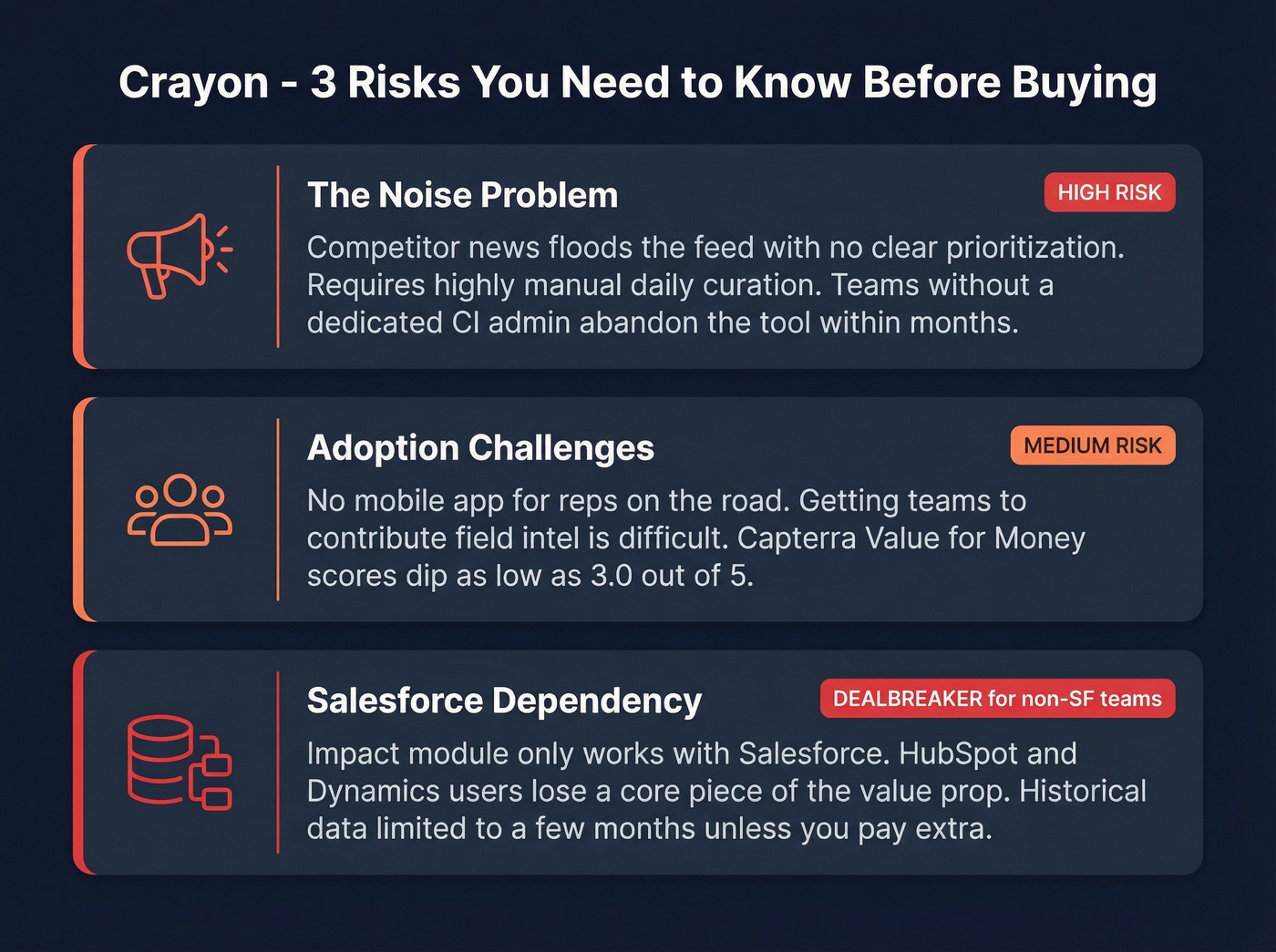
Adoption is the second challenge. Getting internal teams to consistently engage and contribute field intelligence is difficult, and Crayon's lack of a mobile app makes it worse for reps who spend their days on the road. Capterra reviews reflect the tension: Value for Money scores dip as low as 3.0/5 even when the overall product rating stays strong.
The CRM situation is a dealbreaker for some. Crayon's Impact module - the one that measures CI's influence on revenue - doesn't work without Salesforce. If you're on HubSpot or Dynamics, you're losing a core piece of the value prop. You should also know that historical data only goes back a few months unless you pay extra.
Who Should (and Shouldn't) Buy
Buy Crayon if:
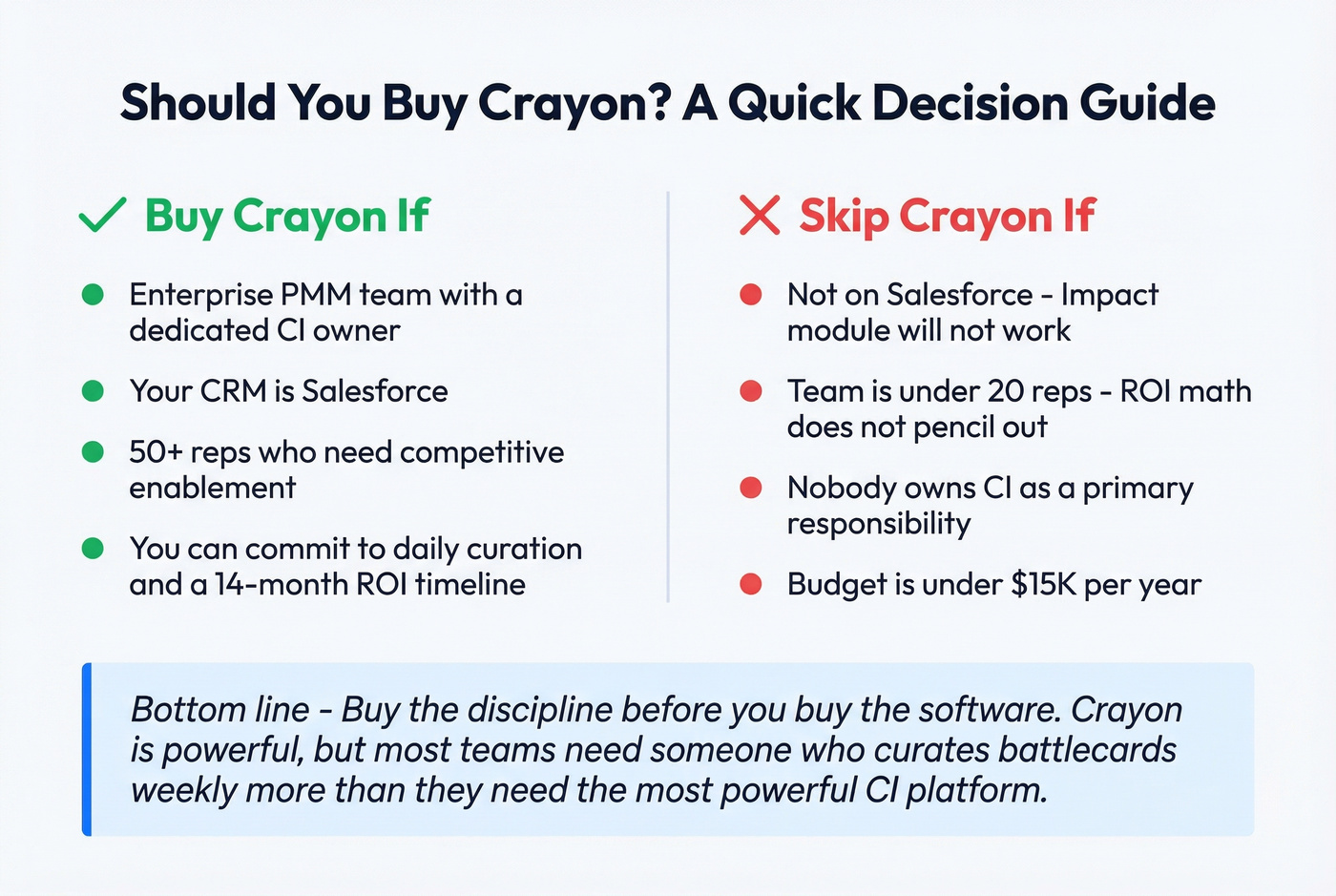
- You're an enterprise PMM team with a dedicated CI owner
- Your CRM is Salesforce
- You have 50+ reps who need competitive enablement
- You can commit to daily curation and a 14-month ROI timeline
Skip Crayon if:
- You're not on Salesforce - the Impact module won't work
- Your team is under 20 reps (the ROI math doesn't pencil out)
- Nobody owns CI as a primary responsibility
- Your budget is under $15K/year
Let's be honest: Crayon is probably the most powerful CI platform on the market right now. But most teams don't need the most powerful CI platform - they need one person who actually curates battlecards every week. Buy the discipline before you buy the software.
Alternatives Worth Considering
Klue occupies the same price tier ($20K-$40K/yr) but scales by users instead of competitor coverage, which makes budgeting more predictable. It also offers a mobile app and browser extension - two things Crayon lacks. UiPath reported a 2x adoption lift after switching from Crayon to Klue, and over 80 former Crayon clients have made the same move. If the curation burden is your main concern, Klue is the obvious first call.
Kompyte starts at around $300/mo and can be up and running fast - you can start seeing insights in 24-48 hours, with full deployment in one to two weeks. It's the right pick for teams building a CI program on a tighter budget who don't need enterprise-grade measurement yet.
Contify takes a different approach entirely - stronger taxonomy and classification means less noise out of the box. Expect pricing in the $15K-$30K/yr range based on market positioning.
Bottom Line
Crayon is a serious CI platform for serious CI programs. If you've got the Salesforce integration, the budget, and someone to own it daily, it'll deliver real results. If any of those three are missing, start with Klue or Kompyte and revisit Crayon once your program matures.
Competitive intelligence is only as good as the data your reps act on. Battlecards tell reps what to say, but they still need to reach the right person at the right time. That's where Prospeo fits into the stack - 98% email accuracy, 125M+ verified mobile numbers, and a 7-day data refresh cycle that keeps your contact data from going stale. It starts free, requires no contracts, and pairs naturally with any CI tool.
If you're building outbound alongside CI, tighten up your sales prospecting techniques and make sure your lead generation workflow doesn't leak handoffs between marketing and sales. And if you're enriching accounts before outreach, compare data enrichment services and best outbound lead generation tools so your reps aren't working half-filled records.
You're spending $20K-$40K/year on competitive intelligence. Don't let stale contact data waste it. Prospeo refreshes every 7 days - not every 6 weeks - and delivers a 30% mobile pickup rate so your reps reach real buyers, not voicemail boxes. At $0.01 per email, it costs less than a single day of Crayon.
Stop losing deals to bad phone numbers and bounced emails.