

CRM Database Enrichment: The 2026 Playbook for Clean, Accurate Data
Poor data quality costs the average organization $12.9M per year. That's bounced emails, wasted rep hours, and deals dying because someone's calling a disconnected number. CRM database enrichment is what separates a pipeline that converts from one that leaks - and right now, 74% of marketers say lead quality is their top challenge, while 44% of sales reps cite outdated data as their biggest headache.
Here's the thing: 30% of your B2B contact data decays every single year. Your reps are spending 27.3% of their time chasing records that should've been updated last quarter. That's not a process problem. It's a data problem.
What You Need (Quick Version)
If your email bounce rate is above 5%, your CRM data is actively costing you deals. Start with a data audit, pick one accurate enrichment source, and add a verification layer.
Our short list for 2026:
- Prospeo - best for email accuracy (98%) and data freshness with a 7-day refresh cycle. Self-serve, starts free.
- Apollo - best free-tier starting point for budget-conscious teams. Layer verification on top.
- Clay - best for RevOps teams with the capacity to build custom waterfall workflows.
What Is CRM Database Enrichment?
CRM database enrichment enhances your existing customer and prospect records with verified external data. You fill gaps, correct decay, and add context that helps reps prioritize the right accounts. At its core, this process transforms incomplete records into actionable profiles your sales team can actually work with - the kind where every field means something, not just takes up space.
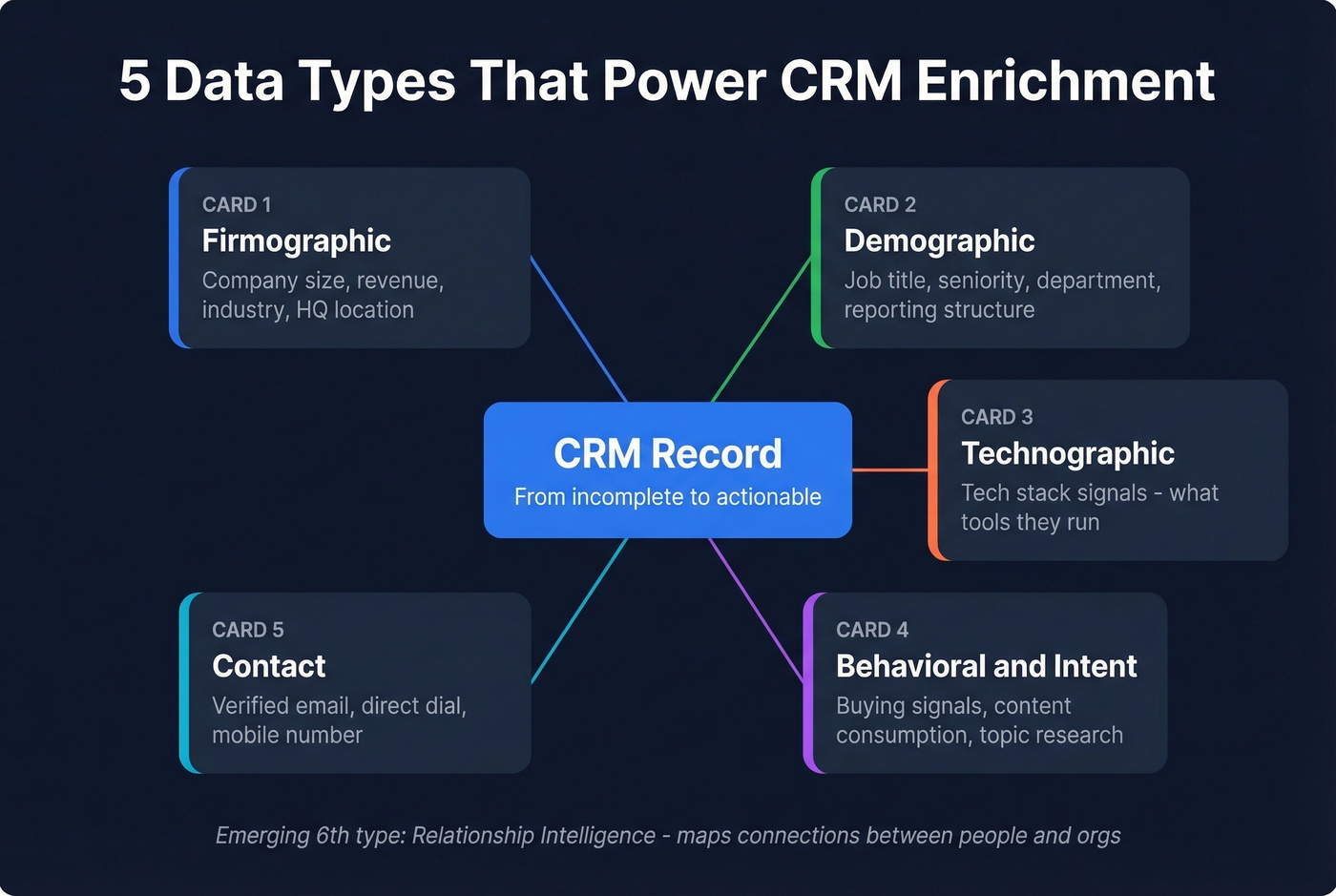
Five data types matter most:
- Firmographic - company size, revenue, industry, HQ location
- Demographic - job title, seniority, department, reporting structure
- Technographic - tech stack signals showing what tools a company runs
- Behavioral/intent - buying signals, content consumption, topic research
- Contact - verified email, direct dial, mobile number
An emerging sixth category - relationship intelligence - maps connections between people and organizations, which is particularly useful in private capital and VC contexts.
First-party data is what you collect directly. Third-party data is what enrichment tools add. The accuracy gap between them is where most CRM problems live. One practical payoff worth calling out: enrichment lets you shorten lead capture forms to two or three fields without losing data depth, because the enrichment layer fills in firmographics, title, and company size automatically, lifting form conversion rates while maintaining the data quality your reps need downstream.
The 4-Stage Enrichment Playbook
Most teams treat enrichment as a one-time project. That's why CRM databases drift back into chaos within months. A repeatable process is what keeps your records reliable quarter after quarter.
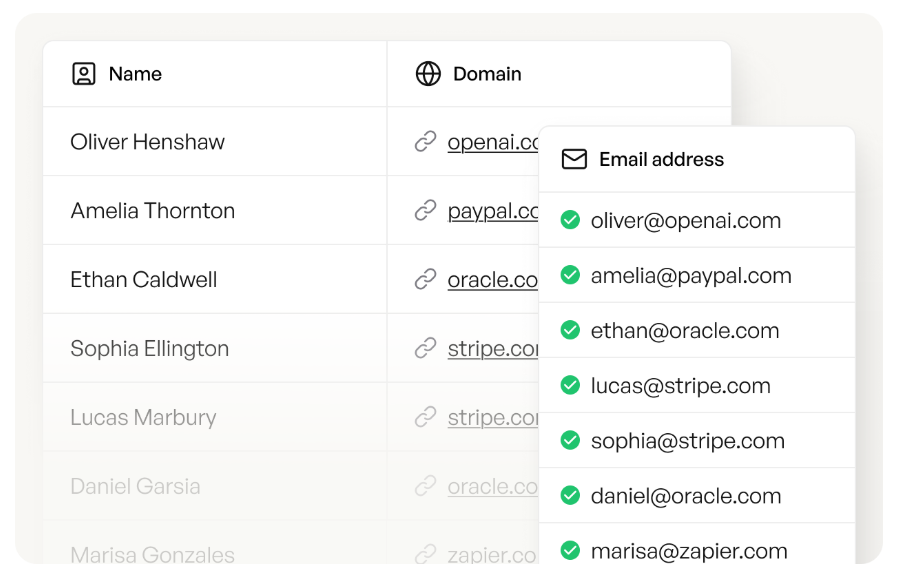
Stage 1: Standardize and Cleanse
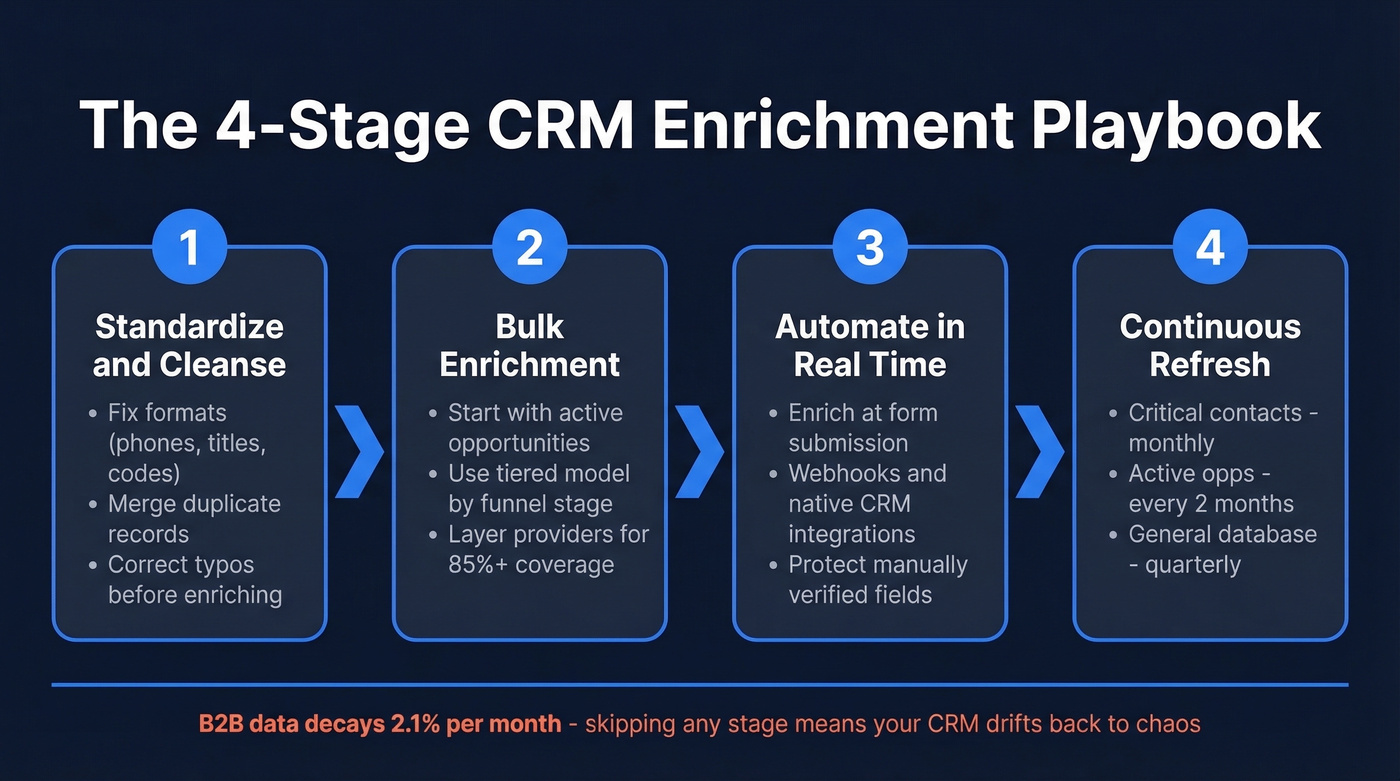
Before you enrich anything, fix what you have. Standardize formats - phone numbers, country codes, job titles - merge duplicates, and correct obvious typos. Enriching dirty data just creates expensive dirty data. Skip this and everything downstream breaks.
Stage 2: Bulk Enrichment
Run your existing database through an enrichment provider in batch. Prioritize by funnel stage using a tiered model:
- Tier 1 (initial capture) - basic firmographics
- Tier 2 (MQLs) - enhanced company data plus contact info
- Tier 3 (SALs) - full org charts and direct dials
- Tier 4 (opportunities) - real-time buying signals
Don't enrich the entire database at once. Start with active opportunities and work backward. We've seen teams run a first pass and hit 58% verified work emails, then add a second provider with stop rules and push to 71% coverage - bounce rate dropped by half. This tiered approach ensures you're spending credits where they generate the most pipeline value.
Stage 3: Automate in Real Time
Set up webhooks or native integrations so new records get enriched the moment they enter your CRM. Enriching at the point of form submission enables instant lead routing and scoring - the speed-to-lead advantage compounds fast.
One critical governance rule: don't overwrite a Mobile Phone field if a "Manually Verified" flag is true. Reps who've confirmed a number firsthand shouldn't have their work replaced by a third-party source that's potentially stale.
Stage 4: Continuous Refresh
B2B contact data degrades roughly 2.1% per month - in tech, that climbs to 40% annually. Set refresh cadences based on record priority:
- Critical contacts: monthly
- Active opportunities: bi-monthly
- General database: quarterly
- Cold leads: annually
Anything less and you're enriching once and praying.

You just read that single-source enrichment caps at 80-85% email accuracy. Prospeo hits 98% with a proprietary 5-step verification process - catch-all handling, spam-trap removal, honeypot filtering included. CRM enrichment returns 50+ data points per contact at a 92% match rate, refreshed every 7 days instead of the 6-week industry average.
Stop enriching dirty data. Start with the source that's actually accurate.
Why Single-Source Enrichment Falls Short
No single data provider covers everything. The structural accuracy ceiling for a single-source database sits around 80-85% for email, and a single enrichment source typically leaves 40-60% of qualified prospects unreachable. You're paying full price for records that are still wrong or missing.
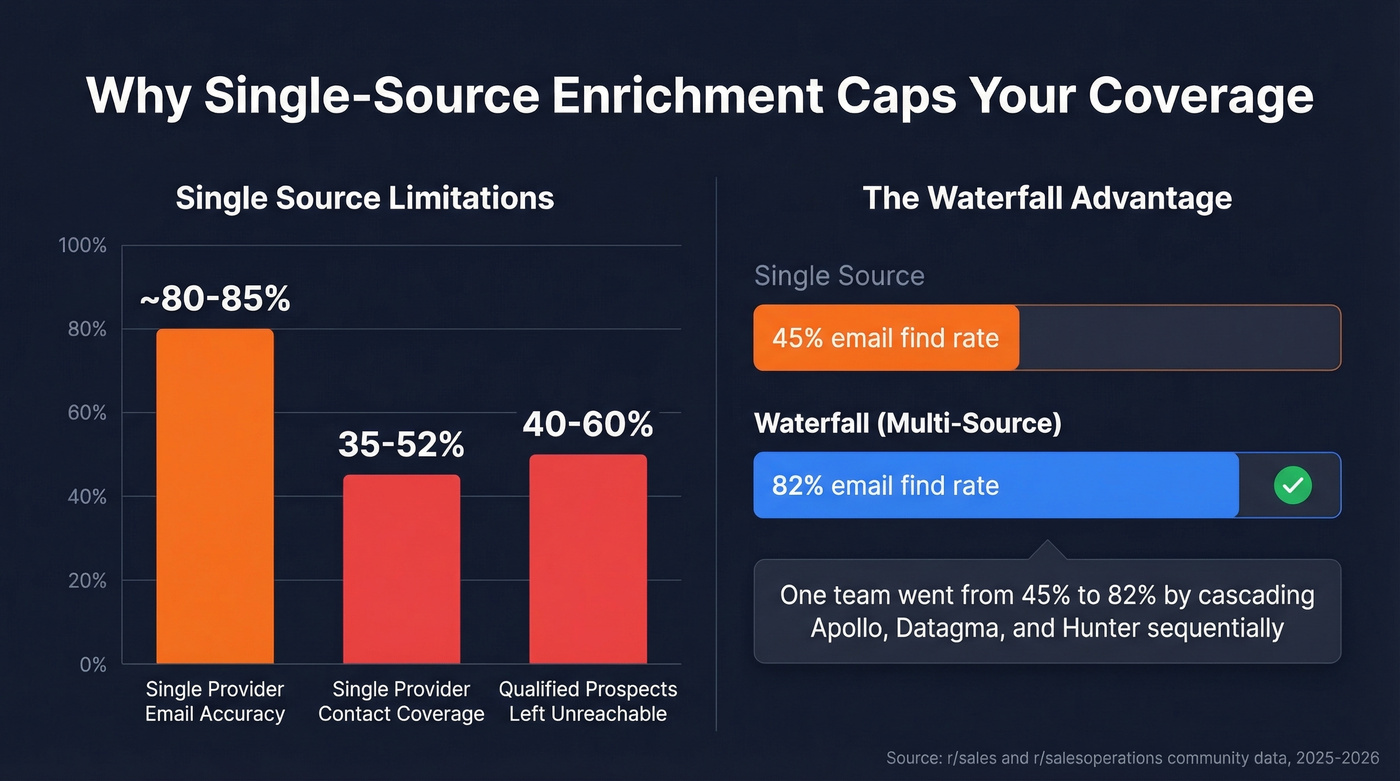
This is the central debate in B2B ops communities right now - the consensus on r/sales and r/salesoperations leans heavily toward multi-source approaches. Single-provider enrichment typically delivers 35-52% coverage, while a well-built waterfall pushes that to 85-90%. One team moved from a 45% email find rate to 82% by cascading Apollo, Datagma, and Hunter sequentially.

The tradeoff is complexity. Multiple providers mean multiple integrations, inconsistent data formats, and increased compliance surface area. Run enriched records through a verification process to flag catch-all domains, spam traps, and honeypots before pushing to your CRM - it's the cheapest insurance against bounced sequences and burned domains. (If you want a deeper breakdown of verification, see our guide to email verification.)
Let's be honest: if your average deal size is under $10K, you probably don't need ZoomInfo-level data. A focused enrichment tool plus a verification layer will outperform an enterprise platform you're only using at 30% capacity.
Best CRM Data Enrichment Tools in 2026
Enrichment tools fall into three categories: contact enrichment (finding emails and phones), platform enrichment (adding intent, technographics, and workflows), and account intelligence (real-time buying signals). Most teams need something from the first category and optionally the second.
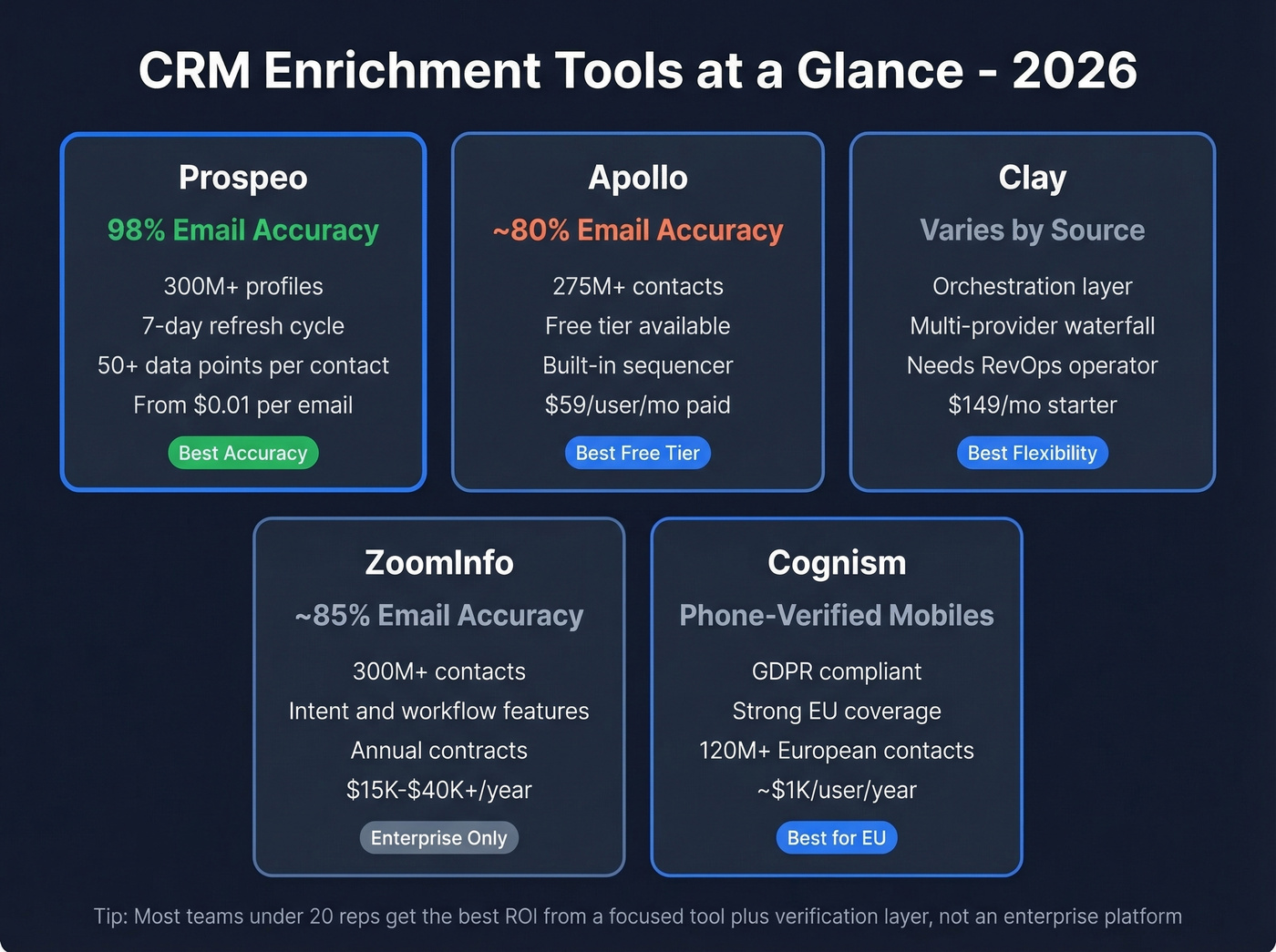
| Tool | Best For | Email Accuracy | DB Size | Starting Price |
|---|---|---|---|---|
| Apollo | Budget teams | ~80% | 275M+ contacts | Free / $59/user/mo |
| Clay | Waterfall workflows | Varies by source | Orchestrator | $149/mo |
| ZoomInfo | Enterprise orgs | ~85% | 300M+ contacts | ~$15K/yr |
| Cognism | EU coverage + compliance | Not public | Not public | ~$1K/user/yr |
| Breeze | HubSpot-native | ~85% | 100M+ contacts | $30-$700/mo (credits) |
| Hunter.io | Simple email finding | Finder only | Not public | Free / $49/mo |
| Kaspr | EU contacts | Not public | 120M+ European | $49/user/mo |
Prospeo
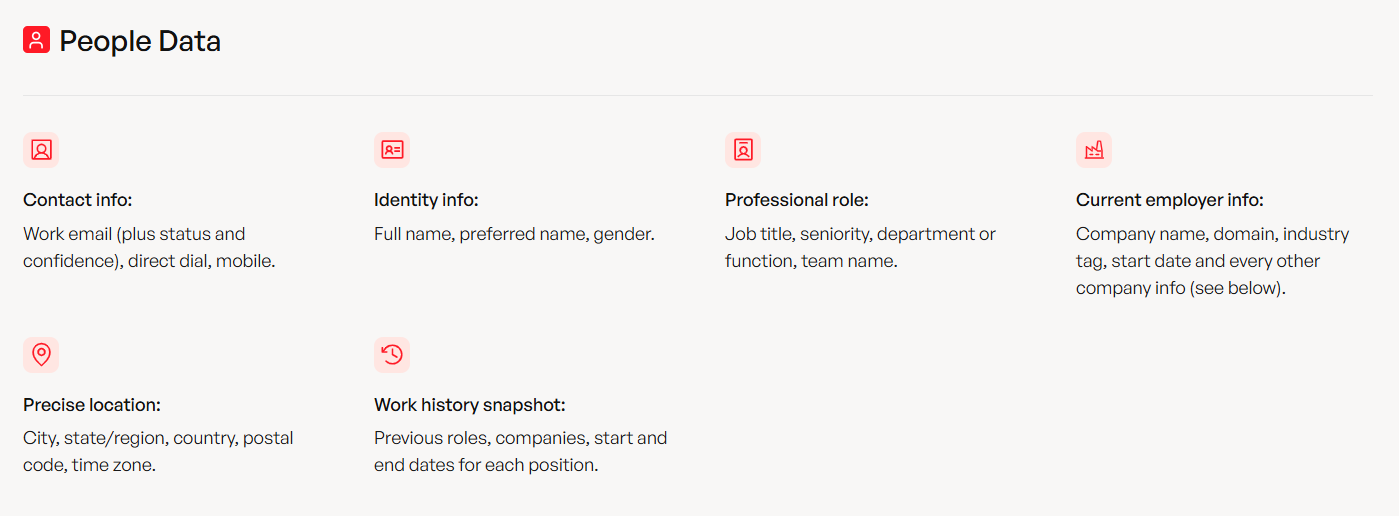
Prospeo covers 300M+ professional profiles with 98% email accuracy and a 7-day refresh cycle - the industry average is six weeks. Every enrichment returns 50+ data points, and the 83% match rate means you're not burning credits on empty results. Intent data covers 15,000 Bombora topics, so you can layer buying signals on top of contact data without stitching together separate tools. Native integrations with Salesforce, HubSpot, Clay, and Zapier mean it slots into existing workflows without custom engineering.
Real results we've tracked: Meritt went from a 35% bounce rate to under 4% after switching, and tripled their pipeline from $100K to $300K per week. GreyScout cut bounce rates from 38% to under 4% and grew pipeline 140%. At roughly $0.01 per email with a free tier of 75 emails/month, the unit economics are hard to beat for teams of any size.
Apollo
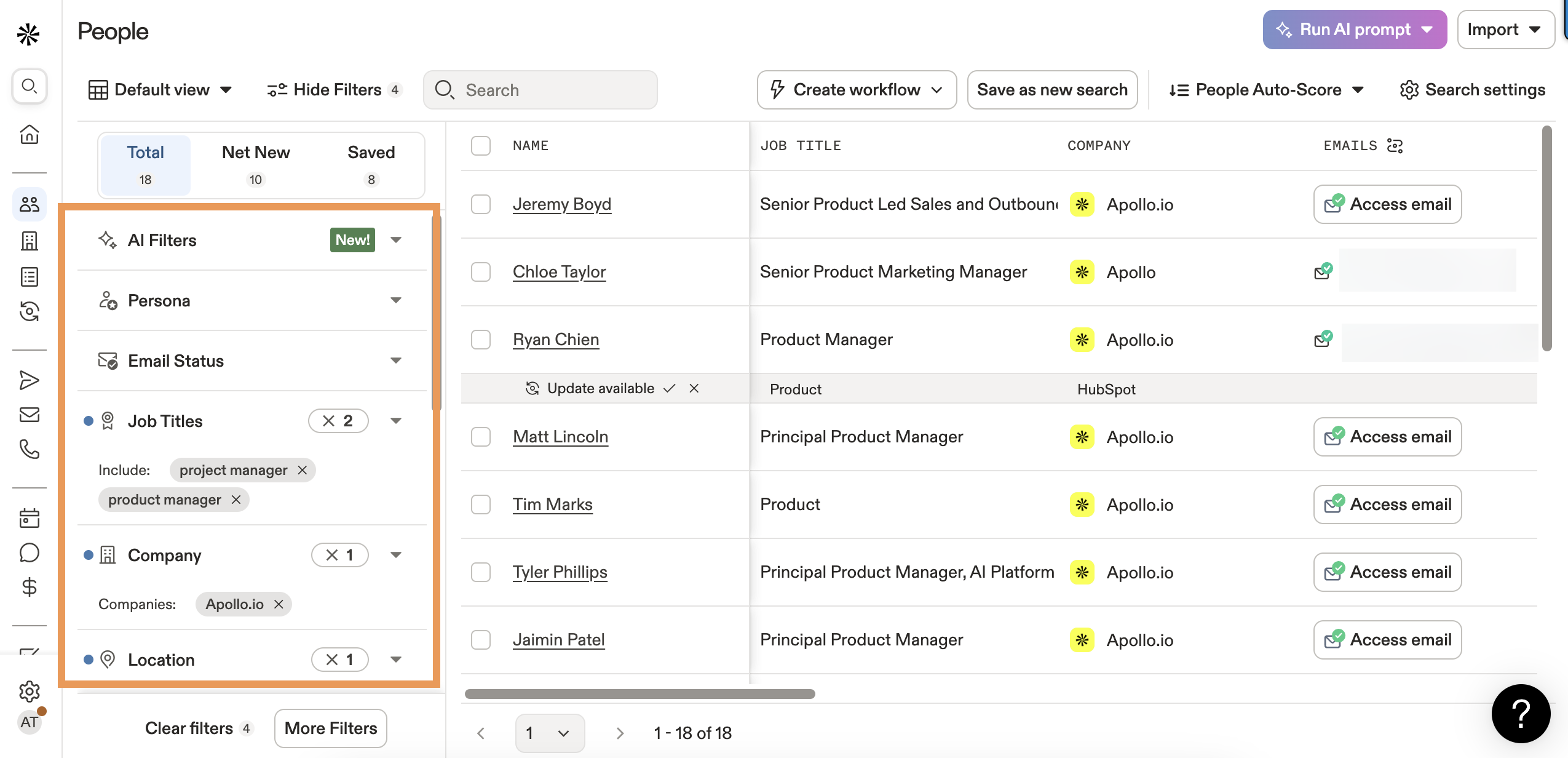
Apollo's 275M+ contact database and generous free tier make it the obvious entry point for startups and SMBs that can't justify $15K+ annually. Paid plans run $59-$149/user/month with Salesforce and HubSpot integrations, plus a built-in sequencer.
The catch: Apollo's email accuracy sits around 80%, which means a meaningful share of emails will be invalid without separate verification. At scale, that's a deliverability problem. We've seen teams pair Apollo's database with a dedicated verification tool and get significantly better results than using Apollo alone - think of it as the starting database, not the final word on data quality. Skip Apollo if you're running high-volume outbound without a verification layer; your domain reputation won't survive.
Clay
Clay isn't a data source - it's an orchestration layer that queries multiple providers sequentially. Powerful for teams that will actually build and maintain waterfall workflows. (If you're evaluating options, compare more vendors in our roundup of the best data enrichment tools.)
Pricing starts at $149/month (Starter), with Explorer at $349/month, Pro at $800/month, and Enterprise custom. Unit economics land around $140 per 1K enrichments depending on your setup and sources.
Look, we've watched teams buy Clay, get excited about the possibilities, and then let it sit unused for months because nobody had time to build the workflows. Without a dedicated RevOps operator, it's shelfware. With one, it's the most flexible enrichment setup on the market.
ZoomInfo
The pricing reality: $15K-$40K+/year, and most mid-market teams end up paying for modules they never activate. ZoomInfo's 300M+ contacts and ~85% email accuracy are solid, and the intent and workflow features make it a genuine all-in-one platform for large sales orgs with the budget and headcount to use it fully. But it's overkill for 80% of teams, and the annual contract locks you in whether the data works for your ICP or not. If your team is under 20 reps, look elsewhere first.
Cognism
GDPR compliance is non-negotiable if you're selling into Europe, and Cognism's phone-verified mobiles and strong EU coverage make it the default for EMEA-focused teams. Pricing runs ~$1,000/user/year for Platinum, with team totals typically landing $15K-$25K for 10-15 reps. No transparent pricing page - you're talking to sales.
Breeze, Hunter.io, and Kaspr
Breeze Intelligence, formerly Clearbit, runs on credit packs from $30-$700/month and lives natively inside HubSpot. Convenient if you're already on HubSpot, but there's no standalone option. Hunter.io is the simplest email finder on the market - free tier, paid plans from $49-$299/month, does one thing well. Kaspr covers 120M+ European contacts verified against 150 sources at $49/user/month, GDPR and CCPA aligned.
Cost per 1K enrichments:
| Tool | Cost per 1K |
|---|---|
| Prospeo | ~$10 |
| Apollo | ~$100 |
| Clay | ~$140 |
| Kaspr | ~$200 |
| Datanyze | ~$344 |
Your reps are wasting 27% of their time on decayed records. Prospeo's CRM enrichment fills gaps across emails, mobiles, firmographics, and intent data - 83% of leads come back with verified contact data. At $0.01 per email, it costs less than one wasted dial on a disconnected number.
Enrich your entire pipeline for less than your team wastes in a single afternoon.
Compliance and Governance
Enrichment without governance is a liability. The largest GDPR fine on record hit EUR 1.2B - that's not theoretical risk.
Lawful basis - legitimate interest is the most common basis for B2B enrichment, but document your reasoning. Purpose limitation - enrich data for the purpose you collected it, not for unrelated campaigns. Data minimization - don't enrich fields you'll never use just because you can. Accuracy - enrichment should improve accuracy, not introduce conflicting records. Storage limitation - set retention policies and actually enforce them.
Every additional provider in a waterfall cascade increases your GDPR/CCPA compliance surface area. Verify that each provider can document data provenance and how consent or legitimate interest was established. This isn't optional - it's the cost of doing business with multiple data sources, and teams that skip it are playing a game they'll eventually lose. For a deeper compliance checklist, see our guide to a GDPR compliant database.
Common Mistakes to Avoid
Overwriting verified data with unverified data. If a rep confirmed a mobile number last week, don't let a batch enrichment replace it with a switchboard number. This one drives our team crazy - it's the fastest way to erode rep trust in your CRM.
Enriching the entire database at once. Prioritize by funnel stage and deal velocity. Your active pipeline matters more than leads that haven't engaged in six months.
Ignoring bounce rates as a quality signal. If your bounce rate is climbing, your enrichment source is degrading. Treat it as an early warning system, not a lagging indicator. (If you want a quick diagnostic, start with check bounce.)
No refresh cadence. Enriching once and forgetting about it is the most expensive mistake. Data decays whether you're watching or not.
Relying on a single method. Using only one approach - manual, API, or batch - limits coverage. The best teams combine multiple techniques to match the right method to each record type and funnel stage. If you're building your process end-to-end, pair enrichment with CRM automation software so routing and scoring happen instantly.
FAQ
What's the difference between data enrichment and data cleansing?
Data cleansing fixes what's already in your CRM - removing duplicates, standardizing formats, correcting errors. Enrichment adds new data from external sources to fill gaps and update stale records. You need both, and cleansing should always come first.
How often should I re-enrich my CRM?
Critical contacts and active opportunities should be refreshed monthly. General database records quarterly. B2B data decays roughly 30% per year, so "set and forget" guarantees a degraded database within two quarters.
Can I enrich CRM data without an enterprise contract?
Yes. Tools like Prospeo offer a free tier with no contract required, and Apollo and Hunter.io also have free starting points. Enterprise contracts are optional - self-serve tools now deliver comparable data quality at a fraction of the cost.
What is waterfall enrichment?
Waterfall enrichment queries multiple data providers sequentially until a verified result is found. If Provider A doesn't return a valid email, the system automatically tries Provider B, then C. This approach lifts match rates from 35-52% to 85-90%.
How do I measure if my enrichment is working?
Track three metrics: email bounce rate (target under 5%), enrichment match rate (percentage of records returning usable data), and field fill rate (percentage of key fields populated across your database). If any trend the wrong direction, your enrichment source needs attention.