

The Best CRM for Sales and Marketing in 2026
A 5-person sales team picks a CRM, spends three months migrating data, and discovers the marketing features they actually need are locked behind a tier that costs triple their budget. This happens constantly. The CRM market is designed to get you in cheap and upsell you later - and the unified "sales and marketing" label is where most of the bait-and-switch lives.
Companies that align sales and marketing are 67% better at closing deals and see up to 20% annual revenue growth. But 53% of organizations still have broken handoffs between the two teams. The right CRM closes that gap. The wrong one gives you two disconnected modules under one logo.
Quick Answers
If you don't want to read 1,800 words, here's the short version:
- Best value overall: Zoho CRM - deep features, fair pricing, PCMag's top pick
- Easiest to start: HubSpot CRM - free tier gets you moving in an afternoon
- Most customizable: monday CRM - flexible workflows for teams that think differently
- Marketing-first: ActiveCampaign - best email automation with CRM bolted on
- Best for keeping CRM data clean: Prospeo - 98% email accuracy, native HubSpot and Salesforce integrations, 7-day data refresh
Here's the thing: the tool you pick matters less than the data you put in it. A $40/user CRM with clean contacts outperforms a $100/user CRM full of stale emails every single time. If your average deal size is under $10k, you almost certainly don't need Salesforce-level complexity, and you'd be better off spending the savings on data quality.
Three CRM Architectures
Stop looking for one tool that does everything. Most platforms that claim to handle both sales and marketing do one well and bolt the other on as an afterthought. Knowing which side a platform leans toward saves you from buying features you'll never use.
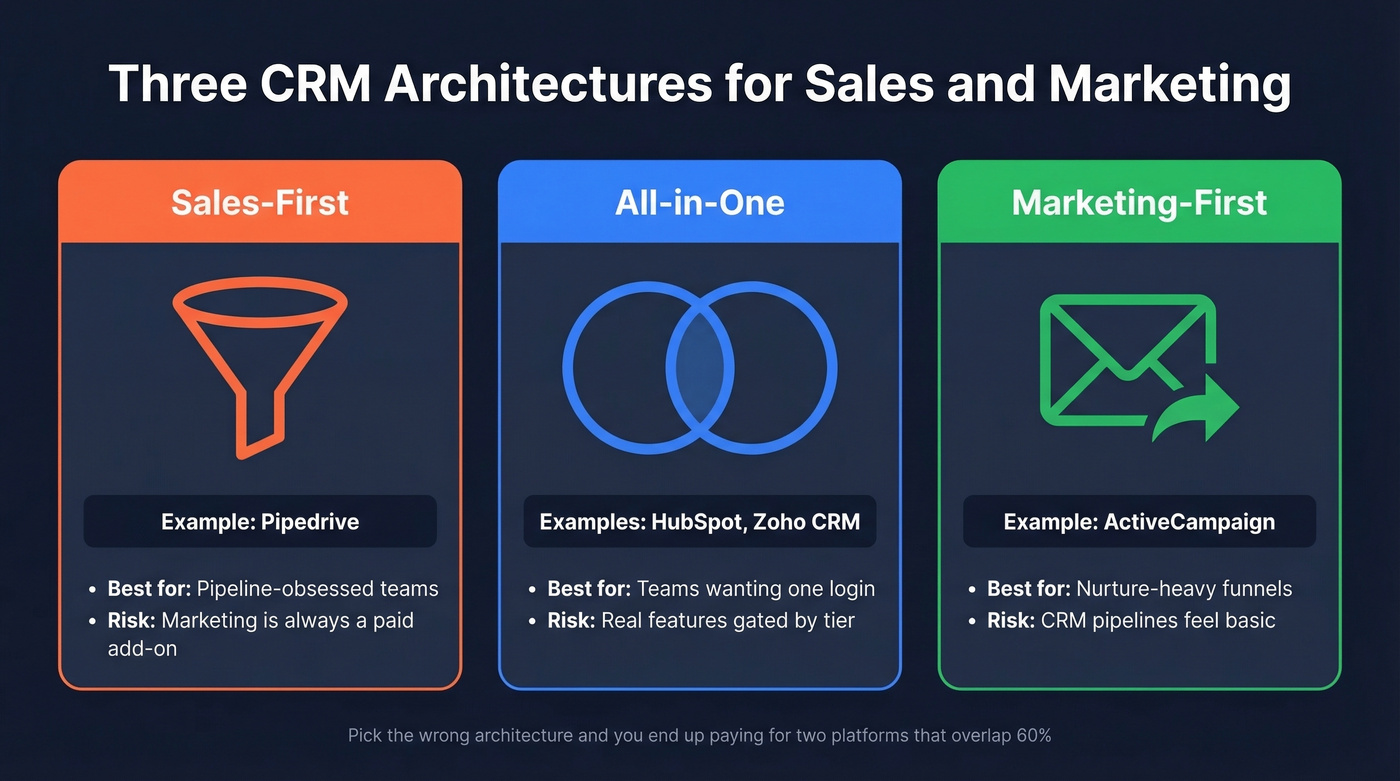
| Approach | Best for | Watch out for |
|---|---|---|
| Sales-first (Pipedrive) | Pipeline-obsessed teams | Marketing = paid add-ons |
| Marketing-first (ActiveCampaign) | Nurture-heavy funnels | CRM pipelines feel basic |
| All-in-one (HubSpot, Zoho) | Teams wanting one login | Feature gating by tier |
The all-in-one path works if you're willing to pay for the tier that actually unlocks both sides. The modular path works if you already have a strong tool on one side and just need the other. Neither is wrong - but picking the wrong architecture is how teams end up paying for two platforms that overlap 60%.
Best CRMs for Unified Sales and Marketing
Zoho CRM - Best Value
Use this if you want the deepest feature set per dollar and don't mind a steeper learning curve. Zoho packs marketing automation, AI via Zia, journey orchestration, and inventory management into a platform with a free plan for up to 3 users and paid tiers starting at $14/user/month billed annually.
Skip this if you need something your team can figure out without documentation. Zoho's flexibility is also its complexity - there are a lot of menus.
Paid tiers run from Standard ($14/user/month) to Ultimate ($52/user/month), with Enterprise ($40/user/month) adding Zia AI and journey orchestration. Mass email limits scale by tier: 250/day on Standard, up to 2,000/day on Ultimate. For real campaign volume, you'll want Zoho Campaigns alongside the CRM. PCMag gave Zoho a 4.5/5 and named it Best Overall - and that tracks with what we've seen in practice. The free tier supports 3 users, enough to evaluate seriously before committing.

HubSpot CRM - Easiest to Start
HubSpot's CRM is 100% free with no expiration date. The free plan includes up to two users and 1,000 contacts with basic email and contact management. The UI is genuinely intuitive - reps don't need training to start logging activities. PCMag calls it the easiest CRM to use, and that's accurate.
The catch is cost at scale. HubSpot's free-to-paid price jump is one of the most common pain points teams run into, and for good reason: Marketing Hub at the Pro level runs around $800/month, and a mid-market team running Sales Hub + Marketing Hub at Professional tiers can easily hit $2,000-$3,000/month once you factor in seats and marketing contacts. The free CRM is legitimately useful for early-stage teams, but know what "easy" costs before you're locked in with migrated data and trained reps.
monday CRM - Most Customizable
monday CRM is for teams whose sales process doesn't fit a standard pipeline. The workflow engine lets you create custom automations, dashboards, and views that mirror how your team actually works - not how a CRM vendor thinks you should work.
Where it falls short is native marketing automation. monday handles mass emails and sequences, but it's not competing with ActiveCampaign or HubSpot on the nurture side. Pricing starts at $12/seat/month on Basic and goes to $28/seat/month on Pro. Basic limits you to 1,000 active contacts and a single dashboard. Standard at $17/seat unlocks 10,000 contacts and 250 automations/month - that's where most teams should start.
Pipedrive - The Add-On Trap
Pipedrive is a beautiful sales pipeline tool. Everything else costs extra.
Plans run from Lite ($24/seat) through Growth ($39), Premium ($64), to Ultimate ($99) - but marketing emails require the Campaigns add-on starting at $16/month for up to 1,000 subscribers, and lead generation needs LeadBooster starting at $32.50/month. The math for a 5-person team on Growth: $195/month for the CRM, plus $16 for Campaigns, plus $32.50 for LeadBooster - roughly $243.50/month before you've sent a single marketing email at scale. Pipedrive is excellent at what it does. Just budget for the full picture, not the sticker price.
ActiveCampaign - Marketing-First
ActiveCampaign is the inverse of Pipedrive: world-class email automation with CRM pipelines bolted on as an add-on called "Enhanced CRM." It starts at $15/month for 1,000 contacts. If your business runs on nurture sequences, segmentation, and behavioral triggers, ActiveCampaign's automation builder is best-in-class - nothing else on this list touches it for email workflow complexity.
The tradeoff is that the sales pipeline feels like an afterthought compared to dedicated CRMs. Teams that are 70% marketing and 30% sales will love it. Sales-heavy orgs will find the pipeline limiting.
Freshsales - Budget Pick
Freshsales offers a free tier and low-cost paid plans with built-in calling, Freddy AI for lead scoring, and a clean interface that doesn't overwhelm small teams. It won't compete with Zoho on depth or HubSpot on ecosystem, but for a 3-person team that needs a CRM with phone and email in one place without add-on fees, Freshsales delivers more than the price tag suggests.
Salesforce - Enterprise Only
Salesforce runs $25-$300/user/month and typically needs a consultant to implement properly. It's built for companies with a dedicated admin, not for a small team trying to align sales and marketing. If you have the budget and headcount, it's the most powerful platform on the market. Everyone else should look elsewhere.
SuperOffice - European B2B
SuperOffice runs around EUR 45-75/user/month with GDPR-first design and strong Microsoft/ERP integrations. For European B2B companies that need compliance baked in rather than bolted on, it belongs on the shortlist. Outside that niche, the other tools here offer more for less.

You just read that aligned sales and marketing teams close 67% more deals. But alignment means nothing if reps are working stale contacts. Prospeo refreshes every record every 7 days and delivers 98% verified emails - so every lead in your CRM is actually reachable.
Stop feeding your CRM dead emails. Start with data that connects.
Pricing Comparison
| Tool | Starting Price | Marketing Included? | AI Tier | Hidden Costs |
|---|---|---|---|---|
| Zoho CRM | $14/user/mo (annual) | Basic (250 emails/day) | Enterprise ($40) | Zoho Campaigns for volume |
| HubSpot | Free (up to 2 users) | Basic email only | Pro (~$800/mo) | Marketing Hub is pricey |
| monday CRM | $12/seat/mo | Mass email, sequences | N/A | 1,000 contact cap on Basic |
| Pipedrive | $24/seat/mo | No - add-on ($16+) | N/A | Campaigns + LeadBooster |
| ActiveCampaign | $15/mo (1K contacts) | Yes - core strength | Pro tier | CRM is an add-on |
| Freshsales | Free / low-cost paid | Built-in phone + email | Growth tier | Limited at free tier |
| Salesforce | ~$25/user/mo | Separate clouds | Einstein ($$) | Consultant fees |
| SuperOffice | ~EUR 45/user/mo | Yes - bundled | N/A | Limited outside EU |
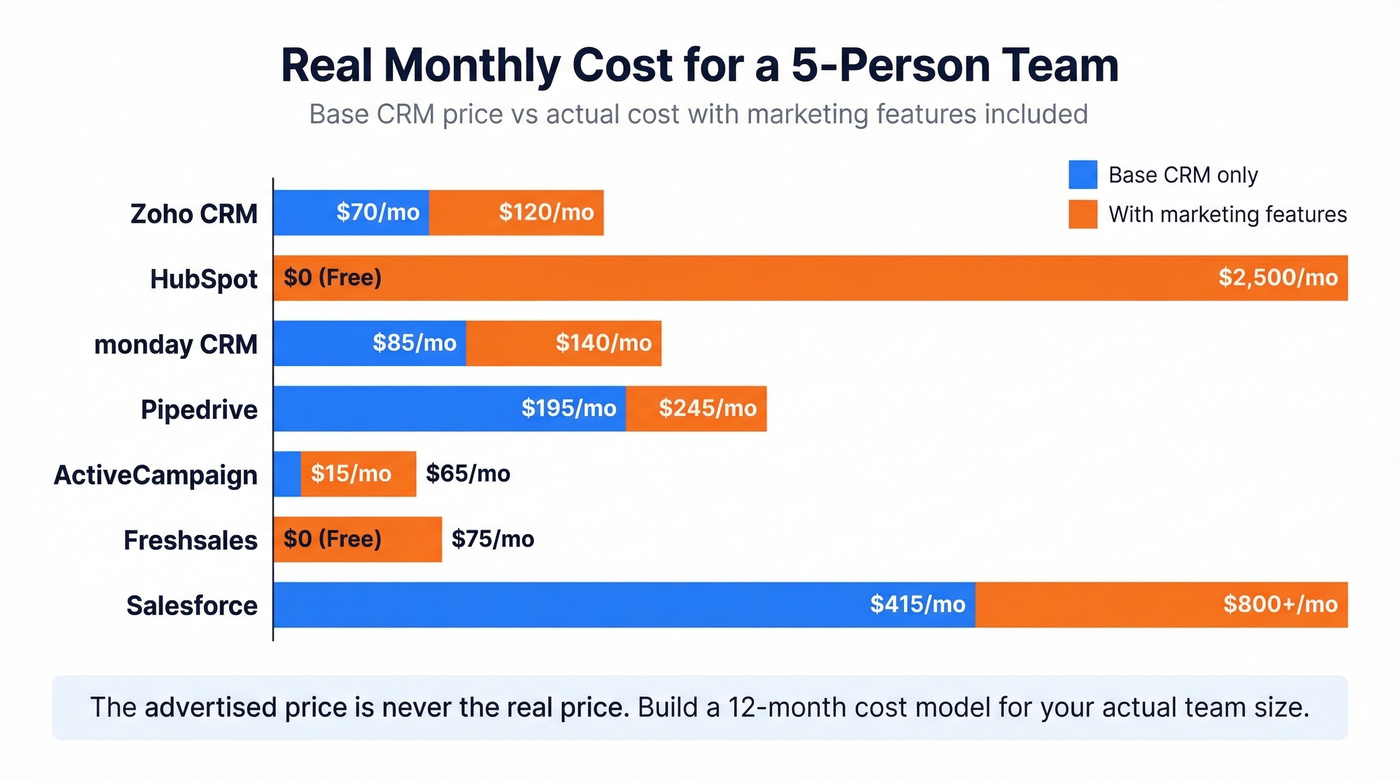
The advertised price is never the real price. Build a 12-month cost model for your actual team size with the features you'll actually use - and factor in migration costs. Once your data, workflows, and team habits live inside a platform, switching carries a real price tag that goes well beyond the subscription line item.
CRM Data Quality: The Real Problem
None of these CRMs matter if the data inside them is garbage.
B2B contact data decays roughly 30% per year - people change jobs, companies rebrand, emails go stale. A team that imports 5,000 contacts in January is working with about 3,500 accurate records by December. We've seen teams launch campaigns from their shiny new CRM and bounce 800 emails in the first week. That's not a CRM problem. That's a data problem. And it tanks your sender reputation, which makes every future campaign harder to land.
Prospeo connects natively to HubSpot and Salesforce, enriches contacts with 50+ data points per record at an 83% match rate, and verifies emails at 98% accuracy. The 7-day data refresh cycle means your CRM doesn't slowly rot between quarterly cleanups that most teams skip anyway. For any platform on this list, a data enrichment layer is what makes the investment actually pay off.
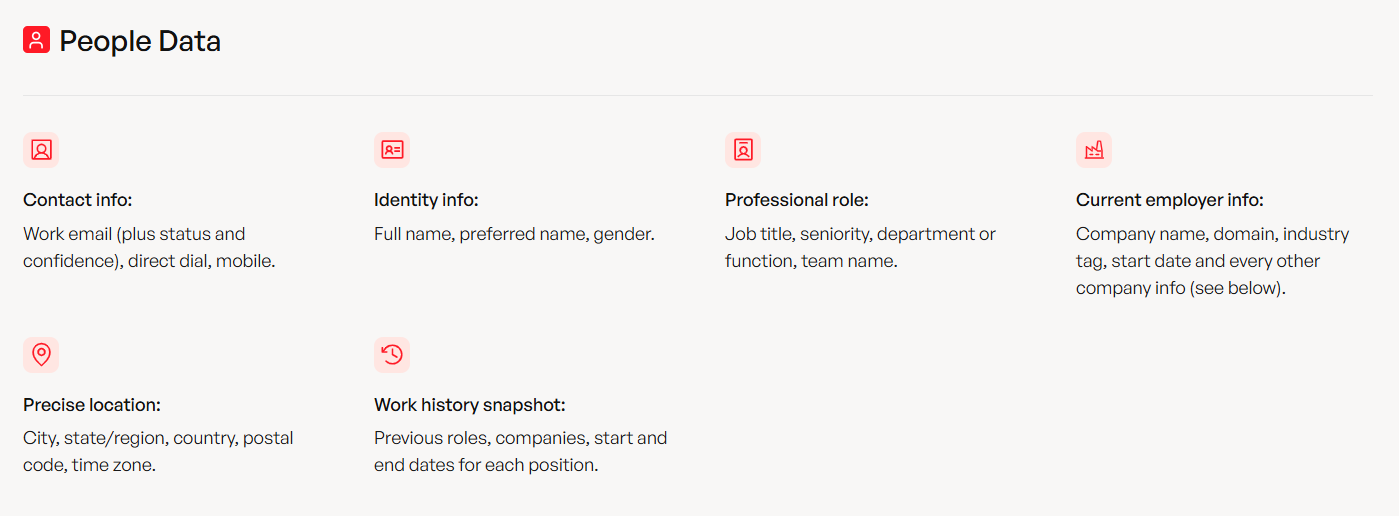
A $40/user CRM with clean data beats a $100/user CRM full of bounces. Prospeo's native HubSpot and Salesforce integrations enrich your CRM with 50+ data points per contact at $0.01/email - so you spend less on tools and more on closing.
Enrich your CRM with verified contacts in one click.
Five Mistakes That Kill CRM Adoption
No goals before rollout. "We need a CRM" isn't a goal. "Reduce lead response time to under 10 minutes" is. Define what success looks like before you pick a tool - and plan to actually use reporting. Only 20% of small business owners use CRM analytics weekly, which means 80% are flying blind on the tool they're paying for.
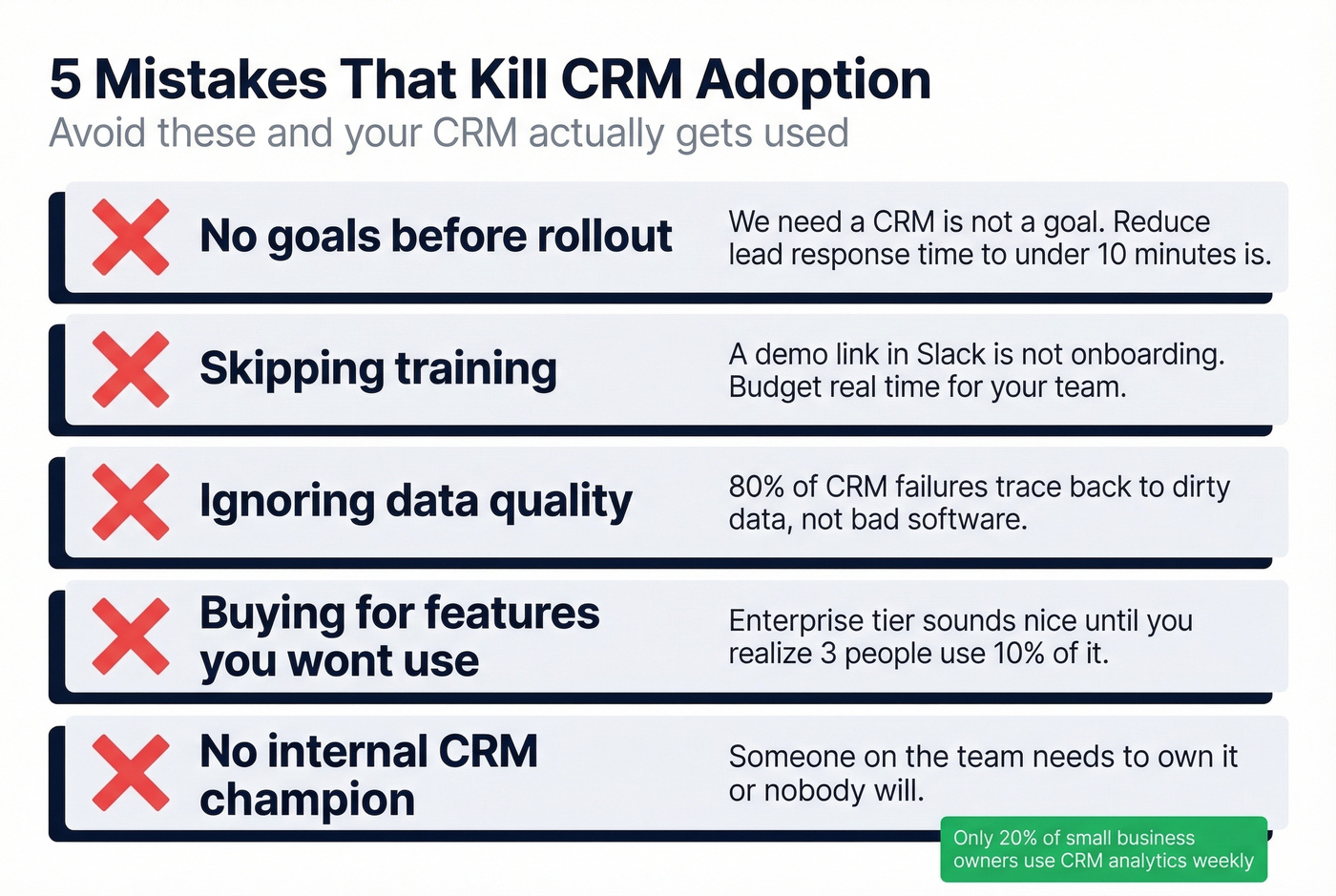
Skipping training and change management. Reps won't use what they don't understand. Budget time for onboarding - not just a demo link in Slack. Appoint an internal CRM champion who owns adoption and answers questions in the first 90 days. A simple 30-60-90 day plan helps make that stick.
Letting data rot. Your CRM becomes a data dumpster within months if nobody owns hygiene. Schedule cleanups at minimum twice a year, or automate enrichment so it doesn't depend on someone remembering.
Ignoring mobile access. Around 73% of people use personal smartphones for work. If your CRM's mobile experience is painful, field reps will stop logging activities. It's that simple.
Rolling out everything at once. Start with pipeline management and contact tracking. Add marketing automation in month two. Layer in reporting in month three. Teams that flip every switch on day one get overwhelmed and abandon the platform entirely.
MarineMax: Proof It Works
When MarineMax unified their sales and marketing inside a single CRM, the results were concrete: average lead response time dropped to 9 minutes, SQL-to-deposit conversion doubled from 3.52% to 6.81%, and same-store sales increased 19% over two years. That's not a vendor promise - that's a before-and-after with real revenue attached.
A unified CRM with clean data and defined processes doesn't just save time. It makes money. If you're tightening your outbound motion, pair your CRM with better sales prospecting and a consistent lead generation workflow.
FAQ
What's the difference between a CRM and marketing automation?
A CRM manages contacts, deals, and pipeline activity. Marketing automation handles email campaigns, nurture sequences, and behavioral triggers. Most modern platforms bundle both, but marketing features are typically gated behind higher-priced tiers - budget accordingly.
Can a free CRM handle both sales and marketing?
HubSpot's free tier covers basic contacts and email for up to 2 users; Zoho's free plan supports 3 users. Neither includes real marketing automation at the free level - expect to upgrade within 3-6 months once campaign volume grows.
How much should a small team budget for CRM?
A 5-person team should budget $50-$200/month for a solid platform with marketing features included. Watch for add-on costs - tools like Pipedrive can double the sticker price once you add campaigns and lead generation modules.
How do you keep CRM contact data accurate over time?
Use an enrichment tool with native CRM integrations and automated refresh cycles. Prospeo's 7-day refresh with 98% email verification keeps records clean without manual effort - far more reliable than quarterly bulk cleanups that most teams skip anyway.