

How to Actually Use CRM in Marketing (Not Just Define It)
You open your CRM on Monday morning. Marketing's campaign data lives in Mailchimp, sales activity sits in Salesforce, and the "unified customer view" your VP promised last quarter is a spreadsheet someone exports manually every Friday. One Reddit user nailed it: "marketing data living in one place and sales activity somewhere else, making cross-tool reporting pretty painful." That's not an edge case - only 32% of companies have a single unified view of their customer data, even though 90% say it'd be valuable.
Using a CRM in marketing should solve this. For most teams, it doesn't - because they skip the fundamentals.
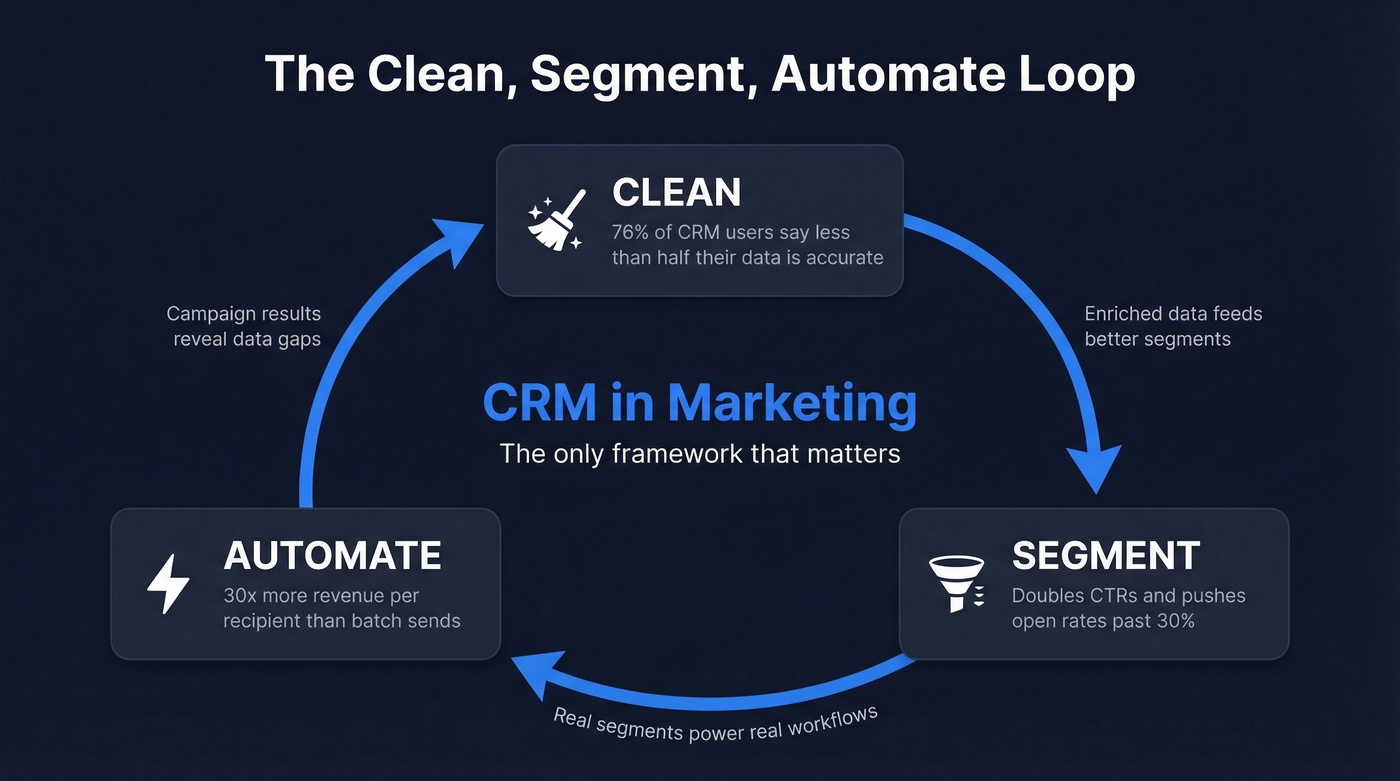
The fix isn't a new tool. It's the Clean, Segment, Automate loop: get your data right, build segments that reflect real behavior, then let automation do the heavy lifting. Teams that skip it drown in bounced emails and duplicate records.
The Quick Version
- Data quality comes first. Your CRM marketing strategy lives or dies on clean data. Audit and enrich before you strategize.
- Set up trigger-based automation immediately. Automated workflows generate 30x more revenue per recipient than batch campaigns. That's not a typo.
- Segment with clean data. Proper segmentation doubles CTRs and pushes open rates past 30%. Generic blasts are dead - and your deliverability suffers every time you send one.
What Does CRM Mean for Marketers?
When sales teams say "CRM," they mean a deal tracker - pipeline stages, call logs, forecasting. When marketers say "CRM," they mean something fundamentally different: a system for understanding who your customers are, what they've done, and what message to send them next. It's customer relationship management applied to campaign strategy, audience understanding, and personalized outreach.
The role of a CRM in marketing is to tie your email, SMS, social, web, and ad data back to a single contact record so you know what each person has seen, clicked, and bought. Without it, you're guessing. With it, you're personalizing at scale.
A quick distinction worth making: CRMs and CDPs (Customer Data Platforms) overlap but aren't the same thing. A CDP ingests raw behavioral data from every touchpoint and builds unified profiles. A CRM organizes that data around relationships and actions. Most marketing teams in 2026 need a CRM with strong data infrastructure - not a separate CDP - unless they're running millions of anonymous web sessions.
The market reflects how central this has become. The CRM market hit $101B in 2024 and is projected to reach $263B by 2032. That's not just sales teams buying Salesforce licenses - it's marketing teams realizing they can't run modern campaigns without a data backbone. 91% of companies with 11+ employees use a CRM. The question isn't whether you need one. It's whether you're running the Clean, Segment, Automate loop correctly.
Why CRM Marketing Matters More in 2026
The ROI is proven and measurable. Companies that adopt CRM for marketing see an average 25% increase in marketing ROI. The broader numbers are even more striking: $8.71 returned for every $1 spent on CRM. That comes from better targeting, less waste on unqualified leads, and automated workflows replacing manual campaign management.
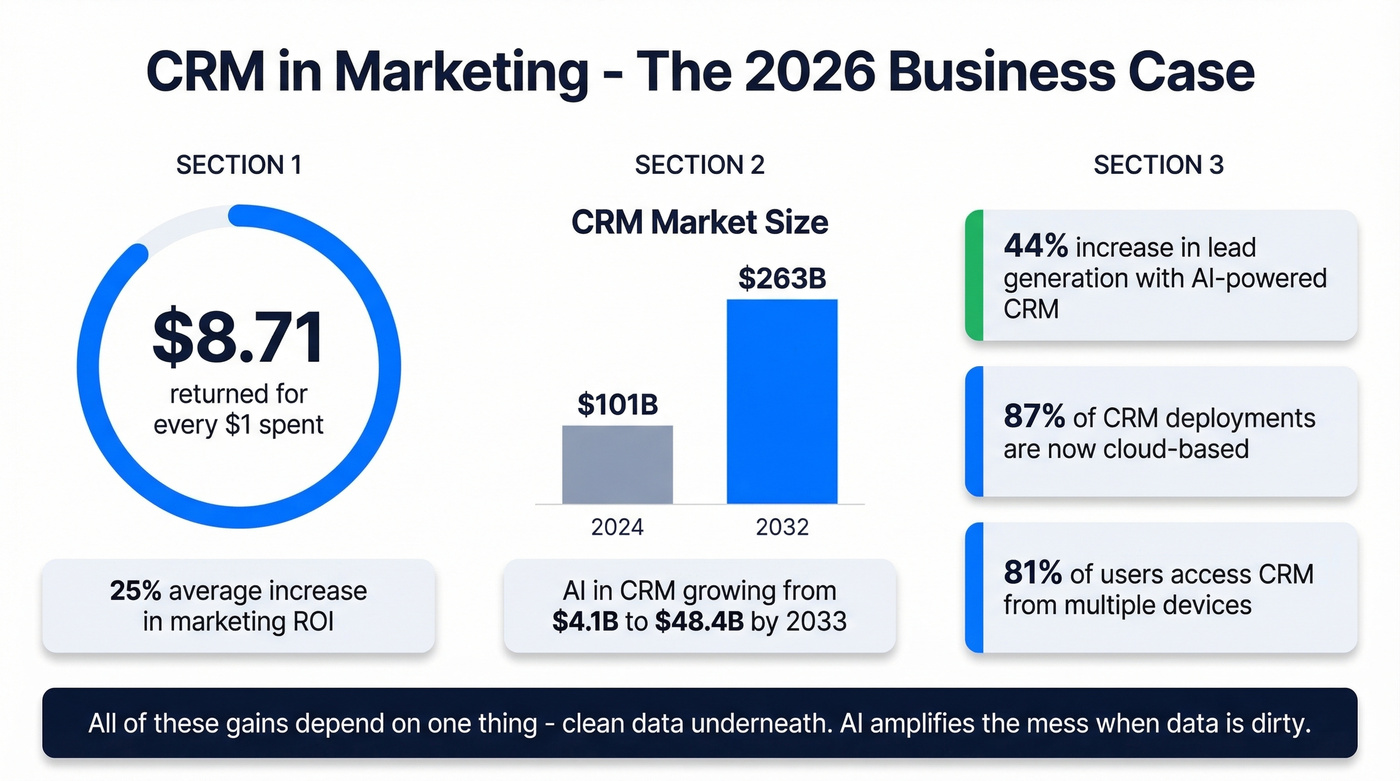
AI is transforming what CRMs can do. The AI-in-CRM market grew from $4.1B in 2023 to a projected $48.4B by 2033, and AI-powered CRM users report a 44% increase in lead generation. Predictive lead scoring, automated content recommendations, dynamic segmentation that adjusts in real time - all of this works brilliantly when your CRM data is clean. When it's dirty, AI amplifies the mess.
The infrastructure has shifted entirely to cloud and mobile. 87% of CRM deployments are now cloud-based, and 81% of users access their CRM from multiple devices. The mobile CRM market is projected at $36.24B in 2026, and mobile access increases productivity by up to 26.4%. That lift extends to marketing teams running real-time campaign adjustments - your team can trigger campaigns and check segment performance from anywhere. But only if the underlying data is solid.
Segmentation That Actually Works
Most marketing teams segment by one dimension - maybe industry, maybe company size - and call it a day. That's barely better than no segmentation at all. Real CRM segmentation uses five distinct approaches, and the best teams layer them together. This is the "Segment" step of the loop, and it's where most of the ROI lives.
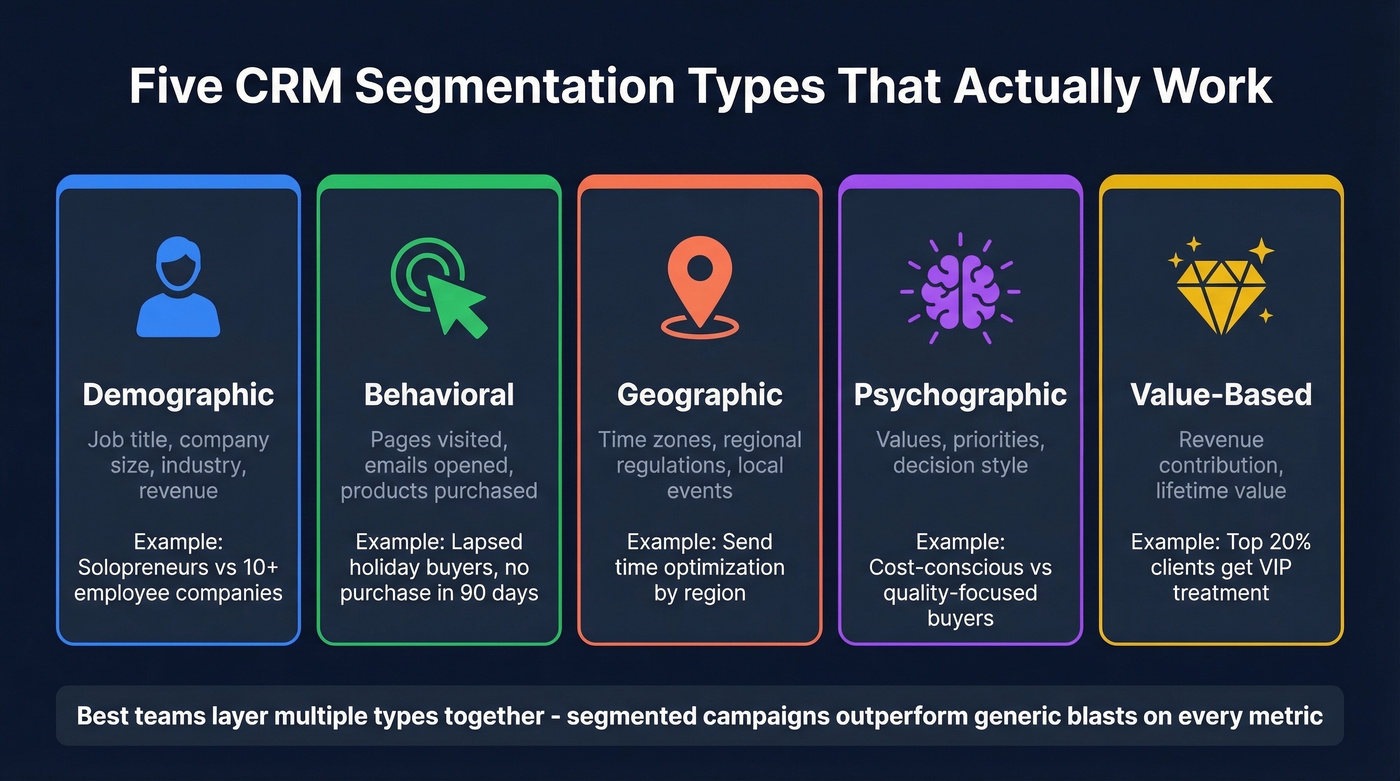
Demographic segmentation is the baseline: job title, company size, industry, revenue. An agency might segment leads into solopreneurs versus companies with 10+ employees, sending completely different content to each group.
Behavioral segmentation is where the real value sits. This means segmenting by what contacts have actually done - pages visited, emails opened, content downloaded, products purchased. A retailer creates a "lapsed holiday buyer" segment: anyone who purchased during a holiday sale but hasn't bought in 90 days. That segment gets a re-engagement discount, not the same newsletter everyone else receives.
Geographic segmentation matters more than most B2B marketers realize. Time zones affect send times, regional regulations affect messaging, and local events create campaign opportunities that generic sends miss entirely.
Psychographic segmentation groups contacts by values and priorities - cost-conscious versus quality-focused, innovation-driven versus risk-averse. This data often comes from survey responses, content engagement patterns, and sales call notes stored in the CRM.
Value-based segmentation is the one most teams skip, and it's the most important. Identify your top 20% of clients by revenue and treat them differently. Priority scheduling, quarterly business reviews, early access to new features. These VIP segments protect your highest-value relationships.
Without segmentation, email open rates typically land between 15-20%. With proper segmentation, open rates push past 30%, CTRs double, and conversions increase meaningfully. Segmented campaigns outperform generic blasts on every metric that matters.

Segmentation doubles CTRs - but only with clean data. Prospeo's CRM enrichment returns 50+ data points per contact at a 92% match rate, filling the gaps that kill your segments.
Stop segmenting dirty data. Enrich your CRM in minutes.
Automation Workflows That Drive Revenue
Every CRM marketing automation workflow follows the same structure: Trigger, Condition, Action. Master that pattern and you can build anything.
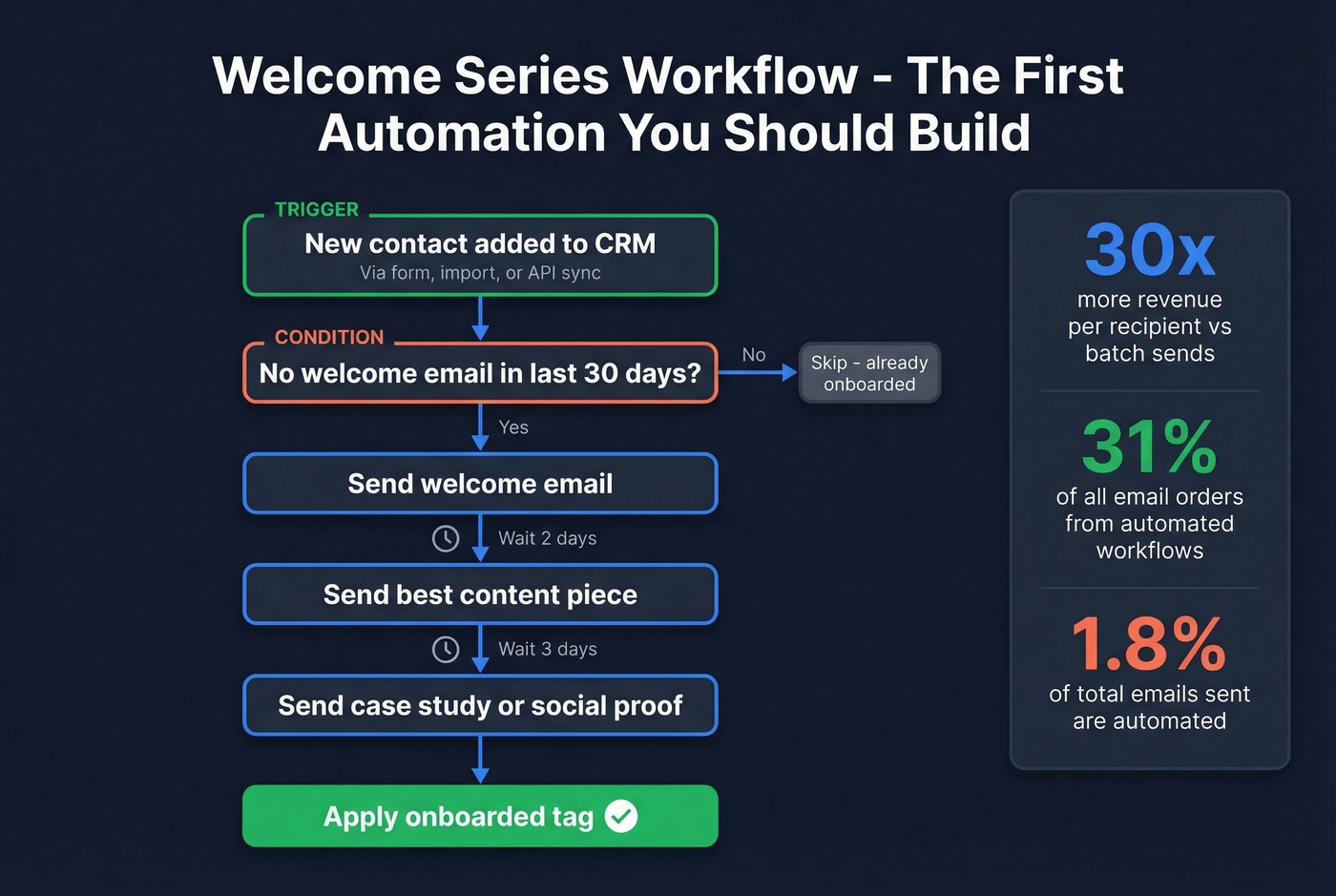
The single most important automation to set up first is a welcome series.
Trigger: A new contact is added to your CRM via form submission, import, or API sync. Condition: The contact hasn't received a welcome email in the last 30 days. Action chain: Send welcome email, wait 2 days, send follow-up with your best content piece, wait 3 days, send a case study or social proof email, apply "onboarded" tag.
Five steps. Takes 20 minutes to build in most CRMs. The impact is disproportionate: automated workflows generate 30x more revenue per recipient than batch sends. 31% of all email orders come from automated workflows, while those workflows account for just 1.8% of total emails sent.
Beyond welcome series, two other workflows deserve immediate attention. Abandoned content sequences re-engage prospects who showed intent but didn't convert - someone downloaded your pricing PDF but didn't book a demo? That's a trigger. Re-engagement workflows target contacts who've gone cold: no opens in 60 days, no site visits in 90 days. Either win them back with a compelling offer or suppress them to protect your sender reputation.
Marketing automation is linked to a 12.2% reduction in overall marketing spend, primarily by eliminating manual campaign management. Tools like ActiveCampaign ship with 900+ pre-made templates, and teams often use Zapier or Make to connect their CRM automation to other tools in the stack.
Fixing Your CRM Data
Here's the thing: you can build the most sophisticated segmentation and the most elegant automation workflows - they'll all fail if your data is garbage. This is why "Clean" comes first in the loop.
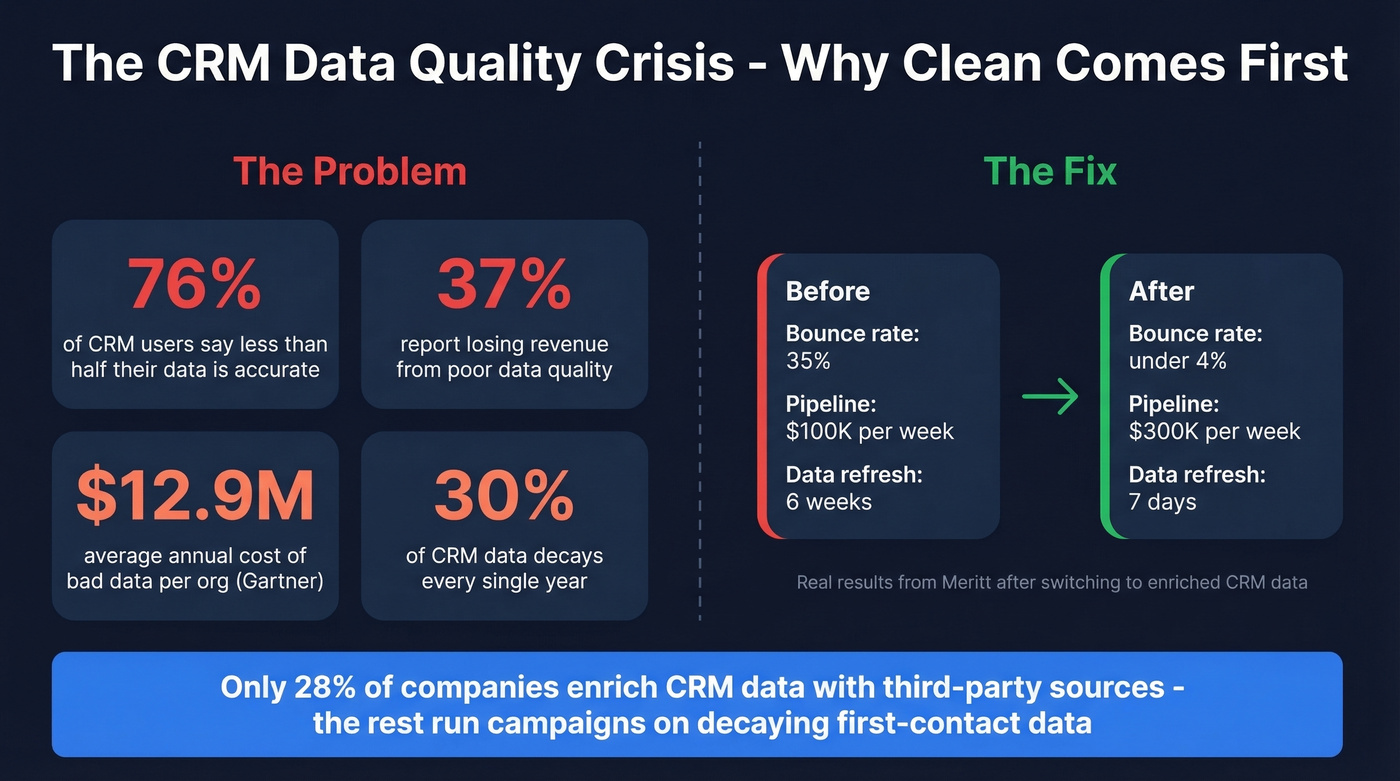
The numbers are brutal. 76% of CRM users say less than half of their data is accurate or complete. 37% report losing revenue directly because of poor data quality. Gartner pegs the average annual cost of bad data at $12.9M per organization. Only 28% of companies enrich their CRM data with third-party sources, meaning the vast majority run campaigns on whatever data they collected at first contact - which decays at roughly 30% per year.
We've seen what this looks like in practice. A marketing team builds a personalized campaign targeting 5,000 contacts, segments by industry, personalizes by job title, crafts compelling copy, and hits send. 3,200 emails bounce. 1,400 records are duplicates. 800 have the wrong first name. The campaign that was supposed to generate pipeline instead damages their domain reputation and wastes a week of work.
45% of CRM users say their data isn't prepared for AI, which means the AI-powered features they're paying for produce flawed outputs from flawed inputs.
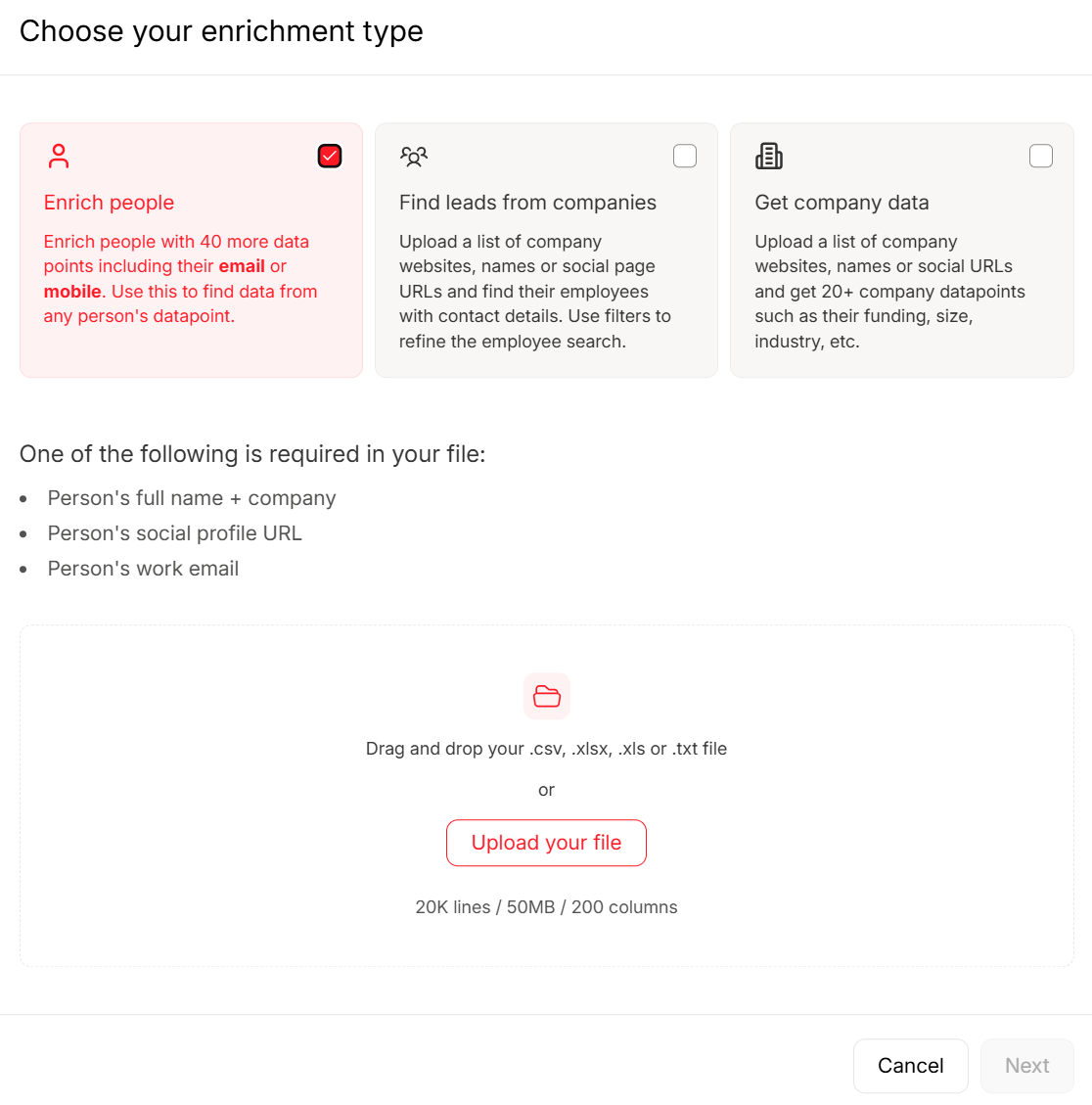
The fix requires a dedicated enrichment layer. Prospeo handles this with 98% email accuracy and an 83% enrichment match rate, filling missing fields and verifying existing records across 50+ data points per contact on a 7-day refresh cycle. One customer, Meritt, saw their pipeline triple from $100K to $300K per week after switching, with bounce rates dropping from 35% to under 4%. That's not incremental improvement - it's a step-change in campaign performance.
Every CRM tool in the next section works better with clean data underneath it. Enrichment isn't optional; it's the prerequisite. If you're comparing vendors, start with a shortlist of data enrichment services and map them to your CRM fields.
Your automation workflows trigger on data that's already stale. Prospeo refreshes every 7 days - not the 6-week industry average - so your welcome series and re-engagement campaigns hit real inboxes at $0.01 per email.
Feed your CRM automations data that's actually fresh.
Data Privacy and Compliance
If you're using CRM data for marketing in 2026, compliance isn't optional - it's existential. Over EUR 2.8B in GDPR fines have been issued since 2018, and enforcement is accelerating.
GDPR maps directly to CRM practices. You need a lawful basis - usually consent or legitimate interest - to process each contact's data, and "they gave us their email at a trade show" doesn't cut it without documented consent. Privacy notices must be clear and accessible, not buried in terms of service. Collecting an email for order confirmations doesn't automatically authorize marketing emails; don't repurpose data without explicit permission. Only collect what you actually need, set retention rules so stale contacts don't linger in active lists, and maintain encryption plus role-based access controls within your CRM.
For email specifically: explicit opt-in before marketing emails, double opt-in as best practice, an unsubscribe link in every message, consent records with timestamps and IP addresses, and opt-out processing within 72 hours. The breach reporting window under GDPR is also 72 hours - miss it and the fines multiply. CCPA adds requirements for California residents, but the GDPR framework covers most of what you need. GDPR applies regardless of where your company is located, as long as you're processing EU residents' data.
Mistakes That Kill ROI
Nearly 50% of CRM implementations fail to meet expectations. Here's the contrarian take: choosing the wrong platform is rarely the problem. Never cleaning your data is.
Skipping training. Proper training increases CRM adoption by 60%+ per Forrester. Most teams buy a CRM, run a one-hour onboarding, and wonder why reps ignore it six months later. Dedicate a full week to hands-on training, then schedule monthly refreshers.
Treating CRM as a contact database. If your team only uses the CRM to store names and emails, you're paying for a Rolodex. Build at least three automated workflows and two active segments within the first 30 days.
Ignoring integrations. Integrating CRM with your core tools yields a 20-30% productivity increase. That Reddit pain point about marketing data and sales activity living in separate systems is the direct result of running your CRM as an island. Connect your email platform, ad tools, and enrichment layer before launching any campaigns. If you're building this out, use a simple checklist to connect outreach tool to CRM without breaking attribution.
Never auditing data quality. Picture your Monday morning pipeline review: 40% of contacts have no phone number, 25% have generic company emails, and nobody's tagged by company size. You can't segment what you can't see. Run quarterly data audits and enrich continuously. If bounces are part of the problem, start with email bounce rate benchmarks and fixes.
Over-customizing before proving value. Teams spend months building custom objects and fields nobody uses. Start with out-of-the-box features, prove ROI, then customize based on actual workflow needs.
Best CRM Tools for Marketing Teams
Let's be honest: if your average deal size is under $15K, you probably don't need Salesforce-level infrastructure. HubSpot or Zoho will get you further, faster, and you can invest the savings in data quality - which matters more than any feature set. If you want a broader view, compare more examples of a CRM before you commit.
| Tool | Best For | Marketing Strengths | Starting Price |
|---|---|---|---|
| HubSpot | SMB teams under 50 | Easiest to use, free CRM | Free / ~$20/mo |
| Salesforce | Enterprise | Deepest customization | ~$25/user/mo |
| Zoho CRM | Value seekers | Rich features, Zia AI | Free (3 users) |
| ActiveCampaign | Email-first teams | 900+ automation templates | ~$29/mo |
| Mailchimp | Small businesses | Simple email + contacts | Free / ~$13/mo |
HubSpot
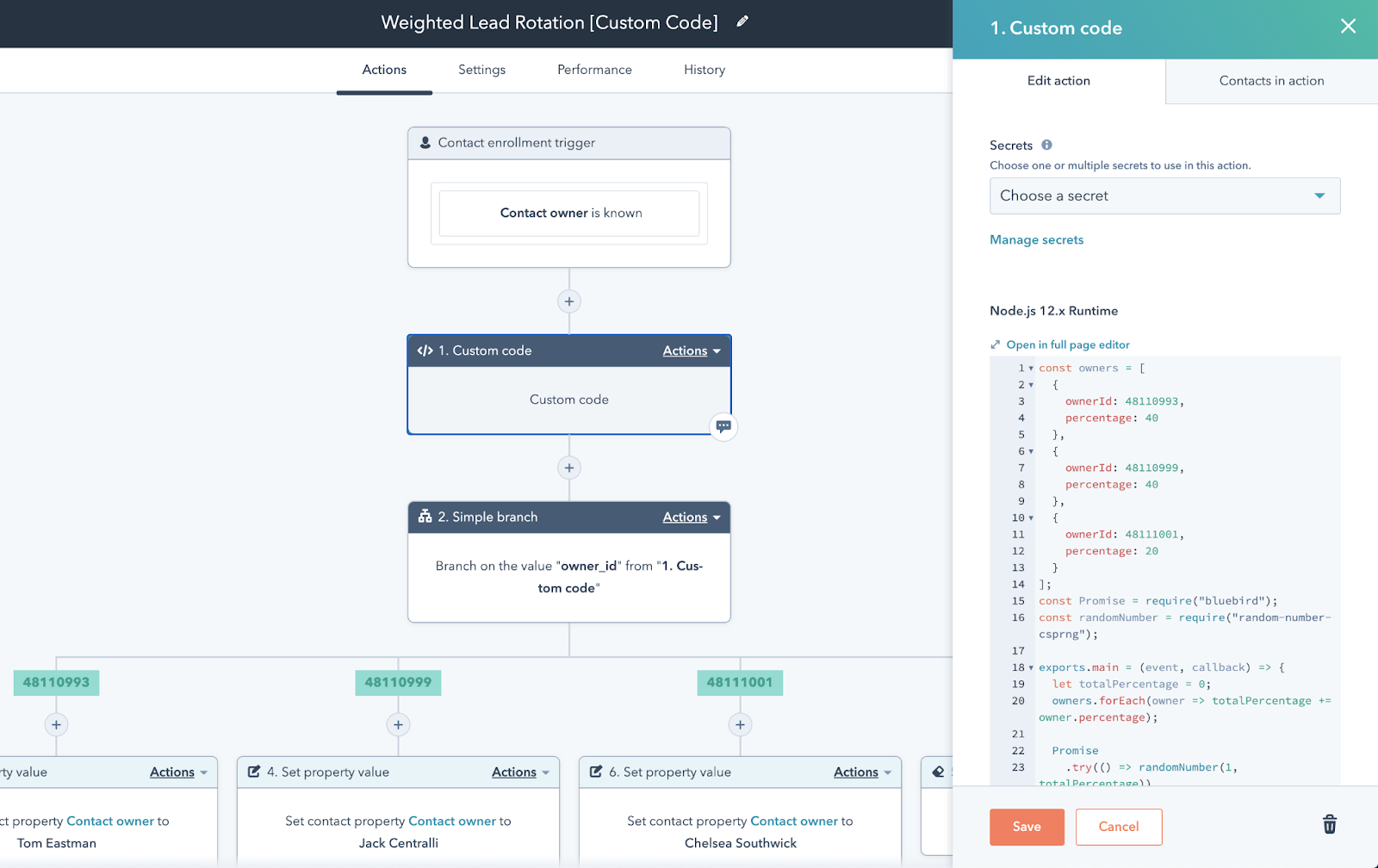
HubSpot is the obvious starting point for marketing teams under 50 people. The free CRM is genuinely useful - not a crippled trial - and Marketing Hub starts around $20/mo on entry tiers, then scales into the hundreds or thousands per month as you add automation, seats, and larger contact lists.
HubSpot moved further into seat-based packaging in 2025, and HubSpot Enrichment is included for paying customers. The ecosystem is massive, the learning curve is gentle, and for most SMB marketing teams, it's the right first CRM. The tradeoff: you'll outgrow it if your segmentation and automation needs get truly complex. In our experience, pairing HubSpot with a dedicated enrichment tool gives you the best of both worlds - a clean UI with data you can actually trust.
Salesforce
The enterprise default. 21.7% CRM market share, and 83% of the Fortune 500 use at least one Salesforce app. Marketing Cloud typically runs $1,000-$3,000+/mo depending on edition and scale, and full implementations with consulting run $25-100K+ per year.
Salesforce Starter Suite starts around $25/user/mo as a small-team on-ramp, but Salesforce is built for organizations with dedicated admins. If you don't have someone who can manage flows, custom objects, and integration architecture, you'll underutilize it badly. When it works, nothing else matches its depth. If you're budgeting, it helps to understand Salesforce pricing before you scope implementation.
Zoho CRM
PCMag's Editors' Choice for best overall CRM. Free for up to 3 users, with paid plans typically around $14-$52/user/mo. Deep customization rivaling Salesforce at a fraction of the cost, plus Zia AI for predictive scoring and anomaly detection. The marketing automation module is solid, though not as polished as HubSpot's. Best fit for teams that want feature density without enterprise pricing.
ActiveCampaign
If you think in email sequences first and CRM second, ActiveCampaign is your tool. 900+ pre-made automation templates mean you're building workflows on day one, not day thirty. Starts around $29/mo. The CRM functionality is lighter than HubSpot or Salesforce - it's a marketing automation platform with contact management bolted on. For email-heavy marketing teams, that's a feature, not a bug. To tighten performance, track your click rate formula in email marketing alongside opens.
Mailchimp
Mailchimp isn't a full CRM - it's a marketing platform with contact management. For small businesses running email campaigns and basic audience segmentation, it works. Free tier available, paid plans start around $13/mo, and Premium is around $350/mo.
Skip this if you need pipeline management, deal tracking, or complex multi-channel automation. Use this if email is your primary marketing channel and you want to be live in an afternoon. If you're seeing inbox placement issues, start with Mailchimp deliverability issues before you blame your list.
FAQ
What is CRM marketing?
CRM marketing uses customer relationship management data - demographics, behavior, purchase history, and engagement signals - to deliver personalized campaigns across email, SMS, social, and paid ads. Companies that adopt it see an average 25% increase in marketing ROI and $8.71 returned per dollar spent, primarily through better targeting and reduced waste on unqualified leads.
What's the difference between a CRM and marketing automation?
A CRM manages the customer relationship and underlying data - who your contacts are and where they sit in the lifecycle. Marketing automation executes campaigns using that data: email sequences, lead scoring, workflow triggers. Most modern platforms like HubSpot bundle both, but standalone tools like ActiveCampaign focus on execution while relying on a CRM for the data layer.
How do I choose a CRM for my marketing team?
Start with data quality, not features. Then evaluate native integrations with your existing stack, automation depth, segmentation flexibility, and pricing at your actual team size. HubSpot suits SMBs, Salesforce fits enterprise, Zoho delivers value. Run a 14-day trial with real data before committing.
How do I keep CRM data clean?
Run enrichment workflows monthly at minimum. Deduplicate on every import, enforce validation rules on required fields, and suppress contacts that bounce or go unengaged for 90+ days. A 7-day refresh cycle prevents the slow data decay that kills campaign performance - we've found that enrichment returning 50+ data points per contact fills the gaps most teams don't even realize they have.
Is CRM marketing GDPR compliant?
Yes, if you implement explicit opt-in before marketing emails, maintain consent records with timestamps and IP addresses, include unsubscribe links in every message, and report breaches within 72 hours. Choose a CRM with built-in audit trails and role-based access controls. GDPR applies regardless of your company's location when processing EU residents' data.