

=== CURRENT ARTICLE (slug: crustdata-vs-apolloio) ===
Crustdata vs Apollo.io: Which B2B Data Tool Fits Your Team?
Comparing Crustdata and Apollo.io isn't really a comparison - it's a category mismatch. Crustdata is data infrastructure for engineering teams. Apollo.io is an all-in-one sales platform for reps. Think of every B2B data purchase as three layers: the data layer, the deliverability layer, and the automation layer. Crustdata covers layer one. Apollo tries to cover all three but doesn't nail deliverability, which means you'll almost certainly need a verification tool on top of either one.
30-Second Verdict
Pick Crustdata if your engineers are building data pipelines or AI SDR agents via API.
Pick Apollo if your reps want one platform for prospecting, sequencing, and calling - and you'll budget for email verification separately.
Skip both if verified emails are your top priority and you don't want to stitch tools together.
What Each Tool Actually Does
Apollo.io
Apollo is the Honda Civic of sales tools - ubiquitous and functional until you push it hard. Its B2B database includes 210M+ contacts and 35M+ companies, and the platform bundles an email sequencer, dialer, and CRM in one package. It holds a 4.7/5 on G2 with 9,500+ reviews, which is genuinely impressive for a tool at this price point. The recurring complaint? Bounce rates can be brutal, especially outside the US. We've seen teams burn through sender reputation in a single campaign because they trusted Apollo's "verified" labels without running a second check.
If you're evaluating similar all-in-one databases, start with our breakdown of sales prospecting databases.
Crustdata
Crustdata is a YC-backed data infrastructure company offering 12M+ company profiles and 250M+ employee profiles via API access and monthly flat-file datasets. It's not a rep-friendly UI like Apollo - it's primarily API and dataset-driven, with webhooks and alerts for real-time signals. If you don't have a data engineer on staff, Crustdata isn't for you.
If you're comparing vendors mainly on enrichment coverage, see our guide to data enrichment services.
Feature-by-Feature Breakdown
| Feature | Crustdata | Apollo.io |
|---|---|---|
| Database | 12M+ companies, 250M+ people | 210M+ contacts, 35M+ companies |
| Data freshness | Monthly flat-file; real-time signals via API | Large database; accuracy varies by region |
| Pricing | ~$200/mo starter; higher tiers custom | $49-$119/seat/mo + credits |
| API quality | Production-grade, API-first | Professional plan includes API access |
| Built-in outreach | None | Sequencer, dialer, CRM |
| Email verification | No native verification | No native verification |
| Ease of use | Requires engineering resources | Self-serve UI |
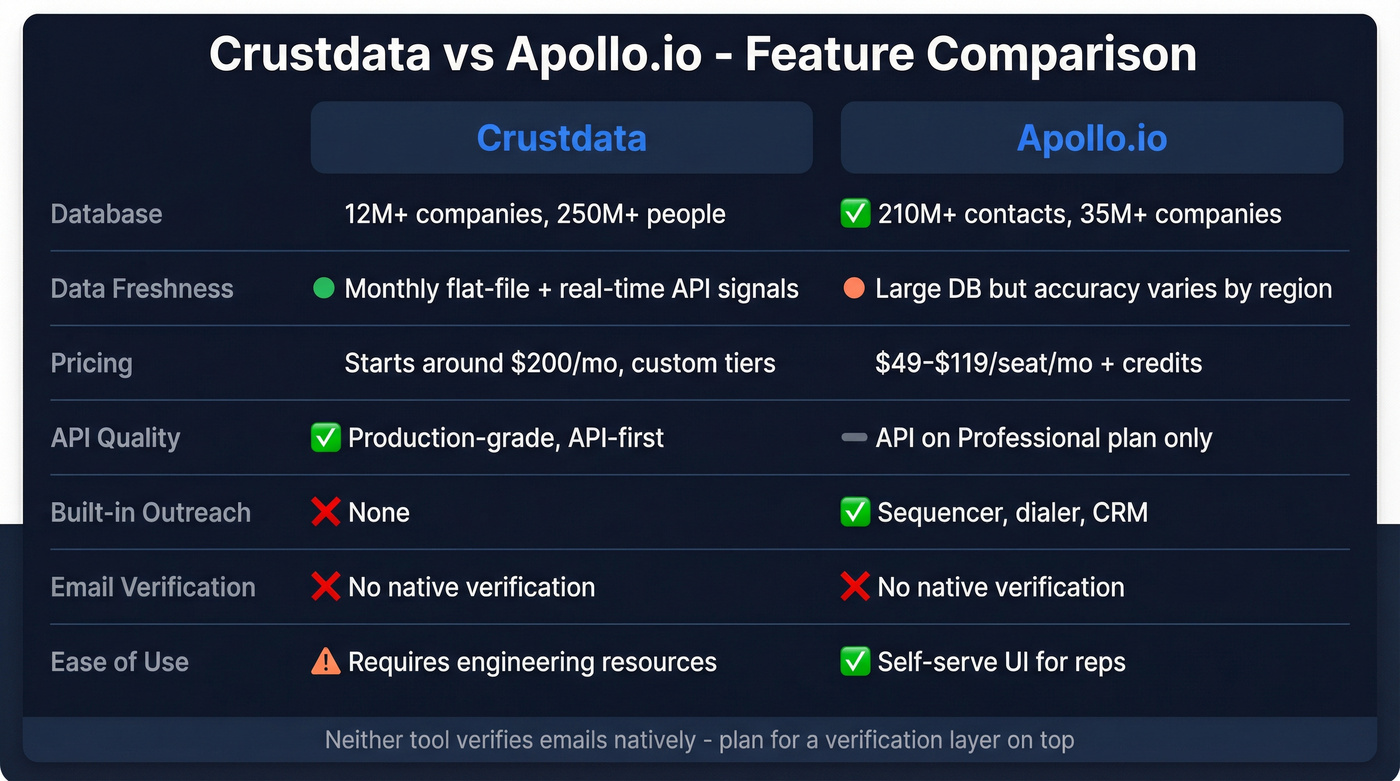
Crustdata wins on API depth. Apollo wins on accessibility. Neither wins on data accuracy. If deliverability is the deciding factor, compare options in our list of Bouncer alternatives.

Apollo users report 32-38% bounce rates. Crustdata doesn't verify emails at all. Prospeo's 5-step verification delivers 98% email accuracy with a 7-day data refresh - no second tool required, no engineering resources needed.
Stop stitching tools together. Get verified contacts in one step.
How Does Data Quality Compare?
Here's the thing: in our testing across multiple enrichment stacks, teams using a waterfall approach - stacking multiple data sources then verifying - got bounce rates down to roughly 10-14%. That's the bar to aim for, and neither tool hits it alone. (If you want the benchmarks and fixes, see our guide to email bounce rate.)
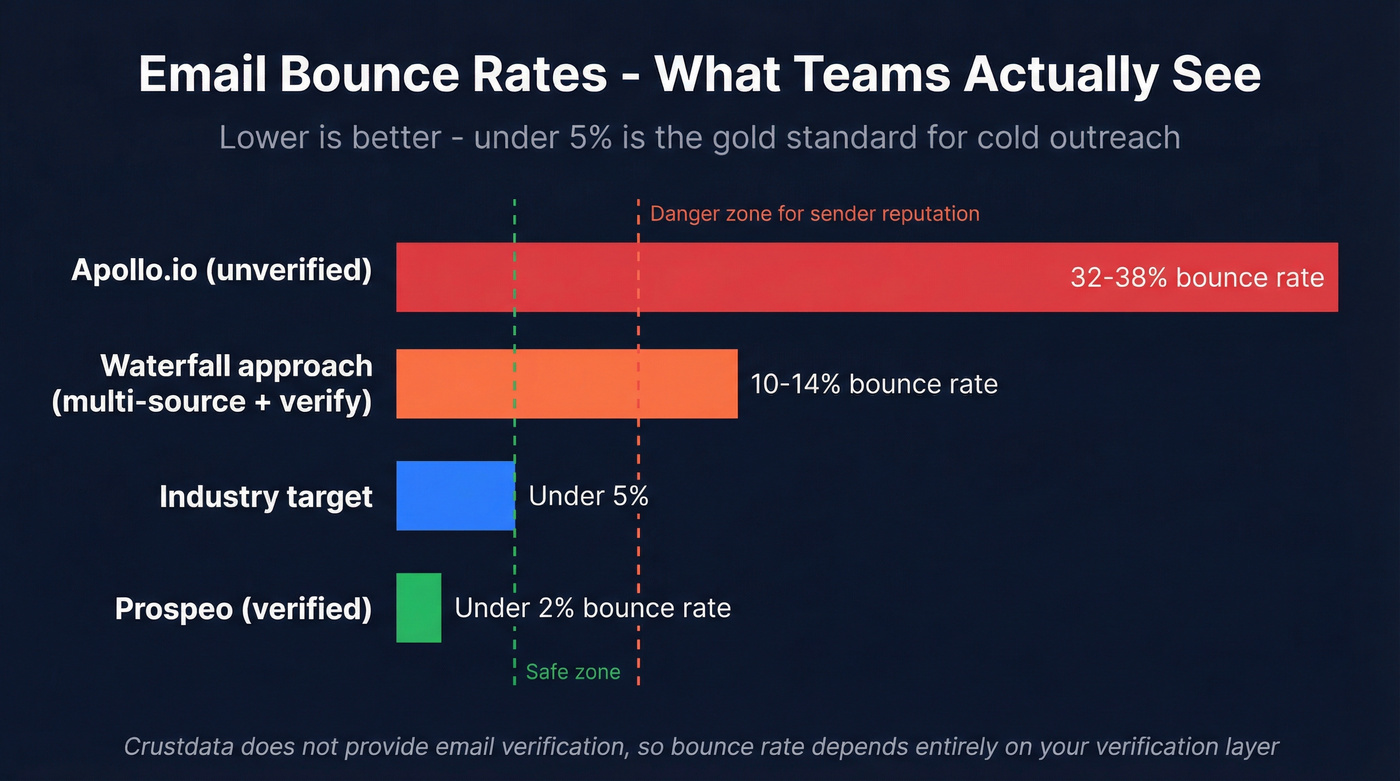
Practitioner testing on Reddit puts Apollo's bounce rates at 32-38%. One agency found 80-90% of profiles in their Apollo lists looked abandoned. That's not a minor data issue - that's a domain reputation killer. If you're sending 500 cold emails a day off Apollo data without verification, you're gambling with your sender score every single morning.
Crustdata is built for real-time company and people data workflows - signals, alerts, enrichment, discovery - and also offers monthly flat-file datasets. Great infrastructure, but still not a verification layer by itself. If you're building a modern outbound stack, our email deliverability guide explains what to fix first.
Pricing Breakdown
Apollo tiers:
| Free | Basic | Professional | Organization | |
|---|---|---|---|---|
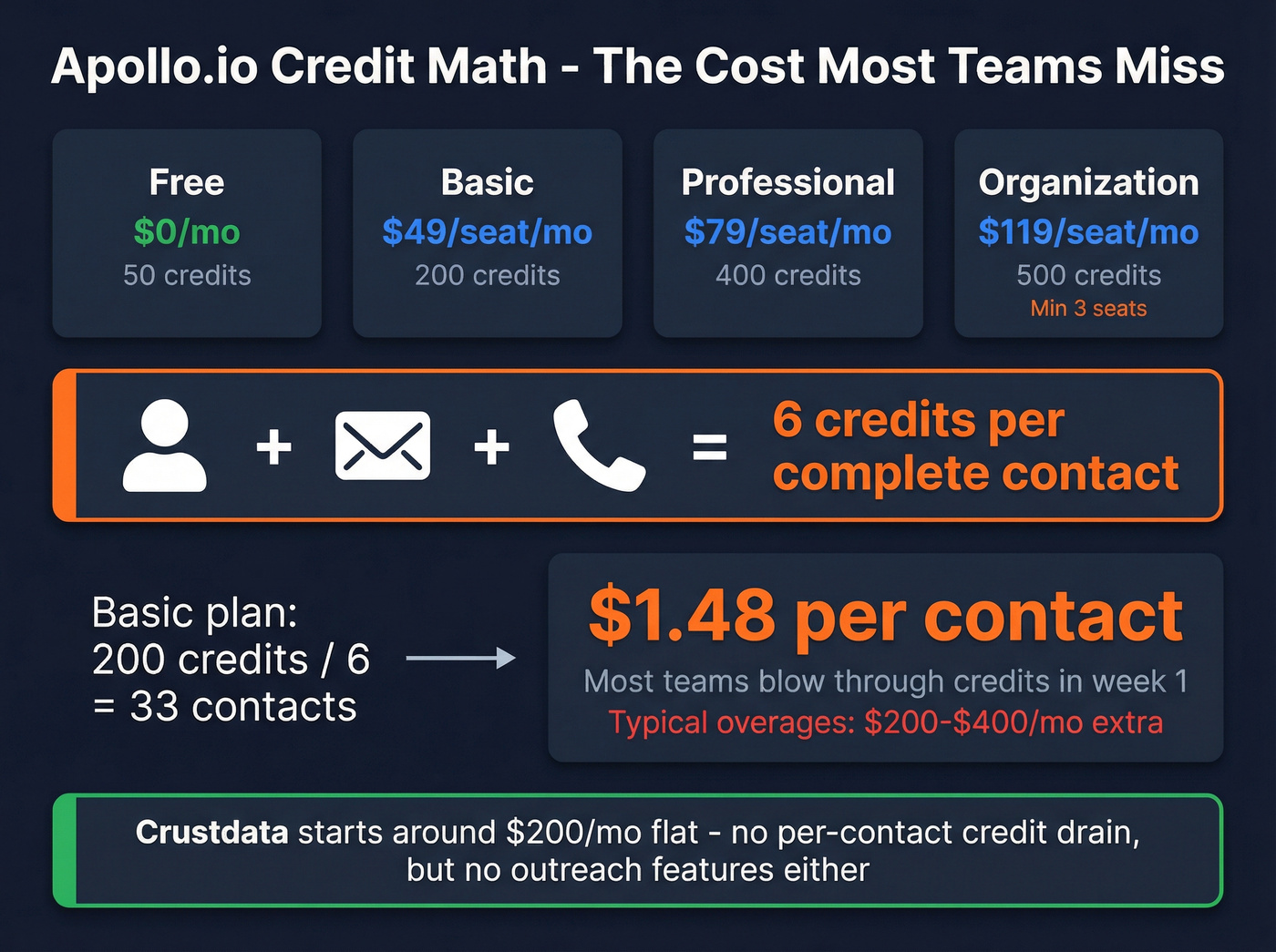
| Price | $0 | $49/seat/mo | $79/seat/mo | $119/seat/mo (min 3 seats) |
| Credits/mo | 50 | 200 | 400 | 500 |
Here's the math most people miss. Exporting one contact with email and mobile costs 6 credits. On the Basic plan, that's 33 complete contacts per month for $49/seat. Most teams blow through credits in the first week and spend $200-$400/mo in overages. Credits don't roll over.
Crustdata doesn't publish pricing publicly - their pricing page describes credit-based tiers without a single dollar figure. Expect starter plans around ~$200/mo for lighter directory and dataset use, scaling into the thousands for heavier API access and enterprise workflows.
If you're trying to avoid credit systems entirely, you may prefer tools in our roundup of free lead generation tools.
Who Should Pick Which
Engineers building data pipelines or AI SDR agents: Crustdata. Nothing here matches its developer experience for real-time signals and API-driven enrichment. (For more stack options, see our list of the best SDR tools.)
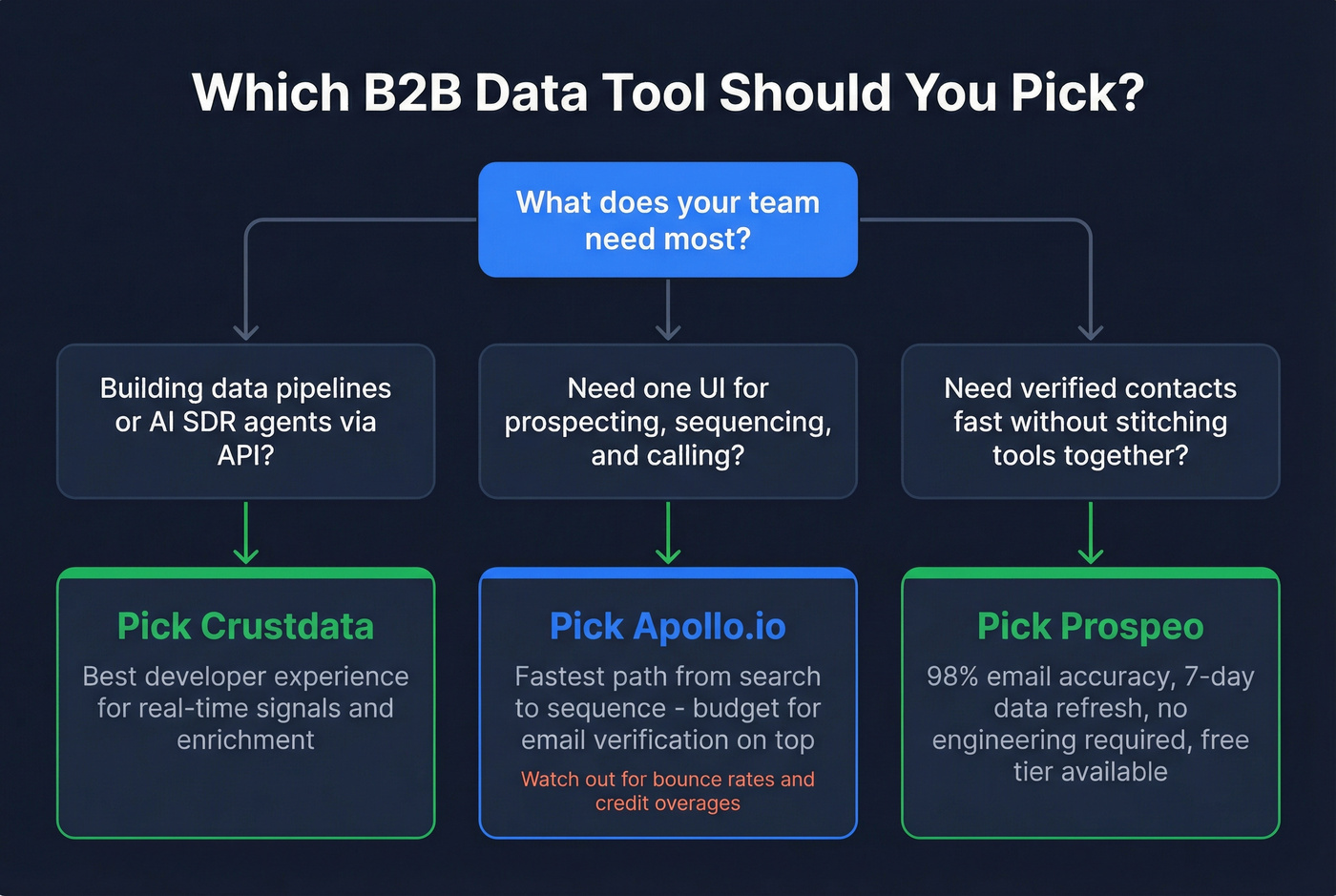
Reps wanting a single UI for prospecting and outreach: Apollo. It's the fastest path from search to sequence. Just know it's weak for local SMB outreach and budget for verification on top. If you're improving your outbound motion, use these sales prospecting techniques to tighten targeting before you scale volume.
Teams that need verified contacts fast without stitching tools together: Prospeo. Upload a CSV or search by 30+ filters, export verified emails and mobiles, push to your sequencer. No engineering required, no credit math headaches. With 300M+ professional profiles, 98% email accuracy, and a 7-day data refresh cycle, it fills the deliverability gap that both Crustdata and Apollo leave open.

When Deliverability Is the Actual Problem
Let's be honest - most teams comparing these tools aren't really shopping for data infrastructure or workflow automation. They're shopping for contacts that actually reach inboxes. If that's you, Prospeo is worth a look. Meritt tripled their pipeline after switching: bounce rates dropped from 35% to under 4% in the first campaign. Free tier available, paid plans from ~$39/mo, no seat fees.
To keep volume safe as you scale, follow best practices around email velocity.
Apollo mobiles connect at ~11%. Crustdata doesn't offer direct dials. Prospeo gives you 125M+ verified mobile numbers with a 30% pickup rate - 3x higher than Apollo - at $0.01 per email with no seat fees.
Fill the deliverability gap both tools leave wide open.
FAQ
Can I use Crustdata and Apollo together?
Yes - some teams use Crustdata's API for company-level signals, then Apollo for contact discovery within those accounts. You'll still want a verification layer to avoid bounces, since neither tool verifies emails natively.
Which tool has better phone data?
Apollo includes mobiles, but users on r/sales report low connect rates around 11%. Crustdata doesn't focus on direct dials. Prospeo offers 125M+ verified mobiles with a 30% pickup rate - roughly 3x higher than what Apollo users report.
Is Crustdata or Apollo better for small teams?
Apollo is more accessible thanks to its self-serve UI and free tier. Crustdata requires engineering resources and starts around $200/mo with no outreach features. For small teams that primarily need accurate contact data without building pipelines, a verification-first tool with a free tier will get you to results faster than either option.
Are these tools GDPR compliant?
Both vendors publish compliance documentation, but review each DPA before purchasing. Apollo's DNC screening covers only the US and the UK. If you're selling into the EU, make sure whatever tool you pick enforces global opt-out - not just US/UK lists.