

The Only Customer Profiling Template Guide You'll Actually Use
Most customer profiling templates are blank worksheets that look productive but produce nothing. You download them, fill in some demographics, share them in a Slack channel, and never open them again.
This guide gives you a customer profiling template that works - with filled-in examples, a scoring rubric, and the methodology to populate it with real data instead of guesses.
Here's the thing: if your average deal is in the low five figures, you don't need a 40-field ICP document. You need a one-page profile with disqualification criteria and a scoring rubric. That's it. Everything else is theater.
What You Need (Quick Version)
B2B teams: grab the ICP scoring rubric template below - it's the only format that turns profiling into prioritization. B2C teams: use the demographic + psychographic + behavioral template and keep it to one page. Don't fill any template from assumptions. Talk to 10+ customers first, then enrich with real contact data.
What Is Customer Profiling?
A customer profiling template is a structured document that captures who your best customers are - demographics, behaviors, pain points, buying patterns - so you can find more people like them. Three related concepts get used interchangeably. They shouldn't be.
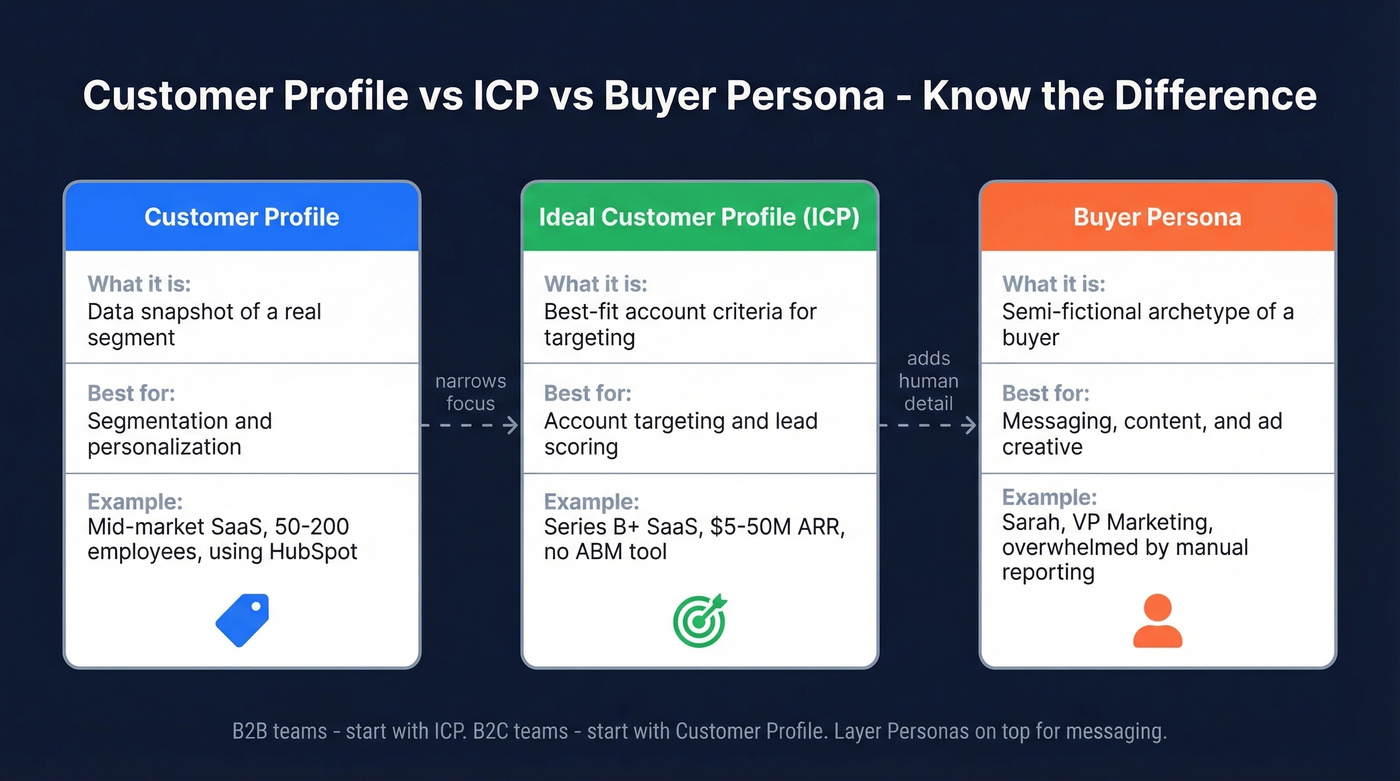
| Customer Profile | Ideal Customer Profile (ICP) | Buyer Persona | |
|---|---|---|---|
| What it is | Data snapshot of a real segment | Best-fit account criteria | Semi-fictional archetype |
| When to use | Segmentation, personalization | Account targeting, lead scoring | Messaging, content, ad creative |
| Example | "Mid-market SaaS, 50-200 employees, using HubSpot" | "Series B+ SaaS, $5-50M ARR, no ABM tool" | "Sarah, VP Marketing, overwhelmed by manual reporting" |
For B2B teams, the ICP matters most for pipeline. For B2C, the customer profile drives segmentation and personalization. Personas layer on top of both for messaging.
Why Customer Profiling Drives Revenue
Profiling isn't a marketing exercise. It's a revenue lever.
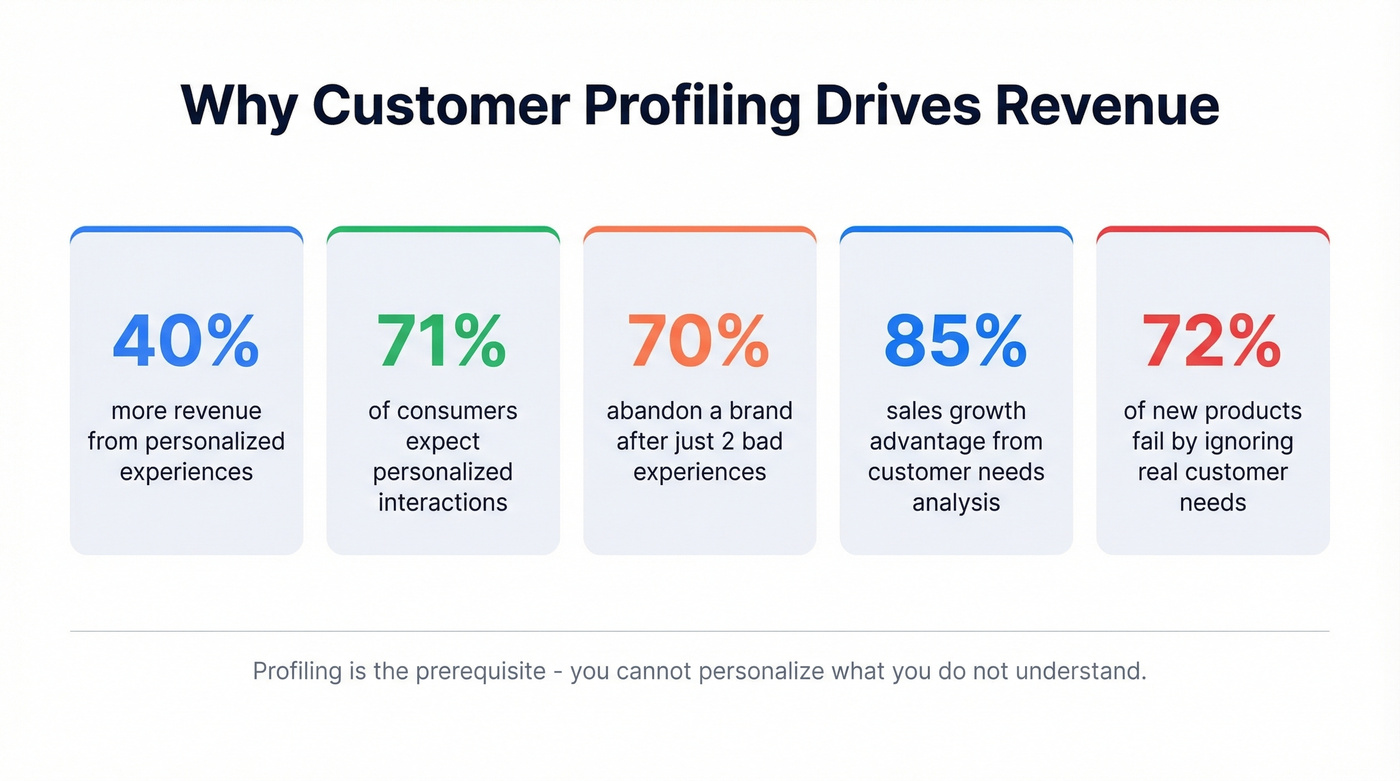
71% of consumers expect personalized interactions, and 76% get frustrated when it doesn't happen. That frustration compounds fast: 70% of customers abandon a brand after just two bad experiences, and 72% switch after three or fewer poor interactions. On the flip side, 61% will spend at least 5% more when they get a good experience - profiling is how you deliver that experience at scale.
The payoff is clear. Companies that provide a personalized experience can generate 40% more revenue, and 74% of consumers say hyper-personalization powered by AI improves their experience. None of that personalization works without knowing who your customer actually is.
Profiling is the prerequisite. Companies excelling at customer needs analysis outperform their markets by 85% in sales growth, while 72% of new products fail because they don't address genuine customer needs. The template is the starting point - the data you put in it determines whether it drives revenue or collects dust.
What to Include in Your Template
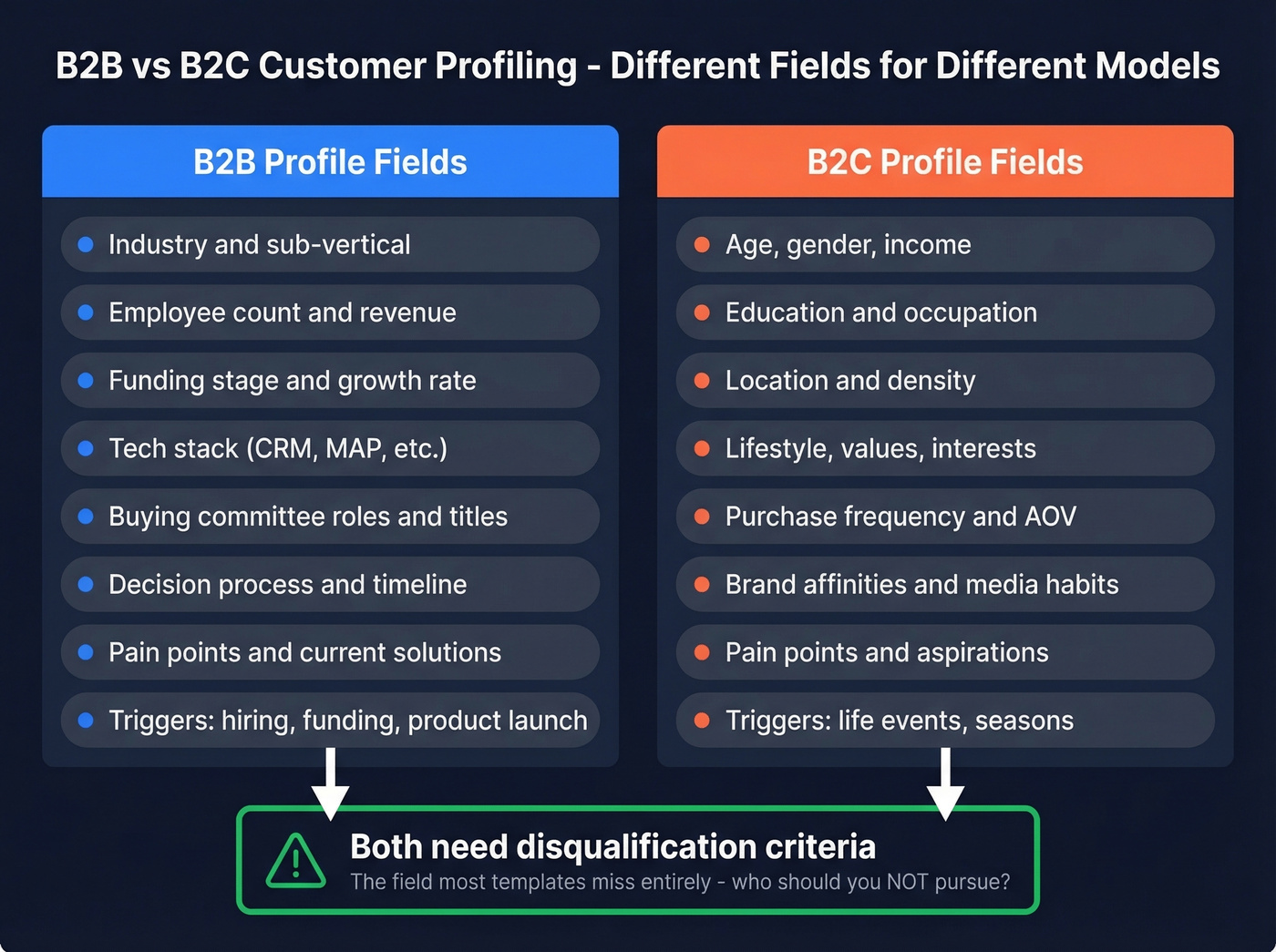
B2B and B2C profiles need fundamentally different fields. Building a B2B profile with B2C demographics is the single most common mistake we see, and it's why most templates end up useless.
| B2B Fields | B2C Fields |
|---|---|
| Industry, sub-vertical | Age, gender, income |
| Employee count, revenue | Education, occupation |
| Funding stage, growth rate | Location, urban/suburban/rural |
| Tech stack (CRM, MAP, etc.) | Lifestyle, values, interests |
| Buying committee roles + titles | Purchase frequency, AOV |
| Decision process + timeline | Brand affinities, media habits |
| Pain points + current solutions | Pain points + aspirations |
| Triggers: hiring, funding, product launch | Triggers: life events, seasons |
| Disqualification criteria | Disqualification criteria |
| Channels + communities they follow | Preferred channels + platforms |
The field most templates miss entirely is disqualification criteria. One practitioner on r/SaaS described realizing that "I target Indie Hackers" was too vague - the segment didn't have the willingness or ability to pay. Disqualification criteria would've caught that before wasted months of outreach.
For B2B, think about disqualification across three dimensions: financial readiness, urgency, and readiness to change. If an account can't pay, doesn't care yet, or is locked into a competitor contract for 18 more months, no amount of outreach will close them.
Free Templates to Download
Here are three template formats, each designed to be filled in, not admired. Copy these sections into Google Sheets or Notion and you're ready to go.
B2B ICP Template - Key fields: Industry & sub-vertical, employee count & revenue, funding stage, tech stack, buying committee roles & titles, decision timeline, pain points & current solutions, buying triggers, disqualification criteria, channels & communities.
B2C Customer Profile Template - Key fields: Age, gender, income, education & occupation, location & density, psychographics (values, interests, lifestyle), behavioral patterns (frequency, AOV, repurchase rate), purchase triggers, preferred channels, disqualification criteria.
ICP Scoring Rubric - Key fields: Six weighted scoring dimensions, engagement event point values, time-decay rules, routing thresholds with SLAs, score-to-action mapping. Full breakdown in the scoring section below.
All three include the disqualification criteria section that generic templates skip.

A customer profiling template filled with stale data is worse than no template at all. Prospeo enriches your ICP with 50+ data points per contact - tech stack, funding stage, headcount growth, and buyer intent across 15,000 topics - all refreshed every 7 days. 83% of leads come back with verified contact data at $0.01 per email.
Turn your ICP template into a live pipeline with real enrichment data.
Filled-In Examples
Templates are useless without context. Here's what completed profiles actually look like.
B2B SaaS Example
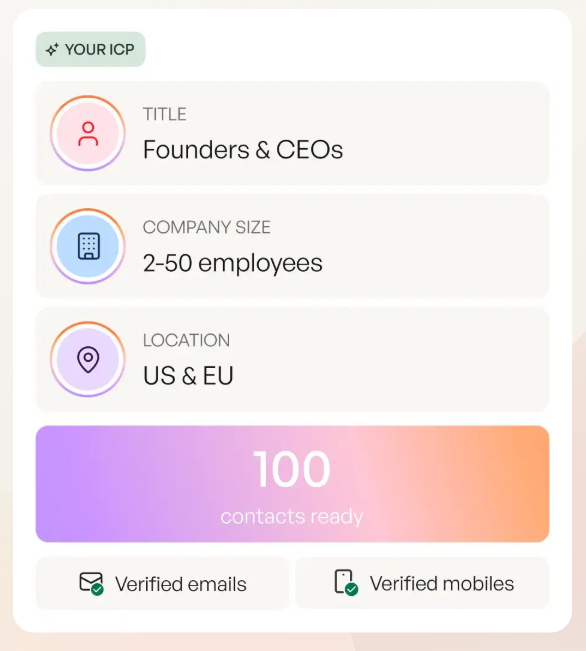
Let's say you sell an ABM platform to mid-market SaaS companies. Here's your completed ICP:
| Field | Example Data |
|---|---|
| Company type | B2B SaaS, marketing automation |
| Employee count | 50-200 |
| Annual revenue | $5M-$25M |
| Funding stage | Series A or B |
| Tech stack | HubSpot CRM, no ABM tool, Outreach for sequences |
| Buying committee | VP Marketing (champion), Head of RevOps (evaluator), CFO (approver) |
| Pain points | Low pipeline conversion, manual lead scoring, no intent data |
| Current solution | Spreadsheet-based ICP, ZoomInfo on a legacy contract |
| Triggers | New VP Marketing hire, missed quarterly targets, board pressure on efficiency |
| Disqualification | <$3M ARR, no dedicated marketing team, locked into 2-year competitor contract |
| Channels | Pavilion community, SaaStr content, RevOps Co-op Slack |
B2C E-Commerce Example
| Field | Example Data |
|---|---|
| Age / Gender | 28-42, skews female (65%) |
| Income | $60K-$120K household |
| Location | Urban/suburban, US + UK |
| Psychographics | Values sustainability, prefers DTC brands, researches before buying |
| Behavioral | Browses 3-5 times before purchase, avg order $85, repurchases quarterly |
| Purchase triggers | Seasonal transitions, influencer recommendations, free shipping thresholds |
| Preferred channels | Instagram, email newsletters, TikTok product reviews |
| Disqualification | Price-only shoppers with no brand loyalty, returns >40% of orders |
These are more detailed than what you'll find in most template roundups - deliberately so. A profile that says "marketing managers aged 30-45" tells you nothing actionable. A profile that includes the tech stack, buying committee, and disqualification criteria tells you exactly who to pursue and who to skip.
How to Build Your Profile Step by Step
A blank template is step one. Here's how to fill it with data that's actually real.
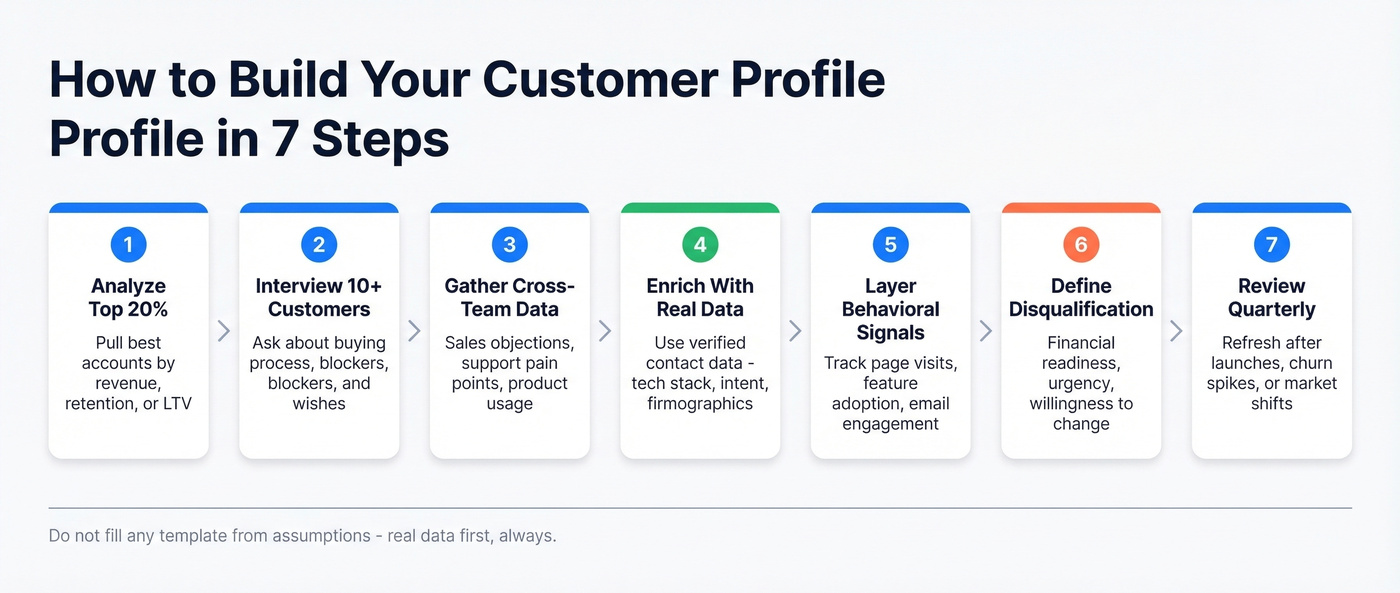
Step 1: Start With Your Best Customers
Pull your top 20% of accounts by revenue, retention, or LTV. Look for patterns in industry, size, tech stack, and acquisition channel. This is your foundation - not assumptions, not TAM slides.
Step 2: Talk to Real People
Aim for 10+ interviews per segment. Ask about their buying process, what almost stopped them, and what they wish they'd known earlier. Demographics alone are weak. Behavioral and psychographic layers separate useful profiles from decorative ones.
Step 3: Gather Data Across Teams
Sales knows objections. Support knows pain points. Product knows usage patterns. Customer profiling isn't a marketing-only exercise - 30% of CMOs say improving data quality is their biggest lever.
Step 4: Enrich With Verified Data
Once you've defined your ICP criteria, populate the template with real contact data. Prospeo's B2B database lets you search by 30+ filters - buyer intent, technographics, job changes, headcount growth - and returns 50+ data points per contact with 98% email accuracy. This is where the template goes from strategy doc to targeting list.

Step 5: Layer In Behavioral Signals
CRM data, product analytics, and engagement history reveal what customers actually do - not just what they say. Track page visits, feature adoption, email engagement, and support tickets. We've found that behavioral data often contradicts what customers report in interviews, so trust the numbers when they diverge.
Step 6: Define Disqualification Criteria
Write down the specific attributes that make an account a bad fit - even if they look good on paper. Financial readiness, urgency, and willingness to change are the three filters that matter most.
Step 7: Review and Refresh Quarterly
Profiles decay. Set a quarterly review cadence for fast-moving SaaS/SMB segments, biannually for stable enterprise markets. Trigger an immediate refresh after a product launch, a churn spike, or a major market shift.
ICP Scoring Rubric
Describing your ideal customer is useful. Scoring them is what makes profiling operational.
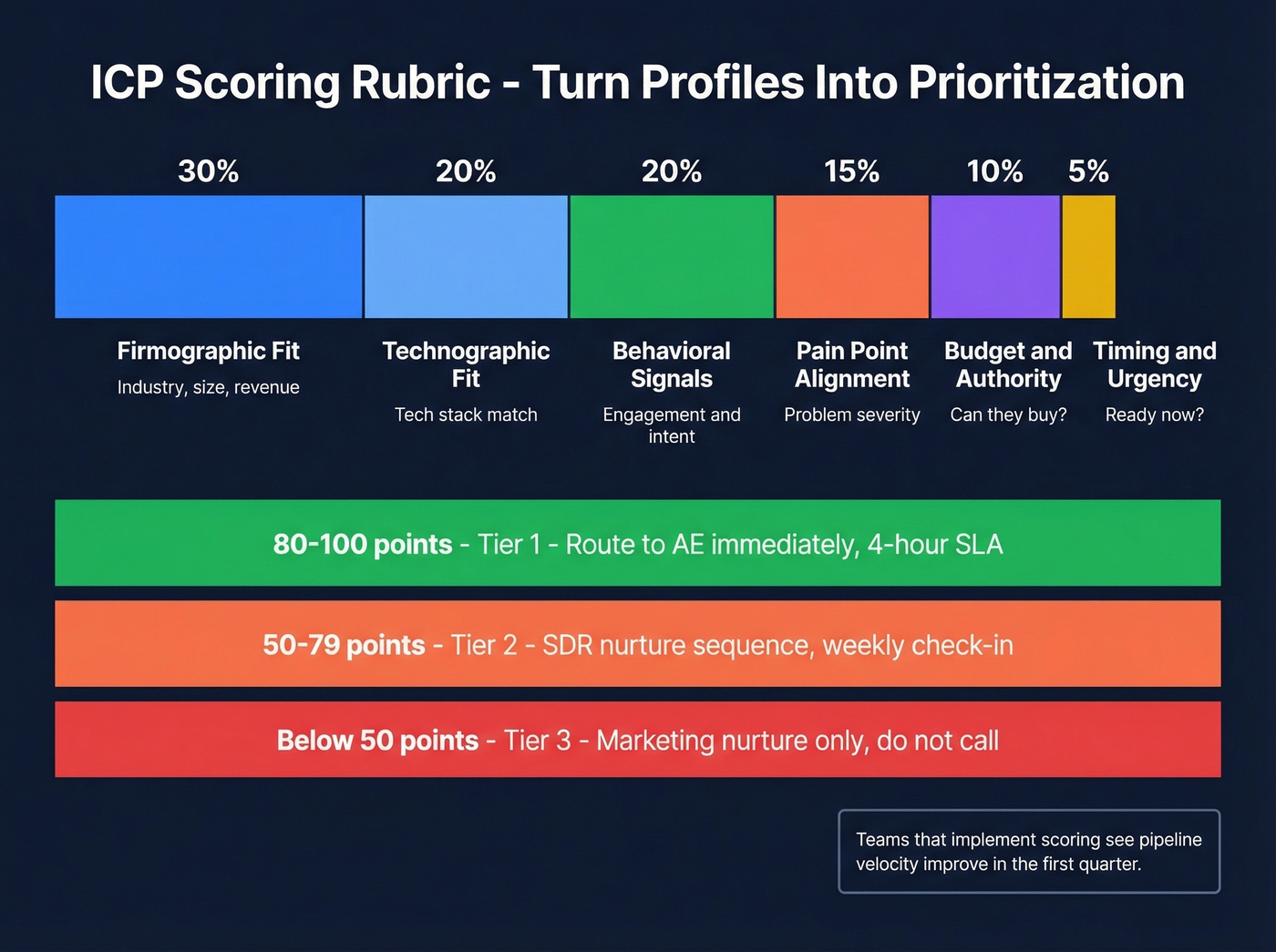
This rubric turns qualitative profiles into quantitative prioritization, and it's the single biggest differentiator between teams that "do profiling" and teams that actually close deals from it. In our experience, teams that implement scoring see pipeline velocity improve within the first quarter because reps stop wasting time on accounts that were never going to close.
Dimension Weights
| Dimension | Weight | What It Measures |
|---|---|---|
| Firmographic fit | 30% | Industry, size, revenue, geography |
| Technographic overlap | 20% | Tech stack compatibility |
| Intent signals | 15% | Active research behavior |
| Engagement behavior | 15% | Interactions with your content/team |
| Buying triggers | 10% | Funding, hiring, leadership changes |
| Economic outcome | 10% | Expected deal size, LTV potential |
Engagement Scoring Events
| Event | Points | Rationale |
|---|---|---|
| Pricing page visit | +10 | Strong buying signal |
| Webinar attendance | +8 | Active evaluation |
| Direct email reply | +5 | Engaged, responsive |
| Two-week inactivity | -7 | Interest cooling |
Apply a time-decay rule: signals older than 30 days lose 50% of their value. A pricing page visit from yesterday is worth +10. The same visit from six weeks ago? Worth +5.
Routing Thresholds
| Score | Label | Action | Timeline |
|---|---|---|---|
| 80-100 | Hot | SDR call | Within 5 minutes |
| 60-79 | Warm | Sequence + SDR call | Within 24 hours |
| <60 | Nurture | Marketing nurture | Until engagement increases |
This is the template format we recommend for any B2B team running outbound at scale. Instead of debating whether an account is "a good fit," you score it, route it, and move on.
AI Prompt for Customer Profiling
Use this prompt as a starting point - not a finished product. Paste it into ChatGPT, Claude, or any LLM, then iterate.
You are a B2B customer research analyst. Build a detailed ideal customer
profile for [YOUR PRODUCT/SERVICE].

Before generating the profile, ask me 5 clarifying questions about:
- Our product's core value proposition
- Our current best customers (industry, size, use case)
- Our pricing model and average deal size
- Our competitive landscape
- Markets or segments we've intentionally excluded

Then output a structured profile covering:
1. Firmographics (industry, employee count, revenue, funding stage)
2. Technographics (current tools, integration requirements)
3. Buying committee (roles, titles, decision process)
4. Pain points (ranked by severity and frequency)
5. Buying triggers (events that create urgency)
6. Decision criteria (what they evaluate, in what order)
7. Disqualification signals (who looks good but isn't)
8. Channels and communities where they spend time

Be specific to the industry and company stage. No generic filler.
AI gives you a solid first draft in minutes. But it can't replace the 10+ customer interviews that reveal what people actually think versus what they tell surveys. Use AI to generate hypotheses, then validate with real conversations.
Mistakes That Kill Customer Profiles
Do: Build B2B profiles around firmographics and buying committees.
Don't: Treat B2B profiles like B2C demographic snapshots. "Marketing managers aged 30-45" isn't an ICP - it's a LinkedIn ad audience.
Do: Interview customers and talk to your sales team.
Don't: Create "fairytale personas" in a conference room without a single customer conversation. The consensus on r/b2bmarketing is clear - profiles built without customer or sales input become shelfware.
Do: Include disqualification criteria in every template.
Don't: Assume everyone who matches your firmographics is a good fit. Financial readiness, urgency, and willingness to change save your team months of wasted effort.
Do: Connect your data sources and refresh regularly.
Don't: Let profiles rot. The average enterprise spreads data across 897 applications, with only 29% effectively connected. If your profile data is stale or siloed, your targeting is wrong.
Do: Share profiles across sales, marketing, product, and CS.
Don't: Treat profiling as a marketing-only exercise. Skip this step and you'll end up with marketing chasing one audience while sales qualifies a completely different one.
Tools for Customer Profiling
You don't need an expensive tech stack. You need the right tool for each layer.
| Tool | Category | Starting Price |
|---|---|---|
| Prospeo | Data enrichment | Free tier; ~$0.01/email |
| HubSpot CRM | CRM + segmentation | Free; paid from ~$15/user/mo |
| Salesforce | CRM + analytics | From ~$25/user/mo |
| Google Analytics | Behavioral data | Free |
| Pipedrive | CRM + pipeline | From ~$14.90/user/mo |
For enrichment, Prospeo bridges the gap between "I have a template" and "I have a populated profile with real contact data." Its database covers 300M+ profiles with 143M+ verified emails and 125M+ verified mobiles, searchable by 30+ filters including buyer intent and technographics. The 83% enrichment match rate and 7-day data refresh cycle keep profiles current rather than stale.
For CRM, HubSpot's free tier handles basic profiling and segmentation for most early-stage teams. Salesforce is the enterprise standard but requires more setup. Google Analytics fills the behavioral layer at no cost.
You just built your ICP scoring rubric. Now you need the data to score against. Prospeo's 30+ search filters - including technographics, funding stage, department headcount, and job changes - map directly to the profiling fields above. Filter 300M+ profiles by your exact ICP criteria and export verified emails with 98% accuracy.
Stop profiling from guesses. Search your exact ICP criteria across 300M+ contacts.
FAQ
How often should I update my customer profile?
Quarterly for SaaS and SMB segments, biannually for stable enterprise markets. Trigger an immediate refresh after product launches, churn spikes, or major competitive shifts - stale profiles lead to misallocated pipeline.
What's the difference between a customer profile and a buyer persona?
Profiles are data-driven segment snapshots used for targeting and lead scoring. Personas are semi-fictional archetypes used for messaging and content. Build the profile first with real data, then layer personas on top for creative direction.
What's the most important field in a B2B customer profiling template?
Disqualification criteria. Defining who to exclude - accounts that can't pay, lack urgency, or are locked into competitor contracts - saves more pipeline time than defining who to include.
How do I get accurate data to fill my template?
Combine customer interviews for qualitative insight, CRM data for behavioral patterns, and a B2B enrichment tool for verified contact data at scale. Prospeo's free tier (75 emails/month) lets you start populating profiles with 98%-accurate emails and 50+ data points per contact without a commitment.
Can AI replace customer interviews for profiling?
No. AI generates a strong first-draft profile in minutes using the prompt template above, but it can't surface the objections, hesitations, and workarounds that only emerge in real conversations. Use AI for hypotheses, then validate with 10+ interviews.