

Customer Relationship Management Tools: The 2026 Buyer's Guide
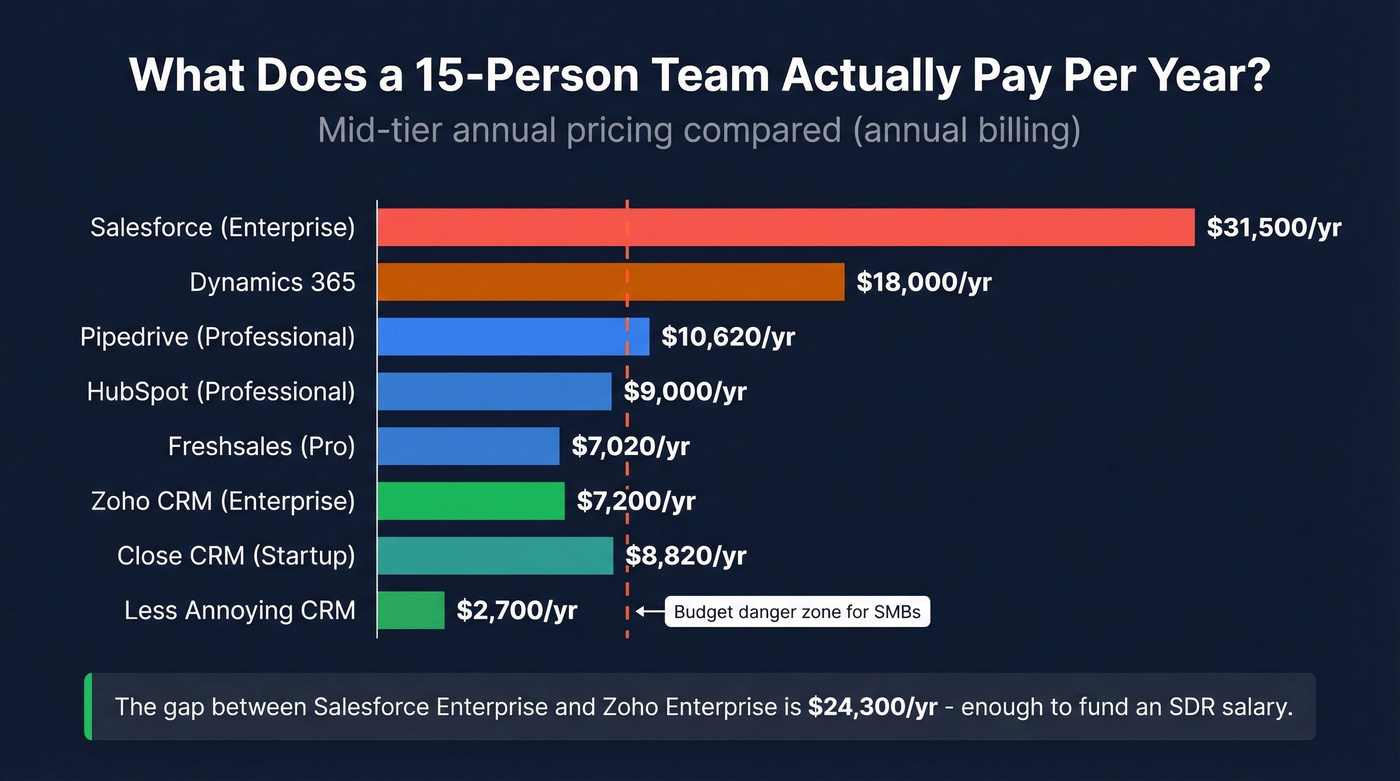
A 15-person sales team signs a Salesforce Enterprise contract at $175/user/month. That's $31,500 a year - and half the reps still track deals in spreadsheets because the CRM is too complicated to use daily. The tool isn't the problem. The choice is.
Picking the right customer relationship management tool comes down to three things: what your team will actually adopt, what you can afford to scale, and whether the data inside it is any good.
What Is a CRM Tool?
A CRM centralizes every interaction between your company and its customers - emails, calls, deals, support tickets, marketing touches - into one system. The goal: give every team member the same view of every relationship so nothing falls through the cracks.
CRMs generally fall into three categories. Operational CRMs automate sales, marketing, and service workflows. Analytical CRMs crunch customer data for forecasting and segmentation. Collaborative CRMs focus on sharing information across departments. Most modern platforms blend all three, which is why the lines between "CRM" and "GTM platform" keep blurring.
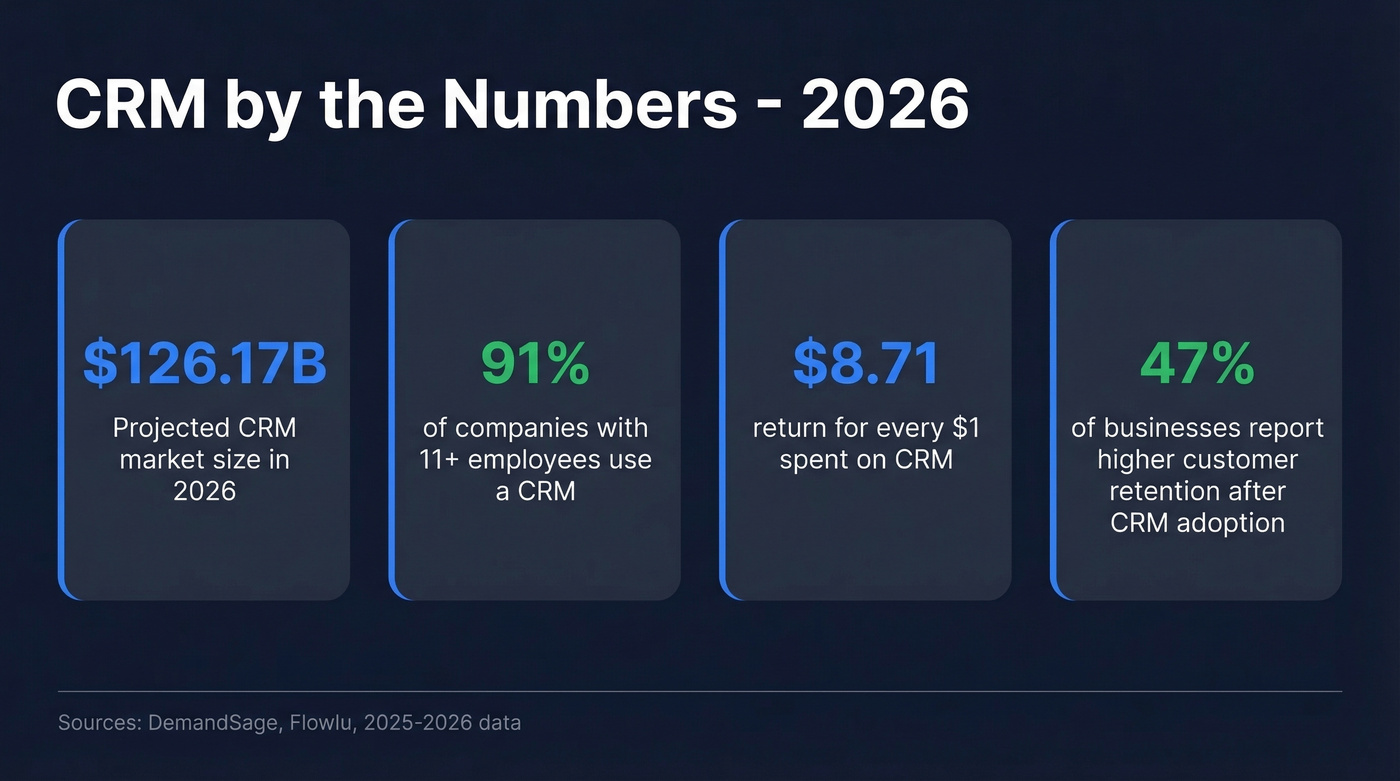
The market reflects how essential these tools have become. CRM software is projected to hit $126.17 billion in 2026, up from $112.91 billion in 2025. 91% of companies with more than 11 employees already use one. And 87% of businesses have moved to cloud-based CRM, up from just 12% in 2008. Meanwhile, 47% of businesses report higher customer retention after adopting a CRM - which makes sense when you stop losing track of conversations.
The average return is $8.71 for every $1 spent. But only if you pick the right tool and keep the data inside it clean. That second part is where most teams stumble.
Quick Recommendations
If you don't want to read 3,000 words, here's the short answer:
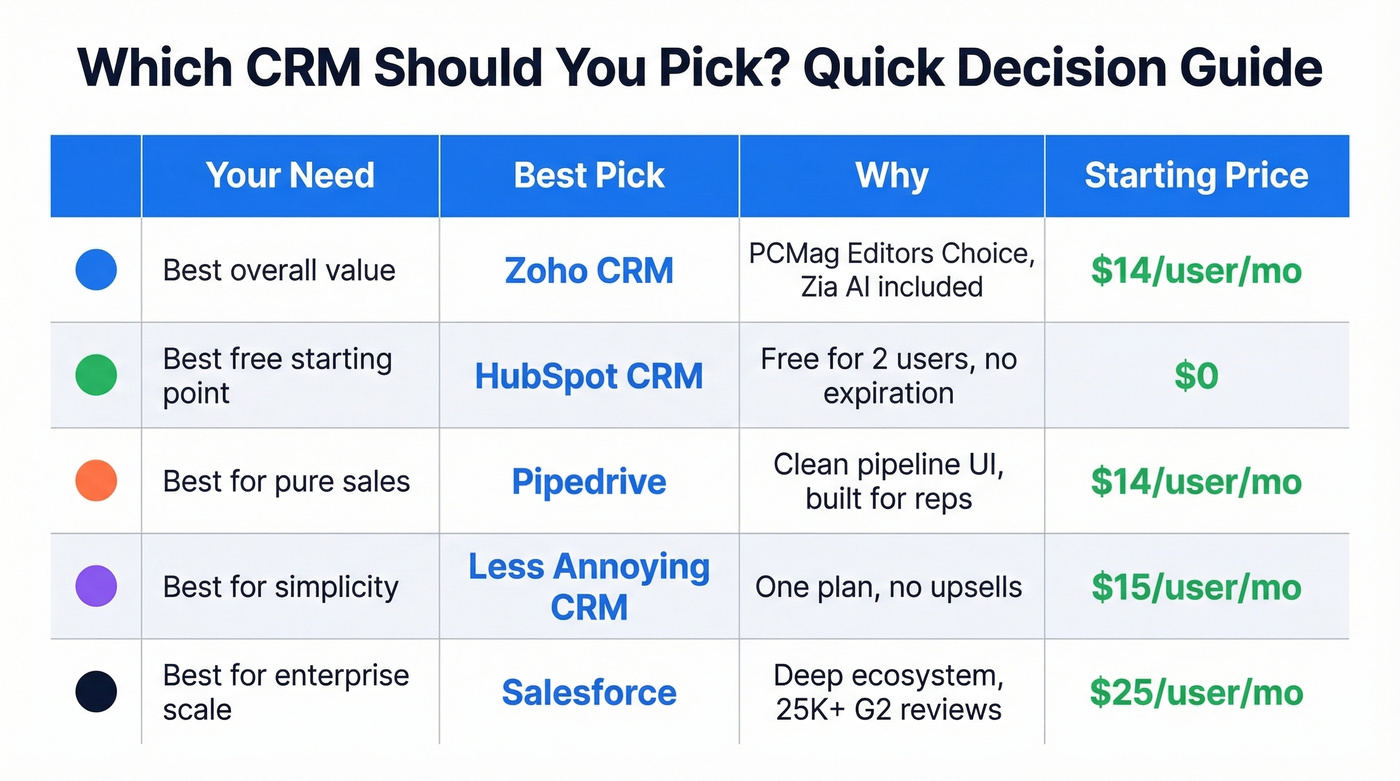
| Need | Pick | Why | Starting Price |
|---|---|---|---|
| Best overall value | Zoho CRM | PCMag Editors' Choice, Zia AI included | $14/user/mo |
| Best free starting point | HubSpot CRM | Free for 2 users, no expiration | $0 |
| Best for pure sales | Pipedrive | Clean pipeline UI, built for reps | $14/user/mo |
| Best for simplicity | Less Annoying CRM | One plan, no upsells | $15/user/mo |
| Best for enterprise scale | Salesforce | Deep ecosystem, 25K+ G2 reviews | $25/user/mo |
Still here? Good. Let's break down each option properly.
Best CRM Tools for 2026
Zoho CRM
Zoho CRM keeps winning editorial awards while costing a fraction of Salesforce. PCMag gave it Editors' Choice with a 4.5/5 "Outstanding" rating, and the reasoning is straightforward: deep customization, the Zia AI assistant, and pricing that doesn't require board approval.
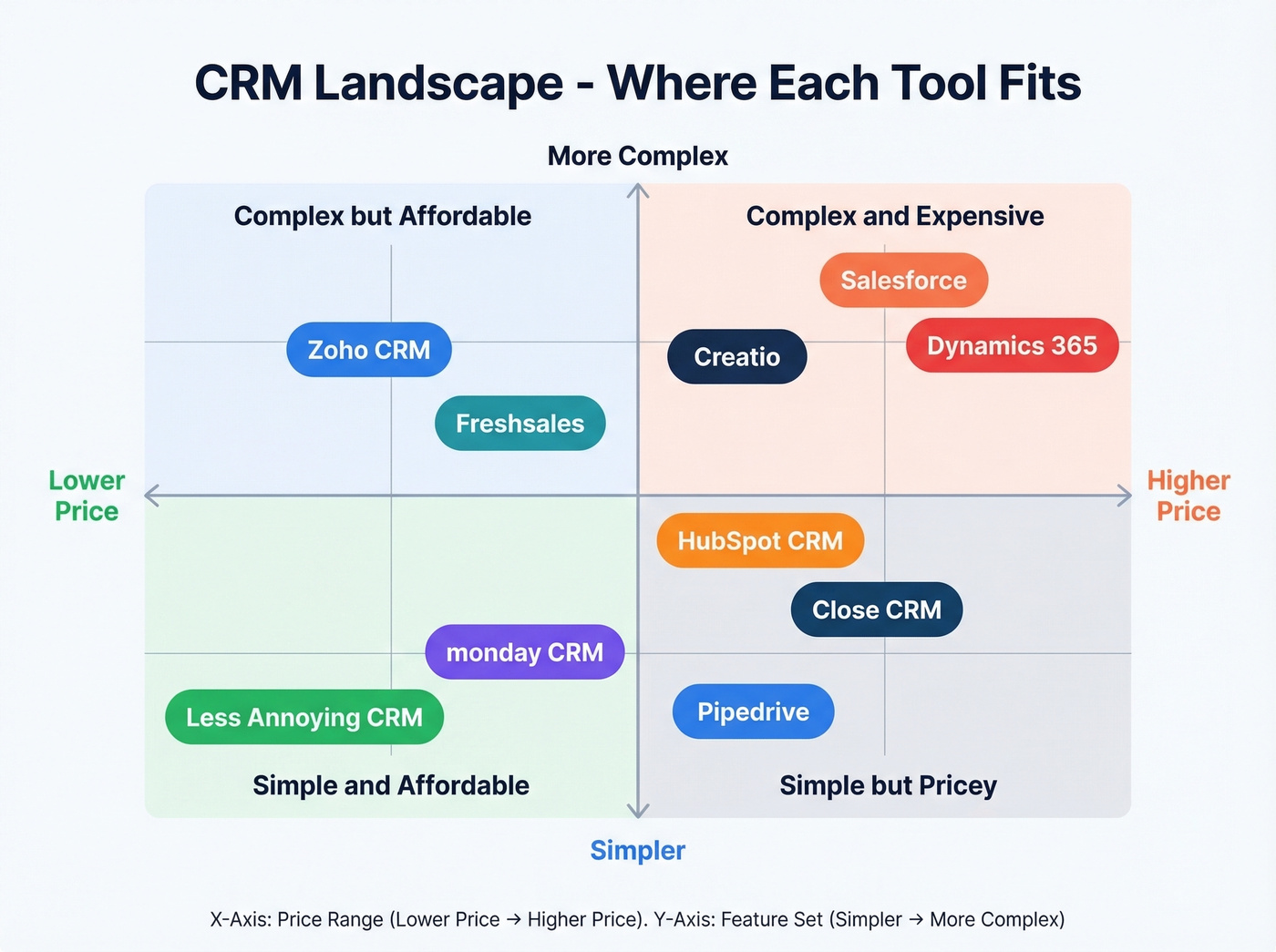
Zia supports AI-driven insights like predictions and anomaly detection, with deeper capabilities unlocking in higher tiers. The customization depth is genuinely impressive - custom modules, multi-step workflow automation, even gamification for sales teams that respond to leaderboards. We've tested most of these tools, and Zoho's customization surprised us more than any other mid-market CRM.
The tradeoff is a steep learning curve. Zoho's flexibility means there are a lot of settings, and teams without a dedicated admin often underuse it. Many advanced features live in higher tiers like Enterprise ($40/user/mo annually) and above. But for a 15-person team, Zoho at $14/user/mo costs $2,520/year. Compare that to $31,500 on a $175/user/mo Salesforce contract. That math speaks for itself.

HubSpot CRM
Use this if you're a startup or small team that needs a CRM today and can't spend a dollar until you've proven the workflow. HubSpot's free tier is genuinely usable - two users, contact management, deal tracking, and email templates with no expiration date.
Skip this if you're planning to scale past 5-10 reps. HubSpot's upgrade path is where the pain starts. Starter begins at $15/seat/mo, and Professional jumps to $50/seat/mo. A 10-person sales team on Professional runs $6,000/year.
HubSpot is also transitioning to a credit-based model for enrichment and AI features by June 2026, which will further gate capabilities. Free and view-only users can't use credits at all. The Breeze AI suite is solid for content generation and lead scoring, but credit-gating means you're constantly watching a meter.
Pipedrive
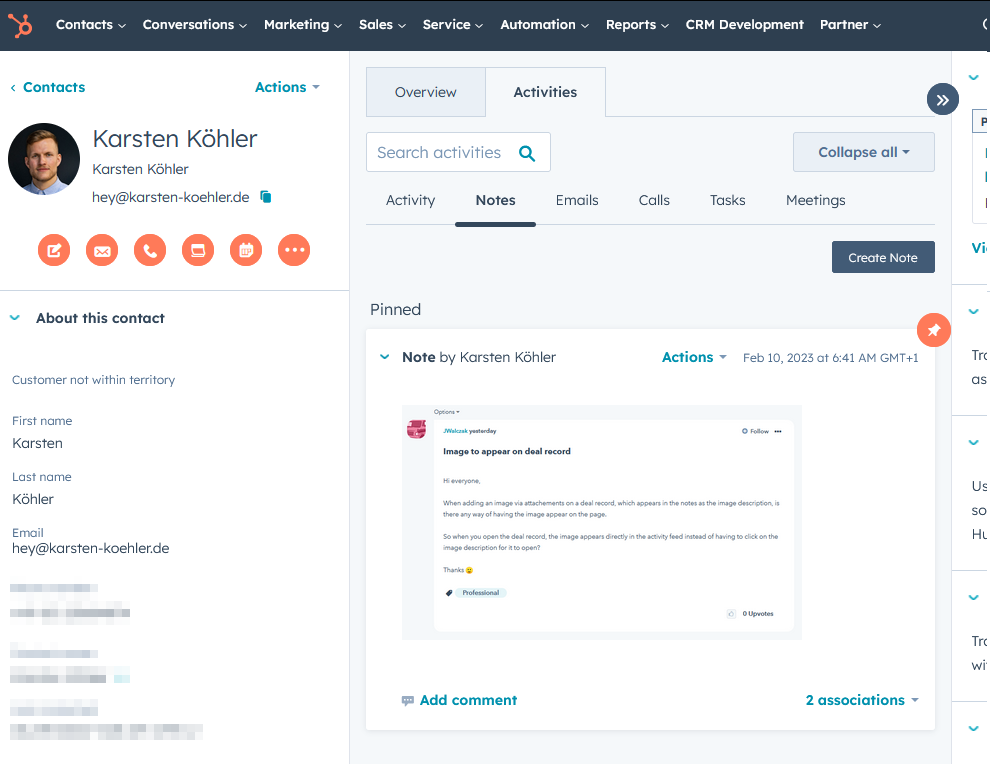
Pipedrive does one thing exceptionally well: visual pipeline management for sales teams. The drag-and-drop deal board is one of the cleanest in the category, and the entire UX is designed around moving deals forward rather than logging activities for management's sake.
Pricing runs $14-$99/user/mo on annual billing, with the Growth tier ($39/user/mo) hitting the sweet spot for most teams - it adds workflow automation and expanded email features. The AI add-on handles lead scoring and email generation but costs extra on top of your plan.
Here's the thing: Pipedrive is a sales tool, not a GTM platform. If you need marketing automation, customer service ticketing, or deep analytics, you'll need to bolt on other software. For teams that just want reps focused on closing, that's a feature, not a bug.
If you're building a broader outbound stack, start with our guide to SDR tools and layer your CRM into that workflow.
Salesforce
Salesforce is the CRM that every enterprise buys and every SMB regrets buying. That's not entirely fair - it's genuinely one of the most powerful platforms in the category, with a 4.4/5 rating across 25,000+ G2 reviews and an ecosystem that can handle virtually any workflow you can imagine. There's a free plan limited to two seats, but it's bare-bones.
The problem is cost and complexity. Starter plans begin at $25/user/mo, but enterprise tiers often land around $175/user/mo, with top tiers pushing $550/user/mo once you need the features that actually justify choosing Salesforce. Then there's Agentforce - Salesforce's agentic AI layer - at $125/user/mo on top of your existing plan. On a $175/user/mo enterprise plan plus $125/user/mo Agentforce, 10 seats is roughly $36,000/year.
ZDNET flagged a real pain point: there's no middle-ground plan between Starter and Pro Suite. You're either on the budget tier or paying enterprise prices. If you're trying to model the real TCO, see our breakdown of Salesforce pricing. For companies with 50+ reps and complex sales processes, Salesforce is still the default. For everyone else, the ROI math gets shaky fast.
Freshsales
Freshsales is the quiet overachiever in the SMB CRM space. It offers a free tier, Freddy AI for lead scoring and deal insights in paid plans, and pricing that starts around $9/user/mo. The Growth plan at roughly $39/user/mo adds AI-powered contact scoring, sales sequences, and custom reports.
For small teams that want built-in AI without credit-gating or add-on fees, Freshsales is a straightforward option. The downside is ecosystem depth - it works best inside the Freshworks suite, and integrations outside that world can feel limited. If you're comparing ecosystems, our Freshworks vs Salesforce guide can help.
monday CRM
monday CRM makes sense if your team already lives in monday.com for project management. The CRM module layers deal tracking, contact management, and basic automation on top of monday's visual workflow engine. Pricing starts at $12/user/mo for Basic, and $17/user/mo on Standard adds email sync. The visual board approach works well for teams that think in Kanban columns rather than traditional CRM views, though AI capabilities are limited compared to dedicated CRM platforms.
Less Annoying CRM
One plan. $15/user/mo. No tiers, no upsells, no enterprise pricing page that requires a sales call.
Less Annoying CRM earned G2's "Easiest to Use" label in the CRM category, and the name is the product philosophy. It covers contacts, calendars, tasks, pipelines, and basic reporting. That's it. For solo founders, small agencies, or teams that just want a CRM that works without a three-month implementation, this is the answer. No AI, no marketing automation - and that's the point.
If your needs are closer to lightweight contact tracking than full pipeline ops, compare options in our contact management software roundup.
Creatio
Creatio positions itself as an AI-native, no-code CRM platform. Pricing starts at $25/month for 5 users, and Sales/Marketing/Service modules run $15/user/month each. Creatio includes AI, but advanced AI actions consume tokens - and if you need more tokens, the minimum purchase is $5,000 per year. For teams that want to build custom CRM workflows without writing code, it's compelling. Just budget for AI tokens separately.
Close CRM
Built-in calling, SMS, and email sequences make Close the CRM for inside sales teams that live on the phone. Starts at around $29/user/mo. Sales-first, no marketing fluff. If your reps make 50+ calls a day, Close can eliminate the need for a separate dialer entirely.
If you're standardizing your outbound motion, pair this with a clear sequence management process.
Microsoft Dynamics 365
The enterprise CRM for organizations already deep in the Microsoft ecosystem. Pricing typically runs $65-$200/user/mo depending on modules. If your company runs on Outlook, Teams, and Azure, Dynamics slots right in. For everyone else, it's usually overkill.
Notable mentions: Apptivo (highly flexible, budget-friendly, no AI), Insightly (project management + CRM hybrid), and SugarCRM (mid-market focus with strong customization).
CRM Pricing Comparison
Let's put the numbers side by side. All prices reflect annual billing where available.
| Tool | Free Tier | Start | Mid-Tier | Enterprise |
|---|---|---|---|---|
| Zoho CRM | No (Bigin has a 1-user free plan) | $14/user/mo | $40/user/mo | $52/user/mo |
| HubSpot | Yes (2 users) | $15/seat/mo | $50/seat/mo | $75/seat/mo |
| Pipedrive | No | $14/user/mo | $59/user/mo | $99/user/mo |
| Salesforce | Yes (2 seats) | $25/user/mo | ~$175/user/mo | ~$550/user/mo |
| Freshsales | Yes | ~$9/user/mo | ~$39/user/mo | ~$59/user/mo |
| monday CRM | No | $12/user/mo | $17/user/mo | Custom |
| Less Annoying | No | $15/user/mo | - | - |
| Creatio | No | $25/mo (5 users) | $15/user/mo per module | Custom |
| Close CRM | No | ~$29/user/mo | ~$49/user/mo | ~$99/user/mo |
| Dynamics 365 | No | ~$65/user/mo | ~$100/user/mo | ~$200/user/mo |
The hidden costs are where budgets blow up. HubSpot's credit-gating means AI and enrichment features have a metered ceiling. Salesforce's Agentforce at $125/user/mo can double your per-seat cost. Creatio's advanced AI actions require token spend on top of base pricing.
For perspective: a 15-person team on a $175/user/mo Salesforce contract pays $31,500/year before Agentforce. The same team on Zoho CRM Enterprise pays $7,200/year. That's a $24,300 gap - enough to fund an entire SDR's salary.

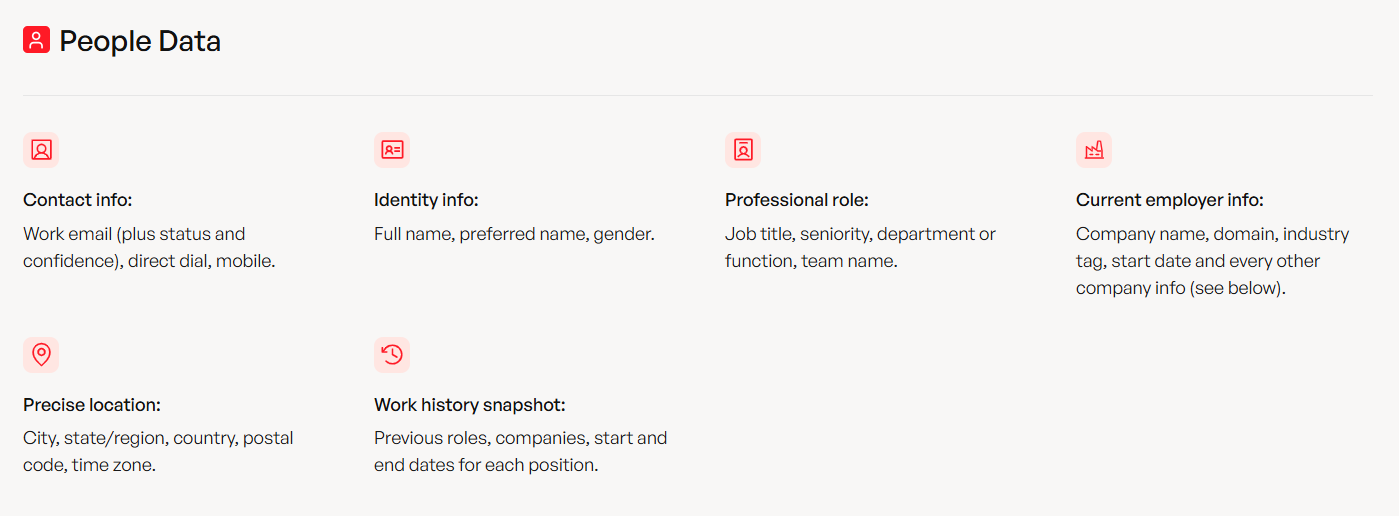
Every CRM on this list has the same weakness: garbage in, garbage out. Prospeo enriches your CRM with 50+ data points per contact at a 92% match rate - verified emails, direct dials, job titles, intent signals. Native integrations with Salesforce and HubSpot mean your reps stop Googling and start selling.
Stop paying for a CRM your reps won't use because the data is wrong.
AI in CRM: What's Included vs. What Costs Extra
Every CRM vendor now has an AI story. The question isn't whether they offer AI - it's whether you can actually use it without a surprise invoice.
Agentic AI is the buzzword for 2026. Unlike traditional CRM automation (if X happens, do Y), agentic AI can plan tasks, execute multi-step workflows, and adjust strategies on its own. Think of it as the difference between a macro and an intern who can actually think.
Here's our hot take: most teams buying AI-powered CRM features in 2026 are wasting money. Not because the AI is bad, but because their data is. If your CRM is full of stale emails, duplicate contacts, and incomplete records, the AI is just reasoning over garbage faster. Fix the data first, then turn on the AI.
You'll get 10x more value from a $14/user CRM with clean data than from a $300/user platform running AI on a polluted database.
| Vendor | AI Brand | In Base Plan? | Add-on Cost | Key Capability |
|---|---|---|---|---|
| Salesforce | Einstein + Agentforce | Einstein: yes | $125/user/mo | Autonomous agents, Atlas Reasoning |
| HubSpot | Breeze | Partial | Credit-gated | Content gen, lead scoring |
| Zoho | Zia | Higher tiers | - | Anomaly detection, predictions |
| Freshsales | Freddy | Yes (paid plans) | - | Contact scoring, deal insights |
| Creatio | Native AI | Basic yes; advanced uses tokens | Min $5K/yr for extra tokens | No-code automation + AI actions |
| Dynamics 365 | Copilot | Higher tiers | - | Meeting summaries, scoring |
Salesforce's Agentforce is the most ambitious play - it supports multi-model flexibility across Gemini and OpenAI/Anthropic via Bedrock. But at $125/user/mo, it's priced for enterprises that can justify the spend with deal velocity improvements.
The uncomfortable truth: 45% of organizations say their CRM data isn't prepared for AI use. You can buy the most sophisticated AI agent on the market, but if it's reasoning over stale emails and duplicate contacts, the output is worthless.

Why Most CRMs Fail (It's the Data)
The CRM itself rarely fails. The data inside it does.
76% of CRM users say less than half their data is accurate or complete. 37% report losing revenue directly because of poor data quality. Only 28% of organizations actively enrich their CRM with third-party sources. And just 32% have a single unified view of customer information - even though 90% say it'd be valuable. Worst of all, 34% of workers don't even know who's responsible for CRM data accuracy. Nobody owns it, so nobody fixes it.
Let's make this concrete. Your SDR imports 500 contacts from a trade show. Three months later, 180 of those emails bounce because people changed jobs, companies rebranded, or the addresses were wrong to begin with. Your domain reputation tanks. Your sequences land in spam. Your pipeline dries up - not because your CRM failed, but because nobody verified the data going in or refreshed it after.
This is where a dedicated enrichment tool earns its keep. Prospeo integrates natively with Salesforce and HubSpot, enriching contacts with 50+ data points per record at an 83% enrichment match rate and 92% API match rate. Its 7-day refresh cycle means contacts don't go stale - compared to the 6-week industry average, that's the difference between catching a job change in real time and emailing someone who left three months ago. With 98% email accuracy and a free tier, it's the cheapest insurance policy against the data decay that kills CRM ROI.
If you're evaluating vendors, start with our list of data enrichment services and then map them to your CRM workflow.
You just read that CRMs return $8.71 for every $1 spent - but only with clean data. Most teams blow their ROI on bounced emails and dead numbers. Prospeo's 7-day data refresh and 98% email accuracy keep your CRM current, not decaying. At $0.01 per email, enrichment costs less than a single bad bounce.
Feed your CRM verified data that actually connects reps to real buyers.
How to Choose the Right CRM
The right customer relationship management tool depends on where your company is today, not where you hope to be in three years. Overbuying is the most common mistake we see - teams purchase Salesforce for the brand, then use 15% of its features.
By company stage:
- Startup (1-10 people): HubSpot free or Freshsales free. Get the workflow habit before spending money.
- SMB (10-50 people): Zoho CRM or Pipedrive. Real features, reasonable pricing, room to grow.
- Mid-market (50-200 people): Zoho Enterprise, HubSpot Professional, or Salesforce Starter. You need automation and reporting depth.
- Enterprise (200+): Salesforce or Dynamics 365. The ecosystem and customization justify the cost at scale.
By primary use case:
- Sales-led: Pipedrive or Close CRM. Pipeline-first, minimal bloat.
- Marketing-led: HubSpot or Zoho. Both bundle marketing automation with CRM.
- Service-led: Freshsales (Freshworks ecosystem) or Salesforce Service Cloud.
By budget:
- Free: HubSpot, Freshsales, Salesforce (2-seat limit)
- $15-25/user/mo: Zoho, Pipedrive, Less Annoying, monday CRM
- $50-100/user/mo: HubSpot Professional, Zoho Ultimate, Pipedrive Premium
- $175+/user/mo: Salesforce enterprise tiers, Dynamics 365
If your reps work in the field, prioritize mobile app quality. In our experience, Pipedrive and HubSpot are strong on mobile; Zoho's mobile app is functional but can feel cluttered.
If you're still narrowing down options, here are more examples of a CRM with real pricing and best-fit notes.
CRM Implementation Checklist
Most CRM failures happen in the first 90 days. In our experience, teams that skip the data audit before migration pay for it later - sometimes for years. Here's how to avoid the common traps:
Audit your data before migration. Deduplicate, verify emails, standardize formats. Importing dirty data into a clean CRM defeats the purpose. Run your contact list through a verification tool before the first import - bad data on day one means bad data forever. (If bounces are already hurting you, start with email bounce rate benchmarks and fixes.)
Define 3-5 required fields per record. More than that and reps won't fill them in. Fewer and your reporting breaks.
Set up validation rules from day one. Require phone format consistency, email verification, and stage-change criteria. Retroactive cleanup is painful and expensive.
Build role-based dashboards. Reps need pipeline views. Managers need forecast reports. Executives need revenue dashboards. One-size-fits-all doesn't work. If forecasting is a priority, compare sales forecasting solutions before you commit.
Get executive sponsorship before launch. If leadership doesn't use the CRM, reps won't either. This is the single most underrated success factor - the consensus on r/sales backs this up consistently.
Pilot with one team before full rollout. Let 5-10 users break things for two weeks. Fix the workflows, then expand.
Integrate your email and calendar immediately. If reps have to manually log activities, they won't. Auto-sync removes the friction.
Plan phased training. Week 1: basic navigation and deal creation. Week 3: automation and reporting. Week 6: advanced features. Don't dump everything at once. A simple 30-60-90 day plan for sales reps can keep adoption on track.
Budget for hidden costs upfront. AI add-ons, extra seats, premium support, integration middleware - these show up on the second invoice, not the first. Map them before you sign.
FAQ
What is a customer relationship management tool?
A customer relationship management tool is software that centralizes all customer interactions - emails, calls, deals, and support tickets - into one system so every team member shares the same view of every relationship. Most modern platforms combine sales automation, marketing features, and analytics. Pricing ranges from free (HubSpot, Freshsales) to $550+/user/month for enterprise Salesforce tiers.
What's the best free CRM in 2026?
HubSpot CRM offers the strongest free tier - two users with no expiration date, contact management, deal tracking, and email templates. Freshsales also has a solid free plan with basic AI features.
How much does a CRM cost per user?
Most SMBs land in the $14-$50/user/month range on annual billing. Enterprise deployments with AI add-ons like Salesforce Agentforce ($125/user/mo) or Creatio token spend can push total cost past $300/user/month. Always calculate total cost including add-ons, not just the base seat price.
What's the difference between CRM and marketing automation?
CRM manages relationships, pipeline, and customer data. Marketing automation handles campaigns, lead nurturing, email sequences, and scoring. Many platforms - HubSpot, Zoho, Salesforce - bundle both, but they're distinct functions. You can run a CRM without marketing automation, but running marketing automation without a CRM creates data silos that'll haunt you.
How do I keep CRM data accurate?
Use a data enrichment tool that integrates directly with your CRM and refreshes contacts automatically. Without active enrichment, CRM data decays within months as people change roles and emails go stale. Pair enrichment with validation rules and regular deduplication for best results.