

Customer Retention vs New Customer Acquisition: What the Data Actually Says
The most-quoted stat in B2B marketing - "it costs 5-25x more to acquire a new customer than to retain one" - traces back to a 2014 HBR piece summarizing prior research. The range is real. But it's so wide it's almost useless without context.
Your industry, your stage, and your unit economics matter far more than a decades-old average. Let's break down what the numbers actually look like right now and how to use them.
Quick Verdict
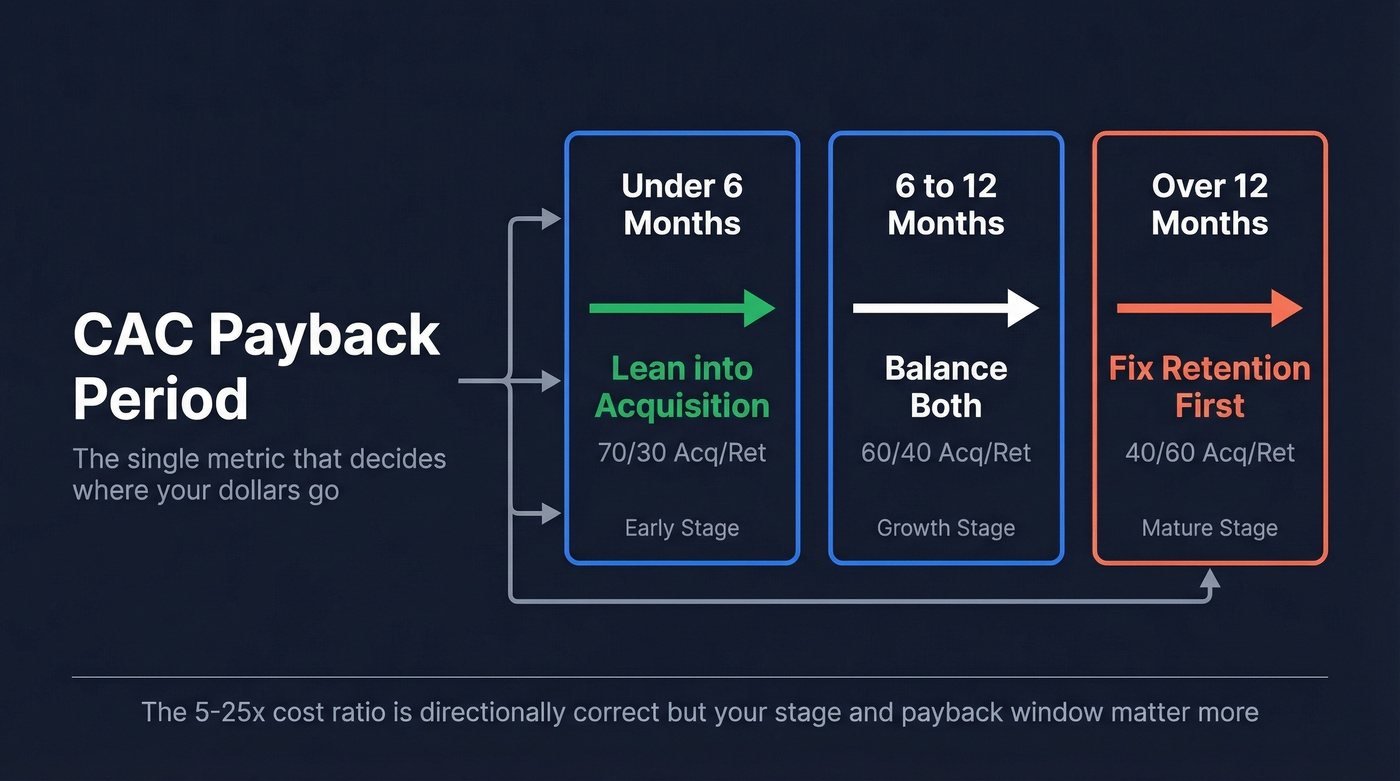
The 5-25x cost ratio is directionally correct but wildly imprecise. Your industry and growth stage determine where you fall. The single metric that decides where to invest is CAC payback period - under 6 months, lean into acquisition; over 12 months, fix retention first. Stage-based budget splits work: early-stage companies should run roughly 70/30 acquisition-heavy, mature companies flip to 40/60 retention-heavy, and growth stage sits at 60/40.
2026 Acquisition Cost Benchmarks
CAC has climbed 40-60% since 2023, driven by ad competition, privacy regulation, and attribution headwinds. Apple's ATT-era privacy changes alone pushed some brands' costs up by as much as 50%. Amazon CPC jumped 30%, from $0.93 to $1.20. In our experience, the companies most shocked by their CAC are the ones who haven't measured it by channel in over a year.
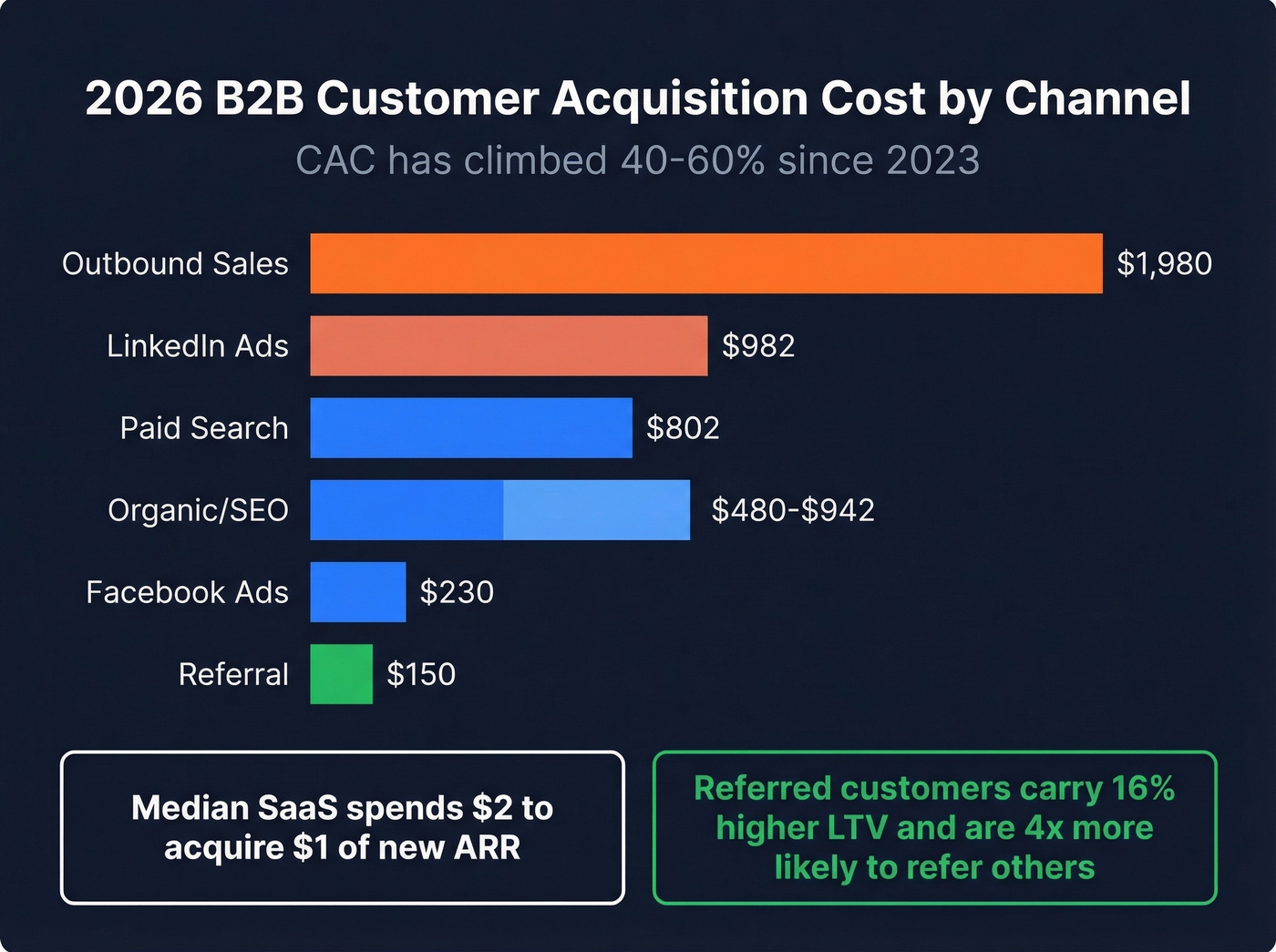
Here's what channel-level costs look like right now:
| Channel | B2B CAC | Ecommerce CPA* |
|---|---|---|
| Paid Search | $802 | $70 |
| LinkedIn Ads | $982 | N/A |
| Facebook Ads | $230 | $45-$72 |
| Organic/SEO | $480-$942 | $290+ |
| Referral | $150 | $30-$50 |
| Outbound Sales | $1,980 | N/A |
*Ecommerce figures reflect channel-level cost-per-acquisition, not blended CAC.
Referral channels also compound - referred customers carry 16% higher LTV and are 4x more likely to refer others. The median CAC-to-new-revenue ratio for SaaS hit $2.00, meaning companies spend $2 to acquire $1 of new ARR. That number alone explains why the retention conversation has gotten so loud. It costs more to bring in new buyers today than at any point in the last decade.
What Retention Actually Looks Like
Retention isn't one number. It's a spectrum that varies wildly by business model and segment.
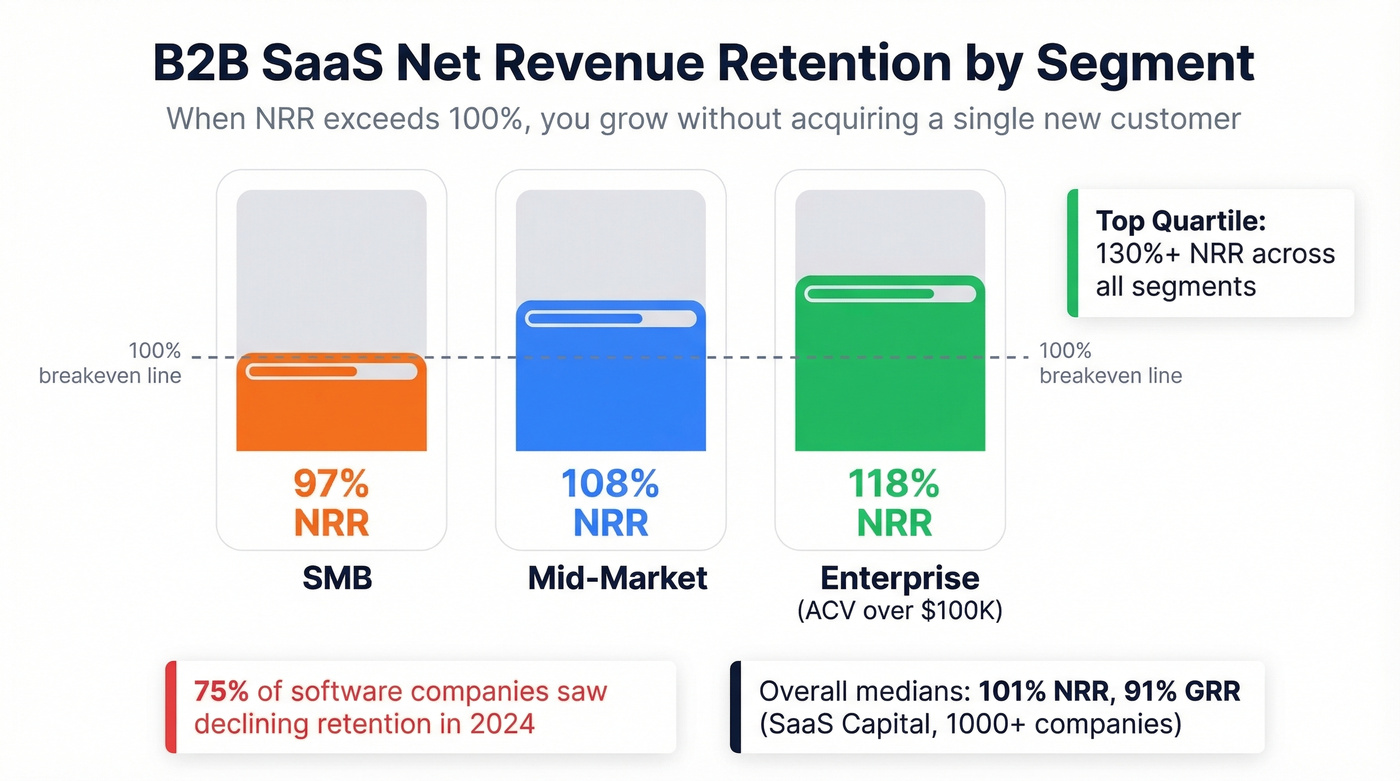
In B2B SaaS, net revenue retention (NRR) is the metric that matters most. Enterprise accounts with ACV above $100K hit 118% median NRR. Mid-market lands at 108%. SMB sits at 97%. Top-quartile companies exceed 130% across all segments - when NRR is above 100%, you're growing without acquiring a single new customer because expansion revenue from existing accounts outpaces churn. A SaaS Capital survey of 1,000+ private B2B SaaS companies found overall medians of 101% NRR and 91% GRR. Fall below that 91% GRR and you're leaking faster than most peers.
Here's the frustrating part: 75% of software companies reported declining retention rates in 2024. That increases acquisition pressure as the leaky bucket gets leakier, which drives up CAC, which makes retention even more critical. It's a vicious cycle.
Ecommerce tells a different story. Average repeat customer rates run about 25-30%, with huge category variation. Grocery and pet supplies hit 30-40%+, fashion sits around 20-26%, electronics at roughly 18%, luxury at about 10%, and home/furniture at around 15%. Existing customers are 50% more likely to try new products and spend 31% more per transaction. The conversion contrast is stark: net-new conversion often runs 2-5%, while repeat-purchase conversion from existing customers can hit 60-70%.

When repeat-purchase conversion hits 60-70% but net-new sits at 2-5%, every acquisition dollar has to count. Prospeo's 98% email accuracy and 7-day data refresh cut the waste that inflates your CAC - Snyk dropped bounce rates from 35% to under 5% and grew AE-sourced pipeline 180%.
Stop paying $2 to acquire $1 of ARR with bad data.
Is the "5x Rule" Still Accurate?
The ratio isn't wrong - it's just too blunt to be useful.
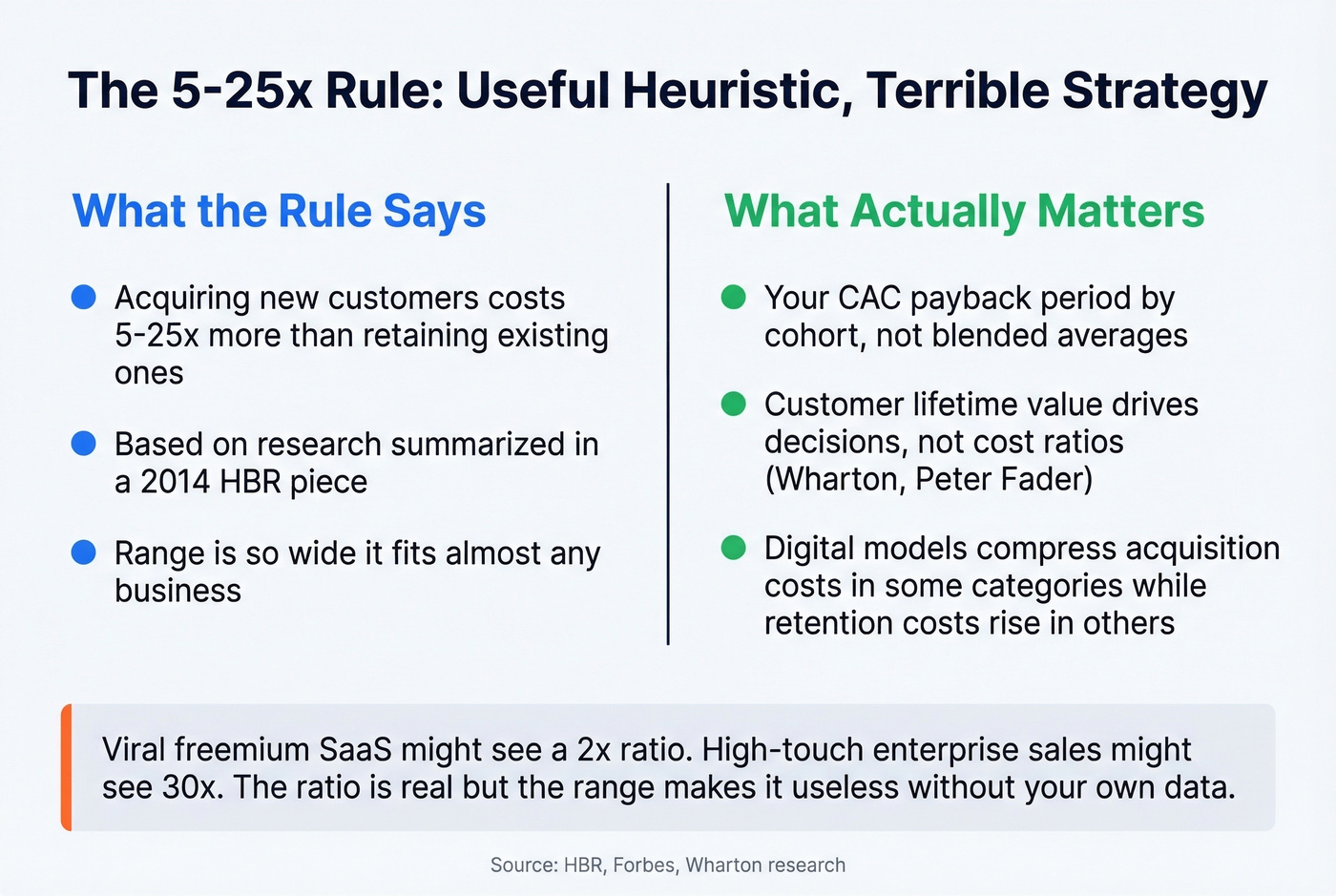
Wharton's Peter Fader has argued for years that the acquisition-vs-retention debate misses the point entirely. Decisions should be driven by customer lifetime value, not by cost ratios. A Forbes analysis makes a similar case: modern digital models compress acquisition costs in some categories (think viral SaaS with freemium) while retention costs rise in others (think subscription fatigue). The ratio is a useful heuristic. It's a terrible strategy.
How to Allocate Budget by Stage
Rather than debating whether the ratio is 5x or 25x, use your CAC payback period as the rebalancing signal. Cohort payback windows tell you what's actually happening - LTV is a lagging indicator that lies to you for months.
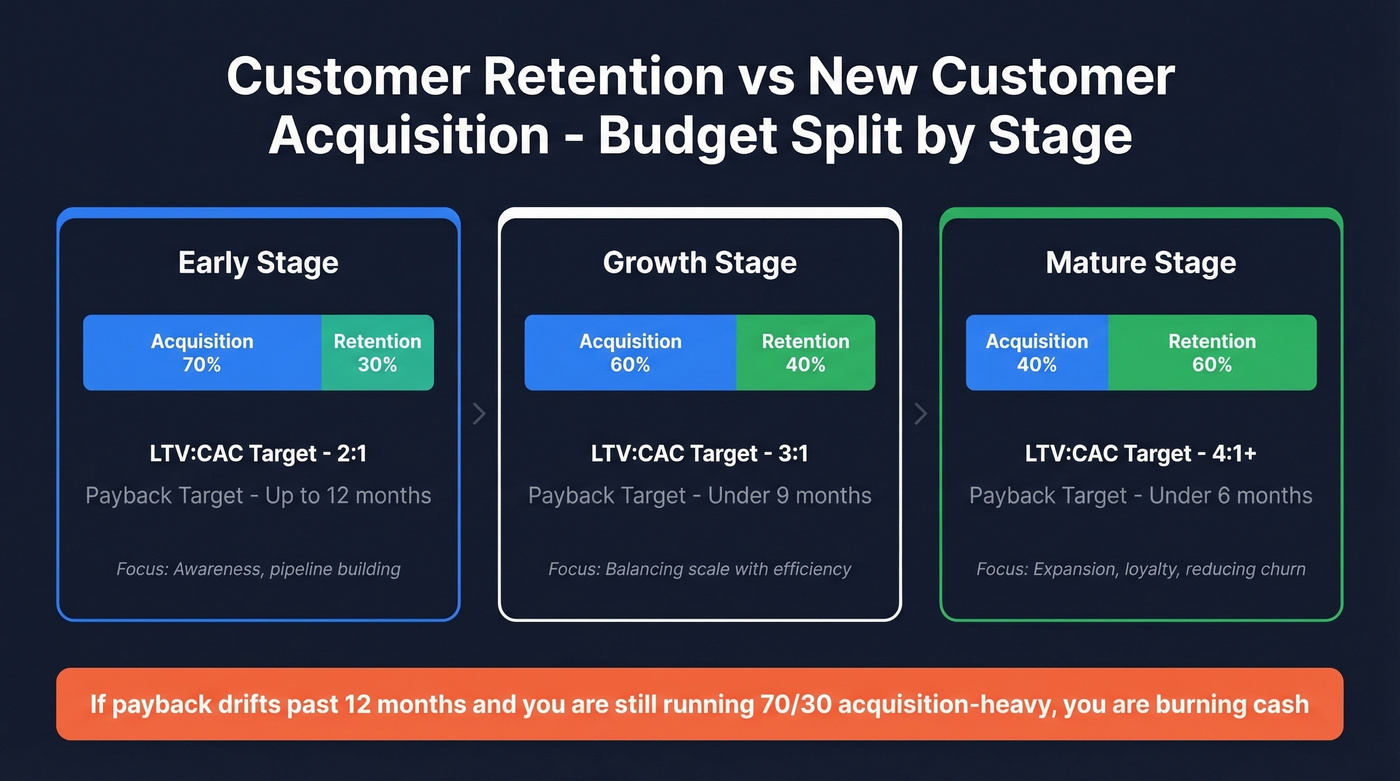
| Stage | Acq/Ret Split | LTV:CAC Target | Payback Target |
|---|---|---|---|
| Early-stage | 70/30 | 2:1 | Up to 12 months |
| Growth | 60/40 | 3:1 | Under 9 months |
| Mature | 40/60 | 4:1+ | Under 6 months |
For context, eCommerce SaaS SMBs average 9-month payback (4 months is "good"), while Fintech enterprise deals average 23 months. If your payback period is drifting past 12 months and you're still running 70/30 acquisition-heavy, you're burning cash.
Here's the thing: if your average deal size sits below $10K annually, you probably can't afford to get retention wrong. At that price point, you don't have enough margin to outrun churn with acquisition spend. Fix the bucket before you pour more water in.
Your messaging should also shift at each stage. Early-stage teams need awareness-driven campaigns, while mature teams get more ROI from loyalty programs and expansion plays. We've seen growth-stage companies waste six figures trying to scale acquisition when their GRR was sitting at 82% - they'd have been better off spending half that on onboarding improvements.
Making Acquisition Spend Count
Before you debate the split, fix the data feeding your acquisition engine. Every bounced email is wasted CAC. Every bad phone number is a rep's time evaporating.

When the median SaaS company spends $2 to generate $1 of new ARR, data quality is the fastest lever to reduce effective acquisition cost. Snyk's sales team cut bounce rates from 35-40% to under 5% after switching to Prospeo's verified contact data - that's not a marginal improvement, it's a structural reduction in wasted outbound spend. With 98% email accuracy and a 7-day data refresh cycle, tools like Prospeo directly compress the cost side of the acquisition equation, especially when outbound is your primary channel and you're paying roughly $1,980 per B2B customer.
Skip this approach if your acquisition is entirely inbound and organic. But for teams running outbound at scale, verifying that your emails actually reach real people isn't optional - it's the difference between a $1,500 CAC and a $2,500 one. If you want to go deeper, start with email bounce rate benchmarks and an email deliverability audit, then add data enrichment to keep records fresh.
Your CAC payback period decides the acquisition vs retention split - but bad contact data stretches payback by burning outbound spend on bounces and wrong numbers. Prospeo delivers 300M+ verified profiles at $0.01/email so your reps reach real buyers, not dead inboxes.
Fix your data before you fix your budget split.
FAQ
Is it really 5x more expensive to acquire a new customer?
The 5-25x range holds directionally, but your own CAC payback period matters more than any industry average. B2B SaaS CAC averages roughly $1,200; ecommerce averages $68-$84. The consistent finding across studies: acquiring new buyers costs significantly more than retaining current ones, but the exact multiple depends on your business model and channel mix.
What's a good customer retention rate?
For SaaS, target gross revenue retention above 90% and NRR above 100%. For ecommerce, 25-30% repeat purchase rate is average - grocery and pet brands hit 30-40%+, luxury sits around 10%. Anything below your segment median signals a leaky bucket that needs attention before you scale acquisition.
When should a startup shift budget from acquisition to retention?
When CAC payback exceeds 12 months or repeat purchase rate crosses 20%. Most companies shift from 70/30 to 60/40 during growth stage, then 40/60 at maturity. Use cohort payback windows - not blended LTV - as the trigger, since LTV averages mask deteriorating unit economics in newer cohorts.
How can I lower acquisition costs without cutting spend?
Improve data quality before increasing volume. Referral programs also help - referred customers cost less to acquire and carry 16% higher lifetime value, compounding savings over time. On the outbound side, reducing bounce rates from 35% to under 5% means your reps spend time talking to real prospects instead of chasing dead addresses.