

Customer Targeting Strategies That Still Work After Privacy Changed Everything
Your CPA jumped 30% and the same interest audiences that worked last year are flat. The r/DigitalMarketing consensus matches what we're seeing everywhere: interest-based targeting on Meta and Google isn't performing the way it used to. Meanwhile, 81% of Americans feel they have little control over how companies collect their data. The customer targeting strategies that worked in 2022 are broken. Here's what's replacing them.
The Short Version
If you're pressed for time, these three moves cover 80% of the value:
- Lifecycle segmentation + winback campaigns. Sort customers by stage and automate re-engagement before they disappear.
- Intent signals + speed-to-lead. For B2B, capture buying signals and respond within hours - not 48. Deals die in the gap.
- Broad targeting + creative testing with first-party signals. Stop micro-targeting. Let algorithms optimize against your first-party data and test creative aggressively.
Here's the contrarian take: you don't need 20 micro-segments. You need 5 you can actually message, measure, and refresh weekly.
What Changed - Targeting After Privacy Shifts
The ground shifted in three ways. Third-party cookies are blocked in Safari and Firefox and heavily restricted elsewhere; Chrome keeps moving toward deprecation and tighter limitations. Server-side tracking recovers 15-30% of lost conversion signals, but most teams haven't implemented it. And 79% of consumers are concerned about how companies use their personal information - meaning even when you can target aggressively, the backlash risk is real.
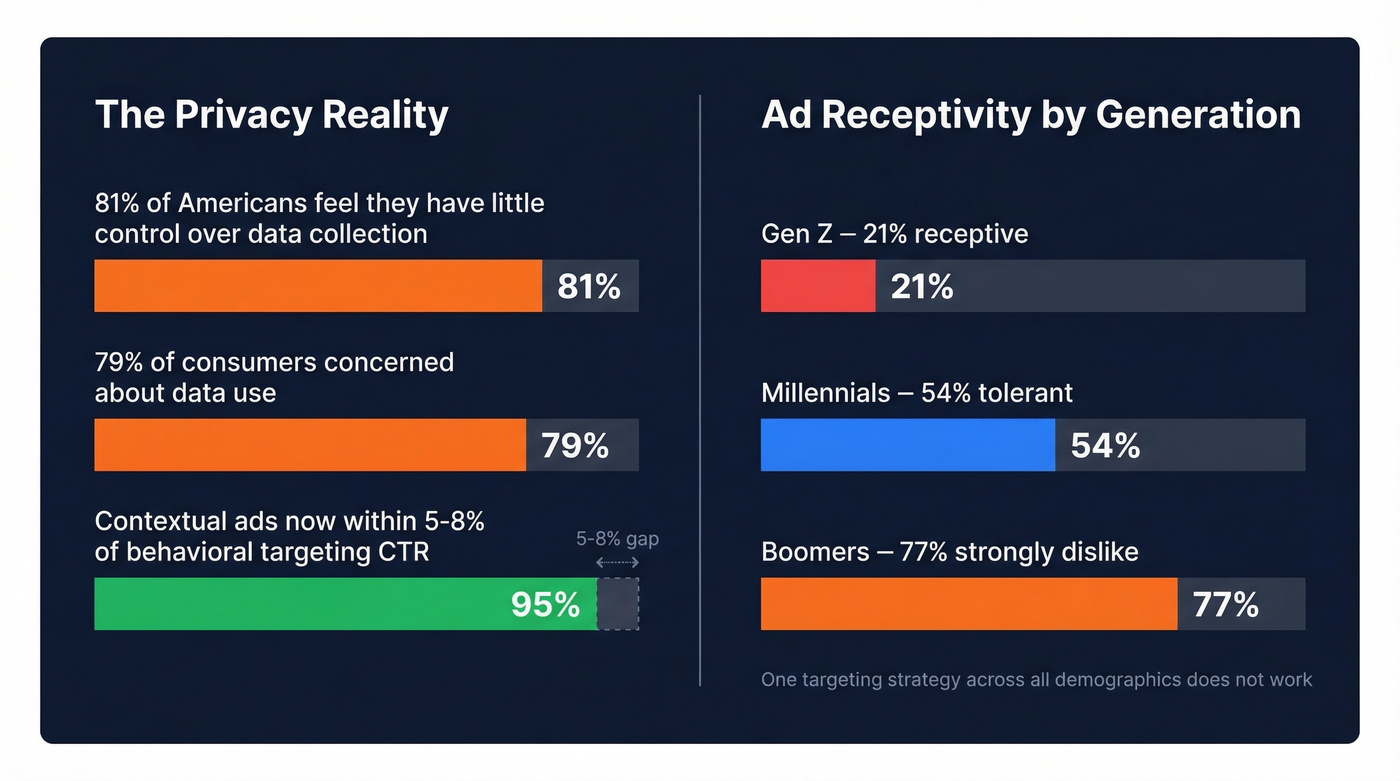
The generational split makes this messier. Only 21% of Gen Z is receptive to targeted ads, while 54% of Millennials tolerate them and 77% of Boomers strongly dislike them. You can't run one targeting strategy across all demographics and expect consistent results. The audience that's fine with personalized retargeting is shrinking. The one that finds it invasive is growing.
The good news? Contextual ads now match behavioral targeting within ~5-8% on CTR and conversion quality. First-party data programs - email lists, purchase history, on-site behavior - are the new foundation. The teams winning right now aren't the ones with the fanciest targeting tech. They're the ones with the cleanest first-party data and the fastest feedback loops.
10 Strategies That Work Now
B2C and Ecommerce
Lifecycle segmentation. Divide your customer base into new, active, lapsed, and churn-risk buckets. Automate winback sequences for lapsed customers. This is the highest-ROI targeting move most ecommerce teams underinvest in, and it's the one we recommend starting with because the data already exists in your CRM - you just need to act on it.
First-party data + lookalike audiences. Replace interest targeting with lookalikes built from your best customers' purchase behavior. Upload your buyer list, let Meta or Google find similar profiles. This remains one of the most reliable replacements for interest targeting.
Skip broad targeting if your ad spend is under ~$3-5k/month. Broad targeting plus aggressive creative testing requires volume. Go broad, let the algorithm optimize, and test 5-10 creative variants per week. The algorithm needs data to learn, and narrow audiences starve it. But below a certain spend threshold, you won't generate enough signal for meaningful optimization - stick with lookalikes instead.
Contextual targeting. Privacy-safe and performs within ~5-8% of behavioral targeting. Place ads based on page content, not user profiles. For brands worried about compliance, this is the safest bet available.
Personalization built on volunteered data. 71% of customers expect personalized experiences, and 76% get frustrated when they don't receive them. But personalization built on third-party data feels creepy. The fix: use data people actually gave you. 69% of customers appreciate personalization when it's based on data they explicitly shared - quizzes, preference centers, progressive profiling. Personalized CTAs convert 200%+ better than generic ones, and fast-growing companies generate 40% more revenue from personalization than slower-growing competitors, per McKinsey. This isn't a nice-to-have anymore.
B2B and Lead Gen
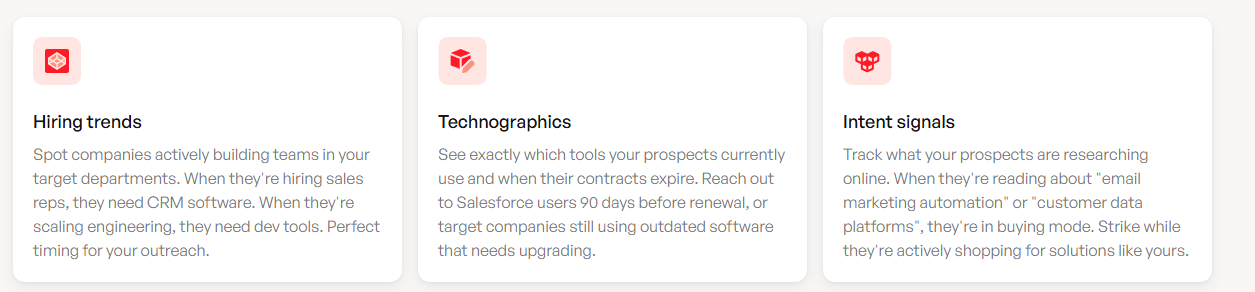
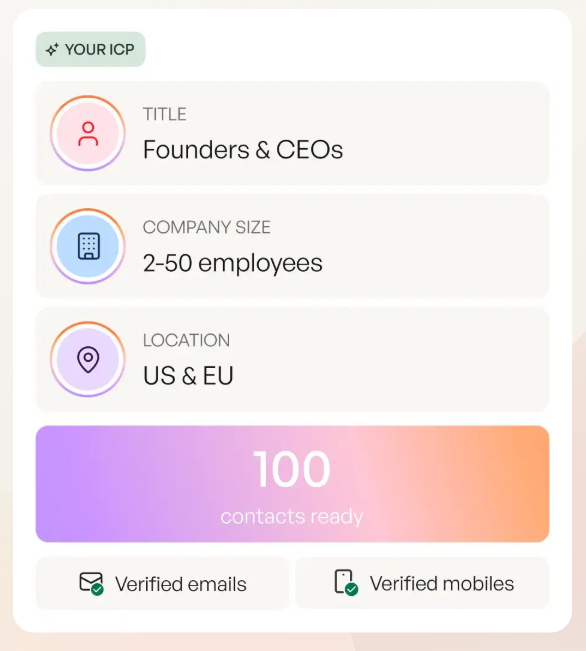
ICP-to-segment mapping. Layer firmographic filters like industry, headcount, and revenue with technographic signals - what tools they use, and critically, what tools they don't use. Filtering out accounts already running a competitor's product saves your reps hours of wasted outreach. Add intent data on top, and a vague ICP becomes a targetable list.
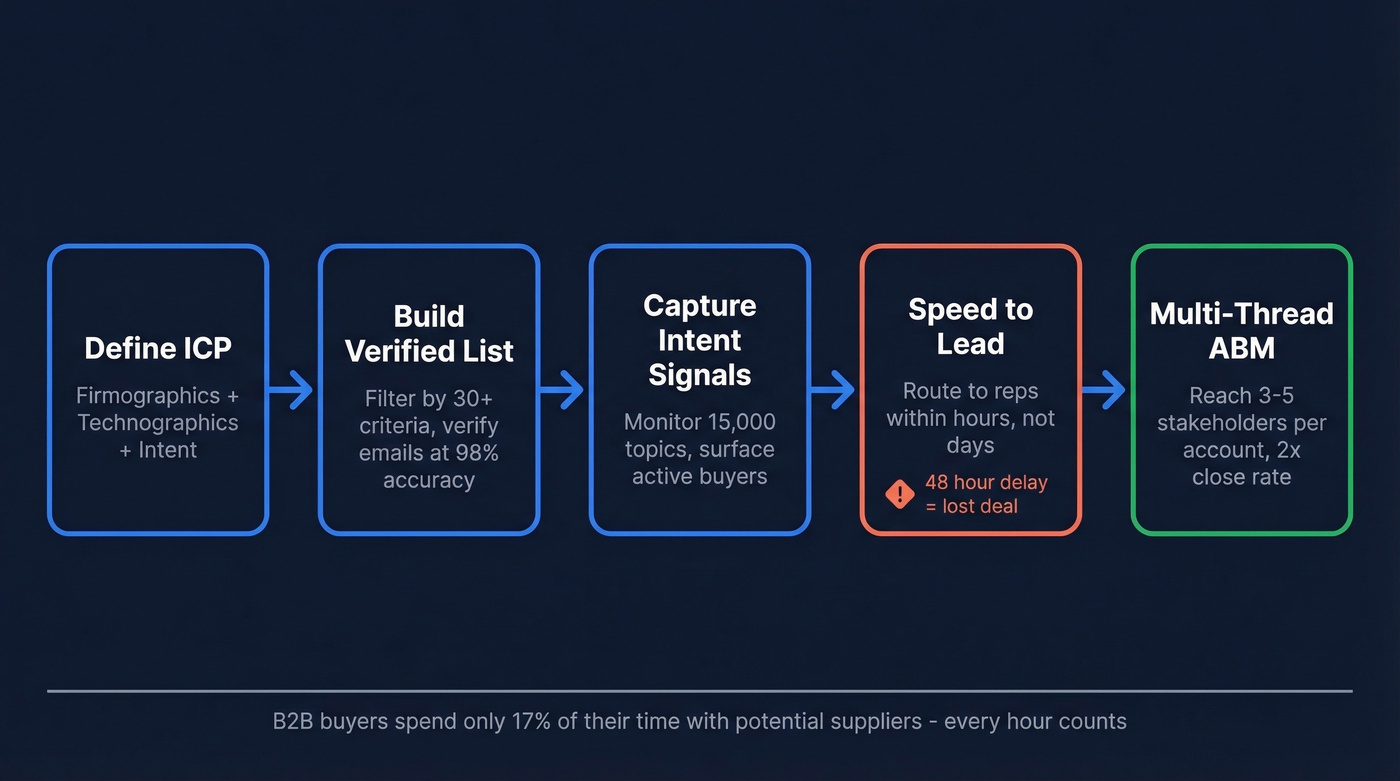
Intent signal capture + speed-to-lead. B2B buyers spend only 17% of their time with potential suppliers. One B2B practitioner framework on Reddit nails the implication: if your response to an active buyer takes 48 hours, you've already lost. Build a system that surfaces buying signals and routes them to reps within hours. Not days. Hours.
Build verified, enriched target lists. An ICP definition is useless if you can't reach the people in it. Prospeo lets you filter by 30+ criteria - including intent data across 15,000 topics, technographics, and funding signals - then export verified emails at 98% accuracy with a 7-day refresh cycle. That turns strategy into a reachable list.
Warm outreach + ABM multi-threading. Content for passive buyers: thought leadership, newsletters, webinars. Direct outreach for active ones. Multi-thread into accounts by reaching 3-5 stakeholders, not just one champion. We've found that deals with three or more contacts engaged close at roughly double the rate of single-threaded ones.
Predictive audiences. GA4's predictive metrics - purchase probability, churn probability, predicted revenue - let you build audiences of likely buyers and push them to Google Ads. The catch: you need ~1,000+ users per week triggering the target event for the models to work reliably. Below that threshold, the predictions are noise.

You just read that intent signals die when response takes 48 hours. Prospeo surfaces in-market buyers across 15,000 intent topics, layers 30+ filters including technographics and funding signals, and delivers verified emails at 98% accuracy - refreshed every 7 days. Your targeting strategy becomes a reachable list in minutes, not days.
Turn your ICP into a verified contact list for $0.01 per email.
Benchmarks - What Good Targeting Produces
Numbers keep you honest.
B2C Benchmarks
| Metric | Benchmark |
|---|---|
| Ecommerce conversion | Under 2% |
| Email conversion | 2.8% |
| Multichannel lift | 2-4x vs single channel |
B2B Benchmarks
| Metric | Benchmark |
|---|---|
| Cold email reply | ~5% |
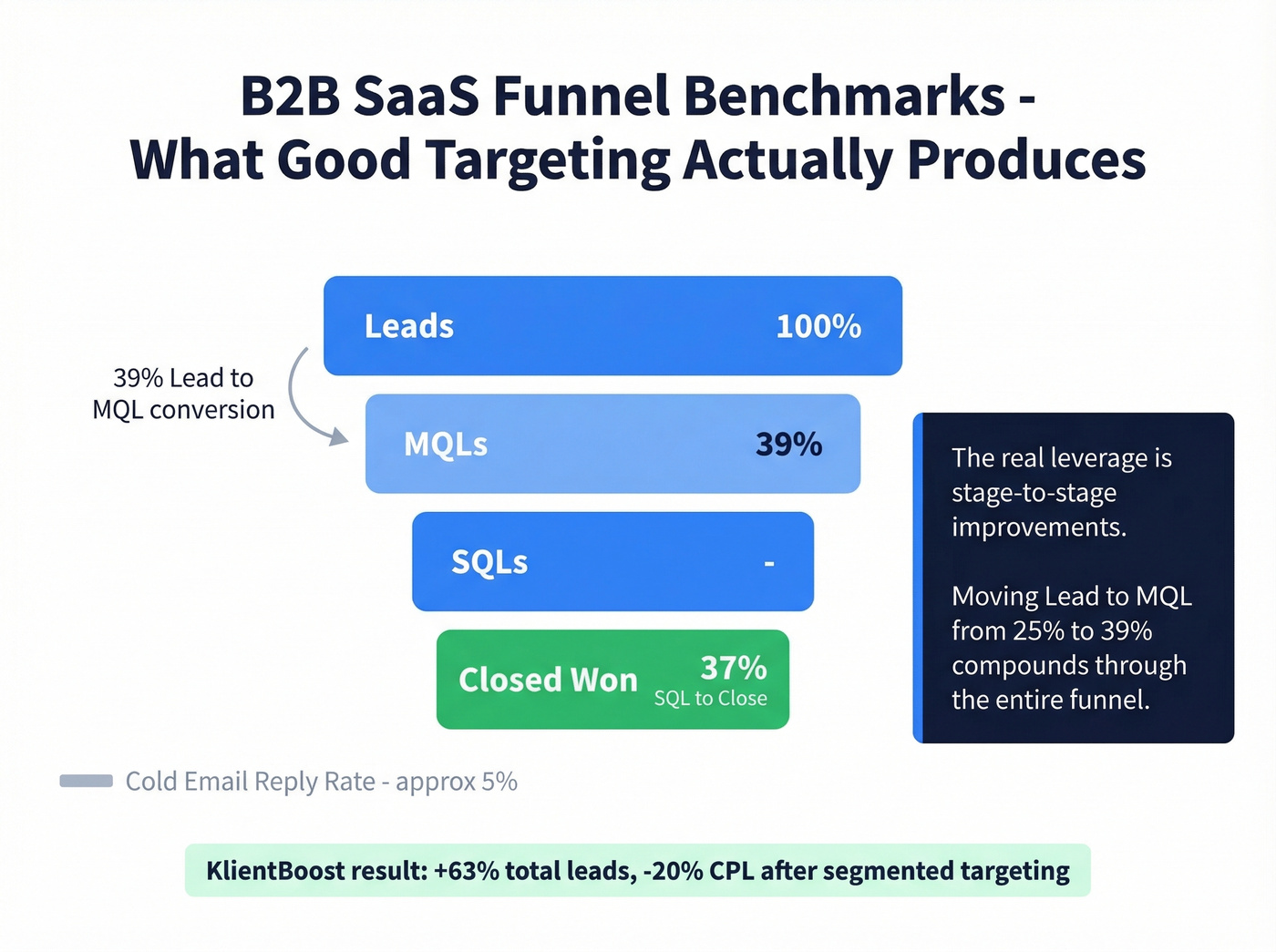
| Lead to MQL | 39% for SaaS |
| SQL to Closed | 37% for SaaS |
| Multichannel lift | 2-4x vs single channel |
Even great targeting doesn't produce 10% conversion rates. If someone's promising that, they're measuring wrong. The real leverage is in stage-to-stage improvements - moving Lead-to-MQL from 25% to 39% compounds through the entire funnel.
For proof: KlientBoost saw +63% total leads and -20% CPL after shifting to segmented, targeted campaigns. That's not a moonshot result. That's what happens when you stop spraying generic ads at generic audiences.
We've found that teams who obsess over one stage-to-stage metric per quarter outperform teams chasing dashboard-wide improvements. Pick the leakiest stage. Fix it. Move on.
Common Mistakes That Kill Targeting ROI
77% of marketing ROI comes from segmented, targeted, and triggered campaigns. When targeting works, it drives the vast majority of your return. But these mistakes destroy that upside fast.
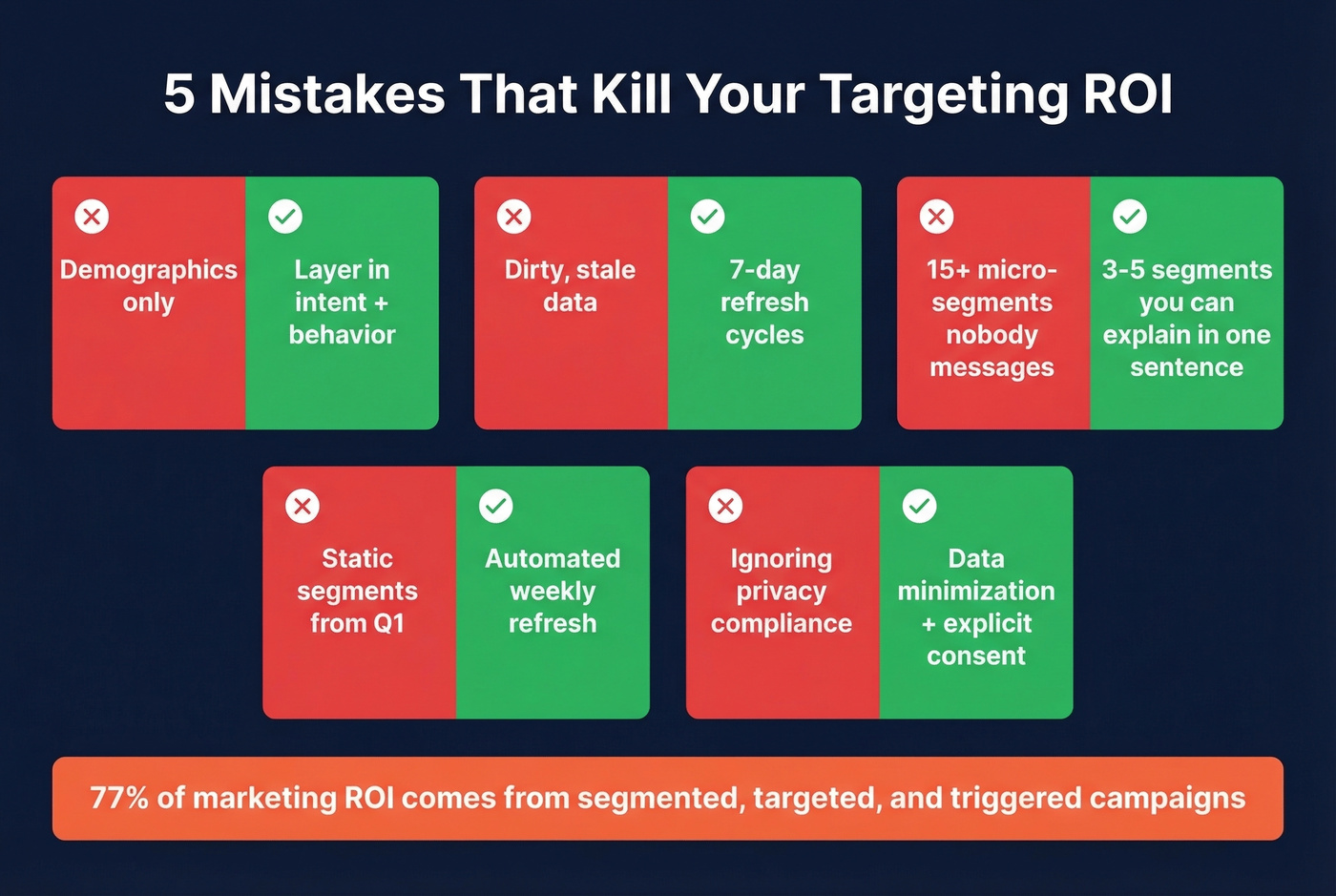
Relying only on demographics. Age and job title aren't enough. A 35-year-old VP actively researching your category is a fundamentally different prospect than one who isn't. Layer in behavioral signals and intent data.
Dirty data. Unverified emails, stale records, and bad phone numbers tank deliverability and waste spend. Many B2B databases refresh every 4-6 weeks. By then, a meaningful chunk of your contact list has changed roles or companies. A 7-day refresh cycle - like Prospeo's - exists to solve exactly this problem, because stale data is the silent killer of otherwise sound targeting.
Too many micro-segments. Let's be honest: we've seen teams waste months building 15+ micro-segments they never actually message. If you can't explain why a segment should buy in one sentence, merge it or drop it.
Static segments that never update. Your best customer from Q1 might be churning by Q3. Automate refresh cycles - weekly for high-velocity segments, monthly at minimum.
Ignoring privacy compliance. Data minimization, explicit consent, clear opt-outs. One viral "creepy ad" story can undo months of targeting work. This isn't hypothetical - it happens every quarter to brands that should know better.
Real-World Targeting Examples
To make these strategies concrete:
- B2C lifecycle winback: An ecommerce brand segments customers who haven't purchased in 90 days, sends a personalized discount based on their last purchase category, and recovers 8-12% of lapsed buyers per quarter. The key isn't the discount - it's the timing and relevance.
- B2B intent-based outreach: A SaaS company filters accounts showing intent signals for "CRM migration," then multi-threads into those accounts within 24 hours - cutting their sales cycle by two weeks compared to cold outbound to the same ICP without intent signals.
- Contextual ad swap: A DTC brand replaces behavioral retargeting with contextual placements on niche review sites, maintaining CTR within 6% of the old approach while eliminating third-party cookie dependency entirely.
These aren't hypothetical. They're the patterns we see repeated across teams that have adapted to post-privacy realities.
Implement in 30 Days
Week 1: Audit existing segments. Kill anything you can't message in one sentence. Map your current data sources and identify gaps.
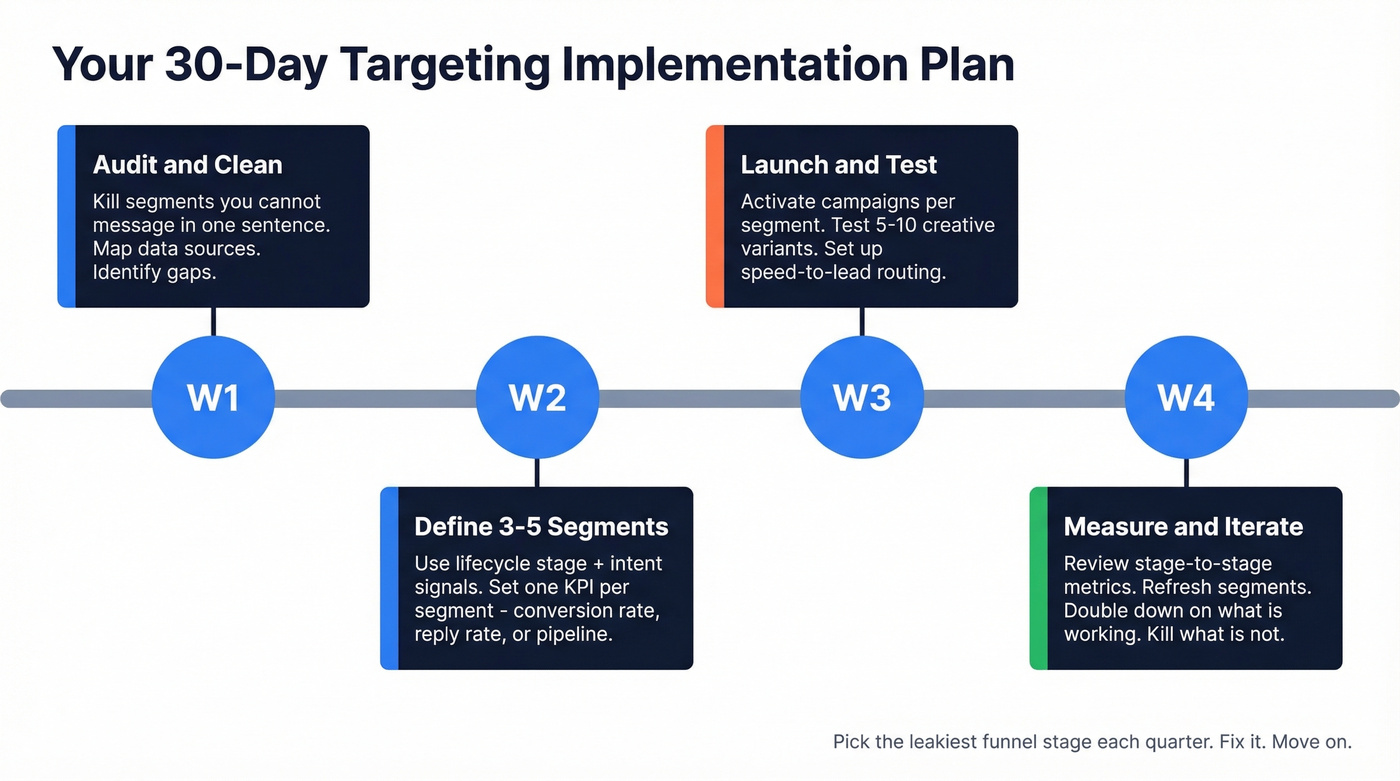
Week 2: Define 3-5 high-impact segments using lifecycle stage and intent signals. Set one KPI per segment - conversion rate, reply rate, or pipeline generated.
Week 3: Build and verify contact lists for B2B or audience lists for B2C. Launch your first creative tests. Ship, don't polish.
Week 4: Measure stage-to-stage conversion. Kill underperformers. Double down on winners. Set the weekly review cadence that carries you through the next 60 days.
The 90-day GTM frameworks floating around are fine for strategy decks. But you'll learn more in 30 days of live testing than in 90 days of planning. The best customer targeting strategies are the ones that get tested fast and iterated weekly - not the ones that sit in a slide deck gathering dust.
Multi-threading into 3-5 stakeholders per account doubles close rates - but only if you can actually reach them. Prospeo gives you verified emails and 125M+ direct dials across decision-makers, with a 30% pickup rate that triples industry average. No stale data, no bounced emails burning your domain.
Stop losing deals to bad contact data. Build verified lists in one click.
FAQ
What's the difference between targeting and segmentation?
Segmentation divides your market into groups based on shared traits; targeting chooses which segments to pursue and how to reach them. Segmentation is the analytical input, targeting is the action you take on it. Most teams over-invest in segmentation and under-invest in activation - they've got beautiful spreadsheets and zero outreach.
How many segments should I target?
Start with 3-5 segments you can distinctly message and measure weekly. If you can't explain why a segment should buy in one sentence, merge it or drop it. Teams running more than 7 active segments almost always have messaging overlap that dilutes results.
What tools help with B2B audience targeting?
GA4 handles predictive audiences for free. HubSpot Marketing Hub Starter starts at ~$15/mo per seat, scaling to ~$890/mo for Professional. For building verified target lists with intent data, Prospeo covers 15,000 intent topics, 98% email accuracy, and 30+ filters - starting with a free tier of 75 emails per month.
What are the biggest targeting challenges in 2026?
Data decay, privacy restrictions limiting third-party signals, and over-segmentation that leads to messaging paralysis. Teams that fix data quality first - using tools with weekly refresh cycles instead of monthly - consistently see 2-3x better conversion rates before touching any other variable. Start there.