

D7 Lead Finder vs Apollo.io: They Don't Do the Same Thing
An agency client asked us to pull "dentists in Phoenix." D7 Lead Finder returned up to 1,200 results in under three minutes - business names, addresses, generic emails, even Instagram follower counts. Then they asked for "VP of Marketing at mid-market SaaS companies." D7 returned nothing useful. Apollo.io is built for that second query. If you're weighing D7 Lead Finder vs Apollo.io, understand this first: these tools serve fundamentally different markets.
30-Second Verdict
Pick D7 if you're scraping local business lists - plumbers, dentists, yoga studios - by keyword and location.
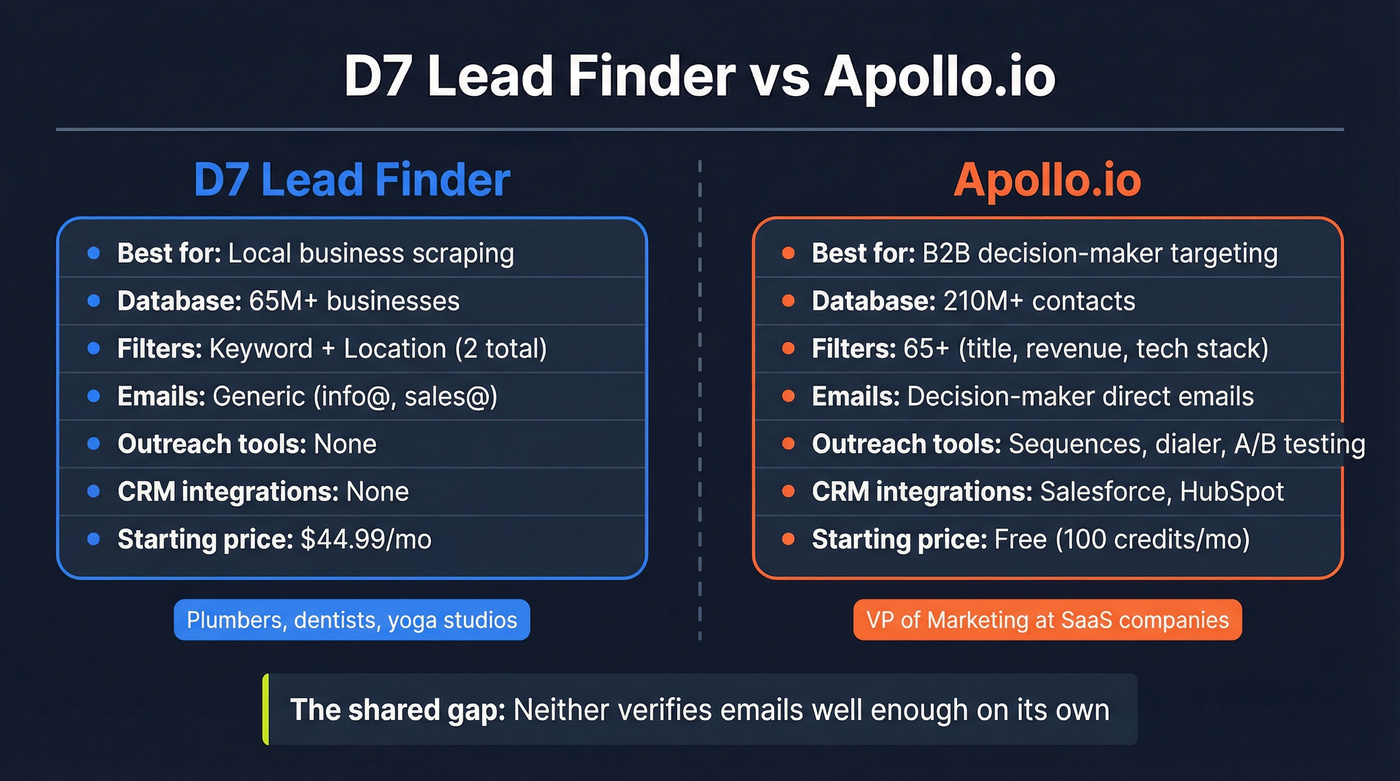
Pick Apollo if you're targeting B2B decision-makers by job title, company size, or industry and need built-in outreach sequences.
Skip both if your real problem is bounced emails destroying your domain reputation. Neither tool verifies data well enough on its own.
What Each Tool Actually Does
D7 Lead Finder is a keyword-plus-location scraper. Type "architects in New York," and it pulls up to 1,200 business records from a 65M+ database in under three minutes. You get business names, emails, websites, addresses, phone numbers, social links, review scores, and whether the business is running ads. Fast, simple, purpose-built for web scraping lead generation and local list building.
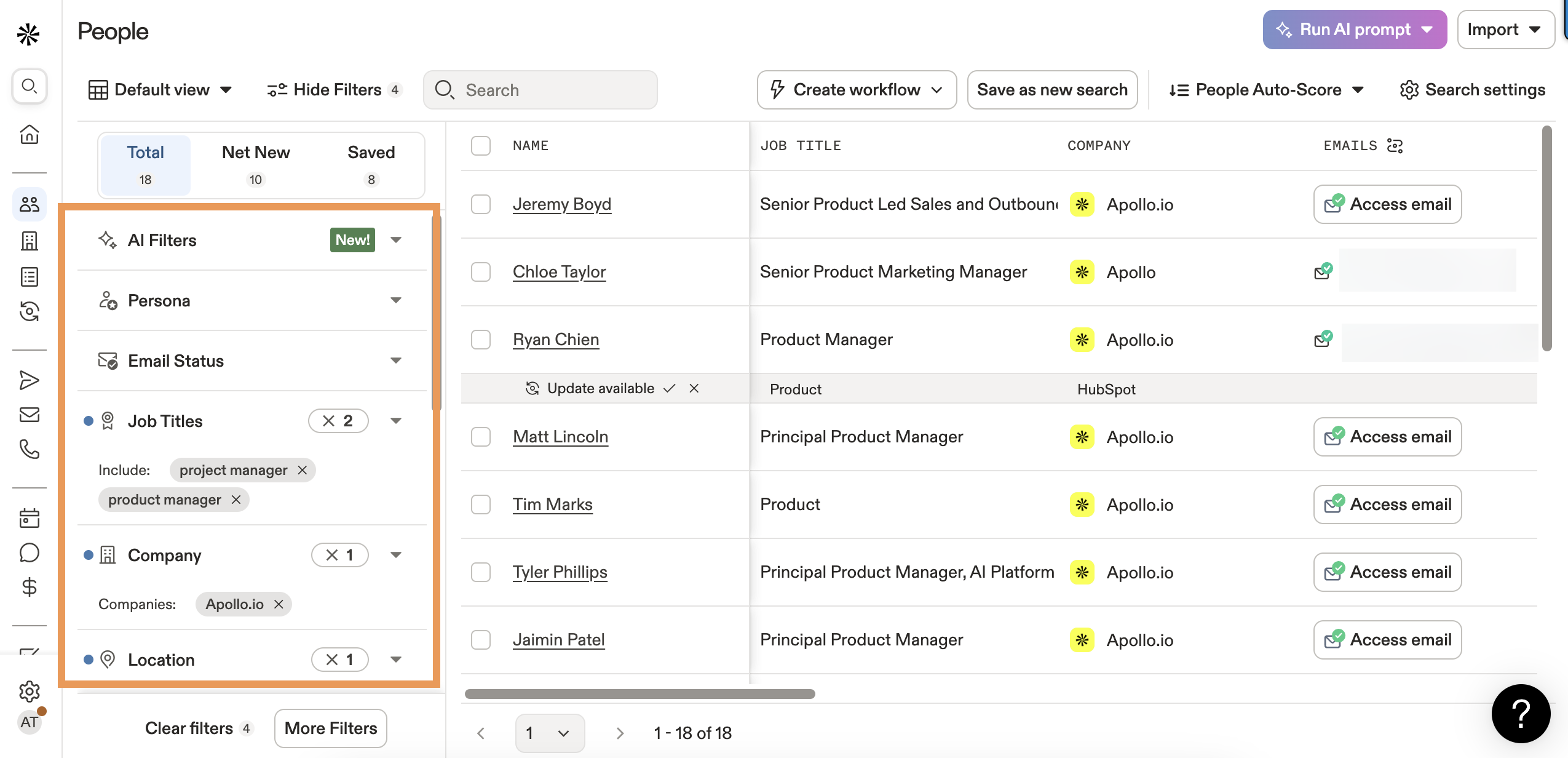
Apollo.io is a full B2B sales intelligence platform with a 210M+ contact database and 65+ search filters - job title, seniority, company revenue, headcount, tech stack, you name it. Beyond the database, Apollo includes outreach sequences, a dialer, A/B testing, and native CRM integrations with Salesforce and HubSpot. It's a different animal entirely.
Feature-by-Feature Comparison
| Feature | D7 Lead Finder | Apollo.io |
|---|---|---|
| Database size | 65M+ businesses | 210M+ contacts |
| Search filters | 2 (keyword + location) | 65+ |
| Email type | Mostly generic (info@, sales@) | Decision-maker emails |
| Verification | Basic syntax-only | "Verified" label, ~65% usable in practice |
| Outreach tools | None | Sequences, dialer, A/B |
| CRM integrations | None | Salesforce, HubSpot |
| G2 rating | 3.7/5 (5 reviews) | 4.1/5 (571+ reviews) |
D7 is a scraper with two knobs. Apollo is a platform with dozens. If you need local businesses in bulk, D7's simplicity is a feature. If you need the right person at the right company, Apollo's filter depth is non-negotiable.

D7 gives you generic emails. Apollo's "verified" labels still bounce 18% on day one. Prospeo's 300M+ profiles with 30+ filters - buyer intent, technographics, job changes - let you target decision-makers AND get 98% accurate emails. No external verification step needed.
Stop paying for leads you can't actually email.
Pricing Breakdown
| Tier | D7 Lead Finder | Apollo.io |
|---|---|---|
| Entry | Starter $44.99/mo (10 daily searches) | Free (100 credits/mo) |
| Mid | Agency $69.99/mo (30 daily searches) | Basic $49/user/mo (annual) |
| Upper | Professional $119.99/mo (100 daily searches) | Professional $79/user/mo (annual) |
| Top | - | Organization $119/user/mo (min 3 users) |
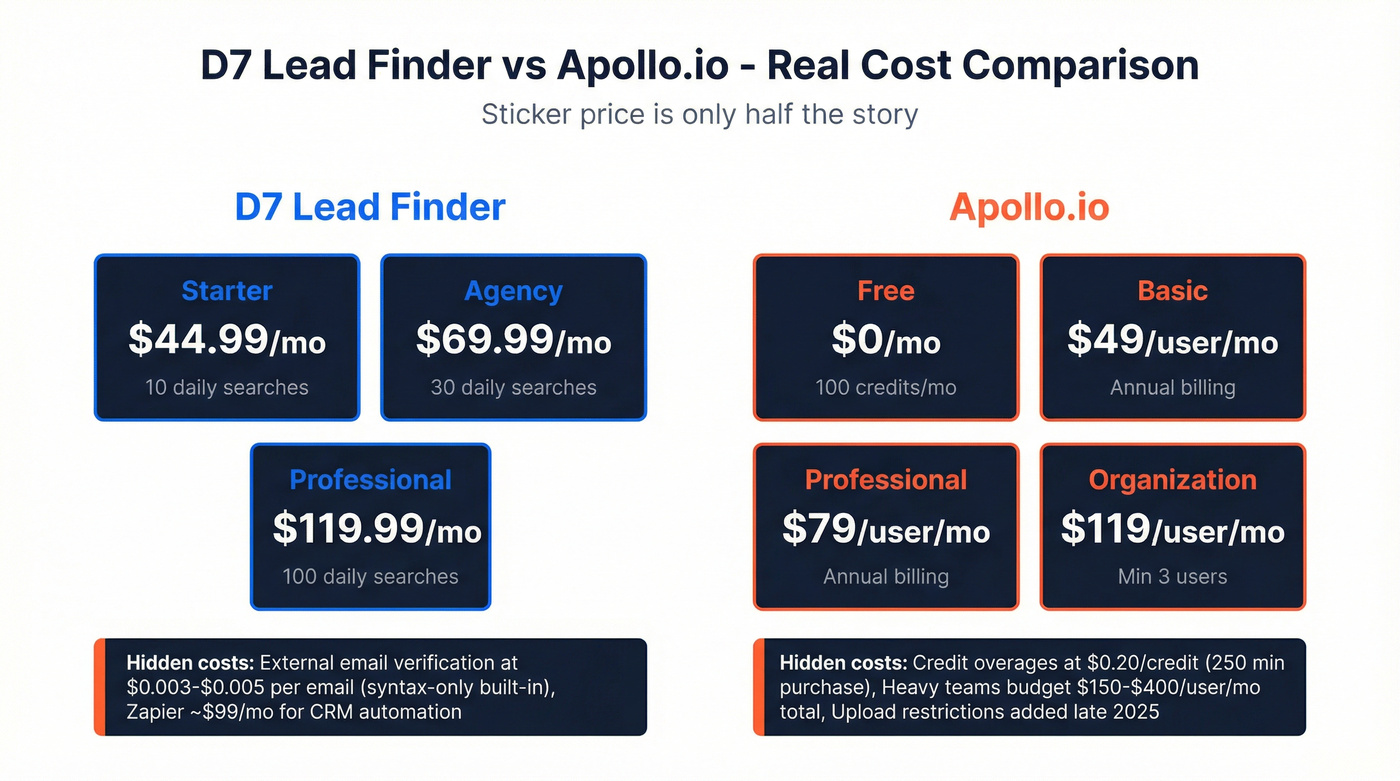
D7's hidden costs add up fast. Its verification is syntax-only, so budget $0.003-$0.005 per email for external verification. And if you want contacts flowing into your pipeline automatically, teams often tack on Zapier (around $99/mo for Pro).
Apollo's hidden costs look different. Overages run $0.20/credit with a 250-credit minimum purchase. Heavy outbound teams should budget $150-$400/user/month once you factor in credit overages. Apollo also removed uploads for emails, phone numbers, and professional profile URLs in late 2025, which broke several common enrichment workarounds teams had relied on.
The Real Problem: Data Quality
Here's the thing - neither tool solves the accuracy problem well.
D7 returns generic emails because it scrapes business listings, not org charts. One G2 reviewer titled their review "Zero Customer Support," and with only 5 reviews total on what appears to be an inactive profile, that signal is hard to ignore. The data needs cleanup, and there's no way to target decision-makers when you've only got two filters to work with.
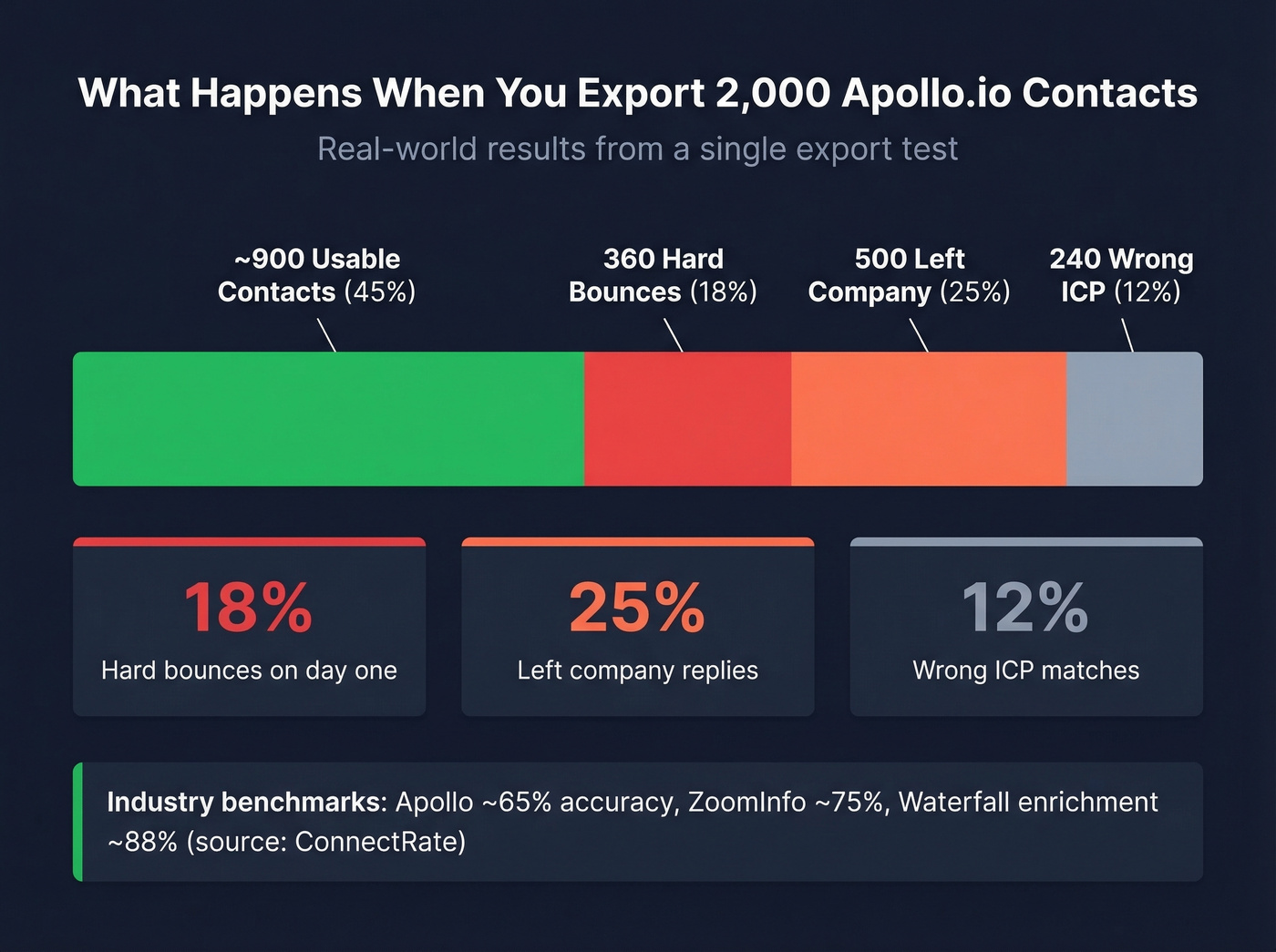
Apollo's "verified" label is misleading. We've seen this firsthand. In one exported list of 2,000 contacts, the breakdown looked like this: 18% hard bounces on day one, roughly 25% "left company" replies, and about 12% wrong-ICP matches - leaving around 900 usable contacts out of 2,000. The consensus on r/sales threads tracks with this: users regularly report Apollo accuracy well below what the platform implies. A separate benchmark from ConnectRate put Apollo at ~65% accuracy, ZoomInfo at ~75%, and waterfall enrichment approaches at ~88%.
Neither tool gets you to a bounce rate that's safe for your domain reputation without an additional verification step.

Which One Should You Pick?
Stop comparing these two if you haven't defined your ICP clearly enough. A local services agency building lists of contractors has zero overlap in tooling needs with a B2B SaaS SDR team targeting VP-level buyers. D7 for local. Apollo for B2B. That's it.
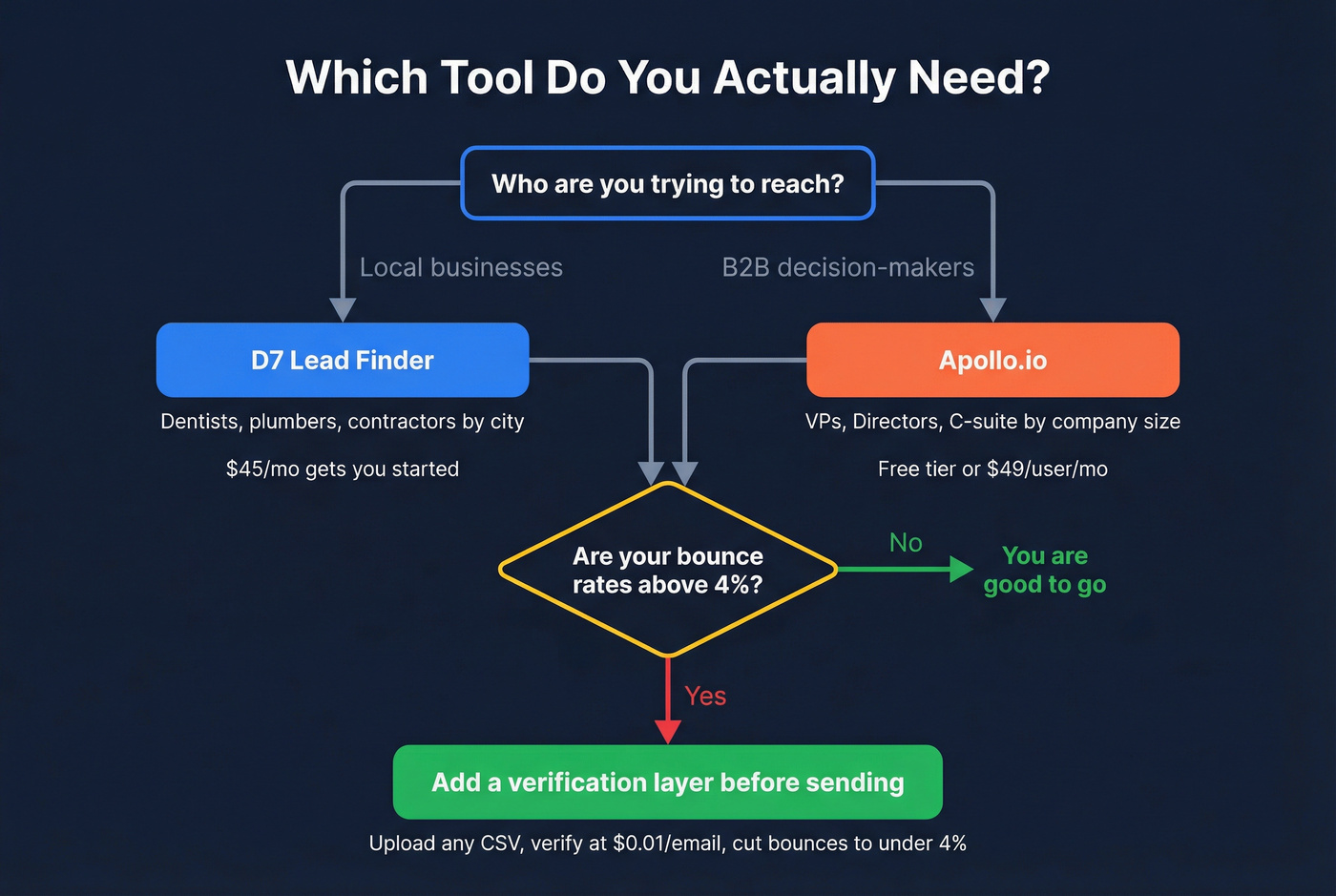
If your average deal size is under $5k and you're selling to local businesses, D7 at $45/mo will outperform Apollo's free tier every time. But the moment you need to reach a specific person at a specific company, D7 is useless - and Apollo becomes the minimum viable tool.
The gap both tools share is accuracy. In our testing, running any export through a dedicated verification layer before sending cut bounce rates from 15-20% down to under 4%. That's the difference between a healthy sending domain and one that's flagged within two weeks.
When Accuracy Matters More Than Either Tool
Let's be honest: if you're burning through leads because half your emails bounce, the database isn't your bottleneck. Verification is.
Prospeo's 300M+ professional profiles with 30+ search filters - buyer intent, technographics, job change signals, headcount growth - make it work as a standalone database or as a verification layer on top of D7 or Apollo exports. Upload a CSV, get verified results back, push clean contacts to Smartlead, Instantly, or HubSpot. The 5-step verification process handles catch-all domains, spam traps, and honeypots, which is where most other tools quietly fail. Free tier gives you 75 verified emails per month, no contract, no credit card.
If you want to go deeper on deliverability, start with email bounce rate benchmarks and a practical email deliverability guide before scaling volume. For teams doing enrichment at scale, compare data enrichment services and build a repeatable lead generation workflow so verification isn't an afterthought.
Whether you're scraping local businesses with D7 or pulling B2B contacts from Apollo, every export needs verification before you hit send. Prospeo's 5-step verification catches catch-all domains, spam traps, and honeypots - cutting bounce rates to under 4%. Upload any CSV and get clean data back at $0.01/email.
Verify any list in minutes - no contract, no credit card.
FAQ
How accurate is Apollo.io's email data?
In one exported list of 2,000 "verified" contacts, the outcome was 18% hard bounces, 25% "left company" replies, and 12% wrong-ICP matches - leaving roughly 900 usable contacts. Adding a verification layer before sending can reduce bounce rates to under 4%. Apollo's own documentation doesn't publish accuracy benchmarks, which tells you something.
Can I use D7 and Apollo together?
Yes. Some teams use D7 for local business scraping and Apollo for B2B decision-maker targeting. The overlap is minimal since they serve different audiences entirely. Run all contacts through a verification step before emailing to catch bounces and stale data from either source.