

=== CURRENT ARTICLE (slug: data-driven-demand-generation) ===
Data-Driven Demand Generation: The Framework, Benchmarks, and Dark Funnel Reality
Your CMO asks which channels drive pipeline. You pull up the dashboard. Eighty percent of closed-won shows as "direct." You know that's wrong, but you can't prove what's right. Meanwhile, 95% of B2B marketers agree that a data-driven demand generation strategy significantly improves results - yet 41% say they can't measure them.
That gap is where pipeline goes to die.
What This Actually Means
The top benefit of going data-driven? Improved lead quality (49%), not more leads (35%). Quality over quantity is the entire point. Data-driven demand generation means connecting every activity - content, ads, events, outbound - to pipeline and revenue using first-party behavioral data, third-party intent signals, and multi-touch attribution. It's the difference between knowing you spent $50k on webinars and knowing those webinars influenced $400k in pipeline at a 14-day acceleration.
The demand gen software market is projected to grow from $4.5B to $8.4B by 2028, and much of that growth comes from automation platforms that consolidate intent scoring, routing, and nurture into a single workflow. Teams aren't just buying more tools. They're buying fewer, better-connected ones.
The Dark Funnel Problem
Roughly 70% of the B2B buyer journey happens in channels you can't track - Slack threads, private communities, podcast mentions, word-of-mouth referrals that never touch a UTM parameter. Sixty percent of B2B buyers use ChatGPT or Gemini during their buying process. Decision-makers consume 3-13 pieces of content before engaging sales, and 78% prefer case studies. Most of that consumption is invisible to your analytics.
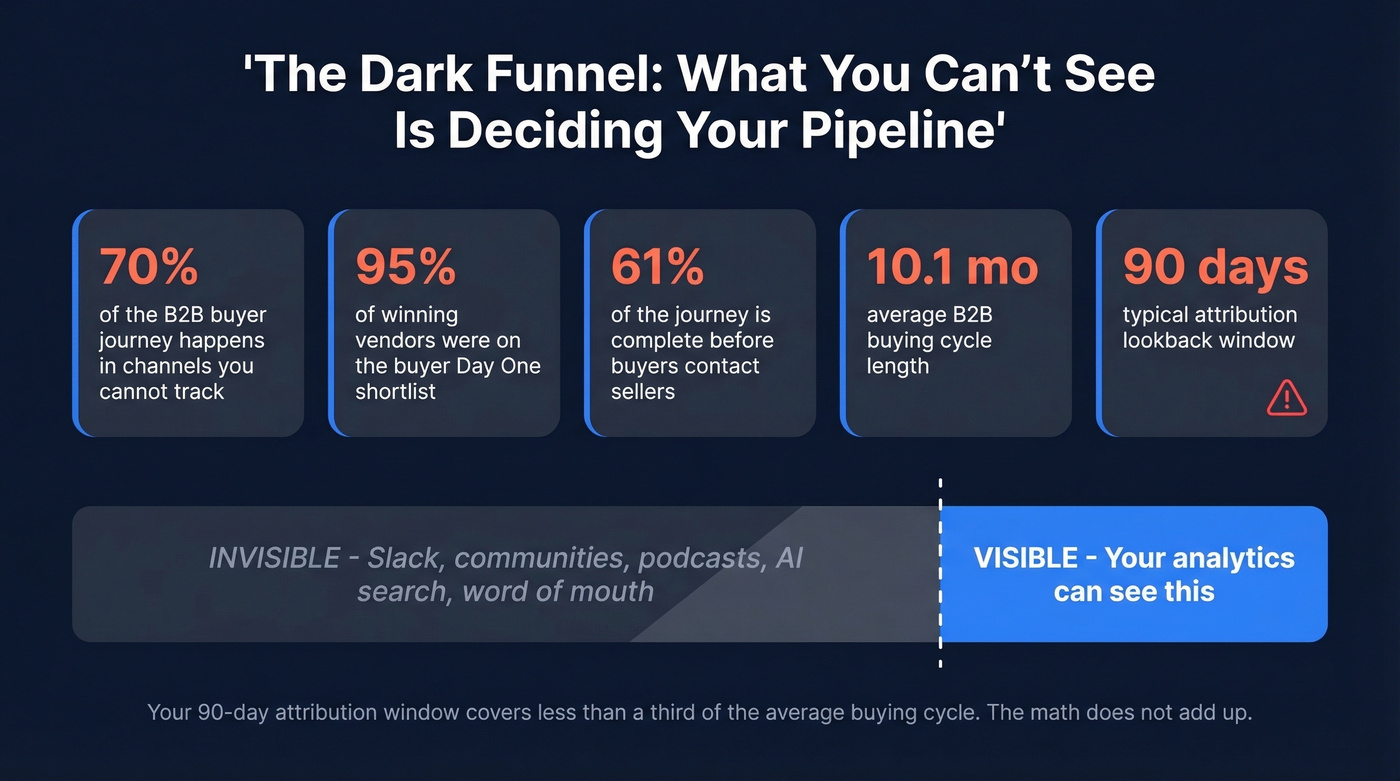
Here's the math that should bother you: the average B2B buying cycle runs 10.1 months, buyers contact sellers at 61% of the journey, and the winning vendor is on the buyer's Day One shortlist 95% of the time. Your attribution lookback window? Usually 90 days. That doesn't add up. Stop trying to track everything - build brand in unmeasurable channels while optimizing the measurable ones.
Five warning signs your dark funnel is eating your attribution:
- Spikes in "direct" conversions that don't correlate with any campaign
- Opportunities appearing with zero marketing touchpoints
- "Unknown" dominating your attribution reports
- Intent data showing ICP accounts surging, but no inbound from them
- Buyers arriving highly knowledgeable with no tracked engagement history
If three or more sound familiar, your attribution model isn't broken. It's blind to where decisions actually happen.
Bottleneck-First Measurement
A practitioner on r/startups laid out a practical approach we've seen work repeatedly: map the whole journey, measure conversion rates between steps, and focus on the real bottleneck. Not the vanity metrics. Not the dashboard that makes marketing look good.
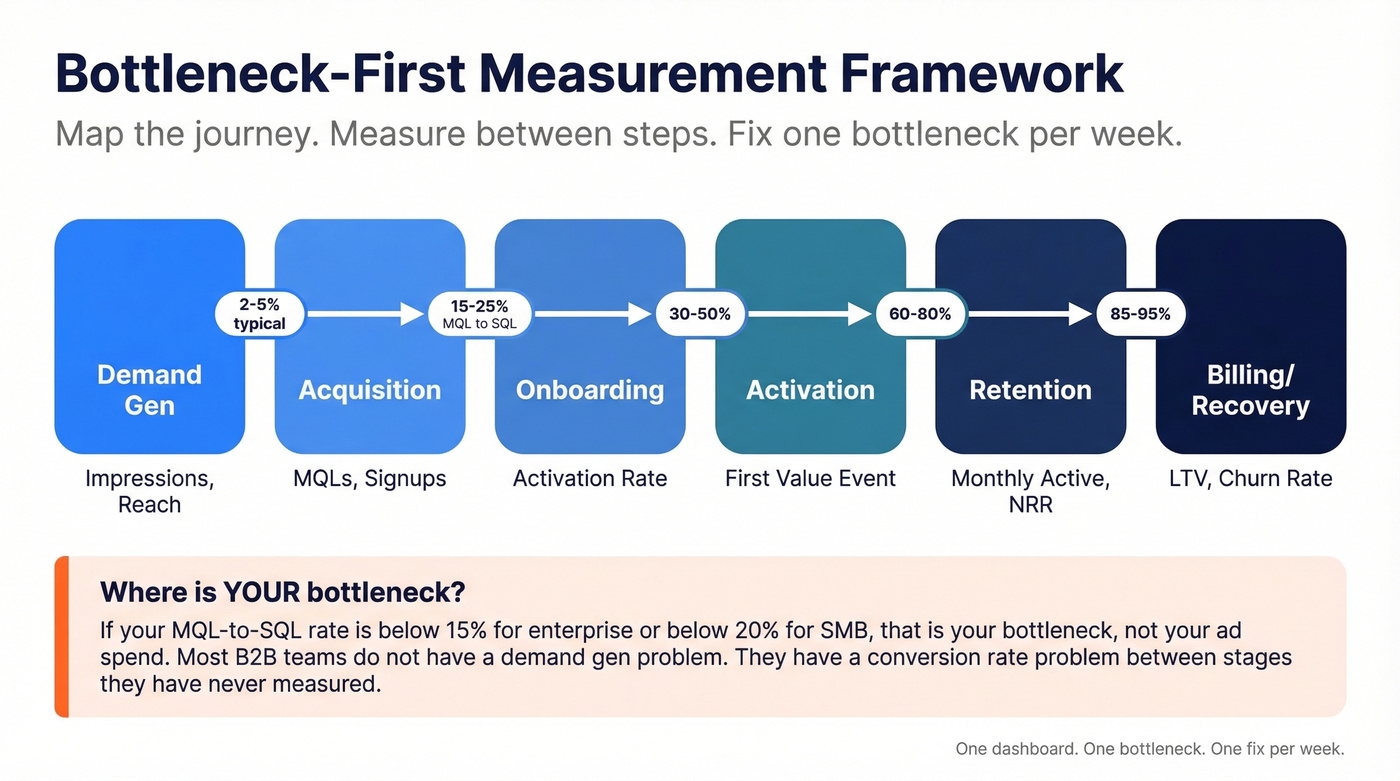
The stages: Demand Gen -> Acquisition -> Onboarding -> Activation -> Retention -> Billing/Recovery. Each stage gets one primary KPI and one conversion rate connecting it to the next. One dashboard, one bottleneck, one fix per week. Using data to plan campaigns at each stage - rather than guessing which lever to pull - is what separates teams that scale from teams that stall.
Let's be honest: most B2B teams don't have a demand gen problem. They have a conversion rate problem between stages they've never measured. MQL-to-SQL rates are often in the teens for enterprise and closer to the 20s for SMB. If yours fall below those floors, that's your bottleneck - not your ad spend.
And here's where most teams get it wrong: they default to last-click attribution because it's easy. Last-click is lying to you.
| Dimension | Last-Click | Multi-Touch |
|---|---|---|
| What gets credit | Final touchpoint only | All touchpoints, weighted |
| Common distortion | Over-credits branded search | Distributes across funnel |
| Adoption at $250M+ companies | ~27% | 73% |
| Best for | Simple funnels, short cycles | Complex B2B with 6-10 stakeholders |
| Blind spot | Ignores awareness entirely | Still can't see dark funnel |
Multi-touch often reallocates 10-30% of spend away from over-credited channels like branded search. That reallocation alone shifts pipeline economics. Yet only 18% of B2B marketers rank cost per opportunity as a top-3 metric - the biggest blind spot in the space. Demand gen takes 30% of median program budgets. You owe it to that spend to measure it properly.

Multi-touch attribution shows you where pipeline starts. Prospeo shows you who's behind it - with 98% email accuracy, 125M+ verified mobiles, and 15,000 Bombora intent topics layered directly onto contact records. No spreadsheet matching. No stale data.
Connect intent signals to verified buyers in one workflow.
Intent Data Changes Everything
Use intent data if you're selling into accounts with 6-10 stakeholders, your sales cycle exceeds 3 months, and you need to prioritize accounts before they raise their hand. Sixty-five percent of marketers say intent signals improved pipeline forecasting accuracy. NFON UK used ABM/intent targeting to identify 400 high-intent resellers in 6 months and signed 8 new partners - a concrete example of intent data compressing a long sales cycle.
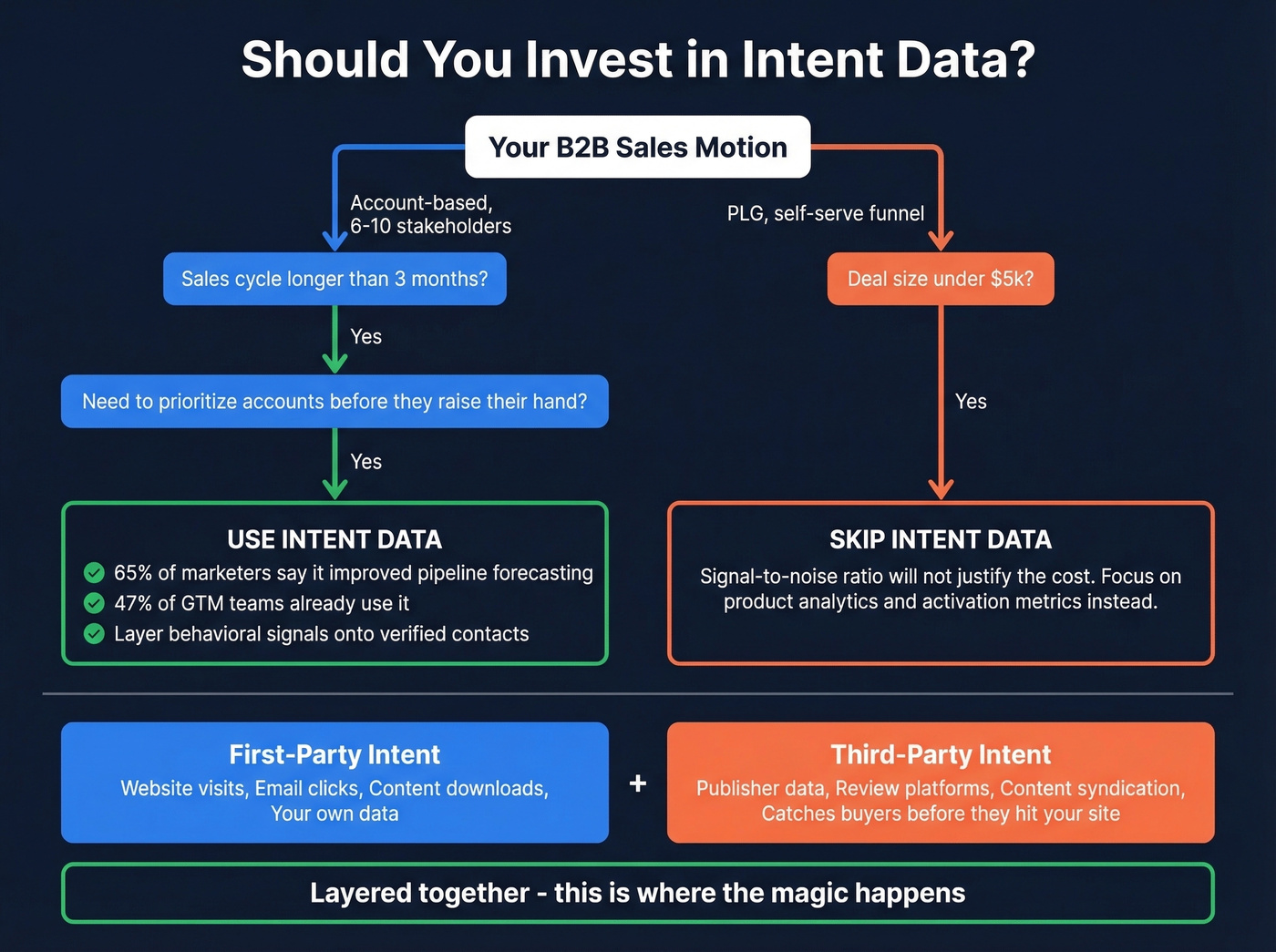
Skip intent data if you're running a PLG motion with a self-serve funnel and sub-$5k deals. The signal-to-noise ratio won't justify the cost.
First-party intent is your own data: website visits, email clicks, content downloads. Third-party intent comes from external sources - publishers, review platforms, content syndication networks - and catches buyers before they ever hit your site. The teams that layer behavioral signals onto verified contacts outperform those relying on firmographics alone. Prospeo tracks 15,000 intent topics via Bombora directly within its contact database, so you're connecting intent signals to verified emails and direct dials in the same workflow rather than exporting to a spreadsheet and praying the data matches.
Forty-seven percent of GTM teams already use intent data for lead gen. If you're not, you're flying blind while half your competitors have the signal.
From Segments to Individuals
Intent data is only half the equation. The other half is what you do with it.
Personalized B2B campaigns - where messaging adapts to a buyer's industry, role, stage, and observed behavior - consistently outperform generic outreach. Higher reply rates, shorter sales cycles, improved win rates across every segment. The spectrum runs from basic segmentation to hyper-personalization, where every touchpoint reflects real-time behavioral and firmographic data. Dynamic personalization means your nurture sequence changes based on what a prospect actually consumed, not just which list they landed on.
When you combine marketing automation with accurate intent signals, you stop sending the same case study to a CISO and a VP of Engineering. You start delivering messaging that maps to each stakeholder's buying criteria. In our experience, this doesn't require a massive martech stack. It requires clean contact data, reliable intent signals, and automation rules that act on both.
Automating Without Losing Quality
Five failure modes we see repeatedly - and most stem from teams that try to automate before fixing the data underneath:
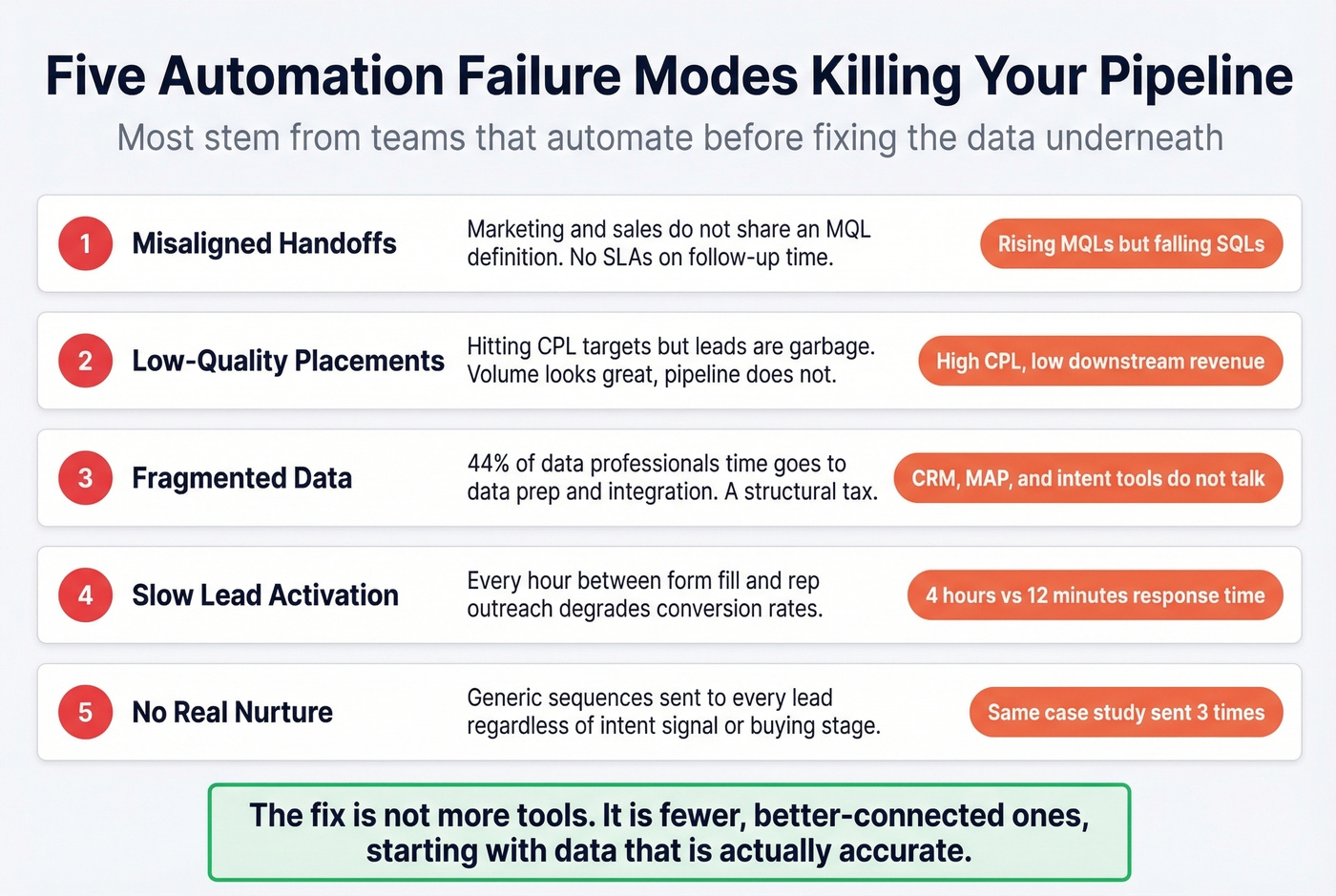
Misaligned handoffs. Marketing and sales don't share an MQL definition. No SLAs on follow-up time. MQLs get rejected by sales, and nobody investigates why. Warning sign: rising MQL volume while SQL count falls.
Low-quality placements inflating volume. You're hitting CPL targets, but the leads are garbage. High CPL with low downstream revenue is the tell.
Fragmented data. Your CRM, MAP, and intent tools don't communicate. Data professionals spend 44% of their time on data preparation and integration - that's a structural tax on your team.
Slow lead activation. Manual routing delays kill speed-to-lead. Every hour between form fill and rep outreach degrades conversion. We've watched teams cut response time from 4 hours to 12 minutes with automated routing, and the pipeline impact was immediate.
No real nurture after capture. Generic sequences sent to every lead regardless of intent signal or buying stage. If your "nurture" is a 6-email drip with the same case study three times, you don't have a nurture - you have a slow unsubscribe campaign.
Data Quality Is Pipeline Quality
Every metric upstream - attribution accuracy, conversion rates, pipeline velocity - collapses if the contact data underneath is wrong. There are 15,384 martech tools in the ecosystem. The answer isn't more tools. It's fewer, better-connected ones, starting with data that's actually accurate.
Look, I've seen teams pour six figures into demand gen programs only to discover their bounce rates were north of 30%. All that intent data, all that personalization, all that attribution modeling - wasted because the emails never arrived. Snyk's team of 50 AEs saw bounce rates drop from 35-40% to under 5% after switching to Prospeo, with AE-sourced pipeline up 180%. That's not a marginal improvement. That's the difference between a demand gen engine that works and one that's burning budget.

Data-driven demand generation only works when the data itself is trustworthy. Fix the foundation first. Then the framework, attribution, and intent layers compound on top of each other instead of amplifying errors. If you're auditing your stack, start with data enrichment and a clear lead scoring model, then pressure-test your funnel metrics and pipeline health weekly.
Your dark funnel is full of in-market buyers you can't see. Prospeo's intent data tracks 15,000 topics and pairs surging accounts with verified emails and direct dials - refreshed every 7 days, not every 6 weeks. At $0.01 per email, the ROI math writes itself.
Turn invisible demand into pipeline you can actually measure.