

Best Data Hygiene Tools in 2026, Sorted by What You Actually Need
Your marketing team just sent 10,000 emails and 2,200 bounced. Your SDRs are calling disconnected numbers. Your forecasting model is built on duplicates nobody noticed for six months. This is what bad data hygiene looks like - and it's costing more than anyone wants to admit.
About 30% of B2B data decays every single year. That's not a slow leak. It's a flood hitting your CRM, your warehouse, and your pipeline all at once. The tools below are organized by what they fix - contact decay, CRM rot, warehouse quality, and pipeline reliability - because each problem needs a different solution.
Our Picks (TL;DR)
| Use Case | Pick | Why |
|---|---|---|
| B2B contact data hygiene | Prospeo | 98% email accuracy, 7-day refresh, free tier |
| Free dataset cleanup | OpenRefine | Open-source, powerful transforms, $0 |
| CRM dedup (Salesforce) | DemandTools | Purpose-built Salesforce hygiene modules |
| Data pipeline observability | Monte Carlo | ML anomaly detection, lineage, root cause |
| Mid-market all-in-one | Integrate.io | Flat-rate plans start around ~$199/mo |
You don't need 10 tools. You need three - one for contact data, one for dataset cleanup, and one for ongoing monitoring. That covers most hygiene needs for under $100/month if you lean on free tiers and open-source.
What Is Data Hygiene?
Data hygiene isn't a weekend project. It's an ongoing discipline: the continuous practice of maintaining accurate, consistent, and complete data across your systems. Most teams confuse it with data cleansing, which is just one piece.
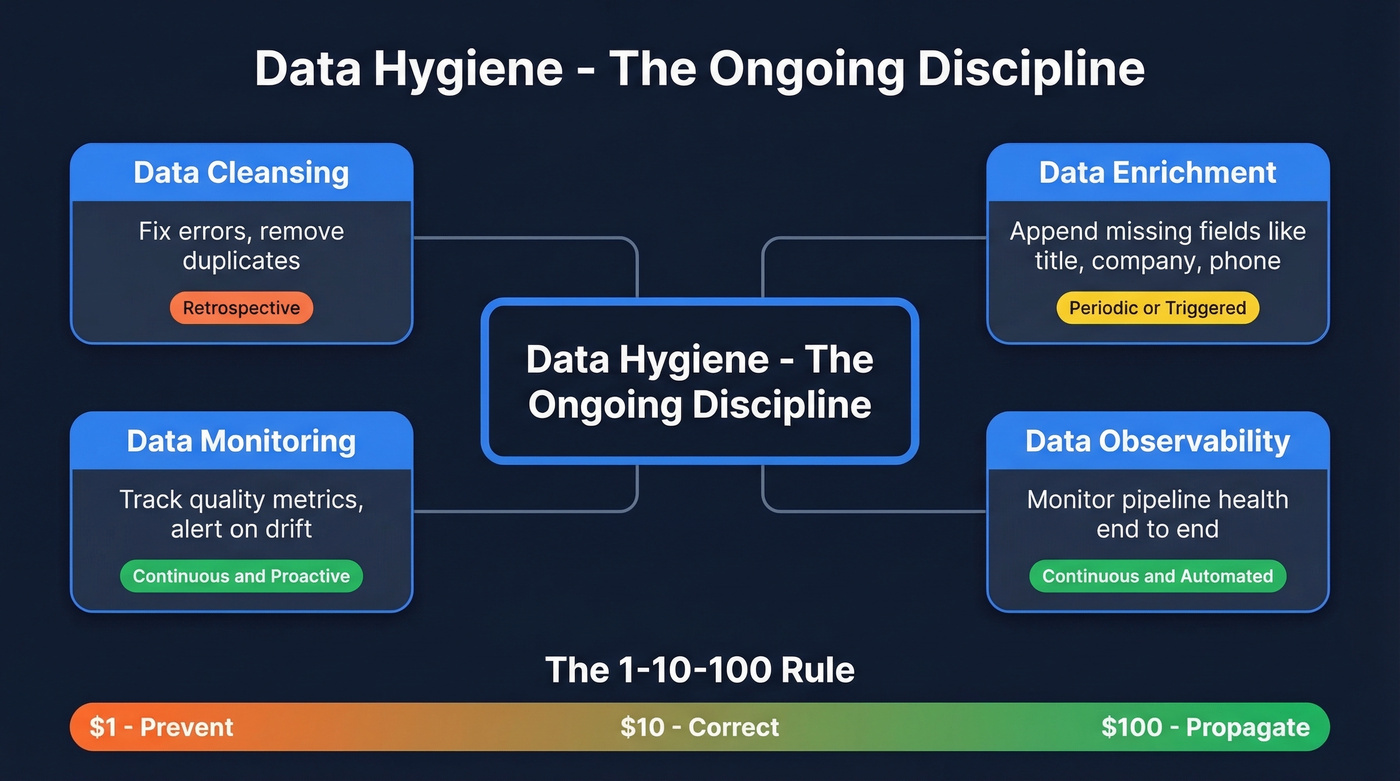
Here's how the terms actually break down:
| Term | What It Means | When It Happens |
|---|---|---|
| Data Hygiene | Ongoing maintenance discipline | Continuous |
| Data Cleansing | Fix errors, remove duplicates | Retrospective |
| Data Enrichment | Append missing fields | Periodic or triggered |
| Data Monitoring | Track quality metrics, alert on drift | Continuous/proactive |
| Data Observability | Monitor pipeline health end-to-end | Continuous/automated |
The distinction matters because it changes which tools you buy. Cleansing is retrospective - you're fixing problems that already exist. Monitoring and observability are proactive - you're catching problems before they propagate into dashboards, sequences, and forecasts.
The 1-10-100 rule makes this concrete. Preventing a data error costs roughly $1. Correcting it after entry costs $10. Letting it propagate through your systems - into reports, campaigns, routing rules, forecasts - costs $100. Every tool in this article sits somewhere on that spectrum.
Why Dirty Data Costs More Than You Think
Over a quarter of organizations estimate more than $5M in annual losses from poor data quality, and seven percent report losses exceeding $25M. IBM's research found that 43% of COOs now identify data quality as their most significant data priority.
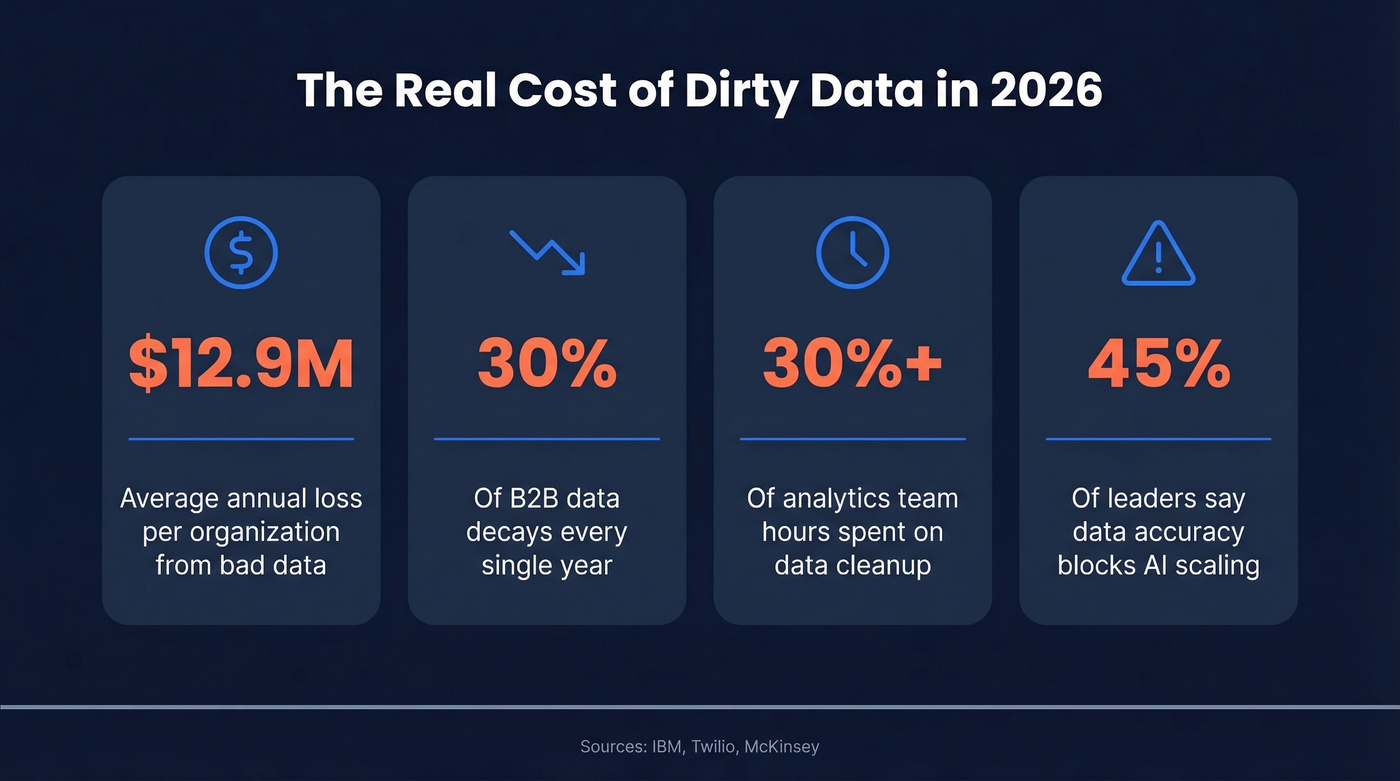
The average organization loses $12.9M per year to bad data. McKinsey pegs the time tax at 30%+ of analytics teams' hours spent on data processing and cleanup. A third of their week doing janitorial work instead of building models.
Here's the kicker: with AI spending forecast to surpass $2T in 2026, nearly 45% of business leaders cite data accuracy concerns as the leading barrier to scaling AI initiatives. You can't feed garbage into an LLM and expect gold out. The data cleaning tools market hit $3.62B in 2025 and is projected to reach $6.78B by 2029 - that growth reflects how many organizations are finally taking this seriously.

You just read that dirty data costs the average org $12.9M per year. Prospeo's 5-step verification catches catch-all traps, spam traps, and honeypots - delivering 98% email accuracy on 143M+ verified addresses. With a 7-day refresh cycle (6x faster than the industry average), your CRM stays clean without quarterly fire drills.
Stop paying the 1-10-100 tax. Start with 75 free verified emails.
How to Choose the Right Tool
Start with the problem, not the tool. Data hygiene breaks into four categories, and your primary pain point determines where to invest first:
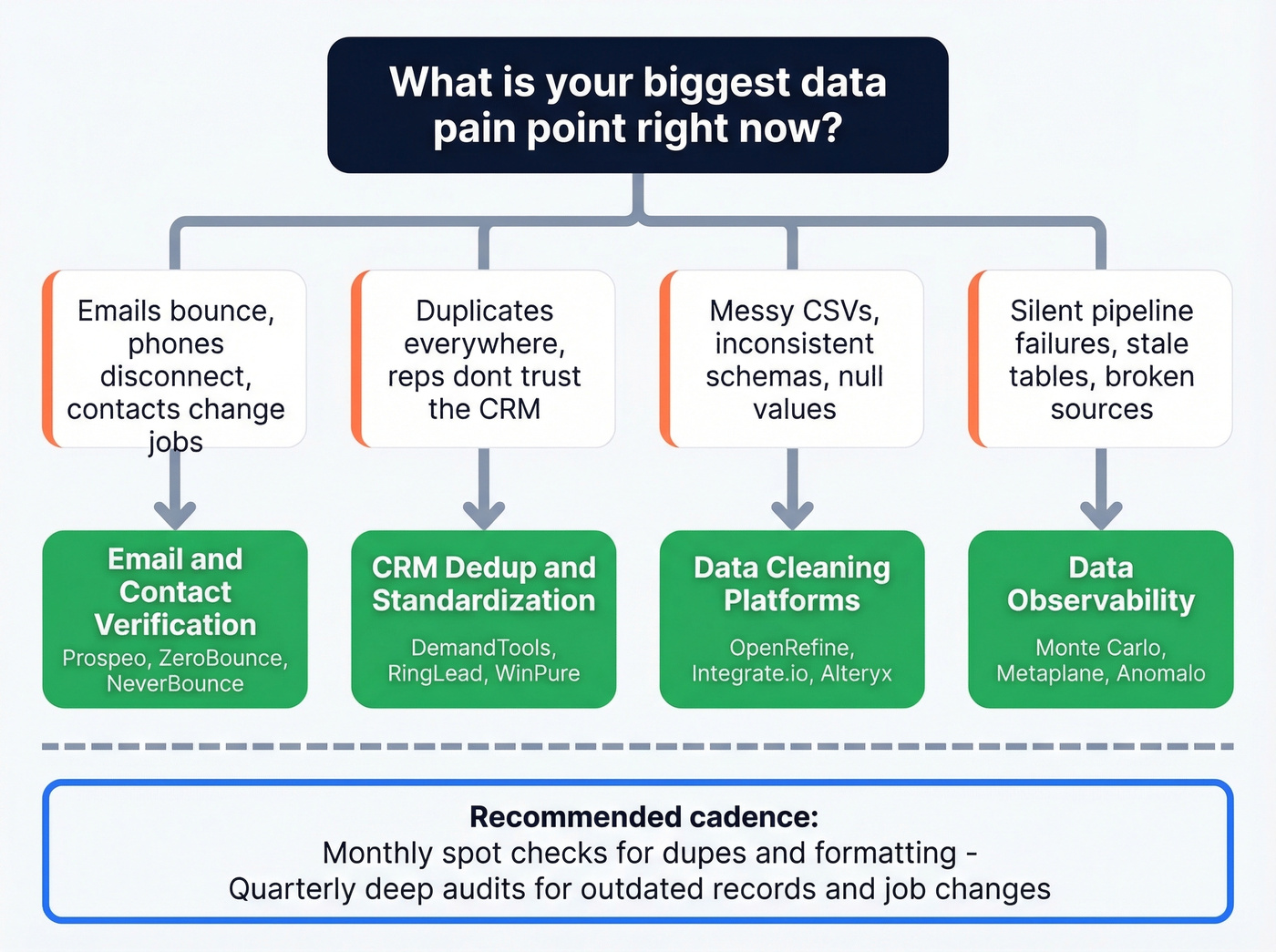
- Contact decay (emails bounce, phones disconnect, people change jobs) - email/mobile verification tools
- CRM rot (duplicates, formatting chaos, incomplete records) - CRM dedup and standardization tools
- Warehouse quality (inconsistent schemas, null values, format mismatches) - data scrubbing and cleaning platforms
- Pipeline reliability (silent failures, stale tables, broken upstream sources) - observability tools
There's also an emerging fifth category worth watching: analytics instrumentation hygiene. Broken tracking pixels, misconfigured events, and schema drift in your analytics pipeline can silently corrupt every downstream report. Tools like Trackingplan monitor your analytics implementation the same way Monte Carlo monitors your data warehouse. If your marketing team has ever made a decision based on a dashboard that was quietly undercounting conversions for weeks, this is the category that prevents it.
The pattern across B2B teams is consistent: they start with a dedupe tool, add an enrichment layer, then realize they need ongoing monitoring to keep things clean. For cadence, the baseline that works for most B2B teams is monthly spot checks for duplicates and formatting issues, quarterly deep audits for outdated records and job changes.
One pricing reality worth flagging: if you need a demo call to learn the price, budget $50K-$200K+/year. If that's not your budget, the categories below have transparent options that'll get you 80% of the way there.
Best Data Hygiene Tools by Category
B2B Contact & Email Verification
This is where dirty data hits your revenue first. Your CRM decays roughly 30% per year - people change jobs, companies get acquired, email servers get reconfigured. When buying groups involve 8-12 stakeholders, a single outdated contact can mean losing visibility into an entire deal. If you're running outbound sequences on unverified data, you're burning domain reputation with every send.
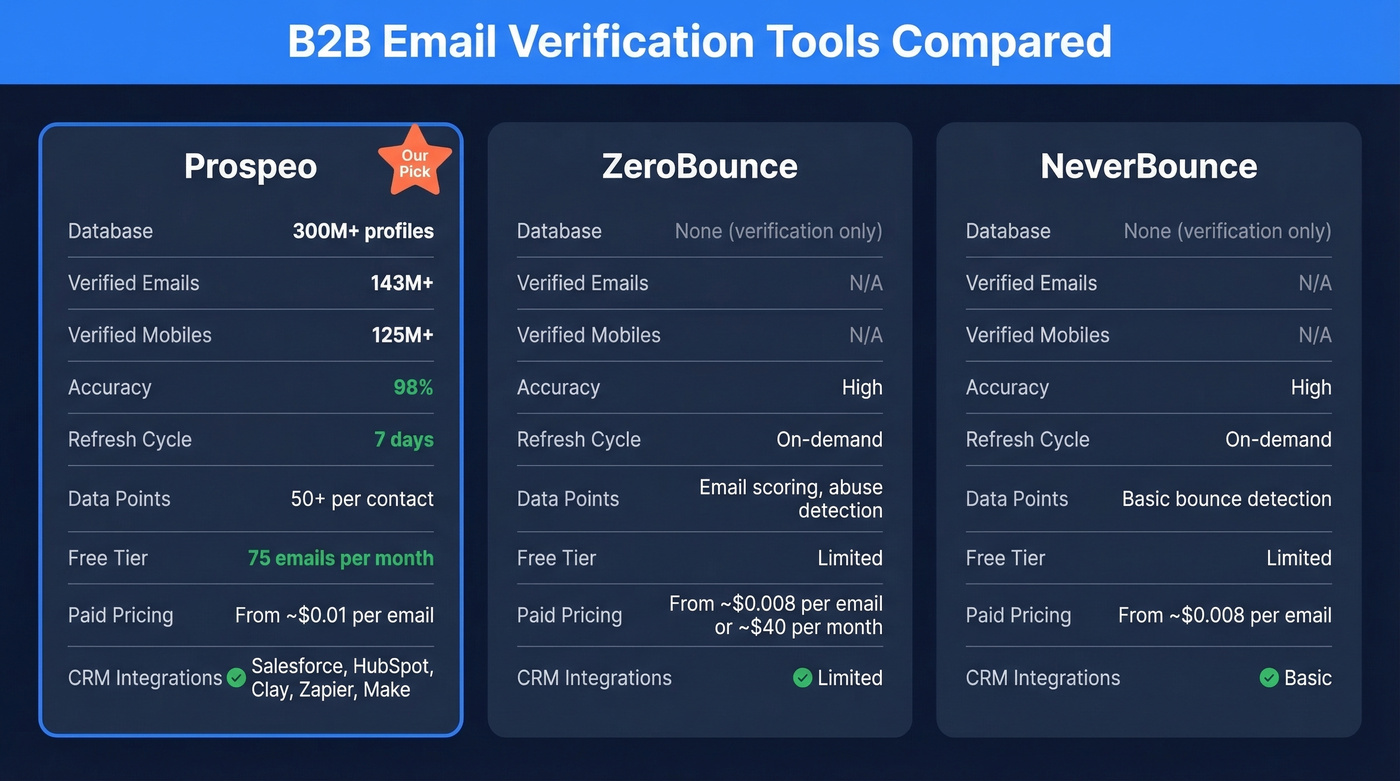
Prospeo is the tool to start with for B2B contact hygiene. The database covers 300M+ professional profiles with 143M+ verified emails and 125M+ verified mobile numbers. A proprietary 5-step verification process handles catch-all domains, removes spam traps, and filters honeypots - delivering 98% email accuracy. That's not a marketing number; we've seen it hold up across our own outbound campaigns and in customer results like Snyk's, where bounce rates dropped from 35-40% to under 5%.
The 7-day data refresh cycle is the stat that matters most here. The industry average is six weeks. In a world where 30% of data decays annually, the difference between weekly and monthly refreshes is the difference between clean sequences and bounced campaigns. Enrichment returns 50+ data points per contact with a 92% API match rate. Pricing is transparent: free tier at 75 emails/month, paid plans at roughly $0.01 per email. Native integrations with Salesforce, HubSpot, Smartlead, Instantly, Lemlist, Clay, Zapier, and Make mean verified contacts flow straight into your workflows without manual exports.
ZeroBounce is a solid pick if you want pay-as-you-go verification without a database attached. It starts at roughly $0.008/email with monthly plans from ~$40/mo, and adds email scoring, abuse detection, and spam-trap flagging. Skip it if you also need to find new contacts - it's verification-only, not a prospecting database.
NeverBounce fills a similar niche: pay-as-you-go from ~$0.008/email, bulk list cleaning, real-time API verification. Simpler feature set than ZeroBounce, but reliable for straightforward list hygiene.
CRM Cleanup & Deduplication
Duplicates are the silent killer of CRM trust. Once reps stop trusting the data, they stop logging activities, and your entire revenue operations model breaks down.
DemandTools (Validity) is the dominant Salesforce hygiene tool for a reason. It's purpose-built with modules for deduplication, merge, standardization, and ongoing maintenance - all within the Salesforce ecosystem. It also supports Microsoft Dynamics 365 CRM. If your CRM is Salesforce or Dynamics and duplicates are your primary headache, this is the tool. Expect $500-$2,000/mo for a mid-size org depending on record volume and modules.
RingLead takes a broader approach: data orchestration across multiple CRMs covering normalization, dedup prevention, enrichment, and lead routing. It's more of a platform play than a point solution. Enterprise pricing typically runs $1,000-$3,000/mo.
WinPure is the outlier - desktop-based clean and match software with one-time licenses ranging from ~$2,000-$10,000 depending on volume. If you want to own the tool outright and run batch cleanups locally, it works. Not for teams that need automation or real-time prevention.
Data Cleaning & Preparation Platforms
OpenRefine is our go-to recommendation for one-off transforms: faceting, clustering, reconciliation against external datasets. Got a messy CSV that needs standardization? OpenRefine will get it done faster than anything else at zero cost.
Here's the thing, though: OpenRefine is great for weekend cleanup projects. It's not a hygiene solution in the ongoing sense. There's no scheduling, no automation, no real-time validation. We've seen teams treat OpenRefine as their complete stack and wonder why the same problems reappear every quarter. Use it for the initial baseline cleanup, then pair it with monitoring tools for the ongoing discipline.
Integrate.io is the step up if you want real-time cleansing with ETL/ELT built in. It starts at ~$199/mo flat-rate with unlimited usage - the obvious choice for teams that have outgrown manual cleanup but aren't ready for six-figure enterprise suites. Skip it if you only need occasional batch cleanup or you're already deep in a Snowflake/dbt stack with its own quality layer.
Alteryx Designer Cloud is the enterprise data prep heavyweight. Powerful visual workflows, broad connector library, serious transformation capabilities. Also seriously priced: ~$5,000-$10,000+/user/year. For data teams with 20+ people and complex multi-source pipelines, Alteryx earns its keep. For everyone else, it's overkill.
Talend and Domo both offer data prep capabilities, but neither is purpose-built for hygiene specifically - they're broader data management platforms where cleaning is one feature among many.
Data Observability & Monitoring
This is the fastest-growing category in the space. Gartner forecasts that by 2026, 50% of enterprises with distributed data architectures will have adopted data observability tools - up from less than 20% in 2024. The shift from "clean data after it breaks" to "detect anomalies before they propagate" is the single biggest evolution in how teams think about quality maintenance.
I watched a data team spend three weeks debugging a revenue dashboard that was off by 15%. The root cause? A schema change in an upstream table that nobody noticed for nine days. An observability tool would've flagged it in minutes.
Monte Carlo is the category leader for enterprise data observability. ML-driven anomaly detection monitors freshness, volume, distribution, and schema changes across your entire pipeline. Root cause analysis and lineage tracking mean you don't just know something broke - you know where and why. Pricing runs ~$50K-$200K+/year, which limits it to larger data teams, but for complex pipelines it pays for itself in avoided fire drills.
Great Expectations takes the opposite approach: open-source, code-first, Python-based. You define "expectations" - essentially unit tests for your data - and GX validates every batch against them. The open-source core is free; GX Cloud adds commercial features. Best for engineering-heavy teams that want full control over their quality logic.
Soda Core is the lighter-weight open-source alternative. SodaCL, its checks language, is more accessible than writing Python expectations. Define checks in YAML, run scans, get results. Soda Cloud adds dashboards and alerting. If Great Expectations feels like too much scaffolding, start here.
Anomalo differentiates on automation: ML-powered anomaly detection that doesn't require manual threshold setting. Point it at your tables and it learns what "normal" looks like. Pricing runs ~$50K-$150K+/year.
Quick mentions: Deequ (free, Spark-based data unit tests from Amazon), Elementary Data (dbt-native observability, free OSS core with commercial tiers), Datafold (diffs and anomaly detection), and dbt tests (free in dbt Core). If you're already in the dbt ecosystem, start with dbt tests before adding another tool.
Enterprise Data Quality Suites
Informatica Data Quality, Collibra, IBM InfoSphere, SAS Data Quality, and Oracle EDQ round out the enterprise tier. Every one of these requires a demo call to learn the price - in practice, they land in the $50K-$500K+/year range depending on scale, modules, and implementation. If your team has fewer than 50 people, look at the categories above first. These suites are built for organizations with dedicated data governance teams and multi-year implementation timelines.
Comparison Table
| Tool | Category | Starting Price | Open-Source | Verdict |
|---|---|---|---|---|
| Prospeo | B2B Contact Verification | Free; ~$0.01/email | No | Start here |
| OpenRefine | Data Cleaning | Free | Yes | Budget pick |
| Monte Carlo | Observability | ~$50K+/yr | No | Enterprise standard |
| Great Expectations | Observability/Testing | Free (OSS) | Yes | Power users |
| Integrate.io | Cleaning/ETL | ~$199/mo | No | Mid-market sweet spot |
| DemandTools | CRM Hygiene | ~$500-$2K/mo | No | Salesforce teams |
| ZeroBounce | Email Verification | ~$0.008/email | No | Verification only |
| Soda Core | Observability/Testing | Free (OSS) | Yes | Lightweight starter |
| Anomalo | Observability | ~$50K+/yr | No | Hands-off ML |
Common Mistakes to Avoid
Removing outliers blindly. Not every outlier is an error. A $500K deal in a pipeline of $20K deals might be your best opportunity, not a data entry mistake. Investigate before you delete.
Dropping missing values without analysis. Blanket deletion of incomplete records can introduce bias and shrink your dataset. Understand why the data is missing before deciding how to handle it.
Mixing inconsistent formats. "United States," "US," "U.S.," and "USA" in the same country field will break every report downstream. Standardize formats early - picklists over free text, always.
Cleaning without documenting. If you can't reproduce your cleanup steps, you can't audit them, improve them, or hand them off. Every transformation should be logged.
Treating hygiene as a one-time project. This is the biggest mistake in B2B. You run a "data cleanup sprint," declare victory, and six months later you're back where you started. Hygiene is a discipline, not a deliverable. Build it into your monthly cadence or it won't stick - and consider automated workflows that run on a schedule so cleanup doesn't depend on someone remembering to do it.
Let's be honest: if your average deal size is under $15K, you probably don't need a six-figure data quality suite. A free verification tier, OpenRefine, and an open-source monitoring tool will outperform an enterprise platform that takes six months to implement and another six to configure properly. The teams with the cleanest data aren't the ones with the biggest budgets - they're the ones with the most consistent habits.
Snyk's 50 AEs went from 35-40% bounce rates to under 5% after switching to Prospeo. That's what real data hygiene looks like - not a one-time scrub, but a 7-day refresh cycle across 300M+ profiles at $0.01 per email. Native integrations with Salesforce, HubSpot, and Clay mean clean data flows into your stack automatically.
Replace your quarterly CRM cleanup with data that never goes stale.
FAQ
What's the difference between data hygiene and data quality?
Data hygiene is the ongoing practice of maintaining clean, accurate data - regular audits, deduplication, validation, and enrichment. Data quality is the broader outcome: data that's accurate, complete, consistent, and timely. Hygiene is the discipline; quality is the result.
How often should you clean your CRM data?
Monthly spot checks for duplicates and formatting issues, plus quarterly deep audits for outdated records and bounced emails. About 30% of B2B data decays annually, so waiting longer than a quarter means errors compound faster than you can catch them. DemandTools or RingLead can automate much of this recurring work.
What's the cheapest way to start with data hygiene tools?
Combine free options: OpenRefine for batch cleanup, Prospeo's free tier for 75 email verifications per month, and Soda Core or Great Expectations for pipeline monitoring. Total cost: $0. That stack covers contact verification, dataset cleanup, and ongoing monitoring - the three pillars most teams need.
Can I automate data hygiene instead of doing it manually?
Yes - and you should. Automated workflows are the difference between a one-time cleanup and a system that stays clean. Monte Carlo and Anomalo continuously monitor for anomalies, while CRM platforms like DemandTools run scheduled dedup and standardization jobs. The goal is proactive prevention, not reactive fixes.