

Database Hygiene: How to Stop Dirty Data From Killing Your Pipeline
A RevOps lead we know ran a campaign last quarter targeting 4,000 "high-intent" leads from their CRM. 1,200 had no email. Another 800 had disconnected numbers. The bounce rate hit 3.2% before the ESP throttled the domain. That's not a data problem - that's a revenue problem wearing a data costume, and it all traces back to neglected database hygiene.
The numbers are ugly. Gartner pegs the average cost of poor data quality at $12.9M per year. IBM IBV found 43% of COOs rank data quality as their most significant data priority, and over a quarter of organizations estimate they're losing more than $5M annually to bad data. The macro damage has been estimated at $3T drained from the U.S. economy every year. Most guides stop at deduplication. This one covers the full stack - CRM ops, email deliverability, AI readiness, and compliance.
If You Read Nothing Else
Do these three things:
- Deduplicate your CRM. Target under 1-3% duplicate rate in active selling segments. Use Validity DemandTools if you're on Salesforce, or OpenRefine for a free option.
- Verify your emails. Keep bounce rates under 0.5%. Prospeo runs 5-step verification with catch-all handling and spam-trap removal - 98% email accuracy at roughly $0.01/email.
- Set a quarterly audit cadence. Monthly spot checks on key fields, quarterly deep audits on the full database. Lists over 100K contacts need monthly cleaning.
That's 80% of the fix. The rest of this article covers the full playbook, email-specific cleaning, compliance requirements, tooling, and ROI math.
What Is Database Hygiene?
Database hygiene is the continuous practice of cleansing, enriching, and validating the data in your systems so it stays accurate, complete, and usable. It's not a project with a completion date. It's a recurring process, because B2B data decays fast. Email addresses alone churn at 22.5% per year as people change jobs, companies rebrand, and domains go dark.
If you cleaned your database in January and haven't touched it since, a fifth of your email data is already suspect.
Signs Your Database Needs Cleaning
You don't need a formal audit to spot the symptoms. Here's what dirty data looks like in practice.
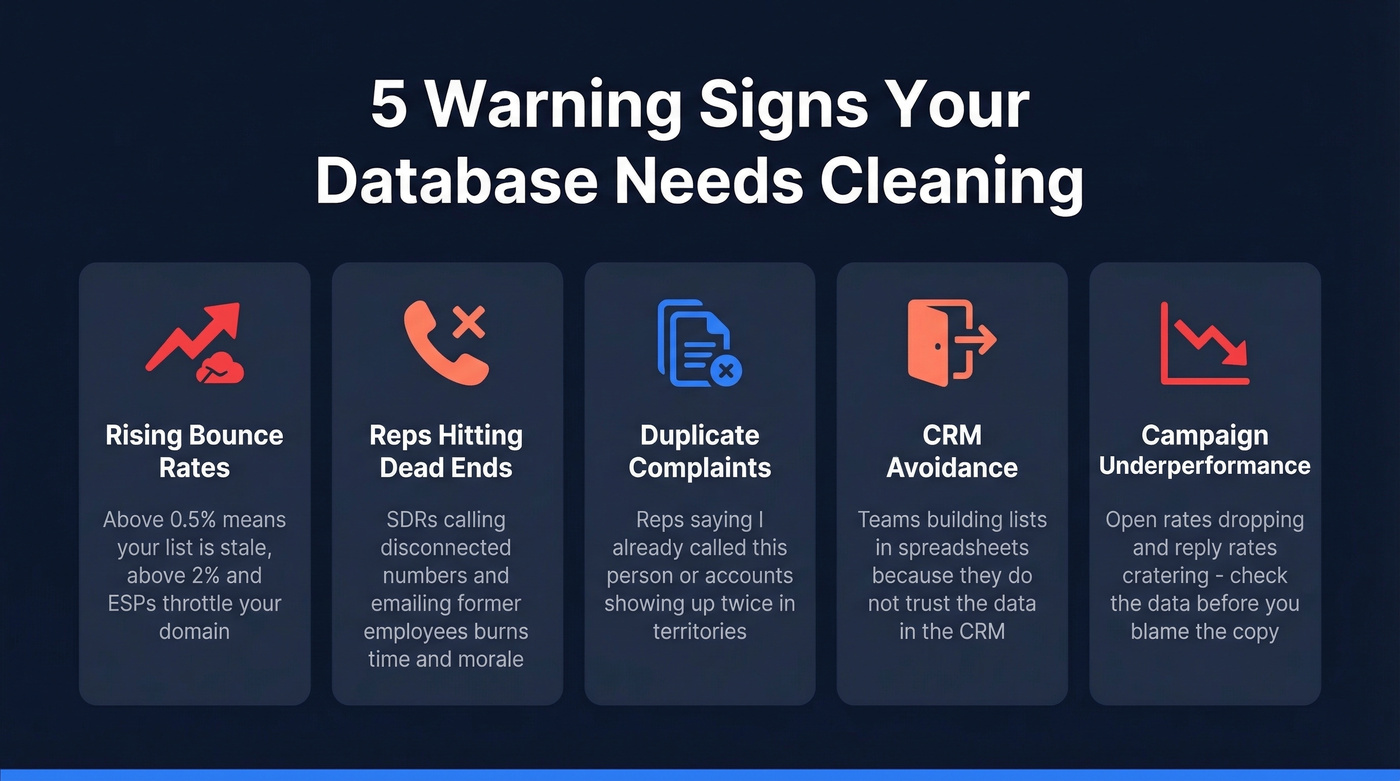
Rising bounce rates. If your outbound sequences are bouncing above 0.5%, your list is stale. Above 2%, most ESPs will start throttling or flagging your domain.
Reps hitting dead ends. SDRs calling disconnected numbers or emailing former employees is the most expensive symptom - it burns rep time and kills morale. B2B buying groups now involve 8-12 stakeholders, and if your data is wrong on even two of them, you're flying blind on the deal.
Duplicate complaints. When reps start saying "I already called this person" or accounts show up twice in territory assignments, your dedup process is broken - or nonexistent.
CRM avoidance. This is the subtle one. When teams start working outside the CRM - building lists in spreadsheets, tracking deals in Notion - it's often because they don't trust the data inside the system. The consensus on r/CRM is blunt: CRMs accumulate duplicates, outdated contacts, incomplete fields, and integration-caused mismatches faster than most teams realize.
Campaign underperformance. Open rates dropping, reply rates cratering, conversion falling - before you blame the copy or the offer, check the data underneath it.
The Full Data-Cleaning Playbook
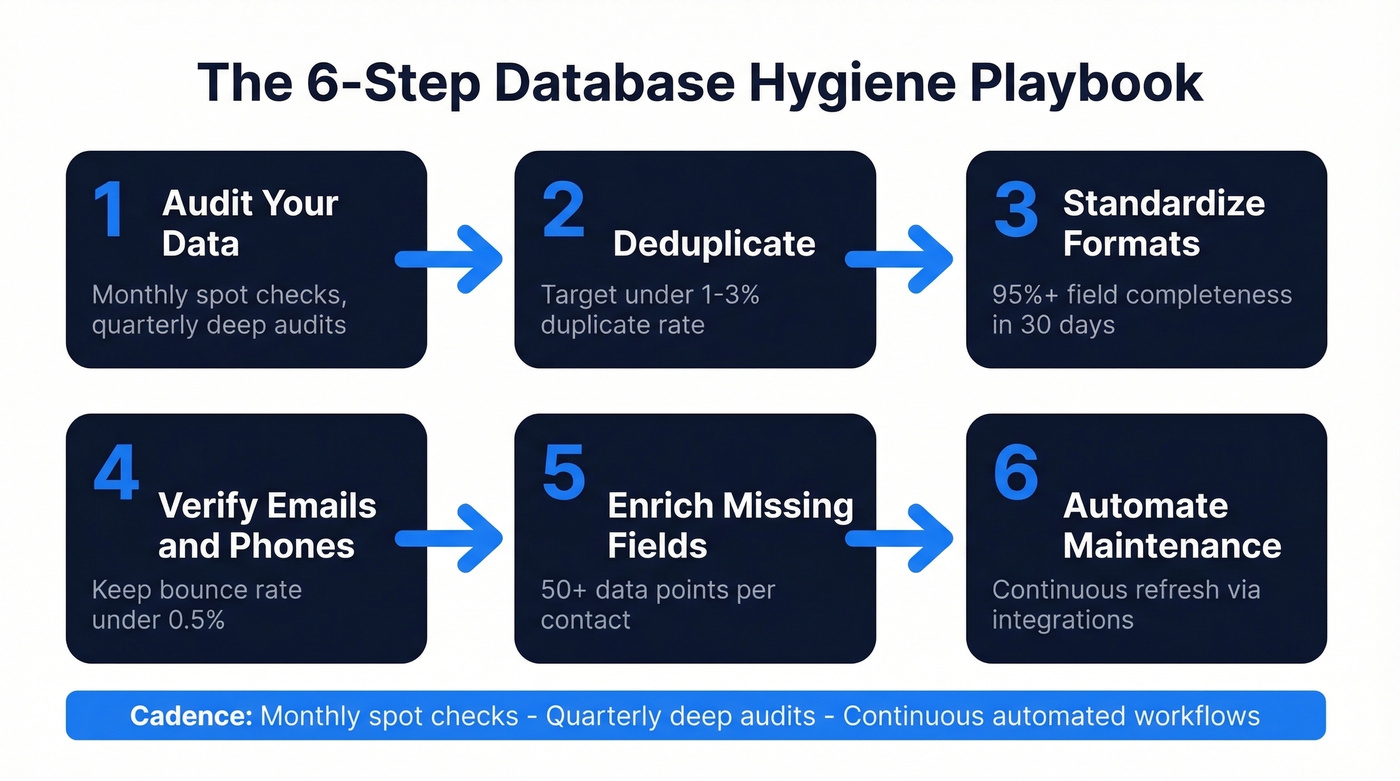
Six steps that keep a B2B database clean. Each one has a specific cadence and target metric.
Audit Your Data
Run monthly spot checks on critical fields - email, phone, title, company. Quarterly, do a deep audit across the full database. You're looking for nulls, duplicates, and stale records. A simple SQL query that counts null values per column, grouped by data source, will tell you where the rot is concentrated.
In our experience, the single biggest source of dirty data is a broken integration that nobody monitors. One bad import batch is usually responsible for the majority of junk records.
Deduplicate
Target under 1-3% duplicate rate in your active selling segments. Above 5% signals a systemic problem - usually a broken integration or missing merge rules at the point of entry.
Here's the thing: be careful about over-cleansing. Records that look like duplicates sometimes represent different roles at the same company, or the same person in different buying contexts. Merging aggressively can destroy historical data you actually need. Validate against business context before you merge.
Standardize Formats
Enforce field-level rules at the point of input, not after the fact. Phone numbers need country codes. State fields need consistent abbreviations. Job titles need a controlled vocabulary or at least a mapping layer. If your CRM lets reps type freeform into structured fields, you'll spend more time cleaning than selling. Aim for 95%+ field completeness on structured fields within 30 days of implementing input rules.
Verify Emails and Phones
This is where most teams see the fastest ROI. A 5-step verification process that handles catch-all domains, removes spam traps, and filters honeypots catches the invisible threats that tank deliverability without warning. Snyk's 50 AEs saw their bounce rate drop from 35-40% to under 5% after switching to verified data, and AE-sourced pipeline jumped 180%.
Enrich Missing Fields
CRM enrichment that returns 50+ data points per contact transforms a skeleton record into something a rep can actually use - verified emails, direct dials, technographics, and firmographics that give your team context before the first touchpoint. When 83% of leads come back with contact data, most records come back actionable, not empty.
Automate Ongoing Maintenance
Manual cleaning doesn't scale. Set up automated workflows that flag incomplete records, quarantine invalid entries, and re-verify data on a schedule. Route invalid records to a quarantine table with metadata (error type, source, timestamp) instead of silently dropping them - you'll want that audit trail.
The critical metric is refresh frequency: the industry average for data providers is a 6-week cycle, but a contact who changed jobs three weeks ago shows as current in one system and stale in another. Integrations with Salesforce, HubSpot, Zapier, and Make keep clean data flowing without manual intervention. For teams with data engineering resources, add data contracts via dbt or Great Expectations to catch schema violations before they pollute downstream systems.

You just read that dirty data costs companies $12.9M per year. Prospeo's 5-step verification with catch-all handling, spam-trap removal, and honeypot filtering delivers 98% email accuracy at ~$0.01/email. CRM enrichment returns 50+ data points per contact with an 83% match rate - turning skeleton records into actionable leads.
Stop cleaning up messes. Start with data that's already clean.
Email-Specific Hygiene Rules
Email deserves its own section because it's where bad data quality hits hardest and fastest. Scale that intro scenario to a 40,000-contact database and you're losing around 9,000 valid addresses every year to natural churn alone.
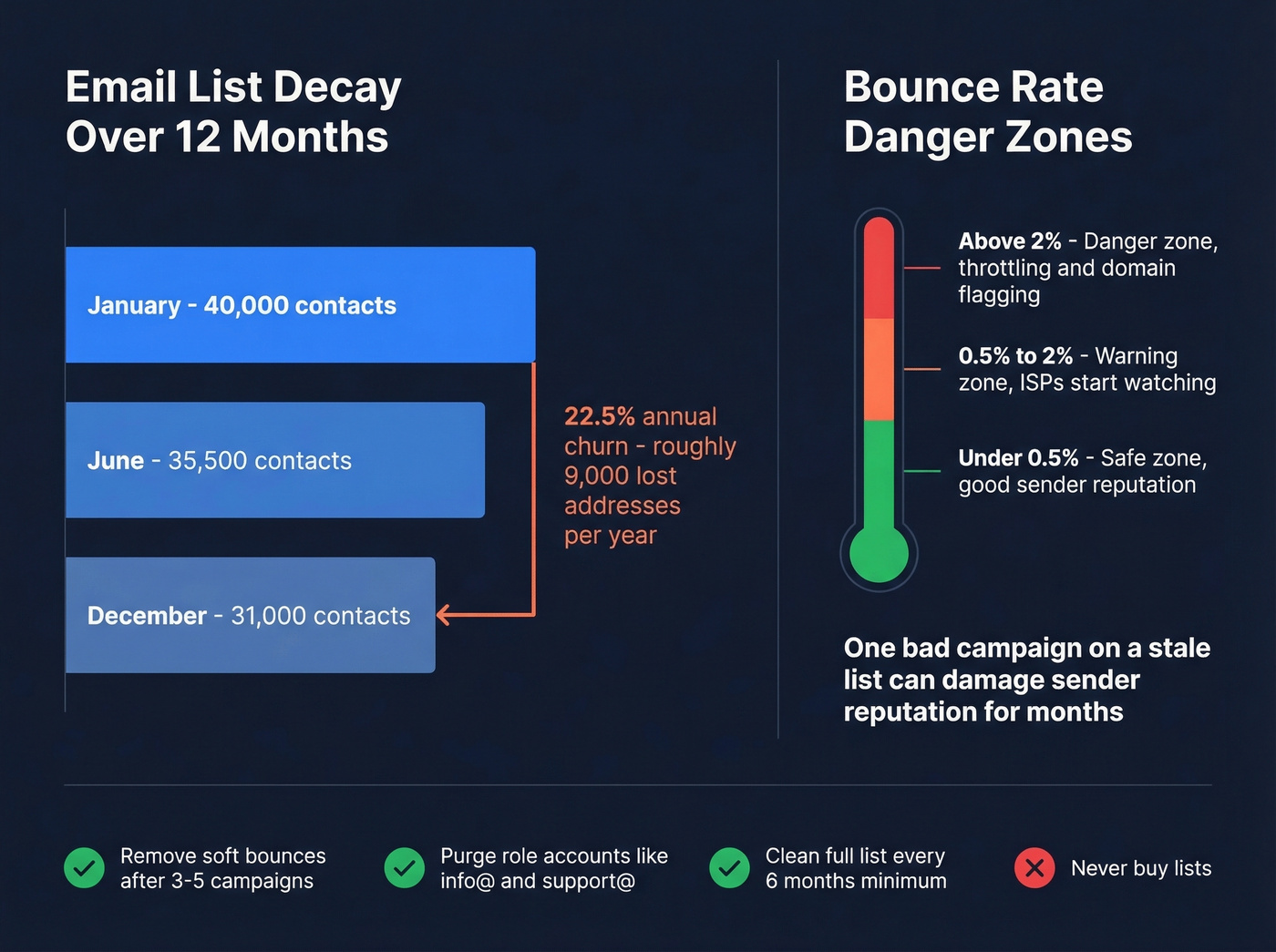
The hard threshold: keep your bounce rate under 0.5%. Above that, ISPs start throttling delivery and your sender reputation takes damage that can take months to repair. We've seen teams get their ESP accounts flagged after a single campaign because they skipped verification on a stale list.
Operational rules that work:
- Remove soft bounces after 3-5 consecutive campaigns.
- Purge role accounts (info@, support@, sales@) - they drive spam complaints and almost never convert.
- Clean your full list every six months at minimum. If you're running 100K+ contacts, clean monthly.
- Never buy lists. Purchased data is the fastest path to a blocklisted domain.

Database Hygiene and AI Readiness
45% of business leaders cite data accuracy as the leading barrier to scaling AI initiatives - and that stat should terrify anyone pouring budget into AI-powered sales tools right now. AI spending is forecast to surpass $2T in 2026 with 37% year-over-year growth. Every company is racing to deploy AI for forecasting, lead scoring, and pipeline prediction.
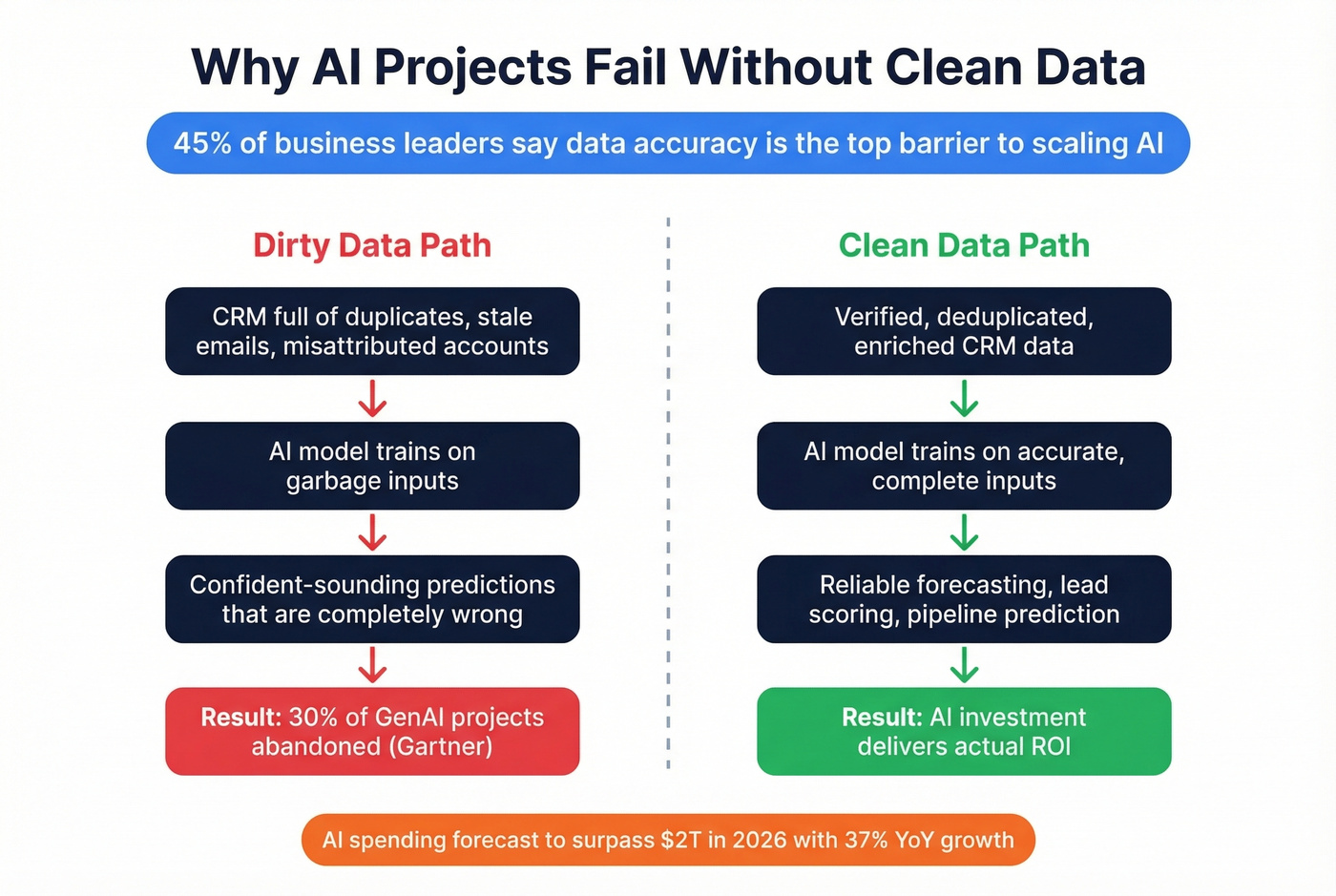
Gartner predicted that 30% of GenAI projects would be abandoned by end of 2025 due to data quality issues. That prediction is playing out right now. Feed your AI model a CRM full of duplicates, stale emails, and misattributed accounts, and you'll get confident-sounding predictions that are completely wrong.
Let's be honest: most teams shouldn't be investing in AI-powered revenue tools until their data quality is solid. The model doesn't matter if the data is garbage.
Compliance - Clean Data Isn't Optional
Dirty data isn't just inefficient - it's a legal liability. GDPR Article 5 requires that personal data be kept only as long as strictly necessary for its original purpose. Recital 39 goes further, requiring controllers to establish time limits for erasure or periodic review. CNIL fined one company EUR250,000 for storing customer details up to six years after the relationship ended. That's not a theoretical risk.
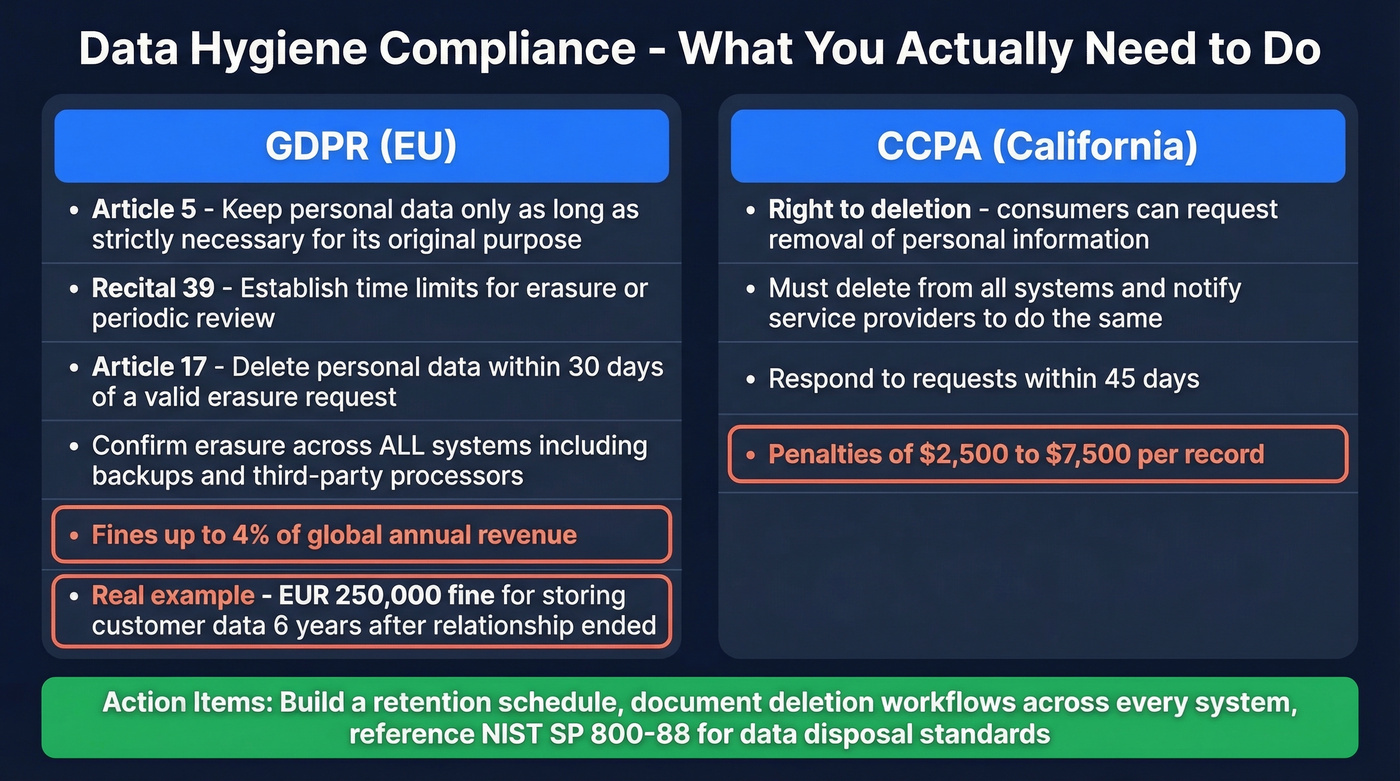
Article 17 - the right to erasure - requires you to delete personal data within 30 days of a valid request and confirm erasure across all systems, including backups and third-party processors. GDPR fines can reach 4% of global annual revenue. CCPA penalties run $2,500-$7,500 per record.
Most B2B teams don't have deletion workflows that actually work across every system. Data lives in the CRM, the marketing automation platform, the enrichment tool, and the spreadsheet someone exported last quarter. Building a retention schedule and a documented deletion process - referencing standards like NIST SP 800-88 for data disposal - isn't optional anymore.
Best Tools for Database Hygiene
Pick based on where your data breaks. Most B2B teams need two or three tools, not an enterprise platform. We've tested most of the tools on this list, and the pattern is consistent: start narrow, solve your biggest pain point first, then layer.
| Category | Tool | Price | Use Case |
|---|---|---|---|
| Email Verification | Prospeo | Free tier; ~$0.01/email | Verify, enrich, 7-day refresh |
| CRM Deduplication | Validity DemandTools | ~$1K-3K/mo | Salesforce-native dedup |
| Data Cleaning | OpenRefine | Free, open-source | Batch cleaning, clustering |
| Data Engineering QA | dbt + Great Expectations | dbt Core free; Cloud ~$100/mo | Schema tests, data contracts |
| Data Observability | Monte Carlo | ~$30K+/yr | Anomaly detection, SLOs |

Skip enterprise platforms like Informatica and Talend unless you're running a data team of 10+ and processing millions of records daily. They're custom-quote and can run $2,000+/month. For most B2B sales and marketing teams, they're overkill.
Measuring the ROI
One illustrative model: a team invested $300K in data enrichment and validation. Before cleanup, email completeness sat at 60%, phone coverage at 45%, segmentation accuracy at 70%. After cleanup, email completeness hit 92%, phone coverage 85%, segmentation accuracy 96%. The campaign generated $10.6M in revenue - a 430% ROI compared to the estimated $3.2M they'd have generated with dirty data.
For a real-world proof point, Snyk's 50 AEs saw AE-sourced pipeline jump 180% after fixing their data quality. That's the kind of return clean data delivers.
Scale that down for a mid-market team. Say you've got 50,000 contacts and 25% are bad - wrong emails, disconnected phones, outdated titles. If each wasted touchpoint costs $2 in rep time and tool spend, that's $25,000 per year burned on contacts who were never going to respond. A database hygiene stack that costs $5,000-$10,000/year pays for itself before Q2.
Manual database hygiene doesn't scale. Prospeo refreshes all 300M+ profiles every 7 days - not the 6-week industry average - so your CRM never falls behind job changes, company moves, or dead emails. Native integrations with Salesforce, HubSpot, Zapier, and Make keep clean data flowing automatically.
A 7-day refresh cycle means your data never goes stale again.
FAQ
How often should I clean my database?
Monthly spot checks on critical fields (email, phone, title) and quarterly deep audits on the full database. Lists exceeding 100,000 contacts need monthly cleaning. High-turnover industries like SaaS and staffing should lean toward monthly regardless of list size.
What's an acceptable duplicate rate?
Target under 1-3% in active selling segments. Above 5% indicates a systemic issue - typically a broken integration or missing merge rules at the point of entry. Audit your data sources to find where duplicates originate before you start merging records.
Does dirty data affect AI and lead scoring?
Yes. 45% of business leaders cite data accuracy as the top barrier to scaling AI. Dirty data produces confident but wrong predictions, corrupts scoring models, and degrades personalization. Clean data is prerequisite infrastructure for any AI-powered revenue tool.