

Deal Desk: The Operator's Guide to Building One That Actually Works
It's Thursday at 4:47 PM. A $180K deal needs five approvals. Two approvers are offline. Salesforce and Ironclad aren't triggering the workflow properly. The customer's calling asking where their quote is. That exact scenario plays out on r/sales with depressing regularity - and it's the clearest sign your deal desk is broken, or that you need to build one that actually works.
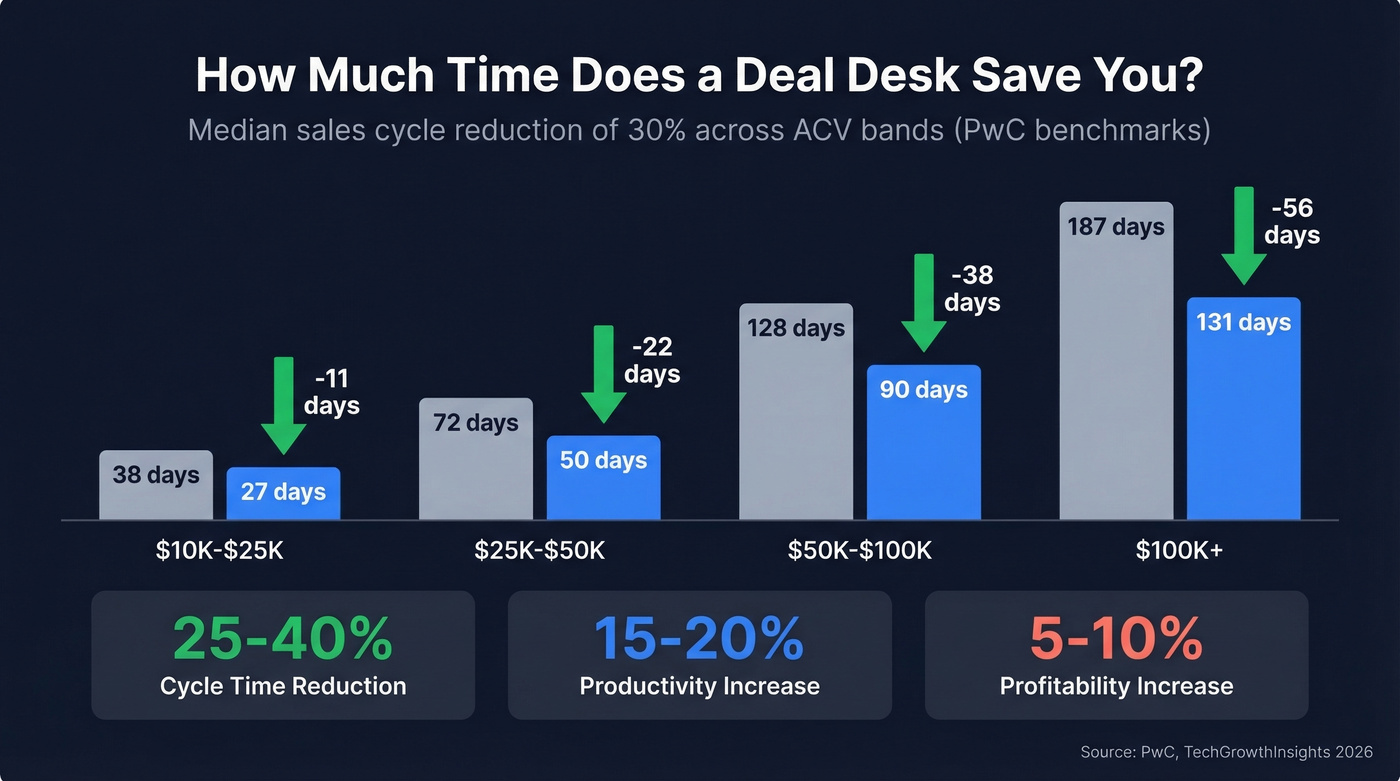
Companies with well-run deal desks reduce sales cycle times by 25-40%, boost sales productivity by 15-20%, and increase profitability by 5-10%, per PwC benchmarks. On a 187-day enterprise cycle, that's 50+ days back per deal. Those aren't marginal gains.
A deal desk is a cross-functional team that standardizes how non-standard deals get reviewed, approved, and executed. You need one if reps are routinely discounting above 15% without oversight, your average deal involves legal, finance, and product sign-off, or last quarter's deal audit reveals unapproved discounts and inconsistent terms.
Jump to: Templates | Build Guide | Careers
What Is a Deal Desk?
A deal desk is a centralized, cross-functional function that governs how non-standard commercial deals move from proposal to execution. It's not a physical desk. It's not a single person. It's a process - with clear roles, approval thresholds, and SLAs - that sits between the sales team's "we need to close this" urgency and the company's "we need to protect margin" mandate.
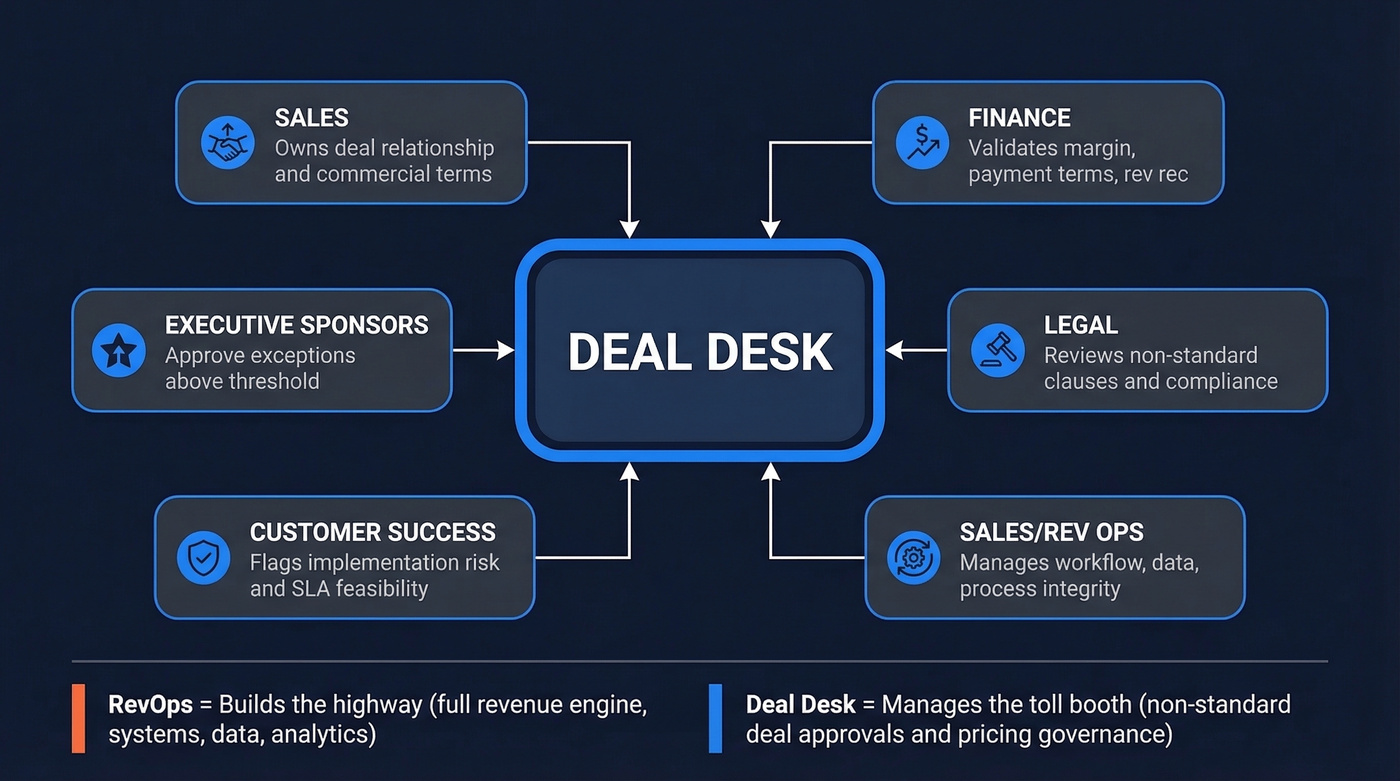
The average B2B deal now involves 13 decision-makers on the buyer side. Internally, the complexity mirrors that. A functioning deal desk pulls together stakeholders from across the org:
- Sales - owns the deal relationship and commercial terms
- Finance - validates margin, payment terms, revenue recognition
- Legal - reviews non-standard clauses, customer paper, compliance
- Sales/Revenue Ops - manages workflow, data, and process integrity
- Customer Success - flags implementation risk and SLA feasibility
- Executive sponsors - approve exceptions above threshold
Don't confuse this function with RevOps. RevOps owns the full revenue engine - systems, data, process, analytics across marketing, sales, and CS. A deal desk is a specific function within that engine, focused narrowly on non-standard deal approvals and pricing governance. RevOps builds the highway; the deal desk manages the toll booth.
Here's the thing: deal desks have a branding problem. They sound bureaucratic. The best ones don't feel like a desk - they feel like a fast lane for complex deals that would otherwise stall in someone's inbox for three days.
Do You Actually Need One?
Not every company does.
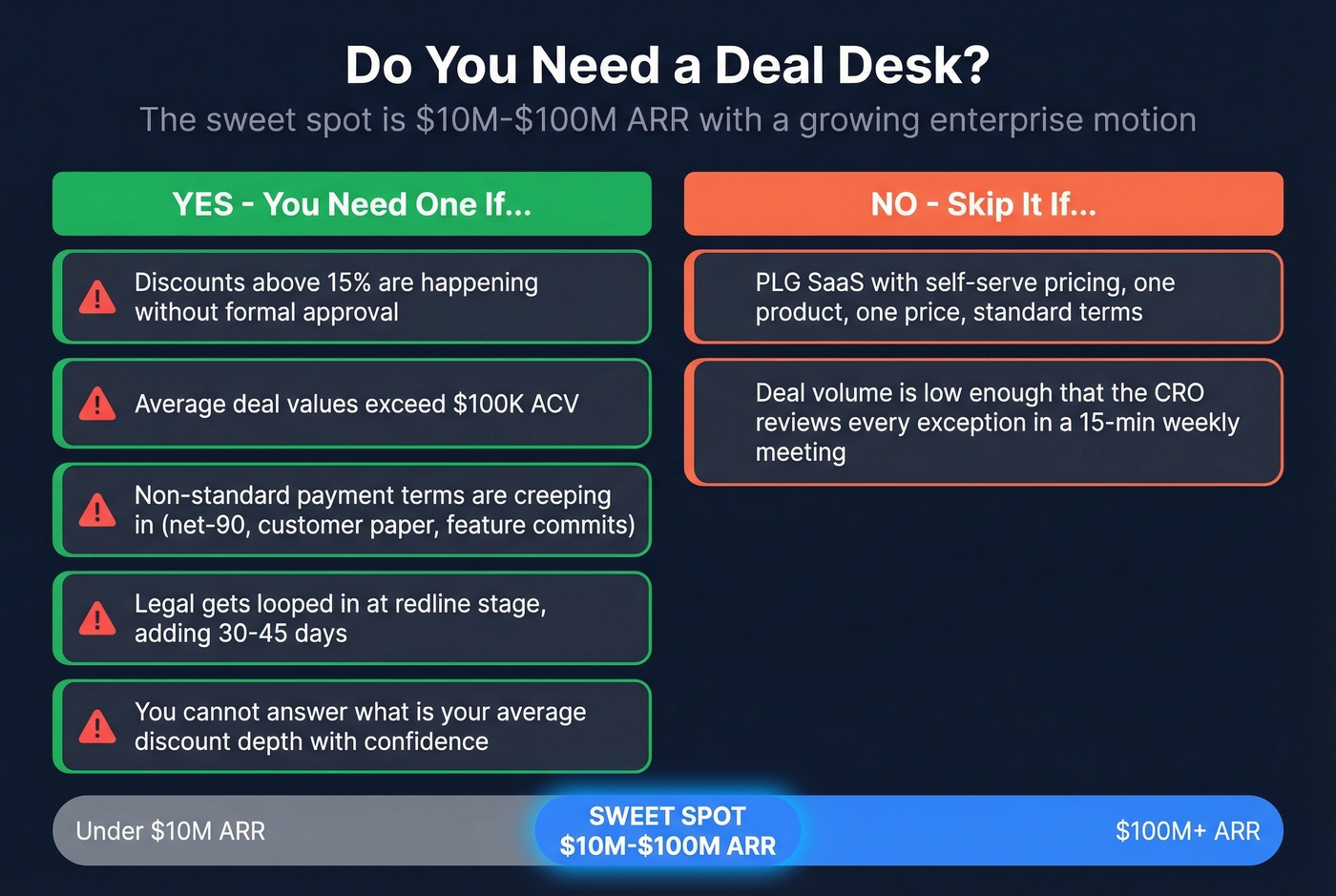
The sweet spot for standing up a deal desk is typically the $10M-$100M ARR range, where you've got a growing enterprise motion and enough deal volume that ad-hoc approvals start breaking down. Below $10M ARR with fewer than 10 reps? You need a pricing spreadsheet and a weekly sync, not a formal approval function.
But if any of these trigger signals sound familiar, it's time:
Discounts above 15% are happening without formal approval. Run an audit. If 40% of last quarter's deals had unapproved discounts, you've got margin erosion you can't even see.
Average deal values exceed $100K ACV. At this level, every deal involves legal, finance, and often product. Without a structured process, each one becomes a bespoke fire drill.
Non-standard payment terms are creeping in. Net-90, customer paper, multi-year ramps, feature commitments - these create revenue recognition headaches under ASC 606 and downstream risk that finance won't discover until book close.
Legal delays are killing deals late-stage. If legal gets looped in at the redline stage instead of during structuring, you're adding 30-45 days to every complex deal.
You can't answer "what's our average discount depth?" with confidence. That's a visibility problem, and it's costing you money.
Skip this function entirely if you're running a PLG SaaS with self-serve pricing and no enterprise motion - one product, one price, standard terms. A centralized approval process adds overhead without value in that model. Same if your deal volume is low enough that the CRO can personally review every exception in a 15-minute weekly meeting.
The ROI of Structured Approvals
The PwC benchmarks are the most-cited in the space, and they hold up against what we've seen in practice:
| Metric | Impact |
|---|---|
| Sales cycle reduction | 25-40% |
| Productivity increase | 15-20% |
| Profitability increase | 5-10% |
Those percentages mean different things depending on your deal size. Here's where sales cycle benchmarks by ACV make the math concrete:
| ACV Band | Median Cycle | Top Quartile | Drag Signal |
|---|---|---|---|
| $10K-$25K | 38 days | 26 days | >55 days |
| $25K-$50K | 72 days | 51 days | >100 days |
| $50K-$100K | 128 days | 94 days | >175 days |
| >$100K | 187 days | 142 days | >250 days |
Now run the math on a $100K+ enterprise deal. A 187-day median cycle with a 30% reduction means 56 fewer days per deal. If your team closes 40 enterprise deals a year, that's 2,240 fewer deal-days stuck in pipeline. Even a conservative 25% reduction gives you 47 days back per deal - enough to pull in an extra quarter's worth of pipeline.
The complexity driver is real. With 13 decision-makers on the buyer side and procurement, legal, and security adding 30-45 days to enterprise cycles, the deals that need structured governance most are the ones where the ROI is highest. A clear approval process doesn't just save time - it prevents the margin erosion that happens when reps give away 25% discounts to "just get it done" on a Thursday afternoon.
How the Process Works
The core workflow is five steps. Every deal desk variation is just a remix of these.
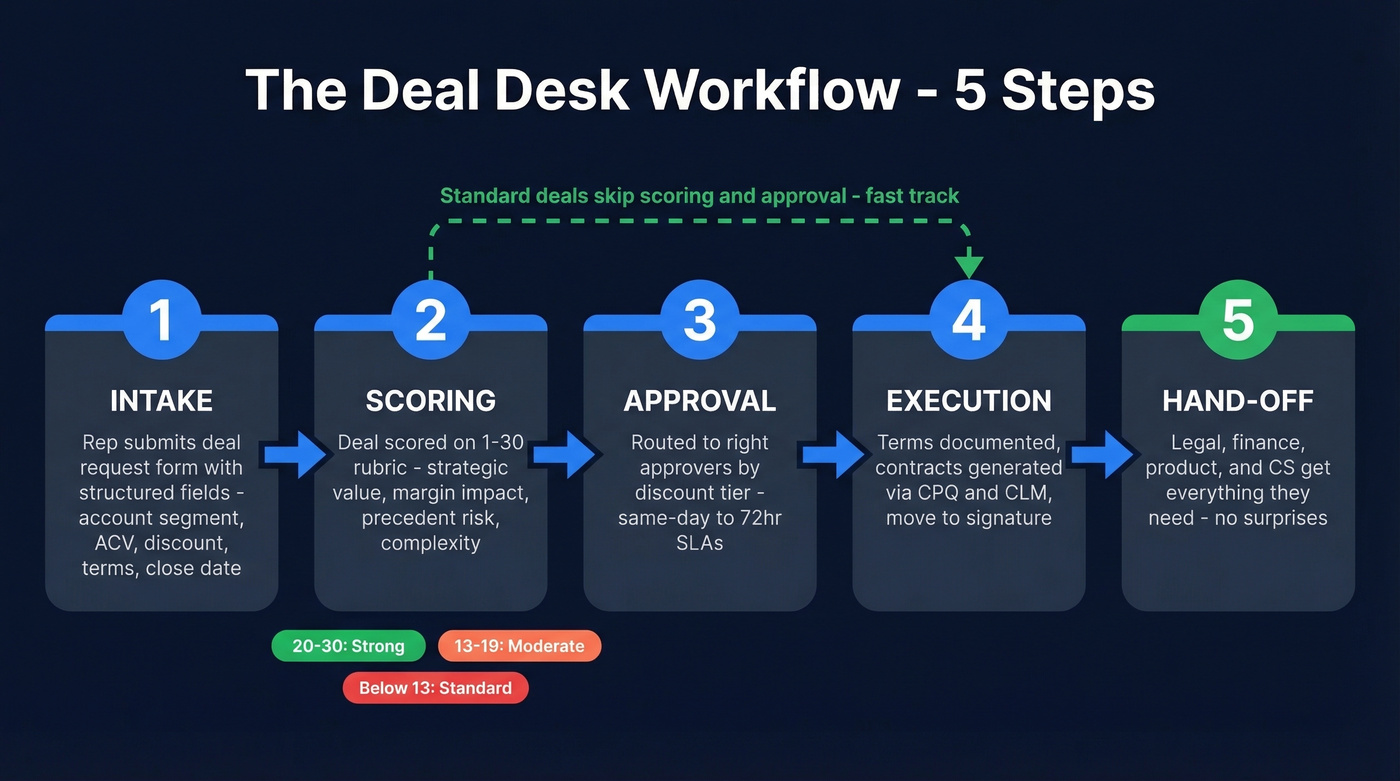
1. Intake. Rep submits a deal request form with structured fields - account segment, proposed ACV, discount amount, non-standard terms, close date. No intake form, no review. This is the gate.
2. Scoring. The deal gets scored on a standardized rubric (a 1-30 scale works well). Factors include strategic value, margin impact, precedent risk, and implementation complexity. Thresholds drive routing: 20+ is a strong deal that gets approved if it's within guardrails; 13-19 is moderate and gets negotiated closer to standard terms; below 13 defaults to standard pricing and requires VP approval for any exception.
3. Approval. Routed to the right approvers based on discount tier and deal complexity. Automated routing based on deal attributes eliminates the "who do I send this to?" delay. SLAs matter - same-day for small discounts, 24-72 hours for escalations.
4. Execution. Approved terms get documented, contracts generated, and the deal moves to signature. CPQ and CLM tools handle quoting and contract generation here.
5. Hand-off. Post-signature, the deal desk ensures legal, finance, product, and CS all have what they need. No surprises during implementation.
Standard deals - ones within published pricing and terms - skip steps 2 and 3 entirely. They fast-track through. The function only activates for custom or non-standard requests. This distinction is critical: a process that reviews every deal is a bottleneck. One that only catches exceptions is a fast lane.

A deal desk cuts cycle times by 25-40% - but only if reps aren't wasting those saved days chasing bad contact data. Prospeo gives your team 98% accurate emails and 125M+ verified mobile numbers so every approved deal reaches the right decision-maker, not a dead inbox.
Stop losing approved deals to bounced emails and wrong numbers.
How to Build a Deal Desk
Eight steps. None of them are optional.
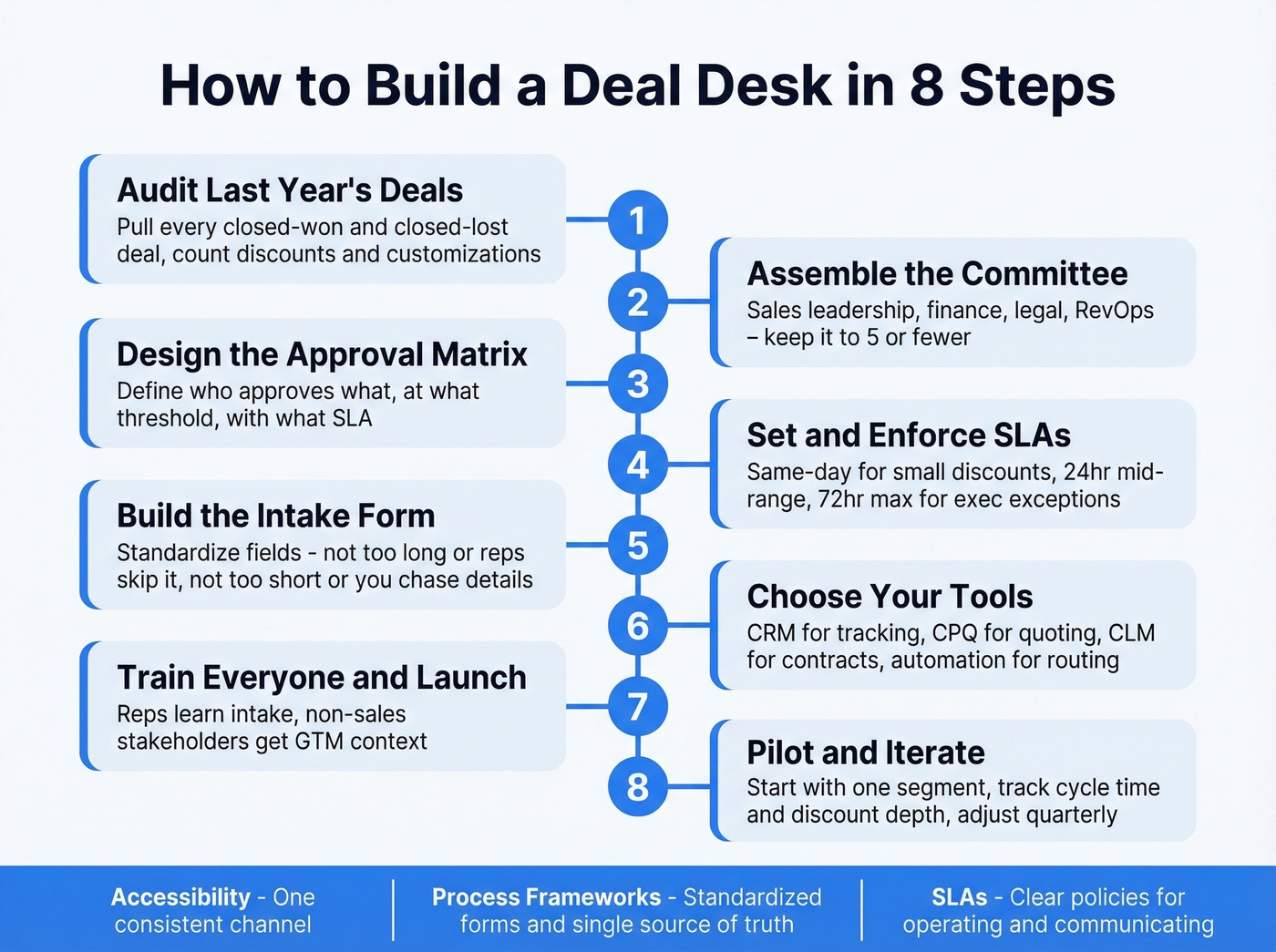
Step 1: Audit last year's deals. Pull every closed-won and closed-lost deal from the past 12 months. Count how many had discounts, how deep those discounts went, and how many involved contract customizations. This audit gives you the baseline - and usually the shock - that justifies the investment.
Step 2: Assemble the committee. You need standing representatives from sales leadership, finance, legal, and RevOps at minimum. Product joins for deals involving feature commitments. Don't over-staff - more than five standing members creates the exact bottleneck you're trying to eliminate.
Step 3: Design the approval matrix. Define who approves what, at what threshold, with what SLA. We've included a ready-to-use matrix in the templates section below. More than three approval tiers for standard deals means your process is slowing you down, not speeding things up.
Step 4: Set SLAs and enforce them. Every approval tier needs a time commitment. Same-day for small discounts. 24 hours for mid-range. 72 hours max for executive-level exceptions. SLAs without enforcement are just suggestions.
Step 5: Build the intake form. Standardize what information reps submit. Account segment, proposed vs. standard ACV, discount type, non-standard terms, close date. If the form is too long, reps won't use it. Too short, and you'll spend time chasing missing details.
Step 6: Choose your tools. CRM for tracking, CPQ for quoting, CLM for contracts, workflow automation for routing. More on the tech stack below.
Step 7: Train everyone and launch. Reps need to understand the intake process. Non-sales stakeholders need context on GTM strategy and deal priorities. Cross-training is what separates a deal desk that works from one that creates resentment.
Step 8: Pilot and iterate. Start with a pilot cohort - your enterprise segment or a single region. Track cycle time, discount depth, revenue quality (margin, payment terms, risk profile), and SLA compliance from day one. Adjust thresholds quarterly based on what the data shows.
The three pillars framework is worth internalizing: Accessibility (one consistent channel for submissions), Process Frameworks (standardized forms and a single source of truth), and SLAs (clear policies for operating and communicating). If any pillar is weak, the whole thing wobbles.
Templates You Can Copy Today
These are the three artifacts every deal desk needs on day one. Adapt the specifics to your business, but the structure is proven.
Deal Request Intake Form
Every non-standard deal starts here. These fields should be required:
| Field | What to Capture |
|---|---|
| Account segment | Enterprise / Mid-Market / SMB |
| Standard ACV | List price for this config |
| Proposed ACV | What the rep wants to quote |
| Contract length | Months or years |
| Expected close date | Calendar date |
| Discount type | Volume / multi-year / competitive / strategic |
| Discount amount | % and $ value |
| Non-standard terms | Payment terms, SLA modifications, custom clauses, add-ons, feature commitments |
Keep it to one page. If a rep can't fill this out in five minutes, it's too complex.
Approval Matrix with SLAs
This is the single most important artifact. Copy it, adjust the thresholds to your business, and enforce it.
| Discount Range | Approver(s) | SLA |
|---|---|---|
| 0-10% | Sales Manager | Same day |
| 11-20% | VP Sales | 24 hours |
| 21-30% | VP Sales + Finance | 48 hours |
| 30%+ or non-standard | CRO/CEO + Finance + PM | 72 hours |
| Feature commitments | Include Product | 72 hours |
The thresholds aren't sacred - a company selling $15K ACV deals will set different breakpoints than one selling $500K contracts. What matters is that every tier has a named approver and a hard SLA.
Post-Approval Checklist
After approval, before anyone pops champagne:
- Document approved terms in CRM (exact discount, non-standard clauses, commitments)
- Notify legal for contract generation
- Notify finance for revenue recognition and billing setup
- Notify product if feature commitments were made
- Notify CS for implementation planning
- Add deal to quarterly tracker for pattern analysis
This checklist prevents the "wait, nobody told us about the custom SLA" conversation that happens three months into implementation.
Five Common Failure Modes
Building a deal desk is the easy part. Keeping it from becoming the bottleneck it was supposed to eliminate - that's the challenge.
Unclear roles. When nobody knows who's responsible for what, deals sit in limbo. Fix it with a RACI chart. Map every step of the workflow to a Responsible, Accountable, Consulted, and Informed owner. Update it quarterly.
Inefficient processes. Email threads, Slack DMs, and spreadsheets nobody checks aren't a process. Standardize the intake channel, automate the routing, and make sure the data entering the process is accurate. We've seen teams lose days chasing the wrong stakeholders because the contact data in their CRM was stale - wrong titles, bounced emails, people who left the company six months ago. Verifying contact data before it enters the pipeline with a tool like Prospeo keeps approval workflows clean and prevents rework downstream.
Protracted approvals. That Reddit post about five approvers going offline while the customer waits for a quote? That's what happens without tiered approvals. Not every deal needs the CRO's sign-off. Route accordingly.
Sales strategy misalignment. Legal and finance need to understand the competitive landscape, the ICP, and why certain deals are strategic even at lower margins. Without that context, they'll optimize for risk avoidance instead of revenue. Cross-training non-sales stakeholders fixes this, but it requires ongoing investment - not a one-time onboarding session.
Out-of-date terms. If your team is working off last quarter's pricing sheet or an outdated MSA template, you're creating legal risk and rework. One source of truth, version-controlled, with clear ownership for updates.
The Tech Stack
You don't need to buy a "deal desk platform." You need the right tools in each layer of the stack, integrated tightly enough that deals don't fall between systems.
CRM is the foundation. Salesforce or HubSpot - you already have one. Every intake form, approval, and outcome gets tracked in the CRM. If it's not in the CRM, it didn't happen.
CPQ handles pricing logic, discount guardrails, and quote generation. Mid-market CPQ implementations typically run $50K-$150K/year; enterprise deployments with complex product catalogs push past $200K. DealHub, Salesforce Revenue Cloud, and Conga are the usual suspects.
CLM manages redlines, approvals, and signatures. Smaller teams can get started around $500/month; enterprise CLM deployments run $50K+/year. The key integration point: CLM needs to trigger from CPQ output, not from a separate manual process.
Workflow automation connects the layers. Whether that's native Salesforce flows, Zapier, or something more purpose-built, the goal is zero manual handoffs between intake, scoring, routing, and execution.
AI and predictive analytics are a real advantage in 2026. The most effective teams use models trained on historical deal data to auto-score incoming requests, flag margin risk, and predict close probability. See predictive analytics in sales for what actually works. Salesforce Einstein and similar tools can auto-route approvals based on deal attributes, cutting hours of manual triage.
Don't Ignore Upstream Data Quality
Let's be honest about a failure mode nobody talks about enough: structured approval processes can't fix what's broken upstream. If the contact data feeding your pipeline is stale - wrong stakeholders, bounced emails, outdated titles - deals arrive already compromised. Reps waste cycles chasing the wrong people, and the review team spends time on deals that were never properly qualified.
This is where data verification tools earn their keep. Prospeo, for example, runs a 7-day refresh cycle on 300M+ professional profiles with 98% email accuracy - a fraction of what enterprise data vendors charge at roughly $0.01 per verified email. If you're evaluating options, start with data enrichment services and then go deeper on email verification and how to check if an email exists. Verified emails and direct dials mean reps are reaching actual decision-makers, not bouncing off invalid addresses.

With 13 decision-makers per deal, your reps need direct lines to every stakeholder - legal, procurement, the VP who goes offline at 4:47 PM. Prospeo's 300M+ profiles with 30+ filters let you map the full buying committee before the deal even hits intake.
Find every approver's direct contact for $0.01 per email.
Deal Desk Careers and Compensation
Deal desk roles are quietly becoming some of the most strategic positions in revenue operations. The career path is clear, the compensation is strong, and the skills transfer everywhere.
| Role | Avg/Median Pay | Range | Top Cities |
|---|---|---|---|
| Deal Desk Analyst | $80,215 avg | $71K-$87K | San Jose $101K, SF $100K, DC $89K |
| Deal Desk Manager | $134K median | $105K-$173K | Varies by market |
The typical progression runs: Analyst -> Specialist -> Manager -> Head of Deal Desk or VP of Revenue Operations. Each step adds scope - from processing individual deals to designing the systems and policies that govern all of them.
What makes this experience valuable beyond the role itself is the cross-functional exposure. You're learning pricing strategy from finance, contract negotiation from legal, GTM motion from sales leadership, and process design from ops. That combination is exactly what companies look for in RevOps leadership hires - especially for a RevOps Manager.
If you're early in your career and choosing between a BDR role and a deal desk analyst role, the analyst path gives you broader business acumen faster. It's not the flashier choice, but it's the one that compounds.
FAQ
What's the difference between a deal desk and RevOps?
RevOps owns the full revenue engine - systems, data, process, and analytics across marketing, sales, and CS. A deal desk is a specific function within that engine, focused on non-standard deal approvals and pricing governance. Think of RevOps as the operating system and the deal desk as one critical application running on it.
How many people should staff a deal desk?
A common ratio is one analyst per 15-25 sales reps, scaling with deal complexity. Start with one dedicated person and grow from there. Overstaffing early creates process for process's sake.
Can you outsource a deal desk?
Yes, fractional services exist for companies under $20M ARR. You'll trade lower cost for less institutional knowledge and slower response times. It works as a bridge while you build the internal function.
What KPIs should a new deal desk track first?
Start with three: cycle time, average discount depth, and SLA compliance. These give immediate visibility into speed, margin, and process health. Add win rate (assisted vs. non-assisted) and revenue quality metrics once the basics are stable.
How does data quality affect deal desk performance?
Bad contact data creates rework - wrong stakeholders, bounced emails, stale records that send reps chasing ghosts. Verifying emails and phone numbers before they enter the pipeline keeps approval workflows clean and prevents the kind of downstream chaos that makes everyone hate the process.