

Predictive Analytics in Sales: What Actually Works (and What Doesn't)
79% of sales organizations miss their forecast by more than 10%, per Forrester. That's not a rounding error - it's a structural problem. Spend any time on r/SalesOperations and you'll find practitioners openly asking whether ML-powered forecasting is real or just vendor hype. The skepticism is earned. But the technology does work when the conditions are right.
Here's the condensed version:
- Clean your CRM data first. Predictive models amplify whatever you feed them. Bad data in, bad predictions out. This is where most teams fail.
- Pick one prediction target. Don't try to score leads, forecast pipeline, and predict churn simultaneously. Start with the one that maps to your biggest revenue leak.
- Use accessible tools. You don't need a data science team. Salesforce Einstein, Clari, or HubSpot's forecasting features can get you started today.
What Predictive Sales Analytics Actually Does
Pattern recognition at scale. You feed historical data into a model, and it identifies which signal combinations correlate with outcomes - closed deals, churned accounts, expansion opportunities. The mental model is simple: inputs go in, outputs come out.
| Input Signals | Prediction Outputs |
|---|---|
| CRM activity + deal stages | Win probability scoring |
| Pipeline velocity + rep behavior | Pipeline health forecasting |
| Product usage + support tickets | Churn prediction |
| Engagement + firmographics | Cross-sell / upsell targeting |
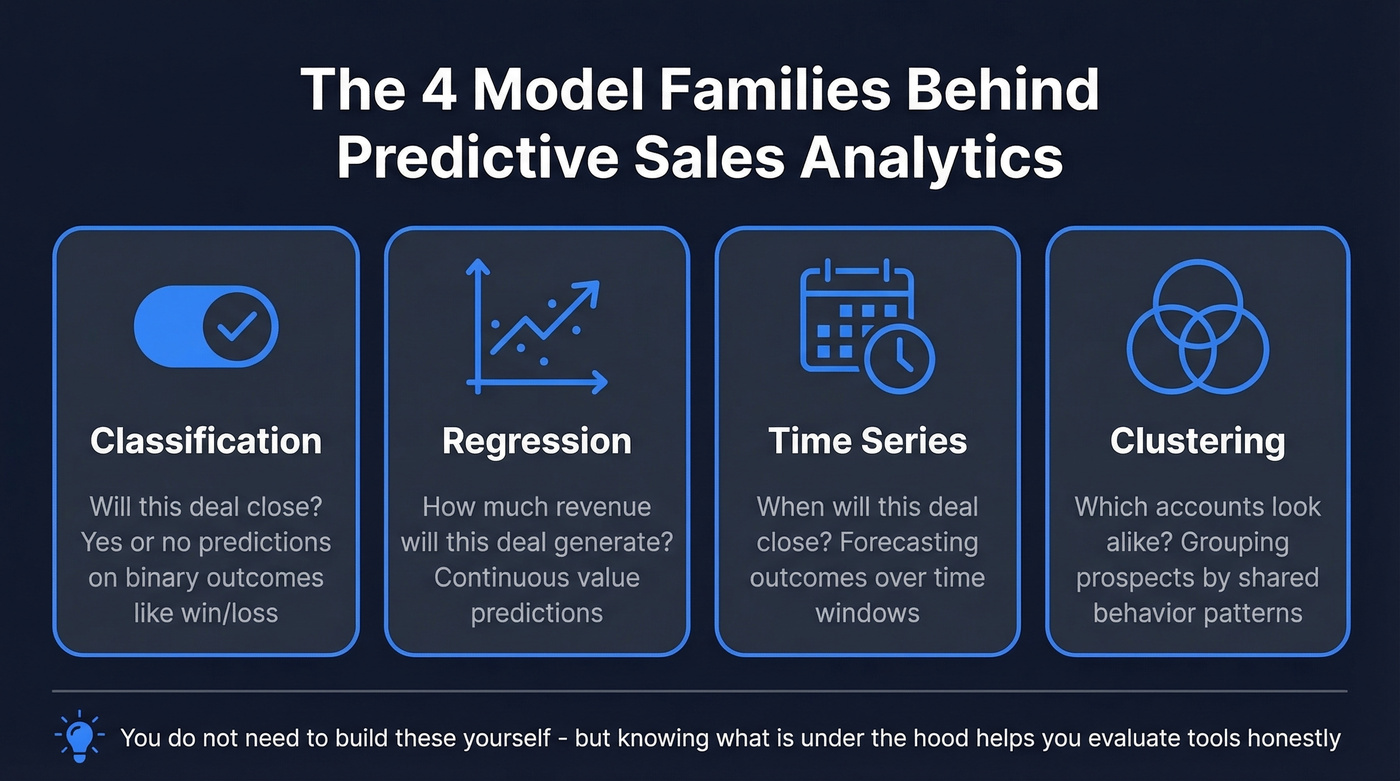
Most sales teams are stuck at descriptive analytics - dashboards full of lagging indicators. The jump to predictive is where revenue impact starts. Four common model families power most of this: classification (will this deal close?), regression (how much revenue?), time series (when will it close?), and clustering (which accounts look alike?). You don't need to build them yourself, but knowing what's under the hood helps you evaluate tools honestly.
Here's the thing: if your average deal size is under $10K, you probably don't need a dedicated predictive platform. Your CRM's built-in forecasting, fed with clean data, will get you 80% of the value at 10% of the cost.
Five Use Cases That Drive Revenue
Acquiring a new customer costs 4-5x more than retaining one, which is why churn prediction has the clearest ROI. Classification models flag at-risk accounts early - declining product usage, fewer support interactions, missed QBRs. In practice, this is one of the most reliable use cases because the signals are usually there if you're collecting them.
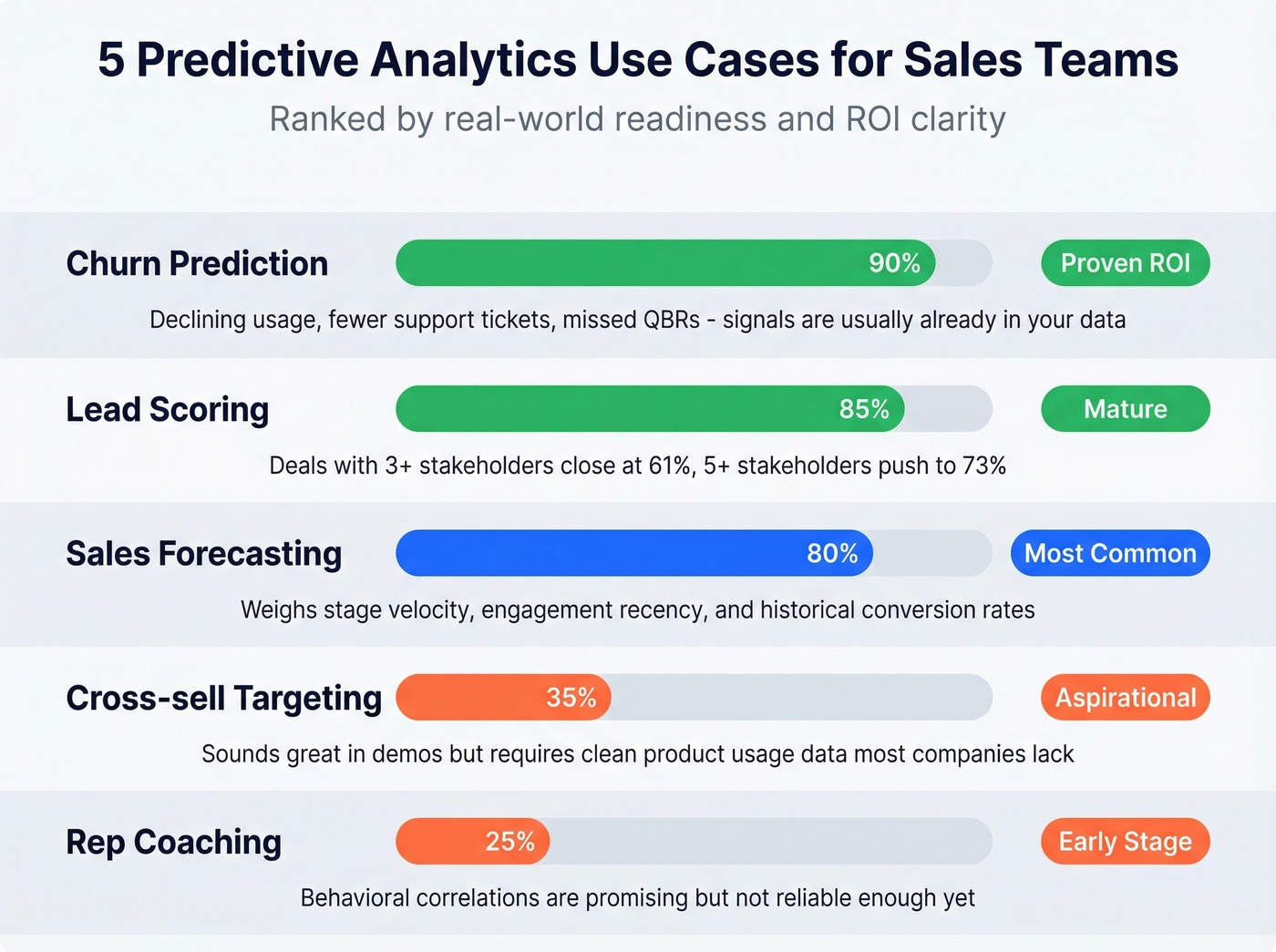
Lead scoring has matured well past the arbitrary point systems of 2015. Real predictive scoring uses deal patterns - deals with 3+ stakeholders close at 61%, while 5+ stakeholders push that to 73%. Models surface these patterns automatically so reps prioritize the right accounts instead of guessing. (If you want a deeper framework, see our guide to lead scoring.)
Sales forecasting is the most common application. Instead of reps sandbagging or inflating, the model weighs stage velocity, engagement recency, and historical conversion rates. Aim for 3-4x pipeline coverage as your baseline; the model tells you whether that coverage is real or inflated.
What's still aspirational? Cross-sell targeting sounds great in demos but requires clean product usage data most companies don't have yet. Rep coaching based on behavioral correlations is similarly promising but early. We've seen teams try both before nailing the basics and waste months chasing shiny features.
Why Most Implementations Fail
60-70% of sales intelligence implementations fail to deliver their promised value. That's not a technology problem. It's a data problem.
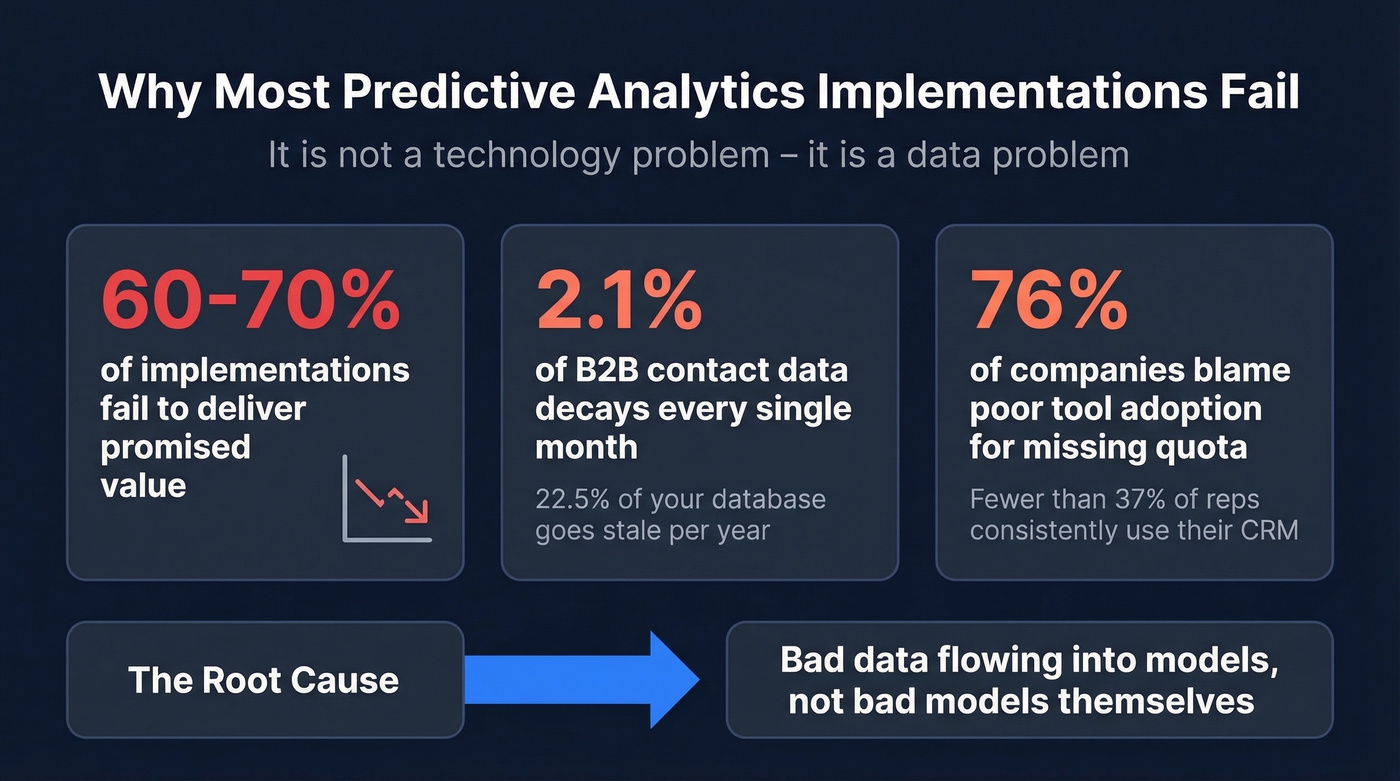
B2B contact data decays at roughly 2.1% per month - 22.5% of your database going stale every year. When 56% of organizations cite data inconsistencies as a major obstacle to hitting sales goals, the root cause isn't the prediction model. It's the garbage flowing into it. The most common complaint in sales ops communities isn't that the models are wrong. It's that the data feeding them was never right to begin with. (More on this in our breakdown of data enrichment services.)

Then there's adoption. 76% of companies blame poor tool adoption for missing quota, and fewer than 37% of reps consistently use their CRM. Your AI model can't predict anything if reps aren't logging activities. (If you're building the function, this is core RevOps work.)
The fix starts at the foundation. Before you buy a forecasting platform, fix the data feeding it. Prospeo's 7-day refresh cycle keeps contact records current compared to the 6-week industry average - that's the difference between a model trained on reality and one trained on ghosts. With 98% email accuracy and a 92% API match rate, you're giving your prediction engine complete, accurate records instead of noise. If you're formalizing the workflow, start with a lead enrichment pass.

60-70% of predictive analytics implementations fail because of bad data - not bad models. Prospeo's 7-day refresh cycle and 98% email accuracy give your prediction engine clean, current records instead of the decayed contacts that poison your forecasts.
Stop training models on ghosts. Start with data you can trust.
How to Implement (No Data Science Team Required)
As of 2026, 74% of organizations have already invested in AI and generative AI, and tech budgets have climbed from 8% to 14% of revenue. The tooling layer has matured enough for non-technical teams. Here's the framework we recommend:
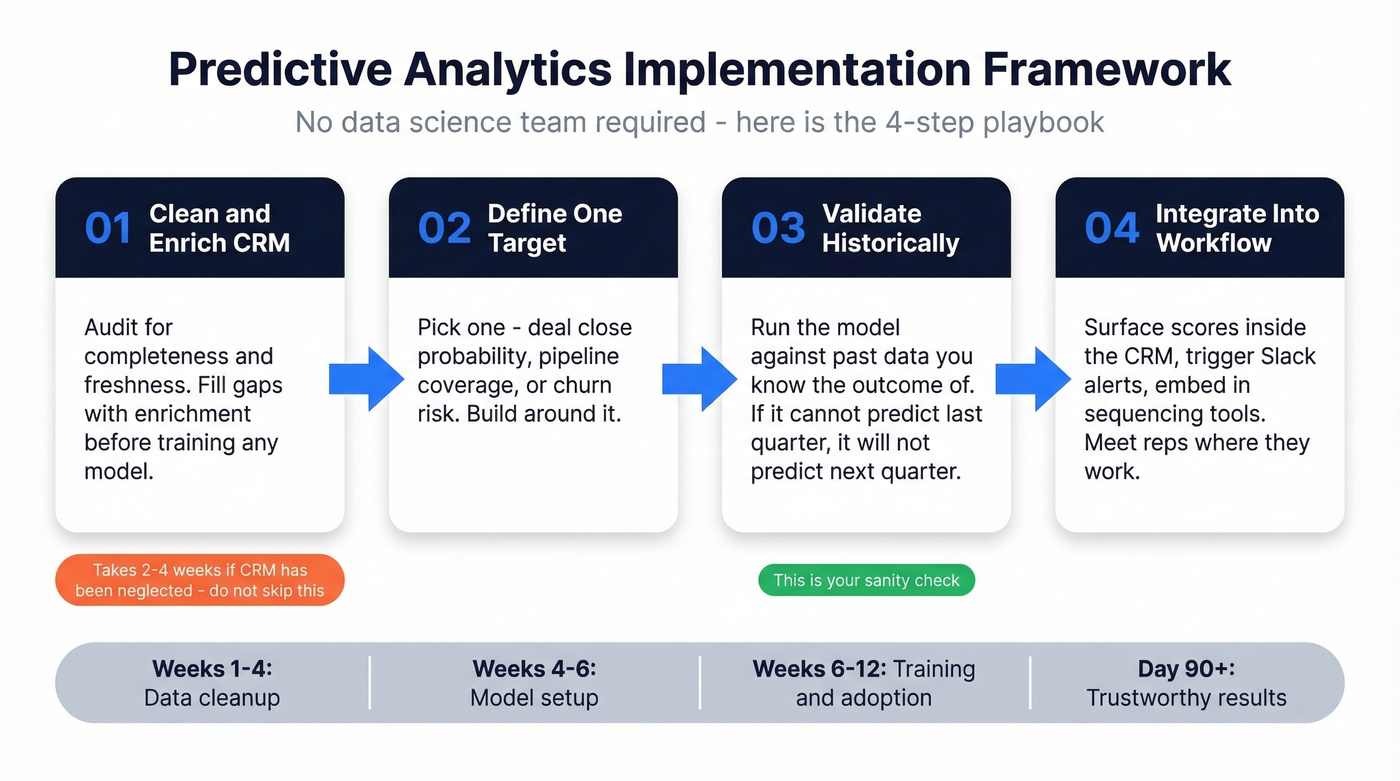
- Clean and enrich your CRM. Audit for completeness and freshness. Run enrichment to fill gaps before you train a single model. (If you're starting from scratch, use a contact management software checklist to define required fields.)
- Define one prediction target. Deal close probability, pipeline coverage, or churn risk - pick one and build around it. (For churn, pair this with a proper churn analysis process.)
- Validate before you scale. Run the model against historical data you already know the outcome of. If it can't predict last quarter, it won't predict next quarter.
- Integrate into the workflow. Predictions in a dashboard don't change behavior. Surface scores inside the CRM, trigger alerts in Slack, embed them into your sequencing tool. The insight has to meet the rep where they work. (This is where sequence management matters.)
Let's be honest about timelines: step one alone takes most teams 2-4 weeks if their CRM has been neglected. That's normal. Don't skip it.
What to Realistically Expect
A well-implemented setup delivers 10-20% improvement in close rates or pipeline velocity. Meaningful, but not magic. Expect roughly 90 days before you see results you can trust - the model needs training time, and your team needs adoption time.
Historical patterns break when markets shift. Models can encode bias from your existing sales motion. And unmeasured variables - a champion leaving, a competitor launching a feature - will always matter. In our experience, the teams that treat predictive analytics as a decision-support layer rather than an oracle are the ones that keep using it past Q1. If your leadership expects the model to replace judgment, you'll be disappointed. If they expect it to sharpen judgment, you'll see real gains. (For a broader view, see data science in sales.)
Best Forecasting Software for Sales Teams
| Tool | Best For | Approx. Pricing | Category |
|---|---|---|---|
| Prospeo | Clean data for any model | Free tier; ~$0.01/email | Data layer |
| Salesforce Einstein | Enterprise Salesforce teams | ~$165/user/mo | CRM-native AI |
| Clari | Revenue intel + forecasting | ~$25K-$75K/yr | Forecasting platform |
| HubSpot | Mid-market forecasting | ~$100/user/mo | CRM-native AI |
| Gong | Conversation intelligence | ~$100-$150/user/mo | Conversation AI |
| Pipedrive | SMB simple forecasting | From $39/user/mo | CRM-native |
| monday CRM | Workflow-oriented teams | ~$12-$28/user/mo | CRM-native |
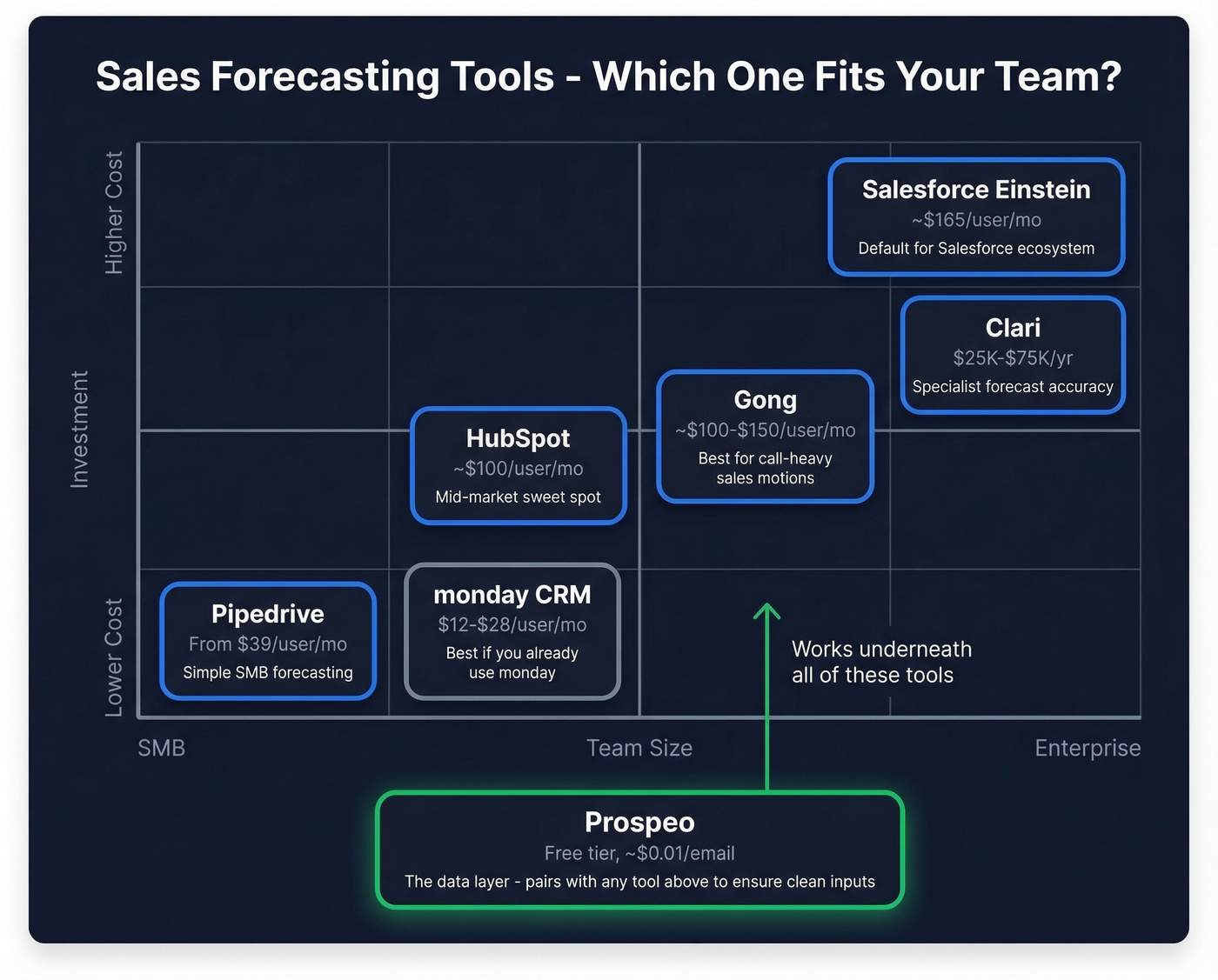
Salesforce Einstein is the default for teams already deep in the Salesforce ecosystem - predictions surface natively on top of your existing data. Clari is the specialist pick when forecast accuracy is a core competency, not a bolt-on. If your sales motion is call-heavy, Gong feeds conversation intelligence into predictions in a way no CRM-native tool matches. HubSpot and Pipedrive hit the sweet spot for teams that want forecasting without a six-figure commitment. (If you want more options, compare sales forecasting solutions.)
Skip monday CRM for forecasting unless your team already lives in monday for project management. Its CRM is improving fast, but the predictive features aren't as mature as the others on this list.
Step one of any predictive analytics rollout is CRM enrichment - and most teams waste 2-4 weeks doing it manually. Prospeo fills gaps across 50+ data points per contact at a 92% match rate, so your models train on complete records from day one.
Clean data in, accurate predictions out. Skip the 2-4 week slog.
FAQ
Can predictive models replace a sales rep's judgment?
No. Models surface patterns humans miss at scale - deal velocity correlations, churn signals, multi-threading effects - but they can't account for relationship context or sudden market shifts. The best implementations augment rep decisions rather than override them.
How much CRM data do you need before predictions work?
Most platforms need 6-12 months of consistent activity data - deals, stage transitions, closed-won and closed-lost outcomes. Cleaner data means you need less of it. Fix CRM hygiene before investing in a forecasting tool.
What's the cheapest way to start with predictive sales forecasting?
HubSpot Sales Hub at ~$100/user/mo or Pipedrive at $39/user/mo both include built-in forecasting. Pair either with Prospeo's free tier (75 emails/month) to make sure your contact records are accurate before running any model.
How does data quality affect forecast accuracy?
Directly and dramatically. With B2B data decaying at 2.1% per month, models trained on stale records produce unreliable scores. A 7-day refresh cycle and verified email data keep your CRM current, giving prediction engines clean inputs instead of outdated noise.