

The Deal Funnel: Stages, Benchmarks, and How to Fix Yours
It's Monday morning pipeline review. Your team shows $2.4M against a $600K quota - 4x coverage. But 30% of those deals haven't had activity in three weeks, and the "close dates" are all conveniently set to the last day of the quarter. Your deal funnel isn't healthy. It's lying to you.
Most pipeline problems aren't volume problems. They're quality problems - bad data, weak qualification, and stages that exist in your CRM but don't map to anything a buyer actually does.
The Short Version
- A deal funnel tracks where prospects drop off; a pipeline tracks which deals reps are working. You analyze the funnel, you manage the pipeline.
- B2B SaaS benchmarks: 39% Lead-to-MQL, 38% MQL-to-SQL, 42% SQL-to-Opp, 37% SQL-to-Closed. If you're below these, you have a specific stage problem - not a "leads" problem.
- The #1 failure mode: a top-heavy funnel stuffed with unqualified deals. More isn't better than better.
- Fix it with qualification gates (MEDDIC/BANT), time-in-stage tracking, and clean contact data feeding your CRM.
What Is a Deal Funnel?
A deal funnel is the analytical view of how prospects move through your sales process - and more importantly, where they drop off. It starts wide with every lead that enters and narrows at each stage as prospects disqualify, go dark, or lose interest.
The pipeline, by contrast, is the management view: the set of active deals your reps are working right now, organized by stage. Here's the heuristic that sticks: you analyze the funnel, you manage the pipeline. The funnel tells you where things break. The pipeline tells you what to do about it today.
VC and PE Deal Flow
The term shows up heavily in venture capital and private equity, where it describes investment deal flow. The math is brutal. Per an HBR study, the average VC considers 101 opportunities to make a single investment - meeting with 28, sending 10 to partner review, running due diligence on 4.8, and issuing just 1.7 term sheets. The average deal takes 83 days to close and 118+ hours of due diligence. If you're here for the investing version, those are your benchmarks. The rest of this piece focuses on the B2B sales version.
Deal Funnel Stages That Map to Buyer Actions
AIDA (Awareness, Interest, Desire, Action)) is a 100-year-old advertising model. Fine for textbooks, but your CRM stages should map to seller actions and buyer commitments, not abstract mental states. Here's what a modern B2B SaaS funnel actually looks like:
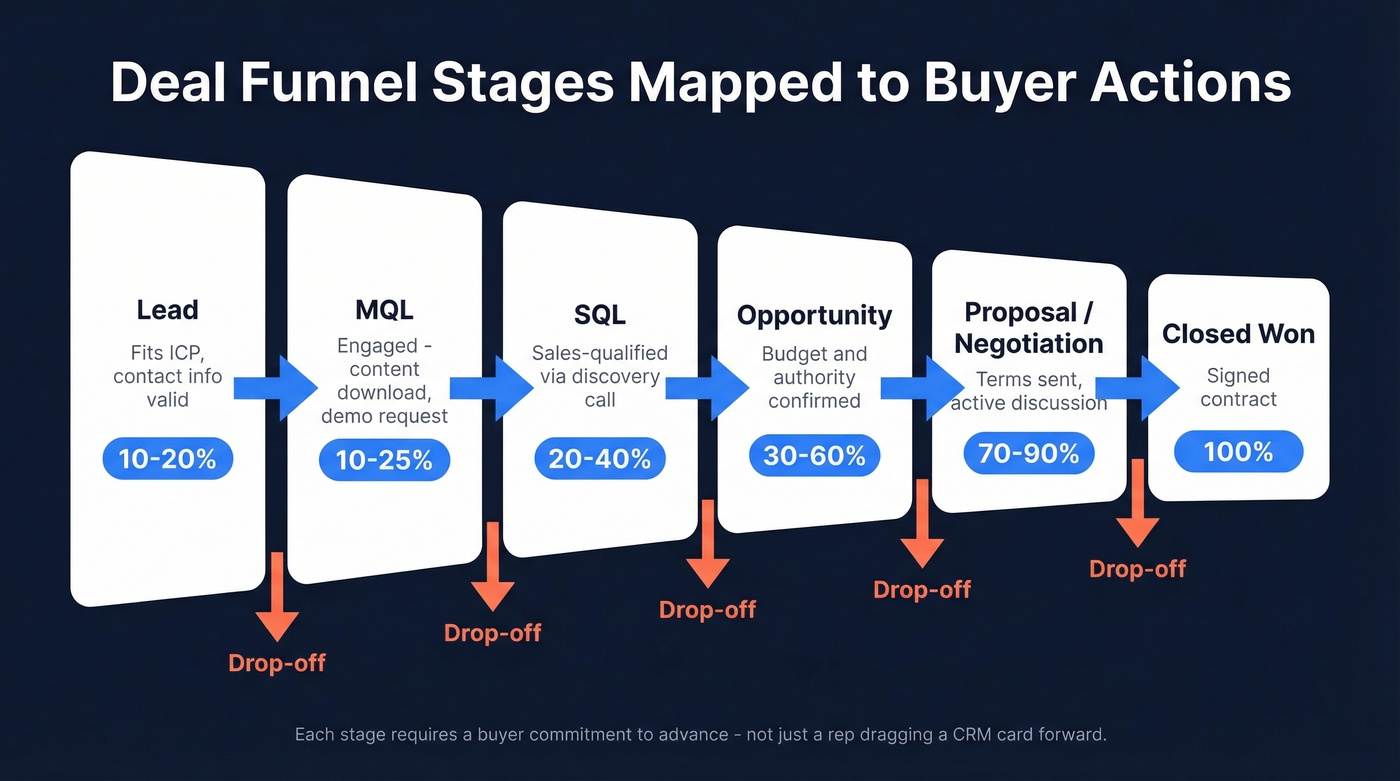
| Stage | Exit Criteria | Est. Close Probability |
|---|---|---|
| Lead | Fits ICP, contact info valid | 10-20% |
| MQL | Engaged (content, demo request) | 10-25% |
| SQL | Sales-qualified via discovery | 20-40% |
| Opportunity | Budget/authority confirmed | 30-60% |
| Proposal/Negotiation | Terms sent, active discussion | 70-90% |
| Closed Won | Signed contract | 100% |
These probabilities aren't gospel - they're defaults to calibrate against. What matters is that each stage has a clear exit criterion tied to a buyer action, not just a rep dragging a card forward in the CRM because their manager asked for an update.
2026 Conversion Benchmarks
Your SDR team generated 200 MQLs last month. Marketing is celebrating. But only 35 became SQLs, and 8 turned into opportunities. Is that good?
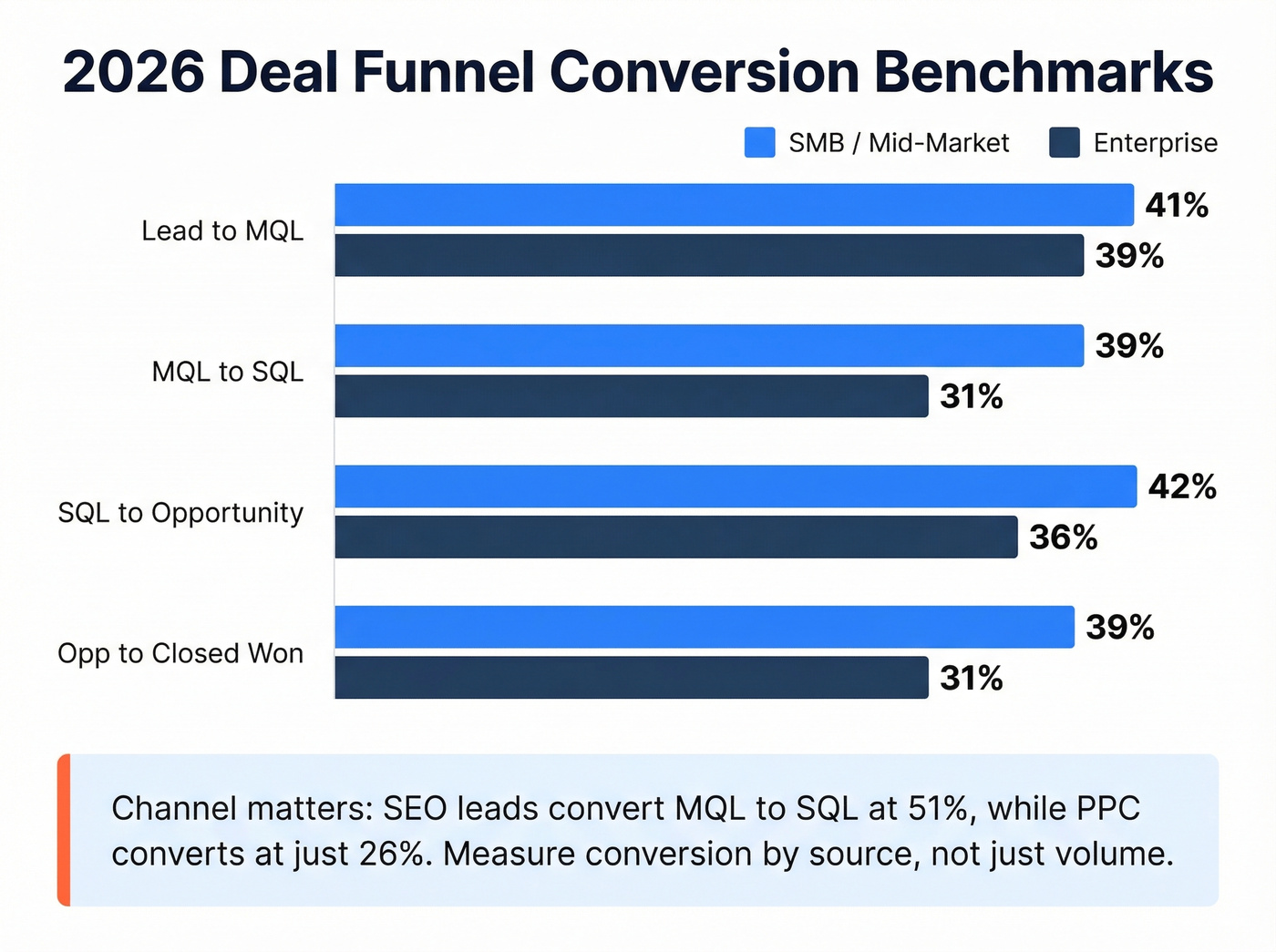
| Metric | B2B SaaS (SMB/MM) | B2B SaaS (Enterprise) |
|---|---|---|
| Lead-to-MQL | 41% | 39% |
| MQL-to-SQL | 39% | 31% |
| SQL-to-Opportunity | 42% | 36% |
| Opp-to-Closed Won | 39% | 31% |
These figures come from Digital Bloom's pipeline benchmark synthesis across 40+ studies. FirstPageSage's independent data tells a similar story, though their "SQL-to-Closed" metric is cumulative from SQL to close - not the same as the stage-by-stage Opp-to-Closed Won rate above.
The channel your leads come from matters enormously. SEO-sourced leads convert MQL-to-SQL at 51%. PPC leads? Just 26%. Events sit at 24% for MQL-to-SQL but climb to 40% at Opportunity-to-Close. Don't just measure volume - measure conversion by source, or you'll over-invest in channels that fill the top but starve the bottom.
Broader benchmarks worth keeping in your back pocket: median sales cycle is 84 days (optimal range 46-75), typical win rate runs 20-30%, and median deal size for private SaaS is around $26,265.

Your MQL-to-SQL conversion tanks when reps chase bad emails and dead phone numbers. Prospeo's 98% email accuracy and 125M+ verified mobiles mean every deal entering your funnel connects to a real buyer - not a bounce.
Stop stuffing your funnel with unverifiable contacts. Start with clean data.
Metrics That Define Funnel Health
Not every metric matters at every stage. Here's a scorecard organized by where it lives in the funnel.
Top of Funnel: Website traffic, visitor-to-lead conversion rate, lead response time. Your RevOps team should track all three weekly, not monthly.
Middle of Funnel: Lead-to-MQL rate, MQL-to-SQL rate, pipeline coverage ratio (Total Pipeline Value / Sales Quota - aim for 3-4x). Layer in intent signals from providers like Bombora to identify in-market accounts before they even enter your funnel. That's how you shift from reactive to proactive pipeline building.
Bottom of Funnel: Win rate, average sales cycle length, pipeline velocity, CAC.
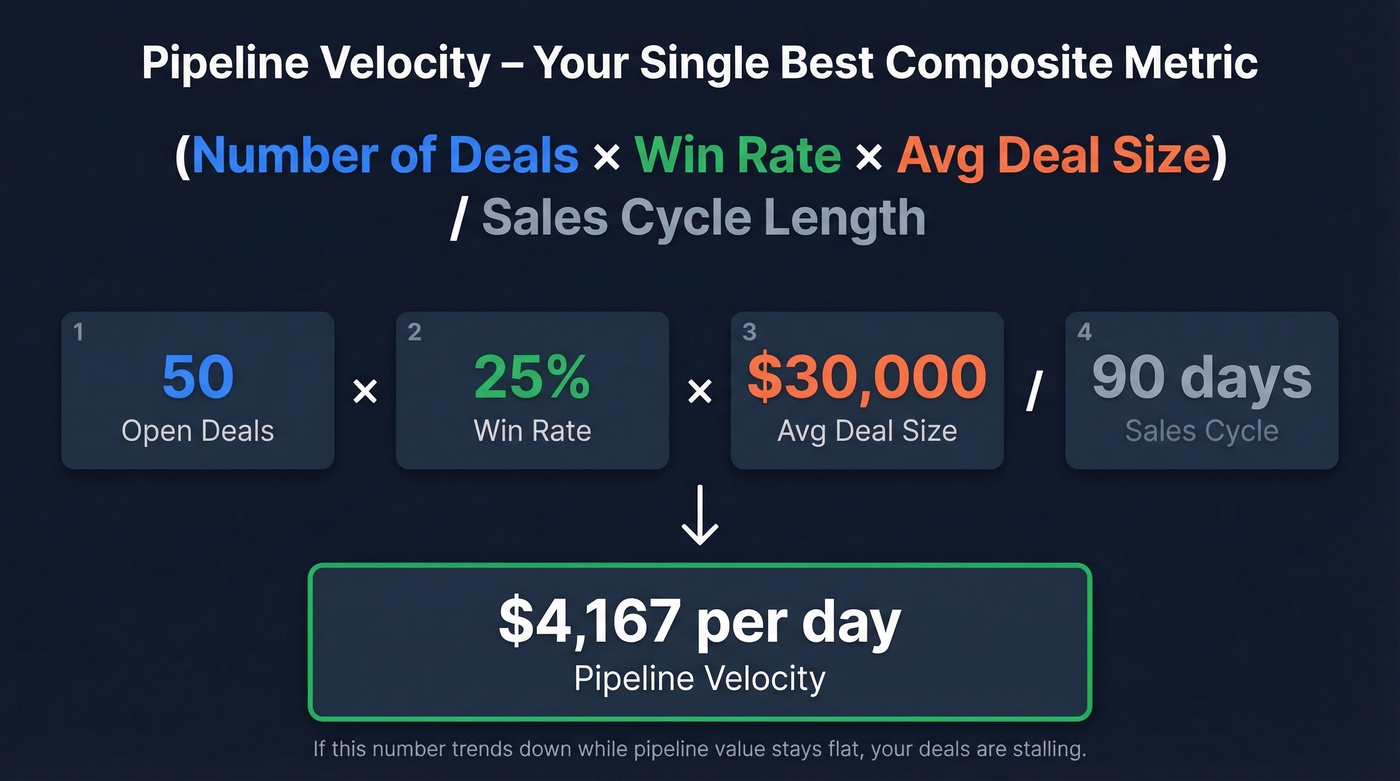
Pipeline velocity deserves its own formula because it's the single best composite metric:
(Number of Deals x Win Rate x Avg Deal Size) / Sales Cycle Length
Worked example: 50 deals x 25% win rate x $30,000 avg deal / 90-day cycle = $4,167/day in pipeline velocity. If that number's trending down while your pipeline value stays flat, deals are stalling - even if the CRM looks full.
If you're under $1M ARR, don't over-instrument. Track four things: open deals, close rate, opportunities by channel, and customer count. Everything else is noise until you have enough volume for the numbers to mean something.
Five Ways Your Deal Funnel Lies
1. Top-heavy pipeline. This is the most common problem we see. Reps create deals after a single discovery call, the funnel looks packed, and leadership thinks quota is safe. Then 60% of those "opportunities" never advance past stage two. The fix is strict entry criteria and lead scoring - the HubSpot community flags this constantly.
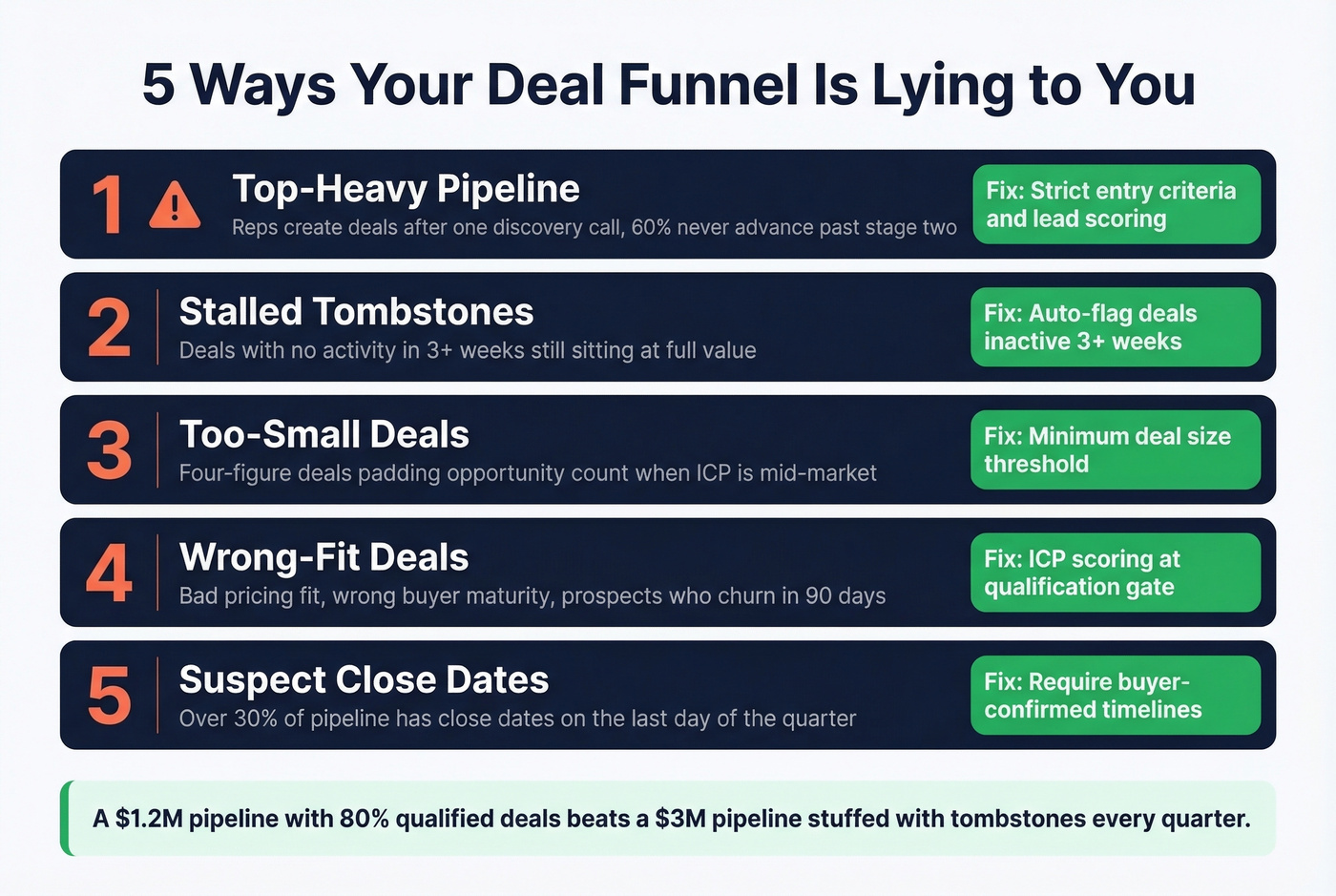
2. Stalled tombstones. Deals that haven't had activity in 3+ weeks but still sit in your pipeline at full value. They're effectively dead. Removing them means admitting the forecast is wrong, so they linger, creating false confidence that compounds every week.
3. Too-small deals. Reps accept four-figure deals to pad their opportunity count when your ICP is mid-market. The funnel looks active, but velocity is anemic because deal size drags the whole formula down.
4. Wrong deals. Bad pricing fit, wrong buyer maturity, or prospects who'll churn in 90 days. Every wrong deal in your funnel displaces attention from a right one.
5. Suspect close dates. If more than 30% of your pipeline has close dates on the last day of the month or quarter, your forecast is fiction. Reps default to period-end dates when they don't have a real timeline from the buyer. We've watched teams miss forecast by 40%+ because nobody challenged those dates during pipeline review.
A $1.2M pipeline with 80% qualified deals will outperform a $3M pipeline stuffed with tombstones and wrong-fit prospects every single quarter.
How to Fix a Broken Deal Funnel
Track time-in-stage, not just stage counts. A deal sitting in "Proposal" for 45 days isn't a proposal-stage deal - it's a stalled deal wearing a costume. Set alerts when deals exceed your median time-in-stage by 50%.
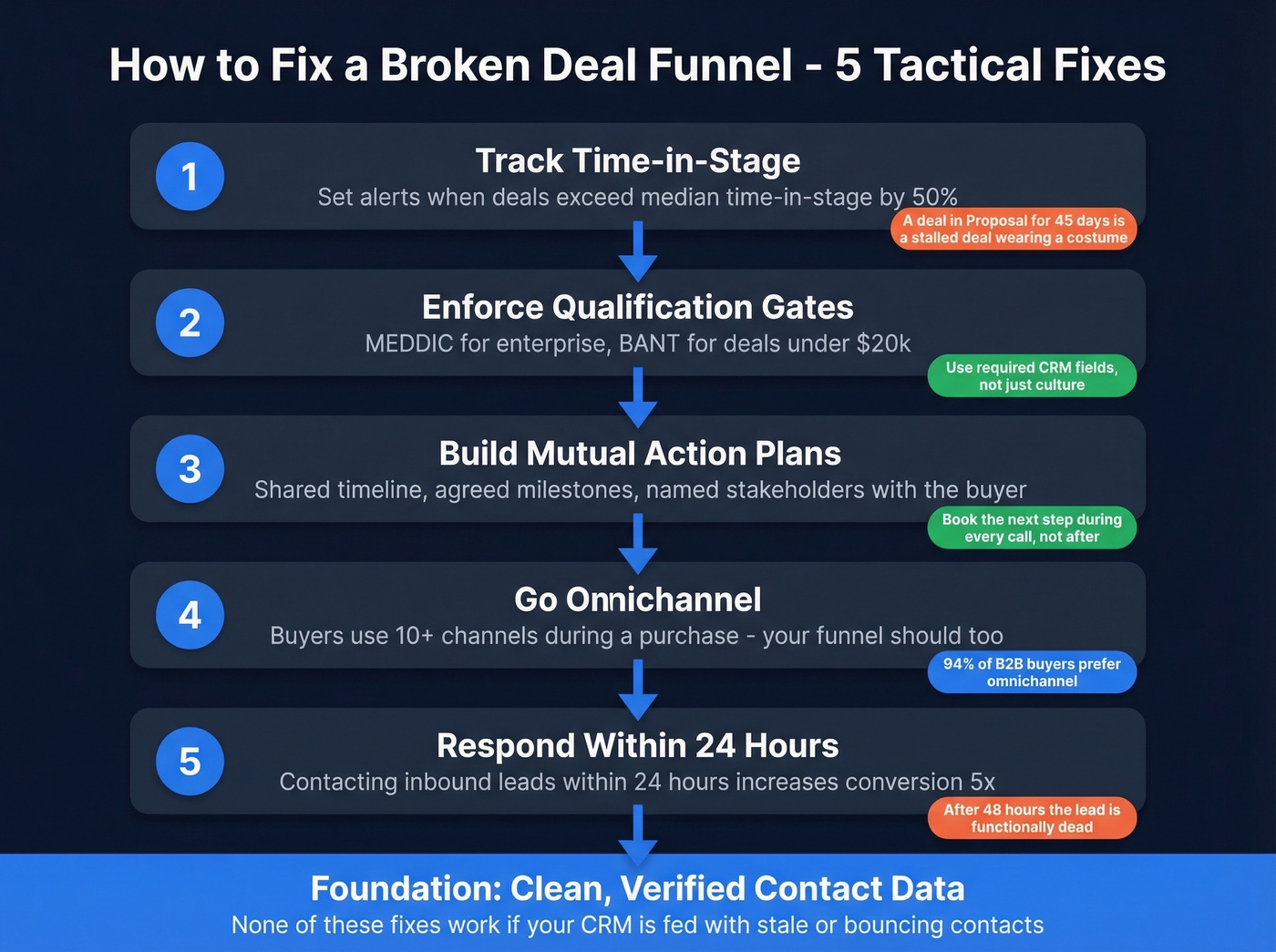
Enforce qualification gates. MEDDIC for enterprise sales cycles, BANT for deals under $20k. The gate isn't optional - if a deal can't answer the qualification questions, it doesn't advance. Use HubSpot properties or Salesforce required fields to enforce this mechanically, not just culturally. Skip this step if your team closes fewer than 10 deals a month; at that volume, rigid gates create more friction than value.
Build mutual action plans. The #1 killer of late-stage deals is "no decision." A mutual action plan with the buyer - shared timeline, agreed milestones, named stakeholders - cuts this dramatically. Book the next step during every call, not after.
Go omnichannel. McKinsey's research shows 94% of B2B decision-makers view omnichannel sales as more effective, and buyers now use 10+ channels during a purchase. If your funnel assumes a linear email-to-call-to-demo path, you're modeling a buyer journey that doesn't exist anymore.
Respond fast. Let's be honest - we've seen teams spend weeks redesigning funnel stages while ignoring the simplest fix. Contacting inbound leads within 24 hours increases conversion by 5x. After 48 hours, the lead is functionally dead.
Clean Data as the Foundation
Here's the thing most deal funnel "optimization" projects miss: they skip the boring part. Teams spend weeks redesigning stages and building dashboards, then feed the whole system with stale contact data. Bad data inflates activity metrics with emails that bounce, creates phantom pipeline attached to contacts who never received your outreach, and destroys forecast confidence. The consensus on r/sales is pretty clear - data quality problems masquerade as funnel problems all the time.
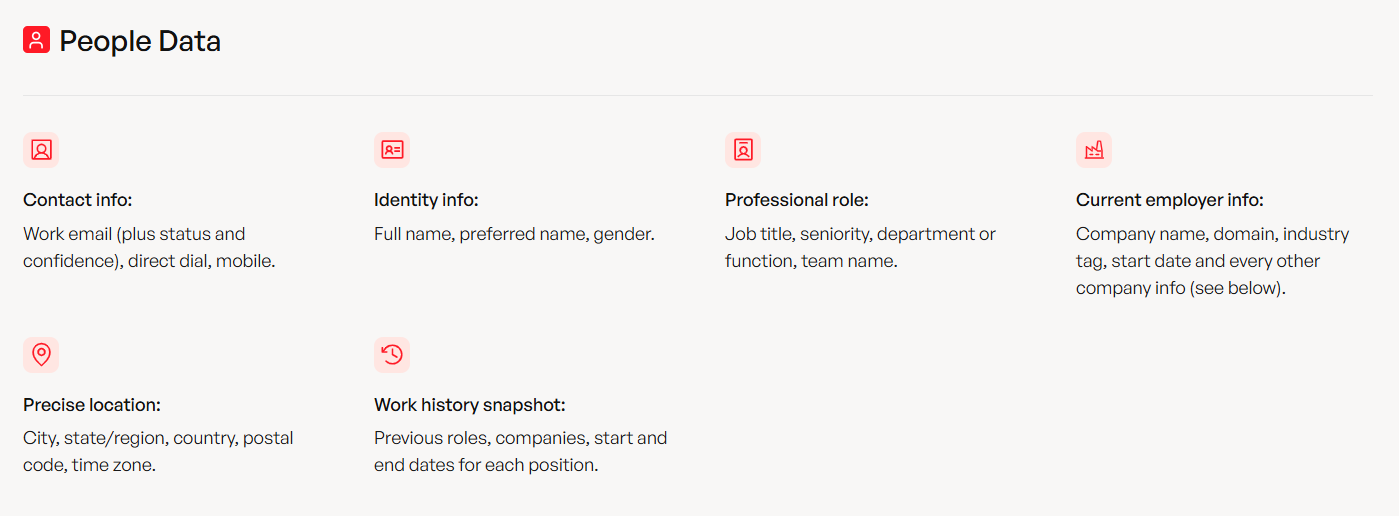
Prospeo addresses this at the source. Its 98% email accuracy and 7-day data refresh cycle mean the contacts feeding your CRM are verified and current - not six-week-old records that bounce on first touch. CRM enrichment returns 50+ data points per contact, with a 92% API match rate, so reps aren't working blind. Real results back this up: Snyk's team of 50 AEs dropped their bounce rate from 35-40% to under 5%, saw AE-sourced pipeline jump 180%, and now generates 200+ new opportunities per month.
Pipeline velocity = deals × win rate × deal size ÷ cycle length. Bad data drags every variable down. Prospeo refreshes 300M+ profiles every 7 days - so your CRM enrichment never feeds stale contacts into active deals.
Kill stalled tombstones before they enter your pipeline. Data refreshed weekly, not monthly.
Building a Funnel Report in Your CRM
If you're on HubSpot Professional or Enterprise, you can build a native funnel report in minutes. Navigate to Reports, then Create Report, select Deals as your data source, and choose Deal Phases as your funnel stages. Add "Num of Deals" as a custom measure, pick the Funnel visualization type, enable Smoothed Bars and Stepped Funnel for readability, and set Label Scale to 0.8 so stage names don't overlap. The HubSpot community has solid threads on customizing these further.
Salesforce gives you more power but demands more setup - meaningful funnel reporting usually requires an Enterprise-tier license and a RevOps admin who knows their way around report types. For smaller teams, Pipedrive offers built-in pipeline reporting that works well without the overhead.
If you want a deeper view of what "good" looks like, compare your numbers to sales pipeline benchmarks and then pressure-test your sales process optimization stage by stage.
Is the Funnel Model Dead?
Brian Halligan famously "retired the funnel" after 28 years and replaced it with the flywheel model. HBR has published multiple critiques arguing marketing can no longer rely on it. They're not wrong that the funnel is an imperfect model of how humans actually make buying decisions.
But the deal funnel isn't dead - your data is.
It was never meant to be a psychological model of buyer behavior. It's an operational diagnostic tool. You don't need it to perfectly capture how a VP of Engineering decides to buy your platform. You need it to show you that 40% of your SQLs are stalling at the proposal stage, and that your enterprise conversion rate is 8 points below benchmark. That's actionable. A flywheel can't tell you that.
Keep the funnel. Fix the data feeding it. Measure what matters at each stage.
FAQ
What's the difference between a deal funnel and a sales pipeline?
A deal funnel is the analytical view showing where prospects drop off at each stage - it diagnoses conversion problems. A pipeline is the management view of active deals with dollar values and close dates. You analyze the funnel to find leaks; you manage the pipeline to close revenue. Same CRM data, different questions.
What's a good deal funnel conversion rate?
For B2B SaaS, solid benchmarks are 39% Lead-to-MQL, 38% MQL-to-SQL, 42% SQL-to-Opportunity, and a 20-30% overall win rate. If you're significantly below any single stage, that's your bottleneck. Enterprise cycles typically run 5-8 points lower at each stage than SMB/mid-market.
How do you build a deal flow funnel for your team?
Map your CRM stages to actual buyer commitments - not internal labels. Define clear exit criteria for each stage, set qualification gates at Lead-to-SQL and SQL-to-Opportunity transitions, and instrument time-in-stage tracking from day one. Benchmark your conversion rates against industry data so you know where specific leaks exist before you start optimizing.
How does bad contact data break a deal funnel?
Stale or unverified contacts create phantom pipeline - deals attached to people who never received your outreach. This inflates stage counts and destroys forecast accuracy. Verifying contacts before they enter your CRM (with tools that maintain 98%+ email accuracy and weekly refresh cycles) prevents this problem at the source rather than patching it downstream.