

Deal Rooms: The Complete Guide to Digital Sales Rooms in 2026
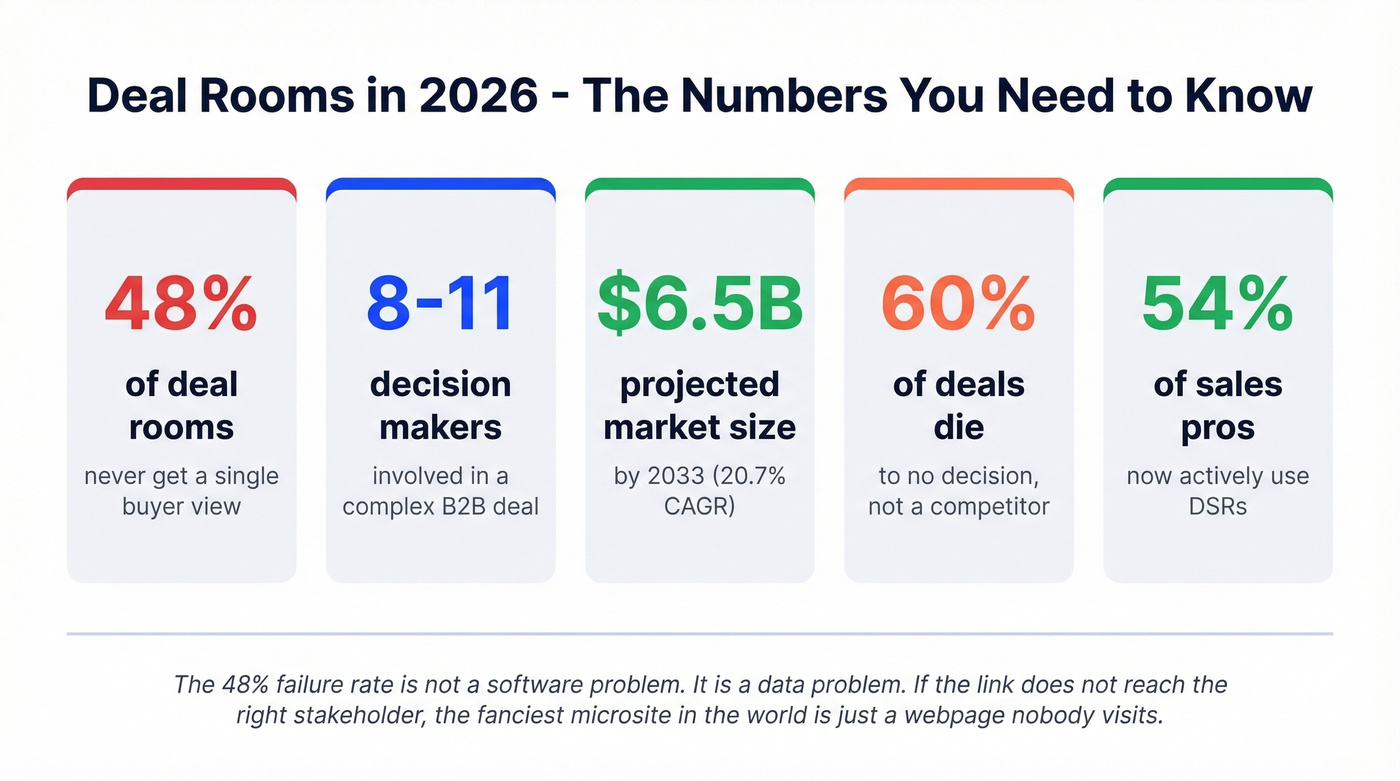
You built a beautiful deal room, shared the link with your champion, and waited. Nothing. Zero views. The email bounced - your contact changed jobs three months ago, and nobody updated the CRM. Nearly 48% of deal rooms never get a single buyer view, and the reason is almost always upstream: wrong person, dead email, or a link that lands in a spam folder.
What You Need (Quick Version)
Deal rooms - also called digital sales rooms - are shared microsites where buyers and sellers collaborate on complex deals. Most teams spend $25-55/user/month; free tiers exist at Dock, Trumpet, Aligned, Flowla, Accord, and Recapped.io. Before you invest, know this: that 48% failure rate isn't a software problem. It's a data problem. If the link doesn't reach the right stakeholder, the fanciest microsite in the world is just a webpage nobody visits.
Quick picks if you're short on time:
- Dock - easiest to adopt (4.7/5 on G2, 436 reviews)
- DealHub - best for teams that also need CPQ and CLM
- Trumpet - strongest free tier for small teams testing the category
Three Products, One Search
Here's the thing: "deal rooms" means three completely different products depending on who's searching. A sales leader wants a digital sales room - a shared microsite for managing a complex deal with multiple stakeholders. An M&A attorney wants a virtual data room - a secure document vault for due diligence. And a VC analyst might be looking for Dealroom.co, the startup intelligence platform that tracks funding rounds.
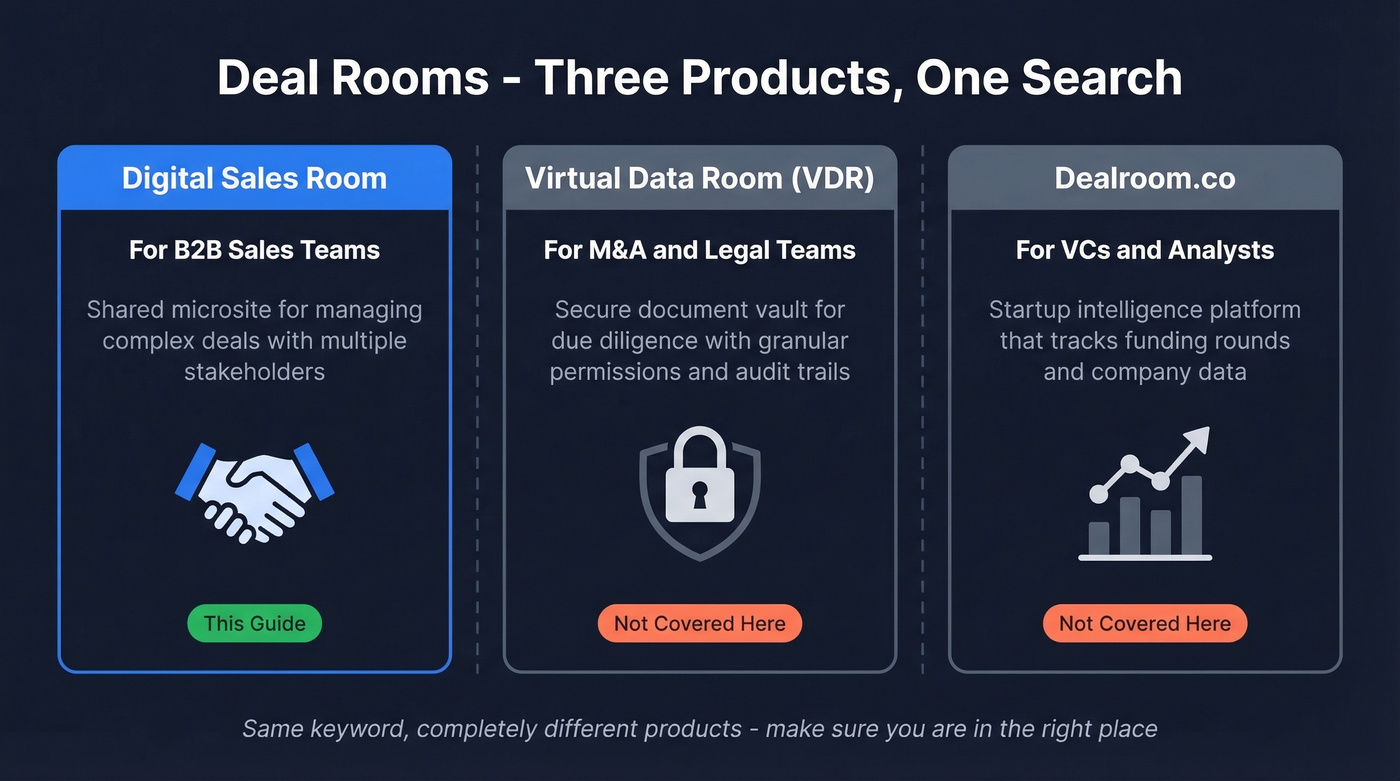
This guide covers the first one: digital sales rooms (DSRs) for B2B sales teams. If you're here for M&A due diligence or startup data, you're in the wrong place.
The global DSR market hit $1.2B in 2024 and is projected to reach $6.5B by 2033 - a 20.7% CAGR. Other estimates put it at $7.9B by 2031. The growth is driven by a simple reality: complex B2B deals now involve 8-11 decision-makers, most of whom never talk to a sales rep directly. Your champion forwarded your PDF to six stakeholders, and you have zero visibility into who read it, who cared, and who killed the deal in a Slack thread.
That's the problem these tools solve.
What Are Digital Sales Rooms?
Gartner defines digital sales rooms as "private, persistent microsites" connecting buying and selling teams to improve engagement throughout the customer journey. They combine content, commerce, and planning tools into a single shared space.
In practice, a DSR replaces the mess of email chains, Google Drive folders, and static PDFs that most sales teams still use to manage complex deals. Instead of sending a proposal as an attachment that gets buried in someone's inbox, you share a single link to a branded microsite. That microsite holds everything - proposals, case studies, pricing, mutual action plans, contracts - and tells you exactly who's engaging with what.
What a Deal Room Is NOT
- Not a CRM. Salesforce tracks your pipeline. A DSR is the buyer-facing layer that sits on top of it.
- Not just e-signature. DocuSign gets the contract signed. A DSR manages everything before the signature.
- Not a file-sharing app. Dropbox stores files. A DSR tracks who viewed which file, for how long, and who they forwarded it to.
- Not a virtual data room. VDRs are built for M&A due diligence with granular permissions and audit trails. DSRs are built for sales collaboration with engagement analytics and mutual action plans.
Gartner predicted that 30% of B2B sales cycles would be managed through DSRs by 2026, and practitioner surveys show 54% of sales professionals now actively use them across all deals. The remaining ~30% who've never touched one are increasingly the outliers.
Key Features to Look For
Not every platform does the same things. Here's what actually matters.
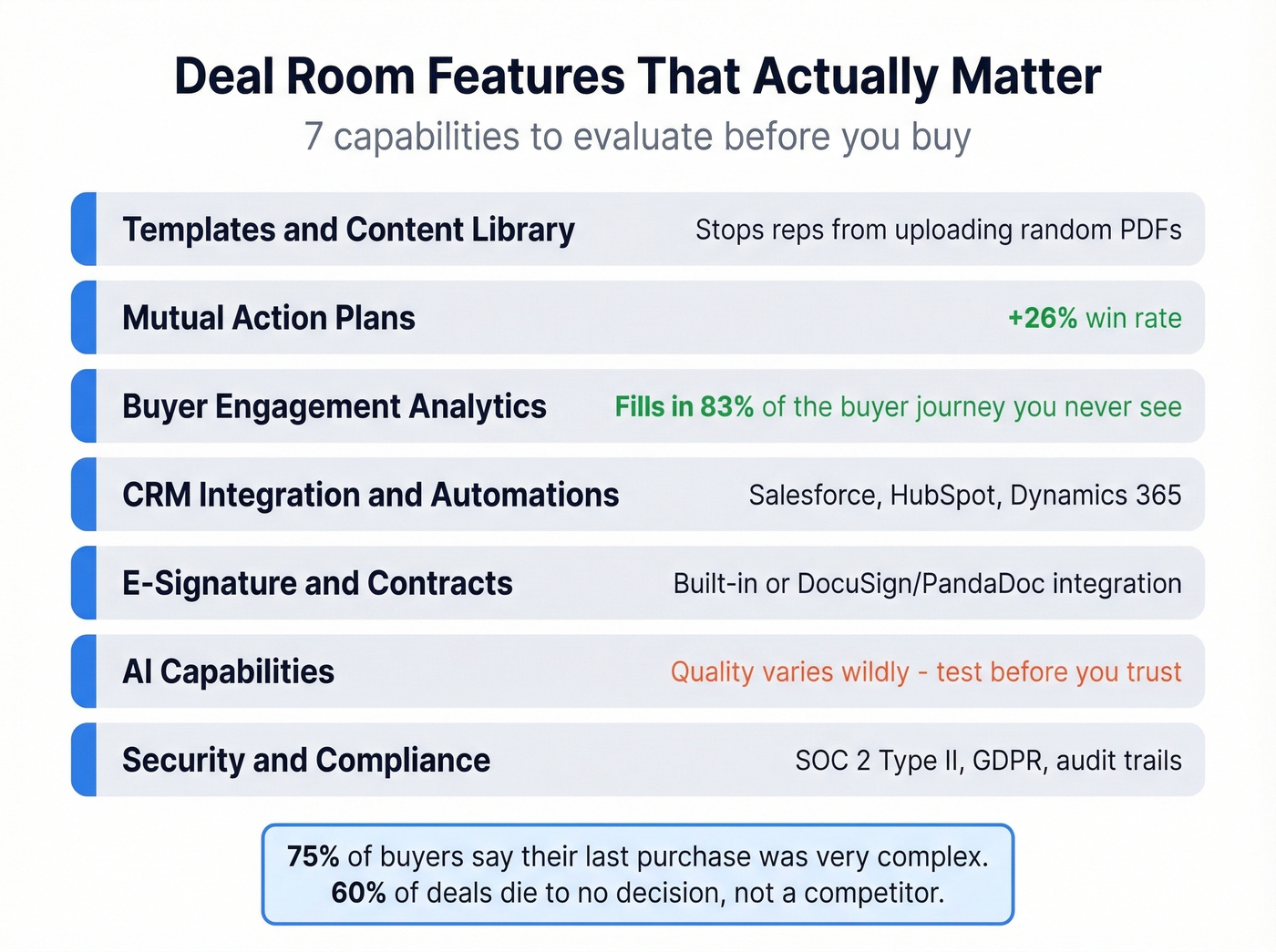
Templates & Content Library
You don't want reps building rooms from scratch for every deal. The best platforms offer pre-built templates by deal stage, industry, or use case - plus a centralized content library so marketing-approved assets are always one click away. If your reps are uploading random PDFs from their desktops, you've already lost the brand consistency battle.
Mutual Action Plans
Mutual action plans (MAPs) are the single most impactful feature in a DSR. They're shared, co-created plans outlining steps, responsibilities, and deadlines for both buyer and seller - essentially a project plan for getting the deal done.
Complex B2B sales involve 8-11 decision-makers, and 75% of buyers describe their last purchase as "very complex." Up to 60% of these deals die to "no decision" - not a competitor win, just organizational inertia. MAPs combat this by creating shared accountability. Deals with a MAP show 26% higher win rates, and 70% of revenue leaders credit MAPs with improved win rates overall. When your deal is being evaluated in meetings you're not invited to, a MAP keeps it on track.
Buyer Engagement Analytics
This is where the investment justifies itself. Good analytics tell you who viewed what content, for how long, and who they shared it with. One GetAccept customer, Visit Linkoeping, described the shift perfectly: before DSRs, they sent PDFs and had no idea who opened them. After, they could see exactly which stakeholders engaged and which ones needed a nudge.
Only 17% of the buyer journey involves direct vendor interaction. Analytics fill in the other 83%.
CRM Integration & Automations
A DSR that doesn't talk to your CRM is a dead end. Look for native integrations with Salesforce, HubSpot, or Dynamics 365 - plus automation triggers that update deal stages, send Slack notifications, or fire follow-up sequences based on buyer activity. The best platforms pull CRM variables into room templates automatically, so reps don't have to manually populate company names and deal values. If you're tightening your RevOps stack, contact management hygiene matters here more than most teams admit.
E-Signature & Contract Workflows
Some platforms (GetAccept, DealHub) include built-in e-signature. Others integrate with DocuSign or PandaDoc. Either way, the contract should live inside the room - not in a separate email thread that breaks the buyer's flow.
AI Capabilities
Several platforms now offer AI-generated room content, smart asset recommendations, and deal summaries. We've tested a few of these, and the quality varies wildly - DealHub's AI-assisted quoting is genuinely useful, while some vendors' "AI features" amount to a GPT wrapper on a text field. Don't let an AI checkbox drive your decision. If you're evaluating the broader landscape, start with generative AI sales tools that actually impact pipeline.
Security & Compliance
For enterprise deals, non-negotiable. Look for SOC 2 Type II compliance, GDPR readiness, granular access controls, and audit trails. If your buyer's legal team asks "where is our data stored?" you need a real answer.

48% of deal rooms never get a single buyer view - not because the software failed, but because the email bounced. Your champion changed jobs, and nobody updated the CRM. Prospeo refreshes 300M+ profiles every 7 days with 98% email accuracy, so your deal room link actually reaches the right stakeholder.
Stop building deal rooms for contacts who left three months ago.
Best Software Compared for 2026
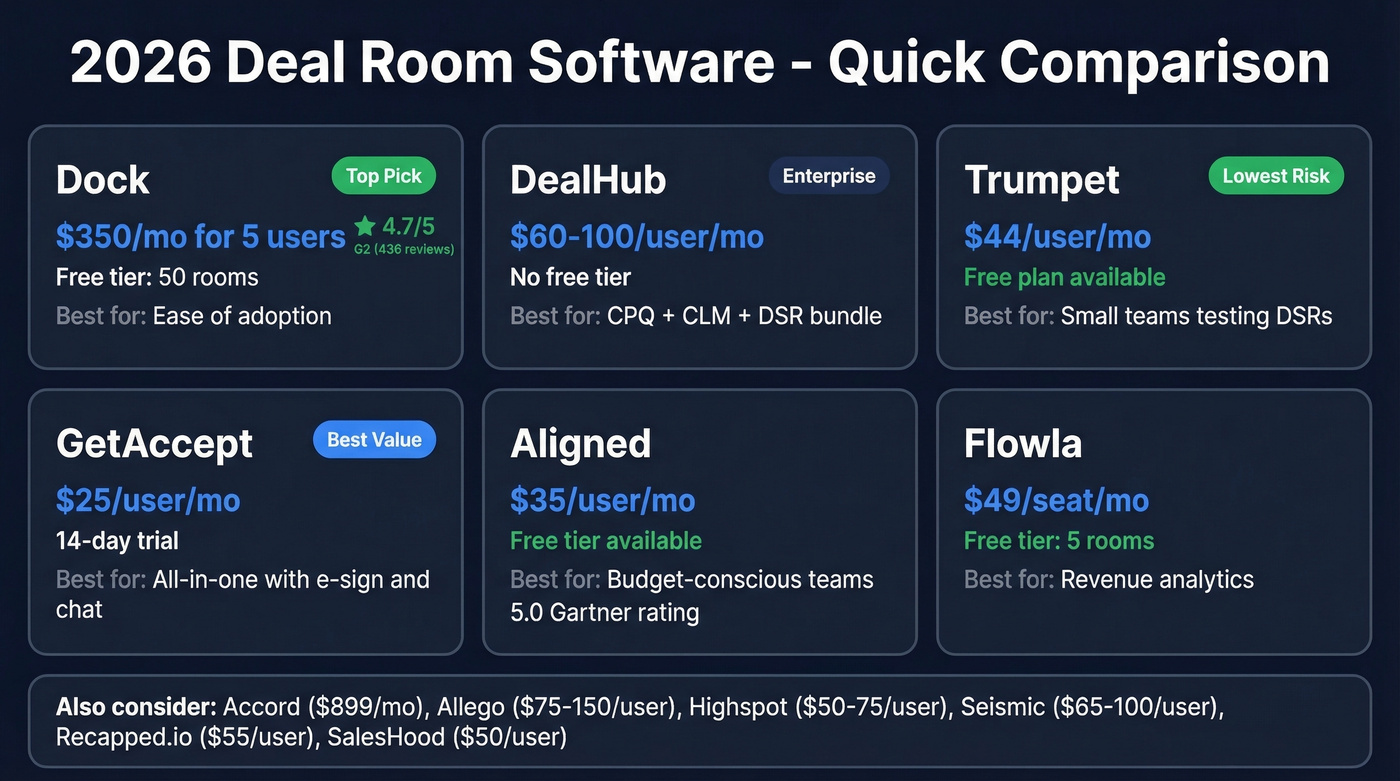
| Tool | Best For | Starting Price | Free Tier? | Key Differentiator |
|---|---|---|---|---|
| Dock | Ease of adoption | $350/mo (5 users) | Yes (50 rooms) | Champion enablement, 4.7/5 G2 |
| DealHub | CPQ + DSR bundle | ~$60-100/user/mo | No | CPQ + CLM + DSR bundle |
| Trumpet | Small teams | $44/user/mo | Yes | Lowest-risk free tier |
| GetAccept | All-in-one DSR | ~$25/user/mo | 14-day trial | In-room chat + e-sign |
| Aligned | Budget-conscious | ~$35/user/mo | Yes | Clean UX, 5.0 Gartner rating |
| Flowla | Revenue analytics | $49/seat/mo | Yes (5 rooms) | Revenue-linked room analytics |
| Accord | Enterprise process | ~$899/mo | Yes | Structured methodology support |
| Allego | Enablement-first | ~$75-150/user/mo | No | Coaching + content + DSR |
| Highspot | Enterprise enablement | ~$50-75/user/mo | No | Content management, 4.8 Gartner |
| Seismic | Enterprise enablement | ~$65-100/user/mo | No | Full enablement suite |
| Recapped.io | Mid-market | ~$55/user/mo | Yes | MAP-focused |
| SalesHood | Coaching + DSR | ~$50/user/mo | No | Evaluation framework |
Dock
Dock is one of the safest picks in the category. With a 4.7/5 rating across 436 G2 reviews, it's among the most established tools here. Ease of use dominates the review sentiment - 273 mentions of it being easy to use, 120 mentions of straightforward setup. Reps actually adopt it, which is half the battle with any sales tool.
The feature set covers the essentials: templates, mutual action plans, buyer analytics, signable order forms, and CRM automation triggers. Dock is SOC 2 Type II and GDPR compliant, with customer-reported outcome lifts of +25% to +31% win rate depending on segment. The free plan caps at 50 workspaces; paid plans start at $350/month for 5 users.
The tradeoff: limited customization is the top complaint (50 G2 mentions), and some teams hit integration friction with third-party CRMs. If you need pixel-perfect branding or deep CPQ workflows, Dock won't get you there. For everyone else, it's the fastest path to a working DSR.
DealHub
Use this if you need CPQ, CLM, and a DSR in one platform and don't want to stitch together three vendors. DealHub's internal data lab analyzed 193,000+ deals and $25B in revenue, reporting up to 3x win rates when teams use DealRoom versus sending PDFs and Word docs. Structured collaborative spaces outperform email attachments - that's not controversial.
Skip this if you're a small team that just wants a simple shared space. DealHub is enterprise-grade - expect to talk to sales and negotiate an annual contract, likely in the $60-100/user/month range depending on which modules you bundle. The CPQ/CLM integration is the differentiator; if you don't need those, you're paying for capabilities you won't use.
Trumpet
Trumpet is the scrappy pick. Named a G2 2026 pick, it offers a genuine free plan and paid tiers starting at $44/user/month. For a small team that wants to test whether DSRs actually improve close rates before committing budget, Trumpet is the lowest-risk entry point. The feature set is lighter than Dock or DealHub, but it covers the core: shared rooms, content hosting, and basic analytics. Start here, graduate later if needed.
GetAccept
GetAccept packs the most features per dollar in the category. Templates, content library, mutual action plans, tracking, in-room chat, automations, and built-in e-signature - all starting around $25/user/month. A 14-day free trial lets you test before committing.
The in-room chat is a genuine differentiator. Instead of buyers emailing questions back to their rep, who then forwards to an SE, who replies two days later - conversations happen inside the room where everyone can see the context. For deals with multiple stakeholders asking overlapping questions, this eliminates a surprising amount of friction.
Aligned
Aligned offers a free plan and paid tiers from around $35/user/month, making it one of the more affordable options. It holds a 5.0 rating on Gartner Peer Insights. The UX is clean and modern - a good fit for teams that want simplicity over feature depth.
Flowla
Flowla stands out for publishing their own DSR market research - the 48% engagement failure stat that anchors this article comes from their data. The free plan gives you 5 rooms with unlimited seats; paid plans start at $49/seat/month. If you want a vendor that's transparent about category-level challenges rather than just selling you on the dream, Flowla earns points for intellectual honesty.
Accord
Accord is enterprise-tier pricing at around $899/month, with a free plan for teams that want to experiment. Named a G2 2026 pick, it's built for organizations with formal sales methodologies and complex approval chains. If your deal process has 15 steps and involves procurement, legal, and IT security reviews, Accord's structure makes sense. For a 5-rep team selling mid-market, it's overkill.
Allego, Highspot, Seismic
These are broader sales enablement platforms that include DSR capability. Allego runs around $75-150/user/month, Highspot around $50-75/user/month, and Seismic in the $65-100/user/month range - all require annual contracts and sales conversations. If you're already evaluating one of these for coaching, content management, or conversation intelligence, the DSR module is a natural add-on. Buying any of them just for collaborative selling would be like buying Salesforce just for the notes field.
Recapped.io, SalesHood, PandaDoc
Recapped.io offers a free plan and paid tiers from around $55/user/month, focused heavily on mutual action plans - if MAPs are your primary use case, it's worth a look. SalesHood starts from around $50/user/month and publishes a useful 10-category evaluation framework if you're running a formal vendor selection. PandaDoc also offers DSR functionality within its document workflow platform, a natural fit for teams already using it for proposals and contracts.
Pricing Breakdown
| Tool | Starting Price | Pricing Model | Free Tier/Trial |
|---|---|---|---|
| Dock | $350/mo (5 users) | Per-team | Free plan (50 rooms) |
| DealHub | ~$60-100/user/mo | Enterprise | No |
| Trumpet | $44/user/mo | Per-user | Free plan |
| GetAccept | ~$25/user/mo | Per-user | 14-day trial |
| Aligned | ~$35/user/mo | Per-user | Free plan |
| Flowla | $49/seat/mo | Per-seat | Free (5 rooms) |
| Accord | ~$899/mo | Per-team | Free plan |
| Allego | ~$75-150/user/mo | Enterprise | No |
| Highspot | ~$50-75/user/mo | Enterprise | No |
| Seismic | ~$65-100/user/mo | Enterprise | No |
| Recapped.io | ~$55/user/mo | Per-user | Free plan |
| SalesHood | ~$50/user/mo | Per-user | No |
Most mid-market teams land in the $25-55/user/month range. Enterprise platforms with CPQ/CLM bundled run $350-900+/month. Six vendors offer free tiers - Dock, Trumpet, Aligned, Flowla, Accord, and Recapped.io - so there's no reason to commit budget before you've tested the category.
Let's be honest: the fact that most vendors hide pricing and force you into a demo tells you something about how they think about the buyer experience. Ironic for a category built around "buyer enablement."
How to Evaluate Your Options
The 10-Category Framework
SalesHood published a useful evaluation framework with 10 categories and 50+ criteria. Here's the condensed version:
- Usability - Can reps build a room in under 5 minutes without training?
- Content management - Centralized library with version control and permissions?
- Collaboration - In-room comments, chat, and @mentions?
- Mutual action plans - Shared timelines with task owners and deadlines?
- Integrations - Native CRM, Slack, CPQ, and e-signature connections?
- AI capabilities - Auto-generated content, smart recommendations, or summaries?
- Branding & personalization - Custom domains, logos, and dynamic content?
- Analytics & insights - Stakeholder-level engagement tracking with alerts?
- Security & scalability - SOC 2, GDPR, SSO, and audit trails?
- Trial & POC - Can you test with real deals before signing a contract?
We've tested most of these platforms, and the ones that stick are the ones reps can set up in under 5 minutes. If adoption requires a two-hour training session and a Slack channel for troubleshooting, you've already lost - regardless of what the feature matrix says. If you're formalizing your process, a lightweight sales POC can prevent expensive shelfware.
When You Don't Need One
If your sales cycle is under 30 days or involves fewer than three stakeholders, a DSR is overhead. A shared Google Doc and good follow-up discipline will outperform a fancy microsite that nobody opens. Deal rooms earn their keep in complex, multi-stakeholder deals where visibility into buyer engagement is the difference between winning and losing to "no decision." If that's not your world, save the budget. For teams selling longer cycles, enterprise B2B sales fundamentals still matter more than any room template.
Why Most Deal Rooms Fail
48% of deal rooms created never get any engagement. Not low engagement - zero. The consensus on r/sales threads echoes this: "this is another tool my buyers have to learn" and "the tracking feels creepy to prospects" come up constantly. But the data points to three specific failure modes.
Wrong person or dead email. You shared the link with a contact who changed roles, and the email bounced. Or you sent it to a mid-level influencer who didn't have the authority or motivation to forward it to the actual buying committee. The room was perfect. The distribution was broken. This is the failure mode you can actually fix before it happens - tools like Prospeo verify emails in real time with 98% accuracy and refresh records every 7 days, so you can confirm a contact is still reachable before you ever share that link. If you're building a repeatable workflow, pair verification with data enrichment services so your CRM stays current.
Added complexity for buyers. Your champion now has to explain to six stakeholders what a "digital sales room" is, why they need to click a link instead of opening an attachment, and how to navigate the interface. If the room isn't dead simple, you've added friction to the buying process - the opposite of what you intended. When you do follow up, use a consistent system (not vibes) - sales follow-up templates help keep it tight.
Surveillance discomfort. Some buyers hesitate when they realize every click is being tracked. The analytics that make DSRs valuable to sellers can feel invasive to buyers. This is a real tension, and most vendors don't talk about it. In our experience, the teams that handle this best are transparent about it - they tell buyers upfront that the room tracks engagement, and frame it as a way to make the process more efficient for everyone. If you're worried about the line between helpful and creepy, read up on ethics in sales.
The practical fixes: keep rooms simple (5-7 content pieces max, not 25), pre-populate with content relevant to the specific stakeholder's role, use mutual action plans to give buyers a reason to return, and be transparent about analytics rather than hiding the tracking. If you're diagnosing why engagement is low, start with sales pipeline challenges that quietly kill momentum.
Complex deals involve 8-11 decision-makers, and most never talk to your rep. You need verified emails and direct dials for every stakeholder on the buying committee - not just your champion. Prospeo gives you 143M+ verified emails and 125M+ mobile numbers at $0.01/email, so your deal room reaches the entire committee.
Map the full buying committee with verified contact data in minutes.
FAQ
What's the difference between a deal room and a virtual data room?
Deal rooms are buyer-facing sales collaboration spaces with engagement analytics and mutual action plans. Virtual data rooms are secure document vaults for M&A due diligence with granular permissions and audit trails. If you're closing a SaaS deal, you want a DSR; if you're running a merger, you want a VDR.
Do I need a deal room for SMB sales?
Probably not. Digital sales rooms shine in complex B2B sales with 5+ stakeholders and 60+ day cycles. For shorter deals with one or two decision-makers, email and a shared doc work fine - save the budget for deals where multi-threading actually matters.
Can deal rooms be used for onboarding or renewals?
Yes. Tools like Dock and GetAccept support post-sale use cases - customer onboarding, QBRs, and expansion plays. Some teams get more value from DSRs in onboarding than in sales, since the shared-space format maps naturally to implementation timelines.
How much does deal room software cost?
Most mid-market tools run $25-55/user/month. Enterprise platforms range from $350-900+/month. Free tiers exist at Dock, Trumpet, Aligned, Flowla, Accord, and Recapped.io - start there before committing budget.
How do I make sure my deal room actually gets opened?
Verify your contact data before sharing. Nearly half of DSRs never get engagement - often because the link went to a stale email. Beyond data quality, keep the room simple, personalize content to the stakeholder's role, and include a mutual action plan that gives buyers a reason to come back.