


DeBounce vs Kaspr: Verification vs Prospecting - Which Do You Actually Need?
Comparing DeBounce vs Kaspr is like comparing a quality inspector to a recruiter. They do different jobs, at different points in your outbound workflow, and buying the "wrong" one usually means you tried to solve the wrong problem.
Here's the thing: most teams don't need a "better" tool. They need a cleaner process.
30-second verdict
Need to clean an existing email list? Pick DeBounce. It's pay-per-check, credits don't expire, and it comes with a 97.5% deliverability guarantee.
Need to pull contact data while prospecting? Pick Kaspr. It's built around a browser extension, it's strong in Europe, and it's fast for grabbing numbers and emails while you're researching.
Want one system that finds contacts and verifies them before you export anything? Use Prospeo. We've used it to keep bounce rates low without running a separate "cleaning day" every week.
What each tool actually does
DeBounce
You've already got a list - from a webinar, a CRM export, a partner spreadsheet, whatever - and you need to know what's safe to send. That's DeBounce's lane.
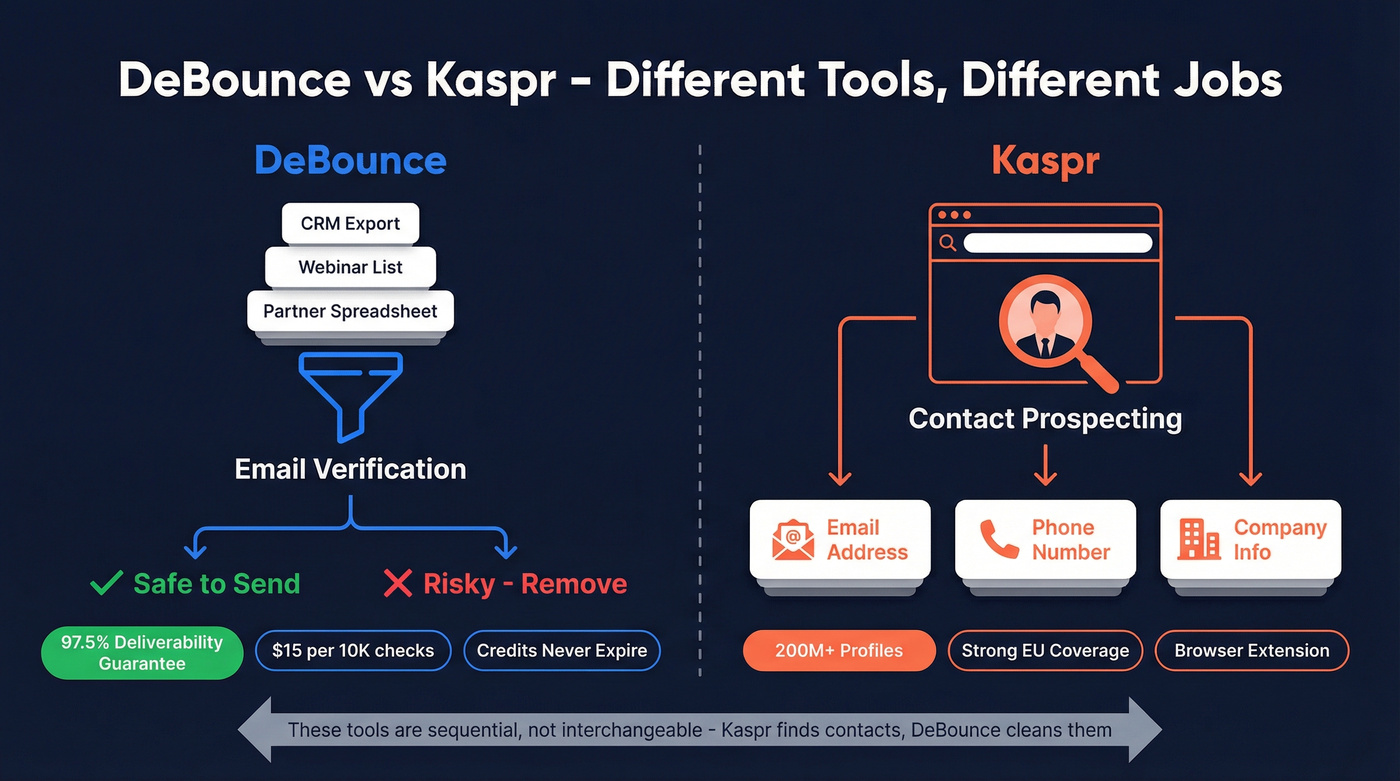
It runs validation on a credit model (the common entry point is $15 for 10,000 checks), and the credits don't expire. There's no subscription to babysit, which is a small thing until you're the person who has to explain to finance why a tool renews even when the SDR team didn't run a campaign that month. DeBounce also includes catch-all detection across plans, and it markets a 97.5% deliverability guarantee for verified emails.
DeBounce doesn't find emails. It tells you whether the emails you already have are likely to land.
Kaspr
Kaspr is a prospecting tool. You use it while you're researching people and companies, and it reveals contact data as you browse professional profiles. Kaspr positions itself as having access to 200M+ profiles, and it's widely seen as strong for EU coverage.
In our experience, Kaspr's value is speed: you can build a list while you're already doing the work of account research. The tradeoff is that you're now living in a credit system with multiple "buckets" (email, phone, exports), and accuracy becomes your problem to manage downstream.
One strong opinion: if you're sending cold email at any real volume, "90% accurate" isn't a comfort statement. It's a warning label.
Feature comparison
| Category | DeBounce | Kaspr | Winner |
|---|---|---|---|
| Primary function | Email verification | Contact prospecting | Depends on your stage |
| Pricing model | Pay-per-check, no expiry | Per-user/month + credits | DeBounce (simpler) |
| Starting price | $15 / 10K checks | €45/user/month (annual) | DeBounce (lower entry) |
| Email accuracy | 97.5% deliverability guarantee | 90% (claimed) | DeBounce |
| Database size | N/A (verification only) | 200M+ profiles | Kaspr |
| Key integrations | API, Zapier | HubSpot, Zapier, browser extension | Kaspr |
| Best for | List cleaning before campaigns | Finding new EU contacts | Tie (different jobs) |
DeBounce doesn't have a database size because it doesn't have a database. Kaspr doesn't have a deliverability guarantee because that's not what it's built to do. That's the whole "apples vs oranges" problem in one table.


Running DeBounce after Kaspr means two tools, two bills, and a stitched-together workflow. Prospeo finds contacts from 300M+ profiles and verifies them in one step - 98% email accuracy, 5-step verification, catch-all handling included. No separate cleaning day required.
One platform. Find, verify, and send - bounce rate under 4%.
Key differences that actually matter
1) Where they sit in the workflow
DeBounce sits at the end of the pipeline: you have contacts, now you clean them before you send.
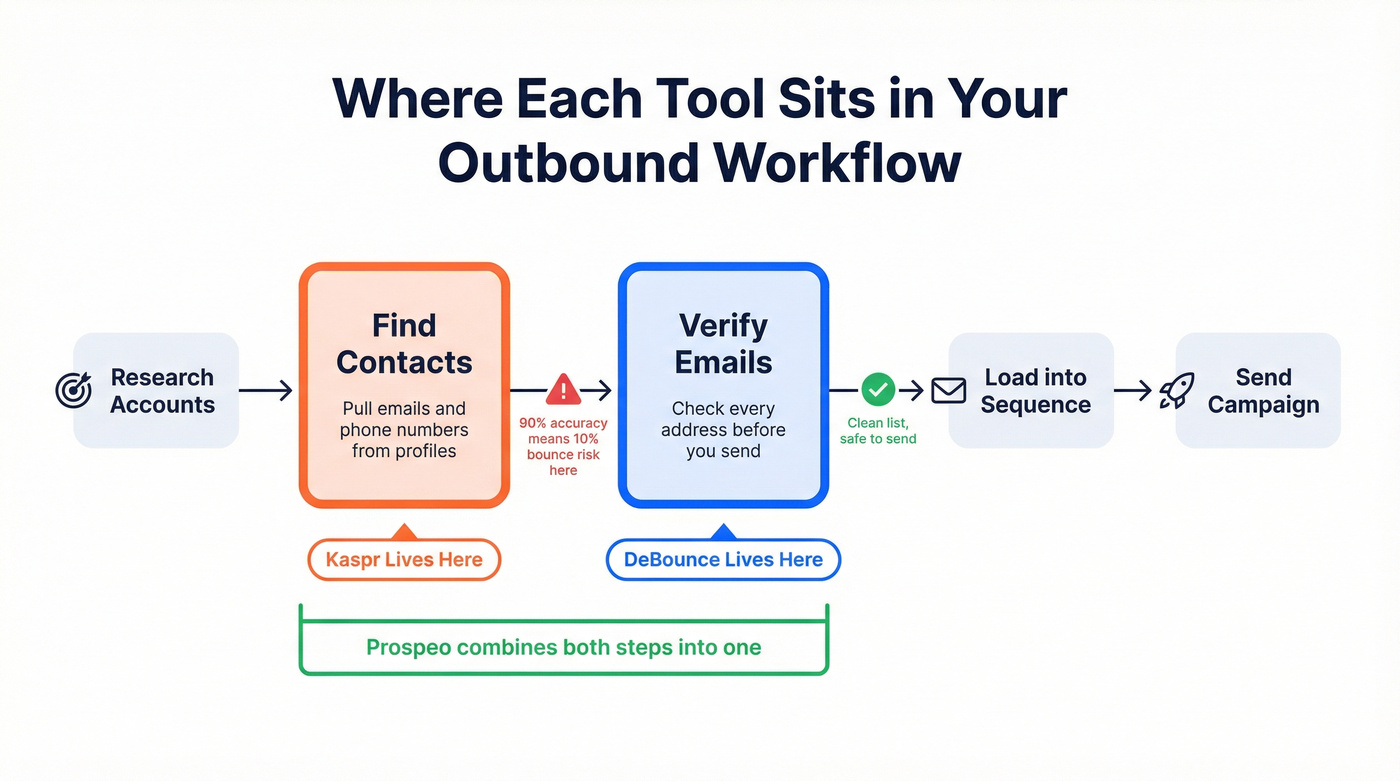
Kaspr sits at the beginning: you don't have contacts yet, so you collect them while prospecting.
They're not substitutes. They're sequential steps. And yes, that's annoying, because it often means two tools, two logins, and two different ways to run out of credits at the worst possible time.
2) Pricing predictability (and the "credit bucket" headache)
DeBounce is straightforward. You pay per check, and you can forecast cost by list size.
Kaspr is where teams get frustrated. It's not just the price; it's the way credits get consumed across different actions. We've seen teams plan for "we'll export 1,000 leads this month" and then realize halfway through that exporting, revealing direct dials, and pulling certain email types all drain different pools, so the real limit isn't leads - it's whichever bucket hits zero first.
That kind of setup creates a weird behavior: reps start rationing data instead of prospecting. That's the opposite of what you want.
3) Accuracy and deliverability risk
DeBounce's promise is simple: reduce bounces. It markets a 97.5% deliverability guarantee on verified emails.
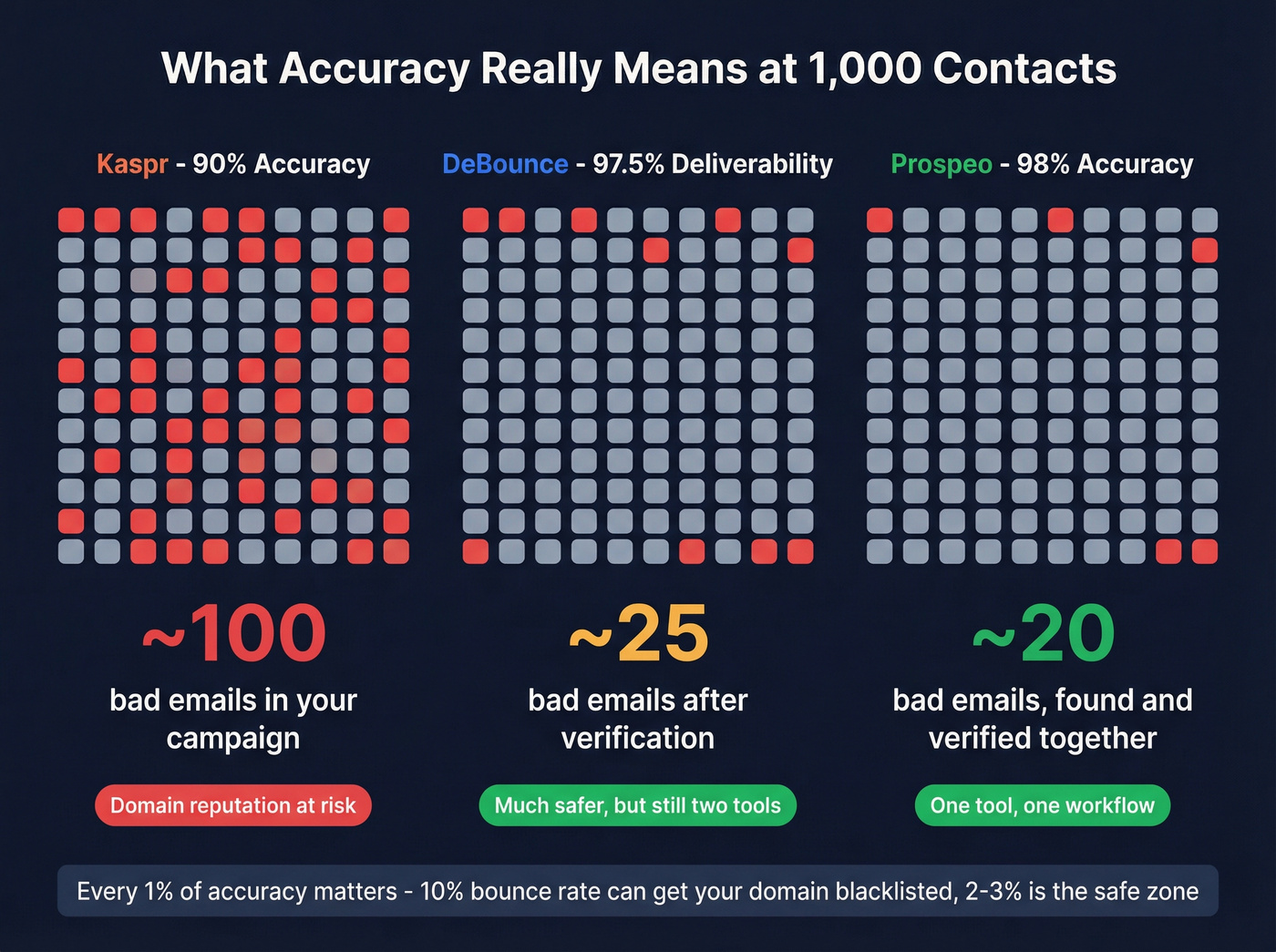
Kaspr claims 90% email accuracy. On paper, that sounds fine. In practice, it means that on a list of 1,000 contacts, you're looking at roughly 100 bad emails before you even account for catch-alls, role accounts, or addresses that went stale since the last refresh. With DeBounce-level verification, that number is closer to 25.
And once you start bouncing at scale, you don't just lose a campaign. You burn a domain.
If you want a solid primer on why this matters, Google and Microsoft both spell out how sender reputation and authentication affect inbox placement:
- https://support.google.com/a/answer/81126 (Gmail sender guidelines)
- https://learn.microsoft.com/en-us/defender-office-365/email-authentication-about (Microsoft email authentication overview)
- https://www.cloudflare.com/learning/email-security/dmarc-dkim-spf/ (clear SPF/DKIM/DMARC explainer)
One more thing: heavy use of any browser-based prospecting extension can trigger account warnings on some platforms. We won't pretend that's unique to Kaspr, but it's a real operational risk if your team lives in a browser all day and tries to run at full speed.
Do you need both?
Often, yes. The common workflow is: prospect with a tool like Kaspr, then verify with a tool like DeBounce before you send.
Let's make it concrete. An SDR pulls 500 contacts for a new sequence on Monday morning. They push it straight into their outbound tool and hit send. If 15% bounce, you're now dealing with a deliverability mess before you even learn whether the messaging works. That's a brutal way to start a week, and we've watched it happen more than once.
So you add verification. Great - now you're managing two tools and two bills, and you're still stitching the workflow together with exports.
If you're only sending tiny batches and you don't care about speed, you can skip Kaspr and just work from inbound leads or partner lists. But if you're building lists every week, verification isn't optional.
When you should skip one of them
Skip DeBounce if you rarely import lists and you're not running outbound email at scale. If you're sending a handful of one-to-one emails and most leads come from warm intros, list cleaning is busywork.
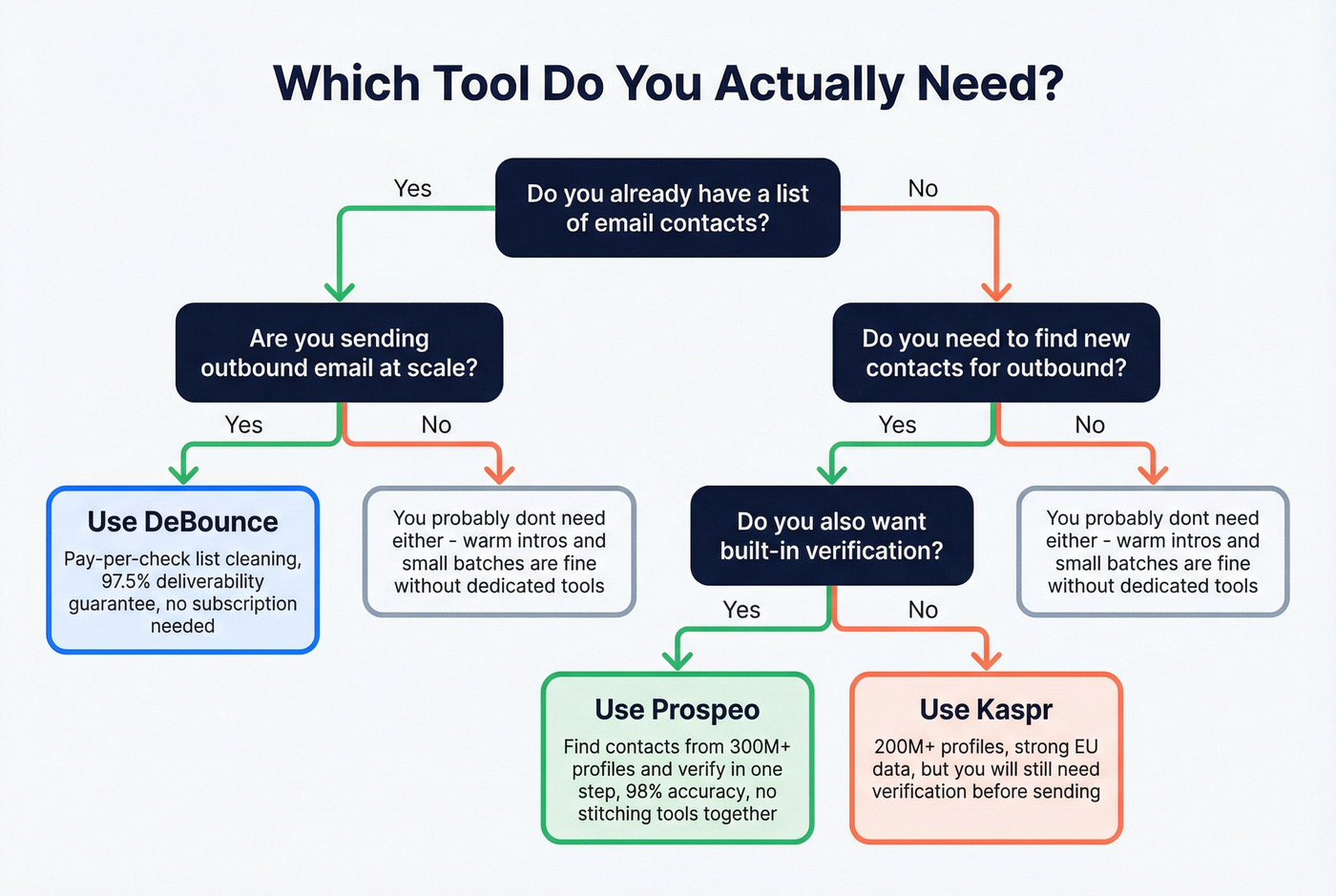
Skip Kaspr if you already have a reliable source of leads (events, inbound, a clean CRM, a strong sales data enrichment flow) and you mainly need to protect deliverability. In that case, paying per user for prospecting features you won't use is just waste.
And if you're thinking "I'll just use Kaspr and accept the bounces," don't. That's how domains get cooked.
The "one-tool" option (and why teams choose it)
A lot of teams end up wanting one place to find contacts and know they're safe to send. That's where Prospeo fits: it combines a B2B database (300M+ professional profiles) with built-in verification, so you aren't exporting a maybe-list and then cleaning it after the fact.
Prospeo includes 143M+ verified emails and 125M+ verified mobile numbers, with 98% email accuracy and a 7-day refresh cycle. That refresh cadence matters more than most people think, because stale data is what quietly wrecks outbound: the email format changes, the person leaves, the domain gets locked down, and suddenly your "good" list isn't good anymore.
We like it for one reason: it reduces moving parts. You can build a list, verify in the same flow, and push it into your stack without turning "data hygiene" into a separate project that someone resents owning.
If you want to go deeper on the mechanics, start with an email deliverability checklist and a practical guide to sender authentication.

Kaspr claims 90% accuracy. That's 100 bad emails per 1,000 contacts - enough to torch your domain. Prospeo's proprietary verification delivers 98% accuracy on 143M+ emails, refreshed every 7 days. At $0.01 per email, you stop rationing credits and start prospecting.
Skip the credit-bucket headache and get data you can actually send to.
FAQ
Can Kaspr replace DeBounce?
No. Kaspr finds contact data, but it isn't a dedicated email verification tool. If you're sending campaigns, you still need verification to keep bounce rates down.
Is DeBounce good for catch-all emails?
Yes. DeBounce includes catch-all domain detection, so you can flag those addresses and decide how aggressive you want to be with sending.
Is there a tool that does both prospecting and verification?
Yes. Prospeo combines a leads database with built-in verification at 98% email accuracy, so every email is checked before you use it.
Which is cheaper for small teams: DeBounce or Kaspr?
For list cleaning only, DeBounce is usually cheaper because it's pay-per-check and doesn't require per-user seats. For prospecting, Kaspr's cost depends on how quickly your team burns through credits and how many seats you need.