

Cold Email Research: The Step Most People Skip (And Why It Costs Them)
95.9% of cold emails go unanswered. Not because the writing is bad - because the research is lazy. A student copies a template from Reddit, swaps in a professor's name, and hits send. An SDR pulls 500 contacts, writes one generic opener, and blasts it. Both get ignored.
Email still returns $36-$40 for every $1 spent in B2B. The gap between "ignored" and "replied" is the 5-15 minutes of pre-outreach investigation people skip before writing.
What You Need (Quick Version)
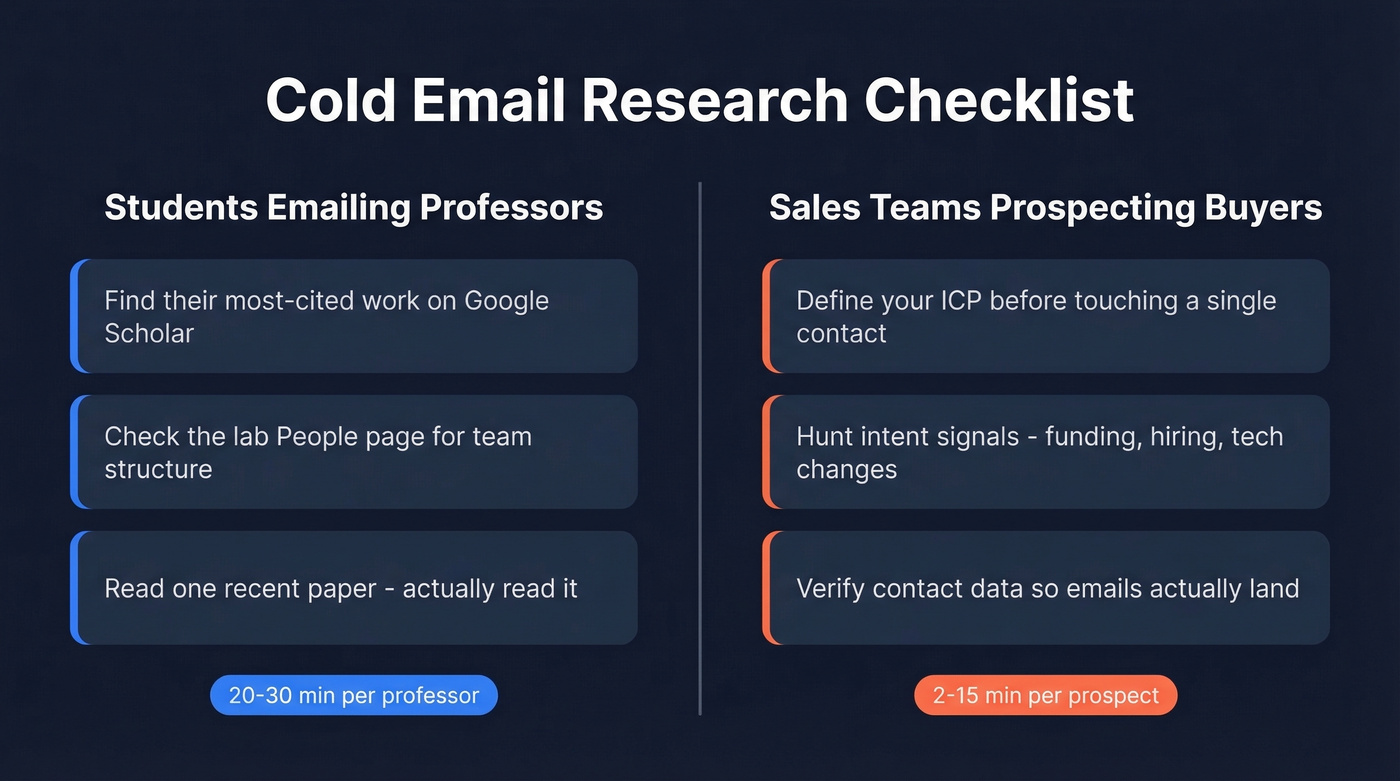
Students emailing professors:
- Google Scholar to find their most-cited work
- Their lab's "People" page for team structure
- One recent paper you've actually read
Sales teams:
- A defined ICP before you touch a single contact
- Intent signals - funding, hiring, tech-stack changes
- Verified contact data so your emails actually land
How to Research Before Emailing a Professor
Cold emailing professors isn't networking. It's a pitch - and the research determines whether it lands. Well-researched professor emails consistently outperform generic template blasts because volume is lower and the personalization bar is higher.
Step 1: Check the lab's "People" page. Understand who's in the lab, what roles exist, and whether they're actively taking students. If the PI seems unresponsive, Columbia's IRB blog recommends reaching out to a lab manager or graduate student first.
Step 2: Use Google Scholar strategically. Don't just skim the professor's page. Find their most-cited papers, read the abstract and conclusions, and think about extensions - directions that build on their existing work. This separates your email from the usual "I'm passionate about research" messages clogging their inbox. And honestly, this homework isn't just about impressing the professor. It helps you decide if the lab's work actually excites you.
Step 3: Know the compliance requirements. If the lab works with human participants, mention any IRB experience or CITI training you have. This shows you understand the ethics side, not just the science.
Step 4: Follow up in 1-2 weeks. Professors are busy. One follow-up is expected, not annoying. Princeton's guide frames this well: the email isn't about proving you're impressive. It's about showing you did the homework.

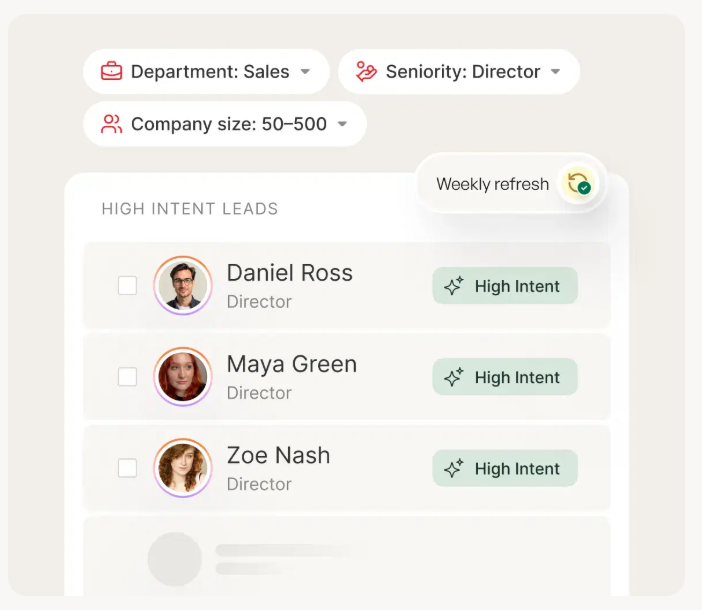
You just read how smaller, signal-rich lists hit 5.8% reply rates versus 2.1% for mass blasts. Prospeo's 30+ search filters - buyer intent, tech-stack, funding, headcount growth - let you build those precise lists from 300M+ profiles. Every email is 5-step verified at 98% accuracy, refreshed every 7 days, so your research doesn't end with a bounce.
Stop researching prospects only to land in spam. Start with verified data.
Prospect Research Workflow for Sales Teams
Most sales teams treat "research" as a checkbox. They glance at a company's homepage, note the industry, and call it personalization. That's not research - it's decoration.
Define Your ICP First
Before you build a single list, nail down four things: target job titles, company size range, industry verticals, and the specific pain points your product solves. A VP of Engineering at a 50-person startup has different problems than a CTO at a 2,000-person enterprise. Skip this step and every email you send is a guess.
Five Signals Worth Investigating
Not all prospect data is equal. Here's what consistently moves the needle:
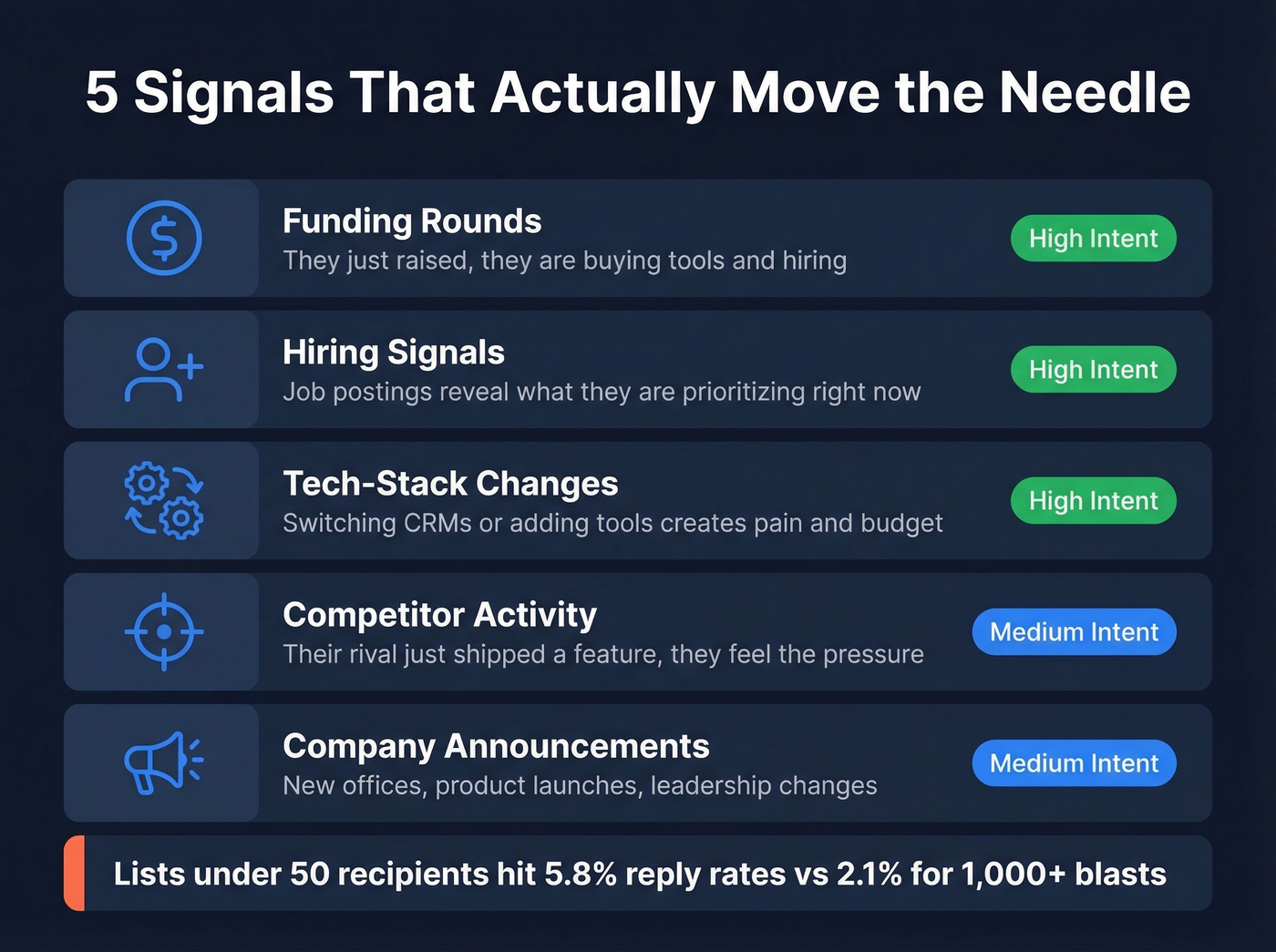
- Funding rounds - a company that just raised is hiring, buying tools, and open to conversations.
- Hiring signals - job postings reveal priorities. If they're hiring three SDRs, they're scaling outbound.
- Tech-stack changes - switching CRMs or adding a new tool creates pain and budget.
- Competitor activity - if their competitor just launched a feature, they're feeling pressure.
- Company announcements - new offices, product launches, leadership changes.
Campaigns targeting 50 or fewer recipients hit 5.8% reply rates versus 2.1% for 1,000+ recipient blasts. Smaller, signal-rich lists win.
Research Depth by Deal Size
Match research depth to deal value. Invest time proportional to the revenue at stake.
| Deal Size | Time Per Prospect | What to Cover |
|---|---|---|
| Under $5K | 2-5 min | ICP fit, verified email, one signal |
| $5K-$50K | 10-15 min | Signals, recent news, role context |
| $50K+ | 30+ min | Deep company research, multi-thread |
The 3-minute-per-email benchmark one team reported for first-line personalization is a solid floor for mid-volume outreach.
Your Prospect Research Stack
Your tools fall into three buckets.
Database + email finding: Prospeo searches 300M+ professional profiles with 98% email accuracy, a 7-day refresh cycle, and a 5-step verification process that catches spam traps before they tank your domain - all at roughly $0.01 per email. Apollo.io ($49/mo and up) bundles sequencing with its database. ZoomInfo ($15-40K/year) is the enterprise option with the broadest feature set.

Intent data: Bombora-powered intent data across 15,000 topics helps you find who's actively researching solutions. 6sense and Demandbase offer deeper ABM-style intent at enterprise price points ($30-100K+/year).
CRM: HubSpot (free CRM tier available) or Salesforce to track outreach and avoid duplicate contacts, with native integrations to sequencing tools like Smartlead, Instantly, and Lemlist. If you're evaluating systems, start with a few examples of a CRM to match your workflow.
What Happens When You Do the Research
One B2B team documented their turnaround on Reddit: reply rates had decayed from 8% to 3% over 18 months. After 62 days of rebuilding - tighter lists, deeper personalization, shorter emails - they hit 6%. Their bounce rate dropped from 11% to under 2% after switching to manually verified contacts. (If you're troubleshooting bounces, use these email bounce rate benchmarks and fixes.)
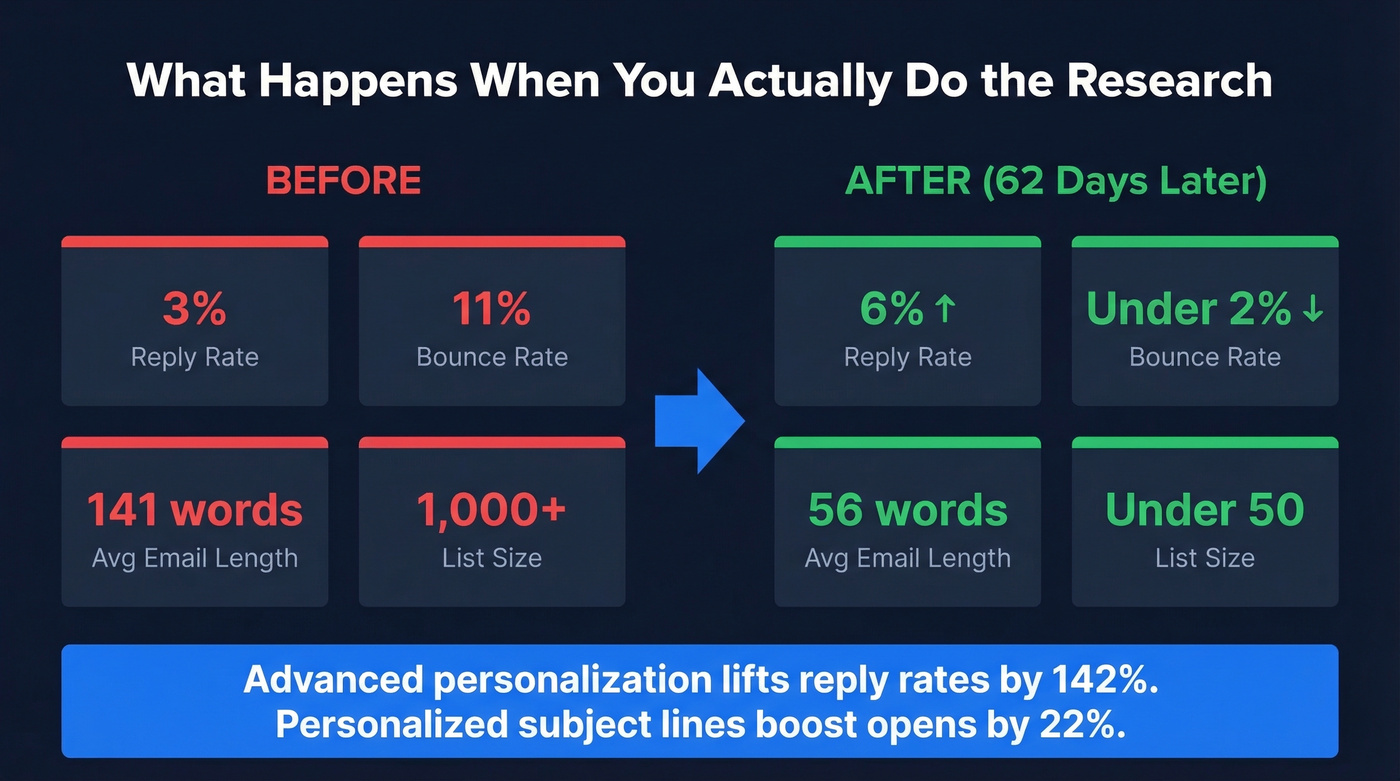
The numbers back this up. Advanced personalization lifts reply rates by 142%. Personalized subject lines boost opens by 22% (use these cold email subject line examples to test faster).
Here's the thing that surprised us when we tested this internally: emails under 150 words performed dramatically better. That same Reddit team cut their average email from 141 words to under 56. Pre-outreach research forces brevity - when you know exactly what matters to someone, you don't need three paragraphs to say it.
Mistakes That Kill Outreach Campaigns
Not defining ICP before building lists. You end up with 1,000 contacts and no coherent message for any of them. If you need a repeatable system, borrow these sales prospecting techniques.
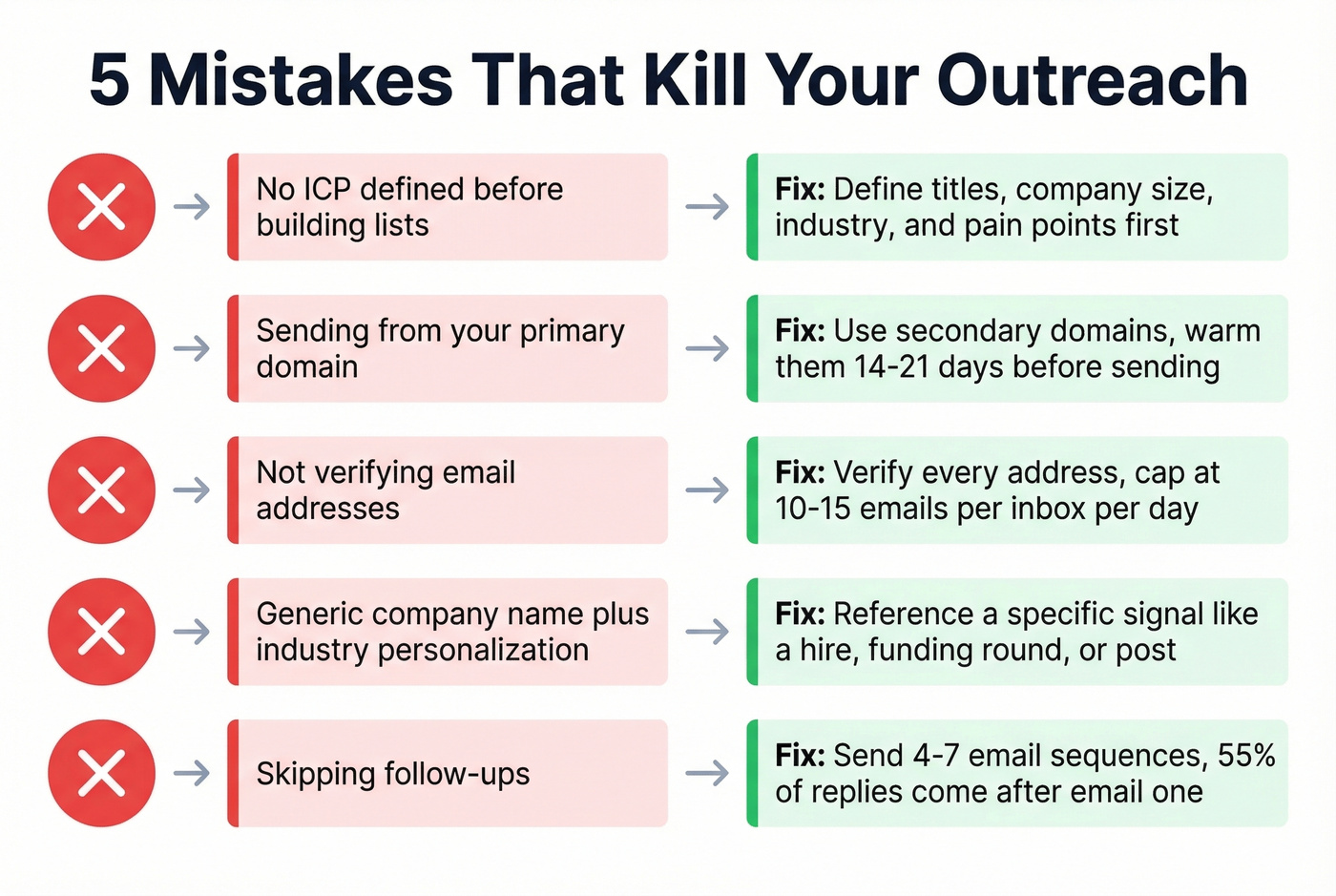
Sending from your primary domain. One spam complaint and your company's real email deliverability is toast. Use secondary domains with proper SPF, DKIM, and DMARC - and warm them for 14-21 days before sending. If you want the full checklist, start with this email deliverability guide.
Not verifying email addresses. An 11% bounce rate doesn't just waste sends - it actively damages your sender reputation. Use 2-3 inboxes per domain and cap volume at 10-15 emails per inbox per day. (More on safe sending limits in email velocity.)
Generic "company name + industry" personalization. Mentioning that someone works at Acme in SaaS isn't personalization. Reference a specific signal - a hire, a funding round, a post they wrote. If you need a framework, use this personalized outreach playbook.
Skipping follow-ups. 55% of replies come after the first email. Sequences of 4-7 emails get 3x more replies than 1-3. Not following up is leaving half your replies on the table. Use these cold email follow-up templates to keep it tight.
Let's be honest: if your average deal is under $8K, you probably don't need a $30K intent data platform. A verified email list, one strong signal per prospect, and a tight 5-email sequence will outperform an enterprise tech stack with sloppy targeting every time. Skip the fancy tools until your fundamentals are airtight.
That Reddit team cut their bounce rate from 11% to under 2% by switching to manually verified contacts. Prospeo does that verification automatically - spam-trap removal, catch-all handling, honeypot filtering - across 143M+ emails at roughly $0.01 each. Pair it with Bombora-powered intent data across 15,000 topics to know who's actually in-market before you write a single line.
Do the research that matters. Let Prospeo handle the data that backs it up.
FAQ
How long should I spend researching each prospect?
For high-volume B2B outreach with deals under $5K, 2-5 minutes per prospect is the sweet spot - enough for one personalized signal without killing throughput. Enterprise deals warrant 15-30 minutes per contact. Students should spend 20-30 minutes reading at least one paper per professor before writing.
What's a good cold email reply rate?
At scale, 2-4% is solid. Teams with tight ICP targeting and deep personalization consistently hit 5-6%. Top performers running small, highly researched lists reach 15-25%, though those numbers don't hold at high volume. Send Tuesday through Thursday between 8-11am for a roughly 16% boost in opens.
What tools do I need for prospect research?
At minimum: a B2B database with verified emails, a CRM to track outreach, and a sending tool with warmup capabilities. Add intent data if you're selling mid-market or enterprise - it tells you who's actively looking. The right stack turns pre-send research from a time sink into a repeatable system.