

Cold Emails That Convert in 2026: What the Data Actually Says
You sent 500 cold emails last month. Three replies. Zero meetings. Before you rewrite your subject lines for the fifth time, stop - it's not your copy. It's deliverability and data hygiene. The average cold email reply rate is 3.43% across billions of emails analyzed. Your messages might not even be reaching the inbox.
What Separates Emails That Work
Three things separate cold emails that convert from messages that get ignored:
- Deliverability comes first. SPF, DKIM, DMARC, domain warmup, verified contacts. This is the biggest lever - and the one most guides skip entirely.
- Short emails with strong offers. 40-75 words. A soft CTA. Not a calendar link. Not a pitch deck.
- Persistent, multi-touch sequences. 4-7 touchpoints across email and social, spaced 3-4 days apart.
Skip subject line hacks until your bounce rate is under 2% and your emails actually land in primary inboxes.
2026 Benchmarks - What Good Looks Like
Instantly's benchmark report analyzed billions of cold email interactions across thousands of workspaces. Here's where the tiers fall:
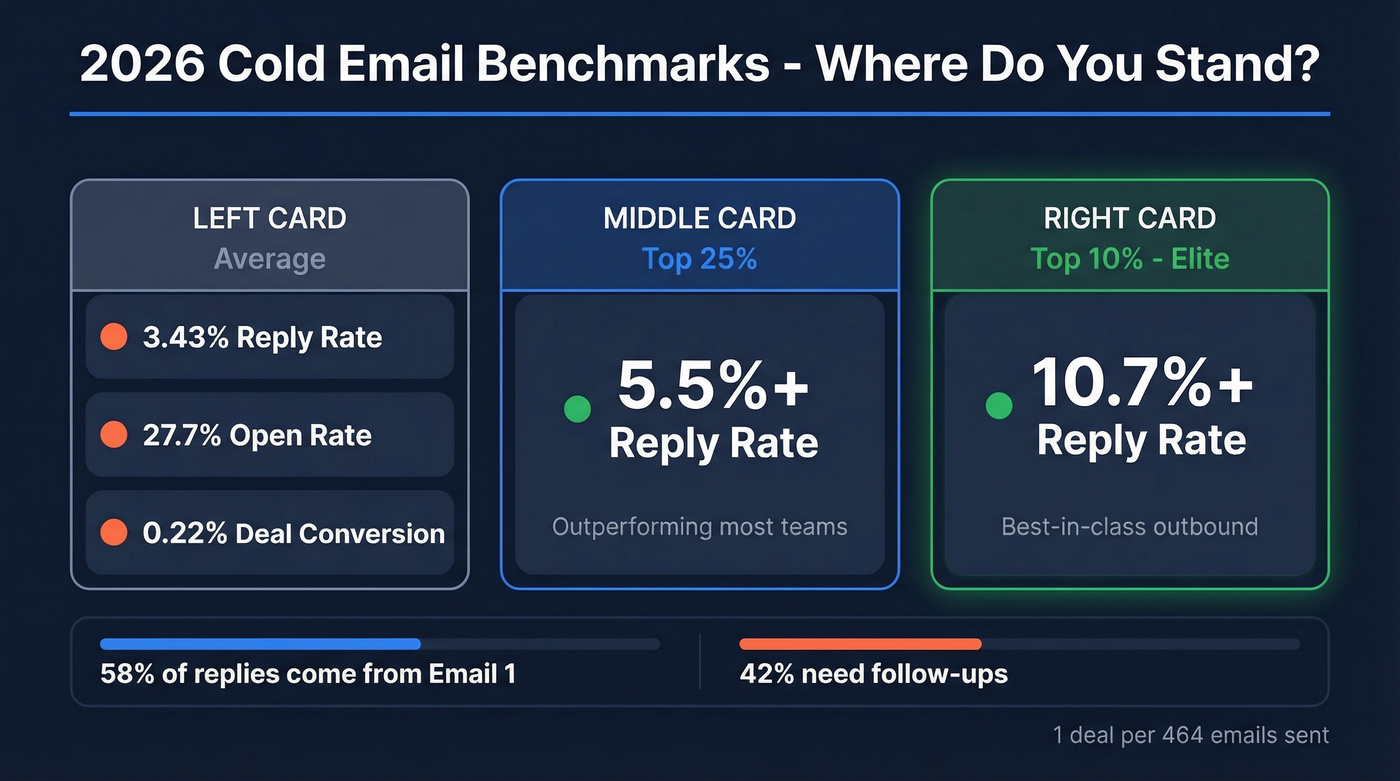
| Metric | Average | Top 25% | Top 10% |
|---|---|---|---|
| Reply rate | 3.43% | 5.5%+ | 10.7%+ |
| Open rate (B2B) | 27.7% | - | - |
| Deal conversion | ~0.22% | - | - |
That deal conversion figure comes from WarmForge's analysis. Even directionally, it's sobering: roughly 1 deal per 464 emails sent.
Here's the critical sequencing insight: 58% of all replies come from the first email in a sequence. The remaining 42% need follow-ups. If you're only sending one email and moving on, you're abandoning almost half your potential replies.
Above 5% reply rate? You're outperforming most teams. Above 10%, you're elite.
Deliverability - The Real Foundation
Here's the thing: personalization is the most overrated lever in cold email right now. Your offer matters ten times more than your opening line. But neither matters if Gmail is quietly routing your messages to spam. Fix deliverability before you touch anything else. If you need a deeper checklist, start with an email deliverability audit.
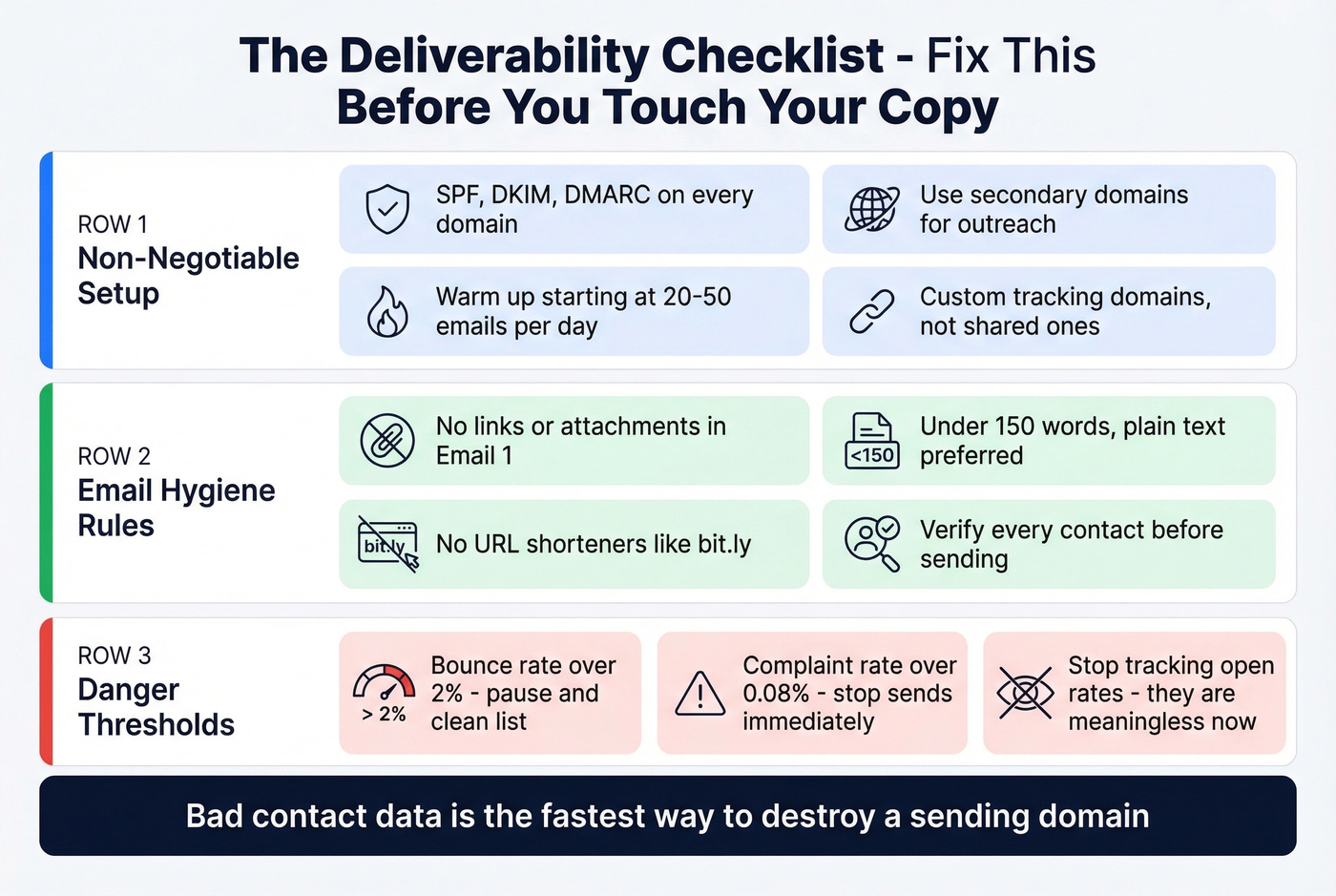
The non-negotiable checklist - we run through this weekly, not once at setup and then forget about it:
- SPF, DKIM, DMARC - authenticate every sending domain. No exceptions.
- Use secondary domains for cold outreach. Protect your primary domain reputation at all costs.
- Warm up new domains starting at 20-50 emails per day, increasing 20-30% weekly. Don't rush this. (If you're shopping tools, see unlimited email warmup.)
- Custom tracking domains - shared tracking pixels get blacklisted constantly. (More on tracking domains here.)
- No links or attachments in email 1. Earn the reply first, send materials second.
- Avoid URL shorteners entirely. Bit.ly and similar services are heavily flagged by spam filters.
- Keep emails under 150 words. Shorter emails get more replies and are safer for deliverability.
- Minimize HTML formatting. Plain text is safer than heavy HTML.
- Bounce rate under 2%. Complaint rate under 0.1%. When we see complaints creep toward 0.08%, we pause sends immediately and clean the list before resuming. (Benchmarks + fixes: email bounce rate.)
- Stop obsessing over open rates. Privacy changes and preloading inflate opens to the point of meaninglessness. Track replies and bounces instead.
Bad contact data is the fastest way to destroy a sending domain. Every bounced email chips away at your sender reputation. In our experience, if bounces climb past 3%, we pause everything and clean lists before sending another message.

Verify your list before every send. Prospeo's email verification uses proprietary infrastructure - not third-party providers - with a 5-step process that catches invalid addresses, spam traps, honeypots, and catch-all domains. With 98% email accuracy and a 7-day data refresh cycle, you aren't sending to stale data that was valid three months ago. Stack Optimize built to $1M ARR using Prospeo-verified lists - 94%+ deliverability, bounce under 3%, zero domain flags across all clients. If you're comparing vendors, start with these data enrichment services.

Every bounced email tanks your sender reputation and kills future campaigns. Prospeo's 5-step verification catches spam traps, honeypots, and catch-all domains before you hit send - 98% email accuracy, refreshed every 7 days, at ~$0.01 per email.
Fix your bounce rate before you rewrite another subject line.
Stack Optimize built a $1M agency on Prospeo data - 94%+ deliverability, under 3% bounce, zero domain flags. When your sequences run 4-7 touches deep, every contact needs to be real. Prospeo's proprietary infrastructure verifies 143M+ emails without relying on third-party providers.
Send 500 cold emails and actually reach 500 inboxes.
Subject Lines That Earn the Open
A Belkins study of 5.5 million emails (Jan-Dec 2024 dataset) produced sharp findings.
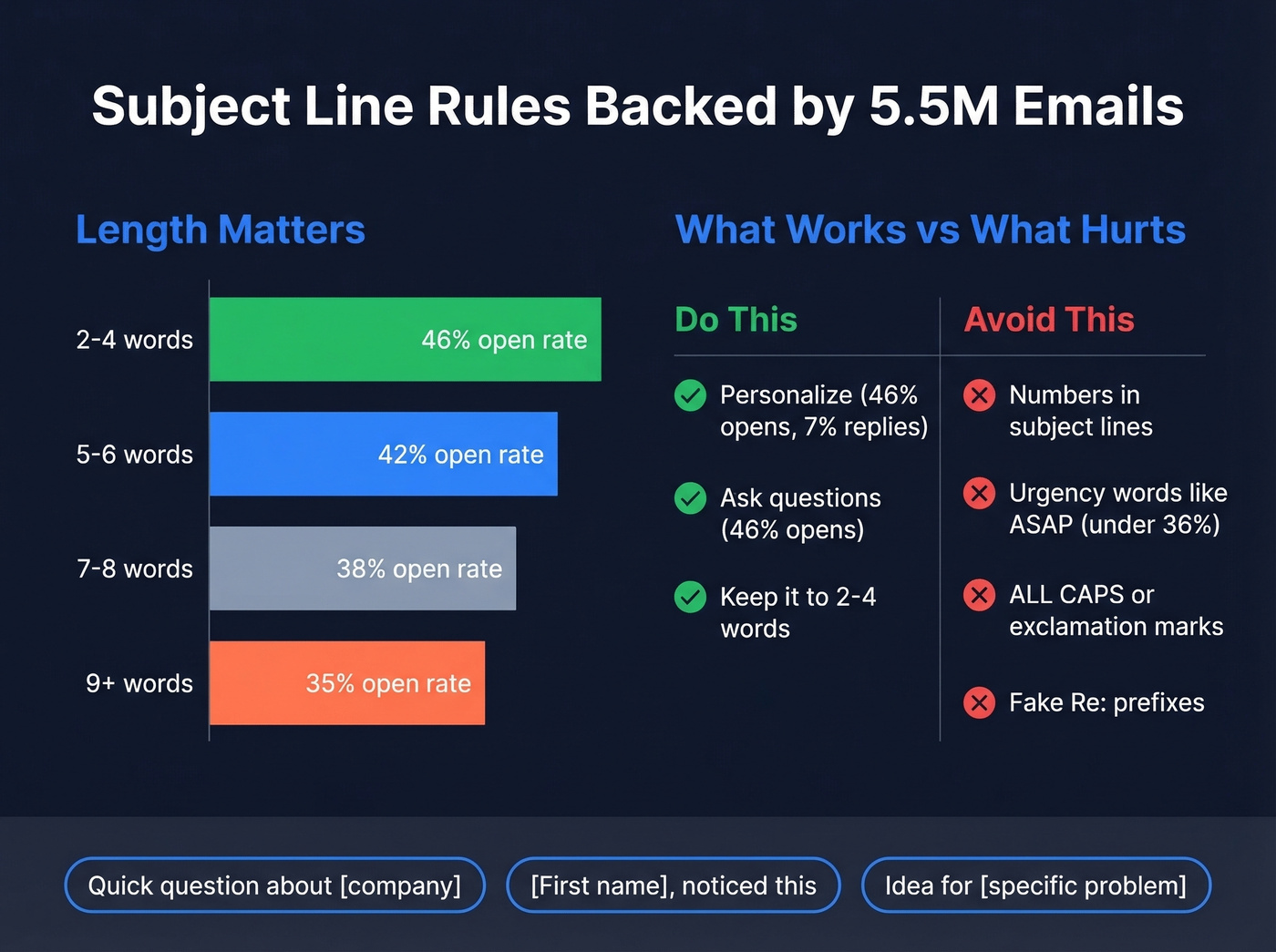
Opens are noisy - privacy features and preloading inflate them. But subject lines still matter because they determine whether your email gets read or filtered. Use these rules to avoid spam signals and earn the read, then measure replies. For more tested options, pull from these cold email subject line examples.
Keep it short. 2-4 word subject lines hit a 46% open rate - the highest of any length bracket. By 9 words, you're down to 35%.
Personalize. Personalized subject lines reached 46% opens versus 35% without, and reply rates jumped from 3% to 7%. That's a 133% increase.
Ask questions. Questions outperform statements at 46% open rate. Numbers in subject lines hurt slightly. Urgency language like "ASAP" pushes opens below 36% - it screams spam.
Three subject lines that follow the data:
- "Quick question about [company]" - short, personalized, question format
- "[First name], noticed this" - personalized, curiosity-driven, 3 words
- "Idea for [specific problem]" - value-forward, concise
Skip anything with ALL CAPS, exclamation marks, numbers, or fake "Re:" prefixes. These don't just hurt opens - they trigger spam filters.
Templates That Drive Replies
In threads on r/copywriting and r/SaaS, the pattern is consistent: ultra-short, value-first outreach wins. Under 75 words. A strong offer. A soft CTA. No links in email 1. If you want more structure, see these emails that get responses.
We've tested 40-60 word emails against 120-word versions across multiple campaigns. The short versions often pull 2-3x the reply rate. Brevity isn't a style preference - it's a performance lever.
Template 1: The Value-First
Saw [company] is scaling [specific function]. We helped [similar company] cut [specific metric] by [percentage] in [timeframe].
Put together a quick breakdown of how it'd work for your team. Worth a look?
Specific proof, clear value, soft CTA. No links, no attachments, no calendar invite. 44 words.
Template 2: The AI-Personalized
Your recent post on rethinking SDR comp structures was sharp - especially the point about activity-based quotas killing pipeline quality.
We built a pipeline analytics tool that shows exactly which rep behaviors drive closed revenue. Acme Corp cut their sales cycle 22% in 60 days.
Worth a 5-min teardown for [company]?
That first paragraph is the {{custom_message}} variable - generated by scraping a prospect's recent post or company news and running it through GPT-4o mini. One team on r/SaaS shared a roughly 3x response lift using this workflow. The key: AI handles research and first-line generation, but you write the core pitch yourself. The moment your email reads like every other AI-generated outreach, you've lost. If you're building this into your process, use an AI cold email outreach workflow that keeps humans in the loop.
Template 3: The Wrong-Person Redirect
Not sure if you're the right person for this - who on your team owns [function/decision]?
We help [type of company] solve [specific problem]. Happy to send a quick overview to whoever handles it.
Low-pressure, high-response. People love redirecting. You get the right contact and an internal referral in one move.
Template 4: The Busy-Exec Permission Ask
I know your inbox is a warzone. One question:
Would it be worth 5 minutes to see how [similar company] [achieved specific result]? If not, no worries - just say "pass."
Respects their time. The "pass" CTA feels safe and actually increases replies because it lowers commitment.
Template 5: The Review-Site Pain Hook
Noticed [company] has been getting feedback on [specific issue from G2/Trustpilot]. That's a problem we've solved for [2-3 similar companies].
Want me to send over how they fixed it?
Shows you did real research. Ties to a pain they already know about. Keep it respectful - cite public reviews, don't be creepy.
A/B Test Weekly
The best outbound teams don't guess. Here's the simple framework: run two variants of one element - subject line, offer, CTA, or first line - across around 200 sends each. After a week, kill the loser and promote the winner. Then test the next element. Rotate through subject, offer, CTA, and first line on a monthly cycle. Small, consistent improvements compound fast: a 1% relative reply-rate lift per month adds up to roughly 13% over a year. That iterative approach is how you build cold emails that convert over time rather than hoping a single template does all the work.
Follow-Up Sequencing
Let's be honest - most teams send two emails, get silence, and assume the prospect isn't interested. This is the single biggest mistake in outbound. In one 500-email campaign, a practitioner on r/SaaS saw roughly 80% of replies arrive after the third touchpoint in a multichannel sequence. That's anecdotal, but it aligns with the broader data: 42% of all replies require follow-ups beyond email one. If you need plug-and-play copy, use these cold email follow-up templates.
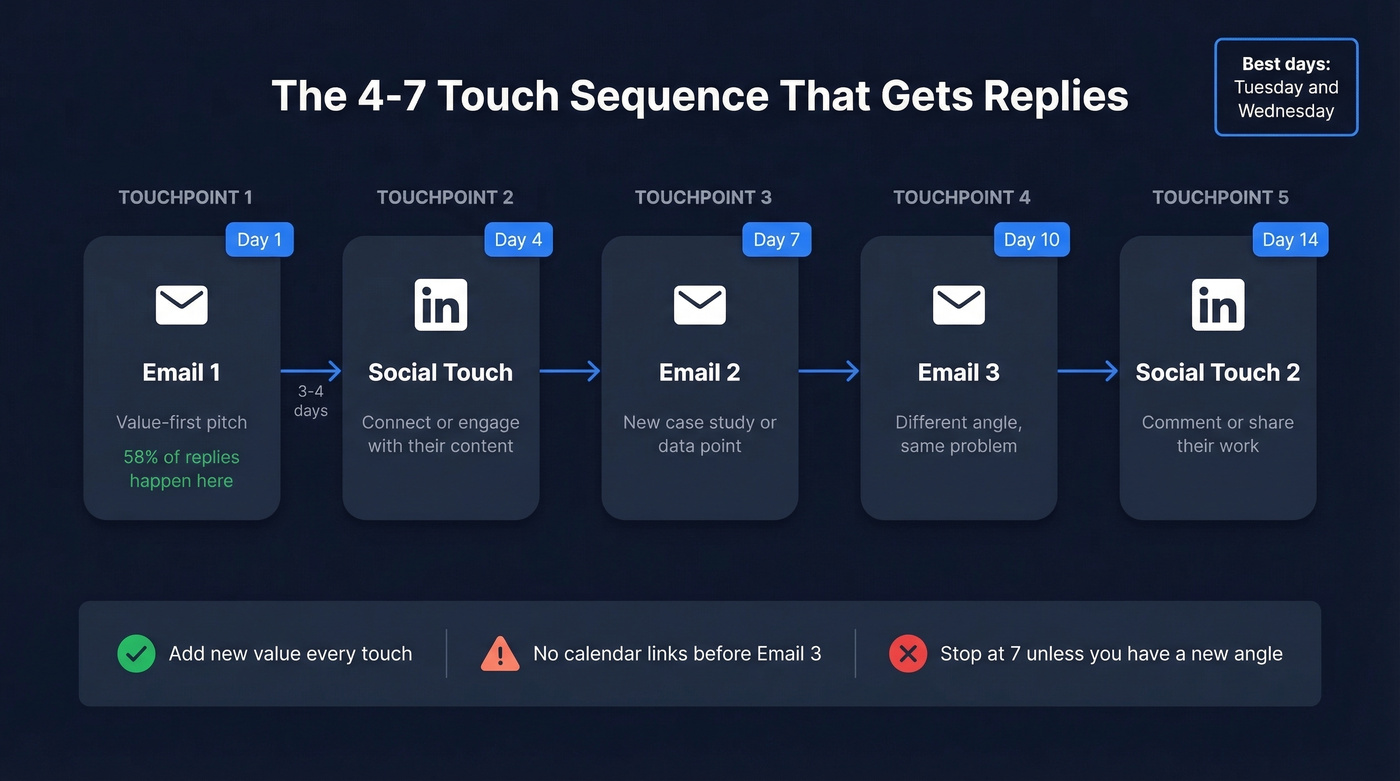
The sweet spot is 4-7 touchpoints. Stop sequences at 7 unless you have a genuinely new asset or angle to share - beyond that, you're spamming.
Email → Social touch → Email → Email → Social touch
Space touchpoints 3-4 days apart. Tuesday and Wednesday consistently produce the highest reply rates, with Wednesday edging ahead. (More data: best time to send cold emails.)
Each follow-up needs to add something new. A case study. A relevant data point. A different angle on the same problem. "Just bumping this to the top of your inbox" is dead - if your seventh email says the same thing as your first, you're not following up, you're harassing.
Three hard rules:
- Skip calendar links until email 3 at the earliest. Earn the conversation first.
- Get your bounce rate under 2% before you scale personalization. Data hygiene before fancy first lines.
- Add a new value element in every touch. No new value = no new email.
Compliance - Don't Get Fined
Cold email is legal in the US under CAN-SPAM when done correctly. In the EU/UK, outreach needs to align with GDPR and the ePrivacy rules around electronic marketing. Enforcement is real, and the fastest way to attract complaints is high-volume blasts without opt-out.
CAN-SPAM (US - applies to B2B):
- Accurate sender info (From, Reply-To, routing)
- Non-deceptive subject lines - no fake "Re:" tricks
- Clear disclosure that the message is commercial where required
- Valid physical postal address
- Clear opt-out mechanism in every email
- Honor opt-outs within 10 business days - opt-out mechanism must remain functional for at least 30 days after sending
- Penalty: up to $53,088 per violating email
GDPR + ePrivacy (EU/UK):
- Legitimate interest can apply for relevant B2B outreach
- Identify yourself and explain how you got their info
- Provide a clear opt-out
- Data minimization - don't collect more than you need
The practical takeaway: a well-targeted cold email with an unsubscribe link to a verified list is fine. Sending 10,000 emails to an unverified purchased list with no opt-out is how you end up on the wrong side of an FTC complaint - or worse, permanently blacklisted by every major email provider.
FAQ
What's a good cold email reply rate in 2026?
The average across billions of emails analyzed is 3.43%. Top 25% of senders hit 5.5%+, and elite senders exceed 10.7%. If you're consistently above 5%, you're outperforming most outbound teams. Focus on deliverability and offer quality first - those two levers move the needle more than subject lines or personalization.
How many follow-ups should I send?
Four to seven touchpoints is the sweet spot. 58% of replies come from the first email, but the remaining 42% need follow-ups beyond that. Past seven touches, returns diminish sharply unless each one adds genuinely new value or uses a different channel.
How do I stop cold emails from landing in spam?
Set up SPF, DKIM, and DMARC authentication on every sending domain. Warm up new domains at 20-50 emails per day. Skip links and attachments in your first email. Keep emails under 150 words. And verify your list before every send - catching invalid addresses, spam traps, and honeypots before they damage your sender reputation is non-negotiable.
Is cold email still legal in 2026?
Yes. Cold email is legal in the US under CAN-SPAM when done correctly - accurate sender info, a physical address, a clear opt-out, and non-deceptive subject lines. In the EU/UK, outreach must align with GDPR and ePrivacy rules, though legitimate interest can apply for relevant B2B outreach.
What's the best day to send outreach?
Tuesday and Wednesday consistently produce the highest reply rates across large datasets, with Wednesday holding a slight edge. Avoid Mondays (inbox overload) and Fridays (mental checkout). Send during business hours in the prospect's timezone - morning sends tend to perform best for B2B audiences.