

Definition of Prospecting: The Benchmarks and Process You Actually Need in 2026
There's a thread on r/sales where a rep describes being great at closing but completely lost when it comes to filling their own pipeline. They'd been fed inbound leads for years, and the moment they moved to a full-cycle role, prospecting felt like learning a different sport entirely. That disorientation is more common than anyone admits.
The Short Answer
The definition: Prospecting is the sales-owned process of identifying, researching, and initiating contact with potential buyers who match your ideal customer profile.
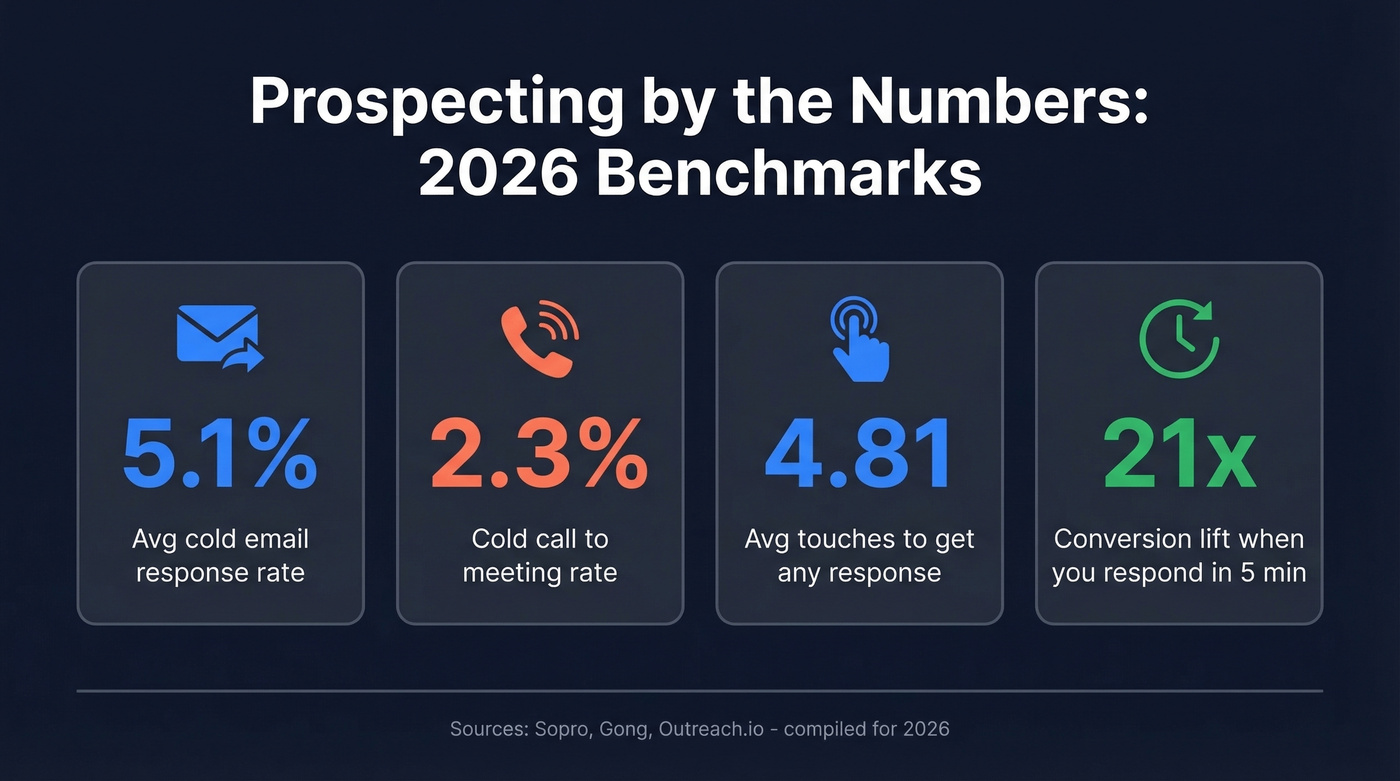
The key numbers: Cold email response rates average 5.1%. Cold calls convert to booked meetings at 2.3%. It takes an average of 4.81 touches to get any response, regardless of lead temperature.
The distinctions: Prospecting is sales-owned outbound to named accounts. Lead generation is marketing-owned inbound at scale. Outreach is the act of initiating contact - it's a step within prospecting, not a synonym for it.
What Does Prospecting Actually Mean?
The word comes from mining. Britannica defines it as the search for economically exploitable mineral deposits (first recorded 1845-50) - geologists scanning terrain for signs of ore beneath the surface. The sales meaning borrows the metaphor directly: you're scanning a market for valuable opportunities hidden in a sea of companies and contacts.
Here's the modern sales definition in one sentence: Prospecting is the systematic process of identifying potential buyers who fit your ideal customer profile, researching them, and initiating contact to generate qualified pipeline.
What does it mean to be prospecting? It means you're actively working to fill your own pipeline rather than waiting for leads to arrive. It sits in the middle of the funnel. Marketing fills the top with awareness and inbound leads. Sales takes over from there - qualifying named accounts, reaching out directly, and booking meetings that actually convert.
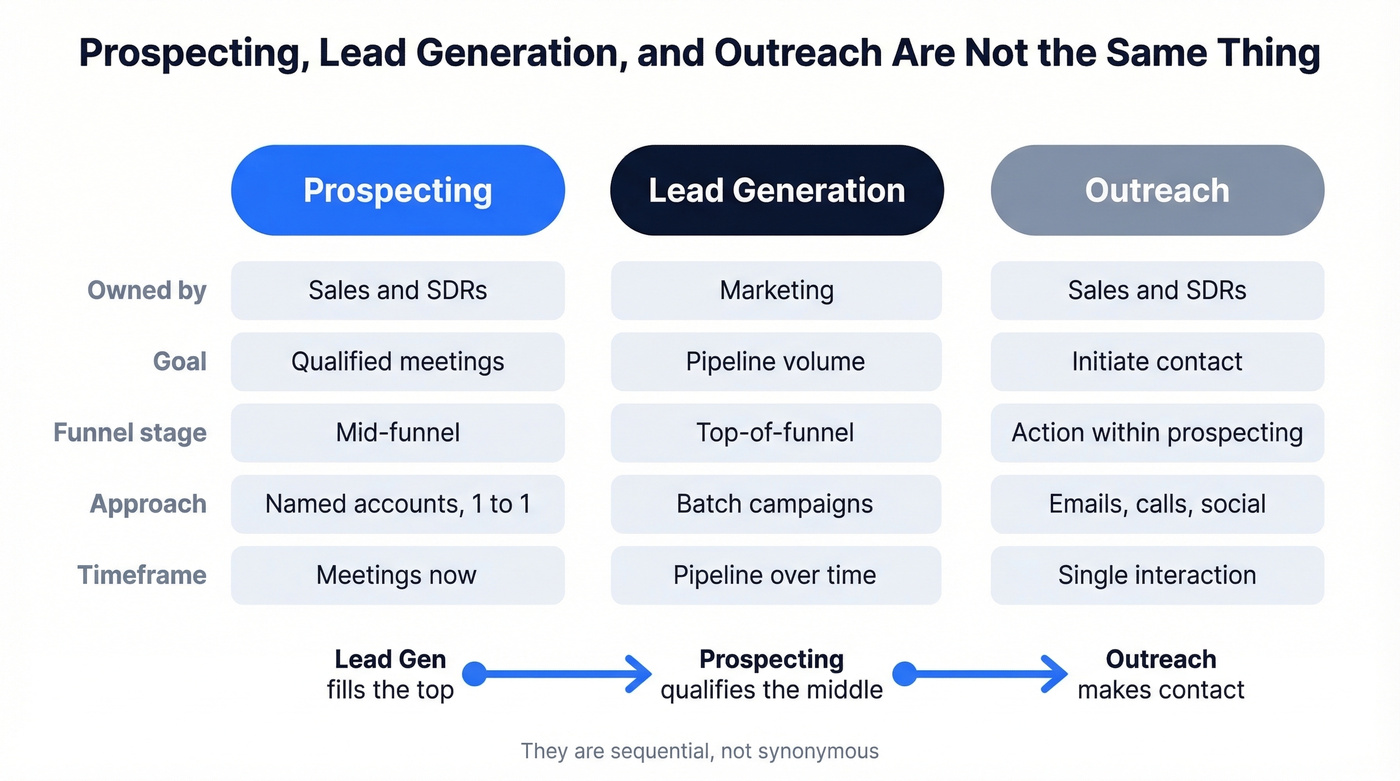
The confusion usually starts when people use "prospecting," "lead generation," and "outreach" interchangeably. They aren't the same thing.
| Prospecting | Lead Generation | Outreach | |
|---|---|---|---|
| Owned by | Sales / SDRs | Marketing | Sales / SDRs |
| Goal | Qualified meetings | Pipeline volume | Initiate contact |
| Funnel stage | Mid-funnel | Top-of-funnel | Action within prospecting |
| Approach | Named accounts, 1:1 | Batch campaigns | Emails, calls, social |
| Timeframe | Meetings now | Pipeline over time | Single interaction |
Prospecting builds the list and qualifies it. Outreach is how you make contact. Lead generation is the broader marketing engine that feeds awareness. They're sequential, not synonymous.
Why Prospecting Feels Hard
42% of salespeople say prospecting is the hardest part. Not negotiating. Not handling objections. Finding people to talk to.
The reason it feels brutal is identity. Reps who thrive in discovery calls and negotiations often struggle with the repetitive, uncertain grind of filling their own pipeline. The feedback loop is slow, and the emotional math is punishing - you send fifty emails to get two replies and maybe one meeting. One Reddit thread captured it well: a rep described it as a grind where "you never know if they're even a good lead," even though their best clients came from exactly that grind.
Here's the thing: 80% of sales happen between the 5th and 12th contact. Most reps quit before the math even starts working. In our experience, teams that prospect consistently outperform those with 2x the inbound volume - because they control their pipeline instead of waiting for it.
2026 Prospecting Benchmarks
Let's ground this in real data.
| Metric | Benchmark | Source |
|---|---|---|
| Cold email response rate | 5.1% avg | Sopro (151M outreach points) |
| Cold call to meeting | 2.3% | Greetnow (citing Gong) |
| Touches to response | 4.81 avg | Outreach (500 professionals) |
| Calls to voicemail | 72% | Greetnow |
| Best connect window | Wed 10-11am | Greetnow |
| Cold emails flagged spam | ~20% | Sopro |
| Speed-to-lead (5 min) | 21x conversion lift | Industry benchmark |
That 4.81 touches is the average - and that's just to get a response, not a meeting. Meanwhile, 72% of your calls go to voicemail regardless of timing. One in five cold emails never reaches the inbox.
Personalization can double cold email response rates from that 5.1% baseline. But personalization on top of bad data is wasted effort - you're crafting custom messages to addresses that bounce.

You just read that 20% of cold emails get flagged as spam and personalization doubles response rates. Both stats become irrelevant if your contact data is wrong. Prospeo's 5-step verification delivers 98% email accuracy - so every prospecting touch you craft actually reaches a real inbox.
Stop prospecting into the void. Start with data that connects.
Types of Prospecting
Inbound Prospecting
Best when your marketing team generates consistent MQLs, your product has strong organic demand, and your AE team has bandwidth to qualify warm leads. Inbound-sourced leads convert to booked meetings at a 62% median rate - dramatically higher than cold outbound. The catch: you don't control the volume, and it can dry up without warning.
Outbound Prospecting
Best when you're targeting specific accounts, entering new markets, or your inbound engine isn't mature yet. Outbound converts 2-5% from initial contact to meeting, which sounds low until you realize you control the volume completely. 80% of prospects prefer email as the initial channel, but 57% of C-suite buyers actually prefer phone.
Why Hybrid Wins
43% of organizations now run a hybrid model blending inbound and outbound. For most teams, this is the right call. Use inbound to capture demand that already exists. Use outbound to create demand where it doesn't. Meanwhile, 61% of B2B buyers say they prefer a rep-free experience - which means your outbound needs to be relevant enough to justify the interruption.
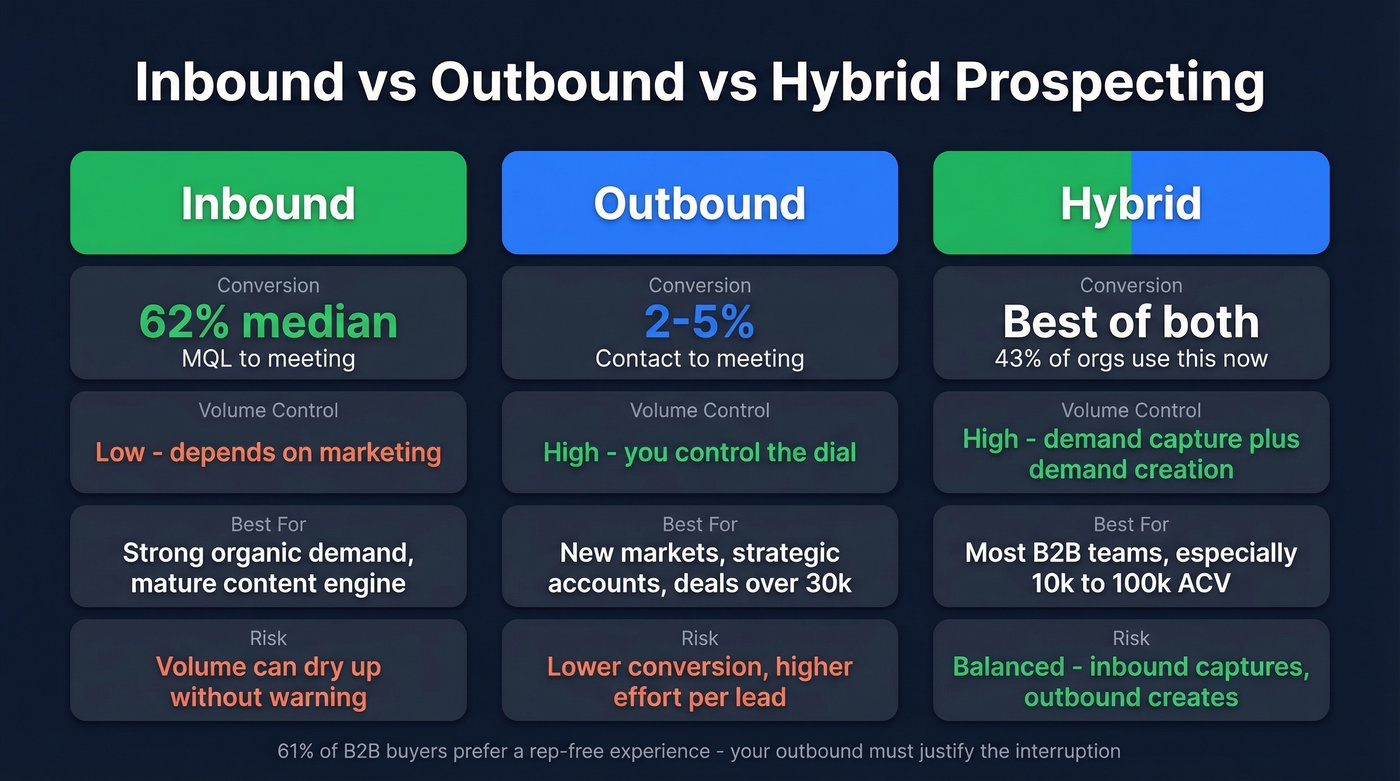
If your average deal size is under $10k, you probably don't need a massive outbound operation. Focus on inbound and use targeted outbound only for strategic accounts. But if you're closing $30k+ deals, outbound isn't optional - it's where your best pipeline will come from.
The Prospecting Process: 6 Steps
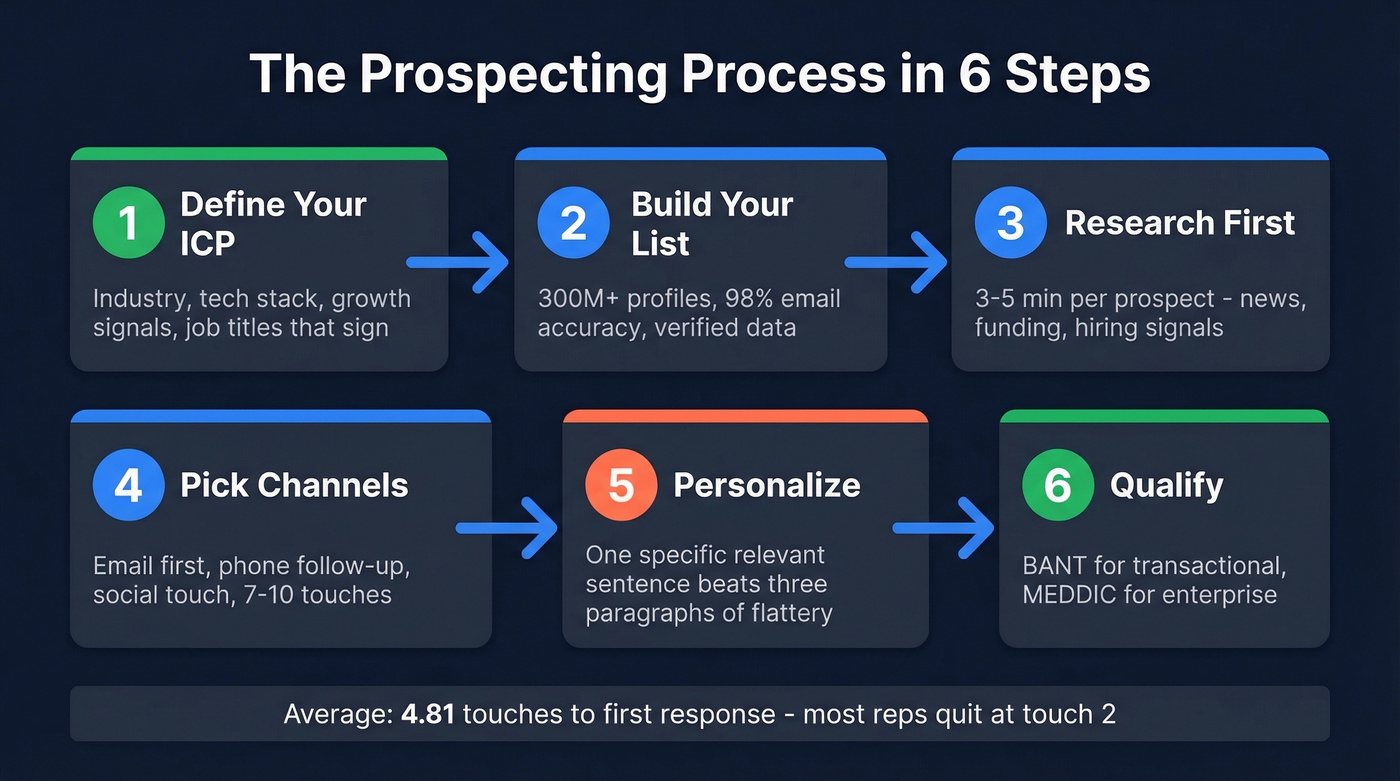
1. Define Your ICP
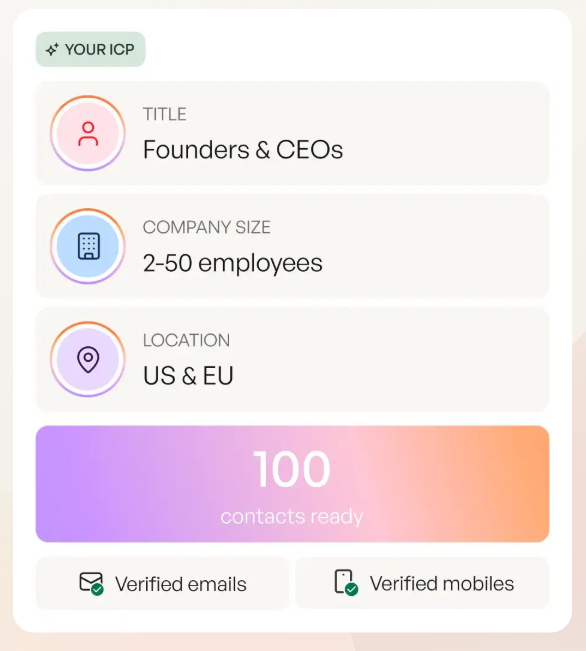
Everything starts here. Your ideal customer profile isn't "companies with 50-500 employees." It's specific: industry, tech stack, growth signals, department headcount, funding stage, and the job titles that actually sign contracts. A vague ICP means you're prospecting into noise.
2. Build Your Prospect List
This is where most teams either overspend or underinvest. You need verified contact data - emails that won't bounce, phone numbers that actually ring. Prospeo covers 300M+ professional profiles with 98% email accuracy and 30+ search filters including buyer intent, technographics, and job changes. That accuracy matters because ~20% of cold emails get flagged as spam, and bounced addresses can tank your sender reputation fast.

3. Research Before You Reach Out
Spend 3-5 minutes per prospect before you write a word. Check their company's recent news, funding rounds, job postings (hiring signals intent), and tech stack. This isn't optional - 58% of sales meetings aren't valuable to buyers. The research is what makes yours different.
For inbound leads specifically, speed matters enormously. Leads contacted within 5 minutes are 21x more likely to convert than those contacted after 30 minutes.
4. Pick Your Channels
Email is the default first touch for most B2B motions. Phone works better for senior executives. The right answer for most teams is a multi-channel cadence: email first, phone follow-up, then a social touch. A typical sequence runs 7-10 touches over about 3 weeks.
5. Personalize the First Touch
Generic templates get generic results. Mentioning a single commonality - shared connection, recent company milestone, relevant tech in their stack - lifts InMail acceptance by 46%. You don't need to write a novel. One specific, relevant sentence beats three paragraphs of flattery every time.
6. Qualify With a Framework
Not every response is a qualified opportunity. Use BANT (Budget, Authority, Need, Timeline) for transactional sales or MEDDIC for complex enterprise deals. The goal isn't to book every meeting - it's to book meetings that convert. Outbound converts 2-5% from contact to meeting. Make sure those meetings count.
5 Mistakes That Kill Pipeline
Targeting the wrong people is the most expensive mistake. If your win rate on outbound-sourced deals is below 15%, your targeting is off - not your messaging. Revisit your ICP quarterly. I've seen teams double their outbound conversion rate just by narrowing their list by 40%.
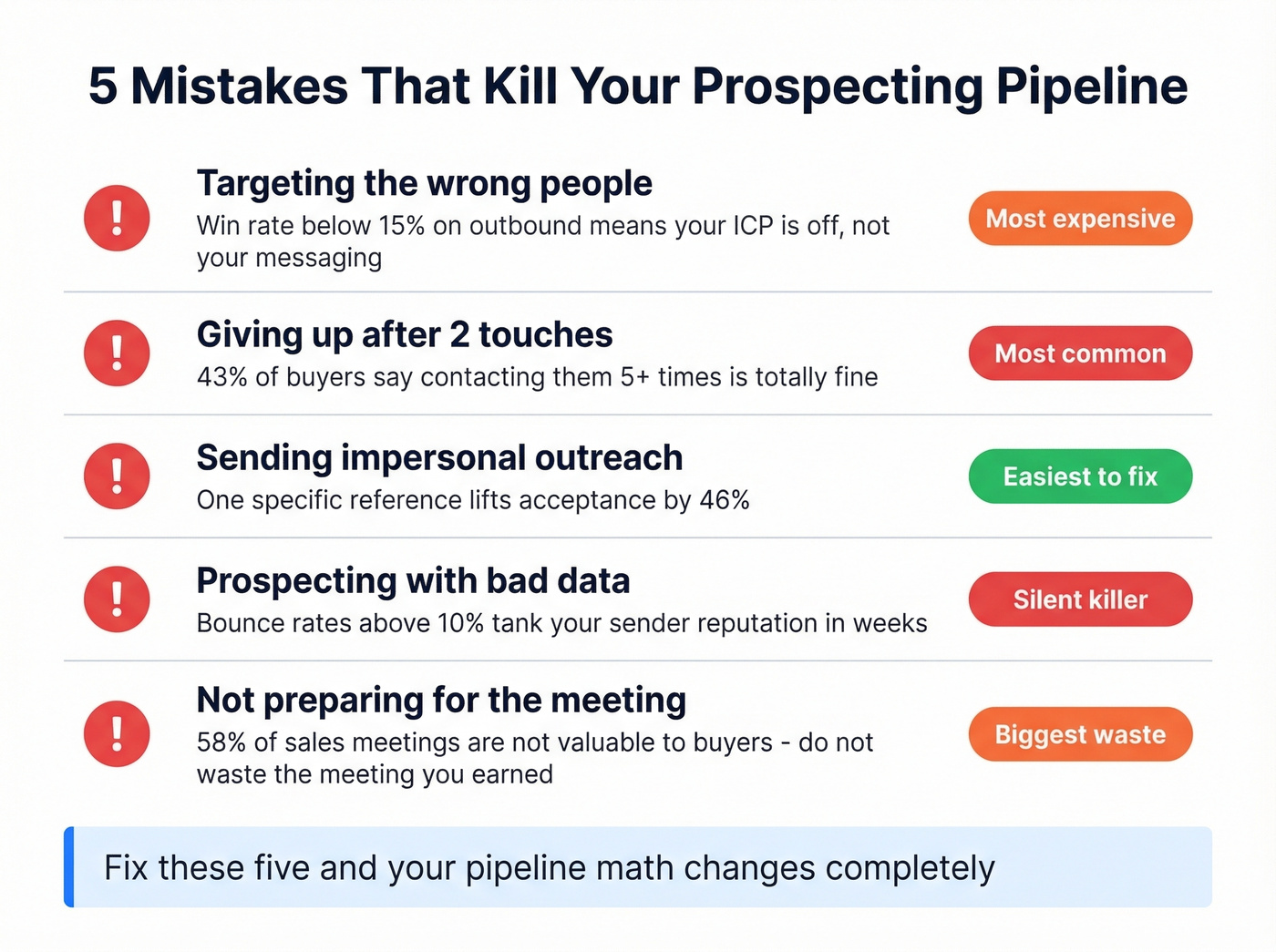
Giving up after 2 touches is the most common. 43% of buyers who accept meetings say it's fine to be contacted 5+ times. Your discomfort isn't a signal. A thread on r/sales put it bluntly: the reps who feel awkward about follow-up #4 are the same ones complaining about empty pipeline in Q3.
Sending impersonal outreach is the easiest to fix. Reference one specific thing about their company or role. That 46% lift from mentioning a commonality isn't a nice-to-have - it's the difference between getting read and getting deleted.
Prospecting with bad data is the silent killer. We've seen bounce rates above 10% tank entire outbound campaigns within weeks. Bad emails destroy sender reputation, and once your domain is flagged, even good messages stop landing.
Not preparing for the meeting you booked wastes everything that came before it. 58% of sales meetings aren't valuable to buyers. You fought through nearly five touches to get this meeting. Show up with a point of view on their business, not a generic discovery script.
How Prospecting Is Changing in 2026
The biggest shift isn't AI - it's the expectation of relevance. Buyers have less patience for generic outreach than ever, and the tools have caught up to make personalization scalable.
54% of sales professionals now use AI for personalized outbound emails, and 45% use it for account research. That doesn't mean AI writes your emails. It means AI handles the research grunt work so reps can focus on the human parts: summarizing 10-Ks and earnings calls for account context, flagging job postings that signal buying intent, and identifying tech stack changes that create opportunity.
Touchpoint inflation is real. 4.81 touches to a response is the new normal, and that number is climbing. The teams winning aren't sending more emails - they're sending better ones, to better-verified contacts, with signals that indicate actual buying intent. Data quality has become the competitive moat. The difference between a 2% and a 5% reply rate often isn't the copy - it's whether the email actually reached a real inbox.
Prospecting Tools: What You Need
You need three categories of tools. Not twelve. Three.
| Category | Recommended Tool | Starting Price |
|---|---|---|
| Outreach / sequencing | Instantly or Lemlist | ~$30-100/mo |
| CRM | HubSpot or Salesforce | Free; paid plans vary |
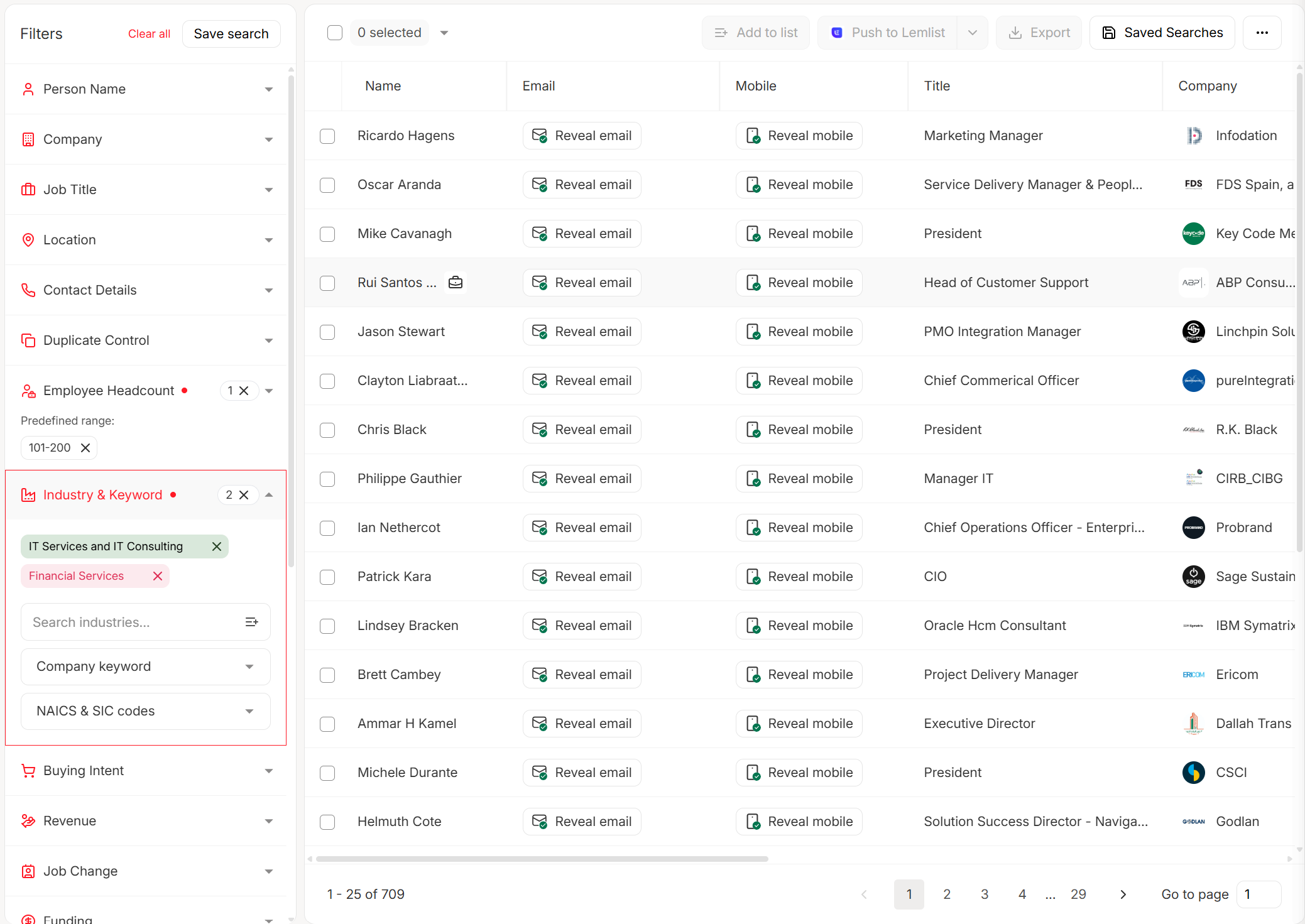
Prospeo is the contact data layer. It covers 300M+ profiles with 98% email accuracy and 125M+ verified mobile numbers delivering a 30% pickup rate - compared to the industry average of 10-15%. The 7-day data refresh cycle means you aren't working with stale records. Pricing starts free with 75 emails/month and scales at roughly $0.01 per email with no contracts.
Cognism fits enterprise teams selling heavily into EMEA, where their phone-verified mobiles and GDPR compliance are strong. Expect ~$1,000-3,000/mo for small teams, with annual contracts.
Instantly handles cold email sequencing with solid deliverability features and inbox rotation. Plans start around $30/mo. Smartlead and Lemlist are comparable alternatives.
HubSpot CRM is free for basic use and handles pipeline tracking for most SMB teams. Salesforce is the better fit once you need custom objects and advanced reporting.
The contact data layer is where most efforts succeed or fail. Your sequencing tool and CRM matter, but they can't fix bad data. Start there.
The benchmarks say it takes 4.81 touches to get a response. That math only works if your prospect list is built on verified data refreshed every 7 days - not the 6-week-old records most providers sell. Prospeo gives you 300M+ profiles with 30+ ICP filters, 125M+ direct dials, and 98% email accuracy at $0.01 per lead.
Build your prospect list on data that actually converts to meetings.
FAQ
What is the definition of prospecting in sales?
Prospecting is the sales-owned process of identifying, researching, and contacting potential customers who match your ideal customer profile to generate qualified pipeline. It's distinct from lead generation (marketing-owned, top-of-funnel) and outreach (a tactic within the broader process). The emphasis is always on proactive identification of qualified buyers - not passive lead collection.
How is prospecting different from lead generation?
Prospecting is sales-driven outbound to named accounts with the goal of booking meetings now. Lead generation is marketing-driven inbound at scale, focused on building pipeline over time. They're sequential steps, not synonyms - prospecting centers on individual, targeted effort while lead generation casts a wider net.
How many touches does it take to get a response?
4.81 on average, regardless of lead temperature - and that's just to get a response, not a meeting. 80% of sales happen between the 5th and 12th contact, so persistence isn't optional.
What tools do I need to start?
Three essentials: a contact data platform like Prospeo for verified emails and direct dials (free tier, 75 emails/month), a sequencing tool like Instantly or Lemlist for automated multi-touch cadences (~$30/mo), and a CRM like HubSpot to track pipeline (free). Total cost under $100/month.
What's a good cold email response rate?
5.1% is the current average across 151M outreach data points. Advanced personalization - referencing specific company signals or shared context - can double that baseline. Data quality matters as much as copy: ~20% of cold emails never reach the inbox.